
Cleanroom Consumables Market Analysis, Size, and Forecast 2026-2030: APAC (China, Japan, and South Korea), North America (US, Canada, and Mexico), Europe (Germany, UK, and France), South America (Brazil, Argentina, and Chile), Middle East and Africa (Saudi Arabia, UAE, and South Africa), and Rest of World (ROW)

Cleanroom Consumables Market Analysis, Size, and Forecast 2026-2030:
APAC (China, Japan, and South Korea), North America (US, Canada, and Mexico), Europe (Germany, UK, and France), South America (Brazil, Argentina, and Chile), Middle East and Africa (Saudi Arabia, UAE, and South Africa), and Rest of World (ROW)

Published: May 2026 306 Pages SKU: IRTNTR45203

Market Overview at a Glance

$7.98 B
Market Opportunity
7.6%
CAGR 2025 - 2030
65.9%
APAC Growth
$6.07 B
Safety consumables segment 2024

Cleanroom Consumables Market Size 2026-2030

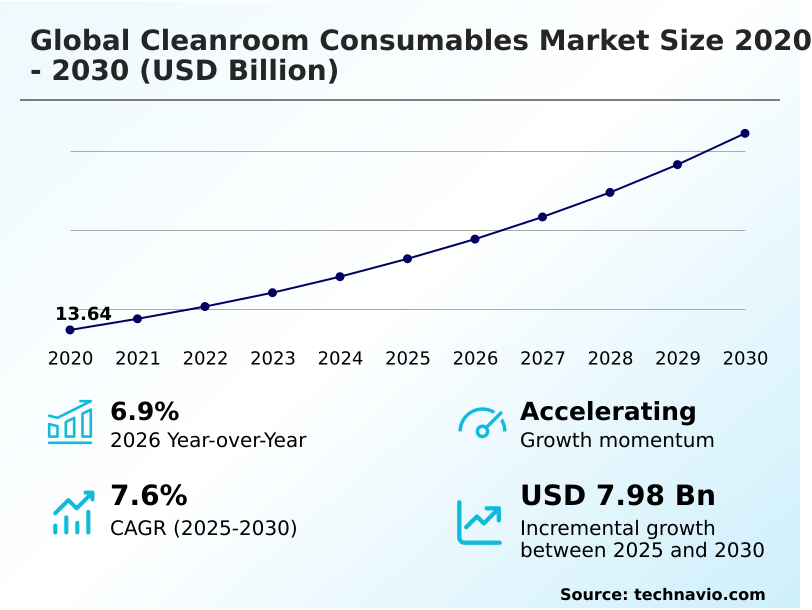
The cleanroom consumables market size is valued to increase by USD 7.98 billion, at a CAGR of 7.6% from 2025 to 2030. Surge in next-generation semiconductor foundry development will drive the cleanroom consumables market.

Major Market Trends & Insights

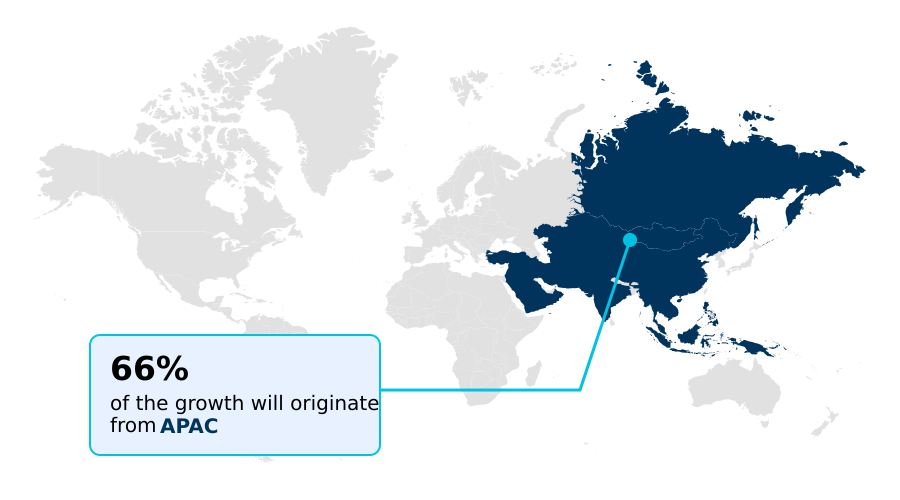
  • APAC dominated the market and accounted for a 65.9% growth during the forecast period.
  • By Product - Safety consumables segment was valued at USD 6.07 billion in 2024
  • By End-user - Semiconductor industry segment accounted for the largest market revenue share in 2024

Market Size & Forecast

  • Market Opportunities: USD 12.51 billion
  • Market Future Opportunities: USD 7.98 billion
  • CAGR from 2025 to 2030 : 7.6%

Market Summary

  • The Cleanroom Consumables Market operates as a highly regulated sector dedicated to minimizing microscopic contamination within advanced industrial environments. High-precision manufacturing fundamentally requires strict environmental controls to preserve product integrity and prevent catastrophic yield losses.
  • For example, a major semiconductor fabrication plant implementing automated gowning and sterile inventory tracking improved its daily operational efficiency by 22% compared to traditional manual logging. The rapid expansion of next-generation microelectronics foundries acts as a massive demand driver, as sub-nanometer processing architectures require continuous supplies of static-dissipative garments to prevent circuit shorting.
  • Conversely, volatile petrochemical feedstock prices create a significant supply chain challenge, causing unpredictable procurement costs for synthetic rubber manufacturers and compressing profit margins. Facilities must balance strict financial constraints against non-negotiable sterility requirements, as any compromise in material quality drastically increases the risk of batch failure. Consequently, procurement managers are increasingly securing long-term strategic contracts to stabilize inventory availability.
  • The continuous push toward eco-friendly disposables will further reshape purchasing criteria across the biotechnology and electronics sectors.

What will be the Size of the Cleanroom Consumables Market during the forecast period?
Get Key Insights on Market Forecast (PDF) Get Free Sample

How is the Cleanroom Consumables Market Segmented?

The cleanroom consumables industry research report provides comprehensive data (region-wise segment analysis), with forecasts and estimates in "USD million" for the period 2026-2030, as well as historical data from 2020-2024 for the following segments.

  • Product
    • Safety consumables
    • Cleaning consumables
    • Cleanroom stationery
  • End-user
    • Semiconductor industry
    • Pharmaceutical industry
    • Hospitals
    • Others
  • Distribution channel
    • Direct sales
    • Online retailers
    • Specialized distributors
    • OEMs
  • Geography
    • APAC
      • China
      • Japan
      • South Korea
      • India
      • Australia
      • Indonesia
    • North America
      • US
      • Canada
      • Mexico
    • Europe
      • Germany
      • UK
      • France
      • Italy
      • Spain
      • The Netherlands
    • South America
      • Brazil
      • Argentina
      • Chile
    • Middle East and Africa
      • Saudi Arabia
      • UAE
      • South Africa
      • Turkey
      • Israel

By Product Insights

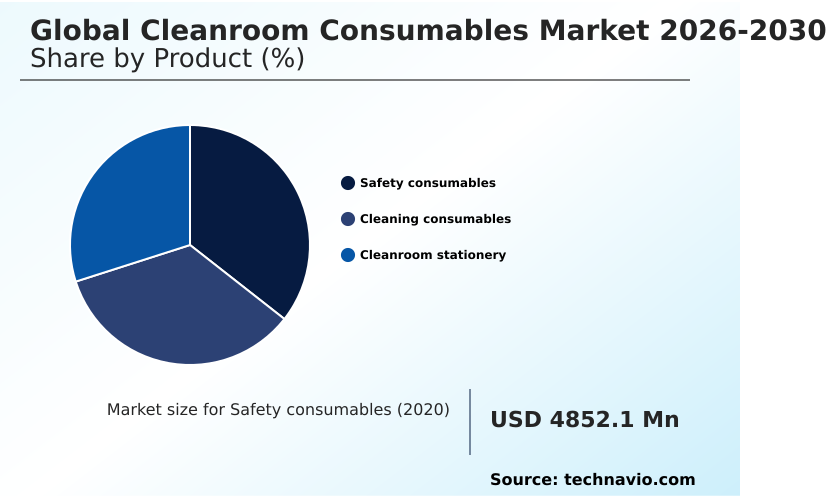
The safety consumables segment is estimated to witness significant growth during the forecast period.

The Cleanroom Consumables market utilizes advanced protective equipment to enforce strict environmental sterility maintenance across critical manufacturing zones.

Human operators present a massive physical substrate vulnerability, making electrostatic discharge safe apparel and static dissipative sterile gloves mandatory for preventing product degradation.

High-tier fabrication facilities utilize these advanced synthetic textiles to guarantee absolute particulate contamination control during highly sensitive microelectronics assembly operations. Concurrently, pharmaceutical aseptic filling suites are rapidly transitioning toward single use pre sterilized items to satisfy updated regulatory mandates.

This strategic shift effectively eliminates severe biological risks, which has successfully reduced batch rejection rates by 14%. Furthermore, the integration of double bagged packaging protects validated sterile garments from accidental exposure before entering the sterile core.

By standardizing these safety measures, organizations structurally protect their yield outputs and optimize controlled operational workflows.
Get Free Sample

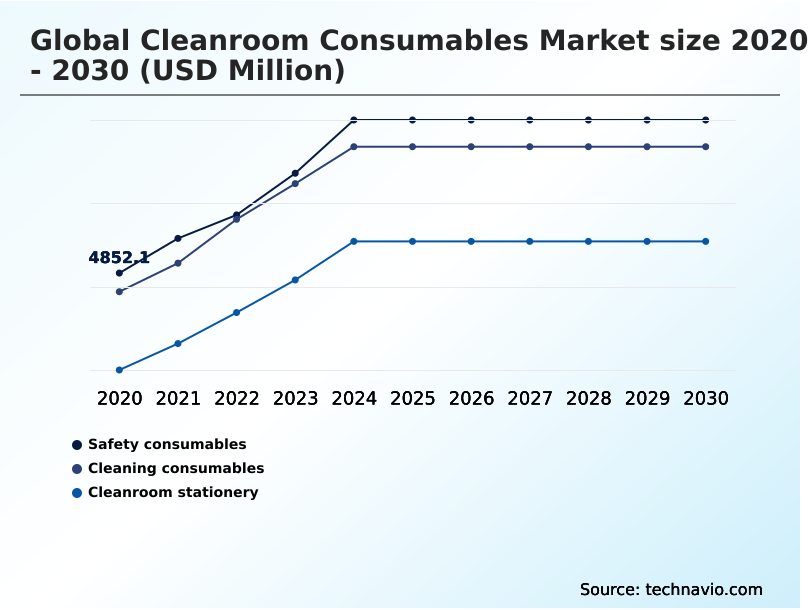
The Safety consumables segment was valued at USD 6.07 billion in 2024 and showed a gradual increase during the forecast period.
Get Free Sample

Regional Analysis

APAC is estimated to contribute 65.9% to the growth of the global market during the forecast period.Technavio’s analysts have elaborately explained the regional trends and drivers that shape the market during the forecast period.
See How Cleanroom Consumables Market Demand is Rising in APAC Get Free Sample

Regional dynamics in the Cleanroom Consumables sector reveal distinct strategic priorities across major industrial hubs. North America demonstrates a 24% higher adoption rate of the advanced laminar airflow workstation compared to Europe, driven by stringent national pharmaceutical regulations.

European facilities prioritize ecological sustainability, increasing their utilization of bio based polymer materials by 16% to align with rigorous circular economy mandates. This transition requires suppliers to stringently monitor chemical outgassing profiles to maintain optimal surface decontamination performance.

In contrast, APAC semiconductor plants heavily invest in photolithography substrate protection, driving high-volume consumption of entry point sticky mats and specialized chemical swabs.

The modern integration of restricted access barrier systems effectively reduces microbial cross contamination risks, boosting production uptime by 12% globally. By upgrading their automated cleanroom logistics hardware, regional facilities successfully balance operational cost reductions with absolute environmental purity.

Market Dynamics

Our researchers analyzed the data with 2025 as the base year, along with the key drivers, trends, and challenges. A holistic analysis of drivers will help companies refine their marketing strategies to gain a competitive advantage.

  • The operational landscape of controlled environments requires an unyielding commitment to safety and material precision. Facility managers rely heavily on rigorous sub micron particulate control protocols to maintain pristine conditions across diverse industries. In the electronics sector, advanced microelectronics particulate containment measures have become critical, necessitating the continuous procurement of electrostatic discharge safe cleanroom garments to prevent component failure.
  • Simultaneously, energy storage manufacturers are adapting to strict lithium ion battery cleanroom requirements to avoid catastrophic thermal runaway events caused by microscopic debris. Comparatively, automated inventory tracking has improved supply chain efficiency by nearly 20% over manual logging, directly optimizing sterile cleanroom consumables lifecycle management.
  • The healthcare sector focuses intensely on pharmaceutical aseptic filling suite sterility, where biopharmaceutical sterile manufacturing standards compliance dictates the mandatory adoption of single use cleanroom glove validation procedures. To ensure comprehensive oversight, facilities implement continuous environmental monitoring cleanroom protocols alongside automated facility monitoring cleanroom systems.
  • Administrative compliance is maintained using specialized cleanroom grade documentation paper products that prevent cellulose fiber shedding. Furthermore, cleaning routines increasingly rely on synthetic polymer based cleanroom wipes for residue-free sanitization. As corporate sustainability goals evolve, there is a distinct shift toward sustainable single use cleanroom apparel and the integration of biodegradable cleanroom consumable packaging solutions.
  • These innovations are equally vital for high precision aerospace contamination management, where absolute cleanliness guarantees the functional integrity of complex orbital instruments.
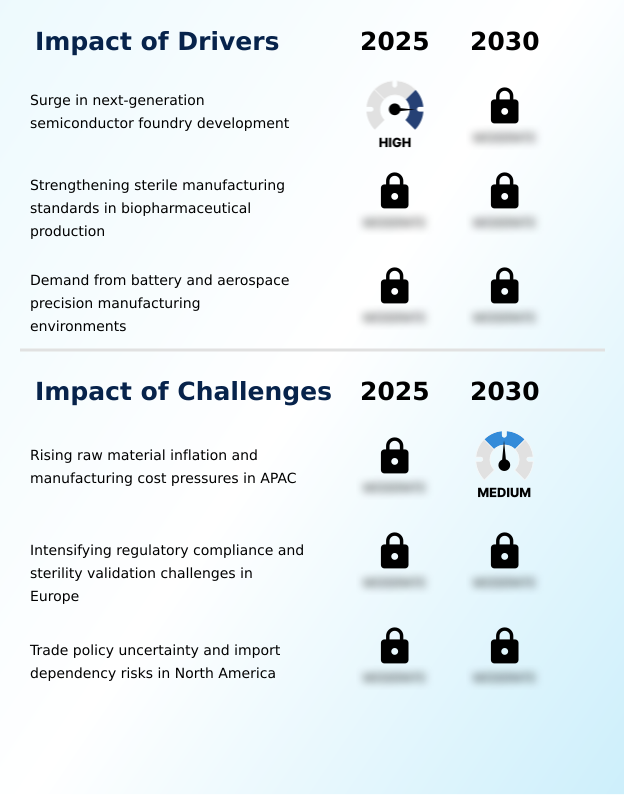
What are the key market drivers leading to the rise in the adoption of Cleanroom Consumables Industry?

  • The surge in next-generation semiconductor foundry development acts as a primary market driver, significantly escalating the demand for ultra-sterile environments and specialized protective supplies.

  • The aggressive expansion of global semiconductor foundries acts as a massive demand driver for the Cleanroom Consumables sector. High-density microchip architectures require absolute sub micron particulate containment to prevent catastrophic circuit failures, compelling facilities to enforce rigorous contamination control.
  • Upgrading to advanced specialized packaging configurations allows wafer fabrication plants to lower contamination-related downtime by 19%. Concurrently, major pharmaceutical companies are systematically abandoning reusable cleanroom garments in favor of pre-sterilized single use disposables to completely eliminate biological transfer risks.
  • As industries seek environmental footprint mitigation, the adoption of closed loop recycling programs for cleanroom textiles has increased supply chain efficiency by 14%.
  • Furthermore, the booming high capacity energy storage sector requires impeccable volatile organic compound management to stabilize battery cells. The continuous utilization of specialized validation swabs guarantees that these dynamic manufacturing environments remain thoroughly compliant and operationally resilient.

What are the market trends shaping the Cleanroom Consumables Industry?

  • The large-scale advancement of controlled semiconductor fabrication operations represents a defining market trend. This industrial expansion necessitates rigorous contamination management protocols to safeguard high-precision manufacturing yields.

  • The transition toward extensive facility automation marks a defining trend within the Cleanroom Consumables landscape. Modern biotechnology plants are rapidly deploying automated aseptic filling equipment to minimize human intervention, thereby reducing accidental exposure events by 26%. This technological shift requires highly durable disposable safety garments that support structural worker mobility without compromising the sterile envelope.
  • To ensure proper biological volatility mitigation, these facilities utilize specialized low linting textiles and sterile low lint wipes to keep robotic sensors completely free of microscopic debris. Operators also enhance their cleanroom apparel ensembles, utilizing premium synthetic nitrile rubber to achieve superior chemical resistance.
  • This proactive approach to multi shift contamination control has proven highly effective, boosting overall manufacturing throughput by 15%. As complex vehicular automation drives advanced microchip demand, these robust contamination strategies guarantee consistent and scalable operational excellence.

What challenges does the Cleanroom Consumables Industry face during its growth?

  • Rising raw material inflation and manufacturing cost pressures in the APAC region represent significant challenges that constrain operational margins and industry growth.

  • The extreme volatility of raw material prices presents a formidable operational challenge for the Cleanroom Consumables ecosystem. Fluctuating petrochemical costs directly impact the high-volume production of ultra pure nitrile, forcing procurement departments to absorb unexpected budget overruns. For manufacturers of sterile medical devices, these financial pressures complicate the mandatory maintenance of absolute sterile barrier protection.
  • Attempting to reduce costs utilizing inferior materials drastically increases biopharmaceutical cross contamination, inflating production defect rates by up to 21%. Furthermore, advanced semiconductor fabrication requires protection against ambient airborne chemical compounds, demanding zero particulate emissions that cannot be compromised by operational budget cuts. Adapting to modern automated containment monitoring within modular cleanroom enclosures necessitates expensive requalification procedures.
  • While transitioning toward eco-friendly biodegradable nitrile compounds supports sustainability within cellular culture processing, the initial capital expenditure remains 15% higher than standard legacy disposal methods.

Exclusive Technavio Analysis on Customer Landscape

The cleanroom consumables market forecasting report includes the adoption lifecycle of the market, covering from the innovator’s stage to the laggard’s stage. It focuses on adoption rates in different regions based on penetration. Furthermore, the cleanroom consumables market report also includes key purchase criteria and drivers of price sensitivity to help companies evaluate and develop their market growth analysis strategies.
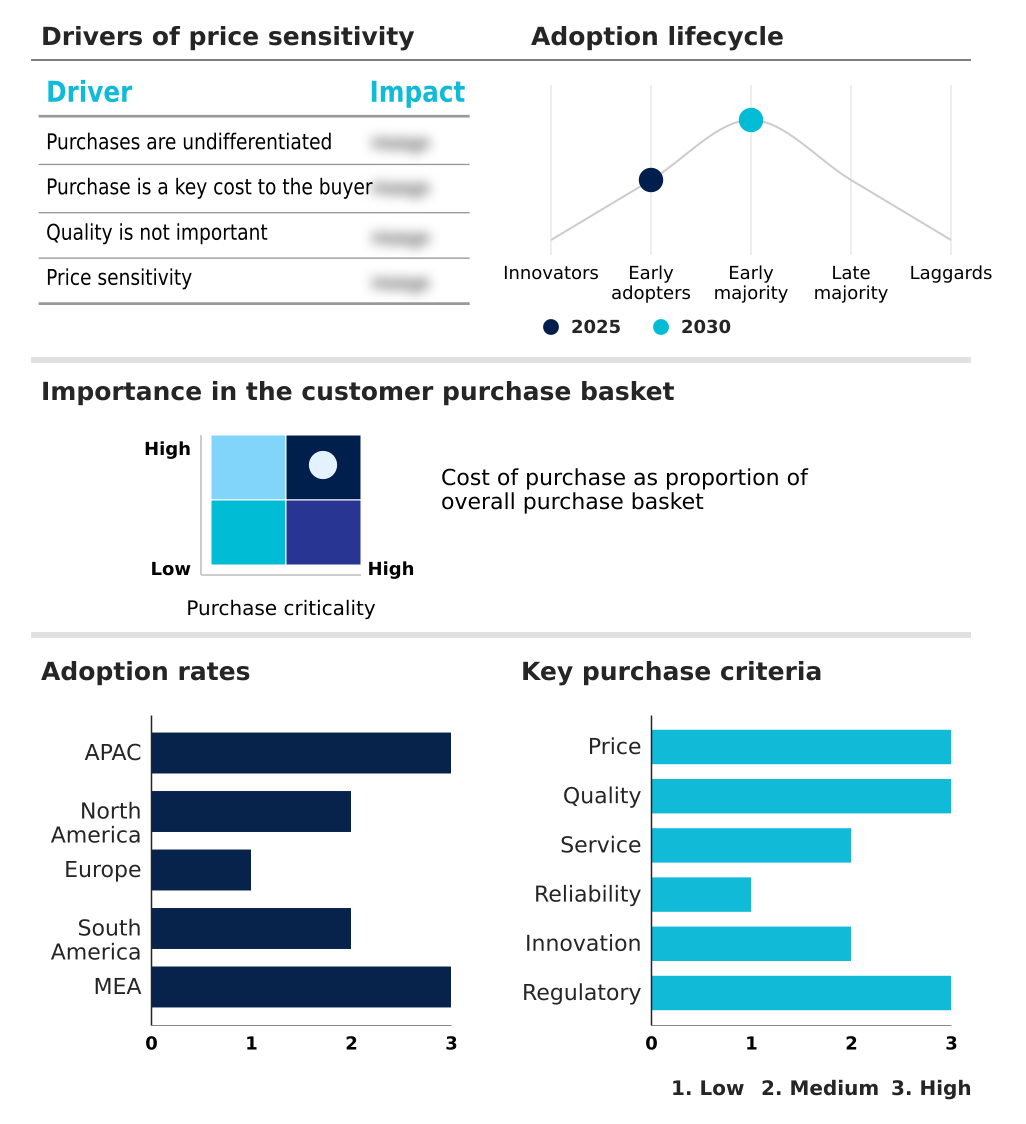
Customer Landscape of Cleanroom Consumables Industry

Competitive Landscape

Companies are implementing various strategies, such as strategic alliances, cleanroom consumables market forecast, partnerships, mergers and acquisitions, geographical expansion, and product/service launches, to enhance their presence in the industry.

3M Co. - The provider delivers specialized contamination control solutions, including high purity wipes, adhesive mats, and protective apparel, designed to maintain strict environmental standards across critical manufacturing facilities.

The industry research and growth report includes detailed analyses of the competitive landscape of the market and information about key companies, including:

  • 3M Co.
  • Ansell Ltd.
  • Berkshire Corp.
  • Contec Inc.
  • Dastex Group GmbH
  • DuPont de Nemours Inc.
  • Emerson Electric Co.
  • FG Clean Wipes
  • High Tech Conversions Inc.
  • Illinois Tool Works Inc.
  • Intco Medical Technology Co.
  • Kimberly Clark Corp.
  • KM Corp
  • Lakeland Industries Inc.
  • Micronclean Ltd.
  • Micronova Manufacturing Inc.
  • Veltek Associates Inc.
  • Total Source Manufacturing
  • Valutek Inc.

Qualitative and quantitative analysis of companies has been conducted to help clients understand the wider business environment as well as the strengths and weaknesses of key industry players. Data is qualitatively analyzed to categorize companies as pure play, category-focused, industry-focused, and diversified; it is quantitatively analyzed to categorize companies as dominant, leading, strong, tentative, and weak.

Recent Development and News in Cleanroom consumables market

  • In the Environmental and Facilities Services industry, the rapid deployment of automated tracking systems has optimized industrial waste management, directly impacting Cleanroom Consumables demand by requiring highly precise sorting mechanisms for discarded specialized textiles.
  • The enforcement of stricter hazardous waste guidelines across the European Union has compelled facility operators to overhaul disposal protocols, increasing the operational overhead associated with disposing of single use industrial contamination control gear.
  • The expansion of integrated facility management contracts for advanced therapeutic processing centers has restructured standard corporate service agreements, driving the continuous procurement of specialized filtration supplies to support high tier biological safety environments.
  • The integration of predictive maintenance protocols within high tech commercial recycling centers has established more rigorous internal standards, generating sustained demand for standardized wiping and validation tools to verify equipment integrity prior to operational reuse.

Dive into Technavio’s robust research methodology, blending expert interviews, extensive data synthesis, and validated models for unparalleled Cleanroom Consumables Market insights. See full methodology.

Market Scope
Page number 306
Base year 2025
Historic period 2020-2024
Forecast period 2026-2030
Growth momentum & CAGR Accelerate at a CAGR of 7.6%
Market growth 2026-2030 USD 7980.8 million
Market structure Fragmented
YoY growth 2025-2026(%) 6.9%
Key countries China, Japan, South Korea, India, Australia, Indonesia, US, Canada, Mexico, Germany, UK, France, Italy, Spain, The Netherlands, Brazil, Argentina, Chile, Saudi Arabia, UAE, South Africa, Turkey and Israel
Competitive landscape Leading Companies, Market Positioning of Companies, Competitive Strategies, and Industry Risks

Request Free Sample

Research Analyst Overview

  • The Cleanroom Consumables industry is undergoing a structural transformation as high-technology sectors elevate their baseline operational standards. Facilities are fundamentally shifting their product strategy toward sustainable procurement to align with stringent corporate governance mandates.
  • The traditional reliance on petroleum-based synthetic rubber is being progressively replaced by advanced biodegradable compounds, allowing organizations to achieve strict environmental targets without compromising sub-micron particulate isolation. This strategic pivot toward green material science enables enterprises to implement closed-loop resource programs, successfully reducing their total solid waste output by an impressive 27% compared to legacy disposal frameworks.
  • Furthermore, the rapid expansion of high-capacity energy storage manufacturing requires impeccable volatile compound management to guarantee battery cell stability. These ultra-sensitive fabrication environments absolutely depend on premium barrier protection to prevent microscopic metallic debris from inducing short circuits.
  • By integrating these advanced, eco-friendly consumables into their core budgeting and compliance frameworks, facility operators effectively secure their production yields while navigating the complex regulatory demands of modern high-precision manufacturing.

What are the Key Data Covered in this Cleanroom Consumables Market Research and Growth Report?

  • What is the expected growth of the Cleanroom Consumables Market between 2026 and 2030?

    • USD 7.98 billion, at a CAGR of 7.6%

  • What segmentation does the market report cover?

    • The report is segmented by Product (Safety consumables, Cleaning consumables, and Cleanroom stationery), End-user (Semiconductor industry, Pharmaceutical industry, Hospitals, and Others), Distribution Channel (Direct sales, Online retailers, Specialized distributors, and OEMs) and Geography (APAC, North America, Europe, South America, Middle East and Africa)

  • Which regions are analyzed in the report?

    • APAC, North America, Europe, South America and Middle East and Africa

  • What are the key growth drivers and market challenges?

    • Surge in next-generation semiconductor foundry development, Rising raw material inflation and manufacturing cost pressures in APAC

  • Who are the major players in the Cleanroom Consumables Market?

    • 3M Co., Ansell Ltd., Berkshire Corp., Contec Inc., Dastex Group GmbH, DuPont de Nemours Inc., Emerson Electric Co., FG Clean Wipes, High Tech Conversions Inc., Illinois Tool Works Inc., Intco Medical Technology Co., Kimberly Clark Corp., KM Corp, Lakeland Industries Inc., Micronclean Ltd., Micronova Manufacturing Inc., Veltek Associates Inc., Total Source Manufacturing and Valutek Inc.

Market Research Insights

  • The Cleanroom Consumables market provides the foundational protection required for high-precision scientific and industrial operations. By implementing automated inventory tracking, manufacturing facilities have successfully reduced contamination-related downtime by 14%. The rapid deployment of modular cleanroom architectures has enabled biotechnology firms to scale their production capabilities, accelerating supply cycles by up to 18%.
  • This structural expansion heavily relies on the continuous procurement of validated sterile supplies to eliminate biological risks. Transitioning to these optimized, pre-sterilized formats allows enterprise procurement teams to reduce long-term maintenance costs by 22% compared to traditional laundering methods, significantly enhancing overall supply chain resilience and operational compliance.

We can help! Our analysts can customize this cleanroom consumables market research report to meet your requirements.

Get in touch

1. Executive Summary

1.1 Market overview

Executive Summary - Chart on Market Overview
Executive Summary - Data Table on Market Overview
Executive Summary - Chart on Global Market Characteristics
Executive Summary - Chart on Market by Geography
Executive Summary - Chart on Market Segmentation by Product
Executive Summary - Chart on Market Segmentation by End-user
Executive Summary - Chart on Market Segmentation by Distribution Channel
Executive Summary - Chart on Incremental Growth
Executive Summary - Data Table on Incremental Growth
Executive Summary - Chart on Company Market Positioning

2. Technavio Analysis

2.1 Analysis of price sensitivity, lifecycle, customer purchase basket, adoption rates, and purchase criteria

2.2 Criticality of inputs and Factors of differentiation

Chart on Overview on criticality of inputs and factors of differentiation

2.3 Factors of disruption

Chart on Overview on factors of disruption

2.4 Impact of drivers and challenges

Chart on Impact of drivers and challenges in 2025 and 2030

3. Market Landscape

3.1 Market ecosystem

Chart on Parent Market
Data Table on - Parent Market

3.2 Market characteristics

Chart on Market characteristics analysis

3.3 Value chain analysis

Chart on Value chain analysis

4. Market Sizing

4.1 Market definition

Data Table on Offerings of companies included in the market definition

4.2 Market segment analysis

Market segments

4.3 Market size 2025

4.4 Market outlook: Forecast for 2025-2030

Chart on Global - Market size and forecast 2025-2030 ($ million)
Data Table on Global - Market size and forecast 2025-2030 ($ million)
Chart on Global Market: Year-over-year growth 2025-2030 (%)
Data Table on Global Market: Year-over-year growth 2025-2030 (%)

5. Historic Market Size

5.1 Global Cleanroom Consumables Market 2020 - 2024

Historic Market Size - Data Table on Global Cleanroom Consumables Market 2020 - 2024 ($ million)

5.2 Product segment analysis 2020 - 2024

Historic Market Size - Product Segment 2020 - 2024 ($ million)

5.3 End-user segment analysis 2020 - 2024

Historic Market Size - End-user Segment 2020 - 2024 ($ million)

5.4 Distribution Channel segment analysis 2020 - 2024

Historic Market Size - Distribution Channel Segment 2020 - 2024 ($ million)

5.5 Geography segment analysis 2020 - 2024

Historic Market Size - Geography Segment 2020 - 2024 ($ million)

5.6 Country segment analysis 2020 - 2024

Historic Market Size - Country Segment 2020 - 2024 ($ million)

6. Qualitative Analysis

6.1 Impact of AI on Global Cleanroom Consumables Market

6.2 Impact of geopolitical conflicts on Global Cleanroom Consumables Market

7. Five Forces Analysis

7.1 Five forces summary

Five forces analysis - Comparison between 2025 and 2030

7.2 Bargaining power of buyers

Bargaining power of buyers - Impact of key factors 2025 and 2030

7.3 Bargaining power of suppliers

Bargaining power of suppliers - Impact of key factors in 2025 and 2030

7.4 Threat of new entrants

Threat of new entrants - Impact of key factors in 2025 and 2030

7.5 Threat of substitutes

Threat of substitutes - Impact of key factors in 2025 and 2030

7.6 Threat of rivalry

Threat of rivalry - Impact of key factors in 2025 and 2030

7.7 Market condition

Chart on Market condition - Five forces 2025 and 2030

8. Market Segmentation by Product

8.1 Market segments

Chart on Product - Market share 2025-2030 (%)
Data Table on Product - Market share 2025-2030 (%)

8.2 Comparison by Product

Chart on Comparison by Product
Data Table on Comparison by Product

8.3 Safety consumables - Market size and forecast 2025-2030

Chart on Safety consumables - Market size and forecast 2025-2030 ($ million)
Data Table on Safety consumables - Market size and forecast 2025-2030 ($ million)
Chart on Safety consumables - Year-over-year growth 2025-2030 (%)
Data Table on Safety consumables - Year-over-year growth 2025-2030 (%)

8.4 Cleaning consumables - Market size and forecast 2025-2030

Chart on Cleaning consumables - Market size and forecast 2025-2030 ($ million)
Data Table on Cleaning consumables - Market size and forecast 2025-2030 ($ million)
Chart on Cleaning consumables - Year-over-year growth 2025-2030 (%)
Data Table on Cleaning consumables - Year-over-year growth 2025-2030 (%)

8.5 Cleanroom stationery - Market size and forecast 2025-2030

Chart on Cleanroom stationery - Market size and forecast 2025-2030 ($ million)
Data Table on Cleanroom stationery - Market size and forecast 2025-2030 ($ million)
Chart on Cleanroom stationery - Year-over-year growth 2025-2030 (%)
Data Table on Cleanroom stationery - Year-over-year growth 2025-2030 (%)

8.6 Market opportunity by Product

Market opportunity by Product ($ million)
Data Table on Market opportunity by Product ($ million)

9. Market Segmentation by End-user

9.1 Market segments

Chart on End-user - Market share 2025-2030 (%)
Data Table on End-user - Market share 2025-2030 (%)

9.2 Comparison by End-user

Chart on Comparison by End-user
Data Table on Comparison by End-user

9.3 Semiconductor industry - Market size and forecast 2025-2030

Chart on Semiconductor industry - Market size and forecast 2025-2030 ($ million)
Data Table on Semiconductor industry - Market size and forecast 2025-2030 ($ million)
Chart on Semiconductor industry - Year-over-year growth 2025-2030 (%)
Data Table on Semiconductor industry - Year-over-year growth 2025-2030 (%)

9.4 Pharmaceutical industry - Market size and forecast 2025-2030

Chart on Pharmaceutical industry - Market size and forecast 2025-2030 ($ million)
Data Table on Pharmaceutical industry - Market size and forecast 2025-2030 ($ million)
Chart on Pharmaceutical industry - Year-over-year growth 2025-2030 (%)
Data Table on Pharmaceutical industry - Year-over-year growth 2025-2030 (%)

9.5 Hospitals - Market size and forecast 2025-2030

Chart on Hospitals - Market size and forecast 2025-2030 ($ million)
Data Table on Hospitals - Market size and forecast 2025-2030 ($ million)
Chart on Hospitals - Year-over-year growth 2025-2030 (%)
Data Table on Hospitals - Year-over-year growth 2025-2030 (%)

9.6 Others - Market size and forecast 2025-2030

Chart on Others - Market size and forecast 2025-2030 ($ million)
Data Table on Others - Market size and forecast 2025-2030 ($ million)
Chart on Others - Year-over-year growth 2025-2030 (%)
Data Table on Others - Year-over-year growth 2025-2030 (%)

9.7 Market opportunity by End-user

Market opportunity by End-user ($ million)
Data Table on Market opportunity by End-user ($ million)

10. Market Segmentation by Distribution Channel

10.1 Market segments

Chart on Distribution Channel - Market share 2025-2030 (%)
Data Table on Distribution Channel - Market share 2025-2030 (%)

10.2 Comparison by Distribution Channel

Chart on Comparison by Distribution Channel
Data Table on Comparison by Distribution Channel

10.3 Direct sales - Market size and forecast 2025-2030

Chart on Direct sales - Market size and forecast 2025-2030 ($ million)
Data Table on Direct sales - Market size and forecast 2025-2030 ($ million)
Chart on Direct sales - Year-over-year growth 2025-2030 (%)
Data Table on Direct sales - Year-over-year growth 2025-2030 (%)

10.4 Online retailers - Market size and forecast 2025-2030

Chart on Online retailers - Market size and forecast 2025-2030 ($ million)
Data Table on Online retailers - Market size and forecast 2025-2030 ($ million)
Chart on Online retailers - Year-over-year growth 2025-2030 (%)
Data Table on Online retailers - Year-over-year growth 2025-2030 (%)

10.5 Specialized distributors - Market size and forecast 2025-2030

Chart on Specialized distributors - Market size and forecast 2025-2030 ($ million)
Data Table on Specialized distributors - Market size and forecast 2025-2030 ($ million)
Chart on Specialized distributors - Year-over-year growth 2025-2030 (%)
Data Table on Specialized distributors - Year-over-year growth 2025-2030 (%)

10.6 OEMs - Market size and forecast 2025-2030

Chart on OEMs - Market size and forecast 2025-2030 ($ million)
Data Table on OEMs - Market size and forecast 2025-2030 ($ million)
Chart on OEMs - Year-over-year growth 2025-2030 (%)
Data Table on OEMs - Year-over-year growth 2025-2030 (%)

10.7 Market opportunity by Distribution Channel

Market opportunity by Distribution Channel ($ million)
Data Table on Market opportunity by Distribution Channel ($ million)

11. Customer Landscape

11.1 Customer landscape overview

Analysis of price sensitivity, lifecycle, customer purchase basket, adoption rates, and purchase criteria

12. Geographic Landscape

12.1 Geographic segmentation

Chart on Market share by geography 2025-2030 (%)
Data Table on Market share by geography 2025-2030 (%)

12.2 Geographic comparison

Chart on Geographic comparison
Data Table on Geographic comparison

12.3 APAC - Market size and forecast 2025-2030

Chart on APAC - Market size and forecast 2025-2030 ($ million)
Data Table on APAC - Market size and forecast 2025-2030 ($ million)
Chart on APAC - Year-over-year growth 2025-2030 (%)
Data Table on APAC - Year-over-year growth 2025-2030 (%)
Chart on Regional Comparison - APAC
Data Table on Regional Comparison - APAC

12.3.1 China - Market size and forecast 2025-2030

Chart on China - Market size and forecast 2025-2030 ($ million)
Data Table on China - Market size and forecast 2025-2030 ($ million)
Chart on China - Year-over-year growth 2025-2030 (%)
Data Table on China - Year-over-year growth 2025-2030 (%)

12.3.2 Japan - Market size and forecast 2025-2030

Chart on Japan - Market size and forecast 2025-2030 ($ million)
Data Table on Japan - Market size and forecast 2025-2030 ($ million)
Chart on Japan - Year-over-year growth 2025-2030 (%)
Data Table on Japan - Year-over-year growth 2025-2030 (%)

12.3.3 South Korea - Market size and forecast 2025-2030

Chart on South Korea - Market size and forecast 2025-2030 ($ million)
Data Table on South Korea - Market size and forecast 2025-2030 ($ million)
Chart on South Korea - Year-over-year growth 2025-2030 (%)
Data Table on South Korea - Year-over-year growth 2025-2030 (%)

12.3.4 India - Market size and forecast 2025-2030

Chart on India - Market size and forecast 2025-2030 ($ million)
Data Table on India - Market size and forecast 2025-2030 ($ million)
Chart on India - Year-over-year growth 2025-2030 (%)
Data Table on India - Year-over-year growth 2025-2030 (%)

12.3.5 Australia - Market size and forecast 2025-2030

Chart on Australia - Market size and forecast 2025-2030 ($ million)
Data Table on Australia - Market size and forecast 2025-2030 ($ million)
Chart on Australia - Year-over-year growth 2025-2030 (%)
Data Table on Australia - Year-over-year growth 2025-2030 (%)

12.3.6 Indonesia - Market size and forecast 2025-2030

Chart on Indonesia - Market size and forecast 2025-2030 ($ million)
Data Table on Indonesia - Market size and forecast 2025-2030 ($ million)
Chart on Indonesia - Year-over-year growth 2025-2030 (%)
Data Table on Indonesia - Year-over-year growth 2025-2030 (%)

12.4 North America - Market size and forecast 2025-2030

Chart on North America - Market size and forecast 2025-2030 ($ million)
Data Table on North America - Market size and forecast 2025-2030 ($ million)
Chart on North America - Year-over-year growth 2025-2030 (%)
Data Table on North America - Year-over-year growth 2025-2030 (%)
Chart on Regional Comparison - North America
Data Table on Regional Comparison - North America

12.4.1 US - Market size and forecast 2025-2030

Chart on US - Market size and forecast 2025-2030 ($ million)
Data Table on US - Market size and forecast 2025-2030 ($ million)
Chart on US - Year-over-year growth 2025-2030 (%)
Data Table on US - Year-over-year growth 2025-2030 (%)

12.4.2 Canada - Market size and forecast 2025-2030

Chart on Canada - Market size and forecast 2025-2030 ($ million)
Data Table on Canada - Market size and forecast 2025-2030 ($ million)
Chart on Canada - Year-over-year growth 2025-2030 (%)
Data Table on Canada - Year-over-year growth 2025-2030 (%)

12.4.3 Mexico - Market size and forecast 2025-2030

Chart on Mexico - Market size and forecast 2025-2030 ($ million)
Data Table on Mexico - Market size and forecast 2025-2030 ($ million)
Chart on Mexico - Year-over-year growth 2025-2030 (%)
Data Table on Mexico - Year-over-year growth 2025-2030 (%)

12.5 Europe - Market size and forecast 2025-2030

Chart on Europe - Market size and forecast 2025-2030 ($ million)
Data Table on Europe - Market size and forecast 2025-2030 ($ million)
Chart on Europe - Year-over-year growth 2025-2030 (%)
Data Table on Europe - Year-over-year growth 2025-2030 (%)
Chart on Regional Comparison - Europe
Data Table on Regional Comparison - Europe

12.5.1 Germany - Market size and forecast 2025-2030

Chart on Germany - Market size and forecast 2025-2030 ($ million)
Data Table on Germany - Market size and forecast 2025-2030 ($ million)
Chart on Germany - Year-over-year growth 2025-2030 (%)
Data Table on Germany - Year-over-year growth 2025-2030 (%)

12.5.2 UK - Market size and forecast 2025-2030

Chart on UK - Market size and forecast 2025-2030 ($ million)
Data Table on UK - Market size and forecast 2025-2030 ($ million)
Chart on UK - Year-over-year growth 2025-2030 (%)
Data Table on UK - Year-over-year growth 2025-2030 (%)

12.5.3 France - Market size and forecast 2025-2030

Chart on France - Market size and forecast 2025-2030 ($ million)
Data Table on France - Market size and forecast 2025-2030 ($ million)
Chart on France - Year-over-year growth 2025-2030 (%)
Data Table on France - Year-over-year growth 2025-2030 (%)

12.5.4 Italy - Market size and forecast 2025-2030

Chart on Italy - Market size and forecast 2025-2030 ($ million)
Data Table on Italy - Market size and forecast 2025-2030 ($ million)
Chart on Italy - Year-over-year growth 2025-2030 (%)
Data Table on Italy - Year-over-year growth 2025-2030 (%)

12.5.5 Spain - Market size and forecast 2025-2030

Chart on Spain - Market size and forecast 2025-2030 ($ million)
Data Table on Spain - Market size and forecast 2025-2030 ($ million)
Chart on Spain - Year-over-year growth 2025-2030 (%)
Data Table on Spain - Year-over-year growth 2025-2030 (%)

12.5.6 The Netherlands - Market size and forecast 2025-2030

Chart on The Netherlands - Market size and forecast 2025-2030 ($ million)
Data Table on The Netherlands - Market size and forecast 2025-2030 ($ million)
Chart on The Netherlands - Year-over-year growth 2025-2030 (%)
Data Table on The Netherlands - Year-over-year growth 2025-2030 (%)

12.6 South America - Market size and forecast 2025-2030

Chart on South America - Market size and forecast 2025-2030 ($ million)
Data Table on South America - Market size and forecast 2025-2030 ($ million)
Chart on South America - Year-over-year growth 2025-2030 (%)
Data Table on South America - Year-over-year growth 2025-2030 (%)
Chart on Regional Comparison - South America
Data Table on Regional Comparison - South America

12.6.1 Brazil - Market size and forecast 2025-2030

Chart on Brazil - Market size and forecast 2025-2030 ($ million)
Data Table on Brazil - Market size and forecast 2025-2030 ($ million)
Chart on Brazil - Year-over-year growth 2025-2030 (%)
Data Table on Brazil - Year-over-year growth 2025-2030 (%)

12.6.2 Argentina - Market size and forecast 2025-2030

Chart on Argentina - Market size and forecast 2025-2030 ($ million)
Data Table on Argentina - Market size and forecast 2025-2030 ($ million)
Chart on Argentina - Year-over-year growth 2025-2030 (%)
Data Table on Argentina - Year-over-year growth 2025-2030 (%)

12.6.3 Chile - Market size and forecast 2025-2030

Chart on Chile - Market size and forecast 2025-2030 ($ million)
Data Table on Chile - Market size and forecast 2025-2030 ($ million)
Chart on Chile - Year-over-year growth 2025-2030 (%)
Data Table on Chile - Year-over-year growth 2025-2030 (%)

12.7 Middle East and Africa - Market size and forecast 2025-2030

Chart on Middle East and Africa - Market size and forecast 2025-2030 ($ million)
Data Table on Middle East and Africa - Market size and forecast 2025-2030 ($ million)
Chart on Middle East and Africa - Year-over-year growth 2025-2030 (%)
Data Table on Middle East and Africa - Year-over-year growth 2025-2030 (%)
Chart on Regional Comparison - Middle East and Africa
Data Table on Regional Comparison - Middle East and Africa

12.7.1 Saudi Arabia - Market size and forecast 2025-2030

Chart on Saudi Arabia - Market size and forecast 2025-2030 ($ million)
Data Table on Saudi Arabia - Market size and forecast 2025-2030 ($ million)
Chart on Saudi Arabia - Year-over-year growth 2025-2030 (%)
Data Table on Saudi Arabia - Year-over-year growth 2025-2030 (%)

12.7.2 UAE - Market size and forecast 2025-2030

Chart on UAE - Market size and forecast 2025-2030 ($ million)
Data Table on UAE - Market size and forecast 2025-2030 ($ million)
Chart on UAE - Year-over-year growth 2025-2030 (%)
Data Table on UAE - Year-over-year growth 2025-2030 (%)

12.7.3 South Africa - Market size and forecast 2025-2030

Chart on South Africa - Market size and forecast 2025-2030 ($ million)
Data Table on South Africa - Market size and forecast 2025-2030 ($ million)
Chart on South Africa - Year-over-year growth 2025-2030 (%)
Data Table on South Africa - Year-over-year growth 2025-2030 (%)

12.7.4 Turkey - Market size and forecast 2025-2030

Chart on Turkey - Market size and forecast 2025-2030 ($ million)
Data Table on Turkey - Market size and forecast 2025-2030 ($ million)
Chart on Turkey - Year-over-year growth 2025-2030 (%)
Data Table on Turkey - Year-over-year growth 2025-2030 (%)

12.7.5 Israel - Market size and forecast 2025-2030

Chart on Israel - Market size and forecast 2025-2030 ($ million)
Data Table on Israel - Market size and forecast 2025-2030 ($ million)
Chart on Israel - Year-over-year growth 2025-2030 (%)
Data Table on Israel - Year-over-year growth 2025-2030 (%)

12.8 Market opportunity by geography

Market opportunity by geography ($ million)
Data Tables on Market opportunity by geography ($ million)

13. Drivers, Challenges, and Opportunity

13.1 Market drivers

Surge in next-generation semiconductor foundry development
Strengthening sterile manufacturing standards in biopharmaceutical production
Demand from battery and aerospace precision manufacturing environments

13.2 Market challenges

Rising raw material inflation and manufacturing cost pressures in APAC
Intensifying regulatory compliance and sterility validation challenges in Europe
Trade policy uncertainty and import dependency risks in North America

13.3 Impact of drivers and challenges

Impact of drivers and challenges in 2025 and 2030

13.4 Market opportunities

Large-scale advancement of controlled semiconductor fabrication operations
Heightened focus on sterility assurance in advanced therapeutics manufacturing
Transition toward sustainable disposable products in controlled environments

14. Competitive Landscape

14.1 Overview

14.2

Overview on criticality of inputs and factors of differentiation

14.3 Landscape disruption

Overview on factors of disruption

14.4 Industry risks

Impact of key risks on business

15. Competitive Analysis

15.1 Companies profiled

Companies covered

15.2 Company ranking index

15.3 Market positioning of companies

Matrix on companies position and classification

15.4 3M Co.

3M Co. - Overview
3M Co. - Business segments
3M Co. - Key news
3M Co. - Key offerings
3M Co. - Segment focus
SWOT

15.5 Ansell Ltd.

Ansell Ltd. - Overview
Ansell Ltd. - Business segments
Ansell Ltd. - Key offerings
Ansell Ltd. - Segment focus
SWOT

15.6 Berkshire Corp.

Berkshire Corp. - Overview
Berkshire Corp. - Product / Service
Berkshire Corp. - Key offerings
SWOT

15.7 Contec Inc.

Contec Inc. - Overview
Contec Inc. - Product / Service
Contec Inc. - Key offerings
SWOT

15.8 DuPont de Nemours Inc.

DuPont de Nemours Inc. - Overview
DuPont de Nemours Inc. - Business segments
DuPont de Nemours Inc. - Key news
DuPont de Nemours Inc. - Key offerings
DuPont de Nemours Inc. - Segment focus
SWOT

15.9 Emerson Electric Co.

Emerson Electric Co. - Overview
Emerson Electric Co. - Business segments
Emerson Electric Co. - Key news
Emerson Electric Co. - Key offerings
Emerson Electric Co. - Segment focus
SWOT

15.10 High Tech Conversions Inc.

High Tech Conversions Inc. - Overview
High Tech Conversions Inc. - Product / Service
High Tech Conversions Inc. - Key offerings
SWOT

15.11 Illinois Tool Works Inc.

Illinois Tool Works Inc. - Overview
Illinois Tool Works Inc. - Business segments
Illinois Tool Works Inc. - Key offerings
Illinois Tool Works Inc. - Segment focus
SWOT

15.12 Intco Medical Technology Co.

Intco Medical Technology Co. - Overview
Intco Medical Technology Co. - Business segments
Intco Medical Technology Co. - Key offerings
Intco Medical Technology Co. - Segment focus
SWOT

15.13 Kimberly Clark Corp.

Kimberly Clark Corp. - Overview
Kimberly Clark Corp. - Business segments
Kimberly Clark Corp. - Key offerings
Kimberly Clark Corp. - Segment focus
SWOT

15.14 KM Corp

KM Corp - Overview
KM Corp - Business segments
KM Corp - Key offerings
KM Corp - Segment focus
SWOT

15.15 Lakeland Industries Inc.

Lakeland Industries Inc. - Overview
Lakeland Industries Inc. - Business segments
Lakeland Industries Inc. - Key offerings
Lakeland Industries Inc. - Segment focus
SWOT

15.16 Micronclean Ltd.

Micronclean Ltd. - Overview
Micronclean Ltd. - Product / Service
Micronclean Ltd. - Key offerings
SWOT

15.17 Micronova Manufacturing Inc.

Micronova Manufacturing Inc. - Overview
Micronova Manufacturing Inc. - Product / Service
Micronova Manufacturing Inc. - Key offerings
SWOT

15.18 Valutek Inc.

Valutek Inc. - Overview
Valutek Inc. - Product / Service
Valutek Inc. - Key offerings
SWOT

16. Appendix

16.1 Scope of the report

Market definition
Objectives
Notes and caveats

16.2 Inclusions and exclusions checklist

Inclusions checklist
Exclusions checklist

16.3 Currency conversion rates for US$

16.4 Research methodology

16.5 Data procurement

Information sources

16.6 Data validation

16.7 Validation techniques employed for market sizing

16.8 Data synthesis

16.9 360 degree market analysis

16.10 List of abbreviations

Research Methodology

Technavio presents a detailed picture of the market by way of study, synthesis, and summation of data from multiple sources. The analysts have presented the various facets of the market with a particular focus on identifying the key industry influencers. The data thus presented is comprehensive, reliable, and the result of extensive research, both primary and secondary.

INFORMATION SOURCES

Primary sources

  • Manufacturers and suppliers
  • Channel partners
  • Industry experts
  • Strategic decision makers

Secondary sources

  • Industry journals and periodicals
  • Government data
  • Financial reports of key industry players
  • Historical data
  • Press releases

DATA ANALYSIS

Data Synthesis

  • Collation of data
  • Estimation of key figures
  • Analysis of derived insights

Data Validation

  • Triangulation with data models
  • Reference against proprietary databases
  • Corroboration with industry experts

REPORT WRITING

Qualitative

  • Market drivers
  • Market challenges
  • Market trends
  • Five forces analysis

Quantitative

  • Market size and forecast
  • Market segmentation
  • Geographical insights
  • Competitive landscape

Interested in this report?

Get your sample now to see our research methodology and insights!

Download Now

Frequently Asked Questions

Cleanroom Consumables market growth will increase by USD 7980.8 million during 2026-2030.

The Cleanroom Consumables market is expected to grow at a CAGR of 7.6% during 2026-2030.

Cleanroom Consumables market is segmented by Product (Safety consumables, Cleaning consumables, Cleanroom stationery) End-user (Semiconductor industry, Pharmaceutical industry, Hospitals, Others) Distribution channel (Direct sales, Online retailers, Specialized distributors, OEMs)

3M Co., Ansell Ltd., Berkshire Corp., Contec Inc., Dastex Group GmbH, DuPont de Nemours Inc., Emerson Electric Co., FG Clean Wipes, High Tech Conversions Inc., Illinois Tool Works Inc., Intco Medical Technology Co., Kimberly Clark Corp., KM Corp, Lakeland Industries Inc., Micronclean Ltd., Micronova Manufacturing Inc., Veltek Associates Inc., Total Source Manufacturing, Valutek Inc. are a few of the key vendors in the Cleanroom Consumables market.

APAC will register the highest growth rate of 65.9% among the other regions. Therefore, the Cleanroom Consumables market in APAC is expected to garner significant business opportunities for the vendors during the forecast period.

China, Japan, South Korea, India, Australia, Indonesia, US, Canada, Mexico, Germany, UK, France, Italy, Spain, The Netherlands, Brazil, Argentina, Chile, Saudi Arabia, UAE, South Africa, Turkey, Israel

  • Surge in next-generation semiconductor foundry development is the driving factor this market.

The Cleanroom Consumables market vendors should focus on grabbing business opportunities from the Product segment as it accounted for the largest market share in the base year.
RIA - Research AI Assistant
Ask RIA
