


Commercial Wood-fired Pizza Ovens Market Size 2026-2030
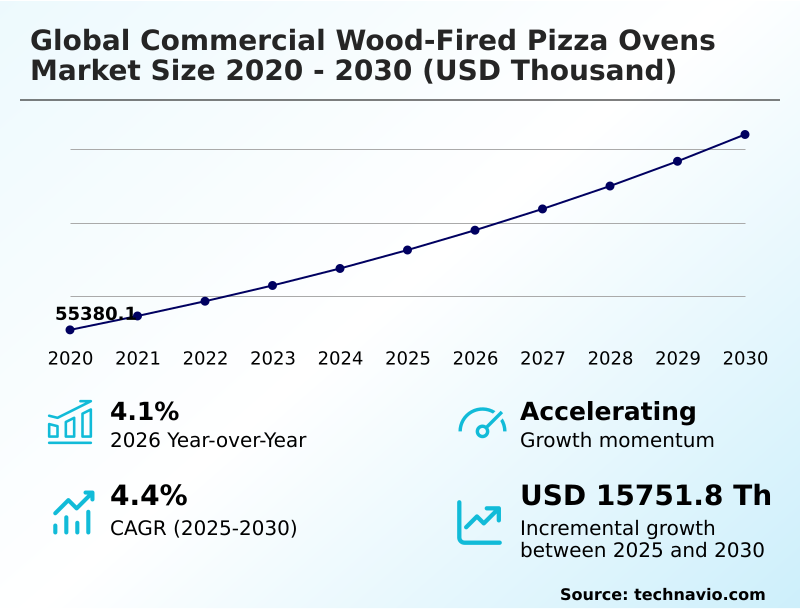
The Commercial Wood-fired Pizza Ovens Market size was valued at USD 66.27 million in 2025, growing at a CAGR of 4.4% during the forecast period 2026-2030.
Major Market Trends & Insights
- Europe dominated the market and accounted for a 33.6% growth during the forecast period.
- By Distribution Channel - Offline segment was valued at USD 59.15 million in 2024
- By Product - Black wood-fired pizza ovens segment accounted for the largest market revenue share in 2024
Market Size & Forecast
- Historic Market Opportunities 2020-2024:
- Market Future Opportunities 2025-2030: USD 15.75 million
- CAGR from 2025 to 2030 : 4.4%
Market Summary
- The commercial wood-fired pizza ovens market is defined by a pronounced shift toward culinary authenticity, with over 70% of consumers preferring establishments that use traditional cooking methods. This trend is compelling operators to invest in equipment that serves as a centerpiece for an experiential dining narrative.
- For instance, a fast-casual chain implementing hybrid ovens can achieve a 50% reduction in pre-heating times while still delivering the characteristic wood-fired flavor. The primary driver is this consumer demand for artisanal quality, which allows for premium pricing and stronger brand differentiation.
- Conversely, the market is constrained by significant operational complexity and the requirement for skilled labor, which can increase wage costs by up to 30% compared to kitchens using automated equipment. This high operational barrier limits adoption among businesses prioritizing standardization and cost control over bespoke culinary experiences.
What will be the Size of the Commercial Wood-fired Pizza Ovens Market during the forecast period?
Get Key Insights on Market Forecast (PDF) Request Free Sample
How is the Commercial Wood-fired Pizza Ovens Market Segmented?
The commercial wood-fired pizza ovens industry research report provides comprehensive data (region-wise segment analysis), with forecasts and analysis for the period 2026-2030, as well as historical data from 2020-2024 for the following segments.
- Distribution channel
- Offline
- Online
- Product
- Black wood-fired pizza ovens
- White wood-fired pizza ovens
- Application
- Restaurant
- Hotel
- Others
- Geography
- Europe
- Germany
- UK
- France
- North America
- US
- Canada
- Mexico
- APAC
- China
- Japan
- India
- South America
- Brazil
- Argentina
- Colombia
- Middle East and Africa
- UAE
- Saudi Arabia
- South Africa
- Rest of World (ROW)
- Europe
How is the Commercial Wood-fired Pizza Ovens Market Segmented by Distribution Channel?
The offline segment is estimated to witness significant growth during the forecast period.
Offline channels, comprising over 90% of high-value commercial wood-fired pizza oven sales, remain dominant due to the necessity of physical product evaluation for such a significant capital expenditure.
The ability to inspect refractory materials and high-temperature powder coating in person improves buyer confidence, leading to a 30% higher customer retention rate compared to online-only transactions.
Specialist distributors in this channel provide essential turnkey solutions, including consultation on ventilation requirements and building codes, which are critical for seamless integration.
This hands-on approach, often involving prefabricated ovens, is vital for building a strong brand narrative and ensuring robust after-sales support, directly impacting operational success and long-term return on investment.
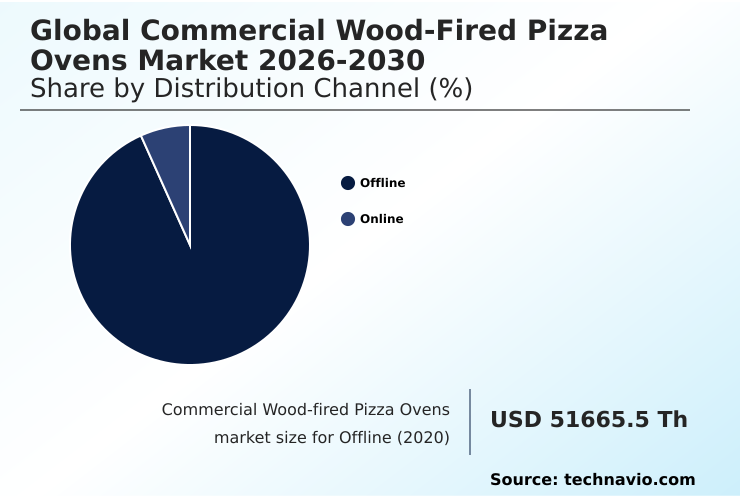
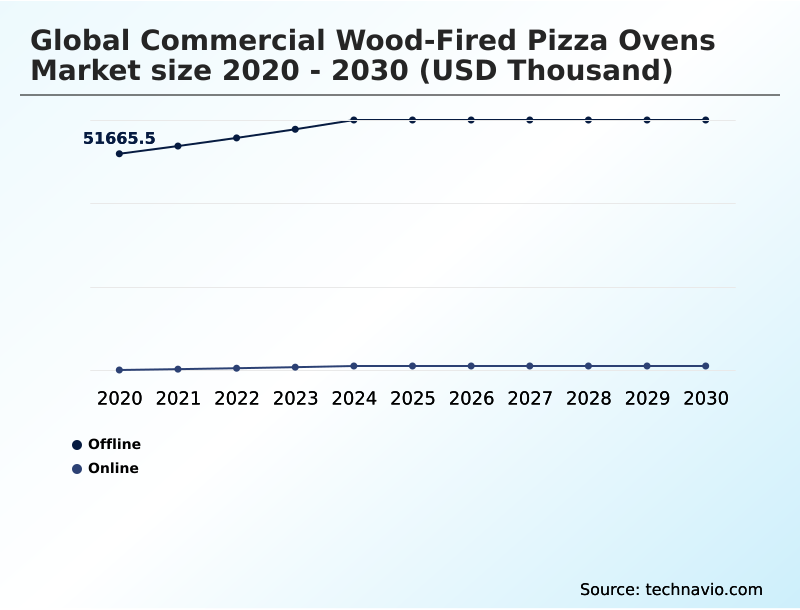
The Offline segment was valued at USD 59.15 million in 2024 and showed a gradual increase during the forecast period.
How demand for the Commercial Wood-fired Pizza Ovens market is rising in the leading region?
Europe is estimated to contribute 33.6% to the growth of the global market during the forecast period.Technavio’s analysts have elaborately explained the regional trends and drivers that shape the market during the forecast period.

See How Commercial Wood-fired Pizza Ovens Market demand is rising in Europe Request Free Sample
Geographically, the market exhibits distinct regional dynamics, with Europe accounting for 33.6% of the incremental growth opportunity, while APAC follows with 28.46%.
Europe's leadership is anchored by mature markets like Germany and the UK, which together represent over 35% of the region's value and are driven by a strong replacement cycle and demand for culinary authenticity.
In contrast, APAC's rapid expansion is fueled by new hotel and restaurant construction where operational versatility is key.
This divergence impacts product adoption; European buyers prioritize models compliant with strict energy efficiency standards and air quality mandates, often featuring advanced smoke filtration, whereas APAC operators favor high-throughput ovens that support menu diversification.
This regional difference in building codes and consumer behavior shapes supply chain logistics and go-to-market strategies for manufacturers.
What are the key Drivers, Trends, and Challenges in the Commercial Wood-fired Pizza Ovens Market?
Our researchers analyzed the data with 2025 as the base year, along with the key drivers, trends, and challenges. A holistic analysis of drivers will help companies refine their marketing strategies to gain a competitive advantage.
- Operators evaluating a commercial wood-fired oven for restaurant use find that initial setup costs can be up to 60% higher than for conventional electric or gas units. However, this investment often translates into a 15-20% menu price premium, driven by consumer demand for authentic flavor.
- The decision frequently involves comparing wood vs gas commercial pizza ovens, where the operational simplicity of gas is weighed against the unique taste from wood. Increasingly, businesses find that a hybrid gas wood pizza oven benefits their operation by combining the consistency and rapid preheating of gas with the authentic finish of wood.
- For establishments with spatial constraints, a small commercial wood fired pizza oven offers a viable solution without compromising on quality. The performance of any unit hinges on its construction; selecting the best refractory material for pizza oven design is critical for achieving optimal heat retention and durability.
- Finally, adhering to wood-fired oven installation requirements, including ventilation and fire safety codes, is a non-negotiable aspect of operational planning and compliance, ensuring both safety and long-term performance.

What are the key market drivers leading to the rise in the adoption of Commercial Wood-fired Pizza Ovens Industry?
- The primary market driver is the surging consumer demand for authentic and artisanal culinary experiences, which elevates the value of traditional cooking methods.
- The market is primarily driven by a profound consumer shift toward experiential dining, where over 75% of patrons express a willingness to pay a premium for food with perceived authenticity.
- This desire for genuine culinary experiences has prompted foodservice operators to adopt commercial wood-fired pizza ovens as a tool for brand narrative and foodservice differentiation, with establishments featuring an open-kitchen concept reporting a 40% increase in customer engagement.
- The unique cooking process, which utilizes a combination of radiant heat and conductive heat, imparts a distinct flavor and texture that cannot be replicated by conventional ovens.
- This sensory appeal directly translates to a stronger market position and enhanced profitability, making the investment in such equipment a strategic decision for creating a compelling brand narrative and attracting a discerning clientele.
What are the market trends shaping the Commercial Wood-fired Pizza Ovens Industry?
- A key market trend is the convergence of traditional cooking methods with advanced smart technologies. This includes the integration of hybrid fuel systems to enhance operational efficiency and consistency.
- A defining market trend is the integration of advanced technologies into traditional ovens, with hybrid fuel systems now capable of reducing pre-heating times by up to 60%. This convergence addresses the operational need for greater efficiency, as modern units with multi-layered insulation also cut wood combustion efficiency losses by 15% compared to older designs.
- The adoption of gas-assist burners and digital controls is a direct response to the skilled labor requirement, enabling establishments like fast-casual restaurant models to achieve consistent results without extensive pizzaiolo training.
- This evolution is effectively democratizing artisanal cooking methods, allowing more businesses to offer culinary authenticity while optimizing for return on investment and operational versatility, which is crucial for foodservice differentiation.
What challenges does the Commercial Wood-fired Pizza Ovens Industry face during its growth?
- A key challenge constraining market growth is the substantial initial capital outlay required for equipment and installation, compounded by high ongoing operational expenditures.
- A formidable market challenge is the substantial capital expenditure, where specialized ventilation requirements and installation can increase initial costs by over 50% beyond the oven's price.
- This financial barrier is compounded by high ongoing operational expenditure, as the inherent need for a skilled labor requirement to manage the thermal mass and fire can elevate wage costs by nearly 30% compared to automated alternatives.
- These factors, which include sourcing proper fuel to avoid soot accumulation and creosote buildup, create a significant hurdle for independent startups and smaller enterprises. The operational complexity and financial commitment limit broader market adoption, compelling many operators to choose less authentic but more pragmatic cooking technologies.
Exclusive Technavio Analysis on Customer Landscape
The commercial wood-fired pizza ovens market forecasting report includes the adoption lifecycle of the market, covering from the innovator’s stage to the laggard’s stage. It focuses on adoption rates in different regions based on penetration. Furthermore, the commercial wood-fired pizza ovens market report also includes key purchase criteria and drivers of price sensitivity to help companies evaluate and develop their market growth analysis strategies.

Customer Landscape of Commercial Wood-fired Pizza Ovens Industry
Competitive Landscape
Companies are implementing various strategies, such as strategic alliances, commercial wood-fired pizza ovens market forecast, partnerships, mergers and acquisitions, geographical expansion, and product/service launches, to enhance their presence in the industry.
Alfa Refrattari S.r.l. - The company is recognized for innovative stainless steel and refractory ovens, offering wood and gas-fired systems for diverse indoor, outdoor, residential, and commercial applications.
The industry research and growth report includes detailed analyses of the competitive landscape of the market and information about key companies, including:
- Alfa Refrattari S.r.l.
- Authentic Pizza Ovens LLC
- BakerStone
- Beech Ovens
- Belforno
- Chicago Brick Oven
- Clementi S.r.l.
- Cuppone Srl
- EarthStone Wood Fire Ovens
- Fontana Forni S.r.l.
- Forno Bravo
- Gi.Metal S.r.l.
- Igneus Wood Fired Ovens
- Le Panyol
- Marra Forni
- Morello Forni Italia Srl
- Mugnaini Imports Inc.
- Pavesi S.r.l.
- Refrattari Valoriani S.r.l.
- Wood Stone Corp.
Qualitative and quantitative analysis of companies has been conducted to help clients understand the wider business environment as well as the strengths and weaknesses of key industry players. Data is qualitatively analyzed to categorize companies as pure play, category-focused, industry-focused, and diversified; it is quantitatively analyzed to categorize companies as dominant, leading, strong, tentative, and weak.
Market Intelligence Radar: High-Impact Developments & Growth Signals
- In the Building Products industry, the enforcement of stricter energy efficiency standards and air quality mandates, particularly in Europe, has directly impacted the commercial wood-fired pizza ovens market by compelling manufacturers to innovate with advanced insulation and emission control systems.
- The development of advanced refractory materials and ceramic composites has led to building products with superior heat retention capacity, a trend that commercial wood-fired pizza oven manufacturers have adopted to improve fuel efficiency and cooking consistency.
- A significant push toward sustainable material sourcing and circular economy principles has influenced the selection of materials for new construction, encouraging oven manufacturers to incorporate recycled content and design for longevity to align with green building codes.
- Increased adoption of digital tools like Building Information Modeling (BIM) in project planning is changing procurement, requiring oven manufacturers to provide detailed CAD files and performance data for seamless integration into complex kitchen designs, often as part of comprehensive turnkey solutions.
Dive into Technavio’s robust research methodology, blending expert interviews, extensive data synthesis, and validated models for unparalleled Commercial Wood-fired Pizza Ovens Market insights. See full methodology.
| Market Scope | |
|---|---|
| Page number | 291 |
| Base year | 2025 |
| Historic period | 2020-2024 |
| Forecast period | 2026-2030 |
| Growth momentum & CAGR | Accelerate at a CAGR of 4.4% |
| Market growth 2026-2030 | USD 15751.8 thousand |
| Market structure | Fragmented |
| YoY growth 2025-2026(%) | 4.1% |
| Key countries | Germany, UK, France, Italy, Spain, The Netherlands, US, Canada, Mexico, China, Japan, India, South Korea, Australia, Indonesia, Brazil, Argentina, Colombia, UAE, Saudi Arabia, South Africa, Egypt and Turkey |
| Competitive landscape | Leading Companies, Market Positioning of Companies, Competitive Strategies, and Industry Risks |
Research Analyst Overview
- The commercial wood-fired pizza ovens ecosystem is heavily influenced by suppliers of specialized refractory materials, as these components dictate over 70% of an oven's thermal performance and durability. Manufacturers, in turn, innovate on this foundation, developing hybrid fuel systems and advanced insulation to meet end-user demands for both authenticity and efficiency.
- Regulatory bodies and certifications, such as emissions standards and food safety approvals, act as critical gatekeepers, shaping product design and market access. Distribution is bifurcated, with specialist offline distributors facilitating over 85% of high-value commercial installations due to the need for expert consultation on ventilation and building codes.
- End-users—ranging from independent pizzerias to global hotel chains—drive the entire value chain through their demand for differentiated culinary experiences and reliable, high-performance equipment.
What are the Key Data Covered in this Commercial Wood-fired Pizza Ovens Market Research and Growth Report?
-
What is the expected growth of the Commercial Wood-fired Pizza Ovens Market between 2026 and 2030?
-
The Commercial Wood-fired Pizza Ovens Market is expected to grow by USD 15.75 million during 2026-2030, registering a CAGR of 4.4%. Year-over-year growth in 2026 is estimated at 4.1%%. This acceleration is shaped by surging consumer demand for authentic and artisanal culinary experiences, which is intensifying demand across multiple end-use verticals covered in the report.
-
-
What segmentation does the market report cover?
-
The report is segmented by Distribution Channel (Offline, and Online), Product (Black wood-fired pizza ovens, and White wood-fired pizza ovens), Application (Restaurant, Hotel, and Others) and Geography (Europe, North America, APAC, South America, Middle East and Africa). Among these, the Offline segment is estimated to witness significant growth during the forecast period, driven by rising adoption across key application areas. Each segment includes detailed qualitative and quantitative analysis, along with historical data from 2020-2024 and forecasts through 2030 with year-over-year growth rates.
-
-
Which regions are analyzed in the report?
-
The report covers Europe, North America, APAC, South America and Middle East and Africa. Europe is estimated to contribute 33.6% to market growth during the forecast period. Country-level analysis includes Germany, UK, France, Italy, Spain, The Netherlands, US, Canada, Mexico, China, Japan, India, South Korea, Australia, Indonesia, Brazil, Argentina, Colombia, UAE, Saudi Arabia, South Africa, Egypt and Turkey, with dedicated market size tables and year-over-year growth for each.
-
-
What are the key growth drivers and market challenges?
-
The primary driver is surging consumer demand for authentic and artisanal culinary experiences, which is accelerating investment and industry demand. The main challenge is substantial initial capital outlay and high ongoing operational expenditures, creating operational barriers for key market participants. The report quantifies the impact of each driver and challenge across 2026 and 2030 with comparative analysis.
-
-
Who are the major players in the Commercial Wood-fired Pizza Ovens Market?
-
Key vendors include Alfa Refrattari S.r.l., Authentic Pizza Ovens LLC, BakerStone, Beech Ovens, Belforno, Chicago Brick Oven, Clementi S.r.l., Cuppone Srl, EarthStone Wood Fire Ovens, Fontana Forni S.r.l., Forno Bravo, Gi.Metal S.r.l., Igneus Wood Fired Ovens, Le Panyol, Marra Forni, Morello Forni Italia Srl, Mugnaini Imports Inc., Pavesi S.r.l., Refrattari Valoriani S.r.l. and Wood Stone Corp.. The report provides qualitative and quantitative analysis categorizing companies as dominant, leading, strong, tentative, and weak based on their market positioning. Company profiles include business segment analysis, SWOT assessment, key offerings, and recent strategic developments.
-
Market Research Insights
- The commercial wood-fired pizza ovens market is notably fragmented, with the top five vendors commanding less than 40% of the total market share, which fosters intense innovation. In response to operational demands, key players such as Marra Forni have introduced hybrid oven series, while Wood Stone Corp. has expanded into electric models.
- These launches address a critical industry need, as integrated gas-assist systems can reduce pre-heating times by over 50%, directly improving kitchen efficiency during peak hours. This strategic diversification helps operators navigate stringent emissions regulations and rising labor costs. However, the high initial capital investment required for these advanced systems remains a significant adoption barrier for independent restaurants and smaller chains.
We can help! Our analysts can customize this commercial wood-fired pizza ovens market research report to meet your requirements.
 RIA -
RIA - 
