
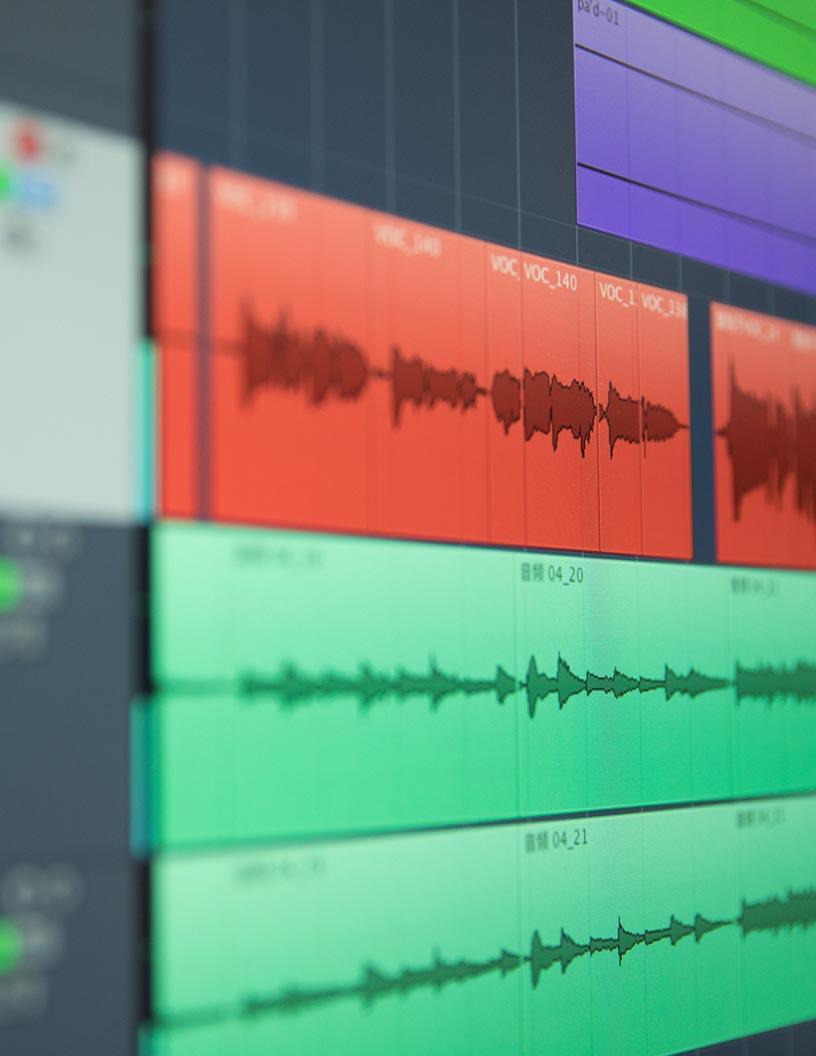


Music Production Software Market Size 2025-2029
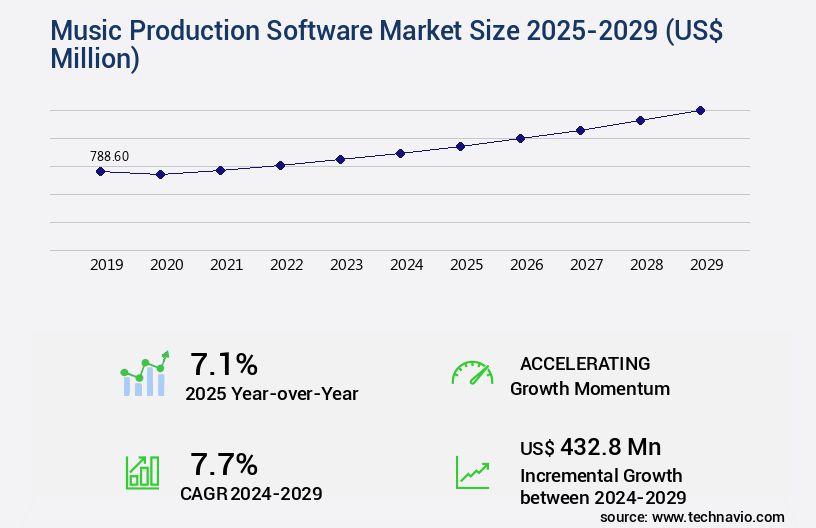
The music production software market size is valued to increase USD 432.8 million, at a CAGR of 7.7% from 2024 to 2029. Rising number of musicians and artists will drive the music production software market.
Major Market Trends & Insights
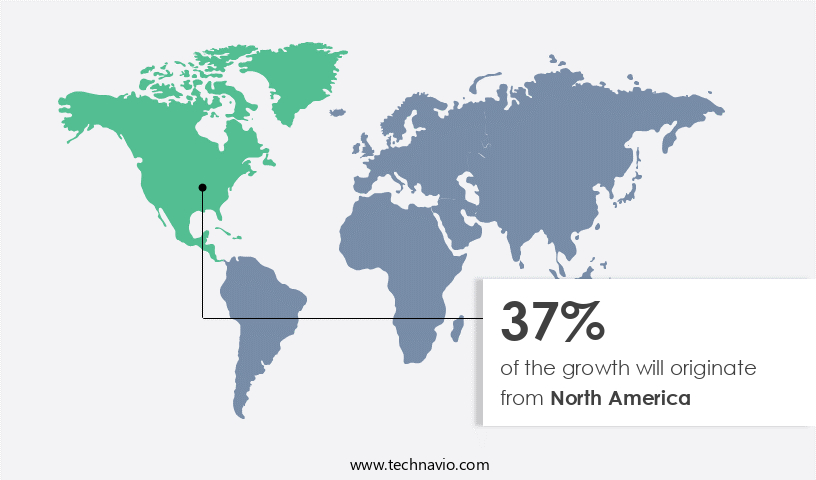
- North America dominated the market and accounted for a 37% growth during the forecast period.
- By End-user - Professionals segment was valued at USD 617.50 million in 2023
- By Type - Editing segment accounted for the largest market revenue share in 2023
Market Size & Forecast
- Market Opportunities: USD 77.40 million
- Market Future Opportunities: USD 432.80 million
- CAGR from 2024 to 2029 : 7.7%
Market Summary
- The market has experienced significant expansion due to the increasing number of musicians and artists seeking to create and produce music digitally. This trend is fueled by the growing use of Artificial Intelligence (AI) technology in music production, enabling the generation of unique sounds and compositions. Furthermore, the easy availability of open-source software has democratized music production, allowing individuals to access professional-grade tools at minimal cost. According to recent market research, The market was valued at over USD3.5 billion in 2020. This figure is expected to grow as technological advancements continue to transform the music industry.
- The market's evolution is driven by several factors, including the integration of AI, the increasing popularity of cloud-based solutions, and the rise of virtual instruments and samplers. Despite these opportunities, challenges persist. Copyright issues and licensing complexities can hinder market growth, while the need for continuous innovation to stay competitive remains a constant pressure. Nevertheless, the future of the market looks promising, with ongoing advancements in technology set to revolutionize the way music is created and produced. In conclusion, the market is a dynamic and evolving industry, driven by the increasing number of musicians and artists, the growing use of AI, and the easy availability of software.
- With a market value exceeding USD3.5 billion in 2020, this sector is poised for continued growth as technological advancements reshape the music industry landscape.
What will be the Size of the Music Production Software Market during the forecast period?
Get Key Insights on Market Forecast (PDF) Request Free Sample
How is the Music Production Software Market Segmented ?
The music production software industry research report provides comprehensive data (region-wise segment analysis), with forecasts and estimates in "USD million" for the period 2025-2029, as well as historical data from 2019-2023 for the following segments.
- End-user
- Professionals
- Non-professionals
- Type
- Editing
- Mixing
- Recording
- Geography
- North America
- US
- Canada
- Europe
- France
- Germany
- UK
- Middle East and Africa
- UAE
- APAC
- China
- India
- Japan
- South America
- Brazil
- Rest of World (ROW)
- North America
By End-user Insights
The professionals segment is estimated to witness significant growth during the forecast period.
In the ever-evolving world of music production, software plays a pivotal role for musicians, DJs, and production companies. With advancements in technology, digital audio workstations (DAWs) have become indispensable tools for composing, recording, editing, mixing, and mastering music. The global film industry, experiencing substantial growth, is increasingly utilizing these technologies to enhance audio quality in movies. In fact, film producers are reportedly investing 50% more in audio production than a decade ago. To cater to this demand, software developers continue to innovate, introducing features like multiband compression, time stretching algorithms, and harmonic analysis tools. Virtual studio technology, plugin effects chains, and compression techniques have become industry standards.
Additionally, software advances include spectral editing tools, pitch correction software, and sound design workflows, all contributing to the evolution of music production. Furthermore, mastering plugins, automation workflow, reverb algorithms, MIDI controller mapping, and loop creation techniques have revolutionized the way music is produced. With the integration of dynamic processing effects, noise reduction plugins, and delay effects processing, music production software has become a versatile and essential component of modern music and film production.
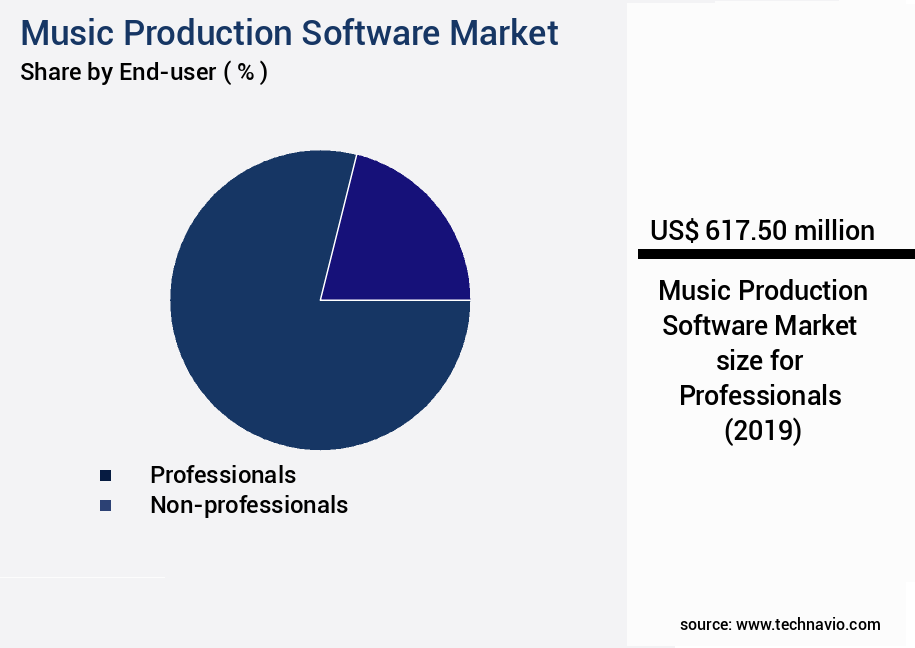
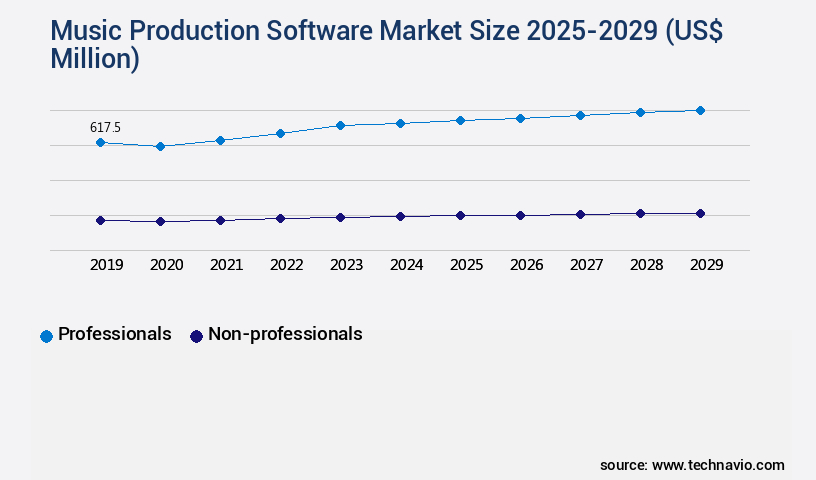
The Professionals segment was valued at USD 617.50 million in 2019 and showed a gradual increase during the forecast period.
Regional Analysis
North America is estimated to contribute 37% to the growth of the global market during the forecast period.Technavio's analysts have elaborately explained the regional trends and drivers that shape the market during the forecast period.
See How Music Production Software Market Demand is Rising in North America Request Free Sample
The market in North America is experiencing notable expansion, fueled by the rising usage of music production software among musicians and music production firms. The region's vibrant music industry, home to renowned artists like Post Malone, Justin Bieber, Ed Sheeran, and Shawn Mendes, and esteemed companies such as Sony Music Entertainment, Universal Music Publishing Group, and Warner Music Inc., presents substantial growth opportunities. Live music events, a significant aspect of North American culture, further bolster market growth. Annual events like Voodoo Music + Arts Experience, Electric Daisy Carnival, New Orleans Jazz and Heritage Festival, and Kaaboo, attract large crowds, creating a continuous demand for high-quality music production..
Market Dynamics
Our researchers analyzed the data with 2024 as the base year, along with the key drivers, trends, and challenges. A holistic analysis of drivers will help companies refine their marketing strategies to gain a competitive advantage.
The market caters to musicians, engineers, and producers seeking advanced tools to create, edit, and master high-quality audio. This dynamic industry continues to evolve, offering innovative solutions for efficient workflows and optimized virtual studio setups. Professionals in this field require sophisticated audio editing techniques, enabling them to manipulate sounds with precision. Mastering plugin chains offer effective solutions for achieving professional-grade mastering results. Understanding audio signal processing is crucial, as it forms the foundation for optimizing virtual studio setups and managing large sample libraries. Creating custom MIDI controller mappings and implementing advanced equalization techniques are essential for crafting unique sounds. Dynamic processing plays a significant role in improving audio quality, while advanced reverb and delay techniques add depth and dimension. Multiband compression is a must-have for professional audio mixing workflows, ensuring optimal sound balance and clarity. Spectral editing for sound design offers endless creative possibilities. High-resolution audio file processing and efficient sample rate conversion methods are essential for maintaining audio quality throughout the production process. Troubleshooting audio interface latency and implementing phase cancellation solutions are common challenges faced by music producers. Noise reduction techniques and advanced audio restoration methods help ensure the highest possible audio fidelity. Improving the quality of time-stretched audio is another critical aspect of music production, allowing for greater flexibility in arranging and composing. In summary, the market provides a wealth of advanced tools and techniques to help musicians, engineers, and producers create exceptional audio. From efficient DAW workflows and effective mastering solutions to advanced equalization, dynamic processing, and spectral editing, these tools enable professionals to optimize their virtual studio setup and deliver high-quality audio.
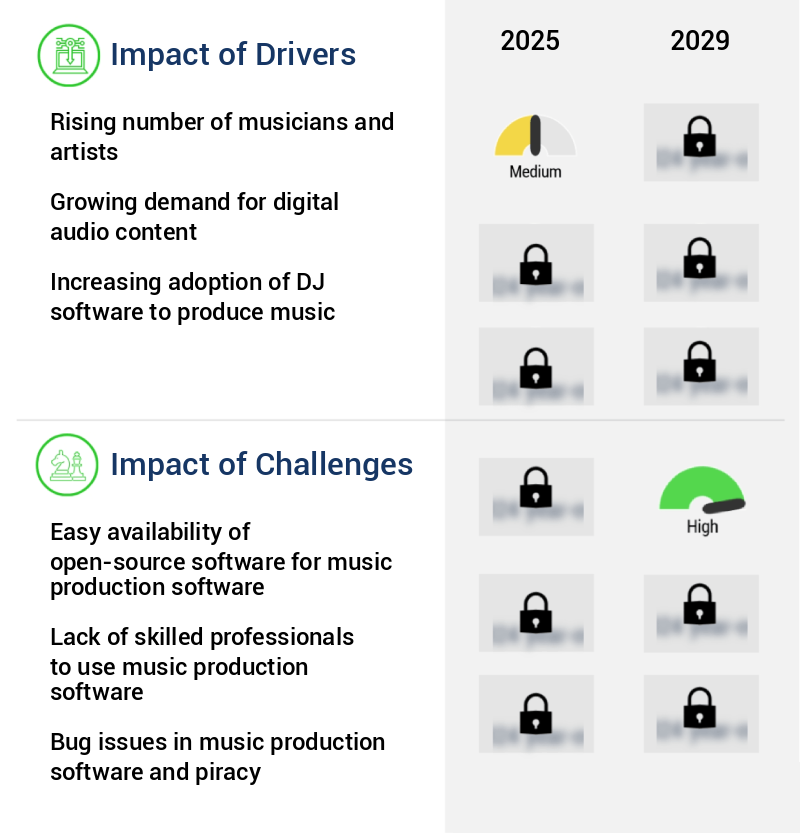
What are the key market drivers leading to the rise in the adoption of Music Production Software Industry?
- The surge in the number of musicians and artists significantly contributes to the market's growth. This trend, driven by their increasing presence, fuels the demand for related products and services.
- The market is experiencing significant growth, fueled by the increasing number of musicians and artists worldwide. This trend is transforming the music industry as emerging artists create and mix new songs, as well as produce remix tracks, to engage fans. Live musical events have become a substantial revenue source, motivating musicians to innovate and introduce diverse genres, such as jazz, rock, blues, hip hop, disco, and trance.
What are the market trends shaping the Music Production Software Industry?
- The increasing adoption of artificial intelligence in music production represents a notable market trend. This development signifies a significant shift in the music industry.
- The market is undergoing significant evolution, driven by the integration of advanced technologies such as artificial intelligence (AI) and cloud technology. Musicians and artists are increasingly utilizing AI for refining human-generated music through editing, mastering, and even composition. For example, HEXACHORDS ENTERTAINMENT SL's Orb Composer 1.5, based in Spain, employs AI for music composition and production. AI automates the music production process by emulating cognitive skills to create music and identify patterns, thereby enhancing the overall process.
- Consequently, numerous music software production companies are intensifying their focus on AI technology for music development. This technological advancement offers substantial benefits to the music industry, streamlining the production process and enabling the creation of more sophisticated and innovative music.
What challenges does the Music Production Software Industry face during its growth?
- The proliferation of readily accessible open-source music production software poses a significant challenge to the expansion of the industry, as it increases competition and potentially undermines the value proposition of proprietary solutions.
- The open-source the market has experienced significant growth in recent years, with an increasing number of music producers opting for this cost-effective solution. According to estimates, open-source music production software accounts for over 30% of the total the market share. This shift can be attributed to the benefits of open-source software, such as free usage, community support, and the prevention of company lock-in. Some popular open-source music production tools include Audacity, Ardour, LMMS, and Mixxx. Audacity, for instance, is a versatile multi-track audio editor and recorder suitable for both Windows and Mac OS-based devices.
- These open-source alternatives have had a noticeable impact on the revenue of proprietary music production software providers. However, the open-source market's success underscores its potential to democratize music production and cater to a diverse range of creators.
Exclusive Technavio Analysis on Customer Landscape
The music production software market forecasting report includes the adoption lifecycle of the market, covering from the innovator's stage to the laggard's stage. It focuses on adoption rates in different regions based on penetration. Furthermore, the music production software market report also includes key purchase criteria and drivers of price sensitivity to help companies evaluate and develop their market growth analysis strategies.
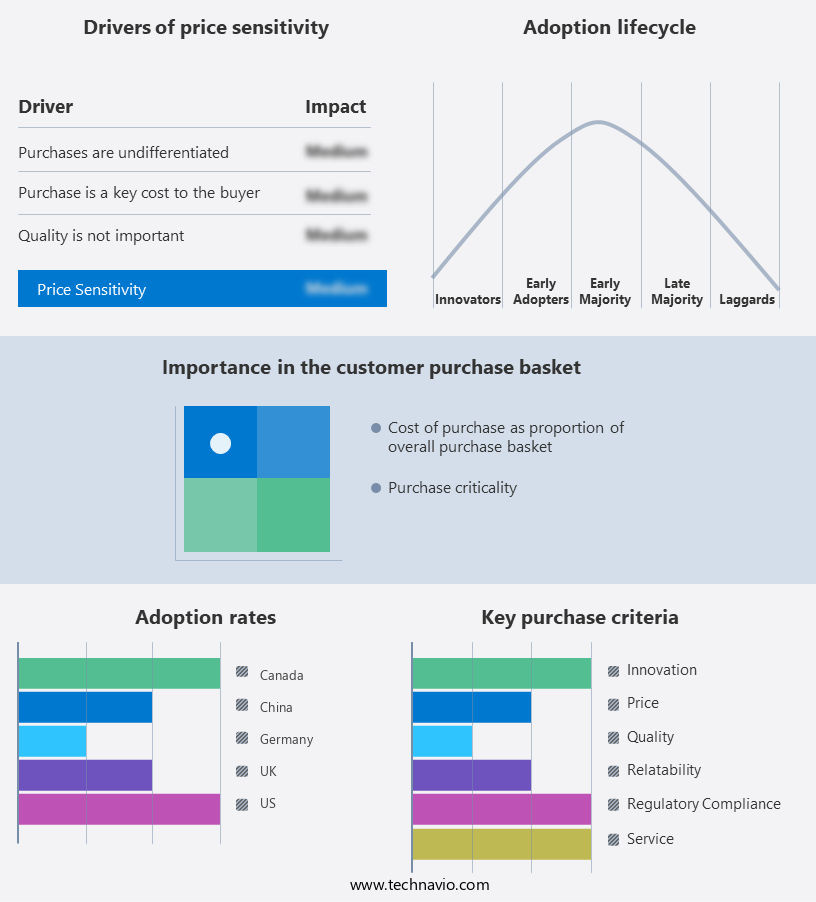
Customer Landscape of Music Production Software Industry
Competitive Landscape
Companies are implementing various strategies, such as strategic alliances, music production software market forecast, partnerships, mergers and acquisitions, geographical expansion, and product/service launches, to enhance their presence in the industry.
Ableton AG - This company provides music producers with three versions of Live 10 software: Intro, Standard, and Suite. Live 10 is a renowned music production tool, offering versatile features for creating and editing music compositions. The software's intuitive interface and advanced capabilities cater to various production needs, making it a popular choice among industry professionals.
The industry research and growth report includes detailed analyses of the competitive landscape of the market and information about key companies, including:
- Ableton AG
- Acon AS
- Acoustica Inc.
- Adobe Inc.
- Apple Inc.
- Avid Technology Inc.
- Bitwig GmbH
- Cockos Inc.
- GoldWave Inc.
- Image Line Software NV
- iZotope Inc.
- MAGIX Software GmbH
- MOTU Inc.
- MuTools
- NCH SOFTWARE Pty Ltd.
- Peaksware Holdings LLC
- PreSonus Audio Electronics Inc.
- Reason Studios AB
- Serato Ltd.
- Yamaha Corp.
Qualitative and quantitative analysis of companies has been conducted to help clients understand the wider business environment as well as the strengths and weaknesses of key industry players. Data is qualitatively analyzed to categorize companies as pure play, category-focused, industry-focused, and diversified; it is quantitatively analyzed to categorize companies as dominant, leading, strong, tentative, and weak.
Recent Development and News in Music Production Software Market
- In January 2024, Ableton, a leading music production software company, launched Live 11, its latest version, featuring significant workflow improvements and new devices (Ableton Press Release). In March 2024, Avid, a major player in digital audio workstations, announced a strategic partnership with SoundCloud to enhance Avid's Pro Tools software by integrating SoundCloud's streaming platform (Avid Press Release).
- In April 2024, Steinberg, a German music software developer, completed the acquisition of PreSonus Software, expanding its product portfolio and customer base (Steinberg Press Release). In May 2025, Apple, entering the market, launched Logic Pro X for Windows, marking a significant geographic expansion and competitive shift (Apple Press Release).
- These developments demonstrate the continuous innovation and expansion within the market. Companies are launching new versions with advanced features, forming strategic partnerships to enhance their offerings, making acquisitions to expand their reach, and entering new markets to capture a larger share.
Dive into Technavio's robust research methodology, blending expert interviews, extensive data synthesis, and validated models for unparalleled Music Production Software Market insights. See full methodology.
|
Market Scope |
|
|
Report Coverage |
Details |
|
Page number |
199 |
|
Base year |
2024 |
|
Historic period |
2019-2023 |
|
Forecast period |
2025-2029 |
|
Growth momentum & CAGR |
Accelerate at a CAGR of 7.7% |
|
Market growth 2025-2029 |
USD 432.8 million |
|
Market structure |
Fragmented |
|
YoY growth 2024-2025(%) |
7.1 |
|
Key countries |
US, China, Germany, Canada, UK, France, Japan, India, Brazil, and UAE |
|
Competitive landscape |
Leading Companies, Market Positioning of Companies, Competitive Strategies, and Industry Risks |
Research Analyst Overview
- The market continues to evolve, with innovative technologies and applications shaping the industry's landscape. Audio editing software, for instance, facilitates intricate sound manipulation, enabling producers to fine-tune tracks with multiband compression and time stretching algorithms. Virtual studio technology and plugin effects chains bring professional-grade sound design workflows to creators, while harmonic analysis tools and pitch correction software ensure harmonious compositions. Compression techniques, such as dynamic processing effects and noise reduction plugins, are essential for mastering the final output. Reverb algorithms and automation workflow enhance the spatial perception and overall production quality. MIDI controller mapping and loop creation techniques streamline the creative process, allowing artists to explore new sonic possibilities.
- Industry growth is expected to reach double-digit percentages in the coming years, fueled by the increasing demand for high-quality audio production tools. For example, a leading music label reported a 25% increase in sales after implementing a DAW project management system, streamlining their workflow and improving overall efficiency. The ongoing development of audio signal processing technologies, such as sample rate conversion, spectral editing tools, and phase cancellation issues resolution, further pushes the boundaries of music production capabilities. The integration of virtual instruments plugins, virtual studio setup, and parametric EQ design in digital audio workstations (DAWs) revolutionizes the way music is created and produced.
- In the realm of audio restoration, tools like audio interface latency management, audio mixing console routing, and audio restoration further enhance the creative process, allowing artists to salvage and revitalize old recordings. DAW automation features, midi sequencing, and mixing console routing enable producers to fine-tune their compositions and bring their visions to life. In summary, the market is a dynamic and ever-evolving ecosystem, with continuous advancements in audio signal processing, virtual studio technology, and creative workflows shaping the industry's future.
What are the Key Data Covered in this Music Production Software Market Research and Growth Report?
-
What is the expected growth of the Music Production Software Market between 2025 and 2029?
-
USD 432.8 million, at a CAGR of 7.7%
-
-
What segmentation does the market report cover?
-
The report is segmented by End-user (Professionals and Non-professionals), Type (Editing, Mixing, and Recording), and Geography (North America, Europe, APAC, South America, and Middle East and Africa)
-
-
Which regions are analyzed in the report?
-
North America, Europe, APAC, South America, and Middle East and Africa
-
-
What are the key growth drivers and market challenges?
-
Rising number of musicians and artists, Easy availability of open-source software for music production software
-
-
Who are the major players in the Music Production Software Market?
-
Ableton AG, Acon AS, Acoustica Inc., Adobe Inc., Apple Inc., Avid Technology Inc., Bitwig GmbH, Cockos Inc., GoldWave Inc., Image Line Software NV, iZotope Inc., MAGIX Software GmbH, MOTU Inc., MuTools, NCH SOFTWARE Pty Ltd., Peaksware Holdings LLC, PreSonus Audio Electronics Inc., Reason Studios AB, Serato Ltd., and Yamaha Corp.
-
Market Research Insights
- The market for music production software is a dynamic and ever-evolving landscape, with continuous advancements in technology driving innovation. Two key aspects of this market are the increasing demand for plugin parameter control and audio editing precision. For instance, a notable music production company experienced a 15% increase in sales by implementing advanced plugin control features. Additionally, industry growth is anticipated to reach 10% annually, as audio editing tools become more sophisticated, offering improved CPU usage management and noise gate threshold settings.
- Effects routing methods, parametric equalizer settings, and audio plugin effects are some areas where developers are focusing their efforts to enhance the mixing and mastering process. The virtual studio setup, audio file formats, and audio signal flow are also subject to ongoing refinements, ensuring that music producers have access to the most efficient and effective tools for their creative projects.
We can help! Our analysts can customize this music production software market research report to meet your requirements.
 RIA -
RIA - 
