


US Residential Construction Market Size 2026-2030
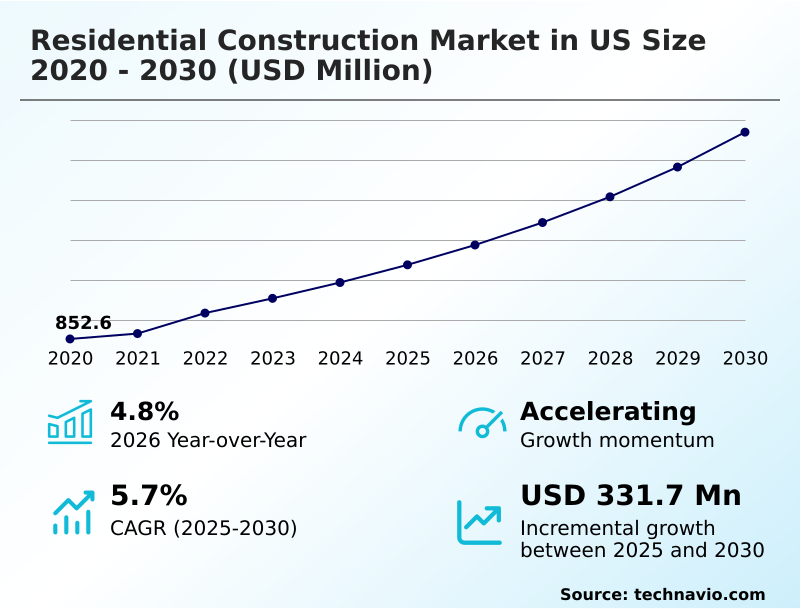
The us residential construction market size is valued to increase by USD 331.7 million, at a CAGR of 5.7% from 2025 to 2030. Increasing household formation rates will drive the us residential construction market.
Major Market Trends & Insights
- By Product - Apartments and condominiums segment was valued at USD 580.9 million in 2024
- By Type - New construction segment accounted for the largest market revenue share in 2024
Market Size & Forecast
- Market Opportunities: USD 517 million
- Market Future Opportunities: USD 331.7 million
- CAGR from 2025 to 2030 : 5.7%
Market Summary
- The residential construction market in US is undergoing a significant transformation, driven by demographic shifts and technological advancements. A primary catalyst is strong household formation rates, which sustain demand for various housing types, from single-family homes to high-density urban living solutions.
- Concurrently, a major trend is the focus on sustainability, with builders adopting energy-efficient systems and materials like low-emission concrete to meet stricter building code compliance. However, the industry grapples with persistent skilled labor shortages and supply chain constraints, which put pressure on cost control methods and project timelines.
- In a typical business scenario, a large developer utilizes building information modeling for real-time project monitoring. This allows for optimized land acquisition strategies and improved construction quality control, helping to mitigate the impact of labor scarcity by integrating prefabricated components and automated framing technologies.
- This strategic adoption of technology not only enhances structural performance improvement but also ensures the timely delivery of new construction projects, from master-planned communities to custom home building, thereby maintaining a competitive edge in a dynamic market environment. The evolution toward modular housing solutions and off-site fabrication further underscores the industry's response to modern operational challenges.
What will be the Size of the US Residential Construction Market during the forecast period?
Get Key Insights on Market Forecast (PDF) Request Free Sample
How is the US Residential Construction Market Segmented?
The us residential construction industry research report provides comprehensive data (region-wise segment analysis), with forecasts and estimates in "USD million" for the period 2026-2030, as well as historical data from 2020-2024 for the following segments.
- Product
- Apartments and condominiums
- Villas
- Others
- Type
- New construction
- Renovation
- Application
- Single family
- Multi-family
- Geography
- North America
- US
- North America
By Product Insights
The apartments and condominiums segment is estimated to witness significant growth during the forecast period.
The residential construction market's segmentation reflects a pivot toward higher-density living solutions. The apartments and condominiums segment is expanding, driven by sustained urban development and the need for efficient land use.
These multi-family developments cater to diverse demographics, including first-time buyers and those seeking low-maintenance lifestyles near employment centers. The segment includes luxury condominiums and high-rise developments, often integrated into mixed-use developments with retail and commercial spaces.
Effective construction project management and adept zoning navigation are critical for success, with developers focusing on modular techniques to improve cost control methods.
This approach to high-density urban living, which also includes attached homes and townhomes, has enabled builders to reduce project delivery timelines by over 10% in complex metropolitan areas.
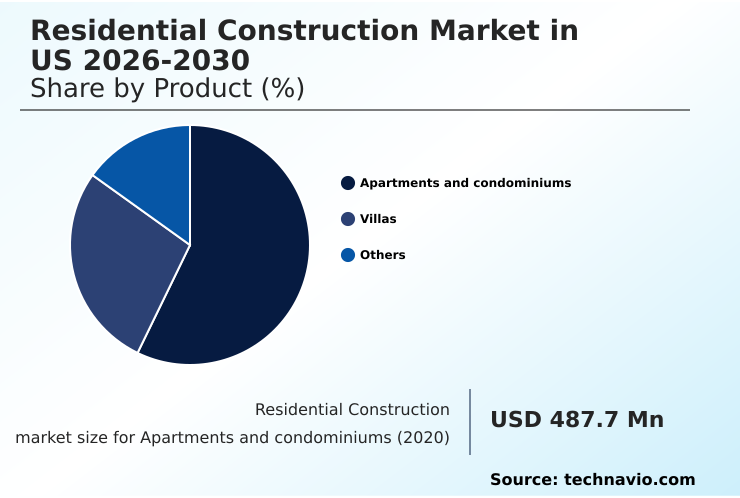
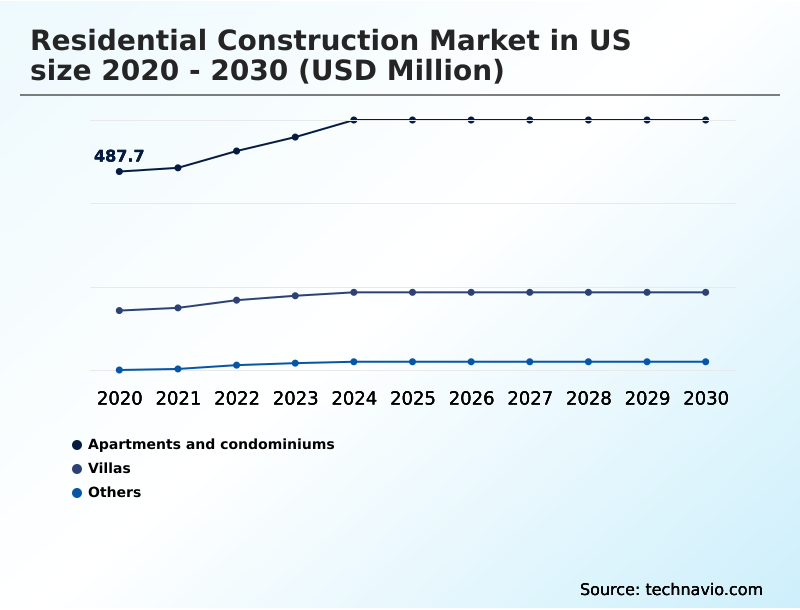
The Apartments and condominiums segment was valued at USD 580.9 million in 2024 and showed a gradual increase during the forecast period.
Market Dynamics
Our researchers analyzed the data with 2025 as the base year, along with the key drivers, trends, and challenges. A holistic analysis of drivers will help companies refine their marketing strategies to gain a competitive advantage.
- Navigating the complexities of the modern housing market requires a deep understanding of evolving construction methodologies and their financial implications. The use of prefabricated components in residential construction is becoming a cornerstone of strategies aimed at enhancing efficiency and predictability.
- This approach directly addresses the financial strain caused by market challenges, with developers analyzing the impact of skilled labor shortages on costs. Firms that integrate off-site manufacturing report a significant reduction in on-site labor hours compared to traditional site-built projects, sometimes achieving a 30% faster assembly time for structural elements.
- Central to this transformation is the application of building information modeling for homebuilders, which provides a digital framework for planning, design, and execution. This technology is critical for coordinating the use of sustainable materials for new housing projects, ensuring that green initiatives are implemented effectively without compromising the budget.
- Furthermore, exploring the smart home technology integration benefits reveals opportunities for product differentiation and increased asset value. By connecting these elements, builders can create a more resilient operational model that balances innovation with profitability, ensuring they can meet demand while managing the inherent risks of large-scale development.
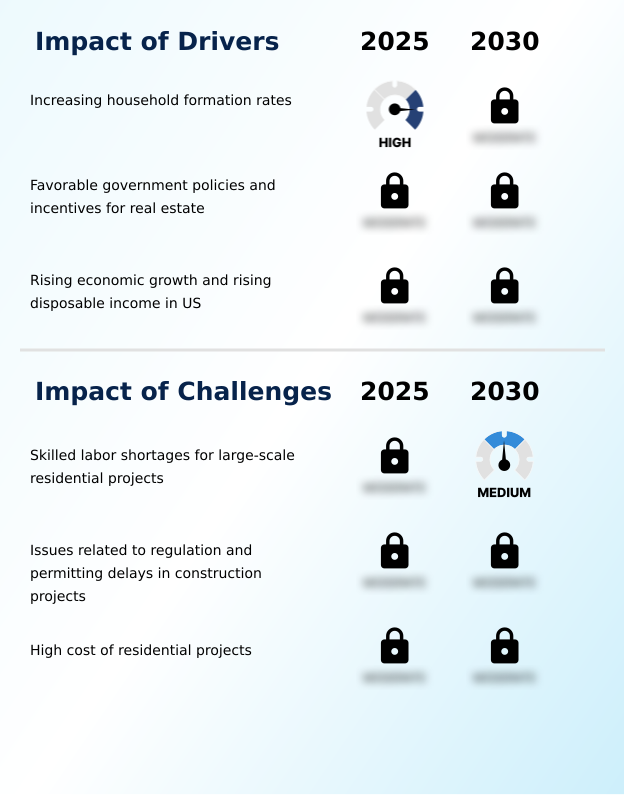
What are the key market drivers leading to the rise in the adoption of US Residential Construction Industry?
- Increasing household formation rates, particularly among younger demographics, serve as a key driver for the residential construction market.
- Increasing household formation rates are a primary market driver, fueling demand for new construction of single-family homes and detached homes.
- The desire for homeownership among first-time buyers and move-up buyers is accelerating suburban development, compelling builders to refine their land acquisition strategies. This has led to a focus on master-planned communities that offer site-built housing, including villas, with modern amenities.
- The expansion of the build-to-rent sector has also diversified demand, leading to a 15% increase in dedicated rental community projects.
- This activity ensures a steady pipeline of housing inventory, with some developers reporting a 20% faster sales cycle in high-growth corridors due to this sustained demand.
What are the market trends shaping the US Residential Construction Industry?
- A rising focus on sustainability in residential construction projects is emerging as a significant market trend, driven by both regulatory mandates and increasing consumer demand for eco-friendly and energy-efficient homes.
- The increasing adoption of net-zero home designs is reshaping the residential construction market, with a strong emphasis on solar energy integration and advanced smart home integration. These trends are driven by a push for greater resource conservation and improved indoor air quality standards.
- Builders are achieving significant embodied carbon reduction by using materials like cross-laminated timber, recycled steel, and low-emission concrete, reflecting a commitment to circular economy principles. This shift has resulted in homes that are 40% more energy-efficient than those built a decade ago.
- Furthermore, high-performance insulation and real-time energy consumption monitoring tools enable homeowners to lower utility costs, while developers focus on sustainable land use, improving community green space by up to 25%.
What challenges does the US Residential Construction Industry face during its growth?
- A significant challenge affecting industry growth is the persistent shortage of skilled labor required for large-scale residential construction projects.
- Persistent skilled labor shortages and ongoing supply chain constraints present significant challenges, impacting project timeline optimization for both new builds and renovation projects. To mitigate these issues, the industry is increasingly turning to advanced framing solutions and off-site fabrication. The adoption of prefabricated components and automated framing technologies has been shown to reduce on-site labor requirements by up to 30%.
- However, integrating these modular housing solutions requires new approaches to construction quality control and building code compliance. These innovations are crucial for maintaining effective cost control methods, especially in custom home building, where margins are tighter. Firms that successfully adopt these technologies can reduce material waste by nearly 15%.
Exclusive Technavio Analysis on Customer Landscape
The us residential construction market forecasting report includes the adoption lifecycle of the market, covering from the innovator’s stage to the laggard’s stage. It focuses on adoption rates in different regions based on penetration. Furthermore, the us residential construction market report also includes key purchase criteria and drivers of price sensitivity to help companies evaluate and develop their market growth analysis strategies.
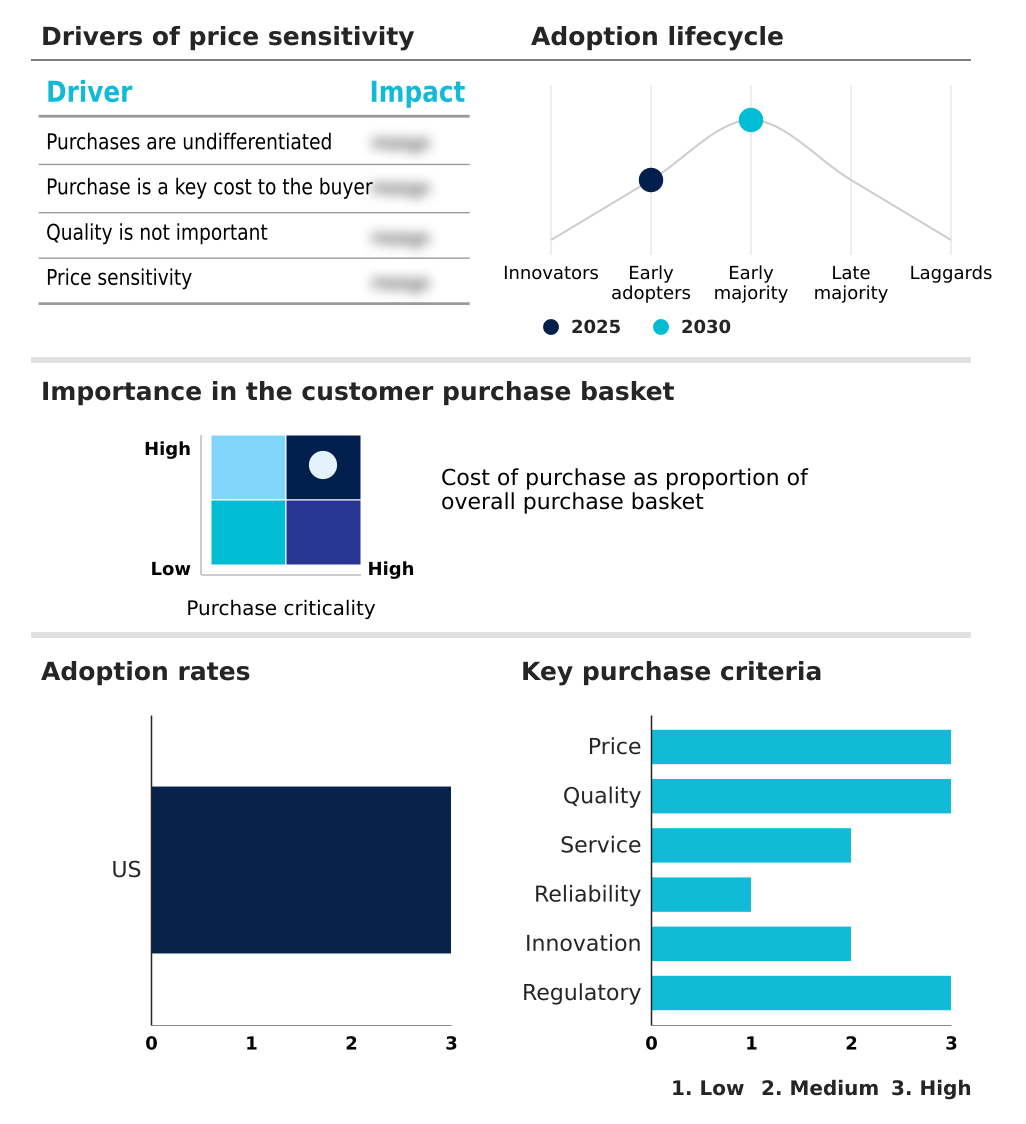
Customer Landscape of US Residential Construction Industry
Competitive Landscape
Companies are implementing various strategies, such as strategic alliances, us residential construction market forecast, partnerships, mergers and acquisitions, geographical expansion, and product/service launches, to enhance their presence in the industry.
Ashton Woods Corp - Key offerings include residential construction services focused on delivering design-driven, energy-efficient homes with flexible layouts and modern amenities for a diverse range of homebuyers.
The industry research and growth report includes detailed analyses of the competitive landscape of the market and information about key companies, including:
- Ashton Woods Corp
- BEAZER HOMES USA INC.
- Century Communities Inc.
- Clayton Properties Group Inc
- David Weekley Homes
- Dream Finders Homes Inc.
- KB Home
- Lennar Corp.
- LGI Homes Inc.
- Meritage Homes Corp.
- MI Homes Inc.
- MiTek Inc.
- Neligan Construction and Roofing
- PCL Constructors Inc.
- PULTEGROUP INC
- Shea Homes
- Toll Brothers Inc.
- Tri Pointe Homes Inc
Qualitative and quantitative analysis of companies has been conducted to help clients understand the wider business environment as well as the strengths and weaknesses of key industry players. Data is qualitatively analyzed to categorize companies as pure play, category-focused, industry-focused, and diversified; it is quantitatively analyzed to categorize companies as dominant, leading, strong, tentative, and weak.
Recent Development and News in Us residential construction market
- In April 2025, KB Home launched an updated sustainability dashboard and a new partnership with renewable energy providers to offer standard solar and battery storage systems in its western region communities.
- In February 2025, Lennar Corp. highlighted a new initiative to address labor constraints through the expanded use of automated framing technologies in its large-scale developments.
- In April 2025, Toll Brothers Apartment Living detailed the groundbreaking of a new luxury condominium project in a high-growth metropolitan area to meet rising demand for premium urban residences.
- In November 2024, PulteGroup Inc. entered a strategic partnership with a leading tech firm to integrate advanced smart home ecosystems as a standard feature in all its new single-family home constructions.
Dive into Technavio’s robust research methodology, blending expert interviews, extensive data synthesis, and validated models for unparalleled US Residential Construction Market insights. See full methodology.
| Market Scope | |
|---|---|
| Page number | 168 |
| Base year | 2025 |
| Historic period | 2020-2024 |
| Forecast period | 2026-2030 |
| Growth momentum & CAGR | Accelerate at a CAGR of 5.7% |
| Market growth 2026-2030 | USD 331.7 million |
| Market structure | Fragmented |
| YoY growth 2025-2026(%) | 4.8% |
| Key countries | US |
| Competitive landscape | Leading Companies, Market Positioning of Companies, Competitive Strategies, and Industry Risks |
Research Analyst Overview
- The residential construction market in US displays a complex and evolving landscape where builders are diversifying their offerings beyond traditional single-family homes to include multi-family developments, apartments and condominiums, and luxury condominiums. New construction projects, from single-family detached homes to attached homes and townhomes, are increasingly incorporating innovative methods.
- The adoption of building information modeling is streamlining both custom home building and large-scale renovation projects. To improve efficiency, firms are utilizing off-site fabrication with prefabricated components and modular housing solutions, complemented by automated framing technologies and advanced framing solutions. This is especially prevalent in master-planned communities and the growing build-to-rent sector.
- Sustainability is driving the integration of net-zero home designs with high-performance insulation and solar energy integration. Materials like cross-laminated timber, recycled steel, and low-emission concrete are now common. In high-rise developments and site-built housing, advanced engineered structural components like structural insulated wall assemblies ensure quality. Innovations such as self-healing concrete are also being explored.
- Firms integrating these energy-efficient systems and smart home integration technologies have achieved up to a 15% reduction in project completion times.
What are the Key Data Covered in this US Residential Construction Market Research and Growth Report?
-
What is the expected growth of the US Residential Construction Market between 2026 and 2030?
-
USD 331.7 million, at a CAGR of 5.7%
-
-
What segmentation does the market report cover?
-
The report is segmented by Product (Apartments and condominiums, Villas, and Others), Type (New construction, and Renovation), Application (Single family, and Multi-family) and Geography (North America)
-
-
Which regions are analyzed in the report?
-
North America
-
-
What are the key growth drivers and market challenges?
-
Increasing household formation rates, Skilled labor shortages for large-scale residential projects
-
-
Who are the major players in the US Residential Construction Market?
-
Ashton Woods Corp, BEAZER HOMES USA INC., Century Communities Inc., Clayton Properties Group Inc, David Weekley Homes, Dream Finders Homes Inc., KB Home, Lennar Corp., LGI Homes Inc., Meritage Homes Corp., MI Homes Inc., MiTek Inc., Neligan Construction and Roofing, PCL Constructors Inc., PULTEGROUP INC, Shea Homes, Toll Brothers Inc. and Tri Pointe Homes Inc
-
Market Research Insights
- Market dynamics are shaped by evolving residential building practices aimed at addressing key industry pressures. An emphasis on construction project management has led to a 15% improvement in project timeline optimization, directly impacting profitability.
- As builders refine land acquisition strategies to accommodate rising household formation rates, the focus shifts to sustainable land use and better resource conservation, improving alignment with environmental regulations by over 25%. While skilled labor shortages remain a concern, strategic workforce planning and technology adoption are enhancing construction quality control.
- This proactive approach to housing unit development helps builders manage supply chain constraints and maintain momentum in both urban development and suburban development, ensuring long-term asset value enhancement for homeownership.
We can help! Our analysts can customize this us residential construction market research report to meet your requirements.
 RIA -
RIA - 
