


Electric Vehicle (EV) Market Size 2026-2030
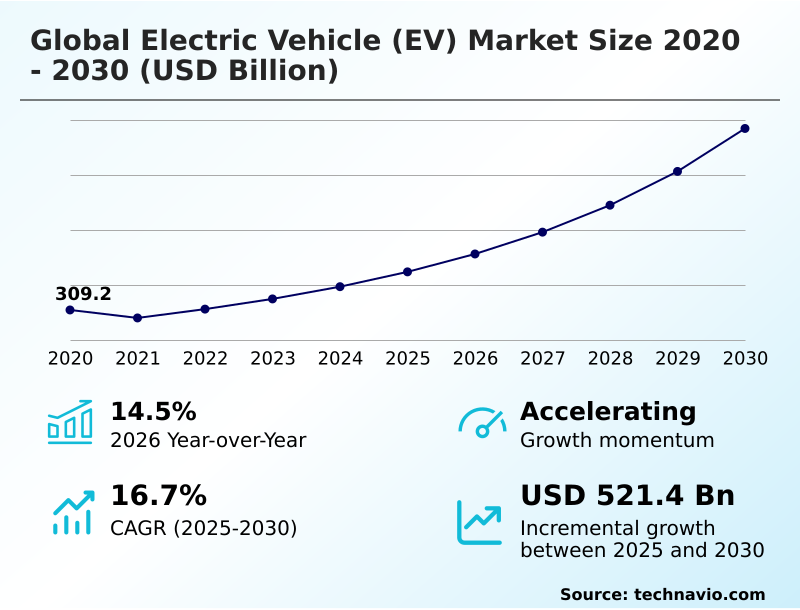
The electric vehicle (ev) market size is valued to increase by USD 521.4 billion, at a CAGR of 16.7% from 2025 to 2030. Stringent government policies, regulations, and financial incentives will drive the electric vehicle (ev) market.
Major Market Trends & Insights
- APAC dominated the market and accounted for a 48.7% growth during the forecast period.
- By Type - BEV segment was valued at USD 249.1 billion in 2024
- By Charging - Normal charging segment accounted for the largest market revenue share in 2024
Market Size & Forecast
- Market Opportunities: USD 660 billion
- Market Future Opportunities: USD 521.4 billion
- CAGR from 2025 to 2030 : 16.7%
Market Summary
- The electric vehicle (ev) market is undergoing a fundamental transformation driven by advancements in battery technology and a global push for decarbonization. The industry is rapidly moving beyond early adoption, focusing on scaling production and enhancing the e-mobility ecosystem. A key dynamic is the development of a resilient supply chain for critical components, as interruptions can significantly impact manufacturing output.
- For instance, a business scenario involving the implementation of a multi-source strategy for battery cells can reduce production downtime by over 15%, ensuring operational continuity. Core innovations center on improving battery energy density to extend range and reducing the total cost of ownership (tco) to achieve price parity with conventional vehicles.
- The expansion of the public charging network and the integration of smart charging technology are critical for building consumer confidence and managing grid stability. Concurrently, the evolution of the software-defined vehicle architecture enables continuous improvement through over-the-air (ota) software updates, reshaping the ownership experience.
- These intersecting forces are creating a highly competitive and rapidly evolving market landscape where technological leadership and supply chain mastery are paramount for success.
What will be the Size of the Electric Vehicle (EV) Market during the forecast period?
Get Key Insights on Market Forecast (PDF) Request Free Sample
How is the Electric Vehicle (EV) Market Segmented?
The electric vehicle (ev) industry research report provides comprehensive data (region-wise segment analysis), with forecasts and estimates in "USD billion" for the period 2026-2030, as well as historical data from 2020-2024 for the following segments.
- Type
- BEV
- PHEV
- Charging
- Normal charging
- Super charging
- Vehicle type
- Passenger cars
- Two wheelers
- Commercial vehicles
- Geography
- APAC
- China
- Japan
- India
- Europe
- Germany
- UK
- France
- North America
- US
- Canada
- Mexico
- South America
- Brazil
- Argentina
- Middle East and Africa
- UAE
- South Africa
- Saudi Arabia
- Rest of World (ROW)
- APAC
By Type Insights
The bev segment is estimated to witness significant growth during the forecast period.
The global electric vehicle (ev) market segmentation reflects a decisive shift toward battery-electric platforms, which are central to the industry's automotive electrification strategy.
This segment's expansion, contributing to over 48% of market growth, is propelled by innovations in lithium-ion battery pack design and improved battery energy density.
The development of a supporting e-mobility ecosystem, featuring accessible DC fast charging (DCFC) and advanced battery thermal management systems, is crucial for both electric passenger car models and emerging commercial electric truck applications.
As part of a broader transport decarbonization policy, advancements such as over-the-air (OTA) software updates and vehicle-to-grid (V2G) capabilities are enhancing vehicle value and utility, directly addressing consumer and fleet operator demands while contributing to urban air quality improvement.
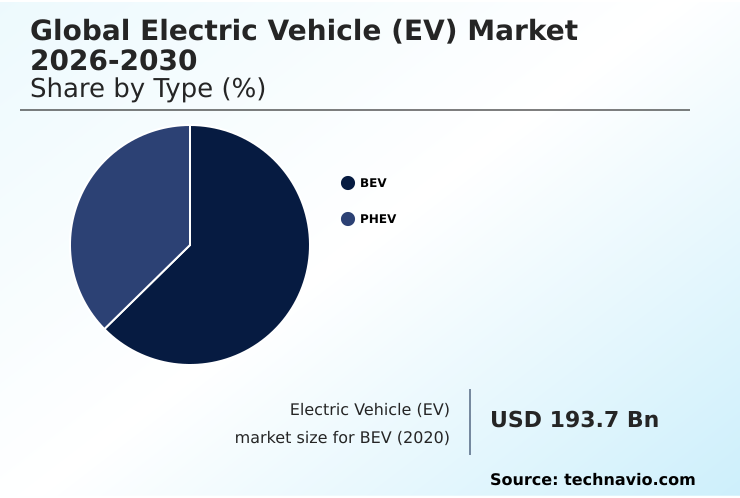
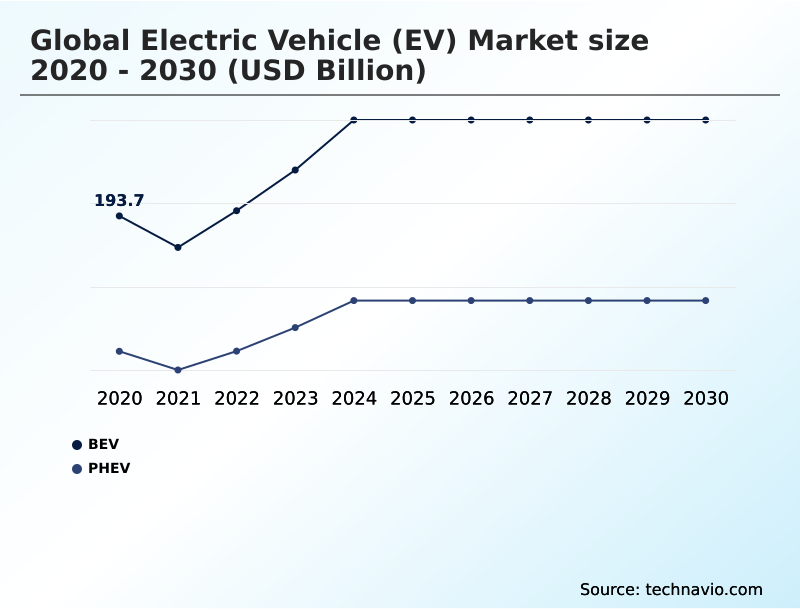
The BEV segment was valued at USD 249.1 billion in 2024 and showed a gradual increase during the forecast period.
Regional Analysis
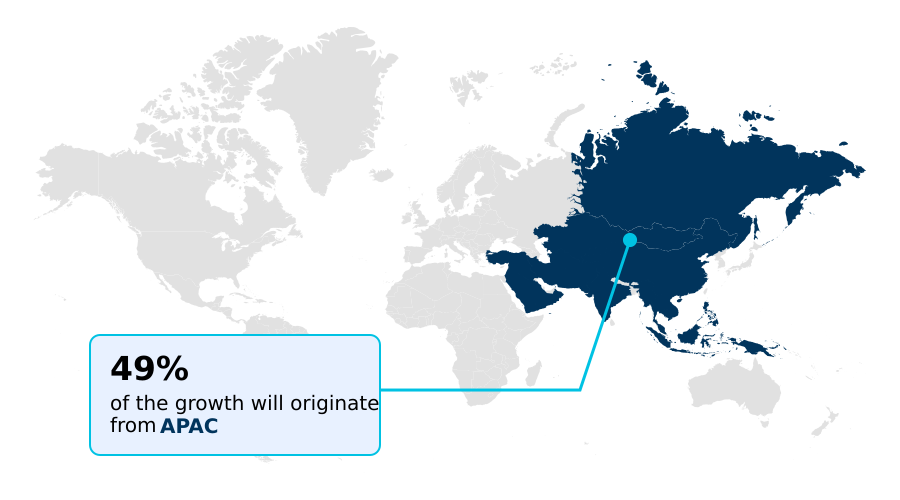
APAC is estimated to contribute 48.7% to the growth of the global market during the forecast period.Technavio’s analysts have elaborately explained the regional trends and drivers that shape the market during the forecast period.
See How Electric Vehicle (EV) Market Demand is Rising in APAC Request Free Sample
The geographic landscape of the market is characterized by varied regional momentum, with APAC leading global expansion by contributing 48.7% of incremental growth, compared to 35.5% from Europe. This disparity is driven by distinct policy frameworks and consumer adoption dynamics.
In leading regions, the focus is on a holistic e-mobility ecosystem, integrating smart charging technology and vehicle-to-home (v2h) power capabilities to enhance grid stability management.
The build-out of battery swapping station networks and support for last-mile delivery van electrification are key priorities. In-cabin infotainment systems are also becoming a major differentiator.
Securing the automotive supply chain security for critical minerals and components remains a universal priority, while low-emission zone access rules create specific demand drivers in urban centers, influencing regional product strategies.
Market Dynamics
Our researchers analyzed the data with 2025 as the base year, along with the key drivers, trends, and challenges. A holistic analysis of drivers will help companies refine their marketing strategies to gain a competitive advantage.
- Strategic decision-making in the market hinges on a complex analysis of multiple interconnected factors. The impact of battery cost on ev price remains a central concern, directly influencing the timeline for developing affordable mass-market evs. The role of government policy in ev adoption is critical, as incentives can heavily sway bev vs phev consumer choice factors.
- At the same time, the challenges of public charging infrastructure and the subsequent impact of ev charging on electricity grid stability require robust solutions, including v2g technology for grid support. Stakeholders are closely watching the solid-state battery commercialization timeline for its potential to revolutionize the industry.
- For fleet operators, the tco comparison of ev vs ice is a primary driver, while the role of evs in corporate sustainability is becoming a boardroom-level priority. For commercial applications, advancements in megawatt charging for commercial trucks are essential.
- Operationally, navigating ev manufacturing supply chain bottlenecks is paramount; agile firms that diversify raw material sourcing for ev batteries have demonstrated a 15% greater resilience to price shocks. Furthermore, software updates improving ev performance and enhanced adas integration in electric vehicles are key value propositions.
- Strategies for mitigating ev range anxiety, such as the battery swapping vs fast charging debate, continue to shape consumer experience. As the market matures, ev battery second-life applications and integrating home energy solutions with evs will become increasingly important, especially for ev adoption in emerging economies where grid constraints are more pronounced.
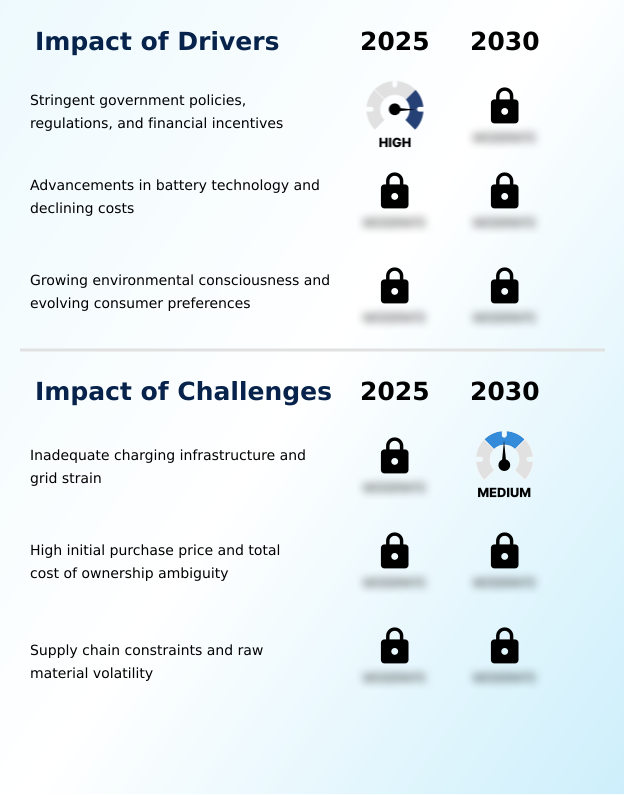
What are the key market drivers leading to the rise in the adoption of Electric Vehicle (EV) Industry?
- The market is primarily driven by stringent government policies, regulations, and financial incentives designed to accelerate the transition to electric mobility.
- Market expansion is fundamentally propelled by financial and technological drivers that make electrification more viable.
- Central to this is ongoing next-generation battery research, which has led to significant advancements in lithium iron phosphate (lfp) chemistry and nickel manganese cobalt (nmc) chemistry, directly addressing range anxiety mitigation.
- The methodical charging infrastructure deployment, encompassing both public charging network expansion and accessible home charging solutions, is critical. This infrastructure increasingly supports bidirectional charging capability, enabling new connected vehicle services. For fleet management, lower operational costs are a compelling factor.
- In the passenger segment, automotive software development is creating new revenue streams. The declining cost of powertrain electrification is also reducing ev resale value depreciation, making ownership more attractive.
- Moreover, the establishment of a formal ev battery recycling process addresses sustainability concerns.
What are the market trends shaping the Electric Vehicle (EV) Industry?
- A defining market trend is the rapid proliferation and diversification of electric vehicle models. This expansion spans across various vehicle segments, body styles, and price points.
- Key market trends are reshaping the automotive industry transformation, centered on the evolution from standalone products to integrated sustainable mobility solutions. The proliferation of both battery electric vehicle (bev) and plug-in hybrid electric vehicle (phev) models is accelerating, supported by ev adoption consumer incentives. This diversification is critical for lowering the total cost of ownership (tco).
- A pivotal development is the rise of the software-defined vehicle architecture, which allows for continuous enhancement of advanced driver-assistance systems (adas) and performance, with some updates improving efficiency by over 5%. As clean freight corridors are established, the focus on electric bus public transit intensifies.
- However, ensuring ev charging station reliability remains a priority, as network uptime directly impacts consumer confidence and adoption velocity, which recently saw a 14.5% year-over-year increase.
What challenges does the Electric Vehicle (EV) Industry face during its growth?
- A key challenge affecting industry growth is the combination of inadequate charging infrastructure and the resulting strain on electricity grids.
- Significant challenges constrain the market's growth potential, primarily related to industrial scale and economic viability. Achieving ev purchase price parity with conventional vehicles is a major hurdle, complicated by volatile supply chain raw materials and the high capital cost of gigafactory production scale. Ensuring consistent battery cell manufacturing quality and securing semiconductor chip integration are persistent operational issues.
- The industry must also adhere to the sustainable battery lifecycle directive, which governs ev battery lifecycle management and adds complexity. For commercial applications, the payload limitations of heavy-duty electric trucks and the need for more efficient light-duty electric vans are key concerns.
- Furthermore, enhancing ev powertrain efficiency, which can vary by up to 20% based on conditions, and optimizing the autonomous driving sensor suite and regenerative braking system are ongoing technical goals.
Exclusive Technavio Analysis on Customer Landscape
The electric vehicle (ev) market forecasting report includes the adoption lifecycle of the market, covering from the innovator’s stage to the laggard’s stage. It focuses on adoption rates in different regions based on penetration. Furthermore, the electric vehicle (ev) market report also includes key purchase criteria and drivers of price sensitivity to help companies evaluate and develop their market growth analysis strategies.
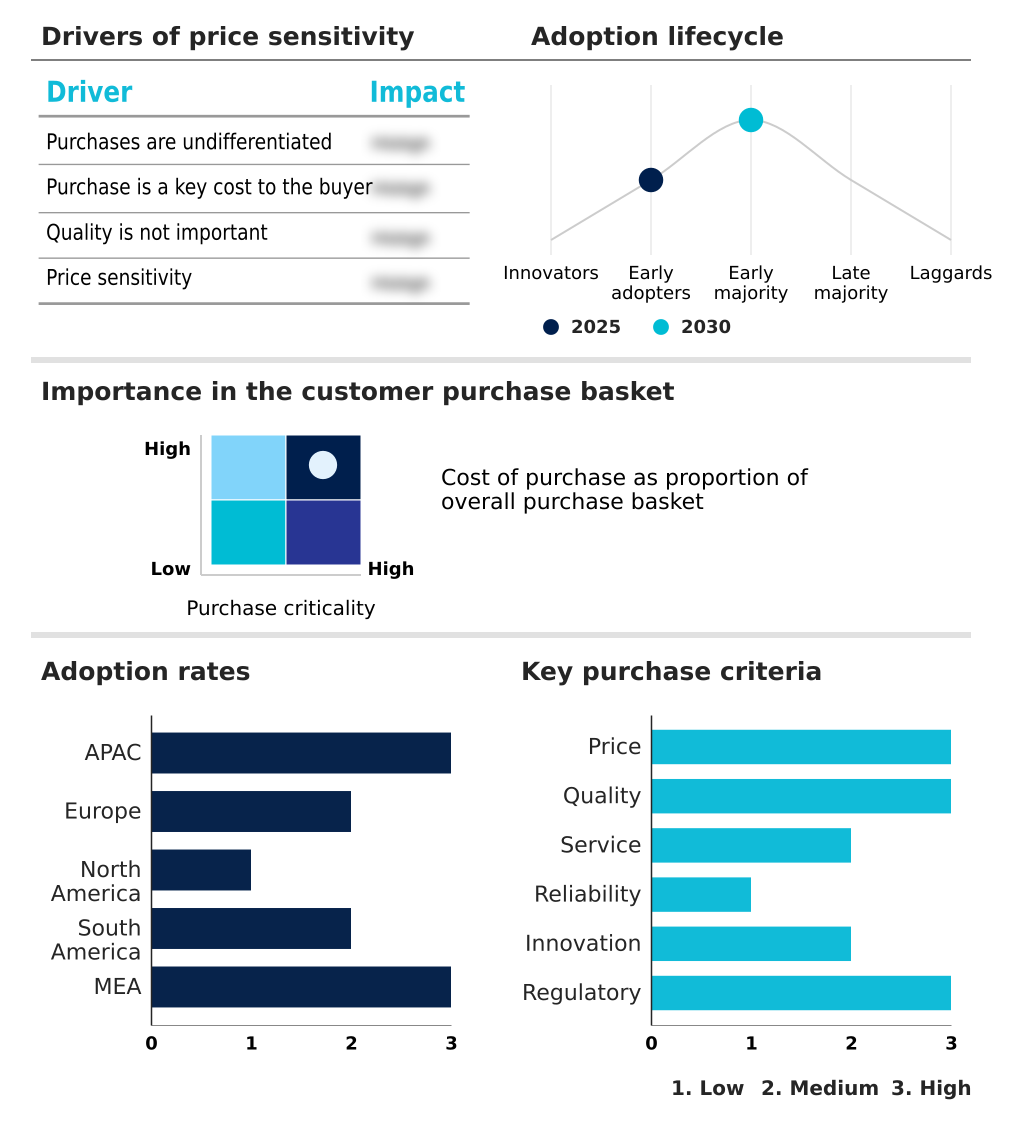
Customer Landscape of Electric Vehicle (EV) Industry
Competitive Landscape
Companies are implementing various strategies, such as strategic alliances, electric vehicle (ev) market forecast, partnerships, mergers and acquisitions, geographical expansion, and product/service launches, to enhance their presence in the industry.
Bayerische Motoren Werke AG - Key offerings include a diverse portfolio of electric vehicles, spanning multiple segments from passenger cars to commercial models, driven by advanced battery and powertrain technology.
The industry research and growth report includes detailed analyses of the competitive landscape of the market and information about key companies, including:
- Bayerische Motoren Werke AG
- BYD Co. Ltd.
- Chery Automobile Co. Ltd.
- Chongqing Changan Auto. Ltd.
- Dongfeng Motor Corporation Ltd
- Ford Motor Co.
- GAC GROUP
- Geely Auto
- General Motors Co.
- Honda Motor Co. Ltd.
- Hyundai Motor Co.
- Mahindra and Mahindra Ltd.
- Mercedes Benz Group AG
- Nissan Motor Co. Ltd.
- Renault SAS
- SAIC Motor Corp. Ltd.
- Stellantis NV
- Tesla Inc.
- Toyota Motor Corp.
- Volkswagen AG
Qualitative and quantitative analysis of companies has been conducted to help clients understand the wider business environment as well as the strengths and weaknesses of key industry players. Data is qualitatively analyzed to categorize companies as pure play, category-focused, industry-focused, and diversified; it is quantitatively analyzed to categorize companies as dominant, leading, strong, tentative, and weak.
Recent Development and News in Electric vehicle (ev) market
- In February 2025, the IONNA charging network, a joint venture of several major automakers including BMW, General Motors, and Honda, activated its first wave of high-speed charging stations across North America, marking a significant collaborative effort to build a unified charging ecosystem.
- In March 2025, Toyota, in partnership with Panasonic and a consortium of Japanese firms, launched the E-Mirai Innovations joint venture with an initial $20 billion commitment to develop and mass-produce solid-state batteries by 2028, aiming to leapfrog current lithium-ion technology.
- In January 2025, the US Environmental Protection Agency and Environment and Climate Change Canada finalized the Clean Freight Corridors mandate, requiring all new medium- and heavy-duty trucks operating on key trade routes to be zero-emission by 2030.
- In May 2025, Saudi Arabia's Public Investment Fund launched NEOM Industrial City-Mobility, a $100 billion project to create a fully integrated, carbon-neutral electric vehicle manufacturing ecosystem, including raw material processing, battery production, and vehicle assembly.
Dive into Technavio’s robust research methodology, blending expert interviews, extensive data synthesis, and validated models for unparalleled Electric Vehicle (EV) Market insights. See full methodology.
| Market Scope | |
|---|---|
| Page number | 303 |
| Base year | 2025 |
| Historic period | 2020-2024 |
| Forecast period | 2026-2030 |
| Growth momentum & CAGR | Accelerate at a CAGR of 16.7% |
| Market growth 2026-2030 | USD 521.4 billion |
| Market structure | Fragmented |
| YoY growth 2025-2026(%) | 14.5% |
| Key countries | China, Japan, India, South Korea, Australia, Indonesia, Germany, UK, France, The Netherlands, Norway, Italy, US, Canada, Mexico, Brazil, Argentina, Chile, UAE, South Africa, Saudi Arabia, Egypt and Kenya |
| Competitive landscape | Leading Companies, Market Positioning of Companies, Competitive Strategies, and Industry Risks |
Research Analyst Overview
- The market's evolution is driven by the convergence of advanced technologies and stringent regulatory frameworks. Central to this is powertrain electrification, with intense competition in battery cell manufacturing and innovations in both lithium iron phosphate (LFP) chemistry and nickel manganese cobalt (NMC) chemistry to improve battery energy density.
- The development of a comprehensive e-mobility ecosystem, supported by massive charging infrastructure deployment, is a primary focus. This includes expanding the public charging network with DC fast charging (DCFC) and a future megawatt charging standard, alongside promoting home charging solutions.
- For boardroom strategy, the zero-emission vehicle mandate directly impacts long-term capital allocation, forcing a pivot in both battery electric vehicle (BEV) and plug-in hybrid electric vehicle (PHEV) development. Firms that effectively integrate a software-defined vehicle architecture for over-the-air (OTA) software updates and advanced driver-assistance systems (ADAS) are gaining a significant competitive edge.
- Balancing the total cost of ownership (TCO) with performance features like electric motor instant torque from a regenerative braking system and a sophisticated battery thermal management system is key.
- Success requires managing the supply chain for raw materials at gigafactory production scale, ensuring semiconductor chip integration, and addressing range anxiety mitigation through technologies like a battery swapping station or vehicle-to-grid (V2G) and vehicle-to-home (V2H) power enabled by a robust onboard battery charger and bidirectional charging capability.
What are the Key Data Covered in this Electric Vehicle (EV) Market Research and Growth Report?
-
What is the expected growth of the Electric Vehicle (EV) Market between 2026 and 2030?
-
USD 521.4 billion, at a CAGR of 16.7%
-
-
What segmentation does the market report cover?
-
The report is segmented by Type (BEV, and PHEV), Charging (Normal charging, and Super charging), Vehicle Type (Passenger cars, Two wheelers, and Commercial vehicles) and Geography (APAC, Europe, North America, South America, Middle East and Africa)
-
-
Which regions are analyzed in the report?
-
APAC, Europe, North America, South America and Middle East and Africa
-
-
What are the key growth drivers and market challenges?
-
Stringent government policies, regulations, and financial incentives, Inadequate charging infrastructure and grid strain
-
-
Who are the major players in the Electric Vehicle (EV) Market?
-
Bayerische Motoren Werke AG, BYD Co. Ltd., Chery Automobile Co. Ltd., Chongqing Changan Auto. Ltd., Dongfeng Motor Corporation Ltd, Ford Motor Co., GAC GROUP, Geely Auto, General Motors Co., Honda Motor Co. Ltd., Hyundai Motor Co., Mahindra and Mahindra Ltd., Mercedes Benz Group AG, Nissan Motor Co. Ltd., Renault SAS, SAIC Motor Corp. Ltd., Stellantis NV, Tesla Inc., Toyota Motor Corp. and Volkswagen AG
-
Market Research Insights
- Market dynamics are defined by rapid technological evolution and shifting consumer priorities, with year-over-year expansion recently recorded at 14.5%. A key factor is the automotive industry transformation toward sustainable mobility solutions, which now influences over 60% of new platform development decisions. Strategic imperatives include enhancing EV range and performance while ensuring emissions standards compliance.
- For instance, regions with proactive transport decarbonization policies see adoption rates nearly double those without such frameworks. The focus on EV maintenance cost reduction and improving the total cost of ownership (TCO) remains critical.
- The development of a reliable public charging network is a key enabler, directly impacting consumer confidence and the practicality of ownership for a wider demographic, shaping regional competitiveness and overall market velocity.
We can help! Our analysts can customize this electric vehicle (ev) market research report to meet your requirements.
 RIA -
RIA - 
