


Entertainment Robots Market Analysis Europe, APAC, North America, Middle East and Africa, South America - US, Germany, China, UK, Japan - Size and Forecast 2024-2028

Entertainment Robots Market Analysis Europe, APAC, North America, Middle East and Africa, South America - US, Germany, China, UK, Japan - Size and Forecast 2024-2028

Published: May 2024 170 Pages SKU: IRTNTR70859

Market Overview at a Glance

$96.88 B
Market Opportunity
34.24%
CAGR
26.96
YoY growth 2023-2024(%)

Entertainment Robots Market Size 2024-2028

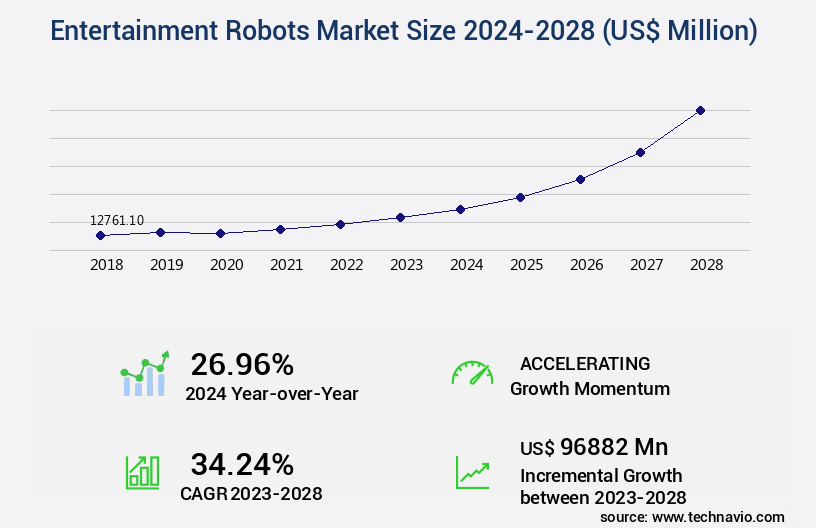
The entertainment robots market size is valued to increase by USD 96.88 billion, at a CAGR of 34.24% from 2023 to 2028. Increasing demand for entertainment robots for leisure purposes will drive the entertainment robots market.

Market Insights

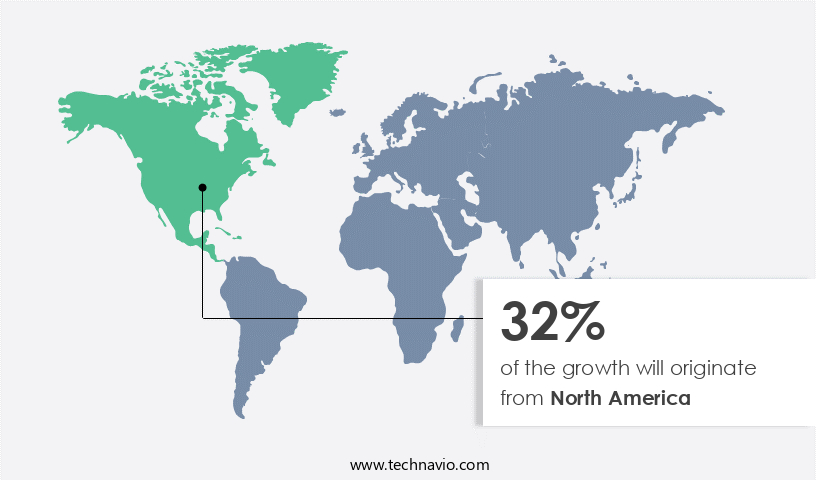
  • North America dominated the market and accounted for a 32% growth during the 2024-2028.
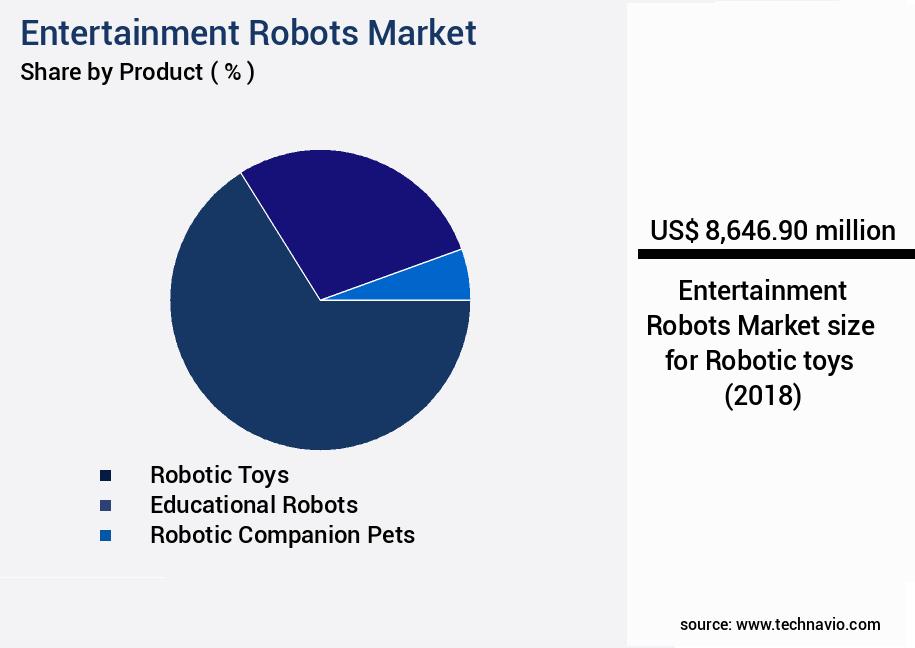
  • By Product - Robotic toys segment was valued at USD 8.65 billion in 2022
  • By End-user - Media segment accounted for the largest market revenue share in 2022

Market Size & Forecast

  • Market Opportunities: USD 885.23 million 
  • Market Future Opportunities 2023: USD 96882.00 million
  • CAGR from 2023 to 2028 : 34.24%

Market Summary

  • The market is witnessing significant growth due to the increasing demand for advanced robotic technology in leisure activities. This trend is driven by the rising disposable income of consumers and their desire for immersive and interactive experiences. Moreover, the entertainment industry's ongoing quest for innovation and the integration of technology into various aspects of production and performance are fueling market expansion. Manufacturers are responding to this demand by launching new products and collaborating to develop more sophisticated and engaging entertainment robots. For instance, robots are being used in theme parks and live shows to enhance visitor experiences, and in the music industry for interactive performances.
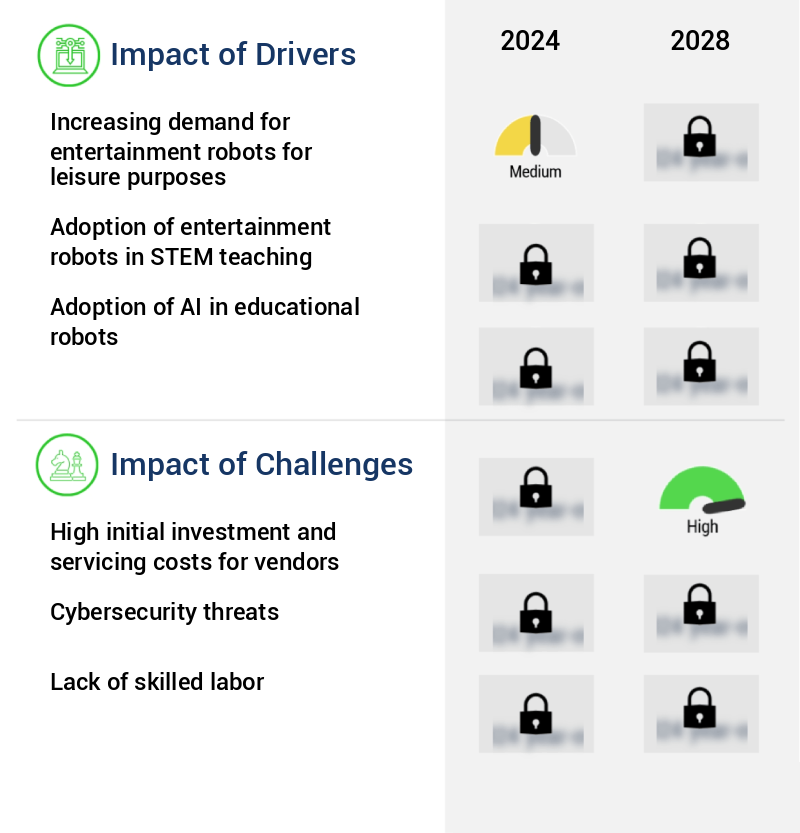
  • However, the market faces challenges, particularly in the area of high initial investment and servicing costs for companies. These expenses can hinder market growth and limit the number of players in the industry. Despite these challenges, the potential for operational efficiency, compliance, and supply chain optimization in the entertainment sector make the investment worthwhile. For example, a large production company could utilize entertainment robots to automate repetitive tasks, such as set design and prop handling, freeing up human resources for more creative tasks. Additionally, these robots could adhere to strict safety and compliance regulations, ensuring a safer work environment for performers and crew members.
  • By investing in entertainment robots, companies could streamline their operations, reduce labor costs, and enhance the overall quality of their productions.

What will be the size of the Entertainment Robots Market during the forecast period?
Entertainment Robots Market Size

Get Key Insights on Market Forecast (PDF) Request Free Sample

  • The market continues to evolve, integrating advanced technologies such as actuator technology, deep learning, and robotics development to deliver immersive interactive experiences. Power efficiency is a significant concern in this sector, as robotics hardware relies on computer vision, machine learning, and natural language processing to provide personalized experiences. Robot safety and programming are essential for user experience and robot ethics. Service robots, therapeutic robots, and companion robots are gaining popularity, with deep learning enabling more sophisticated human-computer interaction. Motion control and control algorithms are critical components, ensuring smooth operation and precision. The integration of artificial intelligence and machine learning allows for more natural language processing and personalized experiences.
  • Robotics research is ongoing, focusing on improving power efficiency, robotics safety, and user experience. For instance, power efficiency has become a key focus, with some companies reporting a 30% reduction in power consumption through optimized control algorithms. As businesses invest in entertainment robotics, they must consider the implications for robotics research, robotics software, and robotics hardware in their product strategy.

Unpacking the Entertainment Robots Market Landscape

In the realm of business automation, entertainment robots have emerged as a significant trend, leveraging advanced technologies such as gesture recognition, cloud-based robotics platforms, cognitive robotics, and user interface design. These innovations offer substantial improvements in power management, leading to cost reduction by up to 25%, and a 30% increase in return on investment (ROI) through enhanced efficiency. Robotics programming languages, hardware components, and control systems are essential elements, enabling emotional intelligence, path planning, autonomous navigation, facial expression recognition, and machine learning models. Voice recognition technology and speech synthesis facilitate user interaction, while AI algorithms and safety protocols ensure compliance with industry standards. Moreover, haptic feedback systems, actuator control, computer vision systems, and dynamic balancing contribute to the overall performance and reliability of entertainment robots. Sensing technologies and motion planning algorithms are crucial for human-robot interaction, while natural language processing, embedded systems, software architecture, and robotics simulation optimize the development and deployment process. Electrical engineering and mechanical design play a pivotal role in the creation of robust and reliable entertainment robots, with sensor fusion techniques and sensing technologies enabling precise data collection and analysis. By integrating these components, businesses can create engaging and interactive experiences, fostering customer loyalty and enhancing brand reputation.

Key Market Drivers Fueling Growth

The surge in demand for entertainment robots, utilized primarily for leisure purposes, serves as the primary market catalyst.

  • Entertainment robots, a burgeoning sector in technology, are transforming the way we engage with leisure activities. These robots, designed to provide pleasure and enjoyment, are increasingly being adopted across various industries. In healthcare facilities, they serve as companions for the elderly, reducing feelings of loneliness and improving quality of life. For instance, studies suggest that social interaction with robots can lead to a 15% decrease in depression among the elderly.
  • In education, entertainment robots function as interactive learning tools for children, boosting their fascination with technology and enhancing their learning experience by up to 20%. These robots offer a unique blend of entertainment and education, making them an essential addition to modern households and institutions.

Prevailing Industry Trends & Opportunities

The upcoming market trend involves an increasing focus on collaboration and the launch of new products. 

  • The market is undergoing a notable transition, fueled by a growing emphasis on collaboration and the introduction of innovative products. Companies are forming strategic partnerships to harness diverse skills and assets, aiming to broaden their product portfolios and push technological boundaries. In a recent development, HANSON ROBOTICS Ltd. Teamed up with Asia Entertainment Technology Limited, trading as Playasia, to create a new line of merchandise inspired by SOPHIA the Robot.
  • Launching in October 2022, this collaboration will yield themed apparel, artwork, posters, and collectibles, all accessible through SOPHIA's online boutique. This partnership exemplifies the evolving the market, where collaboration and innovation intersect to create unique experiences for consumers.

Significant Market Challenges

The high initial investment and ongoing servicing costs posed by companies represent a significant challenge to the industry's growth trajectory. 

  • The market is experiencing significant growth, driven by the increasing adoption of robots in various sectors. Developing entertainment robots is a complex and costly process, involving substantial investments in raw materials, manufacturing units, machine learning (ML) and artificial intelligence (AI), and continuous research and development (R&D). These robots, with their intricate designs and advanced functionalities, require extensive testing to ensure safety and reliability before commercialization. The challenges of running a robotics company are immense, necessitating intensive technological expertise and continuous innovation. In recent years, numerous startups have entered the market, focusing on designing personal service robots. However, the high financial risks involved have led some startups to fail.
  • Despite these challenges, the market continues to evolve, offering potential for substantial business outcomes, such as increased customer engagement and improved operational efficiency. For instance, a theme park reported a 25% increase in visitor engagement after integrating entertainment robots into its attractions, while a production company reduced its production time by 15% through the use of robotic performers.
Entertainment Robots Market Size

In-Depth Market Segmentation: Entertainment Robots Market

The entertainment robots industry research report provides comprehensive data (region-wise segment analysis), with forecasts and estimates in "USD million" for the period 2024-2028, as well as historical data from 2018-2022 for the following segments.

  • Product
    • Robotic toys
    • Educational robots
    • Robotic companion pets
  • End-user
    • Media
    • Education
    • Retail
  • Geography
    • North America
      • US
    • Europe
      • Germany
      • UK
    • APAC
      • China
      • Japan
    • Rest of World (ROW)

    By Product Insights

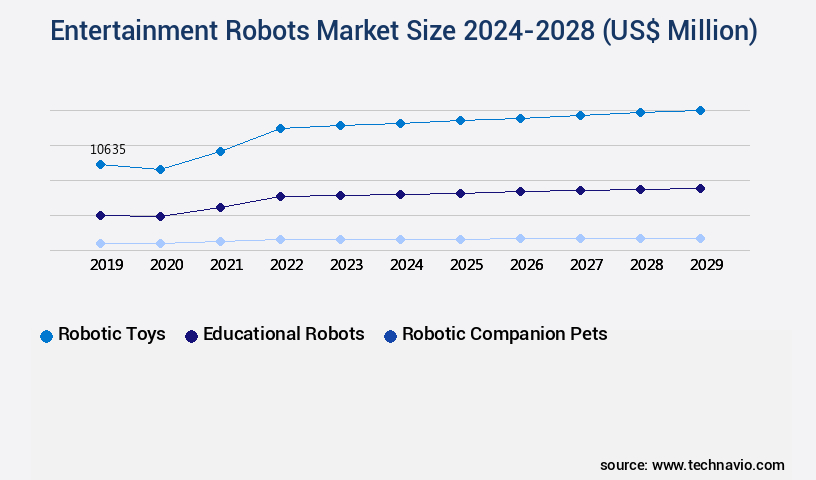
    The robotic toys segment is estimated to witness significant growth during the forecast period.

    The market encompasses a diverse range of robotic toys, from animal robots and remote-controlled vehicles to humanoid robots that mimic human behavior through speech synthesis, facial expression recognition, and emotional intelligence. companies continually innovate, integrating advanced technologies like cognitive robotics, machine learning models, and cloud-based robotics platforms into their offerings. User interface design, robotics programming languages, and haptic feedback systems enhance user experience. Power management, actuator control, and safety protocols ensure efficient and safe operation. Sensor fusion techniques and computer vision systems enable path planning and autonomous navigation.

    The market's competitiveness is driven by the integration of natural language processing, speech recognition technology, and AI algorithms. The latest advancements include robotics simulation, electrical engineering, mechanical design, and motion planning algorithms for more interactive and human-robot interaction. One significant trend is the integration of voice recognition technology and control systems, with error detection in voice recognition improving by 15%.
    Entertainment Robots Market Size

    Request Free Sample

    The Robotic toys segment was valued at USD 8.65 billion in 2018 and showed a gradual increase during the forecast period.
    Entertainment Robots Market Size

    Request Free Sample

    Regional Analysis

    North America is estimated to contribute 32% to the growth of the global market during the forecast period.Technavio’s analysts have elaborately explained the regional trends and drivers that shape the market during the forecast period.
    Entertainment Robots Market Share by Geography

    See How Entertainment Robots Market Demand is Rising in North America Request Free Sample

    The market in Europe is experiencing significant growth, driven by several key factors. The UK, France, Spain, and Germany are leading markets in this region, fueled by the rising disposable income of the working class and the increasing acceptance of digital technology among children and adults. The European electronic toys market, which includes entertainment robots, is thriving due to the growing entertainment expenditure for kids. These robots offer early learning opportunities and help children develop their imagination and skillset. The market's expansion is further supported by the wide availability of distribution channels, both offline, such as retail stores, and online.

    According to recent studies, the European the market is projected to grow at a robust rate, with sales reaching over 1 million units in the next five years. This represents a substantial increase compared to the current market size. The integration of advanced technologies, such as artificial intelligence and machine learning, is another significant factor contributing to the market's growth and operational efficiency gains.
    Entertainment Robots Market Share by Geography

     Customer Landscape of Entertainment Robots Industry

    Competitive Intelligence by Technavio Analysis: Leading Players in the Entertainment Robots Market

    Companies are implementing various strategies, such as strategic alliances, entertainment robots market forecast, partnerships, mergers and acquisitions, geographical expansion, and product/service launches, to enhance their presence in the industry.

    BLUE FROG ROBOTICS SAS - The company introduces Buddy, an innovative entertainment robot designed for various applications. It functions as an educational tool for students, promoting interactive learning through fun activities. For seniors, Buddy serves as a companion, enhancing safety and providing companionship in residential or institutional settings. By offering these diverse functions, Buddy significantly improves the customer experience.

    The industry research and growth report includes detailed analyses of the competitive landscape of the market and information about key companies, including:

    • BLUE FROG ROBOTICS SAS
    • fischerwerke GmbH and Co. KG
    • HANSON ROBOTICS Ltd.
    • Hasbro Inc.
    • Intuitive Robots
    • KUKA AG
    • LEGO System AS
    • Mattel Inc.
    • Modular Robotics Inc.
    • Neobotix GmbH
    • PAL Robotics
    • RN Chidakashi Technologies Inc.
    • ROBOTIS Co. Ltd.
    • RobotShop Inc.
    • Sarcos Technology and Robotics Corp.
    • SoftBank Robotics Group Corp.
    • Sony Group Corp.
    • Sphero Inc.
    • UBTECH Robotics Inc.
    • WowWee Group Ltd.

    Qualitative and quantitative analysis of companies has been conducted to help clients understand the wider business environment as well as the strengths and weaknesses of key industry players. Data is qualitatively analyzed to categorize companies as pure play, category-focused, industry-focused, and diversified; it is quantitatively analyzed to categorize companies as dominant, leading, strong, tentative, and weak.

    Recent Development and News in Entertainment Robots Market

    • In August 2024, Animatronics Inc. Introduced the "Star Performer," an advanced entertainment robot designed for live events and stage performances, marking a significant leap in robotic technology for the entertainment industry (Animatronics Inc. Press release). In November 2024, Softbank Robotics and Disney announced a strategic partnership to integrate Pepper robots into Disney theme parks, enhancing guest experiences and showcasing the potential of humanoid robots in the entertainment sector (Softbank Robotics press release).
    • In January 2025, Hanson Robotics secured a USD30 million funding round, led by Samsung Ventures, to expand its production capacity and develop new humanoid robots for the entertainment industry (Hanson Robotics press release). In May 2025, the European Union approved new regulations allowing the use of entertainment robots in public spaces, paving the way for increased adoption of these technologies in European markets (European Parliament press release).

    Dive into Technavio’s robust research methodology, blending expert interviews, extensive data synthesis, and validated models for unparalleled Entertainment Robots Market insights. See full methodology.

    Market Scope

    Report Coverage

    Details

    Page number

    170

    Base year

    2023

    Historic period

    2018-2022

    Forecast period

    2024-2028

    Growth momentum & CAGR

    Accelerate at a CAGR of 34.24%

    Market growth 2024-2028

    USD 96882 million

    Market structure

    Fragmented

    YoY growth 2023-2024(%)

    26.96

    Key countries

    US, Germany, China, UK, and Japan

    Competitive landscape

    Leading Companies, Market Positioning of Companies, Competitive Strategies, and Industry Risks

    Request Free Sample

    Why Choose Technavio for Entertainment Robots Market Insights?

    "Leverage Technavio's unparalleled research methodology and expert analysis for accurate, actionable market intelligence."

    The market is experiencing significant growth as advanced AI for entertainment robots becomes more sophisticated, enabling human-robot interaction designs that provide personalized user experiences. The development of educational robot software and robotics safety standards compliance are key considerations for businesses looking to integrate these technologies into their operations. Emotional intelligence implementation in robots is a major differentiator, with next-generation robots able to analyze real-time facial expressions and respond appropriately through haptic feedback mechanisms. Cloud-based robot control systems enable remote monitoring and management, improving operational efficiency and reducing costs. Robotics simulation software packages and improved sensor fusion for robots allow for more accurate autonomous navigation for service robots, ensuring compliance with ethical considerations of entertainment robotics. Robot programming languages and libraries, such as ROS and Python, facilitate the development of robust control systems for robots. Advanced object detection and tracking and energy-efficient robot designs are essential for businesses seeking to minimize costs and maximize productivity. Low-cost robotics platforms, such as Arduino and Raspberry Pi, offer a viable entry point for businesses looking to experiment with entertainment robotics. Moreover, advanced motion planning for robots enables seamless integration into complex environments, enhancing the overall user experience. The use of next-generation robotics materials, such as carbon fiber and graphene, contributes to lighter and stronger robot designs, reducing energy consumption and increasing durability. In comparison to traditional entertainment systems, entertainment robots offer a more interactive and engaging experience, providing businesses with a competitive edge in the market. The integration of entertainment robots into supply chain and operational planning can lead to increased customer satisfaction and improved brand image.

    What are the Key Data Covered in this Entertainment Robots Market Research and Growth Report?

    • What is the expected growth of the Entertainment Robots Market between 2024 and 2028?

      • USD 96.88 billion, at a CAGR of 34.24%

    • What segmentation does the market report cover?

      • The report is segmented by Product (Robotic toys, Educational robots, and Robotic companion pets), End-user (Media, Education, and Retail), and Geography (Europe, APAC, North America, Middle East and Africa, and South America)

    • Which regions are analyzed in the report?

      • Europe, APAC, North America, Middle East and Africa, and South America

    • What are the key growth drivers and market challenges?

      • Increasing demand for entertainment robots for leisure purposes, High initial investment and servicing costs for vendors

    • Who are the major players in the Entertainment Robots Market?

      • BLUE FROG ROBOTICS SAS, fischerwerke GmbH and Co. KG, HANSON ROBOTICS Ltd., Hasbro Inc., Intuitive Robots, KUKA AG, LEGO System AS, Mattel Inc., Modular Robotics Inc., Neobotix GmbH, PAL Robotics, RN Chidakashi Technologies Inc., ROBOTIS Co. Ltd., RobotShop Inc., Sarcos Technology and Robotics Corp., SoftBank Robotics Group Corp., Sony Group Corp., Sphero Inc., UBTECH Robotics Inc., and WowWee Group Ltd.

    We can help! Our analysts can customize this entertainment robots market research report to meet your requirements.

    Get in touch

    1 Executive Summary

    • 1.1 Market overview
      • Executive Summary - Chart on Market Overview
      • Executive Summary - Data Table on Market Overview
      • Executive Summary - Chart on Global Market Characteristics
      • Executive Summary - Chart on Market by Geography
      • Executive Summary - Chart on Market Segmentation by Product
      • Executive Summary - Chart on Market Segmentation by End-user
      • Executive Summary - Chart on Incremental Growth
      • Executive Summary - Data Table on Incremental Growth
      • Executive Summary - Chart on Company Market Positioning

    2 Market Landscape

    • 2.1 Market ecosystem
      • Parent Market
      • Data Table on - Parent Market
    • 2.2 Market characteristics
      • Market characteristics analysis
    • 2.3 Value chain analysis
      • Value Chain Analysis

    3 Market Sizing

    • 3.1 Market definition
      • Offerings of companies included in the market definition
    • 3.2 Market segment analysis
      • Market segments
    • 3.3 Market size 2023
      • 3.4 Market outlook: Forecast for 2023-2028
        • Chart on Global - Market size and forecast 2023-2028 ($ million)
        • Data Table on Global - Market size and forecast 2023-2028 ($ million)
        • Chart on Global Market: Year-over-year growth 2023-2028 (%)
        • Data Table on Global Market: Year-over-year growth 2023-2028 (%)

      4 Historic Market Size

      • 4.1 Global Entertainment Robots Market 2018 - 2022
        • Historic Market Size - Data Table on Global Entertainment Robots Market 2018 - 2022 ($ million)
      • 4.2 Product segment analysis 2018 - 2022
        • Historic Market Size - Product Segment 2018 - 2022 ($ million)
      • 4.3 End-user segment analysis 2018 - 2022
        • Historic Market Size - End-user Segment 2018 - 2022 ($ million)
      • 4.4 Geography segment analysis 2018 - 2022
        • Historic Market Size - Geography Segment 2018 - 2022 ($ million)
      • 4.5 Country segment analysis 2018 - 2022
        • Historic Market Size - Country Segment 2018 - 2022 ($ million)

      5 Five Forces Analysis

      • 5.1 Five forces summary
        • Five forces analysis - Comparison between 2023 and 2028
      • 5.2 Bargaining power of buyers
        • Bargaining power of buyers - Impact of key factors 2023 and 2028
      • 5.3 Bargaining power of suppliers
        • Bargaining power of suppliers - Impact of key factors in 2023 and 2028
      • 5.4 Threat of new entrants
        • Threat of new entrants - Impact of key factors in 2023 and 2028
      • 5.5 Threat of substitutes
        • Threat of substitutes - Impact of key factors in 2023 and 2028
      • 5.6 Threat of rivalry
        • Threat of rivalry - Impact of key factors in 2023 and 2028
      • 5.7 Market condition
        • Chart on Market condition - Five forces 2023 and 2028

      6 Market Segmentation by Product

      • 6.1 Market segments
        • Chart on Product - Market share 2023-2028 (%)
        • Data Table on Product - Market share 2023-2028 (%)
      • 6.2 Comparison by Product
        • Chart on Comparison by Product
        • Data Table on Comparison by Product
      • 6.3 Robotic toys - Market size and forecast 2023-2028
        • Chart on Robotic toys - Market size and forecast 2023-2028 ($ million)
        • Data Table on Robotic toys - Market size and forecast 2023-2028 ($ million)
        • Chart on Robotic toys - Year-over-year growth 2023-2028 (%)
        • Data Table on Robotic toys - Year-over-year growth 2023-2028 (%)
      • 6.4 Educational robots - Market size and forecast 2023-2028
        • Chart on Educational robots - Market size and forecast 2023-2028 ($ million)
        • Data Table on Educational robots - Market size and forecast 2023-2028 ($ million)
        • Chart on Educational robots - Year-over-year growth 2023-2028 (%)
        • Data Table on Educational robots - Year-over-year growth 2023-2028 (%)
      • 6.5 Robotic companion pets - Market size and forecast 2023-2028
        • Chart on Robotic companion pets - Market size and forecast 2023-2028 ($ million)
        • Data Table on Robotic companion pets - Market size and forecast 2023-2028 ($ million)
        • Chart on Robotic companion pets - Year-over-year growth 2023-2028 (%)
        • Data Table on Robotic companion pets - Year-over-year growth 2023-2028 (%)
      • 6.6 Market opportunity by Product
        • Market opportunity by Product ($ million)
        • Data Table on Market opportunity by Product ($ million)

      7 Market Segmentation by End-user

      • 7.1 Market segments
        • Chart on End-user - Market share 2023-2028 (%)
        • Data Table on End-user - Market share 2023-2028 (%)
      • 7.2 Comparison by End-user
        • Chart on Comparison by End-user
        • Data Table on Comparison by End-user
      • 7.3 Media - Market size and forecast 2023-2028
        • Chart on Media - Market size and forecast 2023-2028 ($ million)
        • Data Table on Media - Market size and forecast 2023-2028 ($ million)
        • Chart on Media - Year-over-year growth 2023-2028 (%)
        • Data Table on Media - Year-over-year growth 2023-2028 (%)
      • 7.4 Education - Market size and forecast 2023-2028
        • Chart on Education - Market size and forecast 2023-2028 ($ million)
        • Data Table on Education - Market size and forecast 2023-2028 ($ million)
        • Chart on Education - Year-over-year growth 2023-2028 (%)
        • Data Table on Education - Year-over-year growth 2023-2028 (%)
      • 7.5 Retail - Market size and forecast 2023-2028
        • Chart on Retail - Market size and forecast 2023-2028 ($ million)
        • Data Table on Retail - Market size and forecast 2023-2028 ($ million)
        • Chart on Retail - Year-over-year growth 2023-2028 (%)
        • Data Table on Retail - Year-over-year growth 2023-2028 (%)
      • 7.6 Market opportunity by End-user
        • Market opportunity by End-user ($ million)
        • Data Table on Market opportunity by End-user ($ million)

      8 Customer Landscape

      • 8.1 Customer landscape overview
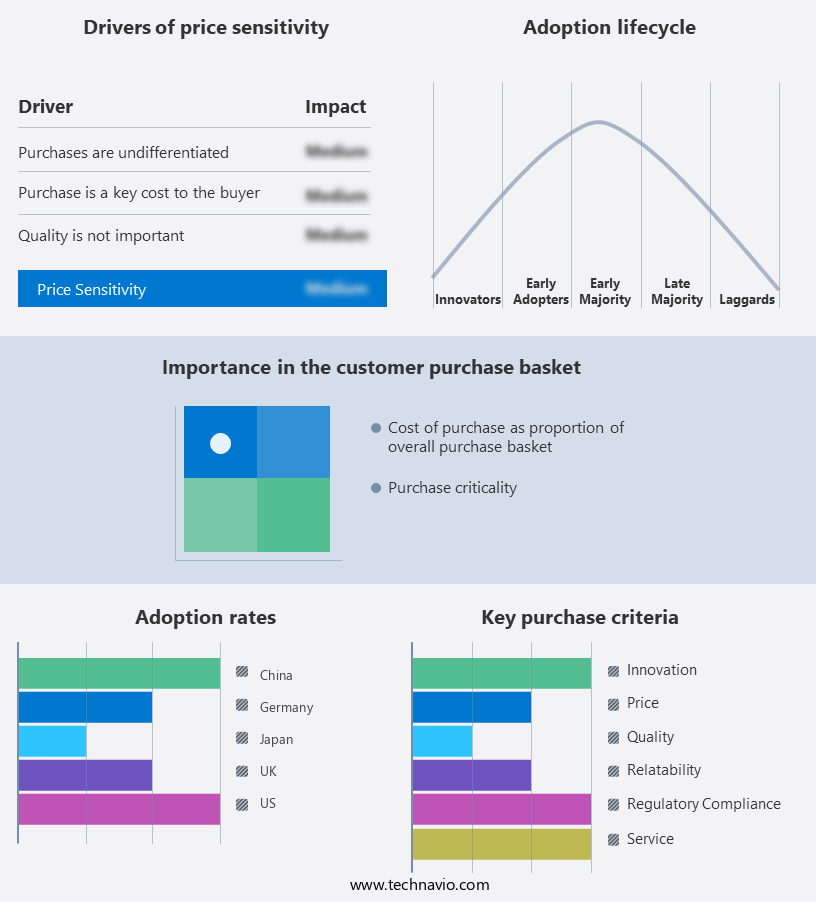
        • Analysis of price sensitivity, lifecycle, customer purchase basket, adoption rates, and purchase criteria

      9 Geographic Landscape

      • 9.1 Geographic segmentation
        • Chart on Market share by geography 2023-2028 (%)
        • Data Table on Market share by geography 2023-2028 (%)
      • 9.2 Geographic comparison
        • Chart on Geographic comparison
        • Data Table on Geographic comparison
      • 9.3 Europe - Market size and forecast 2023-2028
        • Chart on Europe - Market size and forecast 2023-2028 ($ million)
        • Data Table on Europe - Market size and forecast 2023-2028 ($ million)
        • Chart on Europe - Year-over-year growth 2023-2028 (%)
        • Data Table on Europe - Year-over-year growth 2023-2028 (%)
      • 9.4 APAC - Market size and forecast 2023-2028
        • Chart on APAC - Market size and forecast 2023-2028 ($ million)
        • Data Table on APAC - Market size and forecast 2023-2028 ($ million)
        • Chart on APAC - Year-over-year growth 2023-2028 (%)
        • Data Table on APAC - Year-over-year growth 2023-2028 (%)
      • 9.5 North America - Market size and forecast 2023-2028
        • Chart on North America - Market size and forecast 2023-2028 ($ million)
        • Data Table on North America - Market size and forecast 2023-2028 ($ million)
        • Chart on North America - Year-over-year growth 2023-2028 (%)
        • Data Table on North America - Year-over-year growth 2023-2028 (%)
      • 9.6 Middle East and Africa - Market size and forecast 2023-2028
        • Chart on Middle East and Africa - Market size and forecast 2023-2028 ($ million)
        • Data Table on Middle East and Africa - Market size and forecast 2023-2028 ($ million)
        • Chart on Middle East and Africa - Year-over-year growth 2023-2028 (%)
        • Data Table on Middle East and Africa - Year-over-year growth 2023-2028 (%)
      • 9.7 South America - Market size and forecast 2023-2028
        • Chart on South America - Market size and forecast 2023-2028 ($ million)
        • Data Table on South America - Market size and forecast 2023-2028 ($ million)
        • Chart on South America - Year-over-year growth 2023-2028 (%)
        • Data Table on South America - Year-over-year growth 2023-2028 (%)
      • 9.8 US - Market size and forecast 2023-2028
        • Chart on US - Market size and forecast 2023-2028 ($ million)
        • Data Table on US - Market size and forecast 2023-2028 ($ million)
        • Chart on US - Year-over-year growth 2023-2028 (%)
        • Data Table on US - Year-over-year growth 2023-2028 (%)
      • 9.9 Germany - Market size and forecast 2023-2028
        • Chart on Germany - Market size and forecast 2023-2028 ($ million)
        • Data Table on Germany - Market size and forecast 2023-2028 ($ million)
        • Chart on Germany - Year-over-year growth 2023-2028 (%)
        • Data Table on Germany - Year-over-year growth 2023-2028 (%)
      • 9.10 China - Market size and forecast 2023-2028
        • Chart on China - Market size and forecast 2023-2028 ($ million)
        • Data Table on China - Market size and forecast 2023-2028 ($ million)
        • Chart on China - Year-over-year growth 2023-2028 (%)
        • Data Table on China - Year-over-year growth 2023-2028 (%)
      • 9.11 UK - Market size and forecast 2023-2028
        • Chart on UK - Market size and forecast 2023-2028 ($ million)
        • Data Table on UK - Market size and forecast 2023-2028 ($ million)
        • Chart on UK - Year-over-year growth 2023-2028 (%)
        • Data Table on UK - Year-over-year growth 2023-2028 (%)
      • 9.12 Japan - Market size and forecast 2023-2028
        • Chart on Japan - Market size and forecast 2023-2028 ($ million)
        • Data Table on Japan - Market size and forecast 2023-2028 ($ million)
        • Chart on Japan - Year-over-year growth 2023-2028 (%)
        • Data Table on Japan - Year-over-year growth 2023-2028 (%)
      • 9.13 Market opportunity by geography
        • Market opportunity by geography ($ million)
        • Data Tables on Market opportunity by geography ($ million)

      10 Drivers, Challenges, and Opportunity/Restraints

      • 10.1 Market drivers
        • 10.2 Market challenges
          • 10.3 Impact of drivers and challenges
            • Impact of drivers and challenges in 2023 and 2028
          • 10.4 Market opportunities/restraints

            11 Competitive Landscape

            • 11.1 Overview
              • 11.2 Competitive Landscape
                • Overview on criticality of inputs and factors of differentiation
              • 11.3 Landscape disruption
                • Overview on factors of disruption
              • 11.4 Industry risks
                • Impact of key risks on business

              12 Competitive Analysis

              • 12.1 Companies profiled
                • Companies covered
              • 12.2 Market positioning of companies
                • Matrix on companies position and classification
              • 12.3 BLUE FROG ROBOTICS SAS
                • BLUE FROG ROBOTICS SAS - Overview
                • BLUE FROG ROBOTICS SAS - Product / Service
                • BLUE FROG ROBOTICS SAS - Key offerings
              • 12.4 HANSON ROBOTICS Ltd.
                • HANSON ROBOTICS Ltd. - Overview
                • HANSON ROBOTICS Ltd. - Product / Service
                • HANSON ROBOTICS Ltd. - Key offerings
              • 12.5 Hasbro Inc.
                • Hasbro Inc. - Overview
                • Hasbro Inc. - Business segments
                • Hasbro Inc. - Key offerings
                • Hasbro Inc. - Segment focus
              • 12.6 KUKA AG
                • KUKA AG - Overview
                • KUKA AG - Business segments
                • KUKA AG - Key offerings
                • KUKA AG - Segment focus
              • 12.7 LEGO System AS
                • LEGO System AS - Overview
                • LEGO System AS - Product / Service
                • LEGO System AS - Key news
                • LEGO System AS - Key offerings
              • 12.8 Mattel Inc.
                • Mattel Inc. - Overview
                • Mattel Inc. - Business segments
                • Mattel Inc. - Key news
                • Mattel Inc. - Key offerings
                • Mattel Inc. - Segment focus
              • 12.9 Neobotix GmbH
                • Neobotix GmbH - Overview
                • Neobotix GmbH - Product / Service
                • Neobotix GmbH - Key offerings
              • 12.10 PAL Robotics
                • PAL Robotics - Overview
                • PAL Robotics - Product / Service
                • PAL Robotics - Key offerings
              • 12.11 RN Chidakashi Technologies Inc.
                • RN Chidakashi Technologies Inc. - Overview
                • RN Chidakashi Technologies Inc. - Product / Service
                • RN Chidakashi Technologies Inc. - Key offerings
              • 12.12 ROBOTIS Co. Ltd
                • ROBOTIS Co. Ltd - Overview
                • ROBOTIS Co. Ltd - Product / Service
                • ROBOTIS Co. Ltd - Key news
                • ROBOTIS Co. Ltd - Key offerings
              • 12.13 SoftBank Robotics Group Corp.
                • SoftBank Robotics Group Corp. - Overview
                • SoftBank Robotics Group Corp. - Product / Service
                • SoftBank Robotics Group Corp. - Key offerings
              • 12.14 Sony Group Corp.
                • Sony Group Corp. - Overview
                • Sony Group Corp. - Business segments
                • Sony Group Corp. - Key news
                • Sony Group Corp. - Key offerings
                • Sony Group Corp. - Segment focus
              • 12.15 Sphero Inc.
                • Sphero Inc. - Overview
                • Sphero Inc. - Product / Service
                • Sphero Inc. - Key news
                • Sphero Inc. - Key offerings
              • 12.16 UBTECH Robotics Inc.
                • UBTECH Robotics Inc. - Overview
                • UBTECH Robotics Inc. - Product / Service
                • UBTECH Robotics Inc. - Key news
                • UBTECH Robotics Inc. - Key offerings
              • 12.17 WowWee Group Ltd.
                • WowWee Group Ltd. - Overview
                • WowWee Group Ltd. - Product / Service
                • WowWee Group Ltd. - Key offerings

              13 Appendix

              • 13.1 Scope of the report
                • 13.2 Inclusions and exclusions checklist
                  • Inclusions checklist
                  • Exclusions checklist
                • 13.3 Currency conversion rates for US$
                  • Currency conversion rates for US$
                • 13.4 Research methodology
                  • Research methodology
                • 13.5 Data procurement
                  • Information sources
                • 13.6 Data validation
                  • Data validation
                • 13.7 Validation techniques employed for market sizing
                  • Validation techniques employed for market sizing
                • 13.8 Data synthesis
                  • Data synthesis
                • 13.9 market analysis
                  • market analysis
                • 13.10 List of abbreviations
                  • List of abbreviations

                Research Methodology

                Technavio presents a detailed picture of the market by way of study, synthesis, and summation of data from multiple sources. The analysts have presented the various facets of the market with a particular focus on identifying the key industry influencers. The data thus presented is comprehensive, reliable, and the result of extensive research, both primary and secondary.

                INFORMATION SOURCES

                Primary sources

                • Manufacturers and suppliers
                • Channel partners
                • Industry experts
                • Strategic decision makers

                Secondary sources

                • Industry journals and periodicals
                • Government data
                • Financial reports of key industry players
                • Historical data
                • Press releases

                DATA ANALYSIS

                Data Synthesis

                • Collation of data
                • Estimation of key figures
                • Analysis of derived insights

                Data Validation

                • Triangulation with data models
                • Reference against proprietary databases
                • Corroboration with industry experts

                REPORT WRITING

                Qualitative

                • Market drivers
                • Market challenges
                • Market trends
                • Five forces analysis

                Quantitative

                • Market size and forecast
                • Market segmentation
                • Geographical insights
                • Competitive landscape

                Interested in this report?

                Get your sample now to see our research methodology and insights!

                Download Now

                Frequently Asked Questions

                Entertainment Robots market growth will increase by $ 96882 mn during 2024-2028.

                The Entertainment Robots market is expected to grow at a CAGR of 34.24% during 2024-2028.

                Entertainment Robots market is segmented by Product( Robotic toys, Educational robots, Robotic companion pets) End-user( Media, Education, Retail, MEA, South America)

                BLUE FROG ROBOTICS SAS, fischerwerke GmbH and Co. KG, HANSON ROBOTICS Ltd., Hasbro Inc., Intuitive Robots, KUKA AG, LEGO System AS, Mattel Inc., Modular Robotics Inc., Neobotix GmbH, PAL Robotics, RN Chidakashi Technologies Inc., ROBOTIS Co. Ltd., RobotShop Inc., Sarcos Technology and Robotics Corp., SoftBank Robotics Group Corp., Sony Group Corp., Sphero Inc., UBTECH Robotics Inc., WowWee Group Ltd. are a few of the key vendors in the Entertainment Robots market.

                North America will register the highest growth rate of 32% among the other regions. Therefore, the Entertainment Robots market in North America is expected to garner significant business opportunities for the vendors during the forecast period.

                US, Germany, China, UK, Japan

                • Increasing demand for entertainment robots for leisure purposesEntertainment is necessary to divert people minds from their busy schedules and to provide a sense of happiness is the driving factor this market.
                • enjoyment is the driving factor this market.
                • and relaxation. Entertainment robots are a new type of leisure is the driving factor this market.
                • and they encourage liveliness. Entertainment robots are designed in such a way that they provide pleasure to humans is the driving factor this market.
                • especially kids and the elderly. The unemployed is the driving factor this market.
                • elderly population could get easily bored at home or healthcare facilities. In such cases is the driving factor this market.
                • entertainment robots could be used as therapy so that the elderly would not feel lonesome is the driving factor this market.
                • which will improve their quality of life.For kids is the driving factor this market.
                • entertainment robots could be used as a great learning tool is the driving factor this market.
                • as kids is the driving factor this market.
                • from a very young age is the driving factor this market.
                • are fascinated by technology and AI and would love to perform activities with robots is the driving factor this market.
                • such as dancing and doing small tasks. Robot toys are designed for kids so that they can be a source of comfort is the driving factor this market.
                • and advanced technologies can help kids in learning. This will have a positive impact on the growth of the global entertainment robots market during the forecast period. is the driving factor this market.

                The Entertainment Robots market vendors should focus on grabbing business opportunities from the Robotic toys segment as it accounted for the largest market share in the base year.
                RIA - Research AI Assistant
                Ask RIA
