


Microgrid Market Size 2026-2030
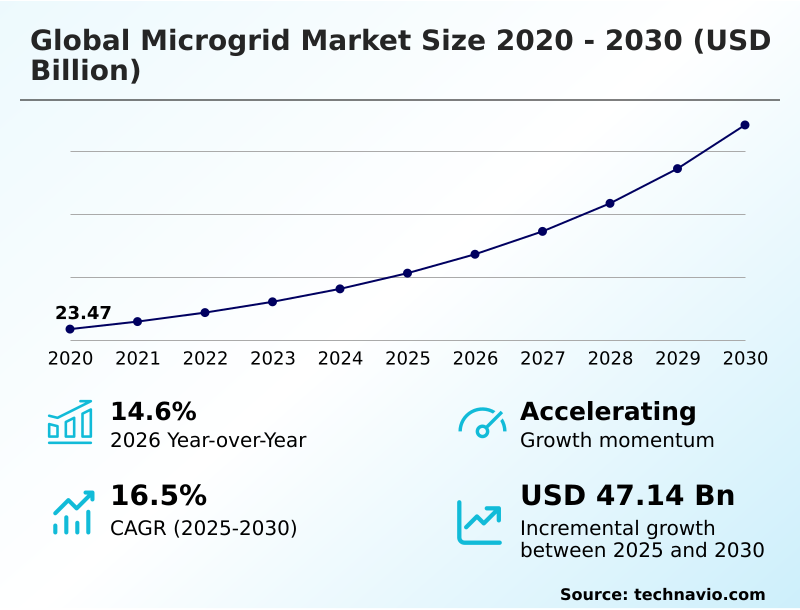
The microgrid market size is valued to increase by USD 47.14 billion, at a CAGR of 16.5% from 2025 to 2030. Increasing frequency of extreme weather events will drive the microgrid market.
Major Market Trends & Insights
- North America dominated the market and accounted for a 30.7% growth during the forecast period.
- By Application - Remote segment was valued at USD 16.36 billion in 2024
- By Connectivity - Grid connected segment accounted for the largest market revenue share in 2024
Market Size & Forecast
- Market Opportunities: USD 64.94 billion
- Market Future Opportunities: USD 47.14 billion
- CAGR from 2025 to 2030 : 16.5%
Market Summary
- The microgrid market is expanding as industries and communities seek greater energy independence and grid resilience. This evolution is driven by the need to integrate a higher mix of distributed energy resources and ensure power quality for sensitive operations.
- The technology enables localized power networks to operate in a grid-connected mode or perform autonomous islanding during utility outages, a critical function for facilities where downtime is not an option. A key trend is the adoption of advanced energy management systems that optimize performance across various assets.
- For instance, a manufacturing facility can deploy a microgrid controller to execute peak shaving strategies, charging battery storage systems when grid power is cheap and discharging during high-cost peak hours. This not only lowers operational expenses but also enhances decarbonization efforts by maximizing the use of onsite renewables.
- While the technology offers significant benefits, challenges such as complex interconnection standards and the need for significant upfront investment remain. The development of turnkey energy systems and innovative energy as a service models is helping to lower these barriers, making decentralized energy more accessible.
What will be the Size of the Microgrid Market during the forecast period?
Get Key Insights on Market Forecast (PDF) Get Free Sample
How is the Microgrid Market Segmented?
The microgrid industry research report provides comprehensive data (region-wise segment analysis), with forecasts and estimates in "USD million" for the period 2026-2030, as well as historical data from 2020-2024 for the following segments.
- Application
- Remote
- Institutions and campus
- Military
- Others
- Connectivity
- Grid connected
- Off-grid connected
- Type
- AC microgrid
- Hybrid
- DC microgrid
- Geography
- North America
- US
- Canada
- Mexico
- APAC
- China
- India
- Japan
- Europe
- Germany
- UK
- France
- South America
- Brazil
- Argentina
- Middle East and Africa
- Saudi Arabia
- UAE
- South Africa
- Rest of World (ROW)
- North America
By Application Insights
The remote segment is estimated to witness significant growth during the forecast period.
The remote segment addresses critical infrastructure needs for geographically isolated areas where extending traditional utility grids is technically or financially unfeasible. These off-grid systems provide energy independence by leveraging local resources like solar and wind, managed by a microgrid controller.
The adoption of localized power networks is driven by the high cost of transporting diesel fuel, with renewable microgrids offering a sustainable alternative that can lead to a 100% reduction in associated emissions.
Integration of energy storage systems ensures continuous power, supporting local economies and essential services.
This shift toward self-sufficient, resilient power network architectures is critical for mines, island communities, and remote industrial sites, enhancing operational efficiency and promoting sustainable development through advanced energy management systems.
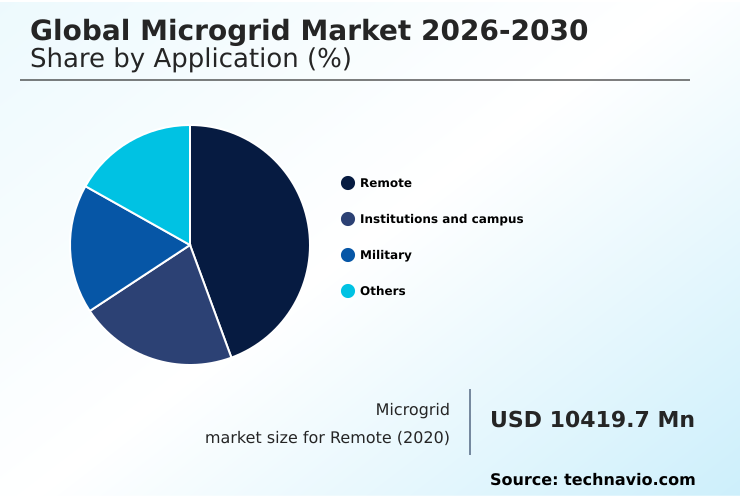
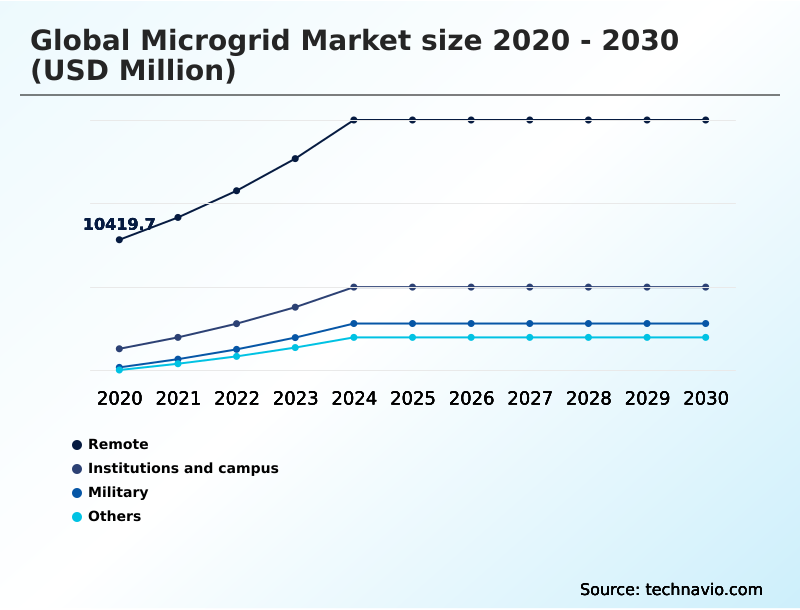
The Remote segment was valued at USD 16.36 billion in 2024 and showed a gradual increase during the forecast period.
Regional Analysis
North America is estimated to contribute 30.7% to the growth of the global market during the forecast period.Technavio’s analysts have elaborately explained the regional trends and drivers that shape the market during the forecast period.
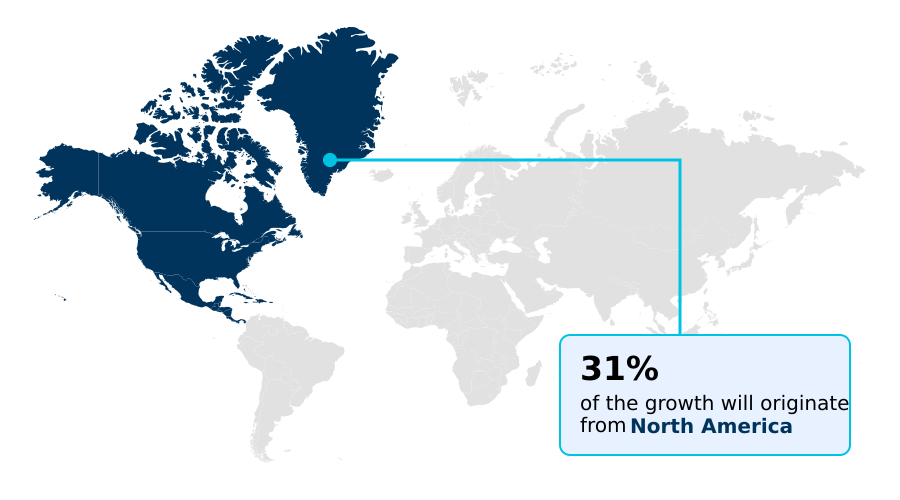
See How Microgrid Market Demand is Rising in North America Get Free Sample
The geographic landscape of the market is diversifying, driven by distinct regional needs for energy independence and decarbonization.
In North America, the focus is on grid resilience, with the average power outage duration having doubled to nearly eight hours, making localized power networks essential for critical infrastructure.
In APAC, the emphasis is on rural off-grid electrification and supporting industrial growth, with large-scale battery projects being deployed to stabilize grids that have high renewable integration.
Europe's market is shaped by aggressive net-zero targets, promoting community microgrids and virtual power plants that leverage sophisticated energy management systems. Across regions, the use of distributed energy resources is central, with deployments of turnkey energy systems reducing project complexity.
A unified goal is achieving greater energy efficiency optimization, with facilities globally reporting significant operational gains from localized control.
Market Dynamics
Our researchers analyzed the data with 2025 as the base year, along with the key drivers, trends, and challenges. A holistic analysis of drivers will help companies refine their marketing strategies to gain a competitive advantage.
- Strategic planning for microgrid adoption requires a comprehensive evaluation of both technical and financial variables. A key initial step involves understanding the payback period for a commercial microgrid, which is heavily influenced by the ability to implement strategies for reducing peak demand with battery storage.
- The technical design, particularly the choice between AC vs DC microgrid efficiency, impacts overall performance and is critical for applications like ensuring microgrid for data center reliability.
- For industrial users, integrating hydrogen storage for industrial microgrids offers a path for long-duration energy storage, while the development of a robust microgrid control system for renewables is essential for maximizing clean energy use. However, developers must navigate significant regulatory hurdles for microgrid interconnection, where the cost of microgrid interconnection studies can be a substantial barrier.
- Cybersecurity is another paramount concern, necessitating secure microgrid cybersecurity communication protocols. For emergency applications, the mobile microgrid for disaster recovery provides crucial flexibility. As the market matures, new community microgrid business models and financing options for microgrid projects are emerging to make these systems more accessible.
- Understanding the microgrid role in utility grid stabilization and the benefits of hybrid AC-DC microgrids is vital for long-term success, especially as supply chain risks for battery storage continue to influence project timelines and costs. In fact, facilities that have successfully navigated these complexities report reliability improvements more than double those of sites with only traditional backup systems.
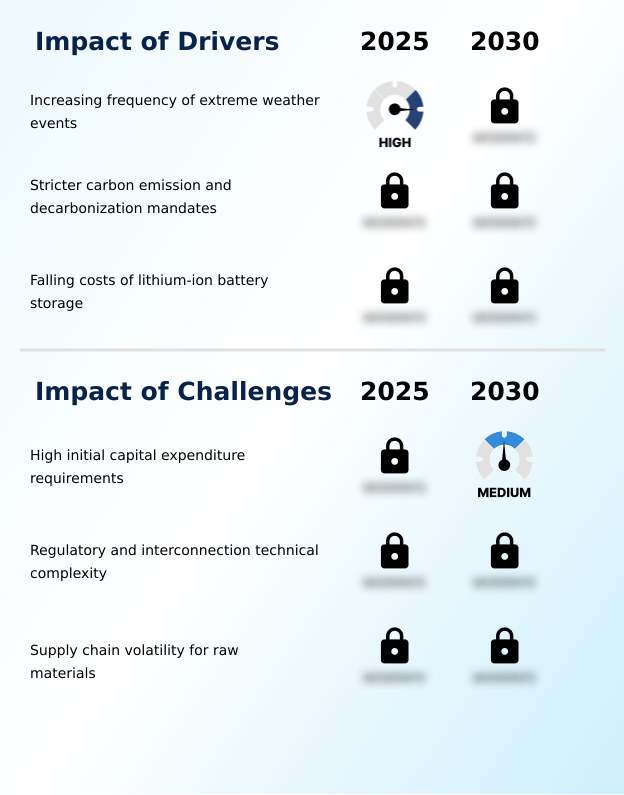
What are the key market drivers leading to the rise in the adoption of Microgrid Industry?
- The increasing frequency and severity of extreme weather events is a key driver for the market, heightening the demand for resilient and reliable energy solutions.
- Market growth is primarily driven by the urgent need for enhanced grid resilience and economic incentives tied to sustainability.
- The increasing frequency of extreme weather has led to a 40% rise in weather-related power outages, making autonomous islanding a critical capability.
- Simultaneously, stricter decarbonization mandates and carbon prices reaching $80 per metric ton are pushing organizations toward renewable integration and carbon footprint reduction, which can be cut by up to 60% with onsite distributed generation.
- The most significant economic driver is the falling cost of lithium-ion battery packs, which have dropped by nearly 80%, making the payback period for technologies like peak shaving much shorter.
- This affordability, combined with the availability of energy as a service models, is democratizing access to advanced energy storage systems.
What are the market trends shaping the Microgrid Industry?
- The integration of hydrogen energy storage systems represents a significant upcoming market trend. This development addresses the need for long-duration storage to support intermittent renewable energy sources.
- Key market trends are centered on enhancing system intelligence and storage capabilities. The integration of hydrogen energy storage systems is gaining traction for seasonal energy shifting, with electrolyzer and fuel cell processes offering long-duration power far exceeding the typical four-to-eight-hour discharge of lithium-ion batteries.
- Another major trend is the shift toward autonomous edge computing control architecture, which enables peer-to-peer fashion communication between assets for millisecond-level responses to grid faults. This is critical for protecting sensitive equipment. Additionally, the deployment of hybrid mobile microgrid unit deployment is increasing for disaster recovery, featuring high-density lithium iron phosphate batteries and foldable solar arrays.
- These containerized microgrid units, using advanced power conversion rates and inverter technology, reduce site-specific engineering costs by over 25%, accelerating access to power in critical situations.
What challenges does the Microgrid Industry face during its growth?
- High initial capital expenditure requirements for hardware and system integration present a key challenge affecting the market's growth trajectory.
- The market faces significant challenges related to high initial costs, regulatory complexity, and supply chain volatility. The capital expenditure for a microgrid can be prohibitive, with hardware and engineering representing nearly 70% of the total cost of ownership.
- Regulatory and interconnection standards add another layer of complexity, as interconnection studies alone can cost upwards of $100,000 and project timelines can be delayed by months. Furthermore, the raw material supply chain for essential components like power electronics and semiconductors remains a major constraint.
- Price volatility for materials such as lithium, which has fluctuated significantly, directly impacts the cost of battery storage. These factors make it difficult to provide stable long-term pricing, hindering investment in alternative battery chemistries and advanced decentralized energy solutions.
Exclusive Technavio Analysis on Customer Landscape
The microgrid market forecasting report includes the adoption lifecycle of the market, covering from the innovator’s stage to the laggard’s stage. It focuses on adoption rates in different regions based on penetration. Furthermore, the microgrid market report also includes key purchase criteria and drivers of price sensitivity to help companies evaluate and develop their market growth analysis strategies.
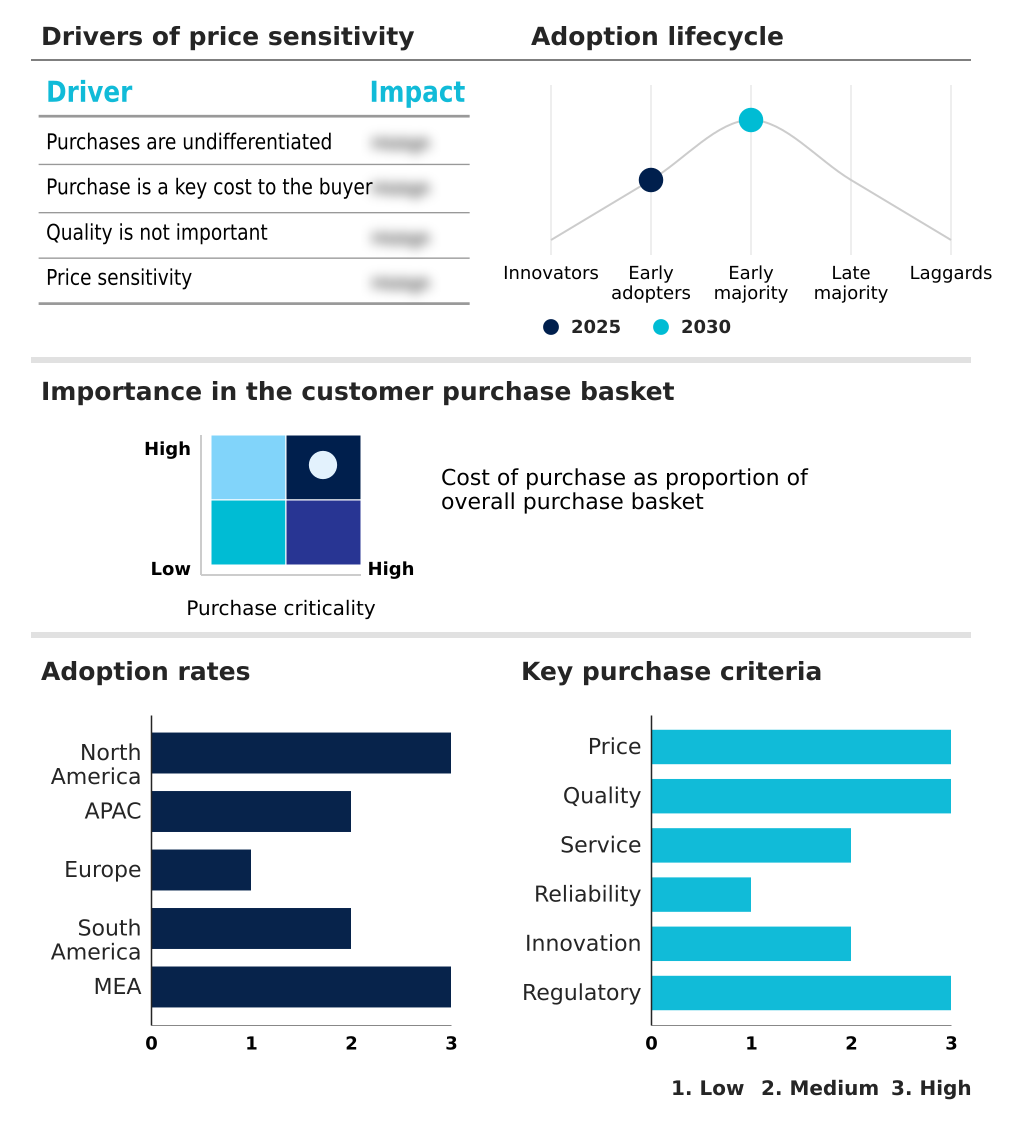
Customer Landscape of Microgrid Industry
Competitive Landscape
Companies are implementing various strategies, such as strategic alliances, microgrid market forecast, partnerships, mergers and acquisitions, geographical expansion, and product/service launches, to enhance their presence in the industry.
ABB Ltd. - Offerings include comprehensive control systems for distributed energy resources, enabling seamless grid integration, renewable power management, and enhanced operational efficiency through advanced digital services.
The industry research and growth report includes detailed analyses of the competitive landscape of the market and information about key companies, including:
- ABB Ltd.
- Canopy Power
- Eaton Corp. Plc
- Emerson Electric Co.
- Exelon Corp.
- GE Vernova Inc.
- General MicroGrids
- Honeywell International Inc.
- Pareto Energy
- Polaris Smart Metering Pte. Ltd
- Power Analytics Global Corp.
- Powerhive Inc.
- S and C Electric Co.
- Scale Microgrid Solutions LLC
- Schneider Electric SE
- Siemens AG
- Spirae LLC
- Tesla Inc.
- Total Energy Solutions
- UL LLC
Qualitative and quantitative analysis of companies has been conducted to help clients understand the wider business environment as well as the strengths and weaknesses of key industry players. Data is qualitatively analyzed to categorize companies as pure play, category-focused, industry-focused, and diversified; it is quantitatively analyzed to categorize companies as dominant, leading, strong, tentative, and weak.
Recent Development and News in Microgrid market
- In August 2024, ABB Ltd. announced a new contract for an industrial microgrid utilizing high-capacity storage to reduce peak demand charges, which can account for up to 40% of a factory's electricity bill.
- In January 2025, Siemens AG was involved in a large-scale project to create a carbon-neutral city district using a networked microgrid that facilitates renewable energy sharing between buildings to meet stringent local environmental regulations.
- In March 2025, Tesla Inc. deployed a fleet of its mobile battery storage units to support a coastal region experiencing localized grid failures during a critical transition to new infrastructure.
- In May 2025, Eaton Corp. collaborated with a regional utility to install a microgrid system specifically engineered to withstand high-wind events and ensure continuous power for a community shelter.
Dive into Technavio’s robust research methodology, blending expert interviews, extensive data synthesis, and validated models for unparalleled Microgrid Market insights. See full methodology.
| Market Scope | |
|---|---|
| Page number | 301 |
| Base year | 2025 |
| Historic period | 2020-2024 |
| Forecast period | 2026-2030 |
| Growth momentum & CAGR | Accelerate at a CAGR of 16.5% |
| Market growth 2026-2030 | USD 47143.5 million |
| Market structure | Fragmented |
| YoY growth 2025-2026(%) | 14.6% |
| Key countries | US, Canada, Mexico, China, India, Japan, Australia, South Korea, Indonesia, Germany, UK, France, Italy, Spain, The Netherlands, Brazil, Chile, Argentina, Saudi Arabia, UAE, South Africa, Israel and Turkey |
| Competitive landscape | Leading Companies, Market Positioning of Companies, Competitive Strategies, and Industry Risks |
Research Analyst Overview
- The microgrid market is fundamentally reshaping energy infrastructure by deploying localized power networks built on distributed energy resources. These systems are managed by a central microgrid controller, which enables critical functions like islanding and autonomous islanding to provide an uninterruptible power supply during grid failures. This capability is paramount for achieving grid resilience and ensuring power quality.
- Boardroom decisions on capital expenditure for business continuity are increasingly influenced by the performance of these systems, as technologies like inverter technology and advanced power electronics mature. For example, implementing peak shaving strategies has been shown to reduce factory energy bills by up to 40%.
- The integration of diverse assets, including lithium-ion battery packs, is optimized through demand response programs and sophisticated local grid management. This enhances decarbonization efforts and drives energy efficiency optimization. As the smart grid infrastructure evolves, these systems offer a scalable solution for renewable integration, critical for meeting sustainability goals and achieving long-term energy independence.
What are the Key Data Covered in this Microgrid Market Research and Growth Report?
-
What is the expected growth of the Microgrid Market between 2026 and 2030?
-
USD 47.14 billion, at a CAGR of 16.5%
-
-
What segmentation does the market report cover?
-
The report is segmented by Application (Remote, Institutions and campus, Military, and Others), Connectivity (Grid connected, and Off-grid connected), Type (AC microgrid, Hybrid, and DC microgrid) and Geography (North America, APAC, Europe, South America, Middle East and Africa)
-
-
Which regions are analyzed in the report?
-
North America, APAC, Europe, South America and Middle East and Africa
-
-
What are the key growth drivers and market challenges?
-
Increasing frequency of extreme weather events, High initial capital expenditure requirements
-
-
Who are the major players in the Microgrid Market?
-
ABB Ltd., Canopy Power, Eaton Corp. Plc, Emerson Electric Co., Exelon Corp., GE Vernova Inc., General MicroGrids, Honeywell International Inc., Pareto Energy, Polaris Smart Metering Pte. Ltd, Power Analytics Global Corp., Powerhive Inc., S and C Electric Co., Scale Microgrid Solutions LLC, Schneider Electric SE, Siemens AG, Spirae LLC, Tesla Inc., Total Energy Solutions and UL LLC
-
Market Research Insights
- The market's dynamics are shaped by a definitive shift toward decentralized energy architectures that deliver enhanced grid resilience and operational efficiency. The adoption of energy as a service models is lowering entry barriers, while advanced energy management systems enable sophisticated asset optimization software.
- This drive for smarter, localized power networks is underscored by performance metrics; for example, implementing peak shaving can reduce a factory's electricity bill by up to 40%. Concurrently, as the average duration of power outages has doubled in the last decade, the value of a resilient power network is more pronounced than ever.
- By integrating distributed energy resources, industrial facilities can achieve a carbon footprint reduction of up to 60%, aligning with net-zero targets and demonstrating a clear return on investment beyond simple energy cost savings.
We can help! Our analysts can customize this microgrid market research report to meet your requirements.
 RIA -
RIA - 
