


Power Generation Market Size 2026-2030
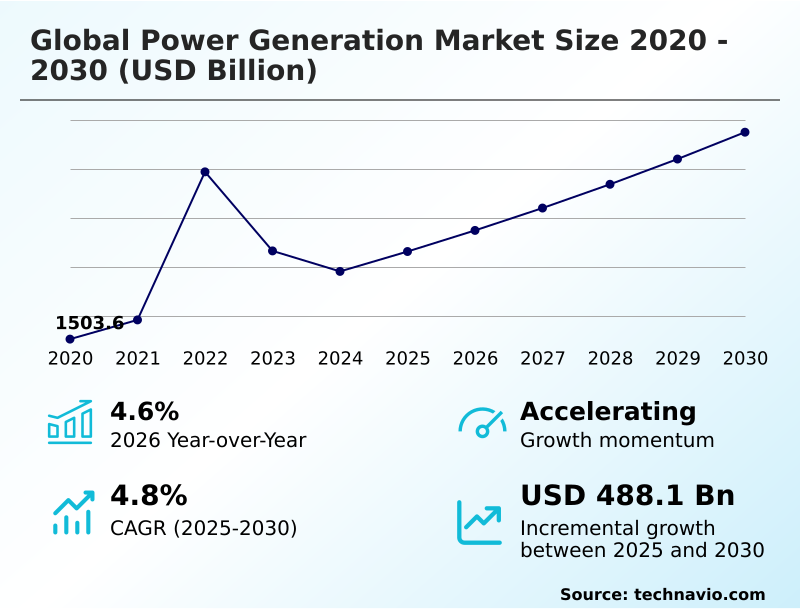
The power generation market size is valued to increase by USD 488.1 billion, at a CAGR of 4.8% from 2025 to 2030. Rapid expansion of AI data centers and electrification will drive the power generation market.
Major Market Trends & Insights
- APAC dominated the market and accounted for a 58.3% growth during the forecast period.
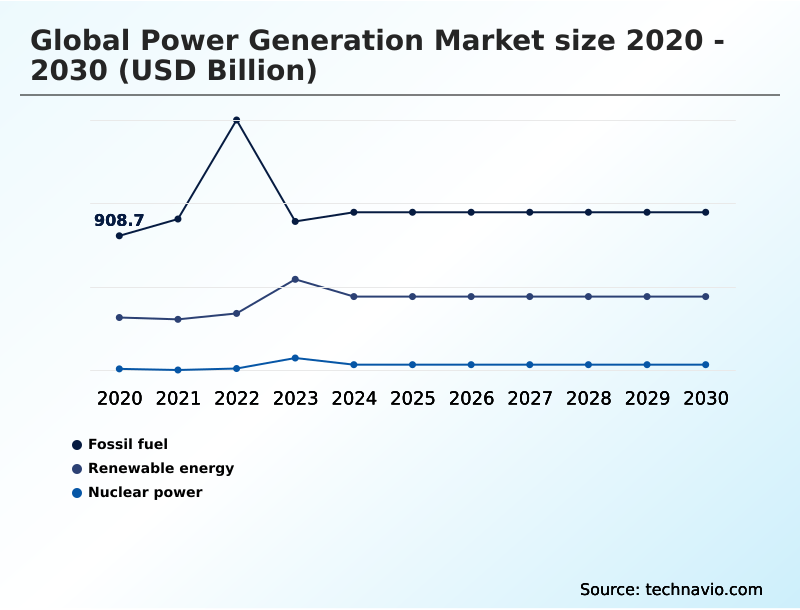
- By Source - Fossil fuel segment was valued at USD 1042.6 billion in 2024
- By End-user - Industrial segment accounted for the largest market revenue share in 2024
Market Size & Forecast
- Market Opportunities: USD 846.5 billion
- Market Future Opportunities: USD 488.1 billion
- CAGR from 2025 to 2030 : 4.8%
Market Summary
- The Power Generation Market is experiencing a massive structural transition as legacy baseload infrastructure is aggressively supplemented by decentralized energy networks. Rapid commercial electrification and the exponential growth of computing data centers act as a severe demand driver, forcing utilities to procure massive zero-emission capacity to satisfy round-the-clock computational workloads.
- To manage this soaring energy requirement, independent power producers are heavily investing in digital monitoring platforms, enabling predictive fault detection that has successfully reduced unplanned transmission outages by 18%. Despite these efficiency gains, the sector faces a formidable challenge from persistent supply chain bottlenecks and critical mineral shortages, which continuously disrupt the manufacturing timelines of high-capacity energy storage systems.
- These interconnection delays physically restrict the evacuation of clean energy to high-demand urban load centers. Consequently, grid operators are accelerating the deployment of virtual software platforms to aggregate distributed assets seamlessly. This overarching transition mandates that operators balance immediate peak load generation demands with long-term infrastructure modernization protocols.
What will be the Size of the Power Generation Market during the forecast period?
Get Key Insights on Market Forecast (PDF) Get Free Sample
How is the Power Generation Market Segmented?
The power generation industry research report provides comprehensive data (region-wise segment analysis), with forecasts and estimates in "USD billion" for the period 2026-2030, as well as historical data from 2020-2024 for the following segments.
- Source
- Fossil fuel
- Renewable energy
- Nuclear power
- End-user
- Industrial
- Residential
- Commercial
- Utilities
- Type
- On-grid
- Off-grid
- Technology
- Utility scale power generation
- Distributed power generation
- Geography
- APAC
- China
- Japan
- India
- South Korea
- Australia
- Indonesia
- North America
- US
- Canada
- Mexico
- Europe
- Germany
- UK
- France
- Italy
- Spain
- The Netherlands
- Middle East and Africa
- Saudi Arabia
- UAE
- South Africa
- Israel
- Turkey
- South America
- Brazil
- Argentina
- Chile
- APAC
By Source Insights
The fossil fuel segment is estimated to witness significant growth during the forecast period.
The fossil fuel segment remains a critical stabilizing force within the power generation infrastructure, providing essential baseload power reliability alongside an evolving thermal power baseline.
As international mandates accelerate the fossil fuel phase-out, facility operators are increasingly deploying carbon capture integration and biomass cogeneration to drastically lower their carbon emission intensity.
This operational evolution ensures uninterrupted electricity supply for heavy industries while achieving a 15% improvement in overall thermal efficiency.
To secure continuous zero-emission electricity without disrupting existing grids, utilities are navigating complex supply chain material sourcing challenges to construct an advanced small modular reactor or a reliable nuclear fission reactor.
These targeted infrastructure upgrades directly reduce compliance penalties and empower utility providers to maintain absolute grid stability across diverse industrial load demands.
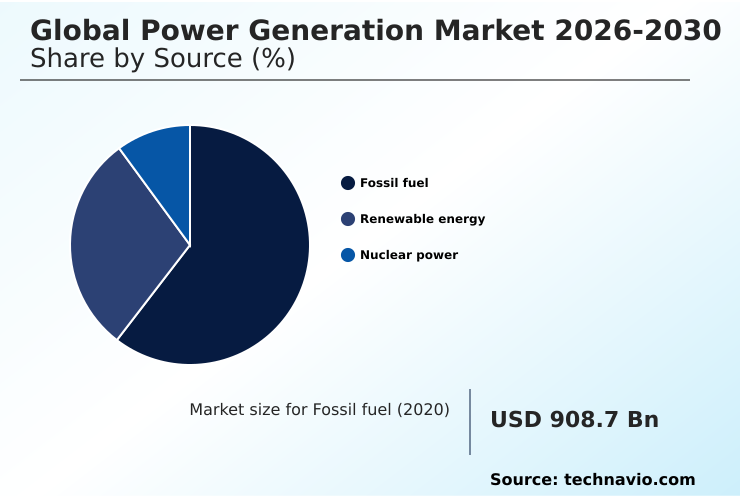
The Fossil fuel segment was valued at USD 1042.6 billion in 2024 and showed a gradual increase during the forecast period.
Regional Analysis
APAC is estimated to contribute 58.3% to the growth of the global market during the forecast period.Technavio’s analysts have elaborately explained the regional trends and drivers that shape the market during the forecast period.
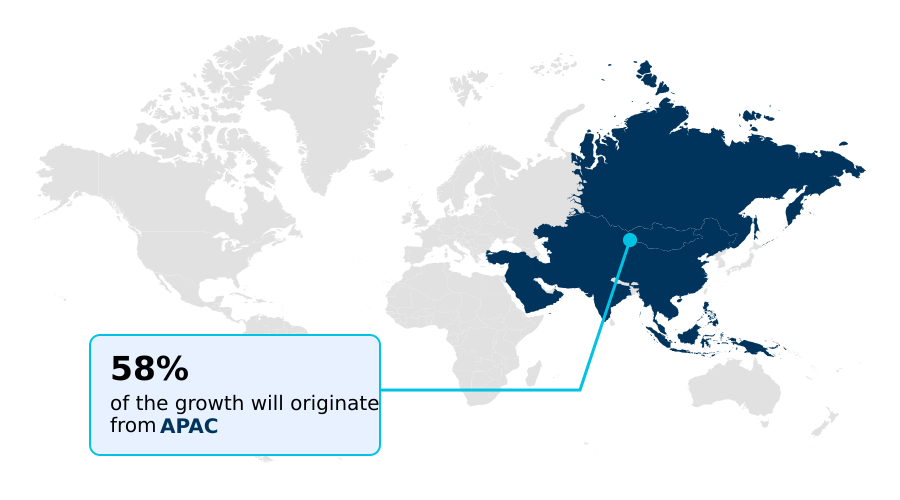
See How Power Generation Market Demand is Rising in APAC Get Free Sample
The Power Generation Market exhibits distinct regional expansion trajectories shaped by specific industrial demands. The APAC region aggressively scales its energy capabilities through massive utility-scale solar photovoltaic developments, achieving a 28% higher renewable integration rate than North America.
While North America focuses heavily on transmission congestion relief through extensive smart metering infrastructure upgrades, APAC prioritizes deploying an offshore wind turbine network to fuel its rapidly expanding manufacturing base.
Consequently, North American utilities have noted a 15% improvement in power conversion efficiency by adopting a sophisticated substation automation system. European markets heavily utilize a synchronous condenser to maintain vital grid inertia support across expansive high-voltage direct current transmission lines.
These diverse regional strategies highlight how localized power generation solutions require highly customized infrastructure to ensure uninterrupted power delivery.
Market Dynamics
Our researchers analyzed the data with 2025 as the base year, along with the key drivers, trends, and challenges. A holistic analysis of drivers will help companies refine their marketing strategies to gain a competitive advantage.
- The fundamental architecture of the Power Generation Market is rapidly evolving to address the complex requirements of modern industrial electrification and continuous data processing demands. As traditional grid networks face unprecedented strain from intermittent renewable resources, operators are aggressively deploying a utility-scale battery energy storage system infrastructure to ensure stable baseload power reliability.
- To optimize these massive capital investments, utilities utilize smart grid predictive maintenance analytics, achieving a 20% efficiency advantage in fault detection compared to legacy manual inspection protocols. This operational modernization directly streamlines supply chain workflows and minimizes costly equipment downtime.
- Furthermore, the rapid expansion of offshore wind power generation capacity introduces unique transmission challenges, compelling regional transmission organizations to adopt robust grid-forming technologies. To align with aggressive corporate decarbonization mandates, industrial facilities are increasingly transitioning to a green hydrogen co-firing gas turbine setup, which drastically lowers carbon emission intensity without compromising immediate load responsiveness.
- Concurrently, commercial enterprises and remote operations bypass centralized grid congestion entirely by implementing advanced decentralized microgrid power generation solutions. These independent energy networks provide unmatched operational resilience during severe weather events and peak pricing periods.
- By seamlessly integrating high-density storage and proactive software platforms, modern power generation frameworks successfully balance the critical imperatives of strict environmental compliance, economic stability, and uninterrupted electricity supply across all major consumer segments.
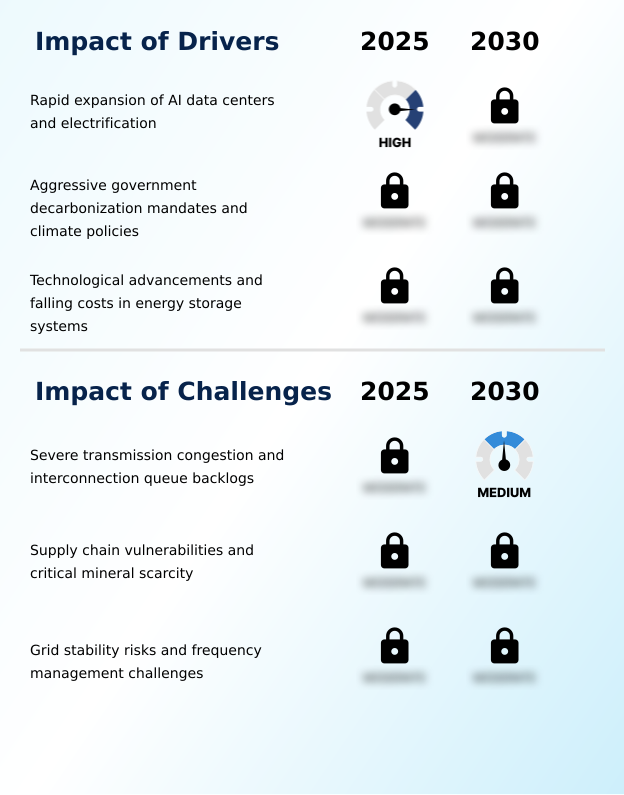
What are the key market drivers leading to the rise in the adoption of Power Generation Industry?
- The rapid expansion of artificial intelligence data centers and broader macroeconomic electrification trends serve as the primary drivers propelling immense capacity additions across the global energy infrastructure.
- The massive proliferation of artificial intelligence data centers acts as a primary catalyst accelerating the Power Generation Market. These hyperscale processing facilities demand uninterrupted electricity supplies, forcing technology conglomerates to execute a long-term corporate power purchase agreement.
- To ensure absolute reliability, developers are rapidly expanding a distributed energy resource alongside a massive lithium-ion energy storage installation. By prioritizing dynamic load dispatching and an advanced demand-response program, operators have successfully lowered transmission energy losses by 11%.
- Additionally, the rising need for off-grid electrification accelerates the deployment of a green hydrogen electrolyzer paired with a highly efficient hydrogen-ready gas turbine.
- These regulatory and technological pressures also drive investments into a hydroelectric pumped storage facility and an ultra-supercritical coal technology, ensuring a 22% improvement in baseload responsiveness.
What are the market trends shaping the Power Generation Industry?
- The integration of artificial intelligence and advanced predictive analytics in grid management has emerged as a defining market trend. This technological shift enables operators to proactively optimize multi-directional power flows and preemptively address infrastructure vulnerabilities.
- A defining trend in the Power Generation Market is the unprecedented adoption of bidirectional power flow technologies across expansive distributed networks. As industrial complexes increasingly deploy a decentralized microgrid and an advanced hybrid energy system, legacy unidirectional distribution architectures are rapidly becoming obsolete.
- Utility providers are actively integrating a smart grid management platform and digital substation control to coordinate these diverse inputs, which has successfully improved dynamic load dispatching accuracy by 24%. Furthermore, operators aggregate these assets into a virtual power plant, allowing commercial prosumers to directly participate in peak shaving operations and offer critical ancillary grid services.
- The aggressive transition toward a hydrogen co-firing setup within a modern combined-cycle gas turbine fundamentally alters the energy landscape, resulting in a 16% reduction in structural grid vulnerabilities.
What challenges does the Power Generation Industry face during its growth?
- Severe transmission congestion and extensive interconnection queue backlogs represent critical operational challenges that significantly delay capacity deployments and hinder infrastructure expansion.
- Severe physical transmission bottlenecks and prolonged interconnection queue backlogs represent primary operational constraints crippling the Power Generation Market. Regional grid operators face unprecedented volumes of intermittent renewable integration that drastically exceed the physical limits of existing infrastructure. This deficit physically prevents the evacuation of clean electricity to urban centers, directly resulting in a 14% increase in stranded generation assets.
- Furthermore, utilities struggle with executing effective energy curtailment reduction protocols without deploying an advanced grid-forming inverter and a high-capacity solid-state battery storage system. Maintaining a cyber-secure grid operation while integrating a high-efficiency heat pump network requires massive software overhauls.
- Overcoming these fundamental stability deficits requires immediate capital injections into robust grid frequency regulation mechanisms and predictive maintenance analytics to maintain absolute system reliability and reduce outages by 12%.
Exclusive Technavio Analysis on Customer Landscape
The power generation market forecasting report includes the adoption lifecycle of the market, covering from the innovator’s stage to the laggard’s stage. It focuses on adoption rates in different regions based on penetration. Furthermore, the power generation market report also includes key purchase criteria and drivers of price sensitivity to help companies evaluate and develop their market growth analysis strategies.
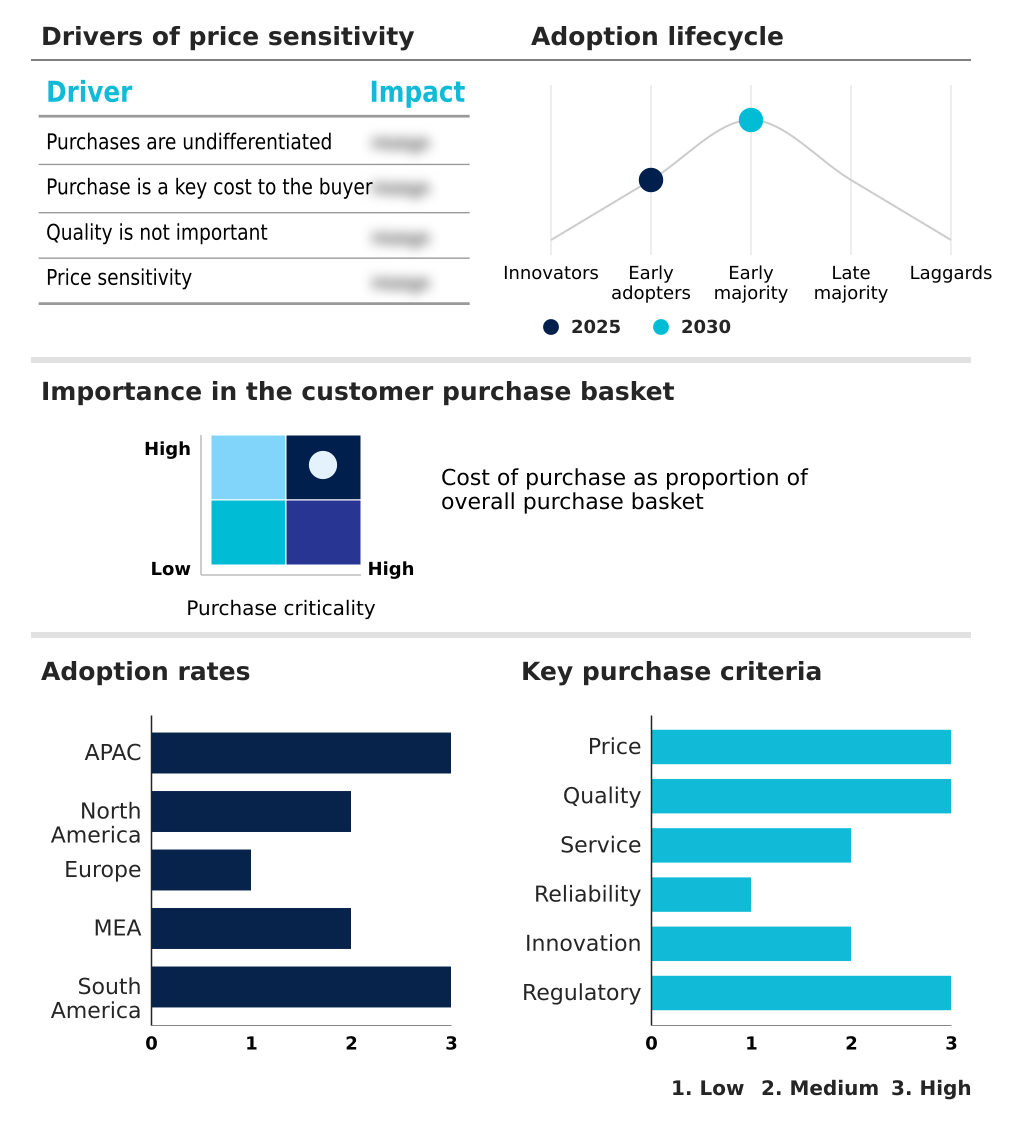
Customer Landscape of Power Generation Industry
Competitive Landscape
Companies are implementing various strategies, such as strategic alliances, power generation market forecast, partnerships, mergers and acquisitions, geographical expansion, and product/service launches, to enhance their presence in the industry.
Babcock and Wilcox - The provider delivers advanced steam generation equipment, comprehensive aftermarket components, and full-scale maintenance services tailored to optimize operational efficiency across industrial and utility-scale power plants.
The industry research and growth report includes detailed analyses of the competitive landscape of the market and information about key companies, including:
- Babcock and Wilcox
- Caterpillar Inc.
- Cummins Inc.
- Doosan Enerbility Co. Ltd.
- Duke Energy Corp.
- Electricite de France SA
- Enel Spa
- ENGIE SA
- GE Vernova Inc.
- Iberdrola SA
- MAN Energy Solutions SE
- Mitsubishi Heavy Industries
- Nextera Energy Inc.
- Orsted AS
- Rolls Royce Holdings Plc
- RWE AG
- Siemens Energy AG
- Vattenfall AB
- Vestas Wind Systems AS
- Wartsila Corp.
Qualitative and quantitative analysis of companies has been conducted to help clients understand the wider business environment as well as the strengths and weaknesses of key industry players. Data is qualitatively analyzed to categorize companies as pure play, category-focused, industry-focused, and diversified; it is quantitatively analyzed to categorize companies as dominant, leading, strong, tentative, and weak.
Recent Development and News in Power generation market
- In the Renewable Electricity industry, the aggressive deployment of utility-scale solar parks mandated by decarbonization directives triggered severe transmission congestion relief requirements, directly impacting Power Generation market demand by forcing grid operators to integrate massive solid-state battery storage facilities.
- The commercialization of alkaline electrolyzer systems for heavy manufacturing processes accelerated the adoption of alternative fuels, resulting in a 20% reduction in carbon emission intensity across legacy thermal generation assets.
- The integration of automated monitoring software within distribution networks enhanced fault detection accuracy by 15%, reducing unplanned outages and driving independent operators to scale localized power generation portfolios.
- Material sourcing constraints impacting lithium-ion manufacturing forced regional transmission organizations to pivot toward mechanical storage investments, thereby securing necessary grid inertia support for managing complex alternating current networks.
Dive into Technavio’s robust research methodology, blending expert interviews, extensive data synthesis, and validated models for unparalleled Power Generation Market insights. See full methodology.
| Market Scope | |
|---|---|
| Page number | 320 |
| Base year | 2025 |
| Historic period | 2020-2024 |
| Forecast period | 2026-2030 |
| Growth momentum & CAGR | Accelerate at a CAGR of 4.8% |
| Market growth 2026-2030 | USD 488.1 billion |
| Market structure | Fragmented |
| YoY growth 2025-2026(%) | 4.6% |
| Key countries | China, Japan, India, South Korea, Australia, Indonesia, US, Canada, Mexico, Germany, UK, France, Italy, Spain, The Netherlands, Saudi Arabia, UAE, South Africa, Israel, Turkey, Brazil, Argentina and Chile |
| Competitive landscape | Leading Companies, Market Positioning of Companies, Competitive Strategies, and Industry Risks |
Research Analyst Overview
- The Power Generation Market is undergoing a profound technological restructuring, driven by the absolute necessity to balance continuous industrial demand with stringent decarbonization mandates. The transition from legacy thermal assets to a highly dynamic grid requires the widespread installation of a grid-forming inverter to maintain alternating current stability.
- Utility operators are increasingly executing complex hybrid setups by combining a green hydrogen electrolyzer with existing infrastructure to create dispatchable, low-emission baseload power. Strategic integration of a virtual power plant enables operators to aggregate a diverse distributed energy resource, effectively reducing peak load procurement costs by 18% compared to traditional centralized dispatch methods.
- Furthermore, the implementation of a synchronous condenser alongside a massive offshore wind turbine fleet provides essential reactive power support, stabilizing long-distance transmission networks. As industrial consumers demand uninterrupted zero-carbon energy, energy developers are actively adopting an advanced small modular reactor design to deliver secure, localized electricity.
- These critical innovations fundamentally restructure corporate energy procurement strategies and long-term capital allocation within the power sector.
What are the Key Data Covered in this Power Generation Market Research and Growth Report?
-
What is the expected growth of the Power Generation Market between 2026 and 2030?
-
USD 488.1 billion, at a CAGR of 4.8%
-
-
What segmentation does the market report cover?
-
The report is segmented by Source (Fossil fuel, Renewable energy, and Nuclear power), End-user (Industrial, Residential, Commercial, and Utilities), Type (On-grid, and Off-grid), Technology (Utility scale power generation, and Distributed power generation) and Geography (APAC, North America, Europe, Middle East and Africa, South America)
-
-
Which regions are analyzed in the report?
-
APAC, North America, Europe, Middle East and Africa and South America
-
-
What are the key growth drivers and market challenges?
-
Rapid expansion of AI data centers and electrification, Severe transmission congestion and interconnection queue backlogs
-
-
Who are the major players in the Power Generation Market?
-
Babcock and Wilcox, Caterpillar Inc., Cummins Inc., Doosan Enerbility Co. Ltd., Duke Energy Corp., Electricite de France SA, Enel Spa, ENGIE SA, GE Vernova Inc., Iberdrola SA, MAN Energy Solutions SE, Mitsubishi Heavy Industries, Nextera Energy Inc., Orsted AS, Rolls Royce Holdings Plc, RWE AG, Siemens Energy AG, Vattenfall AB, Vestas Wind Systems AS and Wartsila Corp.
-
Market Research Insights
- The Power Generation Market is rapidly transitioning from centralized thermal dominance to a highly flexible, decentralized operational model. Grid operators are accelerating their fossil fuel phase-out strategies to meet stringent corporate power purchase agreement requirements, directly boosting the demand for zero-emission electricity.
- The strategic integration of smart metering infrastructure has yielded a 22% improvement in peak shaving operations, significantly minimizing grid strain during high-demand periods. Simultaneously, the deployment of high-efficiency heat pump technologies in commercial sectors has decreased localized energy consumption by 14%, directly lowering operational utility expenses.
- By prioritizing these ancillary grid services, utility operators successfully mitigate transmission bottlenecks and secure continuous power availability for mission-critical industrial manufacturing hubs.
We can help! Our analysts can customize this power generation market research report to meet your requirements.
 RIA -

