

Orthopedic Surgical Robots Market Analysis North America, Europe, Asia, Rest of World (ROW) - US, UK, Germany, China, Japan - Size and Forecast 2024-2028

Orthopedic Surgical Robots Market Analysis North America, Europe, Asia, Rest of World (ROW) - US, UK, Germany, China, Japan - Size and Forecast 2024-2028

Published: Jun 2024 169 Pages SKU: IRTNTR45626

Market Overview at a Glance

$1.49 B
Market Opportunity
27.17%
CAGR
20.98
YoY growth 2023-2024(%)

Orthopedic Surgical Robots Market Size 2024-2028 

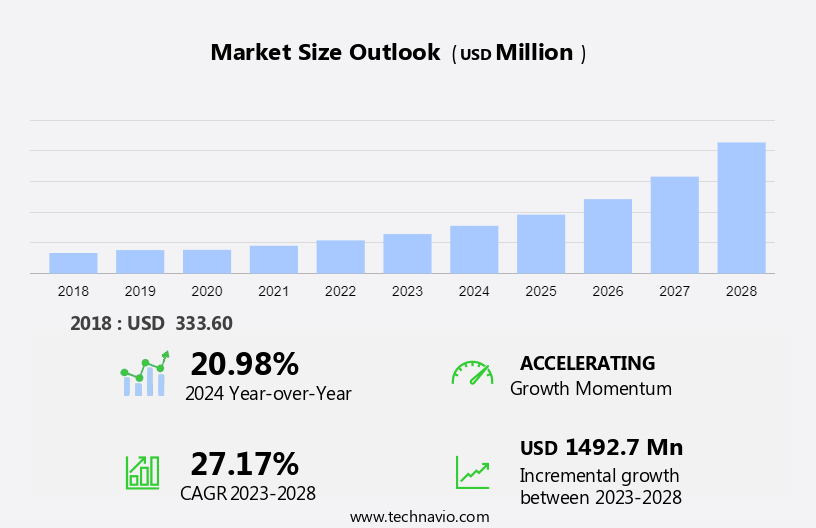
The orthopedic surgical robots market size is forecast to increase by USD 1.49 billion at a CAGR of 27.17% between 2023 and 2028.

  • Market growth hinges on several factors including the rise of robotic surgical platforms due to limitations in traditional surgeries, evolving regulatory landscapes, and ongoing technological advancements. These elements collectively drive innovation and adoption within the medical field. The shift towards robotic solutions stems from the need for enhanced precision, reduced invasiveness, and improved patient outcomes, addressing shortcomings in conventional surgical methods.
  • Furthermore, regulatory changes play a pivotal role in shaping market dynamics and influencing the development and deployment of advanced medical technologies. With continuous technological progress, including AI integration and surgical automation, the market is poised for further expansion and transformative changes in healthcare practices.

What will be the Size of the Market During the Forecast Period?
Orthopedic Surgical Robots Market Size

 Request Free Sample

  • The market is witnessing significant growth due to advancements in technology and the increasing prevalence of musculoskeletal disorders. Orthopedic surgery focuses on the correction of spinal deformities, joint fractures, musculoskeletal traumas, bone infections, and bone deformities. Surgical robots play a crucial role in these procedures, offering precision and accuracy. Key technological advances include acetabulum positioning systems, arthroscopy, and the use of molecular diagnostics in orthopedic research.
  • Furthermore, manufacturing companies like Monogram Orthopedics, Engage Surgical, and Extremity Orthopedics are leading the way with new developments in robotic arms and hinges, such as the Triathlon Hinge. Inpatient facilities benefit from these advancements, providing better patient care and outcomes. Orthopedic surgical robots are transforming the field of orthopedics, enabling minimally invasive procedures and improving the human skeletal system's overall health. The market for these robots is expected to continue growing as research in musculoskeletal disorders, such as osteoarthritis, progresses.

How is this market segmented and which is the largest segment?

The market research report provides comprehensive data (region-wise segment analysis), with forecasts and estimates in "USD billion" for the period 2024-2028, as well as historical data from 2018-2022 for the following segments.

  • Application
    • Knee surgery
    • Hip surgery
  • End-user
    • Hospitals
    • Ambulatory service centers
  • Geography
    • North America
      • US
    • Europe
      • Germany
      • UK
    • Asia
      • China
      • Japan
    • Rest of World (ROW)

By Application Insights

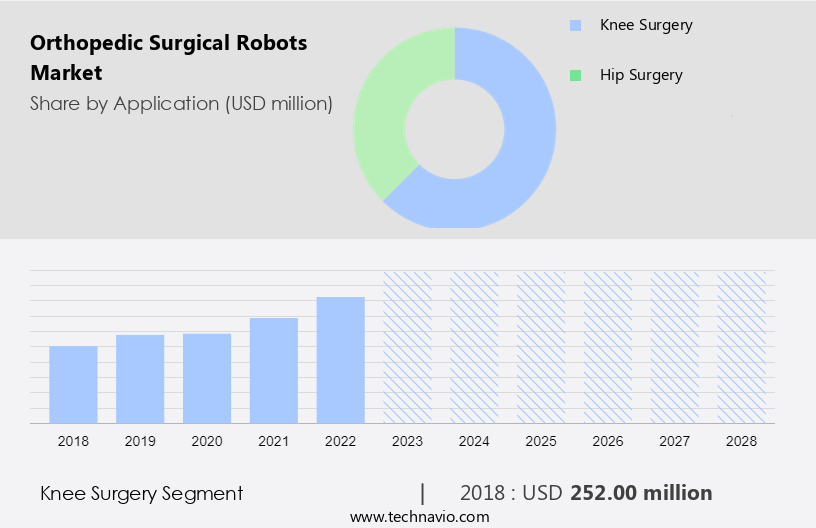
  • The knee surgery segment is estimated to witness significant growth during the forecast period.

The market encompasses advanced technologies for knee and hip surgeries, including acetabulum positioning and femur preparation. With an aging population and increasing health complications, there is a growing demand for orthopedic solutions in developed and developing countries. New developments in medtech devices, such as Mako orthopedic robot and Engage Surgical, facilitate precise procedures for knee osteoarthritis, meniscus tear, ligament rupture, and bone fractures.

Furthermore, orthopedic surgeons utilize diagnostic technology and digitization to improve the quality of care for patients with bone deformities, hip fractures, joint disorders, and musculoskeletal traumas. The market expansion is driven by the approval of new prostheses for knees, such as CORI and those from Monogram Orthopedics, and the increasing healthcare expenditure for geriatric population and inpatient facilities. Musculoskeletal research and molecular diagnostics are also significant areas of focus for companies in this market.
Orthopedic Surgical Robots Market Size

Get a glance at the market report of share of various segments Request Free Sample

The knee surgery segment was valued at USD 252.00 million in 2018 and showed a gradual increase during the forecast period.

Regional Analysis

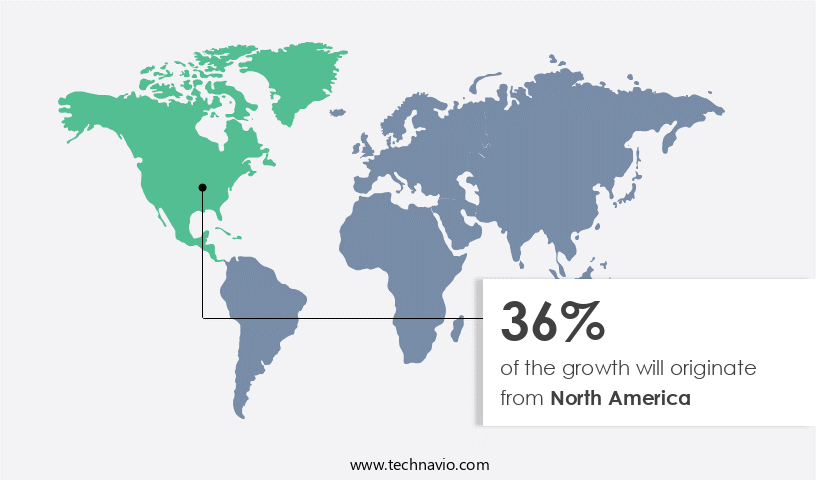
  • North America is estimated to contribute 36% to the growth of the global market during the forecast period.

Technavio's analysts have elaborately explained the regional trends and drivers that shape the market during the forecast period.
Orthopedic Surgical Robots Market Share by Geography

For more insights on the market share of various regions Request Free Sample

The Orthopedic surgery market in North America is experiencing substantial growth due to the increasing adoption of orthopedic surgical robots and the rise in the number of surgical procedures. Osteoarthritis and Osteoporosis patients are major beneficiaries of this trend. Outpatient centers and podiatrists are key providers of these advanced orthopedic treatments. Precision and safety are crucial factors driving the market, with regulatory standards ensuring quality. Reamer irrigator aspirators and robotic arms are essential robotic equipment used in orthopedic surgeries.

Furthermore, strategic decisions are being made to address skill gaps and the need for skilled expertise in performing complex spinal deformity corrections. Technological advances, such as self-efficacy-enhancing Triathlon Hinge implants, are also contributing to market growth. Surgical robots enable providers to offer minimally invasive procedures, meeting the supportive care needs of patients with osteoarthritis, osteoporosis, and spinal deformities.

Market Dynamics

Our researchers analyzed the data with 2023 as the base year, along with the key drivers, trends, and challenges. A holistic analysis of drivers will help companies refine their marketing strategies to gain a competitive advantage.

What are the key market drivers leading to the rise in adoption of Orthopedic Surgical Robots Market?

Limitations in conventional surgeries spurring the adoption of robotic surgical platforms is the key driver of the market.

  • Orthopedic surgical robots have gained significant attention in the healthcare industry due to their ability to enhance accuracy in implant placement during surgeries. This precision is crucial for addressing various orthopedic conditions such as bone deformities, fractures, infections, and disorders. The aging population, particularly those with health complications, is a major driver for the market's growth. These robots facilitate improved acetabulum positioning, femur preparation, and femoral osteotomies, reducing postoperative complications and hospitalization time.
  • Furthermore, new developments in medtech devices, including Mako orthopedic robot and Engage Surgical, enable more efficient arthroscopy, knee replacements, and ligament repair. The market is engaged in manufacturing advanced solutions for extremity orthopedics, meniscus tear, and hip fractures. Digitization and molecular diagnostics play a vital role in the market, ensuring better visualization and preoperative planning. Orthopedic surgeons rely on these robots for hip and knee replacements, addressing conditions like osteoarthritis and bone infections. The market is poised for new developments in musculoskeletal research and traumas, catering to the increasing demand for advanced orthopedic treatments.

What are the market trends shaping the Orthopedic Surgical Robots Market?

An increase in minimally invasive surgery (MIS) procedures in orthopedics is the upcoming trend in the market.

  • The market is experiencing significant growth due to the increasing preference for minimally invasive surgeries in orthopedics. Arthroscopy is a common minimally invasive procedure used for bone fractures, joint reconstruction, and extremity realignment. The market is driven by factors such as the aging population, increased healthcare expenditure, and the need to address musculoskeletal disorders like bone deformities, ligament rupture, and meniscus tear. New developments in medtech devices, such as orthopedic surgical robots from companies like Engage Surgical and Monogram Orthopedics, are gaining approval for procedures like acetabulum positioning, femoral osteotomies, and femur preparation.
  • Furthermore, these robots enhance precision and reduce health complications associated with traditional surgeries. The market is expected to expand further with the digitization of diagnostic technology and the increasing awareness of minimally invasive procedures for conditions like hip fractures, knee disorders, and knee osteoarthritis. The market is also expected to engage orthopedic surgeons in the treatment of bone infections and joint replacements like CORI knee replacement and Mako orthopedic robot. The growth of the market is further fueled by new developments in musculoskeletal research and molecular diagnostics.

What challenges does Orthopedic Surgical Robots Market face during the growth?

High equipment and maintenance costs are key challenges affecting the market growth.

  • The market faces significant challenges, including the high costs of equipment and maintenance, which can exceed USD 1 million. This expense may deter patients from undergoing robotic surgeries, particularly in developed countries with healthcare initiatives, such as bundled payments and reimbursements for joint replacements. The acceptance of robotics in surgeries is also limited, especially in developing countries, due to skepticism towards technology in healthcare. Key applications of orthopedic surgical robots include arthroscopy, acetabulum positioning, and femoral osteotomies.
  • Furthermore, these robots are used to address various musculoskeletal disorders, such as bone deformities, fractures, infections, and traumas. New developments in medtech devices, including Mako orthopedic robot and Engage Surgical, aim to improve diagnostics and surgical precision. The aging population and geriatric population's increased need for joint replacements and knee disorders treatment contribute to the market's growth. Musculoskeletal research and digitization are also driving factors. Manufacturers like Monogram Orthopedics and CORI are focusing on addressing health complications and meniscus tear, among other bone and ligament injuries.

Exclusive Customer Landscape

The market forecasting report includes the adoption lifecycle of the market, covering from the innovator's stage to the laggard's stage. It focuses on adoption rates in different regions based on penetration. Furthermore, the market report also includes key purchase criteria and drivers of price sensitivity to help companies evaluate and develop their market growth analysis strategies.
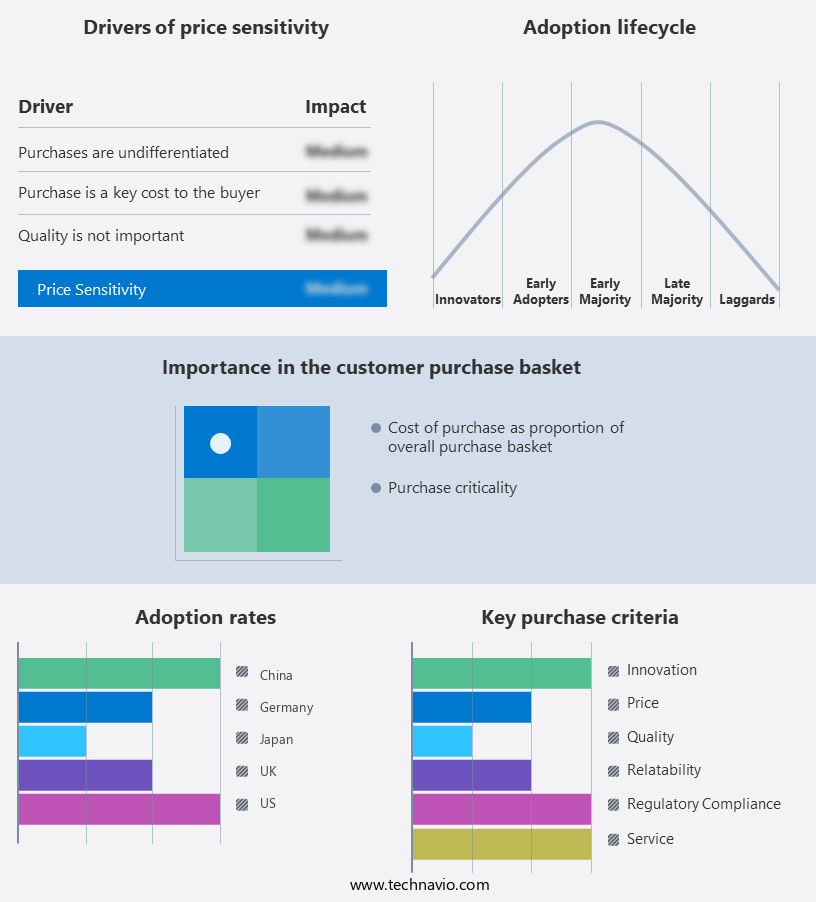
Orthopedic Surgical Robots Market Share by Geography

 Customer Landscape

Key Companies & Market Insights

Companies are implementing various strategies, such as strategic alliances, market forecast, partnerships, mergers and acquisitions, geographical expansion, and product/service launches, to enhance their presence in the market.

The market research and growth report includes detailed analyses of the competitive landscape of the market and information about key companies, including:

  • Asensus Surgical US Inc.
  • Brainlab AG
  • Corin Group Plc
  • Curexo Inc.
  • Galen Robotics Inc.
  • GANYMED ROBOTICS SAS
  • Globus Medical Inc.
  • Intuitive Surgical Inc.
  • Johnson and Johnson Services Inc.
  • KUKA AG
  • Medtronic Plc
  • Nuvasive Inc.
  • OrthAlign Corp.
  • Renishaw Plc
  • Shanghai MicroPort MedBot Group Co. Ltd.
  • Siemens AG
  • Smith and Nephew plc
  • Stryker Corp.
  • THINK Surgical Inc.
  • Zimmer Biomet Holdings Inc.

Qualitative and quantitative analysis of companies has been conducted to help clients understand the wider business environment as well as the strengths and weaknesses of key market players. Data is qualitatively analyzed to categorize companies as pure play, category-focused, industry-focused, and diversified; it is quantitatively analyzed to categorize companies as dominant, leading, strong, tentative, and weak.

Research Analyst Overview

The market is witnessing significant growth due to the increasing adoption of advanced technologies in orthopedic surgeries. The use of these robots enhances precision, flexibility, and accuracy in surgical procedures, leading to improved patient outcomes. Agile and lightweight robots are gaining popularity in the market as they offer easier maneuverability and reduced invasiveness. The market is driven by factors such as the rising prevalence of orthopedic disorders, the growing geriatric population, and the increasing demand for minimally invasive surgeries. Key players in the market include Stryker, Medtronic, and Zimmer Biomet. They are investing in research and development to launch innovative products and expand their market presence.

Furthermore, the market is segmented based on product type, application, and end-user. The product types include robotic arms, robotic systems, and accessories. The applications include hip replacement, knee replacement, and spine surgery. The end-users include hospitals, ambulatory surgical centers, and academic and research institutions. The market is expected to grow at a steady pace in the coming years due to the increasing demand for minimally invasive surgeries and the ongoing advancements in robotics technology. The use of artificial intelligence and machine learning algorithms in orthopedic surgical robots is also expected to drive market growth.

Market Scope

Report Coverage

Details

Page number

169

Base year

2023

Historic period

2018-2022

Forecast period

2024-2028

Growth momentum & CAGR

Accelerate at a CAGR of 27.17%

Market growth 2024-2028

USD 1.49 billion

Market structure

Fragmented

YoY growth 2023-2024(%)

20.98

Key countries

US, UK, Germany, China, and Japan

Competitive landscape

Leading Companies, Market Positioning of Companies, Competitive Strategies, and Industry Risks

Request Free Sample

What are the Key Data Covered in this Market Research and Growth Report?

  • CAGR of the market during the forecast period
  • Detailed information on factors that will drive the market growth and forecasting between 2024 and 2028
  • Precise estimation of the size of the market  and its contribution of the market in focus to the parent market
  • Accurate predictions about upcoming market growth and trends and changes in consumer behaviour
  • Growth of the market across North America, Europe, Asia, and Rest of World (ROW)
  • Thorough analysis of the market's competitive landscape and detailed information about companies
  • Comprehensive analysis of factors that will challenge the growth of market companies

We can help! Our analysts can customize this market research report to meet your requirements. Get in touch

1 Executive Summary

  • 1.1 Market overview
    • Executive Summary - Chart on Market Overview
    • Executive Summary - Data Table on Market Overview
    • Executive Summary - Chart on Global Market Characteristics
    • Executive Summary - Chart on Market by Geography
    • Executive Summary - Chart on Market Segmentation by Application
    • Executive Summary - Chart on Market Segmentation by End-user
    • Executive Summary - Chart on Incremental Growth
    • Executive Summary - Data Table on Incremental Growth
    • Executive Summary - Chart on Company Market Positioning

2 Market Landscape

  • 2.1 Market ecosystem
    • Parent Market
    • Data Table on - Parent Market
  • 2.2 Market characteristics
    • Market characteristics analysis
  • 2.3 Value chain analysis
    • Value Chain Analysis

3 Market Sizing

  • 3.1 Market definition
    • Offerings of companies included in the market definition
  • 3.2 Market segment analysis
    • Market segments
  • 3.3 Market size 2023
    • 3.4 Market outlook: Forecast for 2023-2028
      • Chart on Global - Market size and forecast 2023-2028 ($ million)
      • Data Table on Global - Market size and forecast 2023-2028 ($ million)
      • Chart on Global Market: Year-over-year growth 2023-2028 (%)
      • Data Table on Global Market: Year-over-year growth 2023-2028 (%)

    4 Historic Market Size

    • 4.1 Global Orthopedic Surgical Robots Market 2018 - 2022
      • Historic Market Size - Data Table on Global Orthopedic Surgical Robots Market 2018 - 2022 ($ million)
    • 4.2 Application segment analysis 2018 - 2022
      • Historic Market Size - Application Segment 2018 - 2022 ($ million)
    • 4.3 End-user segment analysis 2018 - 2022
      • Historic Market Size - End-user Segment 2018 - 2022 ($ million)
    • 4.4 Geography segment analysis 2018 - 2022
      • Historic Market Size - Geography Segment 2018 - 2022 ($ million)
    • 4.5 Country segment analysis 2018 - 2022
      • Historic Market Size - Country Segment 2018 - 2022 ($ million)

    5 Five Forces Analysis

    • 5.1 Five forces summary
      • Five forces analysis - Comparison between 2023 and 2028
    • 5.2 Bargaining power of buyers
      • Bargaining power of buyers - Impact of key factors 2023 and 2028
    • 5.3 Bargaining power of suppliers
      • Bargaining power of suppliers - Impact of key factors in 2023 and 2028
    • 5.4 Threat of new entrants
      • Threat of new entrants - Impact of key factors in 2023 and 2028
    • 5.5 Threat of substitutes
      • Threat of substitutes - Impact of key factors in 2023 and 2028
    • 5.6 Threat of rivalry
      • Threat of rivalry - Impact of key factors in 2023 and 2028
    • 5.7 Market condition
      • Chart on Market condition - Five forces 2023 and 2028

    6 Market Segmentation by Application

    • 6.1 Market segments
      • Chart on Application - Market share 2023-2028 (%)
      • Data Table on Application - Market share 2023-2028 (%)
    • 6.2 Comparison by Application
      • Chart on Comparison by Application
      • Data Table on Comparison by Application
    • 6.3 Knee surgery - Market size and forecast 2023-2028
      • Chart on Knee surgery - Market size and forecast 2023-2028 ($ million)
      • Data Table on Knee surgery - Market size and forecast 2023-2028 ($ million)
      • Chart on Knee surgery - Year-over-year growth 2023-2028 (%)
      • Data Table on Knee surgery - Year-over-year growth 2023-2028 (%)
    • 6.4 Hip surgery - Market size and forecast 2023-2028
      • Chart on Hip surgery - Market size and forecast 2023-2028 ($ million)
      • Data Table on Hip surgery - Market size and forecast 2023-2028 ($ million)
      • Chart on Hip surgery - Year-over-year growth 2023-2028 (%)
      • Data Table on Hip surgery - Year-over-year growth 2023-2028 (%)
    • 6.5 Market opportunity by Application
      • Market opportunity by Application ($ million)
      • Data Table on Market opportunity by Application ($ million)

    7 Market Segmentation by End-user

    • 7.1 Market segments
      • Chart on End-user - Market share 2023-2028 (%)
      • Data Table on End-user - Market share 2023-2028 (%)
    • 7.2 Comparison by End-user
      • Chart on Comparison by End-user
      • Data Table on Comparison by End-user
    • 7.3 Hospitals - Market size and forecast 2023-2028
      • Chart on Hospitals - Market size and forecast 2023-2028 ($ million)
      • Data Table on Hospitals - Market size and forecast 2023-2028 ($ million)
      • Chart on Hospitals - Year-over-year growth 2023-2028 (%)
      • Data Table on Hospitals - Year-over-year growth 2023-2028 (%)
    • 7.4 Ambulatory service centers - Market size and forecast 2023-2028
      • Chart on Ambulatory service centers - Market size and forecast 2023-2028 ($ million)
      • Data Table on Ambulatory service centers - Market size and forecast 2023-2028 ($ million)
      • Chart on Ambulatory service centers - Year-over-year growth 2023-2028 (%)
      • Data Table on Ambulatory service centers - Year-over-year growth 2023-2028 (%)
    • 7.5 Market opportunity by End-user
      • Market opportunity by End-user ($ million)
      • Data Table on Market opportunity by End-user ($ million)

    8 Customer Landscape

    • 8.1 Customer landscape overview
      • Analysis of price sensitivity, lifecycle, customer purchase basket, adoption rates, and purchase criteria

    9 Geographic Landscape

    • 9.1 Geographic segmentation
      • Chart on Market share by geography 2023-2028 (%)
      • Data Table on Market share by geography 2023-2028 (%)
    • 9.2 Geographic comparison
      • Chart on Geographic comparison
      • Data Table on Geographic comparison
    • 9.3 North America - Market size and forecast 2023-2028
      • Chart on North America - Market size and forecast 2023-2028 ($ million)
      • Data Table on North America - Market size and forecast 2023-2028 ($ million)
      • Chart on North America - Year-over-year growth 2023-2028 (%)
      • Data Table on North America - Year-over-year growth 2023-2028 (%)
    • 9.4 Europe - Market size and forecast 2023-2028
      • Chart on Europe - Market size and forecast 2023-2028 ($ million)
      • Data Table on Europe - Market size and forecast 2023-2028 ($ million)
      • Chart on Europe - Year-over-year growth 2023-2028 (%)
      • Data Table on Europe - Year-over-year growth 2023-2028 (%)
    • 9.5 Asia - Market size and forecast 2023-2028
      • Chart on Asia - Market size and forecast 2023-2028 ($ million)
      • Data Table on Asia - Market size and forecast 2023-2028 ($ million)
      • Chart on Asia - Year-over-year growth 2023-2028 (%)
      • Data Table on Asia - Year-over-year growth 2023-2028 (%)
    • 9.6 Rest of World (ROW) - Market size and forecast 2023-2028
      • Chart on Rest of World (ROW) - Market size and forecast 2023-2028 ($ million)
      • Data Table on Rest of World (ROW) - Market size and forecast 2023-2028 ($ million)
      • Chart on Rest of World (ROW) - Year-over-year growth 2023-2028 (%)
      • Data Table on Rest of World (ROW) - Year-over-year growth 2023-2028 (%)
    • 9.7 US - Market size and forecast 2023-2028
      • Chart on US - Market size and forecast 2023-2028 ($ million)
      • Data Table on US - Market size and forecast 2023-2028 ($ million)
      • Chart on US - Year-over-year growth 2023-2028 (%)
      • Data Table on US - Year-over-year growth 2023-2028 (%)
    • 9.8 UK - Market size and forecast 2023-2028
      • Chart on UK - Market size and forecast 2023-2028 ($ million)
      • Data Table on UK - Market size and forecast 2023-2028 ($ million)
      • Chart on UK - Year-over-year growth 2023-2028 (%)
      • Data Table on UK - Year-over-year growth 2023-2028 (%)
    • 9.9 Germany - Market size and forecast 2023-2028
      • Chart on Germany - Market size and forecast 2023-2028 ($ million)
      • Data Table on Germany - Market size and forecast 2023-2028 ($ million)
      • Chart on Germany - Year-over-year growth 2023-2028 (%)
      • Data Table on Germany - Year-over-year growth 2023-2028 (%)
    • 9.10 China - Market size and forecast 2023-2028
      • Chart on China - Market size and forecast 2023-2028 ($ million)
      • Data Table on China - Market size and forecast 2023-2028 ($ million)
      • Chart on China - Year-over-year growth 2023-2028 (%)
      • Data Table on China - Year-over-year growth 2023-2028 (%)
    • 9.11 Japan - Market size and forecast 2023-2028
      • Chart on Japan - Market size and forecast 2023-2028 ($ million)
      • Data Table on Japan - Market size and forecast 2023-2028 ($ million)
      • Chart on Japan - Year-over-year growth 2023-2028 (%)
      • Data Table on Japan - Year-over-year growth 2023-2028 (%)
    • 9.12 Market opportunity by geography
      • Market opportunity by geography ($ million)
      • Data Tables on Market opportunity by geography ($ million)

    10 Drivers, Challenges, and Opportunity/Restraints

    • 10.1 Market drivers
      • 10.2 Market challenges
        • 10.3 Impact of drivers and challenges
          • Impact of drivers and challenges in 2023 and 2028
        • 10.4 Market opportunities/restraints

          11 Competitive Landscape

          • 11.1 Overview
            • 11.2 Competitive Landscape
              • Overview on criticality of inputs and factors of differentiation
            • 11.3 Landscape disruption
              • Overview on factors of disruption
            • 11.4 Industry risks
              • Impact of key risks on business

            12 Competitive Analysis

            • 12.1 Companies profiled
              • Companies covered
            • 12.2 Market positioning of companies
              • Matrix on companies position and classification
            • 12.3 Asensus Surgical US Inc.
              • Asensus Surgical US Inc. - Overview
              • Asensus Surgical US Inc. - Product / Service
              • Asensus Surgical US Inc. - Key offerings
            • 12.4 Brainlab AG
              • Brainlab AG - Overview
              • Brainlab AG - Product / Service
              • Brainlab AG - Key offerings
            • 12.5 Corin Group Plc
              • Corin Group Plc - Overview
              • Corin Group Plc - Product / Service
              • Corin Group Plc - Key offerings
            • 12.6 Curexo Inc.
              • Curexo Inc. - Overview
              • Curexo Inc. - Product / Service
              • Curexo Inc. - Key offerings
            • 12.7 Galen Robotics Inc.
              • Galen Robotics Inc. - Overview
              • Galen Robotics Inc. - Product / Service
              • Galen Robotics Inc. - Key offerings
            • 12.8 Globus Medical Inc.
              • Globus Medical Inc. - Overview
              • Globus Medical Inc. - Product / Service
              • Globus Medical Inc. - Key offerings
            • 12.9 Intuitive Surgical Inc.
              • Intuitive Surgical Inc. - Overview
              • Intuitive Surgical Inc. - Product / Service
              • Intuitive Surgical Inc. - Key news
              • Intuitive Surgical Inc. - Key offerings
            • 12.10 Johnson and Johnson Services Inc.
              • Johnson and Johnson Services Inc. - Overview
              • Johnson and Johnson Services Inc. - Business segments
              • Johnson and Johnson Services Inc. - Key news
              • Johnson and Johnson Services Inc. - Key offerings
              • Johnson and Johnson Services Inc. - Segment focus
            • 12.11 Medtronic Plc
              • Medtronic Plc - Overview
              • Medtronic Plc - Business segments
              • Medtronic Plc - Key news
              • Medtronic Plc - Key offerings
              • Medtronic Plc - Segment focus
            • 12.12 Nuvasive Inc.
              • Nuvasive Inc. - Overview
              • Nuvasive Inc. - Business segments
              • Nuvasive Inc. - Key offerings
              • Nuvasive Inc. - Segment focus
            • 12.13 Renishaw Plc
              • Renishaw Plc - Overview
              • Renishaw Plc - Business segments
              • Renishaw Plc - Key offerings
              • Renishaw Plc - Segment focus
            • 12.14 Smith and Nephew plc
              • Smith and Nephew plc - Overview
              • Smith and Nephew plc - Business segments
              • Smith and Nephew plc - Key news
              • Smith and Nephew plc - Key offerings
              • Smith and Nephew plc - Segment focus
            • 12.15 Stryker Corp.
              • Stryker Corp. - Overview
              • Stryker Corp. - Business segments
              • Stryker Corp. - Key news
              • Stryker Corp. - Key offerings
              • Stryker Corp. - Segment focus
            • 12.16 THINK Surgical Inc.
              • THINK Surgical Inc. - Overview
              • THINK Surgical Inc. - Product / Service
              • THINK Surgical Inc. - Key offerings
            • 12.17 Zimmer Biomet Holdings Inc.
              • Zimmer Biomet Holdings Inc. - Overview
              • Zimmer Biomet Holdings Inc. - Business segments
              • Zimmer Biomet Holdings Inc. - Key news
              • Zimmer Biomet Holdings Inc. - Key offerings
              • Zimmer Biomet Holdings Inc. - Segment focus

            13 Appendix

            • 13.1 Scope of the report
              • 13.2 Inclusions and exclusions checklist
                • Inclusions checklist
                • Exclusions checklist
              • 13.3 Currency conversion rates for US$
                • Currency conversion rates for US$
              • 13.4 Research methodology
                • Research methodology
              • 13.5 Data procurement
                • Information sources
              • 13.6 Data validation
                • Data validation
              • 13.7 Validation techniques employed for market sizing
                • Validation techniques employed for market sizing
              • 13.8 Data synthesis
                • Data synthesis
              • 13.9 360 degree market analysis
                • 360 degree market analysis
              • 13.10 List of abbreviations
                • List of abbreviations

              Research Methodology

              Technavio presents a detailed picture of the market by way of study, synthesis, and summation of data from multiple sources. The analysts have presented the various facets of the market with a particular focus on identifying the key industry influencers. The data thus presented is comprehensive, reliable, and the result of extensive research, both primary and secondary.

              INFORMATION SOURCES

              Primary sources

              • Manufacturers and suppliers
              • Channel partners
              • Industry experts
              • Strategic decision makers

              Secondary sources

              • Industry journals and periodicals
              • Government data
              • Financial reports of key industry players
              • Historical data
              • Press releases

              DATA ANALYSIS

              Data Synthesis

              • Collation of data
              • Estimation of key figures
              • Analysis of derived insights

              Data Validation

              • Triangulation with data models
              • Reference against proprietary databases
              • Corroboration with industry experts

              REPORT WRITING

              Qualitative

              • Market drivers
              • Market challenges
              • Market trends
              • Five forces analysis

              Quantitative

              • Market size and forecast
              • Market segmentation
              • Geographical insights
              • Competitive landscape

              Interested in this report?

              Get your sample now to see our research methodology and insights!

              Download Now

              Frequently Asked Questions

              Orthopedic Surgical Robots market growth will increase by $ 1492.7 mn during 2024-2028.

              The Orthopedic Surgical Robots market is expected to grow at a CAGR of 27.17% during 2024-2028.

              Orthopedic Surgical Robots market is segmented by Application( Knee surgery, Hip surgery) End-user( Hospitals, Ambulatory service centers, Asia, ROW)

              Asensus Surgical US Inc., Brainlab AG, Corin Group Plc, Curexo Inc., Galen Robotics Inc., GANYMED ROBOTICS SAS, Globus Medical Inc., Intuitive Surgical Inc., Johnson and Johnson Services Inc., KUKA AG, Medtronic Plc, Nuvasive Inc., OrthAlign Corp., Renishaw Plc, Shanghai MicroPort MedBot Group Co. Ltd., Siemens AG, Smith and Nephew plc, Stryker Corp., THINK Surgical Inc., Zimmer Biomet Holdings Inc. are a few of the key vendors in the Orthopedic Surgical Robots market.

              North America will register the highest growth rate of 36% among the other regions. Therefore, the Orthopedic Surgical Robots market in North America is expected to garner significant business opportunities for the vendors during the forecast period.

              US, UK, Germany, China, Japan

              • Limitations in conventional surgeries spurring the adoption of robotic surgical platformsThe major drivers of orthopedic surgical robots are the advantages they offer over conventional surgeries. One of these is the accuracy in the placement of implants is the driving factor this market.
              • which is achieved with the involvement of orthopedic surgical robots. This in turn is the driving factor this market.
              • is expected to fulfill the need for hospitals to increase their Return on investment (ROI) and reduce postoperative complications such as premature implant failure is the driving factor this market.
              • revisions is the driving factor this market.
              • and mechanical faults is the driving factor this market.
              • and reduce hospitalization and recovery time during the forecast period. On the other hand is the driving factor this market.
              • orthopedic surgical robots allow for more dexterity is the driving factor this market.
              • efficiency in hand-eye coordination is the driving factor this market.
              • ergonomic positioning is the driving factor this market.
              • and improvement in visualization with the assistance of CT scans is the driving factor this market.
              • preoperative plans is the driving factor this market.
              • and simulation software.Hospitals are increasingly adopting strategies that enable minimally invasive surgeries rather than open surgeries. Orthopedic surgical robots can solve medical issues in a less invasive manner. For instance is the driving factor this market.
              • Stryker Robotic Arm Interactive Orthopedic (RIO) System is being used by surgeons to perform total knee arthroplasty with partial knee replacement procedures wherever possible.The limitations involved in open surgeries have driven the adoption of surgical robots. Open and laparoscopic surgeries require large incisions and longer recovery times. Also is the driving factor this market.
              • these procedures are associated with increased infection rates and increased blood transfusion rates. Therefore is the driving factor this market.
              • surgeons are increasingly adopting surgical robots owing to their benefits over open surgeries. Some of the advantages of surgical robots include the reduction of incision size is the driving factor this market.
              • fewer blood transfusions is the driving factor this market.
              • and improved recovery times. Also is the driving factor this market.
              • their use reduces urinary incontinence is the driving factor this market.
              • erectile dysfunction is the driving factor this market.
              • and mortality rates. Further is the driving factor this market.
              • robotic surgery enhances opportunities for simulation.In the case of orthopedic surgeries is the driving factor this market.
              • while an open surgery involves an opening up of the joint is the driving factor this market.
              • robotic surgeries require only two small incisions is the driving factor this market.
              • one for the arthroscope and one for the instruments to be used in the knee cavity. This is the driving factor this market.
              • in turn is the driving factor this market.
              • is expected to lead to less trauma to the connective soft tissues in the area surrounding the joint during the forecast period. This is mainly preferable for treating professional athletes who frequently suffer from knee joint injuries. Hence the market in focus is expected to grow during the forecast period. is the driving factor this market.

              The Orthopedic Surgical Robots market vendors should focus on grabbing business opportunities from the Knee surgery segment as it accounted for the largest market share in the base year.
              RIA - Research AI Assistant
              Ask RIA
