



Vietnam Higher Education Market Size 2026-2030
The vietnam higher education market size is valued to increase by USD 974.6 million, at a CAGR of 19.7% from 2025 to 2030. Advent of changes in educational content delivery methods will drive the vietnam higher education market.
Major Market Trends & Insights
- By Product - Software segment was valued at USD 325.6 million in 2024
- By End-user - Private colleges segment accounted for the largest market revenue share in 2024
Market Size & Forecast
- Market Opportunities: USD 1.31 billion
- Market Future Opportunities: USD 974.6 million
- CAGR from 2025 to 2030 : 19.7%
Market Summary
- The higher education market in vietnam is undergoing a profound structural transformation, driven by government mandates for modernization and a strategic shift toward high-technology industrialization. This evolution is characterized by a diversification of delivery models, where traditional public institutions are increasingly competing with agile private universities offering specialized programs.
- A key driver is the emphasis on digital transformation, including the adoption of digital learning platforms and virtual classrooms to enhance student engagement and support competency-based education.
- For instance, a university might deploy a new learning management system integrated with ai-powered tools to create adaptive learning paths, which helps improve graduate employability by aligning curriculum development more closely with labor market needs. At the same time, institutions face challenges related to rising operational costs and the need for robust quality assurance frameworks to secure global accreditation.
- The trend toward institutional autonomy is empowering universities to innovate, but it also increases pressure to demonstrate clear returns on investment through strong industry collaboration and high graduate competency levels. This dynamic environment is fostering a more competitive and responsive educational ecosystem focused on producing a skilled workforce for a digital economy.
What will be the Size of the Vietnam Higher Education Market during the forecast period?
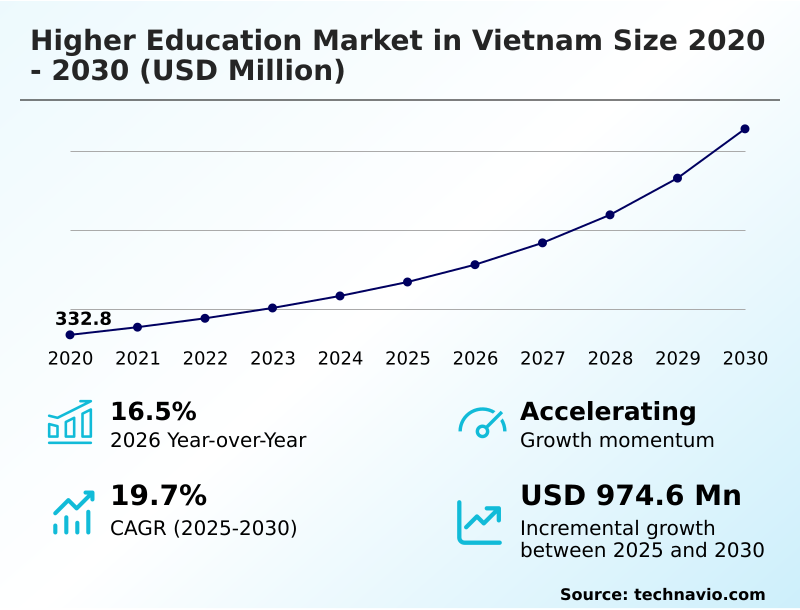
Get Key Insights on Market Forecast (PDF) Request Free Sample
How is the Vietnam Higher Education Market Segmented?
The vietnam higher education industry research report provides comprehensive data (region-wise segment analysis), with forecasts and estimates in "USD million" for the period 2026-2030, as well as historical data from 2020-2024 for the following segments.
- Product
- Software
- Hardware
- End-user
- Private colleges
- State universities
- Community colleges
- Courses
- Undergraduate
- Masters
- PhD
- Geography
- APAC
By Product Insights
The software segment is estimated to witness significant growth during the forecast period.
The software segment is pivotal to the evolution of the higher education market in vietnam 2026-2030, driven by the adoption of learning management systems and ai-powered tools.
Institutions are implementing comprehensive student information software and administrative enterprise resource planning tools to enhance pedagogical efficacy. This shift, amplified by national digital transformation programs mandating paperless administration, moves beyond basic tools toward sophisticated, AI-driven platforms.
These systems support adaptive learning paths and utilize predictive analytics, with some universities reporting a 15% improvement in student retention rates.
The focus is on integrating specialized research software and collaborative digital platforms, including online assessment tools, to align with global academic standards and foster improved student engagement through blended learning models.
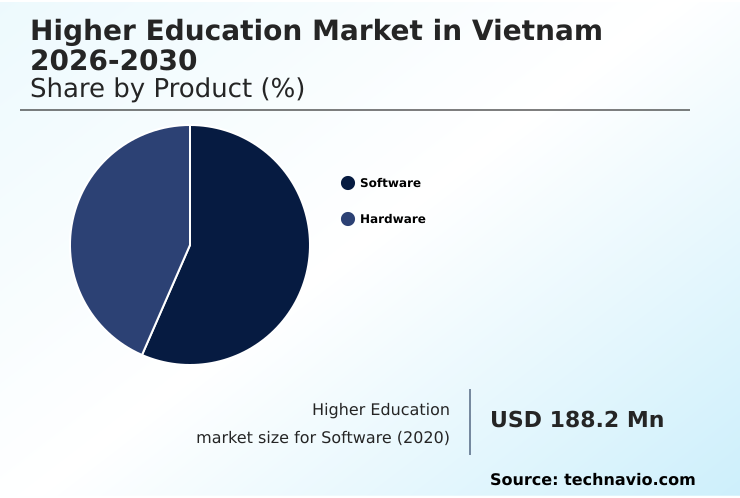
The Software segment was valued at USD 325.6 million in 2024 and showed a gradual increase during the forecast period.
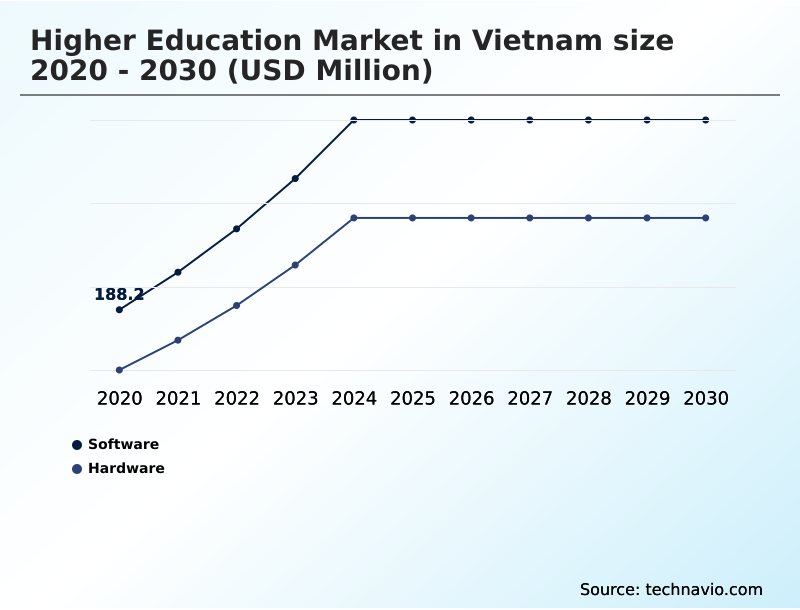
Market Dynamics
Our researchers analyzed the data with 2025 as the base year, along with the key drivers, trends, and challenges. A holistic analysis of drivers will help companies refine their marketing strategies to gain a competitive advantage.
- Strategic positioning in the higher education market in vietnam 2022-2026 hinges on effectively addressing the skills gap in vietnam through robust curriculum alignment with industry needs. Institutions are pursuing state university digital transformation and private university infrastructure expansion to create competitive learning environments.
- This involves not only implementing technology-based course delivery methods but also integrating ai in higher education to personalize the student experience. As a result, improving graduate employability rates has become a primary benchmark for success. Universities focused on aligning academic programs with workforce demands have seen a twofold increase in successful student placements compared to those with more traditional structures.
- Key strategies include fostering international partnerships for higher education, developing stem education enhancement programs, and ensuring robust quality assurance in online learning. Furthermore, navigating the challenges of faculty development and retention is critical, as is the successful implementation of university autonomy policies. Success ultimately depends on enhancing university-industry collaboration, which directly influences student career outcomes and institutional reputation.
- The focus on vocational training for the digital economy and the expansion of transnational education partnerships are also vital for long-term growth and relevance in a rapidly evolving market.
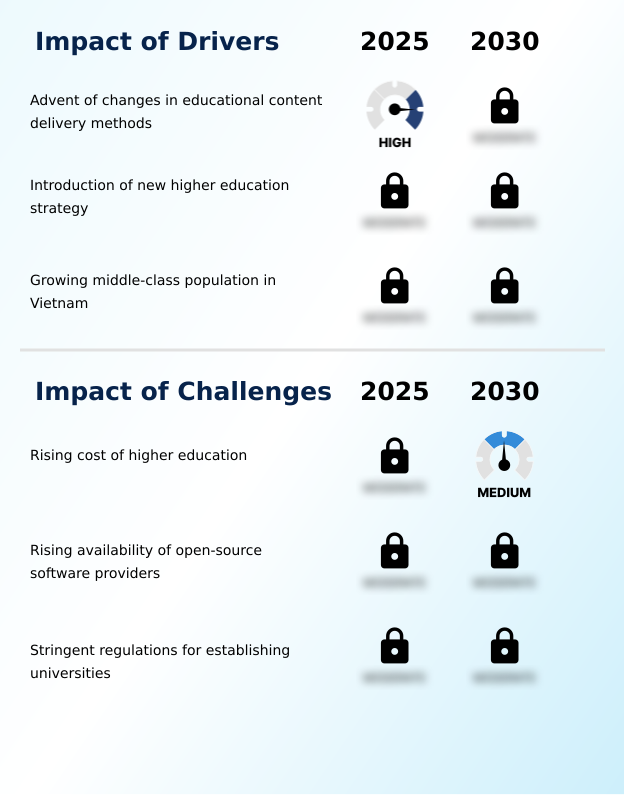
What are the key market drivers leading to the rise in the adoption of Vietnam Higher Education Industry?
- The evolution of educational content delivery methods is a key driver stimulating market growth.
- Growth in the higher education market in vietnam 2026-2030 is primarily propelled by the adoption of new digital content delivery methods and supportive national strategies.
- The shift toward hybrid learning and virtual classrooms has led to a 20% increase in enrollment from working professionals seeking flexible educational pathways. This digital transformation aligns with government initiatives focused on modernization and improving labor market needs.
- Concurrently, the expansion of the middle-class population has fueled demand for high-quality programs, spurring a 25% year-over-year expansion in private university capacity.
- This demographic driver supports greater investment in advanced infrastructure and diversified academic offerings, including cross-border research and innovative teaching methods.
What are the market trends shaping the Vietnam Higher Education Industry?
- The growing internationalization of the education sector represents a significant market trend. This development is reshaping academic standards and institutional strategies.
- Key trends reshaping the higher education market in vietnam 2026-2030 are the push for institutional autonomy and the rapid internationalization of the educational landscape. As universities gain more independence, they are better able to pursue curriculum development tailored to emerging fields, with autonomous institutions reporting a 40% faster time-to-market for new, industry-relevant courses.
- This is complemented by the growth of joint degree programs, which now account for over 15% of offerings at top private universities. The emphasis on technology-based course delivery, supported by digital learning platforms and virtual classrooms, is creating more flexible and accessible learning environments, enhancing the overall academic experience and promoting academic competitiveness on a global scale.
What challenges does the Vietnam Higher Education Industry face during its growth?
- The rising cost of higher education presents a key challenge to the industry's growth trajectory.
- Significant challenges constrain the higher education market in vietnam 2026-2030, including stringent regulations and the rising availability of open-source software. The complex regulatory framework for establishing new universities can delay market entry for international branch campuses by over 24 months, limiting competition. Meanwhile, the shift toward open-source platforms for functions like student information software introduces new complexities.
- While offering cost savings, reliance on internal IT staff for maintenance has increased operational overhead by up to 18% for some institutions, diverting resources from core academic functions like research commercialization. These factors, combined with the rising cost of education, create a difficult operating environment requiring strategic management of paperless administration and technology integration.
Exclusive Technavio Analysis on Customer Landscape
The vietnam higher education market forecasting report includes the adoption lifecycle of the market, covering from the innovator’s stage to the laggard’s stage. It focuses on adoption rates in different regions based on penetration. Furthermore, the vietnam higher education market report also includes key purchase criteria and drivers of price sensitivity to help companies evaluate and develop their market growth analysis strategies.
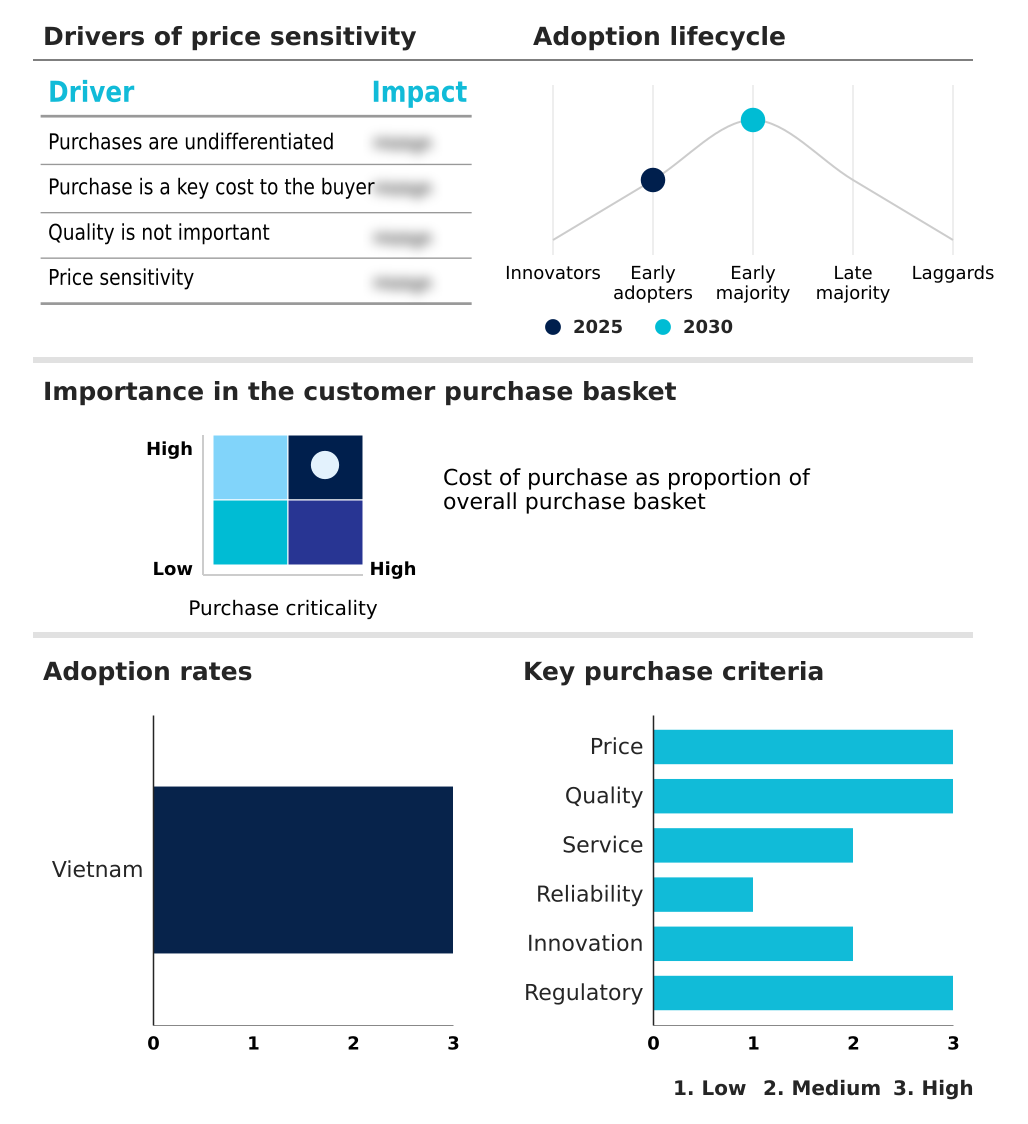
Customer Landscape of Vietnam Higher Education Industry
Competitive Landscape
Companies are implementing various strategies, such as strategic alliances, vietnam higher education market forecast, partnerships, mergers and acquisitions, geographical expansion, and product/service launches, to enhance their presence in the industry.
British University Vietnam - Key offerings include specialized, internationally-accredited degree programs that focus on enhancing graduate employability and aligning with modern workforce requirements through competency-based education.
The industry research and growth report includes detailed analyses of the competitive landscape of the market and information about key companies, including:
- British University Vietnam
- EQuest Education Group
- FPT University
- Gia Dinh University
- Hoa Sen University
- Hong Bang Intl. University
- Keiser University Vietnam
- Phu Xuan University
- Phuong Dong University
- RMIT University Vietnam
- Saigon Business School
- Saigon International University
- Saigon Technology University
- Swinburne Vietnam
- University of EF
- University of Finance Marketing
- Van Hien University
- Van Lang University
Qualitative and quantitative analysis of companies has been conducted to help clients understand the wider business environment as well as the strengths and weaknesses of key industry players. Data is qualitatively analyzed to categorize companies as pure play, category-focused, industry-focused, and diversified; it is quantitatively analyzed to categorize companies as dominant, leading, strong, tentative, and weak.
Recent Development and News in Vietnam higher education market
- In April, 2025, British University Vietnam inaugurated the second phase of its Ecopark campus, featuring specialized laboratories and smart classrooms to support a paperless learning environment.
- In March, 2025, the U.S. Mission to Vietnam initiated a major academic partnership, facilitating a study tour for leaders from 21 U.S. universities to expand collaboration with Vietnamese institutions.
- In March, 2025, leaders from the UK and Vietnamese higher education sectors convened to launch the British Council's four-year UK-Viet Nam iTechPath initiative, aimed at expanding long-term partnerships in talent development and innovation.
- In March, 2025, an updated legal framework in Vietnam continued to attract foreign investment into the higher education sector, resulting in over USD 4.5 billion in capital and 430 joint programs.
Dive into Technavio’s robust research methodology, blending expert interviews, extensive data synthesis, and validated models for unparalleled Vietnam Higher Education Market insights. See full methodology.
| Market Scope | |
|---|---|
| Page number | 172 |
| Base year | 2025 |
| Historic period | 2020-2024 |
| Forecast period | 2026-2030 |
| Growth momentum & CAGR | Accelerate at a CAGR of 19.7% |
| Market growth 2026-2030 | USD 974.6 million |
| Market structure | Fragmented |
| YoY growth 2025-2026(%) | 16.5% |
| Key countries | Vietnam |
| Competitive landscape | Leading Companies, Market Positioning of Companies, Competitive Strategies, and Industry Risks |
Research Analyst Overview
- The higher education market in vietnam 2026-2030 is driven by a strategic imperative to enhance global academic competitiveness and align educational output with high-technology industrialization. A central theme is the move toward institutional autonomy, compelling university leadership to make critical budgetary decisions regarding investments in advanced educational technologies.
- The adoption of integrated student information software has enabled some institutions to reduce administrative processing times by over 25%, reallocating funds to support faculty development and research commercialization. This transformation requires the implementation of robust learning management systems, ai-powered tools, and virtual labs to support diverse pedagogical approaches like blended learning models.
- As universities expand joint degree programs and transnational education models, the focus sharpens on maintaining stringent quality assurance frameworks to secure global accreditation. Success is increasingly measured by graduate employability and the ability to produce graduates with competencies in key stem disciplines, supported by modern digital content delivery and adaptive learning paths.
What are the Key Data Covered in this Vietnam Higher Education Market Research and Growth Report?
-
What is the expected growth of the Vietnam Higher Education Market between 2026 and 2030?
-
USD 974.6 million, at a CAGR of 19.7%
-
-
What segmentation does the market report cover?
-
The report is segmented by Product (Software, and Hardware), End-user (Private colleges, State universities, and Community colleges), Courses (Undergraduate, Masters, and PhD) and Geography (APAC)
-
-
Which regions are analyzed in the report?
-
APAC
-
-
What are the key growth drivers and market challenges?
-
Advent of changes in educational content delivery methods, Rising cost of higher education
-
-
Who are the major players in the Vietnam Higher Education Market?
-
British University Vietnam, EQuest Education Group, FPT University, Gia Dinh University, Hoa Sen University, Hong Bang Intl. University, Keiser University Vietnam, Phu Xuan University, Phuong Dong University, RMIT University Vietnam, Saigon Business School, Saigon International University, Saigon Technology University, Swinburne Vietnam, University of EF, University of Finance Marketing, Van Hien University and Van Lang University
-
Market Research Insights
- The higher education market in vietnam 2026-2030 is defined by dynamic competitive pressures and strategic shifts toward digital maturity. The adoption of blended learning models has expanded access, leading to a 20% increase in enrollments from non-traditional student segments.
- As institutions embrace digital content delivery, they are achieving a 30% faster curriculum update cycle, which is critical for programs in rapidly evolving technology fields. This transition to cross-border research and innovative teaching methods is essential for maintaining relevance.
- Furthermore, the emphasis on competency-based education and enhanced student support services is a direct response to market demands for job-ready graduates, pushing institutions to refine their academic offerings and administrative processes.
We can help! Our analysts can customize this vietnam higher education market research report to meet your requirements.
 RIA -
RIA - 
