


Cryptocurrency Market Size 2026-2030
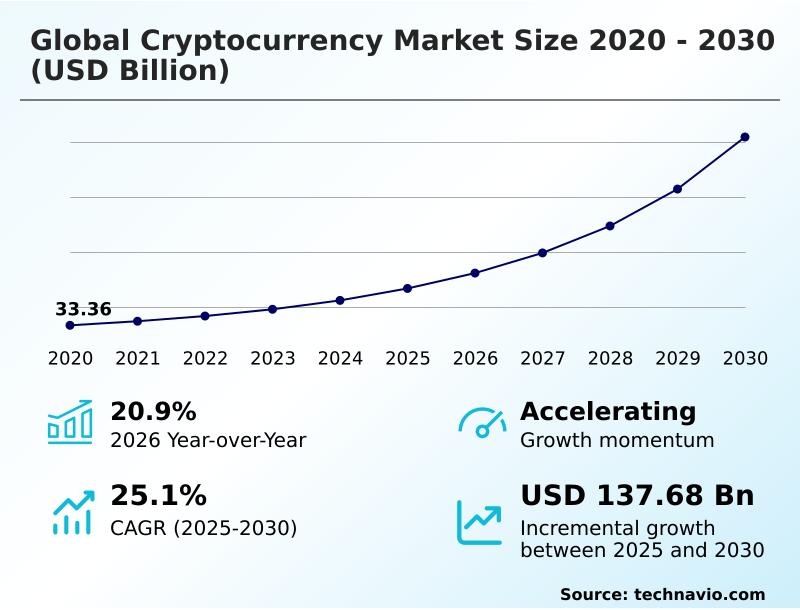
The cryptocurrency market size is valued to increase by USD 137.68 billion, at a CAGR of 25.1% from 2025 to 2030. Mainstream integration of tokenized assets and on-chain finance will drive the cryptocurrency market.
Major Market Trends & Insights
- North America dominated the market and accounted for a 34.4% growth during the forecast period.
- By Type - Bitcoin segment was valued at USD 33.53 billion in 2024
- By Application - Trading and investment segment accounted for the largest market revenue share in 2024
Market Size & Forecast
- Market Opportunities: USD 171.18 billion
- Market Future Opportunities: USD 137.68 billion
- CAGR from 2025 to 2030 : 25.1%
Market Summary
- The cryptocurrency market is undergoing a fundamental maturation phase, shifting from a focus on speculative retail trading toward deep-seated institutional integration and comprehensive regulatory oversight. This evolution is driven by the legitimization of digital assets, catalyzed by the successful launch of spot exchange-traded products and the subsequent entry of major asset managers.
- As global financial infrastructure adopts distributed ledger technology (DLT), the utility of cryptocurrencies has expanded beyond simple value storage to include programmable on-chain finance, cross-border settlement through peer-to-peer transactions, and the tokenization of real-world assets.
- For instance, a global logistics firm can leverage blockchain technology to create an immutable record of its supply chain, enhancing transparency and reducing fraud by over 25%. This transition necessitates high-grade technical interoperability and the development of robust institutional-grade custody solutions.
- The rise of decentralized finance (DeFi) protocols, supported by expanding stablecoin reserves, challenges conventional banking models by offering permissionless lending and borrowing. However, this segment remains under scrutiny regarding smart contract vulnerabilities and the need for scalable layer-2 scaling solutions to handle increasing transaction volumes without compromising the core tenets of decentralization.
What will be the Size of the Cryptocurrency Market during the forecast period?
Get Key Insights on Market Forecast (PDF) Request Free Sample
How is the Cryptocurrency Market Segmented?
The cryptocurrency industry research report provides comprehensive data (region-wise segment analysis), with forecasts and estimates in "USD million" for the period 2026-2030, as well as historical data from 2020-2024 for the following segments.
- Type
- Bitcoin
- Ethereum
- Others
- Application
- Trading and investment
- Payments and remittances
- Others
- End-user
- Retail
- Institutional
- Geography
- North America
- US
- Canada
- Mexico
- APAC
- India
- Indonesia
- South Korea
- Europe
- UK
- Germany
- France
- Middle East and Africa
- South Africa
- UAE
- Saudi Arabia
- South America
- Brazil
- Argentina
- Colombia
- Rest of World (ROW)
- North America
By Type Insights
The bitcoin segment is estimated to witness significant growth during the forecast period.
The cryptocurrency market segmentation reflects a maturing ecosystem. Bitcoin maintains its position as the preeminent asset, primarily serving as a digital store of value and a hedge against macroeconomic volatility.
The institutionalization of bitcoin has reached an inflection point, transitioning from a speculative retail instrument to a foundational component of diversified investment portfolios, with North America now commanding over 34% of institutional capital flows.
This shift is attributed to the proliferation of regulated spot exchange-traded funds (ETFs). The integration of bitcoin into national treasury strategies and the establishment of a strategic bitcoin reserve in some nations mark a significant evolution.
As the network continues to undergo technological refinements, such as improvements in layer-2 scaling solutions, its capacity for high-volume settlement and on-chain finance is expected to expand, reinforcing its dominance as a driver of market liquidity and investor sentiment.
The reliance on proof-of-work protocols, however, faces scrutiny under new environmental transparency mandates.
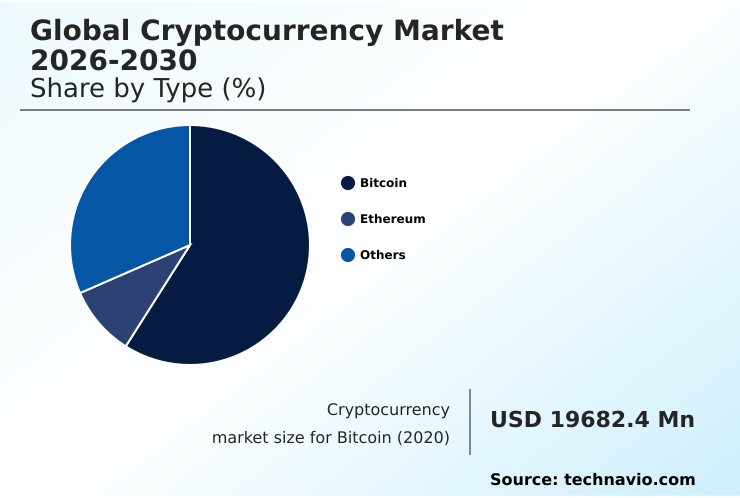
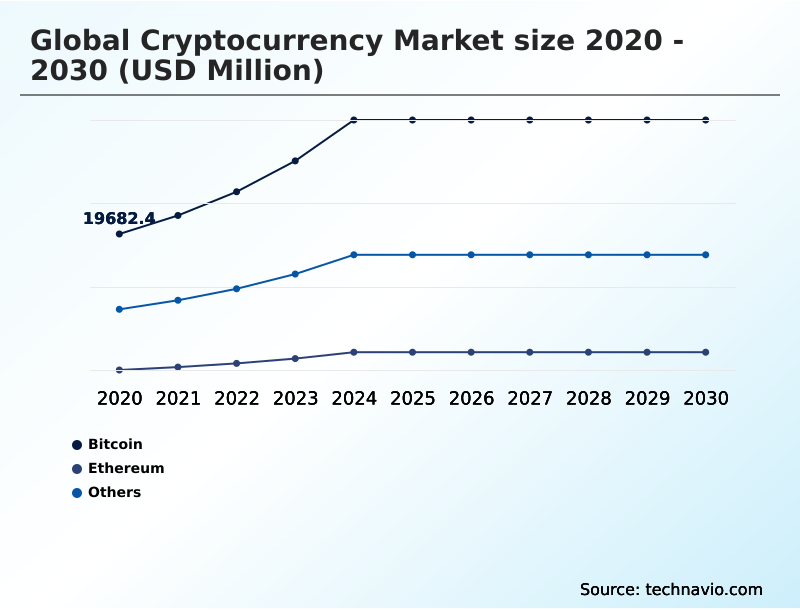
The Bitcoin segment was valued at USD 33.53 billion in 2024 and showed a gradual increase during the forecast period.
Regional Analysis
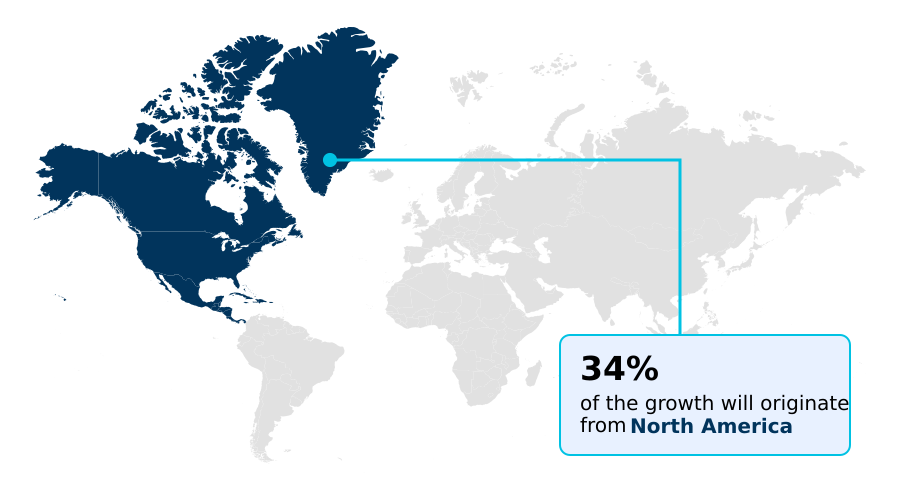
North America is estimated to contribute 34.4% to the growth of the global market during the forecast period.Technavio’s analysts have elaborately explained the regional trends and drivers that shape the market during the forecast period.
See How Cryptocurrency Market Demand is Rising in North America Request Free Sample
The geographic landscape of the cryptocurrency market is diverse and dynamic, with different regions exhibiting unique drivers and regulatory approaches. In North America, institutional adoption leads, with a focus on regulated investment products and enterprise-grade technology.
The APAC region is a hub of retail engagement and innovation, with markets showing a high appetite for decentralized finance (DeFi) and a notable kimchi premium in some areas; this region is expanding at a rate of 25.7%, slightly ahead of Europe’s 25.2%.
Europe has established a comprehensive legal framework through the markets in crypto-assets (MiCA) regulation, creating a stable environment for virtual asset service providers (VASPs).
In the Middle East, the virtual assets regulatory authority (VARA) in Dubai is setting global standards, while South America leverages crypto, including the upcoming brazilian digital real (DREX), as a hedge against inflation.
This regional specialization fosters a resilient global ecosystem where different use cases, from sharia compliance to p2p engine development, can flourish.
Market Dynamics
Our researchers analyzed the data with 2025 as the base year, along with the key drivers, trends, and challenges. A holistic analysis of drivers will help companies refine their marketing strategies to gain a competitive advantage.
- The global cryptocurrency market is navigating a complex interplay of innovation and regulation, where the institutional adoption of tokenized assets is a primary catalyst. The real-world asset tokenization benefits are becoming clear as corporations explore digitizing balance sheets for enhanced liquidity. However, this progress is met with the compliance burden of fragmented regulations, creating a challenging environment for global firms.
- The debate between decentralized finance versus traditional finance continues, with DeFi protocols offering compelling alternatives for yield generation in proof-of-stake networks. At the same time, the industry grapples with significant security challenges in decentralized finance, where the risks of cross-chain bridge exploits and flash loan attacks demand enhanced cybersecurity resilience.
- The role of oracles in DeFi protocols is critical for data integrity, while managing liquidity on decentralized exchanges remains a key operational challenge. Technologically, the push for layer-2 scaling for ethereum network is essential for accommodating the growth of stablecoin integration in cross-border payments. Platforms leveraging these solutions report transaction throughput increases of over 500% compared to legacy mainnets.
- Concurrently, the role of CBDCs in digital economy is being actively explored by governments, which could reshape the landscape. The legal status of decentralized autonomous organizations and the energy consumption of proof-of-work mining are also under intense scrutiny, influencing the growth of regulated crypto derivative markets and the corporate treasury adoption of bitcoin.
What are the key market drivers leading to the rise in the adoption of Cryptocurrency Industry?
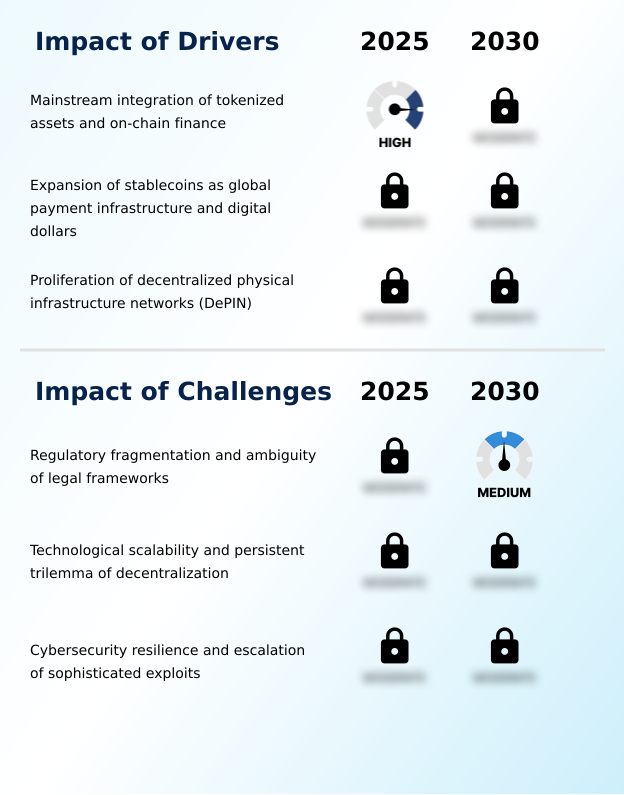
- The mainstream integration of tokenized assets and the expansion of on-chain finance are key drivers propelling market growth.
- Market growth is propelled by the mainstream integration of on-chain finance and tokenized assets, which provide enhanced liquidity and transparency. On-chain finance models can reduce intermediary costs by up to 40% compared to traditional settlement systems.
- The rapid expansion of stablecoins as a foundational layer for international payments, including cross-border b2b payments, offers near-instant finality, a stark contrast to the multi-day cycles of legacy banking.
- The rise of decentralized physical infrastructure networks (DePIN) adds a tangible utility layer, with networks sustained by real-world usage.
- This shift is accelerated by clear regulatory frameworks, such as the markets in crypto-assets (MiCA) regulation, which provide the legal certainty for corporations and virtual asset service providers (VASPs) to embed blockchain-based financial software into their core operations, supported by innovations like the ruble-pegged stablecoin for specific trade corridors.
What are the market trends shaping the Cryptocurrency Industry?
- A structural transition toward the tokenization of real-world assets is underway. This shift is attracting significant institutional capital, reshaping the market's fundamental value proposition.
- The cryptocurrency market is shaped by a structural transition toward the tokenization of real-world assets and the proliferation of stablecoins, with digital payment instruments now backed by formal legal frameworks in over 70% of major jurisdictions. The convergence of artificial intelligence with distributed ledger technology (DLT) is creating new efficiencies, where agentic protocols enable autonomous economic agents.
- Sectors like decentralized physical infrastructure networks (DePIN) now represent a multi-billion dollar segment, a tenfold increase in just two years. This trend is supported by institutional-grade tokenization platforms that facilitate the creation of regulated digital instruments. Furthermore, the expansion of peer-to-peer transactions and the development of the e-rupee and digital yuan highlight a global move towards digital currencies.
- This evolution is supported by the establishment of crypto-securities registry systems in advanced economies, formalizing asset management.
What challenges does the Cryptocurrency Industry face during its growth?
- Regulatory fragmentation and the ambiguity of legal frameworks present a key challenge to the industry's growth trajectory.
- The market faces significant challenges from regulatory fragmentation and the technical limitations of scalability. The absence of a unified global standard creates a compliance burden for regulated crypto-exchanges, with firms navigating disparate rules from the financial sector conduct authority (FSCA) in one region to the national securities commission (CNV) in another.
- Technologically, legacy networks experience transaction fees that can be over 100 times higher than those on layer-2 solutions during peak congestion. Cybersecurity remains a primary constraint; sophisticated flash loan attacks and smart contract vulnerabilities have led to losses exceeding billions in a single quarter.
- The integrity of cross-chain bridges is a persistent weak point, necessitating a shift toward proactive, AI-driven fraud detection and more resilient architectures to protect digital asset custody and prevent events like the kimchi premium from distorting markets through arbitrage.
Exclusive Technavio Analysis on Customer Landscape
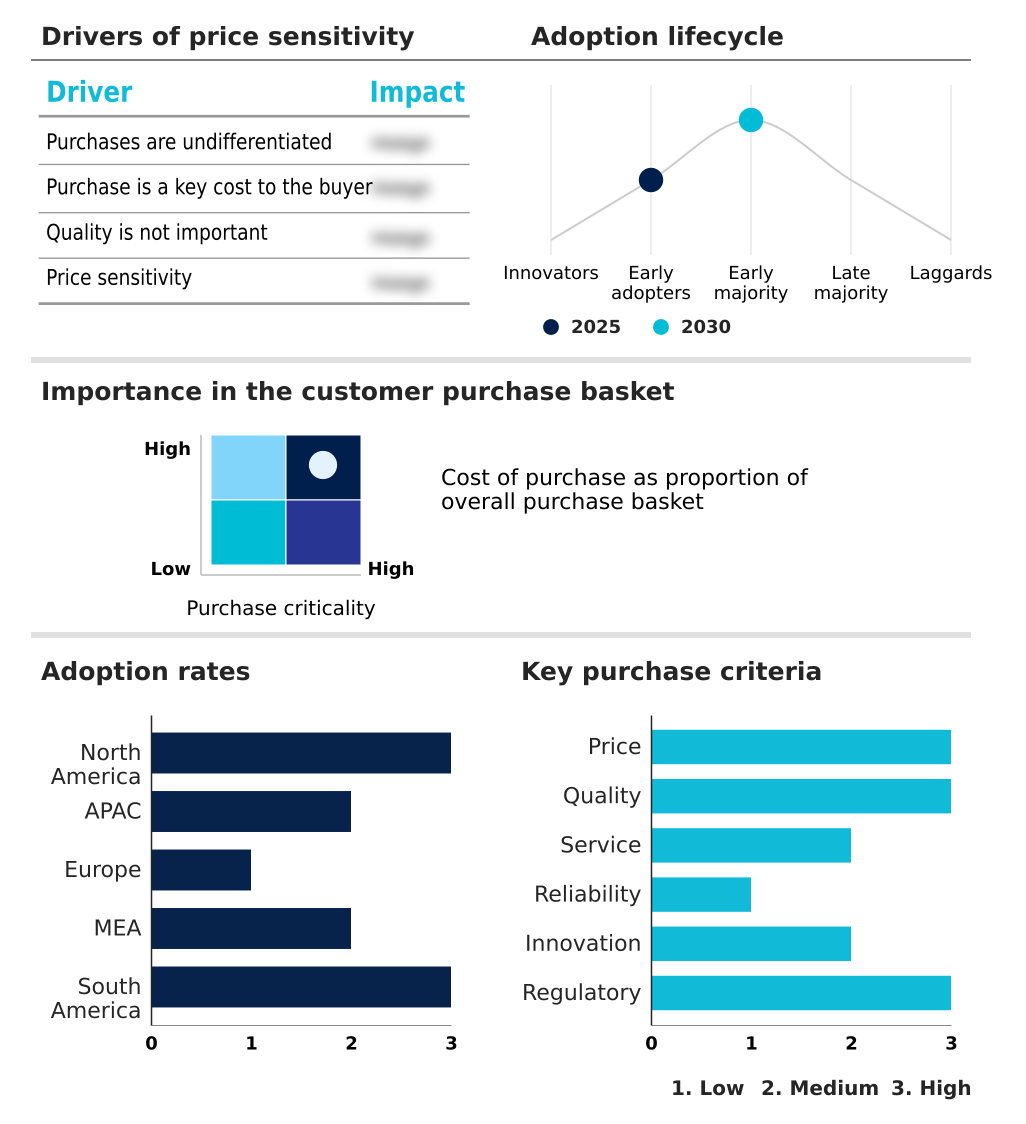
The cryptocurrency market forecasting report includes the adoption lifecycle of the market, covering from the innovator’s stage to the laggard’s stage. It focuses on adoption rates in different regions based on penetration. Furthermore, the cryptocurrency market report also includes key purchase criteria and drivers of price sensitivity to help companies evaluate and develop their market growth analysis strategies.
Customer Landscape of Cryptocurrency Industry
Competitive Landscape
Companies are implementing various strategies, such as strategic alliances, cryptocurrency market forecast, partnerships, mergers and acquisitions, geographical expansion, and product/service launches, to enhance their presence in the industry.
AlphaPoint Corp. - Analysis indicates a focus on providing enterprise-grade technology and white-label exchange software for operating secure trading platforms, brokerage services, and managing digital asset custody.
The industry research and growth report includes detailed analyses of the competitive landscape of the market and information about key companies, including:
- AlphaPoint Corp.
- Binance Holdings Ltd.
- Bit2Me
- Bitfury Group Ltd.
- Coinbase Global Inc.
- Dogecoin Foundation
- FMR LLC
- Gemini Trust Co. LLC
- KuCoin
- Ledger SAS
- Marathon Digital Holdings Inc.
- Neblio Technologies Pvt .Ltd.
- Pantera Capital
- PT Pintu Kemana Saja
- Riot Platforms Inc.
- Ripple Labs Inc.
- Valora
- WazirX
- Xapo Bank Ltd.
Qualitative and quantitative analysis of companies has been conducted to help clients understand the wider business environment as well as the strengths and weaknesses of key industry players. Data is qualitatively analyzed to categorize companies as pure play, category-focused, industry-focused, and diversified; it is quantitatively analyzed to categorize companies as dominant, leading, strong, tentative, and weak.
Recent Development and News in Cryptocurrency market
- In January, 2025, Fidelity Investments expanded its digital asset footprint by introducing FIDD, a new Ethereum-based stablecoin aimed at providing institutional clients with a compliant and liquid asset for on-chain settlement.
- In March, 2025, GameStop announced its strategic decision to integrate Bitcoin into its corporate treasury reserve assets, signaling a shift in how consumer-facing enterprises view digital currencies as viable balance-sheet components.
- In May, 2025, the acquisition of Algeco by A Star All Solutions Limited demonstrated how infrastructure-focused organizations are increasingly looking toward digital asset integration to streamline asset management and operational tracking.
- In September, 2025, the Cabinet of Ministers of Ukraine approved a detailed digital transformation plan that includes the full legalization of cryptocurrencies, aiming to integrate the Ukrainian digital market with the European ecosystem.
Dive into Technavio’s robust research methodology, blending expert interviews, extensive data synthesis, and validated models for unparalleled Cryptocurrency Market insights. See full methodology.
| Market Scope | |
|---|---|
| Page number | 289 |
| Base year | 2025 |
| Historic period | 2020-2024 |
| Forecast period | 2026-2030 |
| Growth momentum & CAGR | Accelerate at a CAGR of 25.1% |
| Market growth 2026-2030 | USD 137678.0 million |
| Market structure | Fragmented |
| YoY growth 2025-2026(%) | 20.9% |
| Key countries | US, Canada, Mexico, India, Vietnam, Indonesia, The Philippines, Thailand, South Korea, Ukraine, Russia, UK, Germany, France, Italy, Nigeria, Egypt, South Africa, UAE, Saudi Arabia, Brazil, Argentina and Colombia |
| Competitive landscape | Leading Companies, Market Positioning of Companies, Competitive Strategies, and Industry Risks |
Research Analyst Overview
- The cryptocurrency market's evolution is marked by a decisive shift toward institutional-grade infrastructure and utility. The core engine of this transformation is blockchain technology, which underpins everything from decentralized finance (DeFi) to the tokenization of real-world assets. Boardroom decisions are increasingly focused on leveraging digital asset treasuries and regulated digital instruments for capital efficiency, moving beyond speculative applications.
- This is evident in the rise of decentralized physical infrastructure networks (DePIN), which are now generating over USD 27 million in on-chain revenue annually by creating verifiable, real-world utility. While the market is energized by innovations like yield-bearing variants and the potential of autonomous economic agents, it is also tempered by persistent challenges.
- These include smart contract vulnerabilities, the systemic risks of flash loan attacks and other algorithmic exploits, and the technical hurdles of scaling via cross-chain bridges and layer-2 scaling solutions.
- Navigating this landscape requires robust digital asset custody and a clear understanding of shifting consensus mechanisms, from energy-intensive proof-of-work protocols to more efficient proof-of-stake (PoS) models, all while preparing for the integration of central bank digital currencies (CBDCs) and non-fungible tokens (NFTs) into mainstream finance.
What are the Key Data Covered in this Cryptocurrency Market Research and Growth Report?
-
What is the expected growth of the Cryptocurrency Market between 2026 and 2030?
-
USD 137.68 billion, at a CAGR of 25.1%
-
-
What segmentation does the market report cover?
-
The report is segmented by Type (Bitcoin, Ethereum, and Others), Application (Trading and investment, Payments and remittances, and Others), End-user (Retail, and Institutional) and Geography (North America, APAC, Europe, Middle East and Africa, South America)
-
-
Which regions are analyzed in the report?
-
North America, APAC, Europe, Middle East and Africa and South America
-
-
What are the key growth drivers and market challenges?
-
Mainstream integration of tokenized assets and on-chain finance, Regulatory fragmentation and ambiguity of legal frameworks
-
-
Who are the major players in the Cryptocurrency Market?
-
AlphaPoint Corp., Binance Holdings Ltd., Bit2Me, Bitfury Group Ltd., Coinbase Global Inc., Dogecoin Foundation, FMR LLC, Gemini Trust Co. LLC, KuCoin, Ledger SAS, Marathon Digital Holdings Inc., Neblio Technologies Pvt .Ltd., Pantera Capital, PT Pintu Kemana Saja, Riot Platforms Inc., Ripple Labs Inc., Valora, WazirX and Xapo Bank Ltd.
-
Market Research Insights
- The market is experiencing a dynamic phase, with year-over-year expansion reaching nearly 21%, significantly outpacing many traditional financial sectors. North America contributes over 34% of this incremental activity, driven by clear movements toward a formal market structure bill.
- Regulatory frameworks like the markets in crypto-assets (MiCA) regulation in Europe are providing legal certainty, encouraging corporations to embed stablecoins and other digital payment instruments into their core operations. The establishment of digital securities sandboxes allows for controlled innovation, while the formalization of virtual asset service providers (VASPs) under bodies like the financial intelligence unit (FIU) is enhancing compliance.
- This structured environment is critical for attracting institutional capital, which increasingly views digital asset treasuries and a strategic bitcoin reserve as viable components of a diversified financial strategy.
We can help! Our analysts can customize this cryptocurrency market research report to meet your requirements.
 RIA -
RIA - 
