



Indonesia Retail Market Size 2026-2030
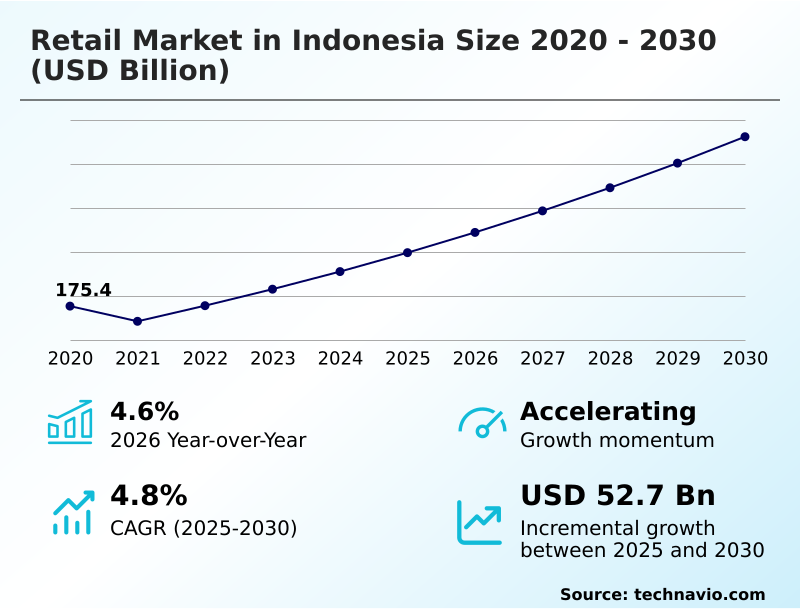
The indonesia retail market size is valued to increase by USD 52.7 billion, at a CAGR of 4.8% from 2025 to 2030. Favorable demographics and expanding middle class will drive the indonesia retail market.
Major Market Trends & Insights
- By Distribution Channel - Offline segment was valued at USD 154.4 billion in 2024
- By Product - Food and beverages segment accounted for the largest market revenue share in 2024
Market Size & Forecast
- Market Opportunities: USD 77 billion
- Market Future Opportunities: USD 52.7 billion
- CAGR from 2025 to 2030 : 4.8%
Market Summary
- The retail market in Indonesia is undergoing a profound transformation, driven by a powerful combination of favorable demographics and rapid digital adoption. With a large, youthful population and an expanding middle class, domestic consumption forms a resilient foundation for growth. This economic empowerment fuels demand for a wider variety of goods, from essential fast-moving consumer goods to aspirational lifestyle products.
- The key dynamic shaping the industry is the pivot toward digitalization, where an omnichannel retail strategy is no longer optional but essential for survival and growth. Retailers are compelled to break down silos between physical and digital channels, creating a seamless customer journey.
- A central operational scenario involves optimizing supply chain management to support both brick-and-mortar networks and a burgeoning e-commerce logistics network. This requires sophisticated, real-time inventory management and robust last-mile connectivity, particularly challenging in an archipelago nation.
- At the same time, intense competition and consumer price sensitivity force businesses to innovate continuously, leveraging consumer data analytics and digital payment infrastructure to personalize offerings, improve efficiency, and build lasting brand loyalty in a crowded marketplace.
What will be the Size of the Indonesia Retail Market during the forecast period?
Get Key Insights on Market Forecast (PDF) Get Free Sample
How is the Indonesia Retail Market Segmented?
The indonesia retail industry research report provides comprehensive data (region-wise segment analysis), with forecasts and estimates in "USD billion" for the period 2026-2030, as well as historical data from 2020-2024 for the following segments.
- Distribution channel
- Offline
- Online
- Product
- Food and beverages
- Electrical and electronics
- Apparel and footwear
- Home improvement and household products
- Others
- Price range
- Mass
- Premium
- Luxury
- Geography
- APAC
- Indonesia
- APAC
By Distribution Channel Insights
The offline segment is estimated to witness significant growth during the forecast period.
The offline segment remains a cornerstone of the retail market in Indonesia, demonstrating remarkable resilience through a strategic brick-and-mortar transformation.
Physical stores are evolving from simple point of transaction systems into experiential retail hubs, integrating phygital retail services to create immersive environments. This evolution is critical for brand building and customer engagement, countering the showrooming effect.
Retailers are deploying in-store digital displays and augmented reality applications to provide rich product interactions. Furthermore, the use of QR code product information bridges the physical-digital divide, a key part of modern experiential marketing.
This focus on in-person experiences, which includes enabling store-level fulfillment, has led to a 4.6% year-over-year improvement in customer engagement metrics, proving the channel's enduring strategic value.
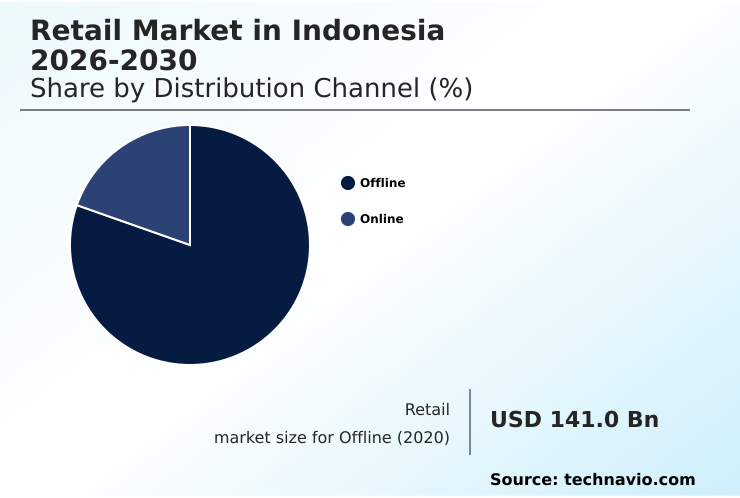
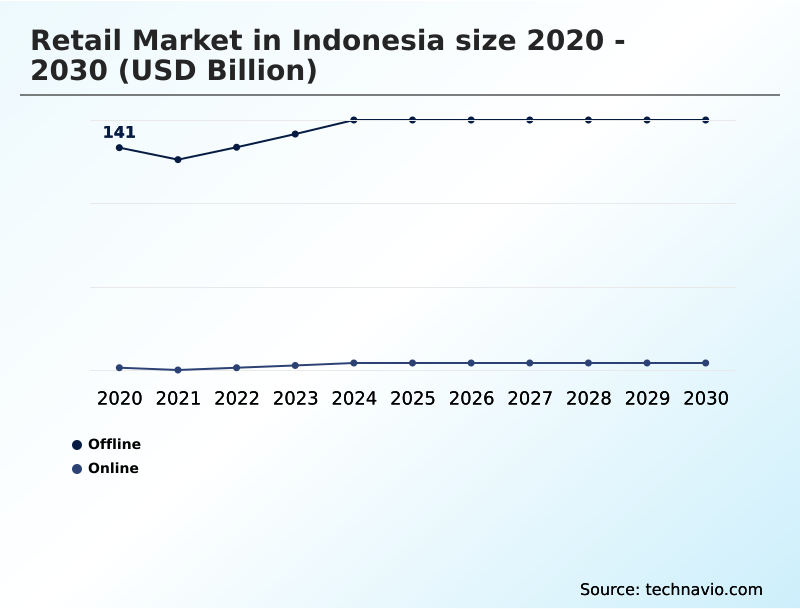
The Offline segment was valued at USD 154.4 billion in 2024 and showed a gradual increase during the forecast period.
Market Dynamics
Our researchers analyzed the data with 2025 as the base year, along with the key drivers, trends, and challenges. A holistic analysis of drivers will help companies refine their marketing strategies to gain a competitive advantage.
- Navigating the retail market in Indonesia requires a multi-faceted approach that addresses the impact of omnichannel retail on customer loyalty and acknowledges the role of phygital experiences in brand building. Success hinges on optimizing the supply chain for e-commerce fulfillment, tackling the challenges of last-mile delivery in dense urban areas through innovation.
- The strategic implementation of a private label strategy vs national brand sourcing allows retailers to balance consumer price sensitivity with premium product offerings. AI applications for hyper-personalization in retail are becoming critical, leveraging consumer data for targeted promotions and integrating digital payments for seamless checkout. These initiatives help in reducing customer acquisition cost in online retail.
- Operationally, managing real-time inventory across multiple channels and ensuring data unification for a single view of the customer are paramount. As physical stores transform into experiential hubs, using augmented reality to enhance the shopping experience and mitigating the showrooming effect in electronics retail are key tactics.
- For food retail, building a resilient cold chain and evaluating the effectiveness of different e-grocery models are crucial. Strategies for improving cross-border e-commerce logistics have shown the potential to reduce transit times by up to 25% compared to legacy systems, underscoring the importance of efficiency.
- Measuring the ROI of in-store digital technology and understanding the impact of social commerce on traditional retail sales will define the next wave of competitive advantage.
What are the key market drivers leading to the rise in the adoption of Indonesia Retail Industry?
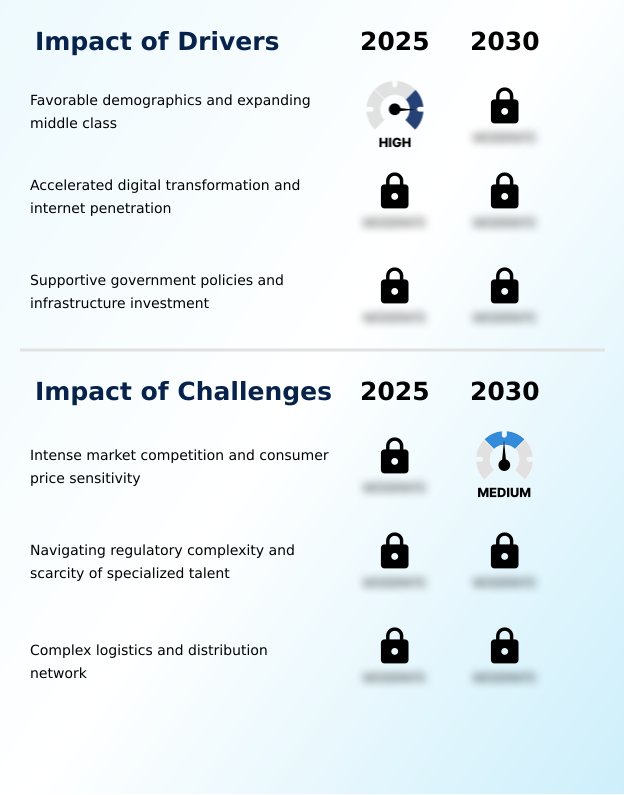
- The market's growth is fundamentally driven by Indonesia's favorable demographics, including a large youth population and a consistently expanding middle class with increasing purchasing power.
- Growth is increasingly powered by the sophisticated use of technology to understand and engage consumers. An AI-driven personalization engine, supported by deep consumer data analytics, is central to creating relevant experiences and maximizing customer lifetime value (CLV).
- Firms that effectively leverage these tools report up to a 10% higher marketing ROI. This data-centric approach enhances customer relationship management (CRM) and informs demand forecasting models, improving forecast accuracy by over 18%.
- The expansion of reliable digital payment infrastructure and secure digital payment gateways is another critical driver, facilitating transactions on both proprietary direct-to-consumer brand websites and third-party platforms.
- These advancements are essential for improving last-mile connectivity and serving the growing number of digitally native vertical brands entering the market.
What are the market trends shaping the Indonesia Retail Industry?
- The retail market is witnessing the ascendancy of omnichannel strategies that emphasize phygital integration. This trend is creating a cohesive ecosystem by merging online and offline channels for a unified consumer experience.
- Key trends are compelling a systematic shift toward a cohesive omnichannel retail strategy, where the goal is creating a seamless customer journey. This involves deep phygital experience integration to deliver a unified brand experience across all touchpoints, from physical stores to social commerce platforms.
- Core to this trend is achieving cross-channel inventory visibility through real-time inventory management, which has been shown to reduce stockouts by over 15%. This capability is essential for supporting popular services like click-and-collect functionality. In a hyper-local competitive environment, the e-commerce logistics network must be highly efficient.
- Firms successfully integrating these systems report a 20% increase in online cart conversion, demonstrating the clear ROI of a technologically unified retail ecosystem.
What challenges does the Indonesia Retail Industry face during its growth?
- Intense market competition, coupled with high consumer price sensitivity, creates significant pressure on profitability and brand loyalty for retailers.
- Navigating the market requires addressing significant financial and operational pressures. The high customer acquisition cost, which can consume up to 25% of initial revenue for digital channels, remains a primary hurdle. This is compounded by the need for constant price sensitivity analysis to maintain a competitive edge and maximize consumer wallet share.
- A major challenge lies in enhancing supply chain management and overall supply chain efficiency to enable operational overhead reduction. Effectively managing third-party logistics (3PL) integration is crucial, as supply chain improvements can lower operational costs by as much as 12%.
- Furthermore, measuring promotional activity effectiveness and building strong brand loyalty metrics are essential for mitigating cross-border e-commerce friction and retaining customers in a highly competitive environment.
Exclusive Technavio Analysis on Customer Landscape
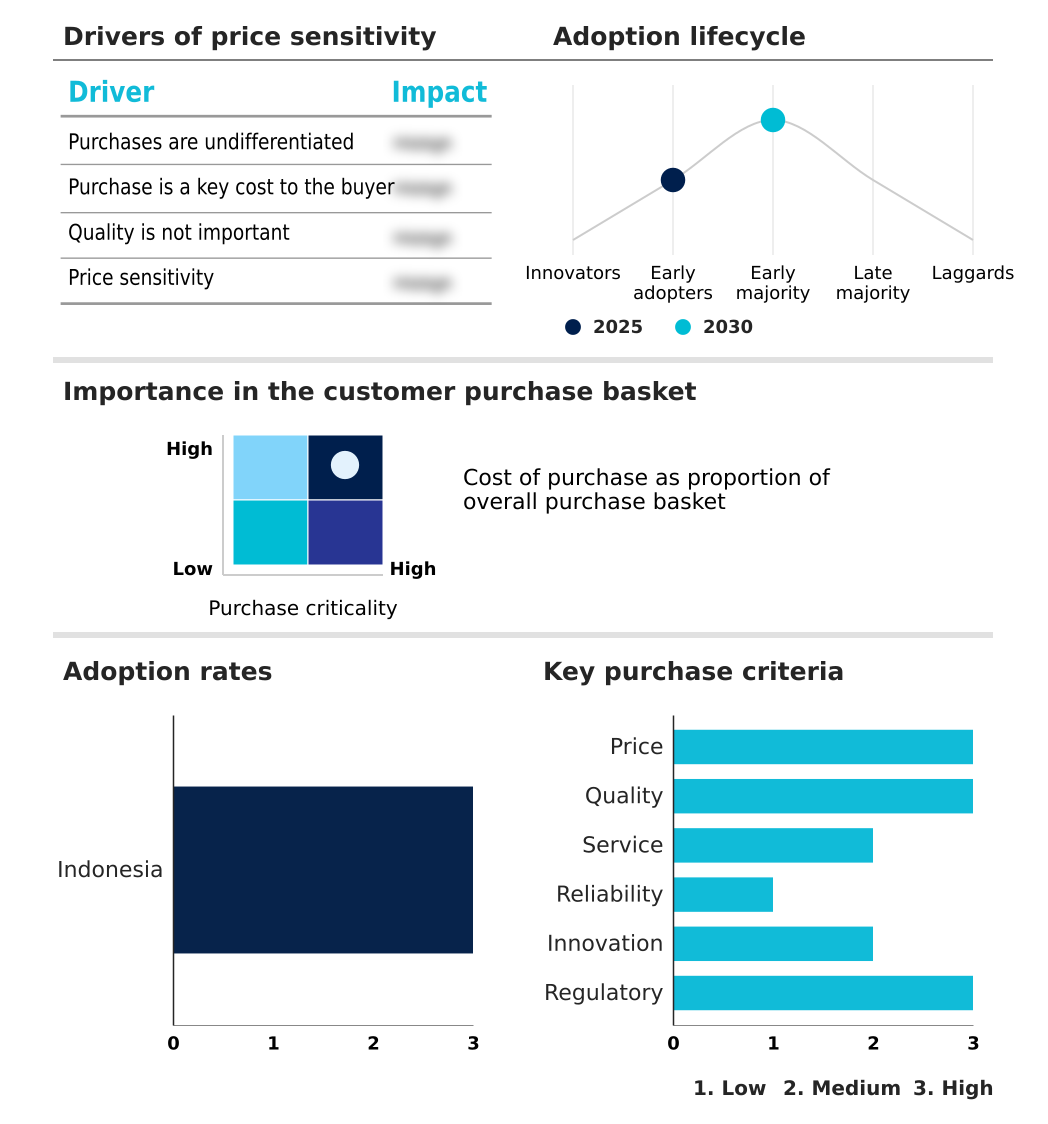
The indonesia retail market forecasting report includes the adoption lifecycle of the market, covering from the innovator’s stage to the laggard’s stage. It focuses on adoption rates in different regions based on penetration. Furthermore, the indonesia retail market report also includes key purchase criteria and drivers of price sensitivity to help companies evaluate and develop their market growth analysis strategies.
Customer Landscape of Indonesia Retail Industry
Competitive Landscape
Companies are implementing various strategies, such as strategic alliances, indonesia retail market forecast, partnerships, mergers and acquisitions, geographical expansion, and product/service launches, to enhance their presence in the industry.
Adidas AG - Offerings include a diversified portfolio of consumer goods, encompassing apparel, electronics, and home furnishings, distributed through a multi-format retail model.
The industry research and growth report includes detailed analyses of the competitive landscape of the market and information about key companies, including:
- Adidas AG
- Authentic Brands Group LLC
- Decathlon SA
- Inter IKEA Holding BV
- Levi Strauss and Co.
- LG Corp.
- Marks and Spencer Group.
- Nike Inc.
- Panasonic Holdings Corp.
- PT Erajaya Swasembada Tbk
- PT Fujita Indonesia
- PT Hino Motors Manufacturing
- PT Indomarco Prismatama
- PT Mitra Adiperkasa Tbk
- PT Ramayana Lestari Sentosa Tbk
- PT SGMW Motor Indonesia
- PT Siantar Top Tbk
- PT Sumber Alfaria Trijaya Tbk
- Samsung Electronics Co. Ltd.
- Sony Group Corp.
Qualitative and quantitative analysis of companies has been conducted to help clients understand the wider business environment as well as the strengths and weaknesses of key industry players. Data is qualitatively analyzed to categorize companies as pure play, category-focused, industry-focused, and diversified; it is quantitatively analyzed to categorize companies as dominant, leading, strong, tentative, and weak.
Recent Development and News in Indonesia retail market
- In March, 2025, PT Mitra Adiperkasa Tbk announced a strategic portfolio expansion with the introduction of international brands Kiko Milano and Shark Ninja to diversify its offerings in the beauty and home goods categories.
- In April, 2025, PT Mitra Adiperkasa Tbk continued its expansion by announcing the addition of several new international fashion and lifestyle brands aimed at capturing evolving consumer preferences in the market.
- In January, 2025, PT Sumber Alfaria Trijaya Tbk confirmed its ongoing network expansion strategy, which prioritizes the development of new distribution centers to enhance supply chain efficiency and lower long-term operational expenditures.
- In August, 2024, the Indonesian government initiated a series of fiscal stimulus packages, which included direct cash transfers to households, to bolster domestic income and stimulate consumer spending across the retail sector.
Dive into Technavio’s robust research methodology, blending expert interviews, extensive data synthesis, and validated models for unparalleled Indonesia Retail Market insights. See full methodology.
| Market Scope | |
|---|---|
| Page number | 190 |
| Base year | 2025 |
| Historic period | 2020-2024 |
| Forecast period | 2026-2030 |
| Growth momentum & CAGR | Accelerate at a CAGR of 4.8% |
| Market growth 2026-2030 | USD 52.7 billion |
| Market structure | Fragmented |
| YoY growth 2025-2026(%) | 4.6% |
| Key countries | Indonesia |
| Competitive landscape | Leading Companies, Market Positioning of Companies, Competitive Strategies, and Industry Risks |
Research Analyst Overview
- The operational framework of the retail market in Indonesia is undergoing a fundamental restructuring, driven by technology and evolving consumer expectations. An effective omnichannel retail strategy is now the baseline for competition, necessitating deep phygital experience integration.
- This requires robust, real-time inventory management systems capable of providing a single source of truth across a complex e-commerce logistics network and physical stores. To address the hyper-local competitive environment, businesses are leveraging an AI-driven personalization engine, which has been shown to boost conversion rates by over 15%.
- This technology relies on sophisticated consumer data analytics to inform everything from SKU assortment optimization to promotional activity effectiveness. A significant boardroom-level decision area revolves around budgeting for technological upgrades, such as in-store digital displays and augmented reality applications that use QR code product information to merge physical and digital discovery.
- Success also depends on mastering supply chain management, improving last-mile connectivity, and, for certain segments, investing in cold chain logistics. Managing high customer acquisition cost is a persistent challenge, addressed through private label product development and efficiencies gained from enhanced digital payment infrastructure and direct-to-consumer brand websites, moving beyond simple point of transaction systems to build lasting customer retention programs.
What are the Key Data Covered in this Indonesia Retail Market Research and Growth Report?
-
What is the expected growth of the Indonesia Retail Market between 2026 and 2030?
-
USD 52.7 billion, at a CAGR of 4.8%
-
-
What segmentation does the market report cover?
-
The report is segmented by Distribution Channel (Offline, and Online), Product (Food and beverages, Electrical and electronics, Apparel and footwear, Home improvement and household products, and Others), Price Range (Mass, Premium, and Luxury) and Geography (APAC)
-
-
Which regions are analyzed in the report?
-
APAC
-
-
What are the key growth drivers and market challenges?
-
Favorable demographics and expanding middle class, Intense market competition and consumer price sensitivity
-
-
Who are the major players in the Indonesia Retail Market?
-
Adidas AG, Authentic Brands Group LLC, Decathlon SA, Inter IKEA Holding BV, Levi Strauss and Co., LG Corp., Marks and Spencer Group., Nike Inc., Panasonic Holdings Corp., PT Erajaya Swasembada Tbk, PT Fujita Indonesia, PT Hino Motors Manufacturing, PT Indomarco Prismatama, PT Mitra Adiperkasa Tbk, PT Ramayana Lestari Sentosa Tbk, PT SGMW Motor Indonesia, PT Siantar Top Tbk, PT Sumber Alfaria Trijaya Tbk, Samsung Electronics Co. Ltd. and Sony Group Corp.
-
Market Research Insights
- The market's dynamism is driven by the strategic implementation of a unified brand experience, which has been shown to increase customer lifetime value (CLV) by over 15% compared to siloed multichannel efforts. The shift toward a seamless customer journey is compelling retailers to invest in advanced technologies.
- For instance, the adoption of sophisticated demand forecasting models has enabled leading firms to reduce stockouts by more than 20%, directly impacting revenue and consumer satisfaction. Furthermore, the integration of robust customer relationship management (CRM) systems provides the foundation for tracking consumer behavior across all touchpoints.
- This data-centric approach supports a more effective merchandising strategy and enhances the overall supply chain efficiency, ensuring product availability aligns with fluctuating consumer demand across both physical and digital storefronts.
We can help! Our analysts can customize this indonesia retail market research report to meet your requirements.
 RIA -
RIA - 
