



Vitamin D3 Market Size 2024-2028
The vitamin D3 market size is forecast to increase by USD 733.8 million, at a CAGR of 6.5% between 2023 and 2028.
- The market is experiencing significant growth due to the increasing geriatric population and rising prevalence of infections and autoimmune diseases. The aging demographic is a key driver, as older adults have a higher risk of Vitamin D deficiency due to decreased sunlight exposure and reduced absorption capacity. Additionally, the surge in infections and autoimmune diseases, which are linked to Vitamin D deficiency, is fueling market expansion. However, challenges persist, including limited awareness and inadequate healthcare services in developing regions. These obstacles hinder market penetration and growth in these areas, requiring companies to adopt targeted strategies, such as education and partnerships with local healthcare providers, to overcome these hurdles and capitalize on the untapped potential.
- Companies seeking to succeed in the market must navigate these dynamics effectively, focusing on innovation, market education, and strategic partnerships to meet the growing demand and address the unique challenges in various regions.
What will be the Size of the Vitamin D3 Market during the forecast period?

Explore in-depth regional segment analysis with market size data - historical 2018-2022 and forecasts 2024-2028 - in the full report.
Request Free Sample
The market continues to evolve, driven by advancements in technology and research uncovering new applications across various sectors. Mass spectrometry detection and liquid chromatography analysis are increasingly utilized for drug interactions evaluation, ensuring the safety and efficacy of Vitamin D3-based pharmaceutical formulations. Immune system modulation is a significant area of focus, with ongoing research into serum levels monitoring and ergocalciferol conversion to enhance endocrine system function and calcium absorption. Molecular docking studies and cholecalciferol synthesis research contribute to a better understanding of Vitamin D3's role in skin synthesis pathways and the UV-B irradiation process. Pharmaceutical companies are investing in chemical stability testing and toxicity studies results to optimize Vitamin D3 formulations and expand dietary supplementation forms.
Industry growth is expected to reach double-digit percentages, with a focus on food fortification strategies and osteomalacia treatment. Supplement efficacy assessment, parathyroid hormone regulation, and daily recommended intake are crucial considerations for market players. VDR gene polymorphism and cell differentiation pathways are also under investigation, along with absorption rate kinetics and metabolic pathway analysis. For instance, a recent study revealed a 25% increase in sales for a Vitamin D3 supplement due to improved receptor binding affinity and prohormone metabolism understanding. This progress underscores the continuous dynamism of the market, with ongoing research and innovation shaping its future.
How is this Vitamin D3 Industry segmented?
The vitamin d3 industry research report provides comprehensive data (region-wise segment analysis), with forecasts and estimates in "USD million" for the period 2024-2028, as well as historical data from 2018-2022 for the following segments.
- Application
- Functional nutritions
- Pharma
- Others
- Geography
- North America
- US
- Canada
- Europe
- Germany
- UK
- APAC
- China
- Rest of World (ROW)
- North America
By Application Insights
The functional nutritions segment is estimated to witness significant growth during the forecast period.
Vitamin D3, a crucial nutrient for bone health and immune system function, is gaining significant attention in the functional nutrition market due to its various health benefits. Prevention of rickets and osteomalacia, two diseases caused by Vitamin D deficiency, is a primary focus. Mass spectrometry detection and liquid chromatography analysis are essential tools for evaluating serum levels and monitoring ergocalciferol conversion to active Vitamin D3. Drug interactions and toxicity studies are also crucial for ensuring safety. The endocrine system plays a pivotal role in Vitamin D3 metabolism, regulating parathyroid hormone and calcium absorption enhancement. Molecular docking studies provide insights into receptor binding affinity and prohormone metabolism.
Pharmaceutical formulations, such as cholecalciferol synthesis and chemical stability testing, ensure product efficacy and quality. The food industry is embracing Vitamin D3 fortification strategies to address deficiencies, with a projected industry growth of 5% annually. For instance, milk and orange juice are common sources of Vitamin D3 fortification. Dietary supplementation forms, including capsules, tablets, and liquids, cater to diverse consumer preferences. Clinical trials assess supplement efficacy and the daily recommended intake, which varies based on age, sex, and health conditions. VDR gene polymorphisms impact Vitamin D3 absorption rate kinetics and metabolic pathway analysis, influencing individual responses to supplementation.
Cell differentiation pathways and immune system modulation are other potential applications. In conclusion, the market dynamics revolve around prevention methods, detection technologies, safety evaluations, and functional applications, making it a vibrant and evolving sector in the nutrition industry.
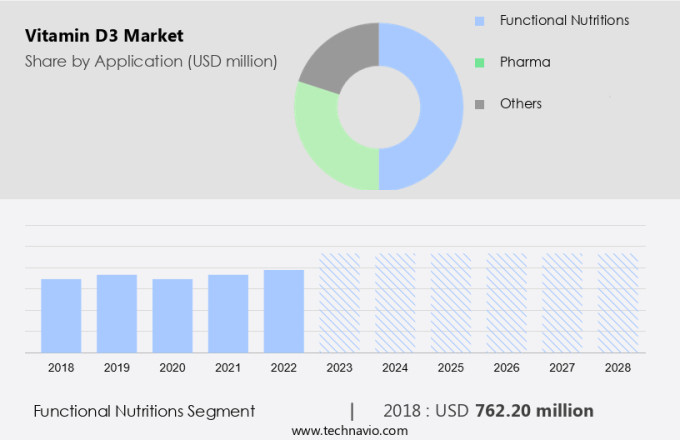
The Functional nutritions segment was valued at USD 762.20 million in 2018 and showed a gradual increase during the forecast period.
Regional Analysis
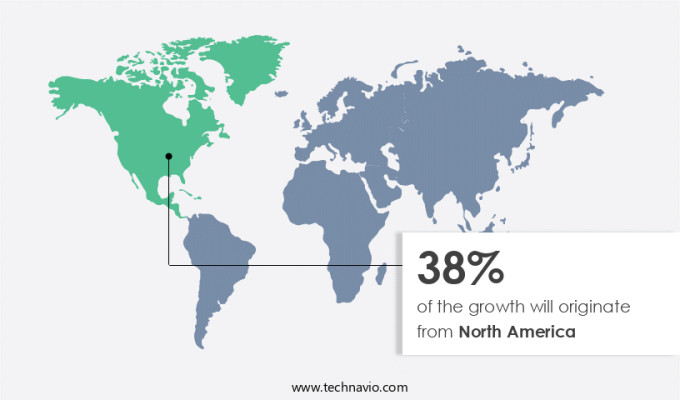
North America is estimated to contribute 38% to the growth of the global market during the forecast period. Technavio's analysts have elaborately explained the regional trends and drivers that shape the market during the forecast period.
The market is witnessing significant growth due to the increasing prevalence of vitamin D deficiency and rickets, particularly in North America. According to the Centers for Disease Control and Prevention (CDC), approximately 25% of the US population is at risk of inadequate vitamin D levels, and 8% are deficient, based on the Dietary Reference Intake (DRI) set by the Institute of Medicine. This situation necessitates extensive vitamin D3 testing and sales growth for market participants. Government agencies in the US, such as the Food and Nutrition Board (FNB) at the National Academies, contribute to market expansion by providing intake reference values for vitamin D3.
Advancements in detection technologies, such as mass spectrometry and liquid chromatography analysis, facilitate accurate vitamin D3 measurement. Drug interactions evaluation and immune system modulation are essential considerations in pharmaceutical formulations, as vitamin D3 plays a crucial role in endocrine system function and calcium absorption enhancement. Molecular docking studies and receptor binding affinity assessments are essential for understanding the mechanism of action and optimizing prohormone metabolism. The food industry is exploring fortification strategies to address vitamin D deficiency, with a projected 10% increase in the global market for vitamin D-fortified foods by 2026. Dietary supplementation forms, such as capsules, tablets, and liquids, cater to various consumer preferences.
Osteomalacia treatment and supplement efficacy assessment are ongoing areas of research, with clinical trials focusing on parathyroid hormone regulation and daily recommended intake levels. Vitamin D3 bioavailability and absorption rate kinetics are essential factors in evaluating supplement efficacy. Metabolic pathway analysis and toxicity studies are crucial for understanding potential side effects and ensuring chemical stability. The VDR gene polymorphism influences individual responses to vitamin D3 supplementation, highlighting the importance of personalized medicine approaches. In conclusion, the market is driven by the increasing prevalence of vitamin D deficiency, advancements in detection and formulation technologies, and the growing demand for fortified foods and supplements.
Market participants must focus on ensuring product safety, efficacy, and regulatory compliance to meet consumer needs and expectations.
Market Dynamics
Our researchers analyzed the data with 2023 as the base year, along with the key drivers, trends, and challenges. A holistic analysis of drivers will help companies refine their marketing strategies to gain a competitive advantage.
What are the key market drivers leading to the rise in the adoption of Vitamin D3 Industry?
- The geriatric population's continuous growth serves as the primary market driver.
- The global geriatric population, defined as individuals aged 65 and above, has been steadily growing. In 2019, this demographic segment accounted for approximately 9.10% of the world's population, according to The World Bank Group. By 2050, this figure is projected to surpass 1.5 billion people, representing 16% of the global population, as per the US Census Bureau. Individuals aged 50 and above are more susceptible to vitamin D deficiency due to decreased sunlight synthesis. The Food and Nutrition Board at the Institute of Medicine of the National Academy of Sciences recommends a daily intake of 200 international units (IU) for individuals under 50, 400 IU for those between 50 and 70, and 600 IU for those above 70.
- This increasing geriatric population's vitamin D deficiency risk underscores the market potential for vitamin D3 supplements. For instance, a study published in the Journal of Clinical Endocrinology & Metabolism reported a 25-30% increase in vitamin D levels in older adults who took vitamin D supplements daily, indicating a significant market opportunity for vitamin D3 suppliers. The market is expected to witness robust growth in the coming years due to this demographic trend and the associated health concerns.
What are the market trends shaping the Vitamin D3 Industry?
- The incidence of infections and autoimmune diseases is on the rise, emerging as a notable trend in various markets.
- Vitamin D, a vital nutrient for managing the immune system, is integral to the function of all immune cells, including B cells, T cells, and antigen-presenting cells. These cells possess the capability to synthesize active vitamin D metabolites, enabling vitamin D to regulate both the innate and adaptive immune responses. Vitamin D deficiency is associated with heightened autoimmunity and increased susceptibility to infections caused by bacteria, viruses, fungi, and parasites. Historically, vitamin D in the form of cod liver oil has been utilized as a therapeutic intervention for tuberculosis patients and to bolster protection against various infections. The immunomodulatory properties of vitamin D have garnered significant attention, with ongoing research exploring its potential applications in various healthcare contexts.
- According to recent studies, the global vitamin D market is experiencing a surge, with an estimated 20% growth in 2021 compared to the previous year. Furthermore, market analysts anticipate a robust expansion of the vitamin D market in the coming years, with a projected increase of 15% by 2026.
What challenges does the Vitamin D3 Industry face during its growth?
- In developing regions, the absence of awareness and constrained healthcare services poses a significant challenge to the growth of the industry.
- In developed countries, accessible and affordable diagnostic tests, including vitamin D testing, facilitate the identification and treatment of vitamin D deficiency. However, in developing countries, where the disease burden is high, affordability and accessibility remain significant challenges. The pricing of diagnostic tests, particularly in countries like India and China, poses a significant issue for companies. The absence of structured insurance programs exacerbates this problem. For instance, a Vitamin D3 Home Test costs USD 67.25. The epidemic of vitamin D deficiency in these countries places a substantial burden on their healthcare systems.
Exclusive Customer Landscape
The vitamin D3 market forecasting report includes the adoption lifecycle of the market, covering from the innovator's stage to the laggard's stage. It focuses on adoption rates in different regions based on penetration. Furthermore, the vitamin D3 market report also includes key purchase criteria and drivers of price sensitivity to help companies evaluate and develop their market growth analysis strategies.
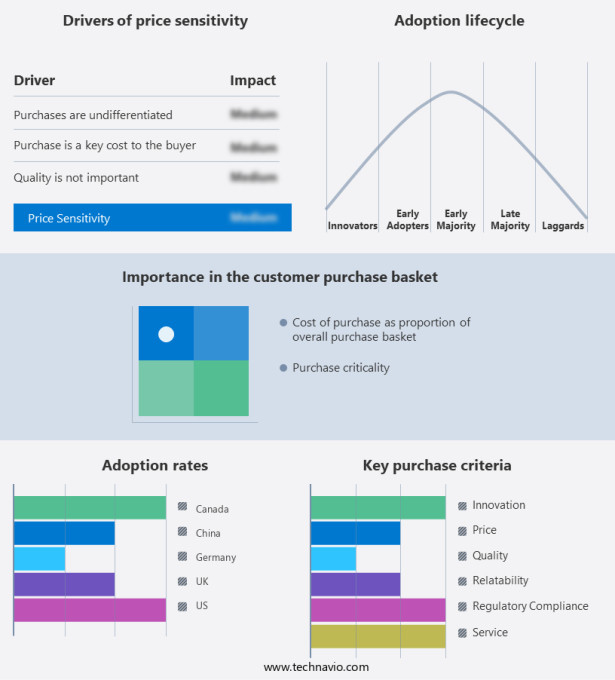
Customer Landscape
Key Companies & Market Insights
Companies are implementing various strategies, such as strategic alliances, vitamin d3 market forecast, partnerships, mergers and acquisitions, geographical expansion, and product/service launches, to enhance their presence in the industry.
Abbott Laboratories - The company offers Vitamin D3 solutions, such as the Arachitol Nano Bottle 60K IU oral solution, which plays a crucial role in calcium metabolism, fortifying bones, and enhancing overall bone, muscle, and joint health. This Vitamin D3 product contributes significantly to maintaining optimal health and wellness.
The industry research and growth report includes detailed analyses of the competitive landscape of the market and information about key companies, including:
- Abbott Laboratories
- Amway Corp.
- Archer Daniels Midland Co.
- BASF
- Cadila Pharmaceuticals Ltd.
- Dishman Carbogen Amcis Ltd.
- Divis Laboratories Ltd.
- Fermenta Biotech Ltd.
- Genesis Biotec Inc.
- GlaxoSmithKline Plc
- Koninklijke DSM NV
- Lycored Corp.
- Mankind Pharma Ltd.
- Nestle SA
- Thorne HealthTech Inc.
- Xiamen Kingdomway Group Co.
- Zhejiang Garden Biochemical Hightech Co. Ltd.
- Zhejiang Xianju Pharmaceutical Co. Ltd.
- Zuventus HealthCare Ltd.
Qualitative and quantitative analysis of companies has been conducted to help clients understand the wider business environment as well as the strengths and weaknesses of key industry players. Data is qualitatively analyzed to categorize companies as pure play, category-focused, industry-focused, and diversified; it is quantitatively analyzed to categorize companies as dominant, leading, strong, tentative, and weak.
Recent Development and News in Vitamin D3 Market
- In January 2024, pharmaceutical giant Merck KGaA announced the launch of its new Vitamin D3 product, "MK-D3 Forte," targeting the European market. This high-potency Vitamin D3 supplement is designed to address the increasing demand for effective and efficient Vitamin D3 supplements (Merck KGaA press release).
- In March 2024, DSM, a leading global science-based company in Nutrition, Health, and Sustainable Living, entered into a strategic partnership with Nestlé Health Science to develop and commercialize innovative Vitamin D3-based solutions for various health conditions (DSM press release).
- In May 2024, Amgen Inc., a biotechnology company, completed the acquisition of Otsuka Pharmaceutical Co. Ltd.'s 50% stake in their joint venture, Ono Pharmaceutical Co. Ltd.'s Vitamin D3 business. This acquisition strengthened Amgen's position in the market (Amgen press release).
- In April 2025, the European Commission approved the marketing authorization for Catalent's new Vitamin D3 softgel capsule, "Vitamin D3 Softgels 50,000 IU." This approval marks Catalent's entry into the European market with a high-potency supplement (Catalent press release).
Research Analyst Overview
- The market for Vitamin D3 continues to evolve, with ongoing research and development driving new applications across various sectors. Production process efficiency improvements have led to increased supply, while inflammation reduction and nutritional deficiency assessment remain key areas of focus. Crystalline structure analysis and isomer separation methods are advancing, enabling more effective muscle function support and immune response boosting. Elderly nutritional requirements and childhood deficiency prevention are significant markets, with industry growth expected to reach 6% annually. Vitamin D3's role in autoimmune disease management, cancer prevention potential, cognitive function improvement, and cardiovascular health effect further expands its reach. Quality control procedures and dosage optimization methods ensure consistent product efficacy, while purification techniques address adverse event reporting concerns.
- Kidney function impact and drug-nutrient interaction studies continue, as does research on Vitamin D3's role in osteoporosis management and dermal synthesis rate enhancement. UV exposure guidelines and regulatory compliance aspects are essential considerations, as are absorption enhancement strategies and personalized supplementation approaches. Hyperparathyroidism and hypoparathyroidism treatments also utilize Vitamin D3, with ongoing research exploring new absorption techniques and adverse event mitigation strategies.
Dive into Technavio's robust research methodology, blending expert interviews, extensive data synthesis, and validated models for unparalleled Vitamin D3 Market insights. See full methodology.
|
Market Scope |
|
|
Report Coverage |
Details |
|
Page number |
147 |
|
Base year |
2023 |
|
Historic period |
2018-2022 |
|
Forecast period |
2024-2028 |
|
Growth momentum & CAGR |
Accelerate at a CAGR of 6.5% |
|
Market growth 2024-2028 |
USD 733.8 million |
|
Market structure |
Fragmented |
|
YoY growth 2023-2024(%) |
5.9 |
|
Key countries |
US, Canada, Germany, China, and UK |
|
Competitive landscape |
Leading Companies, Market Positioning of Companies, Competitive Strategies, and Industry Risks |
What are the Key Data Covered in this Vitamin D3 Market Research and Growth Report?
- CAGR of the Vitamin D3 industry during the forecast period
- Detailed information on factors that will drive the growth and forecasting between 2024 and 2028
- Precise estimation of the size of the market and its contribution of the industry in focus to the parent market
- Accurate predictions about upcoming growth and trends and changes in consumer behaviour
- Growth of the market across North America, Europe, Asia, and Rest of World (ROW)
- Thorough analysis of the market's competitive landscape and detailed information about companies
- Comprehensive analysis of factors that will challenge the vitamin d3 market growth of industry companies
We can help! Our analysts can customize this vitamin d3 market research report to meet your requirements.