

Aircraft Fuel Systems Market Analysis North America, Europe, APAC, South America, Middle East and Africa - US, France, Germany, China, Canada - Size and Forecast 2024-2028

Aircraft Fuel Systems Market Analysis North America, Europe, APAC, South America, Middle East and Africa - US, France, Germany, China, Canada - Size and Forecast 2024-2028

Published: May 2024 175 Pages SKU: IRTNTR43810

Market Overview at a Glance

$1.52 B
Market Opportunity
5.45%
CAGR
5.07
YoY growth 2023-2024(%)

Aircraft Fuel Systems Market Size 2024-2028

The aircraft fuel systems market size is forecast to increase by USD 1.52 billion at a CAGR of 5.45% between 2023 and 2028.

  • The market is experiencing significant growth, driven by the increasing demand for fuel efficiency and optimized performance in the aviation industry. The use of measured quantities of fuel onboard is becoming increasingly important for airlines to reduce operational costs and improve environmental sustainability. This trend is further fueled by continuous advancements in aircraft components, which enable more efficient fuel consumption and reduced emissions. However, the market is not without challenges. Increasing environmental regulations, such as the International Civil Aviation Organization's (ICAO) Carbon Offsetting and Reduction Scheme for International Aviation (CORSIA), are placing additional pressure on airlines to reduce their carbon footprint.
  • This has led to a rise in demand for alternative fuels and more advanced fuel systems that can accommodate these new energy sources. Key elements include fuel management systems, fuel pumps, distribution and delivery systems, gauges, storage systems, refueling and transfer systems, valves, filters, lines, fuel efficiency systems, and fuel consumption optimization technologies.  Companies seeking to capitalize on this market opportunity must stay abreast of regulatory developments and invest in research and development to meet these evolving demands. Overall, the market presents significant growth potential for companies that can offer innovative solutions to optimize fuel efficiency, reduce emissions, and comply with evolving regulations.

What will be the Size of the Aircraft Fuel Systems Market during the forecast period?
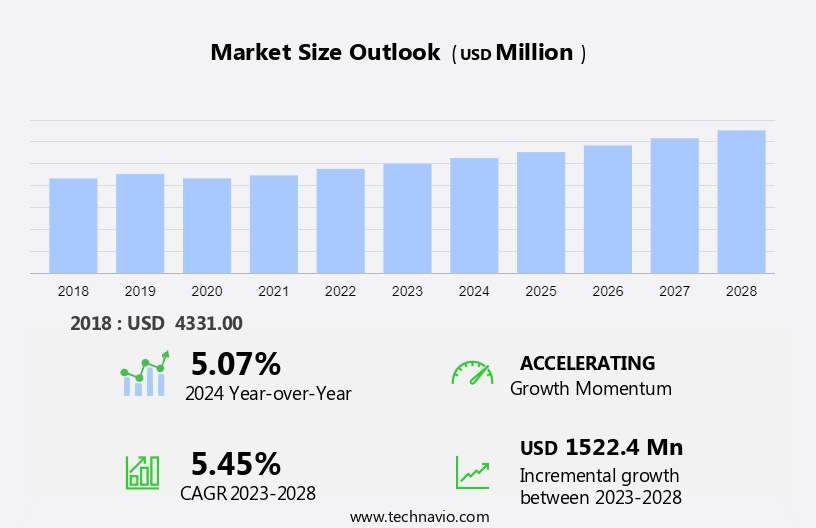
Aircraft Fuel Systems Market Size

 Request Free Sample

  • The market encompasses a range of components essential for the efficient and safe delivery of fuel to aviation engines. This market continues to evolve, driven by increasing demand for fuel efficiency, safety, and environmental sustainability. Aircraft fuel control systems, along with aircraft fuel tank components, play a crucial role in the efficiency of aircraft fuel consumption. Regular aircraft fuel system inspection, aircraft fuel system repair, and aircraft fuel system upgrades are essential to maintain high fuel system performance. Aircraft fuel technology and aircraft fuel system advancements continue to improve, driving innovations in fuel system solutions and aircraft fuel system aftermarket services offered by aircraft fuel system manufacturers.
  • Fuel system optimization and advanced technologies, such as electric and hybrid fuel systems, are gaining traction to reduce fuel consumption and emissions. The market is projected to grow steadily, underpinned by the expanding aviation industry and ongoing advancements in fuel systems technology. Aircraft fuel tanks, aircraft fuel pumps, aircraft fuel gauges, aircraft fuel valves, aircraft fuel filters, and aircraft fuel lines are essential components of an aircraft's fuel system, with aircraft fuel sensors and aircraft fuel monitoring systems providing real-time data for efficient aircraft fuel control. The aircraft fuel system design, aircraft fuel system engineering, and aircraft fuel system maintenance of these aircraft fuel system components ensure optimal performance, safety, and reliability in aviation. Aircraft fuel system performance is continually improving due to ongoing aircraft fuel system developments, which focus on enhancing efficiency, safety, and reliability in modern aviation.

How is the Aircraft Fuel Systems Industry segmented?

The aircraft fuel systems industry research report provides comprehensive data (region-wise segment analysis), with forecasts and estimates in "USD million" for the period 2024-2028, as well as historical data from 2018-2022 for the following segments.

  • Technology
    • Fuel injection
    • Pump feed
    • Gravity feed
  • Application
    • Commercial
    • Military
  • Geography
    • North America
      • US
      • Canada
    • Europe
      • France
      • Germany
    • APAC
      • China
    • South America
    • Middle East and Africa

By Technology Insights

The fuel injection segment is estimated to witness significant growth during the forecast period. Aircraft fuel systems play a crucial role in ensuring the optimal performance and efficiency of aircraft engines. These systems consist of various components, including fuel tanks, aviation fuel systems, fuel management systems, fuel pumps, fuel distribution systems, fuel delivery systems, fuel gauges, fuel storage systems, refueling systems, fuel transfer systems, fuel valves, fuel filters, fuel lines, fuel sensors, fuel quantity indicators, fuel system integration, fuel system testing, fuel system certification, fuel system safety, fuel efficiency systems, and fuel system optimization.

These systems are integral to maintaining engine functionality while improving fuel economy and reducing carbon emissions. They offer advantages such as quick setup, enhanced fuel-burning efficiency, smooth engine operation, reduced fuel consumption, precise fuel flow to all cylinders, increased aircraft mileage, and adaptability to alternative fuels. By measuring, supplying, and optimizing fuel consumption, these systems contribute to prolonging engine life.
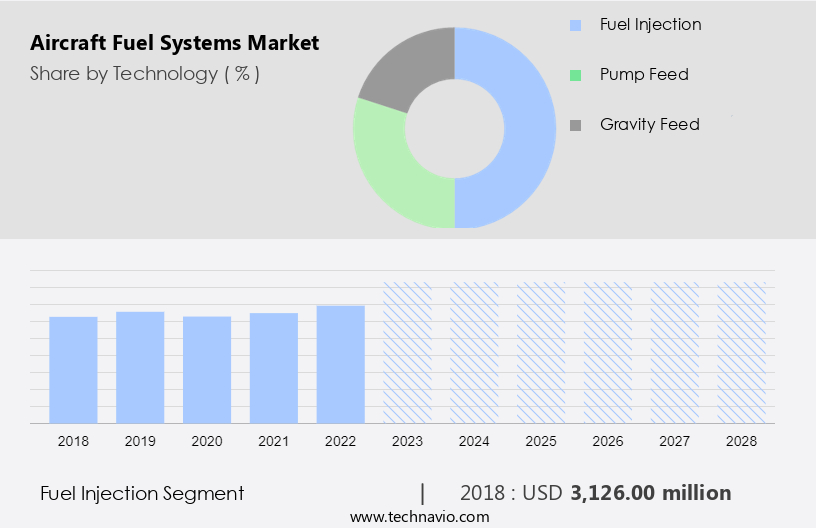
Aircraft Fuel Systems Market Size

Get a glance at the market report of share of various segments Request Free Sample

The Fuel injection segment was valued at USD 3.13 billion in 2018 and showed a gradual increase during the forecast period.

Regional Analysis

Europe is estimated to contribute 36% to the growth of the global market during the forecast period. Technavio's analysts have elaborately explained the regional trends and drivers that shape the market during the forecast period.
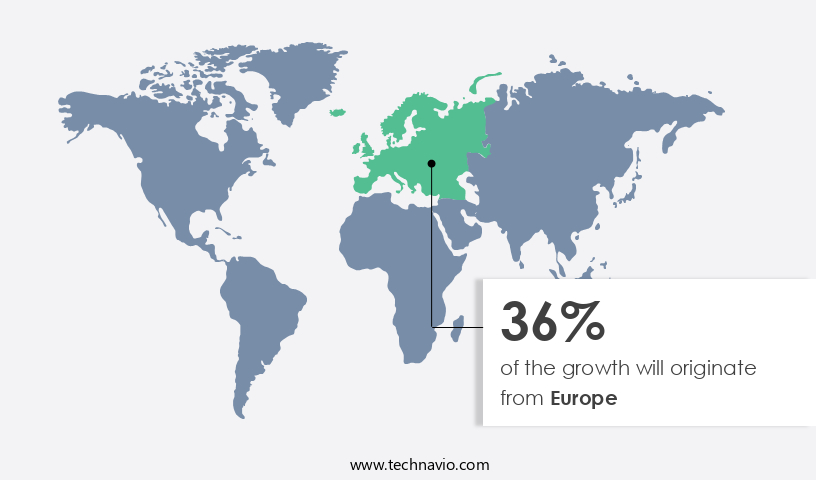
Aircraft Fuel Systems Market Share by Geography

For more insights on the market size of various regions, Request Free Sample

The market encompasses various components such as fuel tanks, aviation fuel systems, fuel management systems, fuel pumps, fuel distribution systems, fuel delivery systems, fuel gauges, fuel storage systems, refueling systems, fuel transfer systems, fuel valves, fuel filters, fuel lines, fuel sensors, fuel quantity indicators, fuel system integration, fuel system testing, fuel system certification, fuel system safety, fuel efficiency systems, and fuel system optimization. These systems play a crucial role in ensuring the reliable and efficient operation of aircraft. The North American market is significant due to the presence of a large aviation industry, particularly In the US, driven by military procurement programs.

However, the pandemic has adversely affected the aviation industry, leading to production shutdowns for Original Equipment Manufacturers (OEMs) like Boeing and Airbus. Despite challenges, advancements in fuel technology and aviation fuel innovations continue to prioritize fuel system reliability, safety, and optimization.

Market Dynamics

Our researchers analyzed the data with 2023 as the base year, along with the key drivers, trends, and challenges. A holistic analysis of drivers will help companies refine their marketing strategies to gain a competitive advantage.

What are the key market drivers leading to the rise In the adoption of Aircraft Fuel Systems Industry?

  • The use of the measured quantity of fuel onboard to optimize performance is the key driver of the market.  Aircraft fuel systems play a crucial role in optimizing the efficiency of aircraft by managing the amount of fuel carried on board. Fuel level monitoring is essential to ensure that an aircraft takes off with an optimal fuel load, especially for short-haul flights. Electrical capacitive sensor systems are employed to detect the fuel level in the tank by measuring the capacitance between the plates. These sensors help maintain the system's efficiency by providing real-time fuel level data to the cockpit.
  • Moreover, advanced fuel management systems compensate for fuel temperature changes to maintain accurate fuel level readings. The fuel temperature influences the fuel density, and these systems use compensators to adjust the fuel level readings based on the fuel temperature. By utilizing these technologies, aircraft operators can optimize fuel consumption and reduce operational costs.

What are the market trends shaping the Aircraft Fuel Systems Industry?

  • Continuous improvements in aircraft components is the upcoming market trend. The global aircraft fuel system market is experiencing significant dynamics due to the expansion of air travel routes, encompassing those at higher altitudes and those crossing the Arctic region. This growth is driven by the increasing airport traffic worldwide. To optimize flight routes and reach higher altitudes swiftly, aircraft require strong fuel systems.
  • However, external environmental conditions can change rapidly, posing challenges to fuel systems. Ice formation, fire hazards, and fuel system failures are among the vulnerabilities. To ensure safety, the European Commission and industry players are collaborating to develop more dependable and long-lasting components for aircraft fuel systems. This ongoing effort underscores the importance of investing in advanced fuel system technologies to maintain optimal flight performance and safety.

What challenges does the Aircraft Fuel Systems Industry face during its growth?

  • An increase in environmental regulations is a key challenge affecting the industry's growth.  In the aviation industry, regulatory bodies such as the Federal Aviation Administration (FAA) and the European Aviation Safety Agency mandate safe operating conditions. The US Environmental Protection Agency (EPA) has identified aircraft emissions as a significant contributor to climate change and a threat to human health and the environment. These emissions, primarily from gas turbine engines with a rated thrust above 26 pounds, account for 12% of all US transportation greenhouse gas emissions and 3% of total US greenhouse gas emissions.
  • The EPA has identified methane, carbon dioxide, hydrofluorocarbons, nitrous oxide, and other gases as the primary components of aircraft emissions, which contribute to greenhouse gas pollution. The aviation sector's environmental impact necessitates the development and implementation of sustainable fuel systems to reduce emissions and promote eco-friendly practices within the industry.

Exclusive Customer Landscape

The aircraft fuel systems market forecasting report includes the adoption lifecycle of the market, covering from the innovator's stage to the laggard's stage. It focuses on adoption rates in different regions based on penetration. Furthermore, the aircraft fuel systems market report also includes key purchase criteria and drivers of price sensitivity to help companies evaluate and develop their market growth analysis strategies.
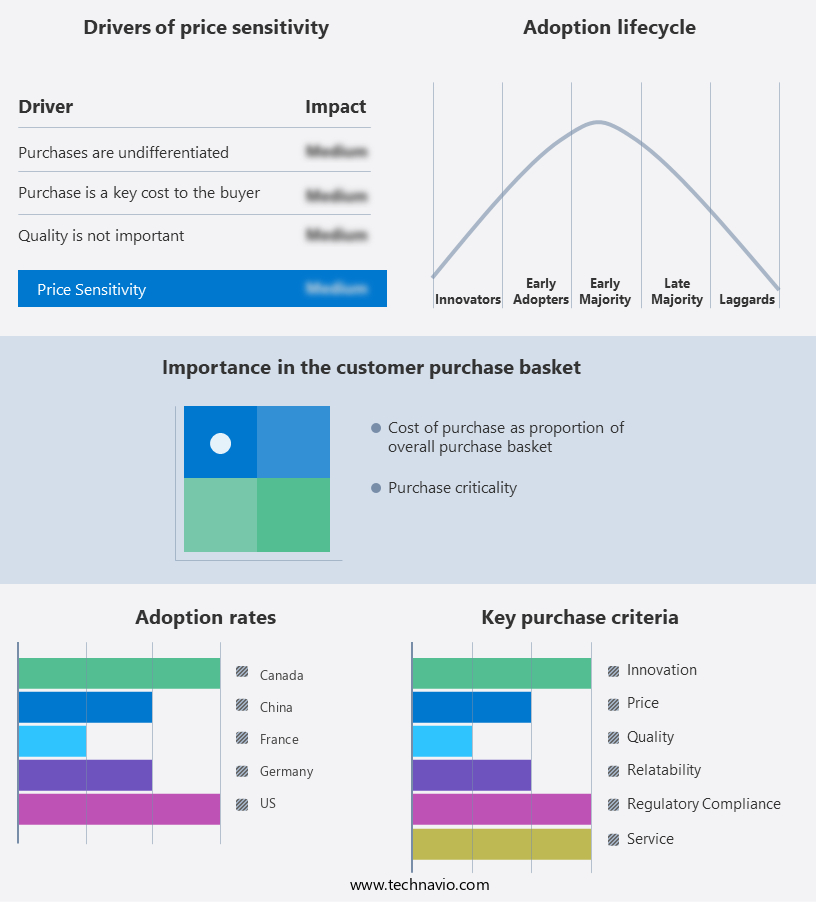
Aircraft Fuel Systems Market Share by Geography

 Customer Landscape

Key Companies & Market Insights

Companies are implementing various strategies, such as strategic alliances, aircraft fuel systems market forecast, partnerships, mergers and acquisitions, geographical expansion, and product/service launches, to enhance their presence In the industry.

Aloft AeroArchitects - The company specializes in providing a range of sports-related offerings, ensuring optimal search engine visibility and delivering comprehensive research insights from a seasoned analyst's perspective.

The industry research and growth report includes detailed analyses of the competitive landscape of the market and information about key companies, including:

  • Aloft AeroArchitects
  • BAE Systems Plc
  • Bryant Fuel Systems
  • Collins Aerospace
  • Crane Aerospace and Electronics
  • Eaton Corp. Plc
  • General Atomics
  • General Aviation Modifications Inc.
  • GKN Aerospace Services Ltd.
  • GNY Equipment Inc.
  • Honeywell International Inc.
  • Melrose Industries Plc
  • Nabtesco Corp.
  • Parker Hannifin Corp.
  • PTI Technologies Inc.
  • Safran SA
  • Secondo Mona S.p.A.
  • Senior Plc
  • Triumph Group Inc.
  • Woodward Inc.

Qualitative and quantitative analysis of companies has been conducted to help clients understand the wider business environment as well as the strengths and weaknesses of key industry players. Data is qualitatively analyzed to categorize companies as pure play, category-focused, industry-focused, and diversified; it is quantitatively analyzed to categorize companies as dominant, leading, strong, tentative, and weak.

Research Analyst Overview

The market encompasses a range of components and systems designed to manage and deliver fuel to the engines of aircraft. These systems are essential for ensuring the safe and efficient operation of aviation engines. Fuel management systems play a crucial role in this process, monitoring fuel levels, regulating pressure, and ensuring that fuel is delivered to the engines in the correct quantity and quality. Fuel distribution systems are responsible for transporting fuel from the main fuel tanks to the engines. Fuel pumps play a key role in this process, providing the necessary pressure to move fuel through the system.

Moreover, fuel lines, filters, and valves are also important components of the fuel distribution system, ensuring that fuel flows smoothly and is free of contaminants. Fuel storage systems are another critical aspect of the aircraft fuel system market. These systems are designed to safely store fuel for extended periods, while also ensuring that it remains at the correct temperature and pressure. Fuel gauges and fuel quantity indicators provide pilots with real-time information about fuel levels, allowing them to make informed decisions about fuel consumption and refueling. Aircraft refueling systems are an essential part of the aviation industry, enabling aircraft to be fueled quickly and efficiently on the ground.

Furthermore, fuel transfer systems are used to move fuel between different tanks or fuel trucks and the aircraft, while fuel system integration ensures that all components of the fuel system work together seamlessly. Fuel system safety is a top priority in the aircraft fuel system market. Fuel system testing and certification are rigorous processes designed to ensure that fuel systems meet the highest safety standards. Fuel efficiency systems and fuel system optimization are also important considerations, as fuel is a significant operating cost for airlines. The aircraft fuel system market is driven by several key factors.

Market Scope

Report Coverage

Details

Page number

175

Base year

2023

Historic period

2018-2022

Forecast period

2024-2028

Growth momentum & CAGR

Accelerate at a CAGR of 5.45%

Market growth 2024-2028

USD 1.52 billion

Market structure

Fragmented

YoY growth 2023-2024(%)

5.07

Key countries

US, France, Germany, China, and Canada

Competitive landscape

Leading Companies, Market Positioning of Companies, Competitive Strategies, and Industry Risks

Request Free Sample

What are the Key Data Covered in this Aircraft Fuel Systems Market Research and Growth Report?

  • CAGR of the Aircraft Fuel Systems industry during the forecast period
  • Detailed information on factors that will drive the market growth and forecasting between 2024 and 2028
  • Precise estimation of the size of the market and its contribution of the industry in focus to the parent market
  • Accurate predictions about upcoming growth and trends and changes in consumer behaviour
  • Growth of the market across North America, Europe, APAC, South America, and Middle East and Africa
  • Thorough analysis of the market's competitive landscape and detailed information about companies
  • Comprehensive analysis of factors that will challenge the aircraft fuel systems market growth of industry companies

We can help! Our analysts can customize this aircraft fuel systems market research report to meet your requirements.

Get in touch

1 Executive Summary

  • 1.1 Market overview
    • Executive Summary - Chart on Market Overview
    • Executive Summary - Data Table on Market Overview
    • Executive Summary - Chart on Global Market Characteristics
    • Executive Summary - Chart on Market by Geography
    • Executive Summary - Chart on Market Segmentation by Technology
    • Executive Summary - Chart on Market Segmentation by Application
    • Executive Summary - Chart on Incremental Growth
    • Executive Summary - Data Table on Incremental Growth
    • Executive Summary - Chart on Company Market Positioning

2 Market Landscape

  • 2.1 Market ecosystem
    • Parent Market
    • Data Table on - Parent Market
  • 2.2 Market characteristics
    • Market characteristics analysis
  • 2.3 Value chain analysis
    • Value Chain Analysis

3 Market Sizing

  • 3.1 Market definition
    • Offerings of companies included in the market definition
  • 3.2 Market segment analysis
    • Market segments
  • 3.3 Market size 2023
    • 3.4 Market outlook: Forecast for 2023-2028
      • Chart on Global - Market size and forecast 2023-2028 ($ million)
      • Data Table on Global - Market size and forecast 2023-2028 ($ million)
      • Chart on Global Market: Year-over-year growth 2023-2028 (%)
      • Data Table on Global Market: Year-over-year growth 2023-2028 (%)

    4 Historic Market Size

    • 4.1 Global Aircraft Fuel Systems Market 2018 - 2022
      • Historic Market Size - Data Table on Global Aircraft Fuel Systems Market 2018 - 2022 ($ million)
    • 4.2 Technology segment analysis 2018 - 2022
      • Historic Market Size - Technology Segment 2018 - 2022 ($ million)
    • 4.3 Application segment analysis 2018 - 2022
      • Historic Market Size - Application Segment 2018 - 2022 ($ million)
    • 4.4 Geography segment analysis 2018 - 2022
      • Historic Market Size - Geography Segment 2018 - 2022 ($ million)
    • 4.5 Country segment analysis 2018 - 2022
      • Historic Market Size - Country Segment 2018 - 2022 ($ million)

    5 Five Forces Analysis

    • 5.1 Five forces summary
      • Five forces analysis - Comparison between 2023 and 2028
    • 5.2 Bargaining power of buyers
      • Bargaining power of buyers - Impact of key factors 2023 and 2028
    • 5.3 Bargaining power of suppliers
      • Bargaining power of suppliers - Impact of key factors in 2023 and 2028
    • 5.4 Threat of new entrants
      • Threat of new entrants - Impact of key factors in 2023 and 2028
    • 5.5 Threat of substitutes
      • Threat of substitutes - Impact of key factors in 2023 and 2028
    • 5.6 Threat of rivalry
      • Threat of rivalry - Impact of key factors in 2023 and 2028
    • 5.7 Market condition
      • Chart on Market condition - Five forces 2023 and 2028

    6 Market Segmentation by Technology

    • 6.1 Market segments
      • Chart on Technology - Market share 2023-2028 (%)
      • Data Table on Technology - Market share 2023-2028 (%)
    • 6.2 Comparison by Technology
      • Chart on Comparison by Technology
      • Data Table on Comparison by Technology
    • 6.3 Fuel injection - Market size and forecast 2023-2028
      • Chart on Fuel injection - Market size and forecast 2023-2028 ($ million)
      • Data Table on Fuel injection - Market size and forecast 2023-2028 ($ million)
      • Chart on Fuel injection - Year-over-year growth 2023-2028 (%)
      • Data Table on Fuel injection - Year-over-year growth 2023-2028 (%)
    • 6.4 Pump feed - Market size and forecast 2023-2028
      • Chart on Pump feed - Market size and forecast 2023-2028 ($ million)
      • Data Table on Pump feed - Market size and forecast 2023-2028 ($ million)
      • Chart on Pump feed - Year-over-year growth 2023-2028 (%)
      • Data Table on Pump feed - Year-over-year growth 2023-2028 (%)
    • 6.5 Gravity feed - Market size and forecast 2023-2028
      • Chart on Gravity feed - Market size and forecast 2023-2028 ($ million)
      • Data Table on Gravity feed - Market size and forecast 2023-2028 ($ million)
      • Chart on Gravity feed - Year-over-year growth 2023-2028 (%)
      • Data Table on Gravity feed - Year-over-year growth 2023-2028 (%)
    • 6.6 Market opportunity by Technology
      • Market opportunity by Technology ($ million)
      • Data Table on Market opportunity by Technology ($ million)

    7 Market Segmentation by Application

    • 7.1 Market segments
      • Chart on Application - Market share 2023-2028 (%)
      • Data Table on Application - Market share 2023-2028 (%)
    • 7.2 Comparison by Application
      • Chart on Comparison by Application
      • Data Table on Comparison by Application
    • 7.3 Commercial - Market size and forecast 2023-2028
      • Chart on Commercial - Market size and forecast 2023-2028 ($ million)
      • Data Table on Commercial - Market size and forecast 2023-2028 ($ million)
      • Chart on Commercial - Year-over-year growth 2023-2028 (%)
      • Data Table on Commercial - Year-over-year growth 2023-2028 (%)
    • 7.4 Military - Market size and forecast 2023-2028
      • Chart on Military - Market size and forecast 2023-2028 ($ million)
      • Data Table on Military - Market size and forecast 2023-2028 ($ million)
      • Chart on Military - Year-over-year growth 2023-2028 (%)
      • Data Table on Military - Year-over-year growth 2023-2028 (%)
    • 7.5 Market opportunity by Application
      • Market opportunity by Application ($ million)
      • Data Table on Market opportunity by Application ($ million)

    8 Customer Landscape

    • 8.1 Customer landscape overview
      • Analysis of price sensitivity, lifecycle, customer purchase basket, adoption rates, and purchase criteria

    9 Geographic Landscape

    • 9.1 Geographic segmentation
      • Chart on Market share by geography 2023-2028 (%)
      • Data Table on Market share by geography 2023-2028 (%)
    • 9.2 Geographic comparison
      • Chart on Geographic comparison
      • Data Table on Geographic comparison
    • 9.3 North America - Market size and forecast 2023-2028
      • Chart on North America - Market size and forecast 2023-2028 ($ million)
      • Data Table on North America - Market size and forecast 2023-2028 ($ million)
      • Chart on North America - Year-over-year growth 2023-2028 (%)
      • Data Table on North America - Year-over-year growth 2023-2028 (%)
    • 9.4 Europe - Market size and forecast 2023-2028
      • Chart on Europe - Market size and forecast 2023-2028 ($ million)
      • Data Table on Europe - Market size and forecast 2023-2028 ($ million)
      • Chart on Europe - Year-over-year growth 2023-2028 (%)
      • Data Table on Europe - Year-over-year growth 2023-2028 (%)
    • 9.5 APAC - Market size and forecast 2023-2028
      • Chart on APAC - Market size and forecast 2023-2028 ($ million)
      • Data Table on APAC - Market size and forecast 2023-2028 ($ million)
      • Chart on APAC - Year-over-year growth 2023-2028 (%)
      • Data Table on APAC - Year-over-year growth 2023-2028 (%)
    • 9.6 South America - Market size and forecast 2023-2028
      • Chart on South America - Market size and forecast 2023-2028 ($ million)
      • Data Table on South America - Market size and forecast 2023-2028 ($ million)
      • Chart on South America - Year-over-year growth 2023-2028 (%)
      • Data Table on South America - Year-over-year growth 2023-2028 (%)
    • 9.7 Middle East and Africa - Market size and forecast 2023-2028
      • Chart on Middle East and Africa - Market size and forecast 2023-2028 ($ million)
      • Data Table on Middle East and Africa - Market size and forecast 2023-2028 ($ million)
      • Chart on Middle East and Africa - Year-over-year growth 2023-2028 (%)
      • Data Table on Middle East and Africa - Year-over-year growth 2023-2028 (%)
    • 9.8 US - Market size and forecast 2023-2028
      • Chart on US - Market size and forecast 2023-2028 ($ million)
      • Data Table on US - Market size and forecast 2023-2028 ($ million)
      • Chart on US - Year-over-year growth 2023-2028 (%)
      • Data Table on US - Year-over-year growth 2023-2028 (%)
    • 9.9 France - Market size and forecast 2023-2028
      • Chart on France - Market size and forecast 2023-2028 ($ million)
      • Data Table on France - Market size and forecast 2023-2028 ($ million)
      • Chart on France - Year-over-year growth 2023-2028 (%)
      • Data Table on France - Year-over-year growth 2023-2028 (%)
    • 9.10 Germany - Market size and forecast 2023-2028
      • Chart on Germany - Market size and forecast 2023-2028 ($ million)
      • Data Table on Germany - Market size and forecast 2023-2028 ($ million)
      • Chart on Germany - Year-over-year growth 2023-2028 (%)
      • Data Table on Germany - Year-over-year growth 2023-2028 (%)
    • 9.11 China - Market size and forecast 2023-2028
      • Chart on China - Market size and forecast 2023-2028 ($ million)
      • Data Table on China - Market size and forecast 2023-2028 ($ million)
      • Chart on China - Year-over-year growth 2023-2028 (%)
      • Data Table on China - Year-over-year growth 2023-2028 (%)
    • 9.12 Canada - Market size and forecast 2023-2028
      • Chart on Canada - Market size and forecast 2023-2028 ($ million)
      • Data Table on Canada - Market size and forecast 2023-2028 ($ million)
      • Chart on Canada - Year-over-year growth 2023-2028 (%)
      • Data Table on Canada - Year-over-year growth 2023-2028 (%)
    • 9.13 Market opportunity by geography
      • Market opportunity by geography ($ million)
      • Data Tables on Market opportunity by geography ($ million)

    10 Drivers, Challenges, and Opportunity/Restraints

    • 10.1 Market drivers
      • 10.2 Market challenges
        • 10.3 Impact of drivers and challenges
          • Impact of drivers and challenges in 2023 and 2028
        • 10.4 Market opportunities/restraints

          11 Competitive Landscape

          • 11.1 Overview
            • 11.2 Competitive Landscape
              • Overview on criticality of inputs and factors of differentiation
            • 11.3 Landscape disruption
              • Overview on factors of disruption
            • 11.4 Industry risks
              • Impact of key risks on business

            12 Competitive Analysis

            • 12.1 Companies profiled
              • Companies covered
            • 12.2 Market positioning of companies
              • Matrix on companies position and classification
            • 12.3 BAE Systems Plc
              • BAE Systems Plc - Overview
              • BAE Systems Plc - Business segments
              • BAE Systems Plc - Key news
              • BAE Systems Plc - Key offerings
              • BAE Systems Plc - Segment focus
            • 12.4 Crane Aerospace and Electronics
              • Crane Aerospace and Electronics - Overview
              • Crane Aerospace and Electronics - Business segments
              • Crane Aerospace and Electronics - Key offerings
              • Crane Aerospace and Electronics - Segment focus
            • 12.5 Eaton Corp. Plc
              • Eaton Corp. Plc - Overview
              • Eaton Corp. Plc - Business segments
              • Eaton Corp. Plc - Key news
              • Eaton Corp. Plc - Key offerings
              • Eaton Corp. Plc - Segment focus
            • 12.6 General Aviation Modifications Inc.
              • General Aviation Modifications Inc. - Overview
              • General Aviation Modifications Inc. - Product / Service
              • General Aviation Modifications Inc. - Key offerings
            • 12.7 GKN Aerospace Services Ltd.
              • GKN Aerospace Services Ltd. - Overview
              • GKN Aerospace Services Ltd. - Product / Service
              • GKN Aerospace Services Ltd. - Key offerings
            • 12.8 Honeywell International Inc.
              • Honeywell International Inc. - Overview
              • Honeywell International Inc. - Business segments
              • Honeywell International Inc. - Key news
              • Honeywell International Inc. - Key offerings
              • Honeywell International Inc. - Segment focus
            • 12.9 Melrose Industries Plc
              • Melrose Industries Plc - Overview
              • Melrose Industries Plc - Business segments
              • Melrose Industries Plc - Key offerings
              • Melrose Industries Plc - Segment focus
            • 12.10 Nabtesco Corp.
              • Nabtesco Corp. - Overview
              • Nabtesco Corp. - Business segments
              • Nabtesco Corp. - Key offerings
              • Nabtesco Corp. - Segment focus
            • 12.11 Parker Hannifin Corp.
              • Parker Hannifin Corp. - Overview
              • Parker Hannifin Corp. - Business segments
              • Parker Hannifin Corp. - Key news
              • Parker Hannifin Corp. - Key offerings
              • Parker Hannifin Corp. - Segment focus
            • 12.12 PTI Technologies Inc.
              • PTI Technologies Inc. - Overview
              • PTI Technologies Inc. - Product / Service
              • PTI Technologies Inc. - Key offerings
            • 12.13 Safran SA
              • Safran SA - Overview
              • Safran SA - Business segments
              • Safran SA - Key news
              • Safran SA - Key offerings
              • Safran SA - Segment focus
            • 12.14 Secondo Mona S.p.A.
              • Secondo Mona S.p.A. - Overview
              • Secondo Mona S.p.A. - Product / Service
              • Secondo Mona S.p.A. - Key offerings
            • 12.15 Senior Plc
              • Senior Plc - Overview
              • Senior Plc - Business segments
              • Senior Plc - Key offerings
              • Senior Plc - Segment focus
            • 12.16 Triumph Group Inc.
              • Triumph Group Inc. - Overview
              • Triumph Group Inc. - Business segments
              • Triumph Group Inc. - Key offerings
              • Triumph Group Inc. - Segment focus
            • 12.17 Woodward Inc.
              • Woodward Inc. - Overview
              • Woodward Inc. - Business segments
              • Woodward Inc. - Key offerings
              • Woodward Inc. - Segment focus

            13 Appendix

            • 13.1 Scope of the report
              • 13.2 Inclusions and exclusions checklist
                • Inclusions checklist
                • Exclusions checklist
              • 13.3 Currency conversion rates for US$
                • Currency conversion rates for US$
              • 13.4 Research methodology
                • Research methodology
              • 13.5 Data procurement
                • Information sources
              • 13.6 Data validation
                • Data validation
              • 13.7 Validation techniques employed for market sizing
                • Validation techniques employed for market sizing
              • 13.8 Data synthesis
                • Data synthesis
              • 13.9 360 degree market analysis
                • 360 degree market analysis
              • 13.10 List of abbreviations
                • List of abbreviations

              Research Methodology

              Technavio presents a detailed picture of the market by way of study, synthesis, and summation of data from multiple sources. The analysts have presented the various facets of the market with a particular focus on identifying the key industry influencers. The data thus presented is comprehensive, reliable, and the result of extensive research, both primary and secondary.

              INFORMATION SOURCES

              Primary sources

              • Manufacturers and suppliers
              • Channel partners
              • Industry experts
              • Strategic decision makers

              Secondary sources

              • Industry journals and periodicals
              • Government data
              • Financial reports of key industry players
              • Historical data
              • Press releases

              DATA ANALYSIS

              Data Synthesis

              • Collation of data
              • Estimation of key figures
              • Analysis of derived insights

              Data Validation

              • Triangulation with data models
              • Reference against proprietary databases
              • Corroboration with industry experts

              REPORT WRITING

              Qualitative

              • Market drivers
              • Market challenges
              • Market trends
              • Five forces analysis

              Quantitative

              • Market size and forecast
              • Market segmentation
              • Geographical insights
              • Competitive landscape

              Interested in this report?

              Get your sample now to see our research methodology and insights!

              Download Now

              Frequently Asked Questions

              Aircraft Fuel Systems market growth will increase by $ 1522.4 mn during 2024-2028.

              The Aircraft Fuel Systems market is expected to grow at a CAGR of 5.45% during 2024-2028.

              Aircraft Fuel Systems market is segmented by Technology( Fuel injection, Pump feed, Gravity feed) Application( Commercial, Military, APAC, South America, MEA)

              Aloft AeroArchitects, BAE Systems Plc, Bryant Fuel Systems, Collins Aerospace, Crane Aerospace and Electronics, Eaton Corp. Plc, General Atomics, General Aviation Modifications Inc., GKN Aerospace Services Ltd., GNY Equipment Inc., Honeywell International Inc., Melrose Industries Plc, Nabtesco Corp., Parker Hannifin Corp., PTI Technologies Inc., Safran SA, Secondo Mona S.p.A., Senior Plc, Triumph Group Inc., Woodward Inc. are a few of the key vendors in the Aircraft Fuel Systems market.

              Europe will register the highest growth rate of 36% among the other regions. Therefore, the Aircraft Fuel Systems market in Europe is expected to garner significant business opportunities for the vendors during the forecast period.

              US, France, Germany, China, Canada

              • Use of measured quantity of fuel onboard to optimize performanceTo enhance the overall efficiency of aircraft is the driving factor this market.
              • the amount of fuel carried on board needs to be optimized. An aircraft usually does not take off with its tanks full unless it is operating on a long-haul route. Electrical capacitive sensor systems are used to fill the gap between the plates in the fuel tank is the driving factor this market.
              • which helps to monitor the fuel level in the fuel tank is the driving factor this market.
              • thus maximizing the efficiency of the system. With the use of fuel and the gradual decline in the fuel level is the driving factor this market.
              • resistance changes and the results are indicated in the cockpit. Also is the driving factor this market.
              • as the fuel temperature dictates the density is the driving factor this market.
              • a few advanced systems employ a compensator to modify and project the value depending on the fuel temperature. Thus is the driving factor this market.
              • it is imperative to calibrate the probes or sensors during maintenance operations to ensure accurate readability. To make this system work error-free is the driving factor this market.
              • a measured quantity of fuel is the driving factor this market.
              • with a known temperature and density is the driving factor this market.
              • is added for calibration through an indicator in the signal conditioning unit. Multiple probes and measuring units are also integrated to maximize the fuel efficiency of aircraft with multiple tanks. The fuel load is mainly balanced by designated pumps is the driving factor this market.
              • as well as by gravity. Multi-engine aircraft have several lines is the driving factor this market.
              • hoses is the driving factor this market.
              • and valves dedicated to the supply of fuel to each engine. To prevent the formation of a vacuum is the driving factor this market.
              • fuel tanks have vents that allow the entry of air. They also have a check valve to prevent the siphoning off of fuel. However is the driving factor this market.
              • in the case of an additional air inlet is the driving factor this market.
              • the fuel may catch fire is the driving factor this market.
              • which can have catastrophic consequences. To prevent such situations is the driving factor this market.
              • many aircraft have pressure refueling valves along with check- and shut-off valves that avert the over-pressurization of fuel tanks. Lastly is the driving factor this market.
              • many large aircraft use a mechanical backup system by dropping a dipstick in the tank to measure the fuel level. The use of such advanced systems and sensors facilitates greater fuel efficiency is the driving factor this market.
              • which will support the growth of the market during the forecast period. is the driving factor this market.

              The Aircraft Fuel Systems market vendors should focus on grabbing business opportunities from the Fuel injection segment as it accounted for the largest market share in the base year.
