



North America LED Lighting Market Size 2026-2030
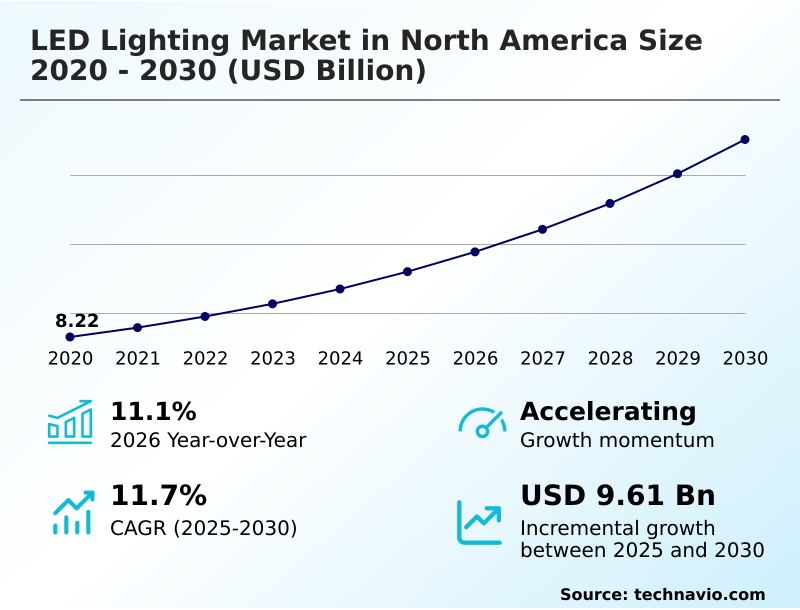
The north america led lighting market size is valued to increase by USD 9.61 billion, at a CAGR of 11.7% from 2025 to 2030. Stringent energy efficiency regulations and government mandates will drive the north america led lighting market.
Major Market Trends & Insights
- By Application - Residential segment was valued at USD 5.20 billion in 2024
- By Product - LED lamps segment accounted for the largest market revenue share in 2024
Market Size & Forecast
- Market Opportunities: USD 14.36 billion
- Market Future Opportunities: USD 9.61 billion
- CAGR from 2025 to 2030 : 11.7%
Market Summary
- The LED lighting market in North America is undergoing a fundamental transformation, moving beyond simple illumination to become an integral part of intelligent infrastructure. This evolution is propelled by stringent energy regulations and the expansion of smart city initiatives, which mandate the adoption of high-efficiency solid-state lighting.
- A key trend shaping the industry is the integration of human-centric lighting, which uses tunable white light to support occupants' circadian rhythms in commercial and healthcare settings. However, the market grapples with challenges related to the interoperability of systems from different manufacturers and the high initial capital required for advanced networks.
- For instance, a commercial real estate firm evaluating a large-scale upgrade must balance the long-term operational savings from reduced energy use against the significant upfront cost of installing an interconnected system with predictive maintenance capabilities.
- This scenario highlights the strategic decision-making required to leverage advanced lighting not just for efficiency, but as a tool for enhancing asset value and occupant well-being through superior color rendering index and integrated controls.
What will be the Size of the North America LED Lighting Market during the forecast period?
Get Key Insights on Market Forecast (PDF) Request Free Sample
How is the North America LED Lighting Market Segmented?
The north america led lighting industry research report provides comprehensive data (region-wise segment analysis), with forecasts and estimates in "USD million" for the period 2026-2030, as well as historical data from 2020-2024 for the following segments.
- Application
- Residential
- Commercial
- Industrial
- Outdoor
- Others
- Product
- LED lamps
- LED luminaires
- Distribution channel
- Offline
- Online
- Geography
- North America
- US
- Canada
- Mexico
- North America
By Application Insights
The residential segment is estimated to witness significant growth during the forecast period.
The residential sector's adoption of solid-state lighting is driven by the integration of smart home ecosystems. Homeowners now prioritize versatile illumination, adopting tunable white light systems with wireless controls to align with natural circadian rhythms.
The market is shifting from simple retrofit lamps to integrated fixtures and decorative smart lighting, often controlled via voice-activated assistants for enhanced convenience.
This focus on data-driven energy management and sophisticated aesthetics reflects a mature consumer base seeking more than just basic illumination.
In fact, installations incorporating integrated fixtures now account for over 30% of new smart home setups, emphasizing the move toward more holistic and architecturally embedded lighting solutions, including outdoor architectural illumination.
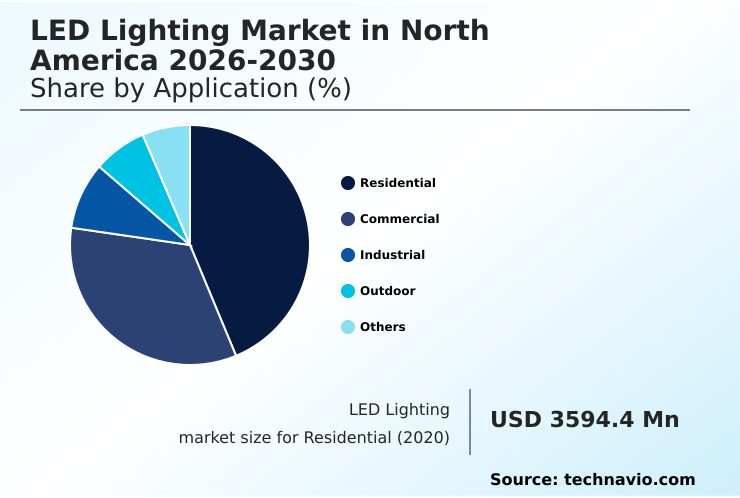
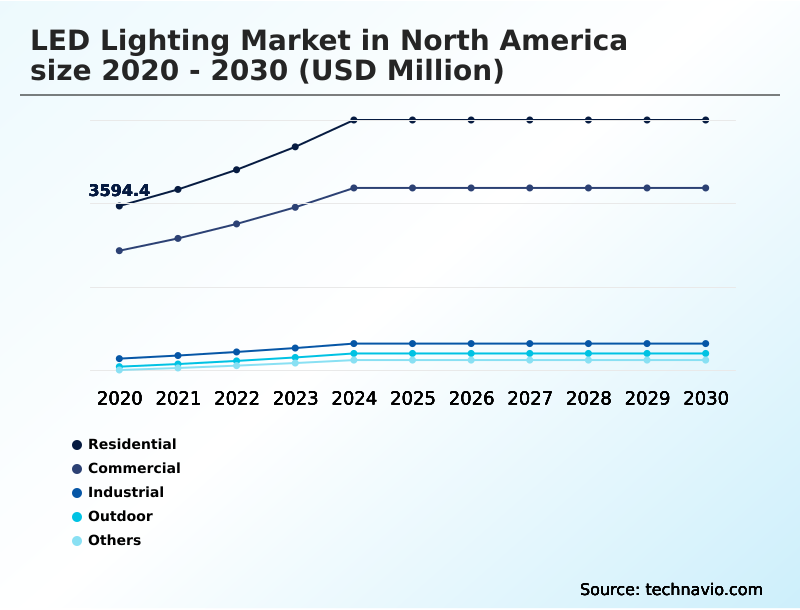
The Residential segment was valued at USD 5.20 billion in 2024 and showed a gradual increase during the forecast period.
Market Dynamics
Our researchers analyzed the data with 2025 as the base year, along with the key drivers, trends, and challenges. A holistic analysis of drivers will help companies refine their marketing strategies to gain a competitive advantage.
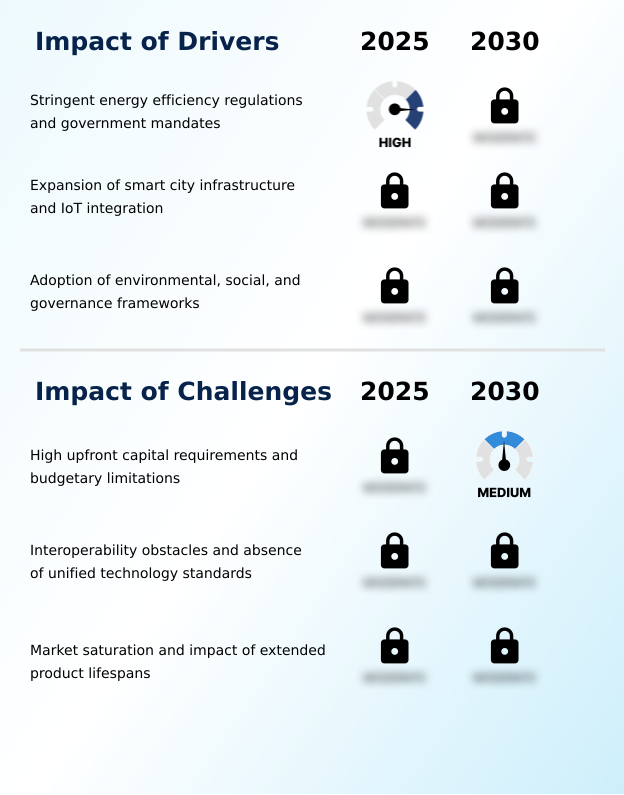
- The strategic direction of the led lighting market in north america 2026-2030 is increasingly shaped by a complex interplay of opportunities and constraints. The impact of stringent energy efficiency regulations continues to be a primary catalyst, compelling a widespread shift in both public and commercial sectors.
- This is complemented by the growth of smart city infrastructure and iot integration, which transforms lighting into a data-gathering platform. Corporations are also responding to pressure to adopt environmental social and governance frameworks, viewing lighting upgrades as a measurable step toward sustainability.
- Key trends such as human centric lighting and wellness design are becoming differentiators, alongside the convergence of ai convergence and predictive lighting analytics for operational intelligence. The transition to circular economy principles in manufacturing is also gaining traction. However, significant hurdles remain. High upfront capital requirements for lighting often conflict with budgetary realities.
- Furthermore, a lack of interoperability and unified technology standards creates complexity, while market saturation from extended product lifespans challenges traditional business models. For specialized sectors, solutions like led lighting for controlled environment agriculture and power over ethernet for commercial lighting are creating new value streams.
- Firms leveraging data analytics from smart lighting networks have been able to refine operational planning with an accuracy level more than double that of those relying on manual assessments. Ultimately, success depends on navigating these dynamics, from integrating lighting with building management systems to advancing sustainable materials in 3d printed luminaires.
What are the key market drivers leading to the rise in the adoption of North America LED Lighting Industry?
- Stringent energy efficiency regulations and government mandates are the key drivers propelling market growth.
- Market expansion is primarily driven by the push for energy efficiency, underpinned by advancements in semiconductor device technology. The core process of electroluminescence is being optimized through high-efficacy phosphors and superior heat sinks, enabling the development of high-performance semiconductor components.
- The rise of intelligent building systems and the pursuit of green building certifications are compelling commercial entities to adopt connected lighting systems. In the public sector, smart street lighting projects, often facilitated by public-private partnerships, are becoming common.
- These initiatives create interconnected urban data networks that improve municipal services.
- The adoption of advanced lighting in industrial settings, including high-bay luminaires and low-bay luminaires, has demonstrated energy savings of up to 60% compared to legacy systems, reinforcing the strong business case for upgrades.
What are the market trends shaping the North America LED Lighting Industry?
- The expansion of human-centric lighting and wellness-centered design is emerging as a significant market trend. This development prioritizes the physiological and psychological impact of illumination on occupants.
- Key trends are reshaping the market, with a strong emphasis on human-centric lighting and wellness, as evidenced by the adoption of the WELL Building Standard. This approach moves beyond simple efficiency to improve occupant well-being. Technologically, the industry is advancing with predictive maintenance enabled by edge computing and predictive lighting analytics, which can reduce system downtime by over 25%.
- Sustainability is another major focus, driving the adoption of circular economy principles through modular design and the use of recycled lighting materials. Innovations such as 3D printing luminaires with bio-based materials are also emerging, with some manufacturers reporting a 40% reduction in carbon footprint compared to traditional methods.
- These trends are supported by integrated lighting controls and a modular luminaire design, indicating a shift toward holistic, intelligent, and sustainable illumination solutions.
What challenges does the North America LED Lighting Industry face during its growth?
- High upfront capital requirements and budgetary limitations present a key challenge affecting industry growth.
- Despite strong drivers, the market faces significant challenges, particularly concerning system integration and cost. The lack of standardized protocols creates an interoperability barrier, making it difficult to create a unified interconnected urban data network that seamlessly integrates lighting with a building management system.
- The high initial cost of advanced lighting controllers and fixtures offering features like power over ethernet remains a deterrent for many organizations. Furthermore, the market for general illumination is seeing emerging competition from substitutes like organic light emitting diodes and natural light harvesting systems using fiber optics.
- While high-intensity discharge lamps are being phased out, their low replacement cost sometimes delays upgrades. The complexity of sourcing components with a high color rendering index and specific phosphor technology adds another layer of difficulty for manufacturers navigating a fragmented supply chain.
Exclusive Technavio Analysis on Customer Landscape
The north america led lighting market forecasting report includes the adoption lifecycle of the market, covering from the innovator’s stage to the laggard’s stage. It focuses on adoption rates in different regions based on penetration. Furthermore, the north america led lighting market report also includes key purchase criteria and drivers of price sensitivity to help companies evaluate and develop their market growth analysis strategies.
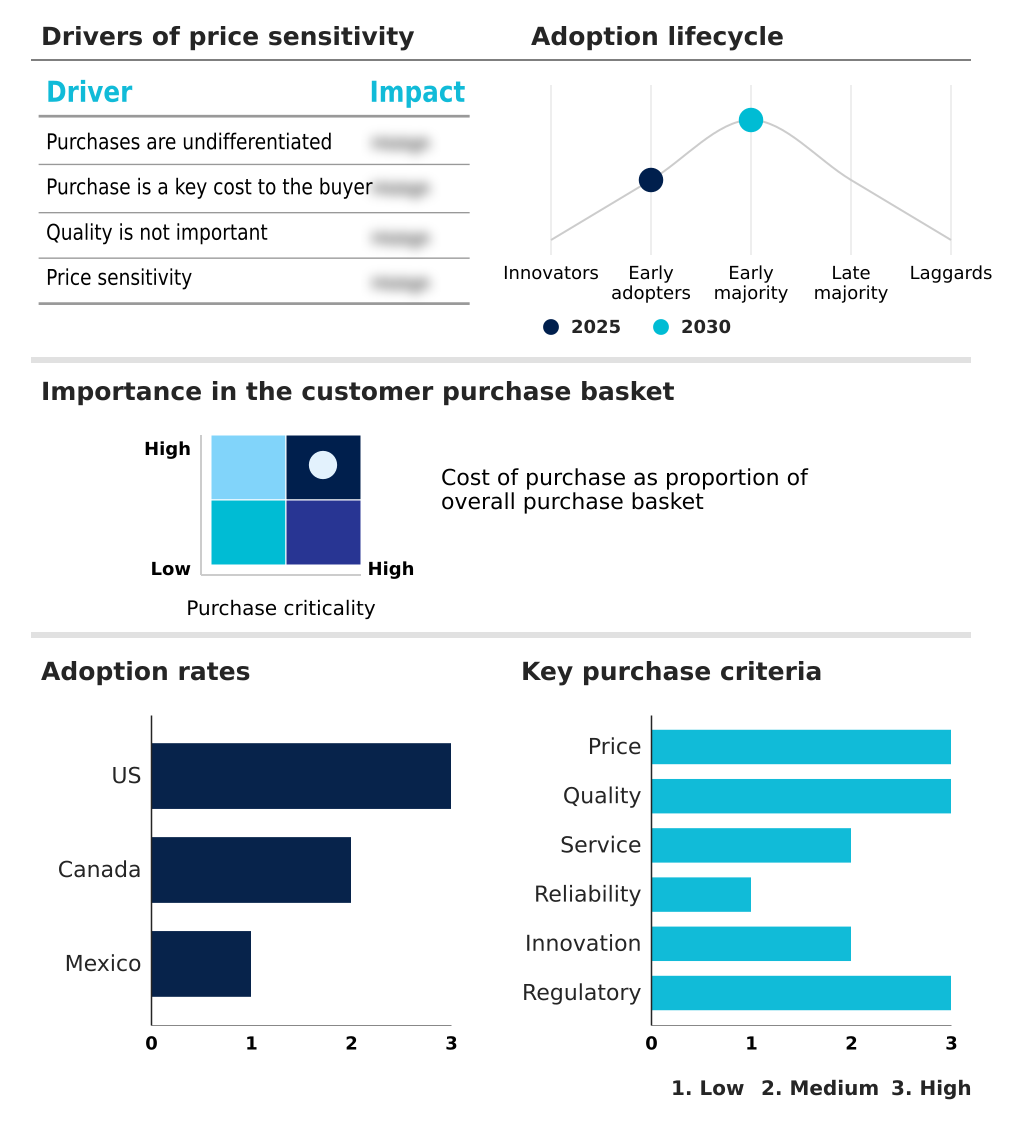
Customer Landscape of North America LED Lighting Industry
Competitive Landscape
Companies are implementing various strategies, such as strategic alliances, north america led lighting market forecast, partnerships, mergers and acquisitions, geographical expansion, and product/service launches, to enhance their presence in the industry.
Acuity Brands Inc. - The competitive landscape is defined by a strategic pivot from commodity hardware toward integrated, software-driven systems and high-value, specialized lighting applications.
The industry research and growth report includes detailed analyses of the competitive landscape of the market and information about key companies, including:
- Acuity Brands Inc.
- ams OSRAM AG
- Black Dog Grow Tech Inc.
- Bridgelux Inc.
- Cree LED
- Dialight PLC
- Eaton Corp. Plc
- Ennostar Inc.
- General Electric Co.
- GrowRay Technologies
- Hubbell Inc.
- Kessil
- Koninklijke Philips N.V.
- LSI Industries Inc.
- Lumileds Holding BV
- Nichia Corp.
- RAB Lighting Inc.
- Signify NV
- Technical Consumer Products Inc
- Toyoda Gosei Co. Ltd.
Qualitative and quantitative analysis of companies has been conducted to help clients understand the wider business environment as well as the strengths and weaknesses of key industry players. Data is qualitatively analyzed to categorize companies as pure play, category-focused, industry-focused, and diversified; it is quantitatively analyzed to categorize companies as dominant, leading, strong, tentative, and weak.
Recent Development and News in North america led lighting market
- In February 2025, the United States Department of Energy finalized a regulatory update enforcing a minimum efficacy standard for all general service lamps, effectively phasing out several older lighting technologies.
- In March 2025, Rexel USA expanded its Midwest distribution network with new high-capacity centers focused on managing inventory for smart lighting systems and providing localized technical support.
- In April 2025, Acuity Brands Inc. introduced a new series of advanced lighting controllers designed to improve the interoperability of luminaires within commercial building networks.
- In May 2025, a major technology provider based in Silicon Valley launched an advanced AI platform for the predictive management of large-scale industrial lighting networks across North America.
Dive into Technavio’s robust research methodology, blending expert interviews, extensive data synthesis, and validated models for unparalleled North America LED Lighting Market insights. See full methodology.
| Market Scope | |
|---|---|
| Page number | 207 |
| Base year | 2025 |
| Historic period | 2020-2024 |
| Forecast period | 2026-2030 |
| Growth momentum & CAGR | Accelerate at a CAGR of 11.7% |
| Market growth 2026-2030 | USD 9605.6 million |
| Market structure | Fragmented |
| YoY growth 2025-2026(%) | 11.1% |
| Key countries | US, Canada and Mexico |
| Competitive landscape | Leading Companies, Market Positioning of Companies, Competitive Strategies, and Industry Risks |
Research Analyst Overview
- The market has evolved from a hardware-centric industry to a sophisticated ecosystem built on semiconductor device technology and the principle of electroluminescence. The emphasis is now on integrated systems where solid-state lighting, featuring advanced thermal management and a high color rendering index, acts as a data-rich infrastructure component.
- Key advancements in high-efficacy phosphors and heat sinks, coupled with increasing vertical integration by manufacturers, are driving performance gains in high-bay luminaires and low-bay luminaires.
- For board-level consideration, the adoption of human-centric lighting, which utilizes tunable white light to support circadian rhythms, directly aligns with corporate wellness and productivity goals, with some studies indicating it can enhance task accuracy by nearly 10%.
- This shift necessitates a strategic focus on systems offering daylight harvesting, superior light distribution, and occupancy sensing, moving beyond simple replacements for high-intensity discharge lamps toward intelligent, data-driven assets that deliver measurable business value through enhanced efficiency and occupant well-being.
What are the Key Data Covered in this North America LED Lighting Market Research and Growth Report?
-
What is the expected growth of the North America LED Lighting Market between 2026 and 2030?
-
USD 9.61 billion, at a CAGR of 11.7%
-
-
What segmentation does the market report cover?
-
The report is segmented by Application (Residential, Commercial, Industrial, Outdoor, and Others), Product (LED lamps, and LED luminaires), Distribution Channel (Offline, and Online) and Geography (North America)
-
-
Which regions are analyzed in the report?
-
North America
-
-
What are the key growth drivers and market challenges?
-
Stringent energy efficiency regulations and government mandates, High upfront capital requirements and budgetary limitations
-
-
Who are the major players in the North America LED Lighting Market?
-
Acuity Brands Inc., ams OSRAM AG, Black Dog Grow Tech Inc., Bridgelux Inc., Cree LED, Dialight PLC, Eaton Corp. Plc, Ennostar Inc., General Electric Co., GrowRay Technologies, Hubbell Inc., Kessil, Koninklijke Philips N.V., LSI Industries Inc., Lumileds Holding BV, Nichia Corp., RAB Lighting Inc., Signify NV, Technical Consumer Products Inc and Toyoda Gosei Co. Ltd.
-
Market Research Insights
- The market's dynamism is fueled by the rapid adoption of intelligent building systems, where advanced lighting controllers and wireless controls are fundamental. This transition toward data-driven energy management enables facilities to achieve significant operational efficiencies.
- For example, commercial buildings deploying such systems have reported energy consumption reductions of up to 35%, while also achieving a 15% decrease in maintenance dispatches due to predictive lighting analytics. The demand for green building certifications further accelerates the uptake of sustainable manufacturing practices and modular luminaire designs.
- As a result, the strategic focus is shifting from standalone hardware to interconnected ecosystems that provide tangible returns on investment, with some projects demonstrating a complete payback in under three years through combined energy and operational savings.
We can help! Our analysts can customize this north america led lighting market research report to meet your requirements.
 RIA -
RIA - 
