


APAC Luxury Goods Market Forecast 2024-2028
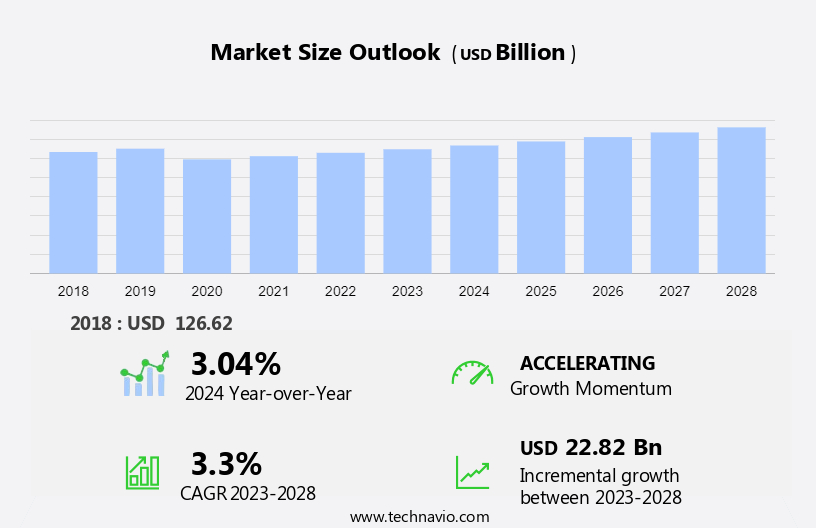
- The APAC luxury goods market size is estimated to grow by USD 22.82 billion between 2023 and 2028
- The market is accelerating at a compound annual growth rate of 3.3%.
The market trends and analysis report covers an in-depth analysis of market growth factors like increased demand for premium products, the expansion in online retailing of luxury goods, and the rising disposable income of consumers in APAC.
To learn more about this report, View Sample PDF
Market Segmentation
By Distribution Channel Analysis
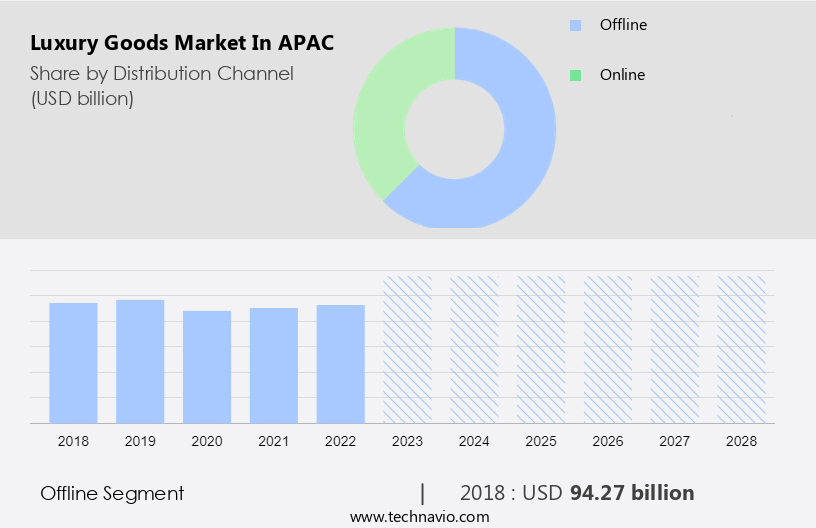
The offline segment will account for a major share of the market's growth during the forecast period. The revenue in this segment has been declining gradually over the years due to the increasing preference for online shopping. To fuel sales of luxury goods through offline channels, companies are expanding their stores in local and regional markets. To survive in such a competitive market and to overcome the declining preference for offline shopping, retailers are introducing new business and retail strategies, such as better pricing strategies and a wide range of products. The offline segment was valued at USD 94.27 billion in 2018. The huge growth in the number of retailers in different regions will drive customer familiarization with different types of footwear, purses, belts, and many other things. It will also increase the value of sales in the market. Although the offline segment is losing its market share to the online segment, innovative marketing strategies by companies will keep the growth rate of the offline segment stable during the forecast period.
To gain further insights on the market contribution of various segments Request a PDF Sample
By Product Analysis
The market is segmented by product into clothing, perfumes and cosmetics, watches and jewelry, and others. The clothing segment will account for the largest share of this segment.?
Key Major Companies
Companies are implementing various market growth and forecasting strategies by analyzing factors such as strategic alliances, partnerships, mergers and acquisitions, geographical expansion, and product or service launches to enhance their presence in the market.
- Burberry Group Plc: The company offers luxury goods such as men's and women's apparel, children's wear, beauty products, sunglasses, watches, leather goods, handbags, and beauty products.
The market report also includes detailed analyses of the competitive landscape of the market and information about 20 market companies, including:
Bang and Olufsen Group, Capri Holdings Ltd., Cartier SA, Chanel Ltd., Compagnie Financiere Richemont SA, Dolce and Gabbana SRL, Gianni Versace Srl, Giorgio Armani S.p.A., Hermes International SA, JOHN HARDY USA Inc., Kering SA, LVMH Moet Hennessy Louis Vuitton SE, MCM Products USA Inc., Prada S.p.A, Ralph Lauren Corp., Rolex SA, S.T. Dupont SA, Swarovski AG, and The Swatch Group Ltd.
Qualitative and quantitative analysis of market growth and trends of companies has been conducted to help clients understand the wider business environment as well as the strengths and weaknesses of key market players. Data is qualitatively analyzed to categorize companies as pure play, category-focused, industry-focused, and diversified. Furthermore, market growth and forecasting it is also quantitatively analyzed to categorize companies as dominant, leading, strong, tentative, and weak.
Market Dynamic
Our researchers analyzed the market research and growth data with 2023 as the base year, along with the key market growth analysis, trends, and challenges. A holistic analysis of drivers, trends, and challenges will help companies refine their marketing strategies to gain a competitive advantage.
Key Market Drivers
Increased demand for premium products is the key factor driving the market. Premium products often offer a combination of tangible and intangible value. The perceived value of owning a well-crafted, exclusive item or experiencing a premium service contributes to the demand for such products and services. APAC includes economically dynamic countries such as China, Japan, Australia, and South Korea. For instance, China stands out as one of the most economically dynamic countries in the APAC region. With a massive and rapidly growing middle class, China has become a major market for premium and luxury products. Similarly, South Korea has witnessed remarkable economic growth over the years, and consumers in the country have developed a strong appetite for premium and luxury goods. Seoul, the capital, is known for its vibrant fashion scene and luxury shopping districts and has a consumer base that values high-quality products.
Moreover, premium products often incorporate cutting-edge design and innovative technologies. Whether it is fashion, electronics, or automobiles, consumers are drawn to products that showcase the latest trends and embody a sense of modernity and luxury. Furthermore, luxury brands frequently offer personalized and customized options in their products. This level of personalization, which takes the form of monogramming, bespoke tailoring, or unique configurations, enhances the exclusivity and individuality of the premium item purchased. Therefore, a rise in the demand for premium products, with a rise in the lifestyles of customers, will foster the growth of the market during the forecast period. Additionally, digital channels are increasingly becoming important channels for reaching Asian luxury consumers whose attitudes heavily favor boutique luxury experiences and customization.
Significant Market Trends
The rise in demand for sustainable goods is the primary trend shaping the market. The rise in the demand for sustainable goods in the market is part of a global trend where consumers are redefining their idea of luxury to include values such as sustainability, responsibility, and authenticity. Brands that embrace and champion these values are likely to find success in meeting the evolving expectations of consumers in the region. The concept of circular fashion, which promotes recycling, upcycling, and the extension of product lifecycles, is gaining traction in the market. Consumers are increasingly valuing brands that contribute to a more sustainable and circular approach to fashion.
Furthermore, the governments of China, India, and Japan are implementing initiatives and regulations to promote sustainable practices in manufacturing. These policies are encouraging brands to adopt eco-friendly production methods and raw materials. Several luxury brands cater to the rising trend of sustainable luxury goods. Additionally, the integration of sustainable practices by luxury brands not only addresses environmental concerns but also meets the growing demand for conscious and ethical consumption, which is expected to drive the growth of the market during the forecast period.
Major Market Challenges
The growing issue of counterfeit products is a challenge that affects market expansion. The growing market prospects for luxury goods (such as handbags, watches, and accessories) and their surging demand parallelly drive the market for counterfeit luxury goods, especially in developing countries such as India and Sri Lanka. The increasing penetration of e-commerce has propelled the sales of counterfeit products. Customers face difficulty in differentiating genuine products from counterfeit products, as both appear similar. These imitation luxury bags often mimic the design, logos, and stitching of authentic products. Furthermore, counterfeit products are inexpensive and are thus high in demand. These products adversely affect the sales and pricing strategies of genuine companies by diluting their market shares and hampering their reputations.
Moreover, manufacturers of counterfeit products save a lot on production and transportation costs through the use of low-quality raw materials and operations in regional or local markets. As a result, these are more cost-effective than their genuine counterparts. Established players in the market are striving to penetrate developing countries such as India and China, which have a significant presence of these due to their low prices. Therefore, the presence of counterfeit products will hinder the expansion of the market during the forecast period.
Get a detailed analysis of drivers, trends, and challenges Request Free PDF Sample !
Market Analyst Overview
The Asia-Pacific region remains a pivotal player in the global industry, with the Asian luxury market exhibiting a robust growth trajectory. From boutique luxury brands to established giants like XL Enterprises and XL Fashions, the shift from physical to digital channels has been pronounced, especially with travel bans and lockdowns influencing consumer behavior and customer spending. While sales volume faced fluctuations, luxury handbag manufacturers adapted, focusing on lining fabric, colors, hardware, and patterns to entice young consumer confidence.
Despite uncertainties like import duties and gray markets, the National Bureau of Statistics reports resilience, especially with Chanel SA spearheading new product development. Online channels led by Alibaba Group Holding Ltd have gained prominence, with platforms like Tmall Luxury Pavilion and Soho becoming go-to destinations, even fostering an online outlet store culture, signaling a dynamic future for the region's luxury landscape.
|
Market Scope |
|
|
Report Coverage |
Details |
|
Page number |
120 |
|
Base year |
2023 |
|
Forecast period |
2024-2028 |
|
Growth momentum & CAGR |
Accelerate at a CAGR of 3.3% |
|
Market Growth 2024-2028 |
USD 22.82 billion |
|
Market structure |
Fragmented |
|
YoY growth (%) |
3.04 |
|
Competitive landscape |
Leading companies, Competitive Strategies, Consumer engagement scope |
|
Key companies profiled |
Bang and Olufsen Group, Burberry Group Plc, Capri Holdings Ltd., Cartier SA, Chanel Ltd., Compagnie Financiere Richemont SA, Dolce and Gabbana SRL, Gianni Versace Srl, Giorgio Armani S.p.A., Hermes International SA, JOHN HARDY USA Inc., Kering SA, LVMH Moet Hennessy Louis Vuitton SE, MCM Products USA Inc., Prada S.p.A, Ralph Lauren Corp., Rolex SA, S.T. Dupont SA, Swarovski AG, and The Swatch Group Ltd. |
|
Market dynamics |
Parent market analysis, Market growth inducers and obstacles, Fast-growing and slow-growing segment analysis, COVID-19 impact and recovery analysis and future consumer dynamics, Market condition analysis for the forecast period. |
|
Customization purview |
If our report has not included the data that you are looking for, you can reach out to our analysts and get segments customized. |
What are the Key Data Covered in this Market Research Report?
- CAGR of the market forecast during the forecast period
- Detailed information on factors that will drive the growth of the market between 2024 and 2028
- Precise estimation of the market size and its contribution of the market in focus to the parent market
- Accurate predictions about upcoming trends and changes in consumer behavior
- Growth of the market across APAC
- Thorough market analysis and report of the market’s competitive landscape and detailed information about companies
- Comprehensive analysis of factors that will challenge the growth of market companies
We can help! Our analysts can customize this market research report to meet your requirements. Get in touch
 RIA -
RIA - 
