



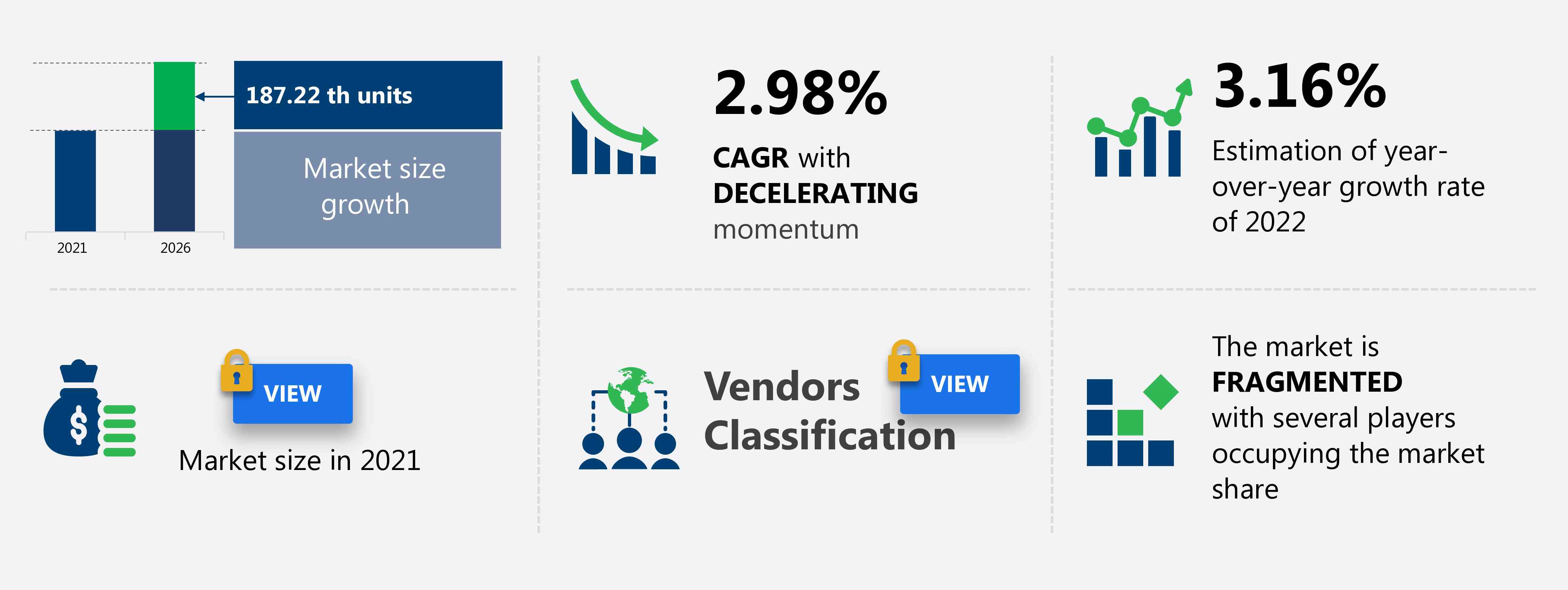
The automotive composites market share in Japan is expected to increase by 187.22 thousand units from 2021 to 2026, at a CAGR of 2.98%.
This automotive composites market in Japan research report provides valuable insights on the post COVID-19 impact on the market, which will help companies evaluate their business approaches. Furthermore, this report extensively covers the automotive composites market in Japan segmentation by vehicle type (passenger vehicles and commercial vehicles) and application (structural assembly, power train components, and other parts). The automotive composites market in Japan report also offers information on several market vendors, including 3B-the fiberglass Co., BASF SE, BMW AG, General Motors Co., Nippon Electric Glass Co. Ltd., Nitto Boseki Co. Ltd., SGL Carbon SE, Solvay SA, Teijin Ltd., and Toray Industries Inc. among others.
What will the Automotive Composites Market Size in Japan be During the Forecast Period?
Download the Free Report Sample to Unlock the Automotive Composites Market Size in Japan for the Forecast Period and Other Important Statistics
Automotive Composites Market in Japan: Key Drivers, Trends, and Challenges
The growing use of carbon fiber materials in the automotive industry is notably driving the automotive composites market growth in Japan, although factors such as high costs associated with carbon fiber may impede the market growth. Our research analysts have studied the historical data and deduced the key market drivers and the COVID-19 pandemic impact on the automotive composites industry in Japan. The holistic analysis of the drivers will help in deducing end goals and refining marketing strategies to gain a competitive edge.
Key Automotive Composites Market Driver in Japan
One of the key factors driving the automotive composites market growth in Japan is the growing use of carbon fiber materials in the automotive industry. The growing competition among automotive OEMs and automakers is fueling the adoption of advanced materials, including aluminum, carbon fibers, and magnesium, for automotive applications. Carbon fibers are highly preferred materials for automotive applications owing to their high strength-to-weight ratio when compared to metals, which makes them 20% lighter than conventional materials, such as aluminum and titanium. The rise in demand for supercars and the growing popularity of hypercars are fueling sales in the global automotive carbon fiber components market, which are thereby expected to boost the growth of the market in focus during the forecast period.
Key Automotive Composites Market Trend in Japan
Another key factor driving the automotive composites market growth in Japan is the rising preference for lightweight materials. As lightweight materials and innovative designs are crucial for automobile manufacturers to increase their market shares, such materials are increasingly being used in automobiles. A 10% reduction in vehicle weight can increase fuel efficiency by 6%-8%. Furthermore, they help reduce greenhouse emissions and improve fuel efficiency in vehicles. It also helps in reducing maintenance costs as well as carbon dioxide emissions from automobiles. Glass fibers are lightweight and are increasingly used in numerous applications in automobiles. Thus, the rising preference for lightweight materials will drive the demand for glass fibers, thereby propelling the growth of the automotive composites market in Japan during the forecast period.
Key Automotive Composites Market Challenge in Japan
One of the key challenges to the automotive composites market growth in Japan is the high costs associated with carbon fiber as they are more expensive than their substitutes, such as metals, plastics, and polymers. Carbon fibers account for more than 35% of the polymer matrix and are considered a significant raw material in the defense and automobile industries. The costs of manufacturing and R&D associated with carbon fiber are very high, which can reduce the demand for carbon fiber in automotive composites and increase the demand for substitute products. The cost of production and R&D of carbon fiber composites is eight times that of steel, which is expected to challenge the growth of the automotive composites market in Japan during the forecast period.
This automotive composites market in Japan analysis report also provides detailed information on other upcoming trends and challenges that will have a far-reaching effect on the market growth. The actionable insights on the trends and challenges will help companies evaluate and develop growth strategies for 2022-2026.
Parent Market Analysis
Technavio categorizes the automotive composites market in Japan as a part of the global specialty chemicals market. Our research report has extensively covered external factors influencing the parent market growth potential in the coming years, which will determine the levels of growth of the automotive composites market in Japan during the forecast period.
Who are the Major Automotive Composites Market Vendors in Japan?
The report analyzes the market’s competitive landscape and offers information on several market vendors, including:
- 3B-the fiberglass Co.
- BASF SE
- BMW AG
- General Motors Co.
- Nippon Electric Glass Co. Ltd.
- Nitto Boseki Co. Ltd.
- SGL Carbon SE
- Solvay SA
- Teijin Ltd.
- Toray Industries Inc.
This statistical study of the automotive composites market in Japan encompasses successful business strategies deployed by the key vendors. The automotive composites market in Japan is fragmented and the vendors are deploying organic and inorganic growth strategies to compete in the market.
Product Insights and News
- 3B-the fiberglass Co. - The company offers automotive composites such as chopped strand, direct roving, continuous filament mat, wet chopped strand, choppable roving, and chopped strand mat.
To make the most of the opportunities and recover from post COVID-19 impact, market vendors should focus more on the growth prospects in the fast-growing segments, while maintaining their positions in the slow-growing segments.
The automotive composites market in Japan forecast report offers in-depth insights into key vendor profiles. The profiles include information on the production, sustainability, and prospects of the leading companies.
Automotive Composites Market in Japan Value Chain Analysis
Our report provides extensive information on the value chain analysis for the automotive composites market in Japan, which vendors can leverage to gain a competitive advantage during the forecast period. The end-to-end understanding of the value chains is essential in profit margin optimization and evaluation of business strategies. The data available in our value chain analysis segment can help vendors drive costs and enhance customer services during the forecast period.
The value chain of the global specialty chemicals market includes the following core components:
- Inputs
- Inbound logistics
- Operations
- Outbound logistics
- Marketing and sales
- Support activities
- Innovation
The report has further elucidated on other innovative approaches being followed by manufacturers to ensure a sustainable market presence.
What are the Revenue-generating Vehicle Type Segments in the Automotive Composites Market in Japan?
To gain further insights on the market contribution of various segments Request for a FREE sample
The automotive composites market share growth in Japan by the passenger vehicle segment will be significant during the forecast period. The growth is attributed to the increase in the disposable income of individuals belonging to the middle-class population. As per the data provided by the Organisation Internationale des Constructeurs d’Automobiles (OICA), the total number of passenger cars manufactured in Japan in 2020 was 6,960,025. Furthermore, Japan is one of the highest contributors to passenger car sales and production in APAC.
This report provides an accurate prediction of the contribution of all the segments to the growth of the automotive composites market size in Japan and actionable market insights on post COVID-19 impact on each segment.
You may be interested in:
China Automotive Carbon Fiber Composites market - The market share is expected to increase by 3.65 thousand units from 2021 to 2026, at a CAGR of 11.17%.
Carbon Fiber in the Automotive Composites market - The market share is expected to increase by 47.92 thousand MT from 2020 to 2025, and the market's growth momentum will decelerate at a CAGR of 26.4%.
Thermoset Composites market - The market share is expected to increase by USD 20.73 billion from 2022 to 2026, and the market’s growth momentum will accelerate at a CAGR of 6.92%.
|
Automotive Composites Market Scope in Japan |
|
|
Report Coverage |
Details |
|
Page number |
120 |
|
Base year |
2021 |
|
Forecast period |
2022-2026 |
|
Growth momentum & CAGR |
Decelerate at a CAGR of 2.98% |
|
Market growth 2022-2026 |
187.22 th units |
|
Market structure |
Fragmented |
|
YoY growth (%) |
3.16 |
|
Regional analysis |
Japan |
|
Key companies profiled |
3B-the fiberglass Co., BASF SE, BMW AG, General Motors Co., Nippon Electric Glass Co. Ltd., Nitto Boseki Co. Ltd., SGL Carbon SE, Solvay SA, Teijin Ltd., and Toray Industries Inc. |
|
Market dynamics |
Parent market analysis, Market growth inducers and obstacles, Fast-growing and slow-growing segment analysis, COVID-19 impact and recovery analysis and future consumer dynamics, Market condition analysis for the forecast period |
|
Customization purview |
If our report has not included the data that you are looking for, you can reach out to our analysts and get segments customized. |
What are the Key Data Covered in this Automotive Composites Market in Japan Report?
- CAGR of the market during the forecast period 2022-2026
- Detailed information on factors that will drive automotive composites market growth in Japan during the next five years
- Precise estimation of the automotive composites market size in Japan and its contribution to the parent market
- Accurate predictions on upcoming trends and changes in consumer behavior
- The growth of the automotive composites industry in Japan
- A thorough analysis of the market’s competitive landscape and detailed information on vendors
- Comprehensive details of factors that will challenge the growth of the automotive composites market vendors in Japan
We can help! Our analysts can customize this report to meet your requirements. Get in touch
 RIA -
RIA - 
