



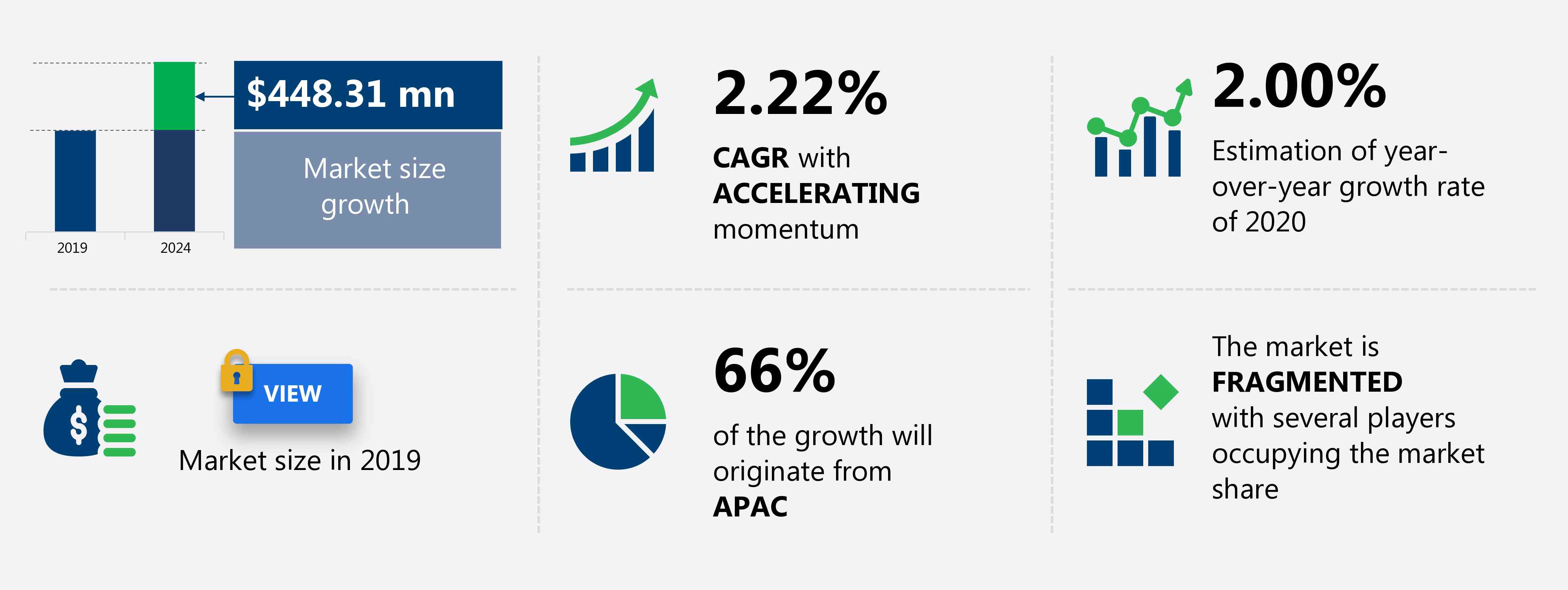
The automotive fuel level sensor market share is expected to increase by USD 448.31 million from 2019 to 2024, and the market’s growth momentum will accelerate at a CAGR of 2.22%.
This automotive fuel level sensor market research report provides valuable insights on the post COVID-19 impact on the market, which will help companies evaluate their business approaches. Furthermore, this report extensively covers automotive fuel level sensor market segmentation by type (capacitive, resistive, and others) and geography (APAC, Europe, North America, and South America). The automotive fuel level sensor market report also offers information on several market vendors, including Bourns Inc., Continental AG, Delphi Technologies Plc, elobau GmbH & Co. KG, Minda Corp. Ltd., Pricol Ltd., Robert Bosch GmbH, Rochester Gauges LLC, TE Connectivity Ltd., and Valeo SA among others.
What will the Automotive Fuel Level Sensor Market Size be During the Forecast Period?
Download the Free Report Sample to Unlock the Automotive Fuel Level Sensor Market Size for the Forecast Period and Other Important Statistics
Automotive Fuel Level Sensor Market: Key Drivers, Trends, and Challenges
Based on our research output, there has been a negative impact on the market growth during and post COVID-19 era. The increasing demand for telematics to monitor fuel is notably driving the automotive fuel level sensor market growth, although factors such as the effect on working capital due to low profitability may impede the market growth. Our research analysts have studied the historical data and deduced the key market drivers and the COVID-19 pandemic impact on the automotive fuel level sensor industry. The holistic analysis of the drivers will help in deducing end goals and refining marketing strategies to gain a competitive edge.
Key Automotive Fuel Level Sensor Market Driver
The increasing demand for telematics to monitor fuel is notably driving the automotive fuel level sensor market growth. The increase in fuel theft and the need for real-time fuel monitoring have led to the development of fuel level sensors equipped with a GPS tracking system. The GPS-enabled fuel level sensor is the latest offering in the global automotive fuel level sensor market and is a factor that is driving the market. Using these GPS-enabled fuel level sensors, a person can track his or her vehicle's fuel level from any place at any point in time. The GPS-enabled sensor is connected to a tracking device, which transmits signals to satellites, and those satellites send responses to the vehicle owner's mobile phone or computer. These fuel sensors are extensively utilized by corporates to ensure the appropriate use of company vehicles. These fuel level sensors prevent fuel theft, optimize fleet operations, monitor fuel line conditions, and monitor engine operation mode. The need to reduce the fuel expenses in the logistics sector has spurred the demand for telematics. This increasing demand for telematics fleet management has positively impacted the global automotive fuel level sensor market.
Key Automotive Fuel Level Sensor Market Trend
Increasing demand and preference for electronic components in vehicles is the key trend driving the automotive fuel level sensor market growth. The evolution of electronics in an automobile has fostered the growth of the automotive market. The growing demand for safety, stability, performance, and comfort has led to increased electrification of automotive components. Electronic components in vehicles are used by OEMs to differentiate their offerings from that of their competitors. Around 90% of enhanced features available in a passenger car model today have been made possible only through the addition of electronic components. Fuel level sensors with tracking and monitoring systems are an example of the growing need for vehicle electrification. Advancements in technology and the growing adoption of the same by buyers will increase the integration of electronic components in commercial vehicles and cars. Moreover, government regulations and safety concerns are also driving the electrification of vehicles, which, in turn, is boosting the global automotive fuel level sensor market.
Key Automotive Fuel Level Sensor Market Challenge
The major challenge impeding the automotive fuel level sensor market growth is the effect on working capital due to low profitability. APAC accounts for the largest production of automotive components across the world. Low labor costs in Asian countries have led many renowned and established OEMs to set up their manufacturing plants in the region. Low labor costs helped OEMs to optimize production costs and maintain a good profit margin. However, these Asian countries are gradually losing this cost advantage as the labor cost is increasing. This rise in labor costs is affecting the production costs, and OEMs are not able to make high profits. Manufacturers are operating at low profits, which, in turn, is affecting their working capital. As a result, OEMs are negotiating with raw material vendors to minimize raw material costs so that they can offer automotive sensors at competitive prices in the market. Thus, skewed profit margins, thinning working capital, and the struggle to offer sensors at low cost and survive in the competitive market have become major challenges for sensor manufacturers.
This automotive fuel level sensor market analysis report also provides detailed information on other upcoming trends and challenges that will have a far-reaching effect on the market growth. The actionable insights on the trends and challenges will help companies evaluate and develop growth strategies for 2020-2024.
Parent Market Analysis
Technavio categorizes the global automotive fuel level sensor market as a part of the global automotive components and accessories market. Our research report has extensively covered external factors influencing the parent market growth potential in the coming years, which will determine the levels of growth of the automotive fuel level sensor market during the forecast period.
Who are the Major Automotive Fuel Level Sensor Market Vendors?
The report analyzes the market’s competitive landscape and offers information on several market vendors, including:
- Bourns Inc.
- Continental AG
- Delphi Technologies Plc
- elobau GmbH & Co. KG
- Minda Corp. Ltd.
- Pricol Ltd.
- Robert Bosch GmbH
- Rochester Gauges LLC
- TE Connectivity Ltd.
- Valeo SA
This statistical study of the automotive fuel level sensor market encompasses successful business strategies deployed by the key vendors. The automotive fuel level sensor market is fragmented and the vendors are deploying growth strategies such as price, quality, innovation, reputation, brand identity, and distribution to compete in the market.
Product Insights and News
- Bourns Inc. - The company offers fuel level sensors in automotive applications typically measured by a float and lever arm assembly that operates a variable resistor mechanism.
To make the most of the opportunities and recover from post COVID-19 impact, market vendors should focus more on the growth prospects in the fast-growing segments, while maintaining their positions in the slow-growing segments.
The automotive fuel level sensor market forecast report offers in-depth insights into key vendor profiles. The profiles include information on the production, sustainability, and prospects of the leading companies.
Automotive Fuel Level Sensor Market Value Chain Analysis
Our report provides extensive information on the value chain analysis for the automotive fuel level sensor market, which vendors can leverage to gain a competitive advantage during the forecast period. The end-to-end understanding of the value chain is essential in profit margin optimization and evaluation of business strategies. The data available in our value chain analysis segment can help vendors drive costs and enhance customer services during the forecast period.
The report has further elucidated other innovative approaches being followed by manufacturers to ensure a sustainable market presence.
Which are the Key Regions for Automotive Fuel Level Sensor Market?
For more insights on the market share of various regions Request for a FREE sample now!
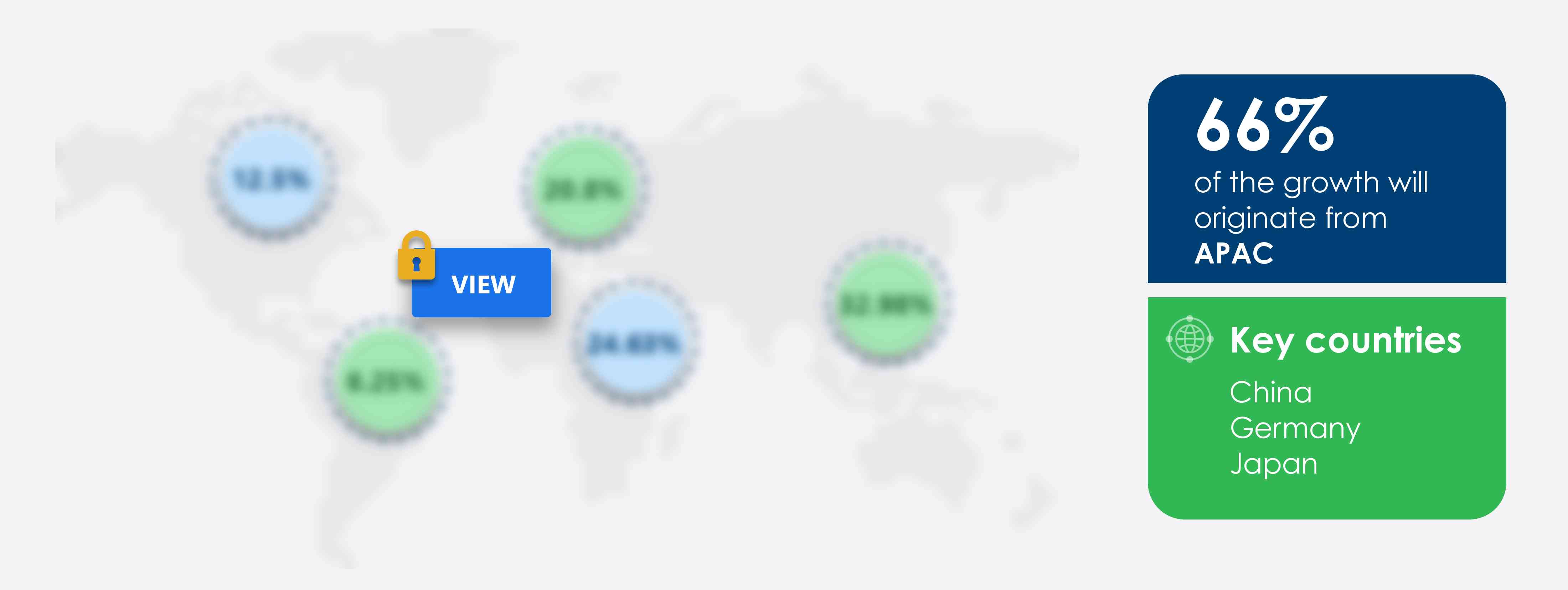
66% of the market’s growth will originate from APAC during the forecast period. China and Japan are the key markets for the automotive fuel level sensor market in APAC. Market growth in this region will be faster than the growth of the European and North American markets.
Global players are heavily investing in production and R&D in the region which will facilitate the automotive fuel level sensor market growth in APAC over the forecast period. This market research report entails detailed information on the competitive intelligence, marketing gaps, and regional opportunities in store for vendors, which will assist in creating efficient business plans.
What are the Revenue-generating Type Segments in the Automotive Fuel Level Sensor Market?
To gain further insights on the market contribution of various segments Request for a FREE sample
The automotive fuel level sensor market share growth by the capacitive segment will be significant during the forecast period. The growing need for constant fuel monitoring and fuel theft detection has led to the development of capacitive fuel level sensors with an inbuilt GPS. This will drive the global automotive capacitive fuel level sensor market during the forecast period and contribute to its growth.
This report provides an accurate prediction of the contribution of all the segments to the growth of the automotive fuel level sensor market size and actionable market insights on post COVID-19 impact on each segment.
|
Automotive Fuel Level Sensor Market Scope |
|
|
Report Coverage |
Details |
|
Page number |
120 |
|
Base year |
2019 |
|
Forecast period |
2020-2024 |
|
Growth momentum & CAGR |
Accelerate at a CAGR of 2.22% |
|
Market growth 2020-2024 |
$ 448.31 million |
|
Market structure |
Fragmented |
|
YoY growth (%) |
2.00 |
|
Regional analysis |
APAC, Europe, North America, and South America |
|
Performing market contribution |
APAC at 66% |
|
Key consumer countries |
China, Germany, Japan, and South Korea (Republic of Korea) |
|
Competitive landscape |
Leading companies, Competitive strategies, Consumer engagement scope |
|
Key companies profiled |
Bourns Inc., Continental AG, Delphi Technologies Plc, elobau GmbH & Co. KG, Minda Corp. Ltd., Pricol Ltd., Robert Bosch GmbH, Rochester Gauges LLC, TE Connectivity Ltd., and Valeo SA |
|
Market dynamics |
Parent market analysis, Market growth inducers and obstacles, Fast-growing and slow-growing segment analysis, COVID 19 impact and recovery analysis and future consumer dynamics, Market condition analysis for forecast period |
|
Customization purview |
If our report has not included the data that you are looking for, you can reach out to our analysts and get segments customized. |
What are the Key Data Covered in this Automotive Fuel Level Sensor Market Report?
- CAGR of the market during the forecast period 2020-2024
- Detailed information on factors that will drive automotive fuel level sensor market growth during the next five years
- Precise estimation of the automotive fuel level sensor market size and its contribution to the parent market
- Accurate predictions on upcoming trends and changes in consumer behavior
- The growth of the automotive fuel level sensor industry across APAC, Europe, North America, and South America
- A thorough analysis of the market’s competitive landscape and detailed information on vendors
- Comprehensive details of factors that will challenge the growth of automotive fuel level sensor market vendors
We can help! Our analysts can customize this report to meet your requirements. Get in touch
 RIA -
RIA - 
