



Buy-Now-Pay-Later Solutions In E-Commerce Market Size and Growth Forecast 2026-2030
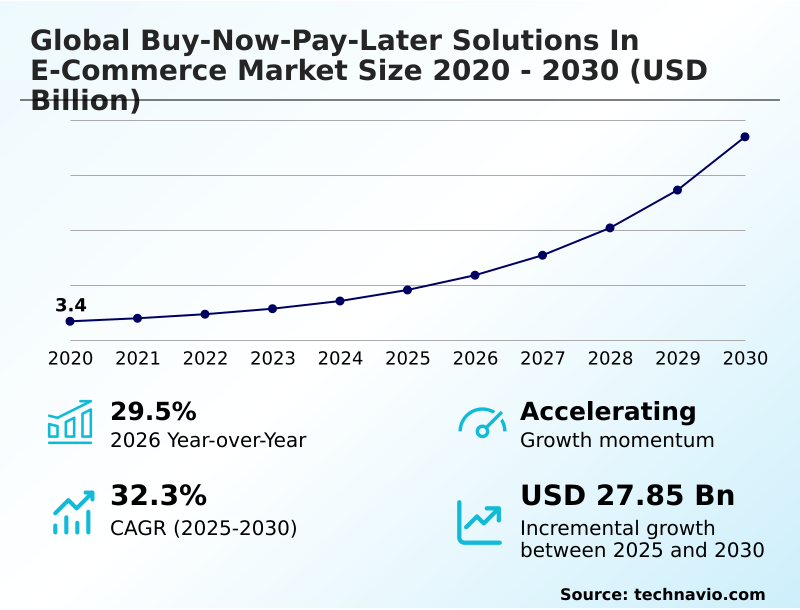
The Buy-Now-Pay-Later Solutions In E-Commerce Market size was valued at USD 9.10 billion in 2025 growing at a CAGR of 32.3% during the forecast period 2026-2030.
North America accounts for 32.6% of incremental growth during the forecast period. The On-platform segment by Channel was valued at USD 4.94 billion in 2024, while the Interest-free BNPL segment holds the largest revenue share by Method.
The market is projected to grow by USD 33.54 billion from 2020 to 2030, with USD 27.85 billion of the growth expected during the forecast period of 2025 to 2030.
Get Key Insights on Market Forecast (PDF) Request Free Sample
Buy-Now-Pay-Later Solutions In E-Commerce Market Overview
The buy-now-pay-later solutions in e-commerce market is defined by a fundamental shift in consumer credit, driven by the demand for more flexible deferred payment models over traditional revolving debt. This transformation compels merchants to prioritize e-commerce checkout integration of various installment payment solutions. North America is expected to contribute over 32% of market growth, fueled by younger demographics rejecting conventional credit cards. The underlying financial technology framework leverages real-time risk assessment and alternative credit scoring, expanding access to credit. For instance, a mid-sized online fashion retailer implementing a 'Pay in 4' option at checkout typically sees shopping cart abandonment rates fall by over 20%, directly boosting conversion. This is made possible by sophisticated credit underwriting algorithms that provide instantaneous credit decisions. The strategic adoption of these tools is no longer a niche advantage but a core requirement for competing effectively in the digital retail environment, influencing everything from customer acquisition cost to overall revenue.
Drivers, Trends, and Challenges in the Buy-Now-Pay-Later Solutions In E-Commerce Market
The evolution of the buy-now-pay-later solutions in e-commerce market is increasingly dictated by regulatory and macroeconomic pressures. For instance, regulatory challenges for BNPL in Europe, under frameworks like the Consumer Credit Directive, are forcing platforms to enhance data privacy in BNPL affordability checks.
In this environment, the impact of rising interest rates on BNPL providers is severe, squeezing margins and compelling a strategic pivot toward more resilient models. This includes diversifying beyond deferred payment for fashion e-commerce into high-margin areas like BNPL for high-ticket electronics and expanding into BNPL solutions for service industries.
An operational example is a travel agency offering installment plans for vacation packages, which can reduce sales friction by over 30% compared to requiring full upfront payment. To combat rising fraud, the use of AI in BNPL risk assessment is becoming standard practice to detect and prevent sophisticated synthetic identity fraud in BNPL.
Furthermore, the open banking impact on BNPL underwriting is enabling more accurate risk modeling. Technology is also driving new commercial applications, from B2B BNPL for invoice financing to the deeper BNPL integration in mobile super-apps, particularly in emerging markets where it advances financial inclusion.
The strategic imperative is clear: providers must balance omnichannel retail implementation with robust risk management, particularly in managing reverse logistics in try-before-you-buy models, to ensure sustainable profitability.
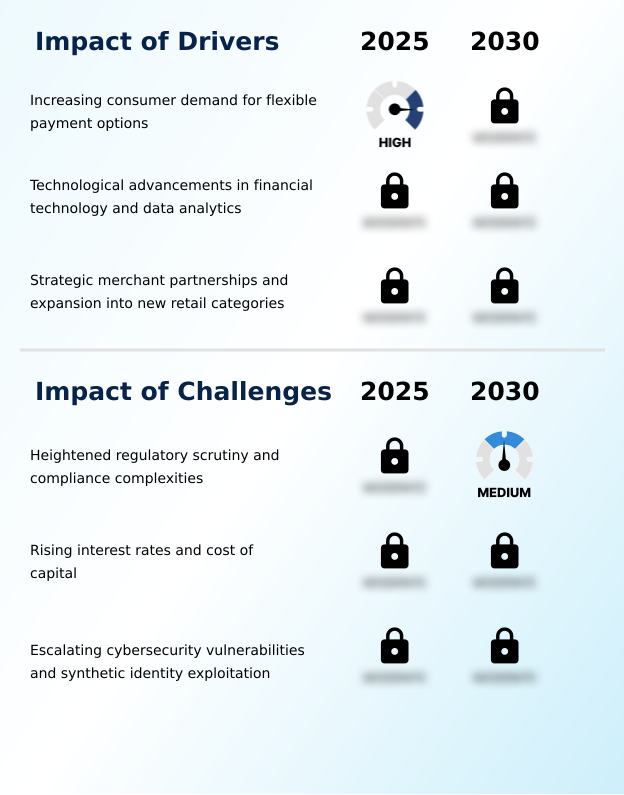
Primary Growth Driver: Increasing consumer demand for flexible and transparent payment options is a key driver for the market.
Market expansion is fueled by a confluence of technological innovation and strategic commercial diversification.
At the core, advanced credit underwriting algorithms allow providers to offer a frictionless checkout experience, which is proven to drive an average order value increase and reduce cart abandonment.
The use of proprietary risk algorithms for real-time risk assessment enables instantaneous credit decisions, expanding access to a wider consumer base without a corresponding rise in defaults. Beyond technology, growth is propelled by aggressive merchant partnership diversification.
The market is moving decisively beyond its origins in fashion and apparel to penetrate high-ticket item financing for categories like electronics and home goods.
Furthermore, expansion into service-oriented industries, including travel and healthcare, is unlocking significant new revenue streams and embedding installment payments into more facets of daily life.
Emerging Market Trend: The deepening penetration of mobile commerce and the widespread adoption of digital wallets are creating significant growth avenues, particularly in emerging economies.
Key trends are reshaping the market's architecture, moving it beyond a simple retail checkout feature into a deeply integrated financial service. The convergence with traditional banking is accelerating, with established financial institutions launching their own white-label installment platforms to leverage their existing customer bases and low-cost capital. This mainstream financial ecosystem convergence is compelling standalone providers to innovate rapidly.
Simultaneously, mobile-first payment strategies are paramount, particularly in APAC, which shows the highest regional growth potential. The seamless digital wallet integration of installment options is a primary driver for both customer acquisition and financial inclusion for unbanked populations.
A third major trend is the alignment with ESG goals through purpose-driven purchasing integration, where platforms facilitate green premium financing for sustainable products, resonating with ethically conscious consumers.
Key Industry Challenge: Heightened regulatory scrutiny and the increasing complexities of compliance represent a key challenge affecting industry growth.
The industry faces significant structural headwinds that threaten profitability and operational models. Foremost among these is the increasing regulatory compliance burden, as authorities in markets like North America and Europe mandate stringent affordability checks to mitigate consumer over-indebtedness risk, adding significant operational costs.
This is compounded by macroeconomic pressures, where cost of capital fluctuations, driven by rising interest rates, directly erode the margins of the interest-free installment model. The third primary challenge is the persistent threat of sophisticated fraud, necessitating heavy investment in cybersecurity vulnerability mitigation.
Combating threats like synthetic identity fraud requires advanced biometric spoofing prevention and behavioral data analysis, which can introduce friction into the checkout process, directly contradicting the core value proposition of seamless transactions.
Explore Full Market Dynamics Analysis Request Free Sample
Buy-Now-Pay-Later Solutions In E-Commerce Market Segmentation
The buy-now-pay-later solutions in e-commerce industry research report provides comprehensive data including region-wise segment analysis, with forecasts and analysis for the period 2026-2030, as well as historical data from 2020-2024 for the following segments.
Channel Segment Analysis
The on-platform segment is estimated to witness significant growth during the forecast period.
On-platform solutions, where buy-now-pay-later options are embedded directly into a retailer's e-commerce checkout integration, represent the market's principal channel.
This model, accounting for the majority of transaction value, is critical for reducing shopping cart abandonment rates by providing a frictionless checkout experience.
Merchants favor this native integration as it keeps consumers within their branded ecosystem, fostering loyalty and enabling an average order value increase. The technical deployment relies on robust embedded finance capabilities and secure payment gateway security protocols to manage data.
By presenting installment payment solutions upfront on product pages, retailers can significantly influence purchasing decisions without redirecting customers to third-party sites, thus maintaining control over the entire user journey and transactional data flow.
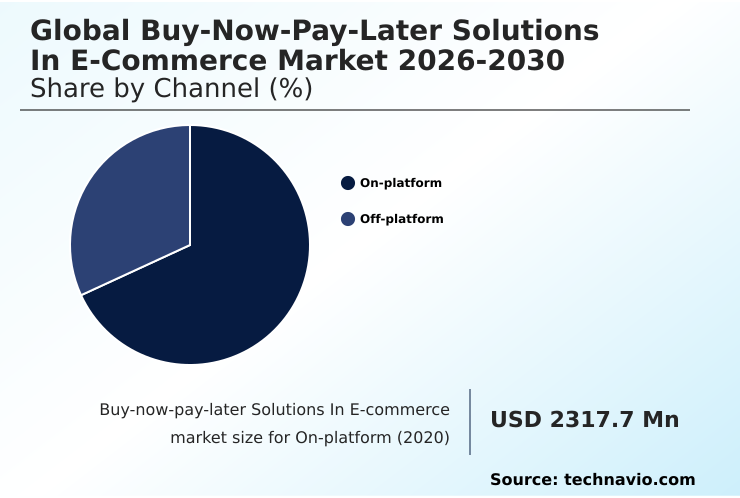
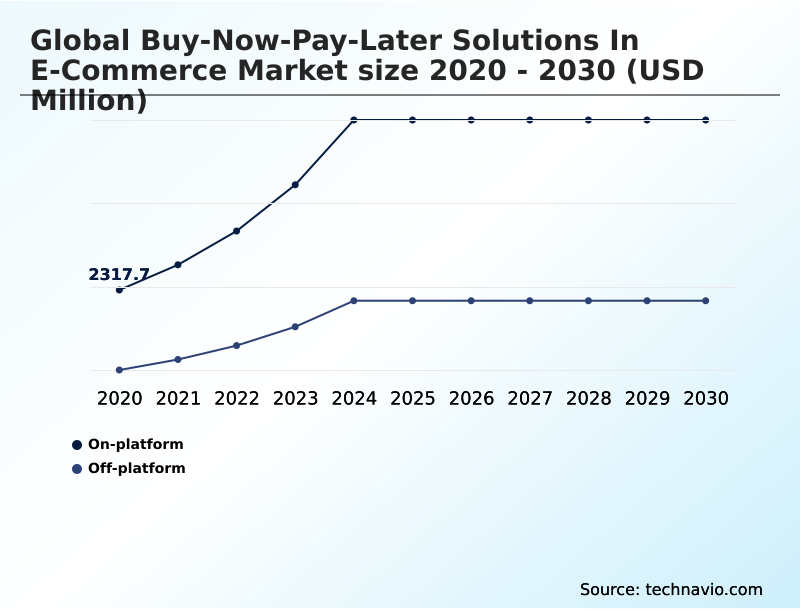
The On-platform segment was valued at USD 4.94 billion in 2024 and showed a gradual increase during the forecast period.
Buy-Now-Pay-Later Solutions In E-Commerce Market by Region: North America Leads with 32.6% Growth Share
North America is estimated to contribute 32.6% to the growth of the global market during the forecast period.
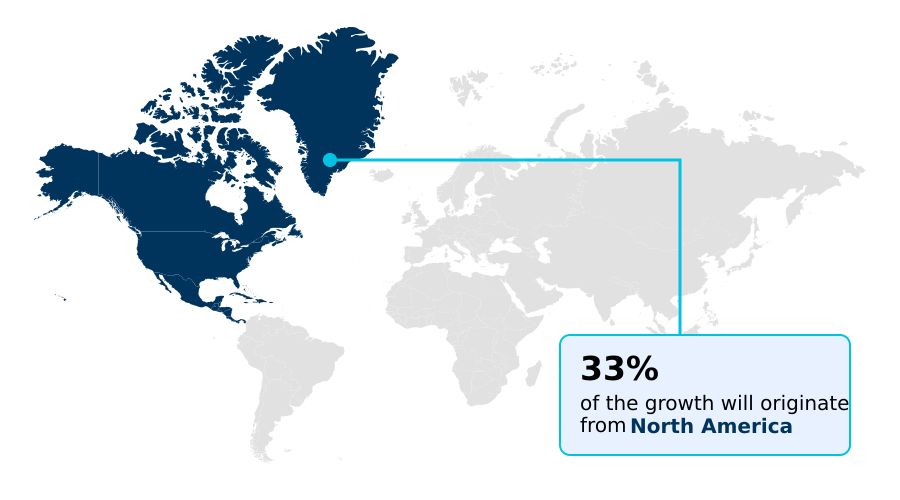
The geographic landscape of the market is diverse, with North America poised to account for nearly 33% of the total growth opportunity, driven by consumer demand for alternatives to traditional credit.
In contrast, the APAC region, exhibiting the highest growth rate at over 33%, is defined by mobile-first payment strategies and the role of BNPL in promoting financial inclusion for unbanked populations.
In the Middle East, growth hinges on the availability of Sharia-compliant financing, highlighting the importance of localized payment preferences. European markets are navigating tightening regulations under the Consumer Credit Directive, which impacts cross-border transaction processing.
This regional fragmentation necessitates that providers tailor their open banking APIs and digital wallet integration strategies to align with local financial ecosystems and compliance mandates, moving beyond a one-size-fits-all approach to capture global market share.
Customer Landscape Analysis for the Buy-Now-Pay-Later Solutions In E-Commerce Market
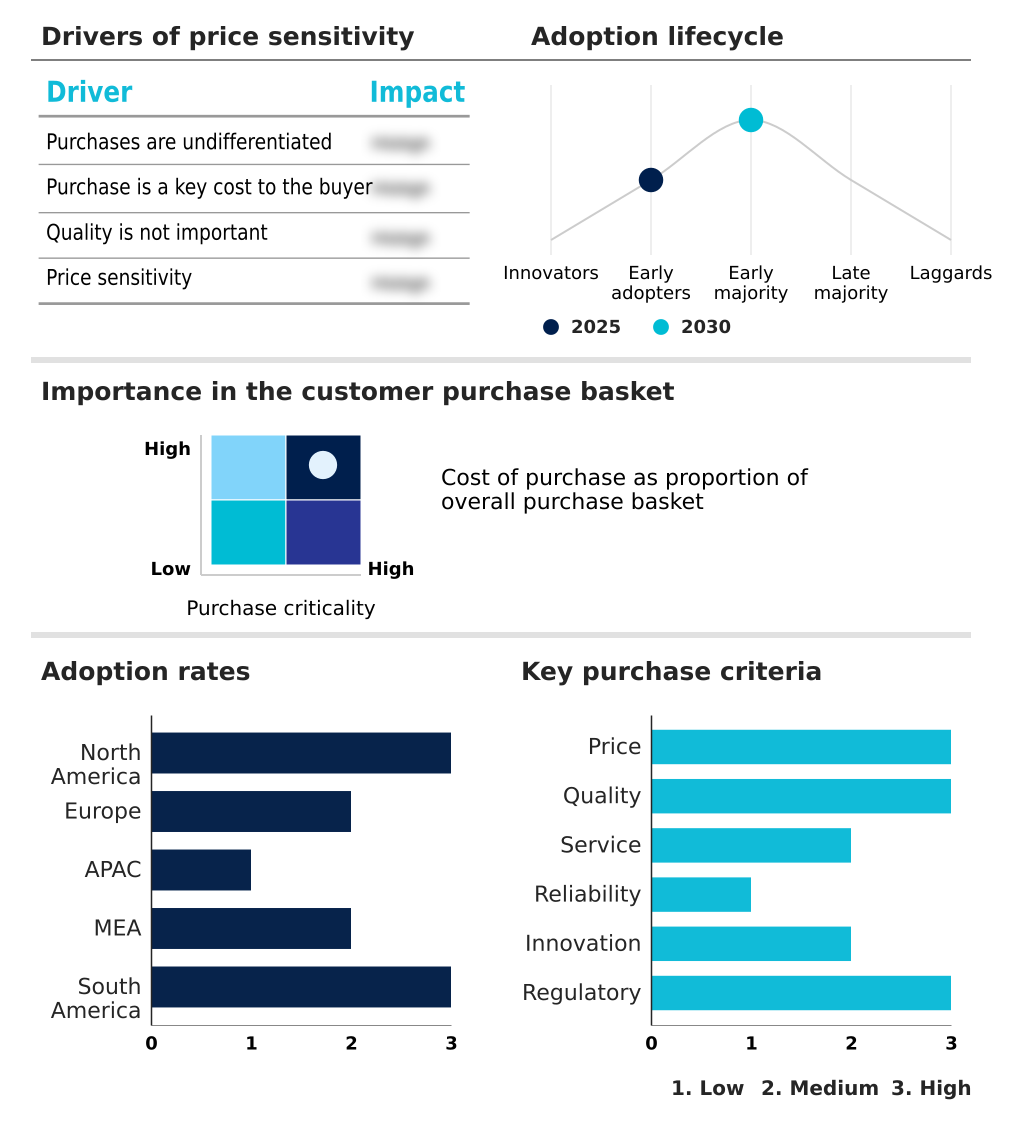
The buy-now-pay-later solutions in e-commerce market forecasting report includes the adoption lifecycle of the market, covering from the innovator’s stage to the laggard’s stage. It focuses on adoption rates in different regions based on penetration. Furthermore, the buy-now-pay-later solutions in e-commerce market report also includes key purchase criteria and drivers of price sensitivity to help companies evaluate and develop their market growth analysis strategies.
Competitive Landscape of the Buy-Now-Pay-Later Solutions In E-Commerce Market
Companies are implementing various strategies, such as strategic alliances, partnerships, mergers and acquisitions, geographical expansion, and product/service launches, to enhance their presence in the buy-now-pay-later solutions in e-commerce market industry.
Adyen NV - Offers a global payment platform that integrates multiple BNPL providers, enabling rapid deployment for e-commerce merchants through a single, unified gateway.
The industry research and growth report includes detailed analyses of the competitive landscape of the market and information about key companies, including:
- Adyen NV
- Affirm Holdings Inc.
- Alma
- Billie
- Block Inc.
- Cross River Bank
- Four Technologies Inc.
- Klarna Bank AB
- KUESKI
- Marqeta Inc.
- PayPal Holdings Inc.
- Plaid Inc.
- Solaris SE
- Splitit
- Stripe Inc.
- Sunbit Now LLC
- Tabby LLC.
- Tamara Finance Company
- Unit Finance Inc.
- Upgrade Inc.
Qualitative and quantitative analysis of companies has been conducted to help clients understand the wider business environment as well as the strengths and weaknesses of key industry players. Data is qualitatively analyzed to categorize companies as pure play, category-focused, industry-focused, and diversified; it is quantitatively analyzed to categorize companies as dominant, leading, strong, tentative, and weak.
Recent Developments in the Buy-Now-Pay-Later Solutions In E-Commerce Market
- In March 2025, Klarna entered into a major agreement with Walmart, replacing Affirm as the exclusive BNPL partner to streamline checkout financing for the retail giant's e-commerce platform.
- In May 2025, CrediLinq, an AI-driven B2B embedded finance enablement platform, raised USD 8.5 million in Series A funding to fuel its international expansion into the US, UK, and Australia and develop its credit infrastructure.
- In January 2025, Billie announced a strategic partnership with a leading European e-procurement platform, integrating its automated B2B invoice financing solution to serve a vast network of enterprise buyers.
- In November 2024, Tabby launched its physical card in the UAE and Saudi Arabia, enabling users to leverage their BNPL credit line for in-store purchases and significantly expanding its omnichannel payment presence.
Research Analyst Overview: Buy-Now-Pay-Later Solutions In E-Commerce Market
The buy-now-pay-later solutions in e-commerce market's structure is solidifying around on-platform integrations, which capture the majority of transaction value and present a critical boardroom decision regarding technology investment versus outsourcing.
A key consideration is the total cost of ownership for a native e-commerce checkout integration, which offers greater control over the customer journey but requires significant upfront and ongoing investment in the financial technology framework.
This decision is increasingly shaped by regulatory pressures, such as the EU's Consumer Credit Directive, which mandates stringent affordability checks and necessitates robust, compliant credit underwriting algorithms. Consequently, capital allocation is shifting toward developing proprietary real-time risk assessment capabilities and securing embedded finance capabilities that can scale across jurisdictions.
For leadership teams, the strategic focus must be on how installment payment solutions can be deployed not just as a payment method, but as a data-rich tool for understanding consumer behavior, enhancing loyalty, and driving profitable growth while navigating a complex global compliance landscape.
Dive into Technavio’s robust research methodology, blending expert interviews, extensive data synthesis, and validated models for unparalleled Buy-Now-Pay-Later Solutions In E-Commerce Market insights. See full methodology.
| Market Scope | |
|---|---|
| Page number | 299 |
| Base year | 2025 |
| Historic period | 2020-2024 |
| Forecast period | 2026-2030 |
| Growth momentum & CAGR | Accelerate at a CAGR of 32.3% |
| Market growth 2026-2030 | USD 27845.7 million |
| Market structure | Fragmented |
| YoY growth 2025-2026(%) | 29.5% |
| Key countries | US, Canada, Mexico, UK, Germany, France, Italy, The Netherlands, Spain, China, India, Japan, Australia, South Korea, Indonesia, Saudi Arabia, UAE, South Africa, Israel, Turkey, Brazil, Argentina and Colombia |
| Competitive landscape | Leading Companies, Market Positioning of Companies, Competitive Strategies, and Industry Risks |
Buy-Now-Pay-Later Solutions In E-Commerce Market: Key Questions Answered in This Report
-
What is the expected growth of the Buy-Now-Pay-Later Solutions In E-Commerce Market between 2026 and 2030?
-
The Buy-Now-Pay-Later Solutions In E-Commerce Market is expected to grow by USD 27.85 billion during 2026-2030, registering a CAGR of 32.3%. Year-over-year growth in 2026 is estimated at 29.5%%. This acceleration is shaped by increasing consumer demand for flexible payment options, which is intensifying demand across multiple end-use verticals covered in the report.
-
-
What segmentation does the market report cover?
-
The report is segmented by Channel (On-platform, and Off-platform), Method (Interest-free BNPL, Interest-bearing installments, and Deferred payment), End-user (Fashion and apparel, Consumer electronics, Home and furniture, Beauty and personal care, and Others) and Geography (North America, Europe, APAC, Middle East and Africa, South America). Among these, the On-platform segment is estimated to witness significant growth during the forecast period, driven by rising adoption across key application areas. Each segment includes detailed qualitative and quantitative analysis, along with historical data from 2020-2024 and forecasts through 2030 with year-over-year growth rates.
-
-
Which regions are analyzed in the report?
-
The report covers North America, Europe, APAC, Middle East and Africa and South America. North America is estimated to contribute 32.6% to market growth during the forecast period. Country-level analysis includes US, Canada, Mexico, UK, Germany, France, Italy, The Netherlands, Spain, China, India, Japan, Australia, South Korea, Indonesia, Saudi Arabia, UAE, South Africa, Israel, Turkey, Brazil, Argentina and Colombia, with dedicated market size tables and year-over-year growth for each.
-
-
What are the key growth drivers and market challenges?
-
The primary driver is increasing consumer demand for flexible payment options, which is accelerating investment and industry demand. The main challenge is heightened regulatory scrutiny and compliance complexities, creating operational barriers for key market participants. The report quantifies the impact of each driver and challenge across 2026 and 2030 with comparative analysis.
-
-
Who are the major players in the Buy-Now-Pay-Later Solutions In E-Commerce Market?
-
Key vendors include Adyen NV, Affirm Holdings Inc., Alma, Billie, Block Inc., Cross River Bank, Four Technologies Inc., Klarna Bank AB, KUESKI, Marqeta Inc., PayPal Holdings Inc., Plaid Inc., Solaris SE, Splitit, Stripe Inc., Sunbit Now LLC, Tabby LLC., Tamara Finance Company, Unit Finance Inc. and Upgrade Inc.. The report provides qualitative and quantitative analysis categorizing companies as dominant, leading, strong, tentative, and weak based on their market positioning. Company profiles include business segment analysis, SWOT assessment, key offerings, and recent strategic developments.
-
Buy-Now-Pay-Later Solutions In E-Commerce Market Research Insights
Market dynamics are shaped by the need for a frictionless checkout experience, which directly impacts customer acquisition cost and lifetime value. Providers focus on delivering instantaneous credit decisions by using proprietary risk algorithms to analyze behavioral data, a practice under review by bodies like the US Consumer Financial Protection Bureau for its data harvesting practices and potential consumer over-indebtedness risk.
A key operational goal is to achieve a significant average order value increase while minimizing default rates. For merchants, the choice between on-platform vs off-platform models involves trade-offs between brand control and market reach.
The implementation of transparent fee structures is crucial for building consumer trust and navigating an environment where regulatory compliance burdens are increasing, forcing a diversification of revenue streams to maintain profitability.
We can help! Our analysts can customize this buy-now-pay-later solutions in e-commerce market research report to meet your requirements.
 RIA -
RIA - 
