



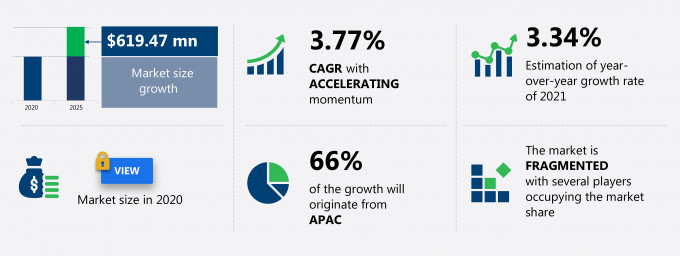
The epichlorohydrin market share is expected to increase by USD 619.47 million from 2020 to 2025, and the market’s growth momentum will accelerate at a CAGR of 3.77%.
This epichlorohydrin market research report provides valuable insights on the post-COVID-19 impact on the market, which will help companies evaluate their business approaches. Furthermore, this report extensively covers epichlorohydrin market segmentation by application (paints and coatings, electronics and electrical, adhesives, dyes, and pigments, and others) and geography (North America, Europe, APAC, South America, and MEA). The epichlorohydrin market report also offers information on several market vendors, including Aditya Birla Management Corp. Pvt. Ltd., Daiso Chemical (Thailand) Co. Ltd, Hanwha Group, Hexion Inc., Jiangsu Yangnong Chemical Group Co. Ltd., Kashima Chemical Co. Ltd., Olin Corp., OSAKA SODA CO. Ltd., Spolchemie AS, and Sumitomo Corp. among others.
What will the Epichlorohydrin Market Size be During the Forecast Period?
Download Report Sample to Unlock the Epichlorohydrin Market Size for the Forecast Period and Other Important Statistics
Epichlorohydrin Market: Key Drivers, Trends, and Challenges
Based on our research output, there has been a neutral impact on the market growth during and after post COVID-19 era. The low cost of raw materials and labor is notably driving the epichlorohydrin market growth, although factors such as epichlorohydrin manufacturers worldwide face stiff competition from Chinese manufacturers that may impede the market growth. Our research analysts have studied the historical data and deduced the key market drivers and the COVID-19 pandemic impact on the epichlorohydrin industry. The holistic analysis of the drivers will help in deducing end goals and refining marketing strategies to gain a competitive edge.
Key Epichlorohydrin Market Driver
The low cost of raw materials and labor is one of the key factors driving the growth of the global epichlorohydrin market. The cost of raw materials required for the production of epichlorohydrin is less compared with bisphenol A (BPA). Bisphenol A is synthesized by the reaction of phenol and acetone. These starting materials, phenol, and acetone are abundantly and readily available compared with the synthesis of epichlorohydrin that is produced through chlorohydrination, which is a three-step process. High-temperature conditions are also required during the reaction. The labor cost is low in many regions, especially in APAC. This is because developing countries, such as China and India, have a huge population and many unemployed individuals. Thus, many individuals are willing to work for low wages. Epichlorohydrin is mainly produced by the chlorohydrination of allyl chloride, which is obtained by the chlorination of propylene. The manufacture of propylene for different applications is inexpensive compared with other substitutes. Thus, the cost of epichlorohydrin ultimately decreases.
Key Epichlorohydrin Market Trend
Bio-based methods replacing synthetic methods will fuel the global epichlorohydrin market growth. The availability of glycerin as a byproduct of biodiesel production has influenced the development of technologies that use glycerin as a raw material to produce value-added products, such as epichlorohydrin. The conventional method used propylene and chlorine to produce epichlorohydrin. Glycerin can also react with hydrochloric acid (HCL) to form an intermediate called chlorohydrin, which can be converted into epichlorohydrin. The cost of glycerin is very high compared with propylene. Consumers are becoming more aware of the harmful effects of propylene on the environment and the benefits of using bio-based products. Bio-based methods can positively influence the epichlorohydrin market and drive its growth in the future. The US is investing heavily in R&D to produce epichlorohydrin from glycerin.
Key Epichlorohydrin Market Challenge
Epichlorohydrin manufacturers worldwide face stiff competition from Chinese manufacturers is the major challenge for the global epichlorohydrin market growth. Epichlorohydrin manufacturers worldwide face stiff competition from Chinese manufacturers. The market in China is concentrated, with the presence of epichlorohydrin manufacturers. In addition, the manufacturing and labor costs are low in this country. Epichlorohydrin manufacturers worldwide face stiff competition from manufacturers in China. The mass production and export of epichlorohydrin by manufacturers in China will restrict the growth of other vendors in the market. Most of the anise will leave the market because of the stiff competition from Chinese manufacturers. In addition, vendors will be compelled to lower their export prices, which will result in low profits and restricted market growth. The above factors will hinder the global epichlorohydrin market growth during the forecast period.
This epichlorohydrin market analysis report also provides detailed information on other upcoming trends and challenges that will have a far-reaching effect on the market growth. The actionable insights on the trends and challenges will help companies evaluate and develop growth strategies for 2021-2025.
Parent Market Analysis
Technavio categorizes the global epichlorohydrin market as a part of the global specialty chemicals market. Our research report has extensively covered external factors influencing the parent market growth potential in the coming years, which will determine the levels of growth of the epichlorohydrin market during the forecast period.
Who are the Major Epichlorohydrin Market Vendors?
The report analyzes the market’s competitive landscape and offers information on several market vendors, including:
- Aditya Birla Management Corp. Pvt. Ltd.
- Daiso Chemical (Thailand) Co. Ltd
- Hanwha Group
- Hexion Inc.
- Jiangsu Yangnong Chemical Group Co. Ltd.
- Kashima Chemical Co. Ltd.
- Olin Corp.
- OSAKA SODA CO. Ltd.
- Spolchemie AS
- Sumitomo Corp.
This statistical study of the epichlorohydrin market encompasses successful business strategies deployed by the key vendors. The epichlorohydrin market is fragmented and the vendors are deploying organic and inorganic growth strategies to compete in the market.
Product Insights and News
- Aditya Birla Management Corp. Pvt. Ltd. - Through this segment, the company offers monomers, polymers organic, electronic material, and optical products.
To make the most of the opportunities and recover from post COVID-19 impact, market vendors should focus more on the growth prospects in the fast-growing segments, while maintaining their positions in the slow-growing segments.
The epichlorohydrin market forecast report offers in-depth insights into key vendor profiles. The profiles include information on the production, sustainability, and prospects of the leading companies.
Epichlorohydrin Market Value Chain Analysis
Our report provides extensive information on the value chain analysis for the epichlorohydrin market, which vendors can leverage to gain a competitive advantage during the forecast period. The end-to-end understanding of the value chain is essential in profit margin optimization and evaluation of business strategies. The data available in our value chain analysis segment can help vendors drive costs and enhance customer services during the forecast period.
The value chain of the global specialty chemicals market includes the following core components:
- Inputs
- Inbound logistics
- Operations
- Outbound logistics
- Marketing and sales
- Service
- Support activities
- Innovation
The report has further elucidated other innovative approaches being followed by service providers to ensure a sustainable market presence.
Which are the Key Regions for Epichlorohydrin Market?
For more insights on the market share of various regions Request PDF Sample now!
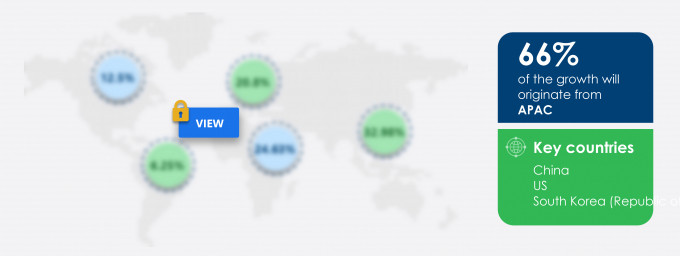
66% of the market’s growth will originate from APAC during the forecast period. China, South Korea (Republic of Korea), and Japan are the key markets for the epichlorohydrin market in APAC. Market growth in this region will be faster than the growth of the market in regions.
The low cost of raw materials and labor will facilitate the epichlorohydrin market growth in APAC over the forecast period. This market research report entails detailed information on the competitive intelligence, marketing gaps, and regional opportunities in store for vendors, which will assist in creating efficient business plans.
COVID Impact and Recovery Analysis
The outbreak of respiratory and infectious diseases, especially COVID-19, in the region has hampered the growth of the regional epichlorohydrin market in the end-user industries such as electronics and electrical, and others. Several countries such as China, India, Nepal, Pakistan, South Korea, Malaysia, Sri Lanka, and the Philippines were under partial or full lockdown due to the COVID-19 pandemic in 2020. However, in 2021, the initiation of large-scale vaccination drives lifted the lockdown and travel restrictions, which led to the resumption of supply chain activities. Such factors are expected to drive the market during the forecast period.
What are the Revenue-generating Application Segments in the Epichlorohydrin Market?
To gain further insights on the market contribution of various segments Request a PDF Sample
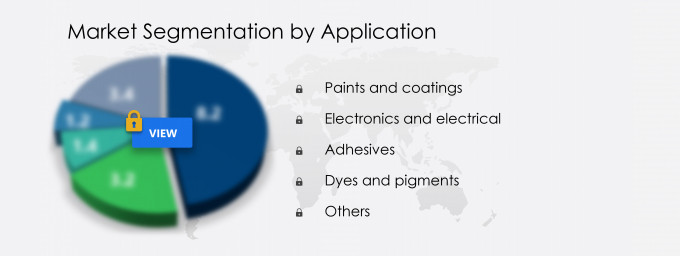
The epichlorohydrin market share growth in the Paints and coatings segment will be significant during the forecast period. The epichlorohydrin market is growing mainly because of the high demand from the paints and coatings segment. The demand for epichlorohydrin-based anti-corrosion coatings from the automotive industry is driving the epichlorohydrin market.
This report provides an accurate prediction of the contribution of all the segments to the growth of the epichlorohydrin market size and actionable market insights on post COVID-19 impact on each segment.
|
Epichlorohydrin Market Scope |
|
|
Report Coverage |
Details |
|
Page number |
120 |
|
Base year |
2020 |
|
Forecast period |
2021-2025 |
|
Growth momentum & CAGR |
Accelerate at a CAGR of 3.77% |
|
Market growth 2021-2025 |
$ 619.47 million |
|
Market structure |
Fragmented |
|
YoY growth (%) |
3.34 |
|
Regional analysis |
North America, Europe, APAC, South America, and MEA |
|
Performing market contribution |
APAC at 66% |
|
Key consumer countries |
China, the US, South Korea (Republic of Korea), Japan, and the UK |
|
Competitive landscape |
Leading companies, Competitive Strategies, Consumer engagement scope |
|
Key companies profiled |
Aditya Birla Management Corp. Pvt. Ltd., Daiso Chemical (Thailand) Co. Ltd, Hanwha Group, Hexion Inc., Jiangsu Yangnong Chemical Group Co. Ltd., Kashima Chemical Co. Ltd., Olin Corp., OSAKA SODA CO. Ltd., Spolchemie AS, and Sumitomo Corp. |
|
Market dynamics |
Parent market analysis, Market growth inducers and obstacles, Fast-growing and slow-growing segment analysis, COVID 19 impact and recovery analysis and future consumer dynamics, Market condition analysis for the forecast period |
|
Customization purview |
If our report has not included the data that you are looking for, you can reach out to our analysts and get segments customized. |
What are the Key Data Covered in this Epichlorohydrin Market Report?
- CAGR of the market during the forecast period 2021-2025
- Detailed information on factors that will drive epichlorohydrin market growth during the next five years
- Precise estimation of the epichlorohydrin market size and its contribution to the parent market
- Accurate predictions on upcoming trends and changes in consumer behavior
- The growth of the epichlorohydrin industry across North America, Europe, APAC, South America, and MEA
- A thorough analysis of the market’s competitive landscape and detailed information on vendors
- Comprehensive details of factors that will challenge the growth of epichlorohydrin market vendors
We can help! Our analysts can customize this report to meet your requirements. Get in touch