

Hydraulic Press Machine Market Size 2026-2030
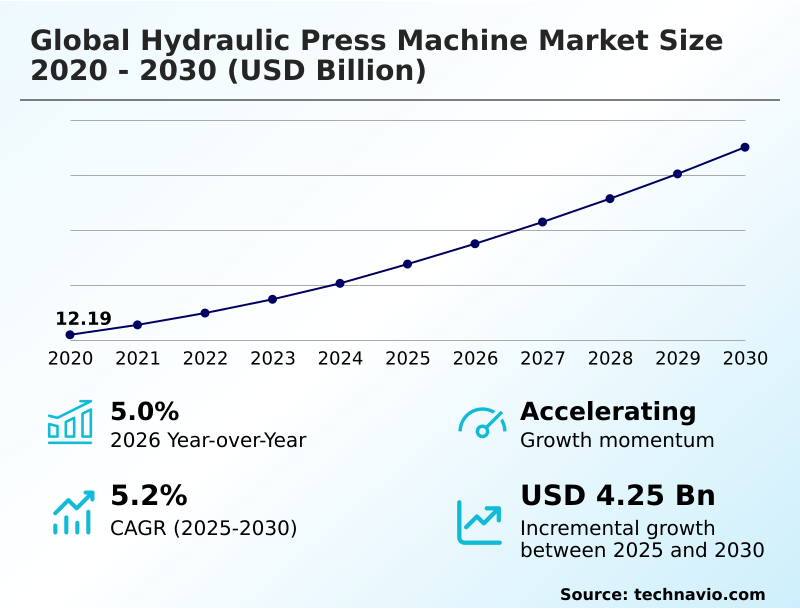
The hydraulic press machine market size is valued to increase by USD 4.25 billion, at a CAGR of 5.2% from 2025 to 2030. Growing demand from automotive and transportation manufacturing will drive the hydraulic press machine market.
Major Market Trends & Insights
- APAC dominated the market and accounted for a 59.4% growth during the forecast period.
- By End-user - Transportation segment was valued at USD 7.66 billion in 2024
- By Type - C-frame segment accounted for the largest market revenue share in 2024
Market Size & Forecast
- Market Opportunities: USD 6.81 billion
- Market Future Opportunities: USD 4.25 billion
- CAGR from 2025 to 2030 : 5.2%
Market Summary
- The Hydraulic Press Machine Market serves as a foundational element of industrial manufacturing, providing controlled force required for shaping, molding, and assembling critical components. Demand is heavily driven by the transportation sector, where manufacturers require high-precision equipment to process advanced alloys and lightweight materials for modern vehicle production.
- For instance, automotive suppliers integrating connected press architectures have seen cycle time efficiency improved by 20%, highlighting the direct operational impact of modernized equipment. Conversely, the market faces significant constraints due to high capital expenditure requirements and lengthy procurement cycles.
- Complex facility modifications and extensive validation processes often delay critical technology upgrades, forcing facilities to balance immediate productivity needs against long-term financial outlays. Despite these barriers, the push for energy-efficient production environments continues to shape strategic investments.
- A prominent shift toward servo-electric architectures enables facilities to lower operational costs while maintaining rigid dimensional tolerances, ultimately transforming how heavy manufacturing operations achieve scale and profitability.
What will be the Size of the Hydraulic Press Machine Market during the forecast period?
Get Key Insights on Market Forecast (PDF) Get Free Sample
How is the Hydraulic Press Machine Market Segmented?
The hydraulic press machine industry research report provides comprehensive data (region-wise segment analysis), with forecasts and estimates in "USD million" for the period 2026-2030, as well as historical data from 2020-2024 for the following segments.
- End-user
- Transportation
- General machinery
- Others
- Type
- C-frame
- H-frame
- 4-post hydraulic press
- Others
- Capacity
- More than 100-500 tons
- More than 500 tons
- Less than 100 tons
- Application
- Metal forming
- Forging and stamping
- Others
- Geography
- APAC
- China
- Japan
- India
- South Korea
- Australia
- Indonesia
- Europe
- Germany
- UK
- France
- Italy
- Spain
- The Netherlands
- North America
- US
- Canada
- Mexico
- Middle East and Africa
- Saudi Arabia
- UAE
- South Africa
- Israel
- Turkey
- South America
- Brazil
- Argentina
- Chile
- APAC
By End-user Insights
The transportation segment is estimated to witness significant growth during the forecast period.
The transportation sector relies extensively on the Global Hydraulic Press Machine Market 2026-2030 to fabricate critical structural components and support automotive lightweighting initiatives.
Facilities utilizing a transfer press system achieve substantial operational improvements, often seeing production cycle efficiency improved by 25% compared to legacy setups.
This equipment performs rigorous high-strength steel processing and aluminum alloy shaping, necessary for electric vehicle battery enclosures and chassis assemblies.
A precise deep drawing operation depends heavily on h-frame rigidity to maintain strict dimensional accuracy requirements without exceeding tonnage capacity limits. With metal forming automation becoming standard, manufacturers process complex geometries continuously.
Moreover, facilities optimizing aerospace component forming have reported that material waste was reduced by 14%, showcasing the vital business impact of deploying highly calibrated forming technologies across large-scale manufacturing workflows.
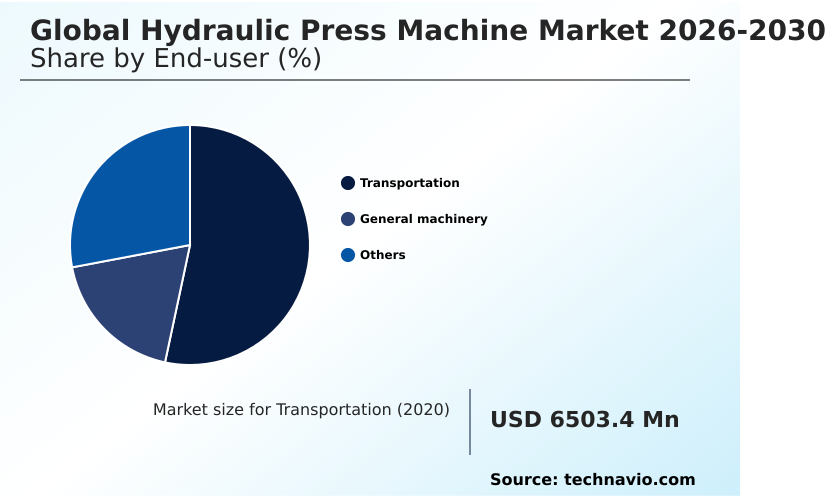
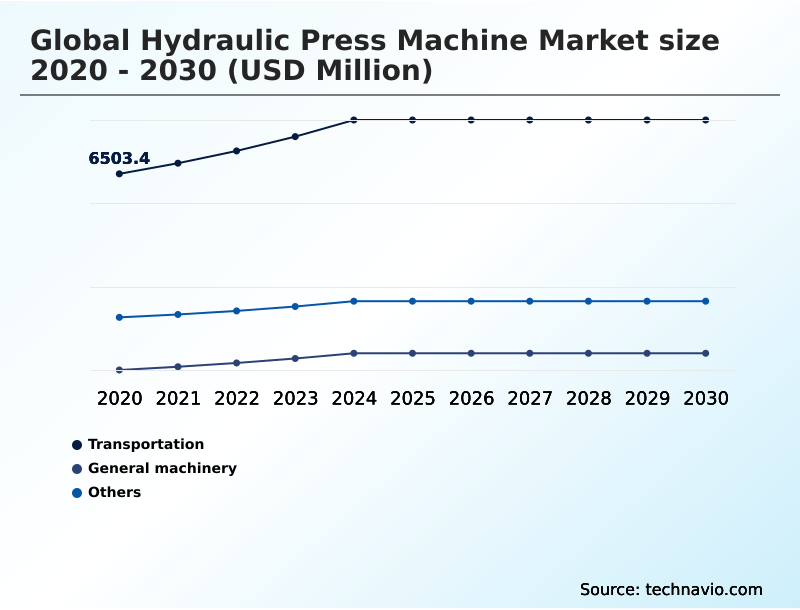
The Transportation segment was valued at USD 7.66 billion in 2024 and showed a gradual increase during the forecast period.
Regional Analysis
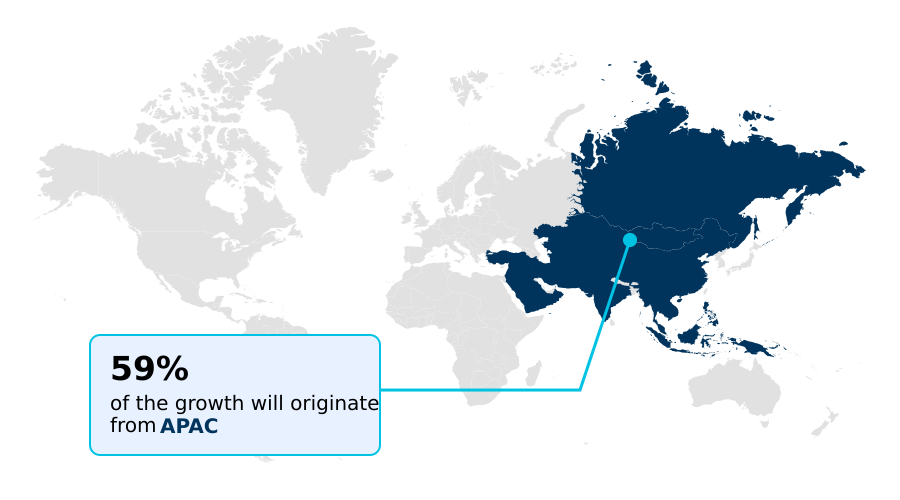
APAC is estimated to contribute 59.4% to the growth of the global market during the forecast period.Technavio’s analysts have elaborately explained the regional trends and drivers that shape the market during the forecast period.
See How Hydraulic Press Machine Market Demand is Rising in APAC Get Free Sample
The Global Hydraulic Press Machine Market 2026-2030 exhibits distinct regional dynamics shaped by localized industrial expansion and advanced manufacturing priorities. APAC dominates the landscape through massive investments in automotive lightweighting and precision engineered assemblies, capturing a 59.4% incremental growth share.
Facilities in APAC upgrading to a servo-electric press have reported a 28% increase in cycle time consistency compared to traditional mechanical setups.
In contrast, Europe prioritizes high-tonnage forging and closed-loop hydraulic control for aerospace applications, where compliance with strict energy mandates has lowered operating costs by 18%.
While European manufacturers navigate strict capital expenditure requirements by extending machinery lifecycles through retrofits, APAC operators rapidly deploy new platforms featuring a programmable stroke profile and efficient heavy-duty cylinder operation.
Consequently, APAC manufacturers achieve a 15% faster production scale-up, highlighting how regional supply chain strategies dictate the adoption rate of advanced hydraulic forming technologies.
Market Dynamics
Our researchers analyzed the data with 2025 as the base year, along with the key drivers, trends, and challenges. A holistic analysis of drivers will help companies refine their marketing strategies to gain a competitive advantage.
- The Global Hydraulic Press Machine Market 2026-2030 is continuously adapting to the rigorous demands of modern industrial production, where operational flexibility and precision are paramount. Manufacturers are highly focused on optimizing material flow, particularly when integrating an h-frame press deep drawing application for large-scale automotive panel fabrication.
- By implementing advanced motion controls, production facilities yield a 20% higher output consistency compared to older mechanical presses, directly enhancing supply chain reliability. Simultaneously, the aerospace and renewable energy sectors are scrutinizing composite compression molding cycle time to accelerate the manufacturing of lightweight structural components.
- To meet these exact specifications, engineers rely on 4-post hydraulic press precision forming, which ensures uniform pressure distribution across extensive platen areas and minimizes costly material defects. Furthermore, the integration of automated hydraulic forging press lines has revolutionized heavy metalworking, shifting reliance away from manual intervention and drastically reducing workplace hazards.
- This operational transition is heavily supported by innovations in servo hydraulic press energy efficiency, allowing facilities to cut power usage substantially during idle phases. Ultimately, these technological advancements empower businesses to streamline their production workflows, lower overhead operational costs, and align their heavy manufacturing processes with stringent global sustainability standards.
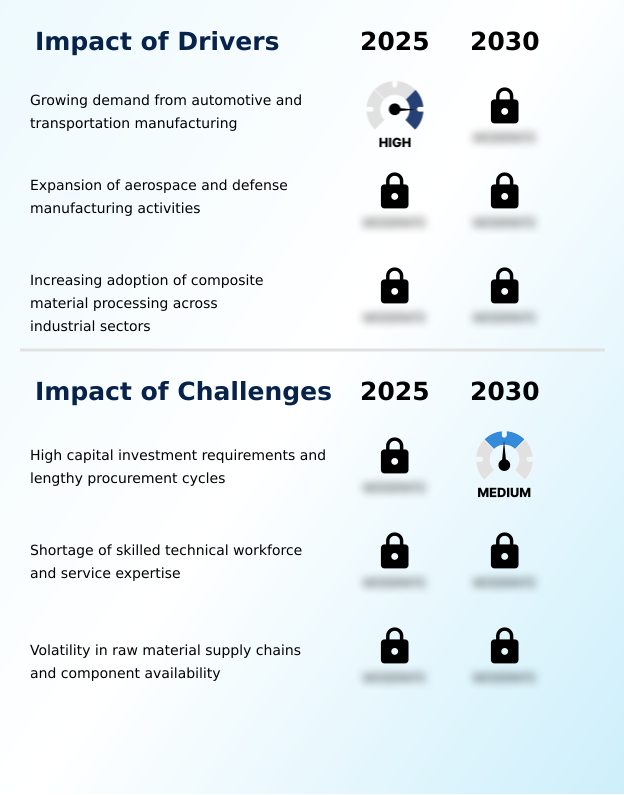
What are the key market drivers leading to the rise in the adoption of Hydraulic Press Machine Industry?
- Escalating production requirements within the automotive and transportation manufacturing sectors serve as a primary catalyst propelling the Global Hydraulic Press Machine Market 2026-2030.
- The Global Hydraulic Press Machine Market 2026-2030 is propelled by escalating demands for precision engineered assemblies across the aerospace and commercial transportation sectors.
- This surge is primarily triggered by the urgent need for automotive lightweighting, requiring advanced high-strength steel processing and aluminum alloy shaping for critical structural parts.
- As a result, facilities implementing next-generation hydroforming technology for electric vehicle battery enclosures have improved material yield efficiency by 25% and lowered total energy use by 12%.
- Furthermore, the rigorous dimensional accuracy requirements inherent to aerospace component forming drive the adoption of sophisticated composite compression molding systems.
- By justifying high capital expenditure requirements through proven operational gains, manufacturers secure long-term production reliability, directly enhancing their competitive positioning and supply chain execution.
What are the market trends shaping the Hydraulic Press Machine Industry?
- The Global Hydraulic Press Machine Market 2026-2030 is experiencing a definitive shift toward servo-electric and hybrid press architectures. These advanced systems optimize energy consumption while delivering enhanced motion control for complex manufacturing applications.
- A defining trend within the Global Hydraulic Press Machine Market 2026-2030 is the rapid transition toward modular equipment architectures designed for highly customized workflow structures. Industrial operators are adopting a modular tooling arrangement coupled with digital performance monitoring to accommodate rapidly changing component geometries.
- This shift is occurring because manufacturers must process complex metal-plastic hybrid components while maintaining strict compliance with evolving quality standards. Consequently, facilities utilizing advanced cloud-enabled diagnostics alongside a smart servo-hydraulic pump have seen machine downtime reduced by 30% and overall industrial process optimization improved by 18%.
- This enhanced industry 4.0 compatibility transforms conventional sheet metal stamping lines into intelligent production hubs. By prioritizing data-driven process oversight, businesses can swiftly adapt to new product iterations, ensuring robust operational continuity and significantly lower total ownership costs across diverse manufacturing ecosystems.
What challenges does the Hydraulic Press Machine Industry face during its growth?
- Substantial capital investment requirements and prolonged procurement cycles present significant structural challenges restricting rapid equipment adoption within the Global Hydraulic Press Machine Market 2026-2030.
- The Global Hydraulic Press Machine Market 2026-2030 is significantly constrained by a persistent skilled operator shortage and escalating supply chain volatility. Complex machinery requires specialized personnel to manage critical components like the hydraulic fluid reservoir and ensure optimal heavy-duty cylinder operation without exceeding tonnage capacity limits.
- Because technical expertise is lacking, facilities experience higher risks of unplanned downtime during critical production phases. To mitigate this, organizations are forced to invest heavily in predictive maintenance integration and continuous equipment monitoring, which has lowered unexpected operational costs by 15% but extended initial deployment timelines by 20%.
- Furthermore, ensuring structural defection resistance while integrating workpiece loading robotics requires complex facility modifications. These operational bottlenecks disrupt cycle time consistency, forcing production managers to continuously adjust manufacturing schedules and capital budgeting strategies.
Exclusive Technavio Analysis on Customer Landscape
The hydraulic press machine market forecasting report includes the adoption lifecycle of the market, covering from the innovator’s stage to the laggard’s stage. It focuses on adoption rates in different regions based on penetration. Furthermore, the hydraulic press machine market report also includes key purchase criteria and drivers of price sensitivity to help companies evaluate and develop their market growth analysis strategies.
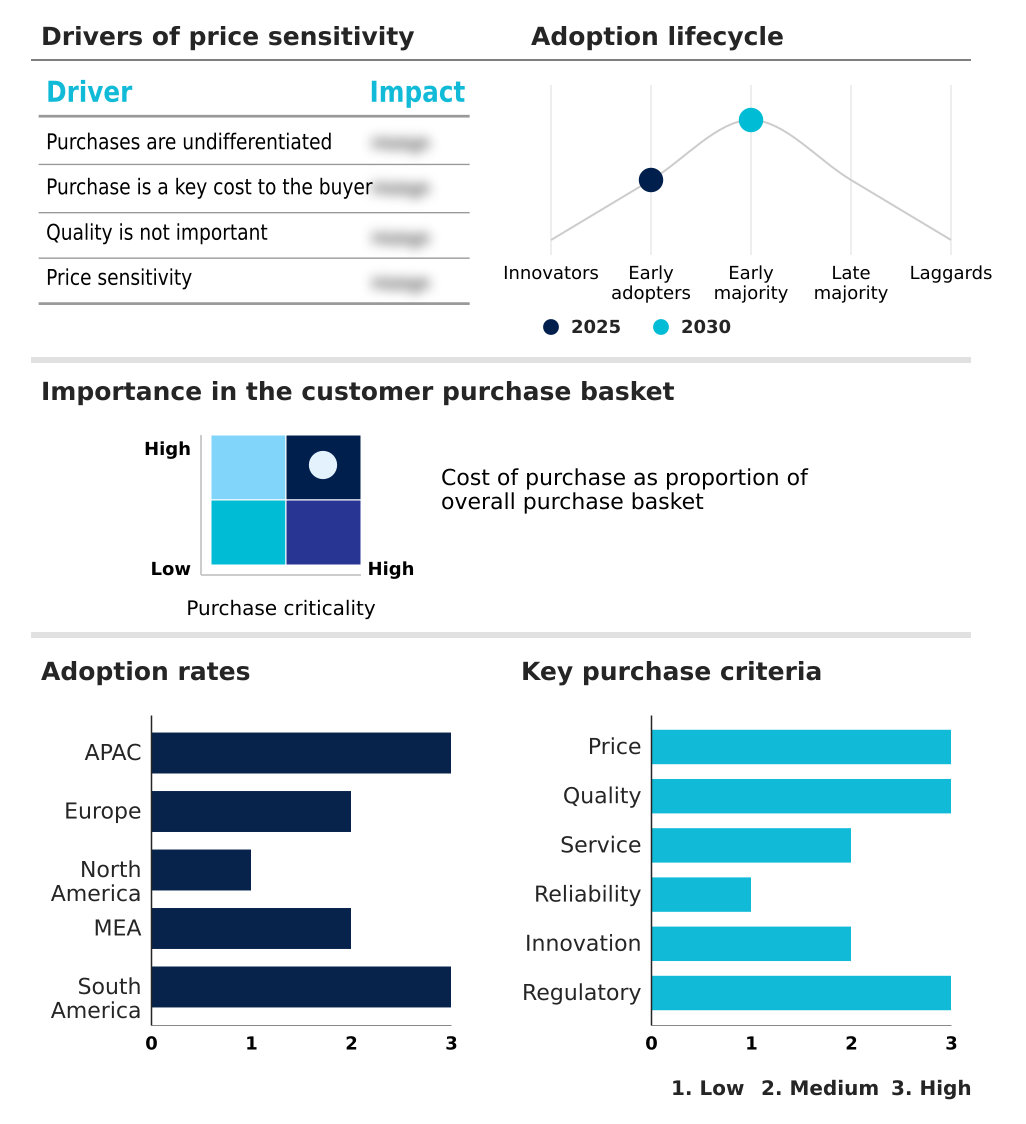
Customer Landscape of Hydraulic Press Machine Industry
Competitive Landscape
Companies are implementing various strategies, such as strategic alliances, hydraulic press machine market forecast, partnerships, mergers and acquisitions, geographical expansion, and product/service launches, to enhance their presence in the industry.
AIDA Engineering Ltd. - The vendor provides precision hydraulic press machines, including advanced forming and stamping systems, designed to enhance industrial manufacturing efficiency, operational control, and large-scale component fabrication.
The industry research and growth report includes detailed analyses of the competitive landscape of the market and information about key companies, including:
- AIDA Engineering Ltd.
- Amino Corp.
- Baileigh Industrial Holdings LLC
- Beckwood Press
- Dake
- Enerpac Tool Group Corp.
- Faccin S.p.A.
- French Oil Mill Machinery Co.
- G.Siempelkamp GmbH and Co. KG
- Gasbarre Products Inc.
- Greenerd Press and Machine Co.
- Haco NV
- LVD Co. nv
- Macrodyne Technologies Inc.
- Neff Press Inc.
- Savage Engineering Inc.
- Schuler AG
- SMS group GmbH
- Standard Industrial Corp.
- Yangli Group Corp.
Qualitative and quantitative analysis of companies has been conducted to help clients understand the wider business environment as well as the strengths and weaknesses of key industry players. Data is qualitatively analyzed to categorize companies as pure play, category-focused, industry-focused, and diversified; it is quantitatively analyzed to categorize companies as dominant, leading, strong, tentative, and weak.
Recent Development and News in Hydraulic press machine market
- In the Industrial Machinery and Supplies and Components industry, the rapid transition toward Industry 4.0 compatibility has driven a 30% increase in the integration of cloud-enabled diagnostics, directly impacting Hydraulic Press Machine demand by requiring highly connected sensor-rich forming equipment.
- Stringent regulatory energy efficiency mandates have forced manufacturing facilities to lower overall energy consumption reduction targets by 15%, accelerating the replacement of legacy fluid systems with advanced servo-hydraulic pump architectures within the Hydraulic Press Machine market.
- The expansion of electric vehicle battery manufacturing facilities has triggered a 25% rise in requirements for structural defection resistance in production lines, pulling demand for specialized Hydraulic Press Machine platforms capable of precise thermoset composite manufacturing.
- The persistent skilled operator shortage across metalworking sectors has led to a 40% increased adoption of workpiece loading robotics, reshaping the Hydraulic Press Machine market to prioritize seamless metal forming automation and continuous equipment monitoring.
Dive into Technavio’s robust research methodology, blending expert interviews, extensive data synthesis, and validated models for unparalleled Hydraulic Press Machine Market insights. See full methodology.
| Market Scope | |
|---|---|
| Page number | 319 |
| Base year | 2025 |
| Historic period | 2020-2024 |
| Forecast period | 2026-2030 |
| Growth momentum & CAGR | Accelerate at a CAGR of 5.2% |
| Market growth 2026-2030 | USD 4248.9 million |
| Market structure | Fragmented |
| YoY growth 2025-2026(%) | 5.0% |
| Key countries | China, Japan, India, South Korea, Australia, Indonesia, Germany, UK, France, Italy, Spain, The Netherlands, US, Canada, Mexico, Saudi Arabia, UAE, South Africa, Israel, Turkey, Brazil, Argentina and Chile |
| Competitive landscape | Leading Companies, Market Positioning of Companies, Competitive Strategies, and Industry Risks |
Research Analyst Overview
- The Global Hydraulic Press Machine Market 2026-2030 is undergoing a structural evolution driven by the integration of intelligent motion controls and high-capacity forming technologies. Industrial facilities are rapidly transitioning toward equipment that guarantees strict hydraulic ram precision and advanced proportional valve control to meet the exact tolerances required in modern manufacturing.
- This technological shift directly influences product strategy and compliance, as manufacturers utilize automated die handling systems to achieve a 30% reduction in tooling changeover time, significantly improving overall plant throughput. Furthermore, complex metalworking processes such as isostatic pressing and the demanding hot forging cycle rely heavily on consistent force application to eliminate structural weaknesses in critical aerospace and defense components.
- The implementation of an active hydraulic cushion within large-scale press brake fabrication setups provides superior material flow control, reducing scrap rates by 12% compared to legacy architectures. Consequently, these innovations empower production executives to optimize heavy manufacturing budgets, ensure stringent quality compliance, and scale complex assembly operations without compromising on operational reliability or worker safety.
What are the Key Data Covered in this Hydraulic Press Machine Market Research and Growth Report?
-
What is the expected growth of the Hydraulic Press Machine Market between 2026 and 2030?
-
USD 4.25 billion, at a CAGR of 5.2%
-
-
What segmentation does the market report cover?
-
The report is segmented by End-user (Transportation, General machinery, and Others), Type (C-frame, H-frame, 4-post hydraulic press, and Others), Capacity (More than 100-500 tons, More than 500 tons, and Less than 100 tons), Application (Metal forming, Forging and stamping, and Others) and Geography (APAC, Europe, North America, Middle East and Africa, South America)
-
-
Which regions are analyzed in the report?
-
APAC, Europe, North America, Middle East and Africa and South America
-
-
What are the key growth drivers and market challenges?
-
Growing demand from automotive and transportation manufacturing, High capital investment requirements and lengthy procurement cycles
-
-
Who are the major players in the Hydraulic Press Machine Market?
-
AIDA Engineering Ltd., Amino Corp., Baileigh Industrial Holdings LLC, Beckwood Press, Dake, Enerpac Tool Group Corp., Faccin S.p.A., French Oil Mill Machinery Co., G.Siempelkamp GmbH and Co. KG, Gasbarre Products Inc., Greenerd Press and Machine Co., Haco NV, LVD Co. nv, Macrodyne Technologies Inc., Neff Press Inc., Savage Engineering Inc., Schuler AG, SMS group GmbH, Standard Industrial Corp. and Yangli Group Corp.
-
Market Research Insights
- The Global Hydraulic Press Machine Market 2026-2030 is rapidly transforming through stringent industry 4.0 compatibility standards and advanced predictive maintenance integration. Facilities adopting these digitally connected architectures have achieved a 22% improvement in asset uptime and an 18% energy consumption reduction compared to conventional hydraulic systems.
- To counteract the skilled operator shortage and unpredictable supply chain volatility, manufacturers are implementing continuous equipment monitoring solutions. This strategic shift has enabled production managers to lower unplanned maintenance costs by 15%, ensuring that heavy-duty forming processes maintain optimal throughput and precise operational control despite fluctuating industrial conditions.
We can help! Our analysts can customize this hydraulic press machine market research report to meet your requirements.
 RIA -