


Industrial Burner Market Size 2026-2030
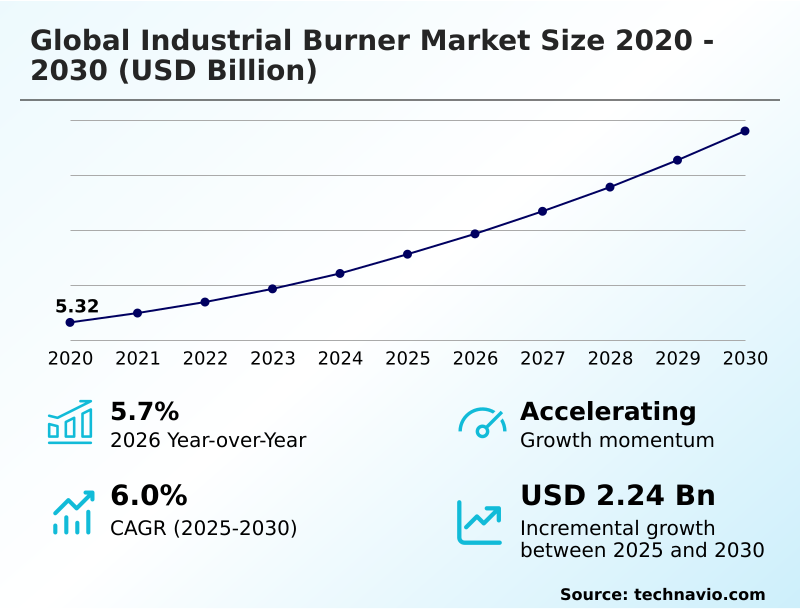
The industrial burner market size is valued to increase by USD 2.24 billion, at a CAGR of 6% from 2025 to 2030. Accelerating transition to hydrogen and low-carbon fuel capabilities will drive the industrial burner market.
Major Market Trends & Insights
- APAC dominated the market and accounted for a 42.9% growth during the forecast period.
- By Fuel Type - Gas burner segment was valued at USD 2.79 billion in 2024
- By End-user - Food and beverages segment accounted for the largest market revenue share in 2024
Market Size & Forecast
- Market Opportunities: USD 3.48 billion
- Market Future Opportunities: USD 2.24 billion
- CAGR from 2025 to 2030 : 6%
Market Summary
- The industrial burner market is undergoing a significant transformation, driven by the dual imperatives of decarbonization and operational efficiency. The strategic shift away from traditional fossil fuels is creating robust demand for advanced industrial burner systems capable of handling hydrogen blends and other low-carbon alternatives.
- This transition is underpinned by stringent global regulations mandating lower emissions of NOx and CO2, compelling operators in energy-intensive sectors to invest in retrofits or new combustion technologies. Concurrently, the integration of IIoT and smart burner management systems is revolutionizing process control, enabling predictive maintenance and real-time optimization of fuel-to-air ratios.
- For instance, a chemical processing facility can leverage this digital oversight not only to ensure compliance with new emission limits, which can be 15% tighter than previous standards, but also to dynamically adjust for fuel composition variability, thereby maintaining thermal efficiency and minimizing unplanned downtime.
- The convergence of these technological and regulatory forces defines the competitive landscape, rewarding innovation in fuel flexibility and digital intelligence for every industrial burner.
What will be the Size of the Industrial Burner Market during the forecast period?
Get Key Insights on Market Forecast (PDF) Get Free Sample
How is the Industrial Burner Market Segmented?
The industrial burner industry research report provides comprehensive data (region-wise segment analysis), with forecasts and estimates in "USD million" for the period 2026-2030, as well as historical data from 2020-2024 for the following segments.
- Fuel type
- Gas burner
- Oil burner
- Dual fuel burner
- End-user
- Food and beverages
- Chemicals and petrochemicals
- Power generation
- Pulp and paper
- Others
- Type
- Regenerative burners
- Radiant tube burners
- Self-recuperative burners
- Air staged burners
- Others
- Geography
- APAC
- China
- India
- Japan
- Europe
- Germany
- UK
- France
- North America
- US
- Canada
- Mexico
- South America
- Brazil
- Argentina
- Colombia
- Middle East and Africa
- Saudi Arabia
- UAE
- South Africa
- Rest of World (ROW)
- APAC
By Fuel Type Insights
The gas burner segment is estimated to witness significant growth during the forecast period.
The gas burner segment represents the core of the industrial heating process, driven by the wide availability and cost-effectiveness of natural gas.
This segment is evolving rapidly, moving beyond conventional combustion efficiency to embrace advanced technologies like regenerative burners and radiant tube burners.
A key development is the engineering of systems compatible with hydrogen blends, a transition critical for decarbonizing thermal processing units.
For example, successful trials integrating a 30% hydrogen blend have been achieved without compromising the precise fuel-to-air ratio needed for sensitive applications. Innovations in flameless oxidation and oxy-fuel combustion are also gaining traction, enabling higher thermal efficiency and lower emissions.
These advancements, including high-velocity burners and thermal oxidizer systems, are crucial for maintaining performance while meeting stricter environmental standards.
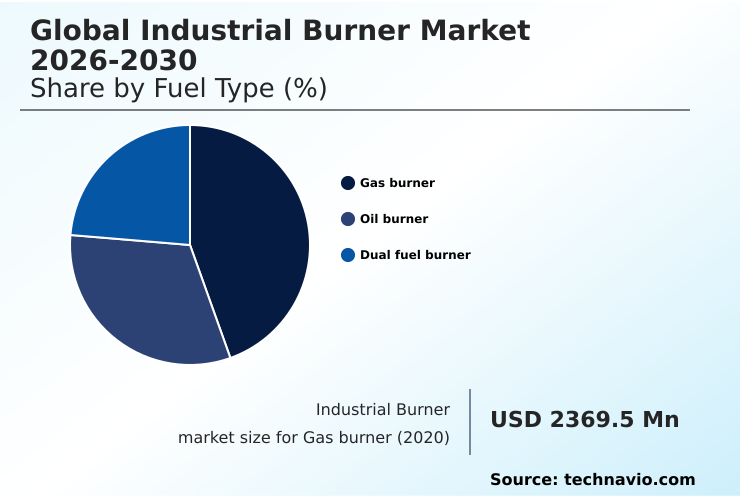
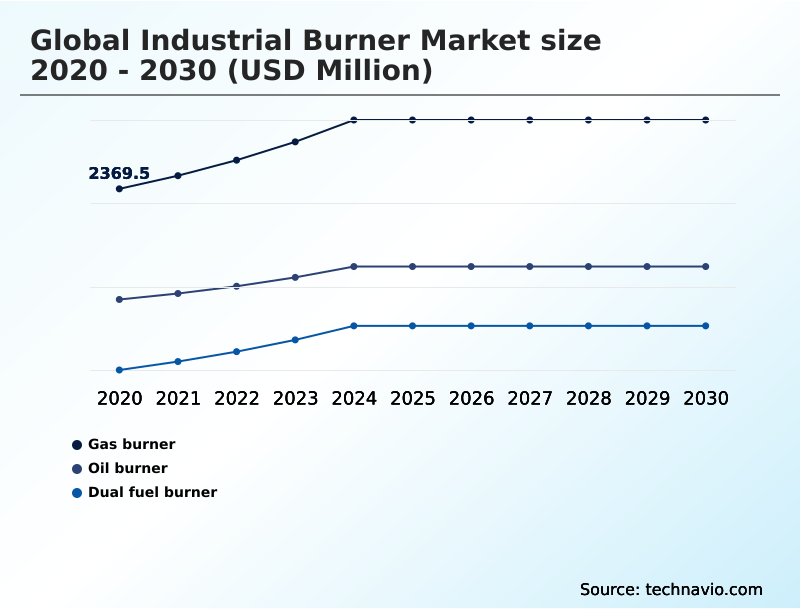
The Gas burner segment was valued at USD 2.79 billion in 2024 and showed a gradual increase during the forecast period.
Regional Analysis
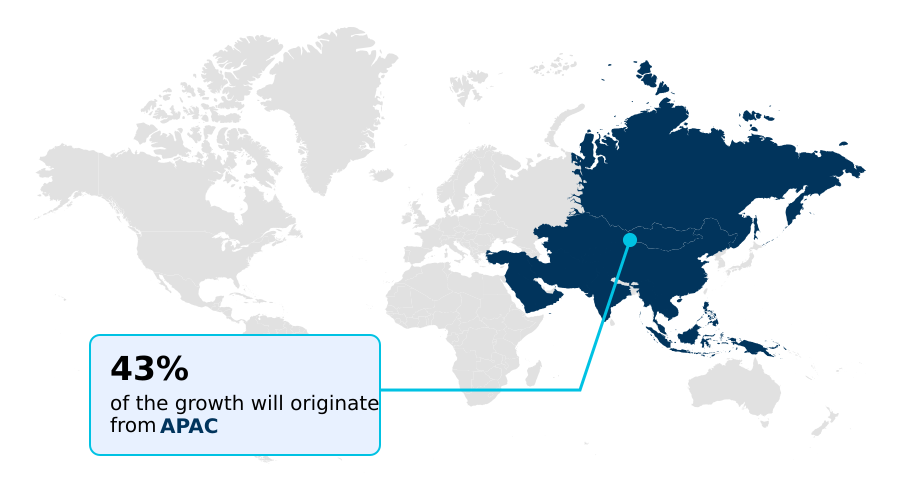
APAC is estimated to contribute 42.9% to the growth of the global market during the forecast period.Technavio’s analysts have elaborately explained the regional trends and drivers that shape the market during the forecast period.
See How Industrial Burner Market Demand is Rising in APAC Get Free Sample
The geographic landscape is dominated by APAC, which accounts for over 42% of the market's incremental growth, fueled by industrial expansion and stringent environmental policies.
In China, government mandates are driving a large-scale transition from coal to gas, boosting demand for high-efficiency process heaters and systems featuring flue gas recirculation for particulate matter reduction.
Meanwhile, advanced economies like Japan and South Korea are pioneering the use of hydrogen for industrial steam generation and supporting grid stability.
This regional focus on decarbonization and waste heat recovery is accelerating the adoption of advanced technologies such as recuperative burners.
These systems are critical for enhancing furnace temperature uniformity in applications ranging from metal processing to lime kilns and duct burner installations, positioning the region as a key hub for combustion technology innovation.
Market Dynamics
Our researchers analyzed the data with 2025 as the base year, along with the key drivers, trends, and challenges. A holistic analysis of drivers will help companies refine their marketing strategies to gain a competitive advantage.
- Achieving higher operational performance in the global industrial burner market 2026-2030 requires a multi-faceted approach. Improving thermal efficiency in industrial furnaces is a primary objective, addressed by technologies like regenerative burners in the steel industry. For the refining sector, adopting low nox burner technology for refineries is no longer optional but a regulatory necessity.
- A significant long-term trend involves hydrogen co-firing in gas turbine burners, a key step toward decarbonization. This transition is supported by the use of a digital twin for industrial combustion optimization, which allows operators to model performance and prevent issues before they occur. However, technical hurdles remain, particularly the challenges of hydrogen combustion flashback.
- For legacy systems, ultra-low nox retrofitting for industrial boilers offers a viable compliance pathway, with some facilities achieving emission reductions of over 50% compared to older equipment. Integrating iiot in burner management systems provides the data-driven control needed to manage these advanced systems.
- As the industry moves forward, advanced burner designs for alternative fuels and the strategic use of a dual fuel burner for energy security will define market leadership, alongside specialized equipment like self-recuperative burners for forge furnaces, air staged burners for pollution control, and both radiant tube burners for heat treating and high-velocity burners for temperature uniformity.
- This is complemented by the niche use of flat flame burners for glass melting.
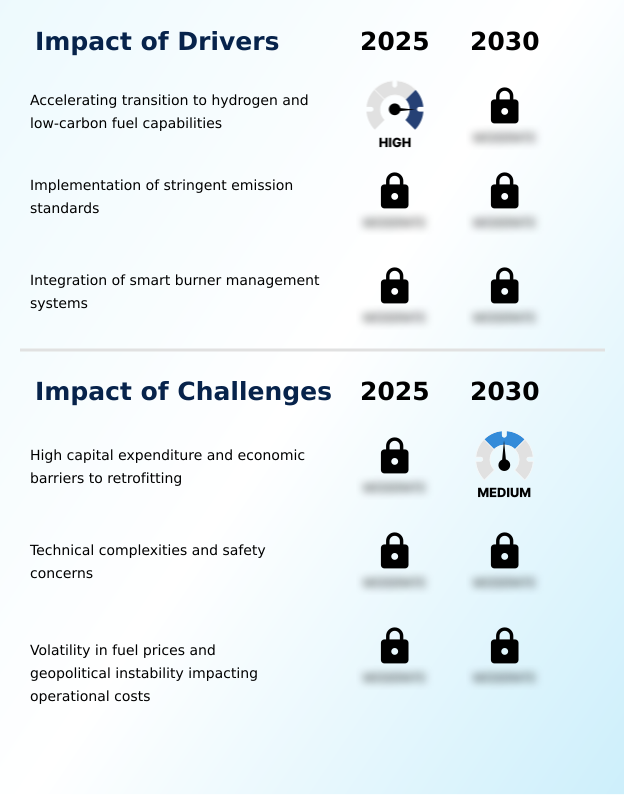
What are the key market drivers leading to the rise in the adoption of Industrial Burner Industry?
- The accelerating transition to hydrogen and other low-carbon fuel capabilities serves as a primary driver for the industrial burner market.
- Market growth is primarily driven by stringent emission compliance mandates and the economic benefits of enhanced efficiency.
- The global push for cleaner air has made low-nox burners and advanced combustion control essential, with new regulations forcing facilities to upgrade to technologies that meet tighter burner safety standards.
- This regulatory pressure is a key factor behind investments in systems offering superior air-fuel ratio control. Furthermore, the integration of iiot in burner management systems provides a significant driver for operational expenditure reduction.
- By leveraging a digital twin for industrial combustion optimization, operators can fine-tune processes to achieve fuel savings of 5-10%.
- The strategic importance of fuel flexibility also propels demand, as industries seek to mitigate risks associated with volatile energy prices through versatile combustion solutions and process heat optimization.
What are the market trends shaping the Industrial Burner Industry?
- A defining market trend is the accelerated adoption of alternative fuels in industrial combustion. This shift is driven by the industry-wide push toward decarbonization and energy diversification.
- Key market trends are centered on sustainability and digitalization, pushing the industry toward cleaner and more intelligent operations. The adoption of alternative fuel combustion is accelerating, driven by the development of hydrogen-ready burners and systems capable of utilizing biofuels, which necessitates advanced staged combustion techniques.
- For instance, facilities are achieving an 85% carbon capture readiness by pairing these systems with specialized carbon capture integration technologies. Simultaneously, the rise of smart combustion is transforming maintenance and efficiency, with predictive maintenance algorithms reducing unplanned downtime by up to 25%. This digital layer enables precise control over the turn-down ratio, a crucial factor in the decarbonization of heat.
- The market is also seeing a surge in ultra-low nox retrofitting, a direct response to stricter environmental mandates, all managed through advanced burner management systems.
What challenges does the Industrial Burner Industry face during its growth?
- High initial capital expenditure and significant economic barriers associated with retrofitting existing systems present a key challenge to market growth.
- Significant challenges constrain market adoption, led by the high costs of combustion system retrofits and technical complexities. The capital required for upgrading to high-efficiency systems can be a major barrier for energy-intensive industries, with project costs often exceeding initial estimates by 15-20% due to integration requirements.
- Moreover, the transition to hydrogen presents formidable engineering hurdles, particularly related to the challenges of hydrogen combustion flashback and the need for new premix technology to ensure stable operation. Ensuring consistent atomization efficiency with alternative fuels remains a concern for high-temperature applications.
- These technical issues, combined with the need for specialized hardware like advanced flame scanners and durable dual fuel burner components, can slow the pace of decarbonization. The market must also address the complexities of handling varied fuel sources, including syngas burners, to improve overall thermal efficiency.
Exclusive Technavio Analysis on Customer Landscape
The industrial burner market forecasting report includes the adoption lifecycle of the market, covering from the innovator’s stage to the laggard’s stage. It focuses on adoption rates in different regions based on penetration. Furthermore, the industrial burner market report also includes key purchase criteria and drivers of price sensitivity to help companies evaluate and develop their market growth analysis strategies.
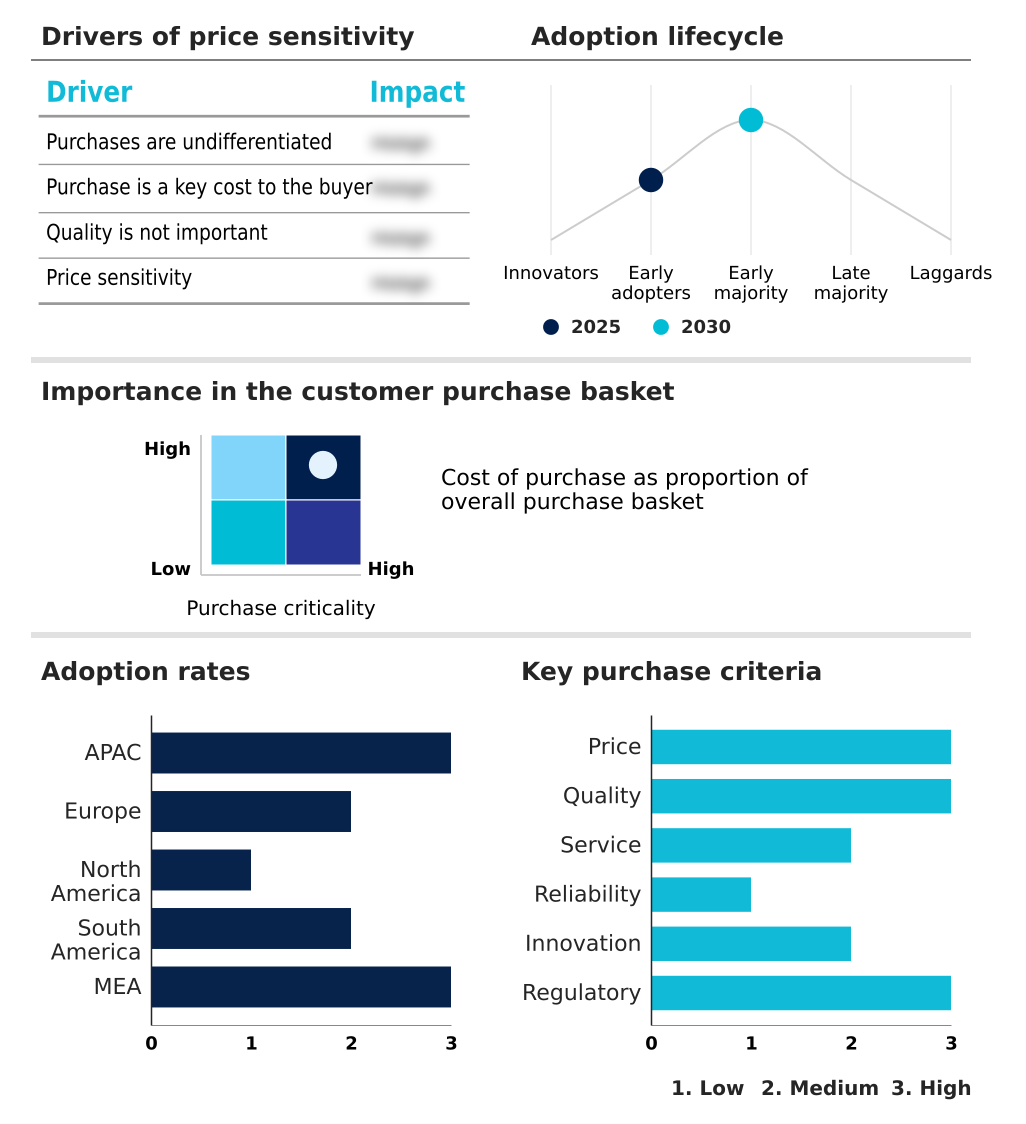
Customer Landscape of Industrial Burner Industry
Competitive Landscape
Companies are implementing various strategies, such as strategic alliances, industrial burner market forecast, partnerships, mergers and acquisitions, geographical expansion, and product/service launches, to enhance their presence in the industry.
AGF Burner Inc. - Provides advanced fluidized bed combustion systems and burners, specializing in solutions for the pulp, paper, and waste-to-energy industries.
The industry research and growth report includes detailed analyses of the competitive landscape of the market and information about key companies, including:
- AGF Burner Inc.
- Andritz AG
- Babcock Wanson
- Baltur Spa
- Bentone
- Bloom Engineering Inc.
- Forbes Marshall Pvt. Ltd.
- Honeywell International Inc.
- IBS GmbH
- John Wood Group PLC
- Koch Industries Inc.
- Limpsfield CE Co. Ltd.
- Mitsubishi Heavy Ltd.
- Oilon Group Oy
- OXILON Pvt. Ltd.
- Power Flame Inc.
- Rapidflame Ltd.
- Selas Heat Technology Co.
- Weishaupt Corp.
- Wesman Group
Qualitative and quantitative analysis of companies has been conducted to help clients understand the wider business environment as well as the strengths and weaknesses of key industry players. Data is qualitatively analyzed to categorize companies as pure play, category-focused, industry-focused, and diversified; it is quantitatively analyzed to categorize companies as dominant, leading, strong, tentative, and weak.
Recent Development and News in Industrial burner market
- In August 2024, Siemens Energy launched a new digital twin platform for industrial combustion systems, allowing operators to simulate and optimize burner performance.
- In January 2025, Oilon Group Oy introduced a new series of industrial heat pumps integrated with hybrid burner systems for comprehensive district heating solutions.
- In February 2025, Fives Group secured a major contract to retrofit a glass manufacturing facility with burners capable of switching between natural gas and hydrogen.
- In May 2025, Koch Engineered Solutions released a new line of process burners engineered to meet sub-5 ppm NOx requirements without external catalytic reduction systems.
Dive into Technavio’s robust research methodology, blending expert interviews, extensive data synthesis, and validated models for unparalleled Industrial Burner Market insights. See full methodology.
| Market Scope | |
|---|---|
| Page number | 312 |
| Base year | 2025 |
| Historic period | 2020-2024 |
| Forecast period | 2026-2030 |
| Growth momentum & CAGR | Accelerate at a CAGR of 6% |
| Market growth 2026-2030 | USD 2239.0 million |
| Market structure | Fragmented |
| YoY growth 2025-2026(%) | 5.7% |
| Key countries | China, India, Japan, South Korea, Australia, Indonesia, Germany, UK, France, Italy, Spain, The Netherlands, US, Canada, Mexico, Brazil, Argentina, Colombia, Saudi Arabia, UAE, South Africa, Israel and Turkey |
| Competitive landscape | Leading Companies, Market Positioning of Companies, Competitive Strategies, and Industry Risks |
Research Analyst Overview
- The industrial burner market is advancing beyond simple combustion, now defined by a sophisticated interplay of thermal efficiency and environmental stewardship. The development of low-nox burners, regenerative burners, and specialized radiant tube burners is central to this evolution, enabling industries to meet tightening emission standards.
- The integration of a dedicated burner management systems, complete with advanced combustion control and a reliable flame scanner, has become standard for ensuring safety and optimizing performance. Boardroom decisions are increasingly influenced by the need to invest in hydrogen-ready burners and oxy-fuel combustion technologies as part of long-term decarbonization strategies.
- Innovations such as flameless oxidation and advanced premix technology are critical for handling alternative fuels. This technological pivot is evident in the adoption of staged combustion techniques, which can reduce NOx emissions by up to 60%.
- The market also sees continued demand for high-velocity burners, recuperative burners, and application-specific hardware like duct burners and syngas burners, all designed to improve atomization efficiency and accommodate a precise air-fuel ratio control, from process heaters and lime kilns to complex thermal oxidizer units.
What are the Key Data Covered in this Industrial Burner Market Research and Growth Report?
-
What is the expected growth of the Industrial Burner Market between 2026 and 2030?
-
USD 2.24 billion, at a CAGR of 6%
-
-
What segmentation does the market report cover?
-
The report is segmented by Fuel Type (Gas burner, Oil burner, and Dual fuel burner), End-user (Food and beverages, Chemicals and petrochemicals, Power generation, Pulp and paper, and Others), Type (Regenerative burners, Radiant tube burners, Self-recuperative burners, Air staged burners, and Others) and Geography (APAC, Europe, North America, South America, Middle East and Africa)
-
-
Which regions are analyzed in the report?
-
APAC, Europe, North America, South America and Middle East and Africa
-
-
What are the key growth drivers and market challenges?
-
Accelerating transition to hydrogen and low-carbon fuel capabilities, High capital expenditure and economic barriers to retrofitting
-
-
Who are the major players in the Industrial Burner Market?
-
AGF Burner Inc., Andritz AG, Babcock Wanson, Baltur Spa, Bentone, Bloom Engineering Inc., Forbes Marshall Pvt. Ltd., Honeywell International Inc., IBS GmbH, John Wood Group PLC, Koch Industries Inc., Limpsfield CE Co. Ltd., Mitsubishi Heavy Ltd., Oilon Group Oy, OXILON Pvt. Ltd., Power Flame Inc., Rapidflame Ltd., Selas Heat Technology Co., Weishaupt Corp. and Wesman Group
-
Market Research Insights
- Market dynamics are increasingly shaped by the pursuit of operational expenditure reduction and enhanced thermal efficiency. The integration of smart combustion systems, for instance, has enabled select refineries to achieve a 4% reduction in fuel consumption through automated air-fuel ratio trimming.
- Similarly, a focus on fuel flexibility is critical for energy-intensive industries, with advanced dual fuel burner systems allowing for dynamic switching based on real-time energy prices. This strategic approach to process heat optimization and emission compliance underscores the shift from standalone hardware to intelligent, integrated thermal processing units, where predictive maintenance algorithms can cut unplanned downtime by over 20%.
We can help! Our analysts can customize this industrial burner market research report to meet your requirements.
 RIA -
RIA - 
