



Level Sensor Market Size 2025-2029
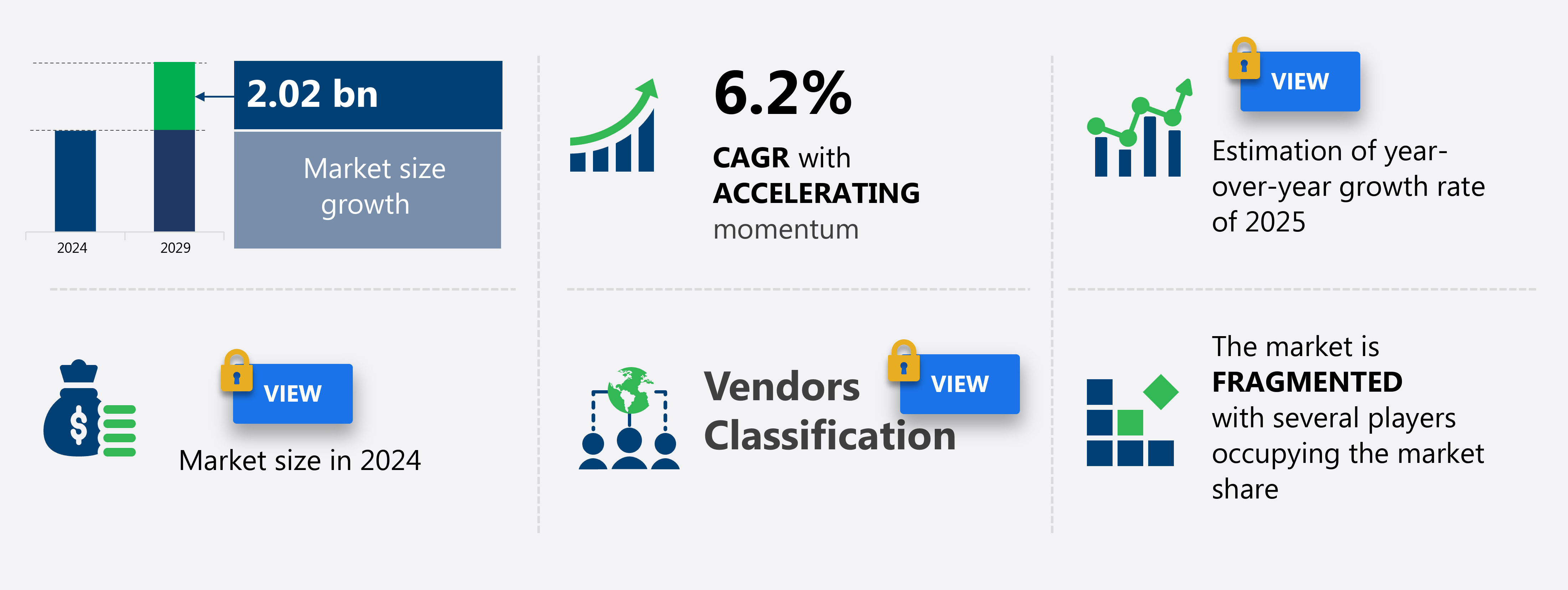
The level sensor market is anticipated to expand by approximately USD 2.02 billion, registering a CAGR of 6.2% during the forecast period. Access to precise market valuations is available upon report purchase.
The level sensor market is drive by technological advancements and increasing automation across industries. The growing demand for precise and reliable measurement solutions is crucial. Advancements like MEMS, machine learning, radar, and optical level sensing are driving adoption in sectors such as food & beverages, pharmaceuticals, oil & gas, and mining & metals. Integrating IoT with level sensors enhances industrial automation, improving process control, inventory management, predictive analysis, and environmental protection. These sensors are essential for preventing overflows, optimizing performance, and ensuring efficient inventory management.
To access the full market forecast and comprehensive analysis, Buy Now
How is this market segmented?
The market research report provides comprehensive data (region-wise segment analysis), with forecasts and estimates in USD bn for the period 2025-2029, as well as historical data from 2019-2024 for the following segments:
- Type
- Magnetostrictive
- Vibratory Probe
- Hydrostatic
- Magnetic & Mechanical Float
- Capacitance Level Sensors
- Sensor Type
- Contact
- Non-contact
- End-user
- Oil & Gas
- Food & Beverages
- Pharmaceutical
- Water & Wastewater
- Metals & Mining
- Electronics
- APAC
- China
- India
- Japan
- Australia
- Rest of APAC
- Germany
- Spain
- Italy
- UK
- Rest of Europe
- US
- Canada
- Brazil
- UAE
- South Africa
- Others
- Type
- Hydrostatic: Provides continuous level measurement, commonly used in tanks and reservoirs.
- Vibratory Probe: Cost-effective and easy to install, ideal for point level detection in liquids and solids.
- Magnetostrictive: Offers high precision and reliability, suitable for demanding industrial applications.
- Capacitance Level Sensors: Suitable for harsh environments
- Magnetic & Mechanical Float: Simple and reliable, suitable for various liquids and applications.
- End-user
- Oil & Gas: Critical for monitoring fluid levels in storage tanks and pipelines.
- Electronics: Monitoring chemical levels in processing solutions
- Pharmaceutical: Critical for precise level control in drug manufacturing.
- Metals & Mining: Used for monitoring material levels in storage bins and processing units.
- Food & Beverages: Important for managing liquid levels in processing and storage tanks.
- Water & Wastewater: Essential for monitoring water levels in treatment plants.
- Sensor Type
- Contact: Offers direct measurement, suitable for various liquids and solids.
- Non-contact: Provides remote measurement, suitable for harsh or sensitive materials.
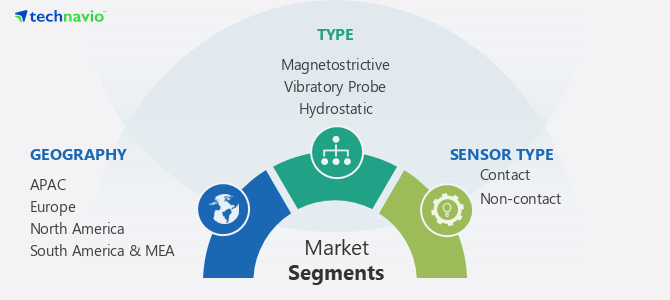
Regional Analysis
- APAC: The Asia Pacific region is expected to witness high growth due to rapid industrialization and economic expansion in China and India. Booming manufacturing, infrastructure development, and energy production increase the demand for precise level measurement solutions. The development of automation technologies will be critical, driving the adoption of level sensors for liquid and solid level monitoring and control to enhance productivity.
- Europe: Europe's level sensor market is driven by stringent regulations and sustainability initiatives. Germany and the UK lead in adopting advanced sensors for process optimization and environmental monitoring. Investments in smart manufacturing and infrastructure further propel market growth, focusing on efficiency and safety.
- North America: North America is a significant market for level sensors, driven by the oil & gas, chemical, and pharmaceutical industries. The US and Canada are key contributors, emphasizing technological innovation and regulatory compliance. Increasing automation and IoT integration boost demand for level sensors in process control and inventory management.
- South America & MEA: South America and MEA offer emerging opportunities for the level sensor market. Brazil is experiencing growth in its industrial sector, increasing demand for level sensors to enhance process efficiency and safety. The UAE's focus on infrastructure development and smart city initiatives drives further adoption of advanced sensing technologies.
Market Dynamics
Our level sensor market researchers analyzed the data with 2024 as the base year, along with the key drivers, trends, and challenges. A holistic analysis of drivers will help companies refine their marketing strategies to gain a competitive advantage.
What are the key market drivers leading to the rise in adoption of level sensor market?
Technological Advancements in Level Sensors. Technological advancements in level sensors, primarily driven by MEMS technology, allow for designing micro-miniature sensors. Sensor miniaturization enables compact, high-efficiency sensors, overcoming the size limitations of traditional sensors in complex environments. Industries such as automotive and pharmaceutical benefit from deploying smaller sensors in space-constrained areas. Miniaturization enhances operational efficiency with wireless and IoT-enabled capabilities for real-time data transmission, improving process control and predictive maintenance.
What are the market trends shaping the level sensor market?
Smart Manufacturing Presents Opportunities for the Market. The rise of smart manufacturing and smart factories offers opportunities for the level sensors market, driven by the trend toward more automated and connected production environments. Industries need precise tracking and control for smooth production processes. Level sensors enable accurate, real-time gathering of fluid levels and raw materials, supporting data-driven decision-making for productivity optimization, downtime elimination, and quality maintenance. In chemical industries, IoT-enabled level sensors check liquid levels in storage tanks and reactors, providing accurate mixtures and enhanced product quality.
What challenges does the level sensor market face?
Industry reluctance to embrace modern-level sensing solutions poses a challenge. A key challenge is the hesitance of mature industries to adopt new technologies. Many industries are conservative and prefer traditional level sensing methods. Initial costs and risks in embracing new technologies can be a setback. Compatibility concerns with existing systems and reliability also play a role. Regulatory complexities further complicate adopting new sensors with extra compliance requirements, challenging the growth of the level sensors market.
Key Companies & Market Insights
Leading companies are implementing strategies such as product innovations, acquisitions, and geographic expansions to enhance their market position. Key players in the level sensor market include:
- ABB (Switzerland)
- Emerson Electric Co. (US)
- Siemens (Germany)
- AMETEK, Inc. (US)
- Honeywell International Inc (US)
- Schneider Electric (France)
- TE Connectivity (US)
- Endress+Hauser Group Services AG (Switzerland)
- Baumer (Switzerland)
- SICK AG (Germany)
- WIKA Alexander Wiegand SE & Co. KG (Germany)
- Pepperl+Fuchs SE (Germany)
- ifm electronic gmbh (Germany)
- KROHNE (Germany)
- Balluff (Germany)
These companies are strategically focused on product development, market expansion, and partnerships to maintain their competitive edge in the growing level sensor market.
|
Market Scope |
|
|
Report Coverage |
Details |
| Base year | 2024 |
| Page number | 211 |
| Key countries | US, UK, China, Germany, India, South Korea |
| Forecast period | 2025-2029 |
| Historic period | 2019-2023 |
| Report coverage | Market size, forecasts, segmentation |
| Regional Analysis | APAC
|
| Growth momentum and CAGR | 6.2% |
| Performing market contribution | Europe, APAC, North America |
 RIA -
RIA - 
