


Rotorcraft Blade System Market 2024-2028
The rotorcraft blade system market size is estimated to grow at a CAGR of 6.07% between 2023 and 2028. The market size is forecast to increase by USD 592.91 million. The growth of the market depends on several factors such as the development and induction of new-generation attack helicopters, design improvements leading to increased safety related to aircraft travel, and increased service life and usefulness of commercial helicopters. Our report examines historic data from 2018 to 2022, besides analyzing the current market scenario.
This report extensively covers market segmentation by application (civil and military), distribution channel (OEM and aftermarket), and geography (North America, Europe, APAC, South America, and Middle East and Africa). It also includes an in-depth analysis of drivers, trends, and challenges.
What will be the size of the Rotorcraft Blade System Market During the Forecast Period?
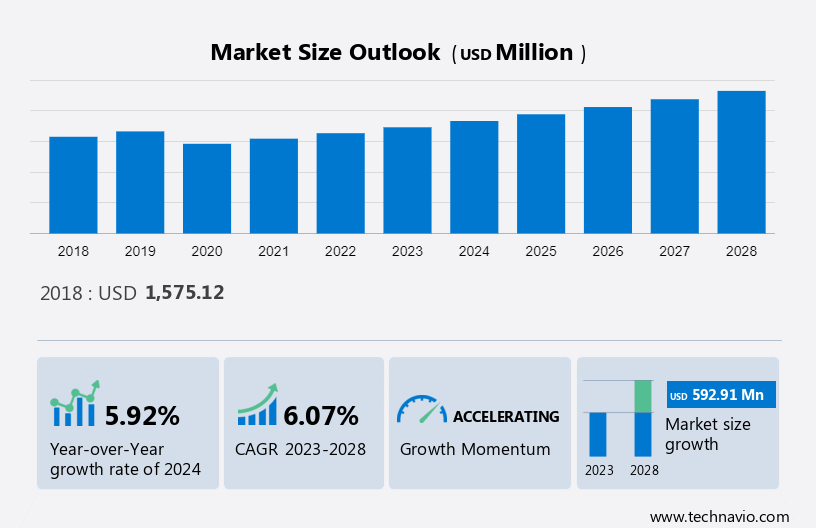
Rotorcraft Blade System Market Forecast 2024-2028
To learn more about this report, Request Free Sample
Rotorcraft Blade System Market Dynamic
Our researchers studied the data for years, with 2023 as the base year and 2024 as the estimated year, and presented the key drivers, trends, and challenges for the market. Although there has been a disruption in the growth of the market during the COVID-19 pandemic, a holistic analysis of drivers, trends, and challenges will help companies refine marketing strategies to gain a competitive advantage.
Driver- Development and induction of new-generation attack helicopters
Helicopters are used by the military for a variety of missions, and most service helicopters have been specifically retooled in accordance with their specific roles. Modern attack helicopters can carry heavy artillery, such as autocannons, machine guns, rockets, and anti-tank guided missiles (ATGM). During armed conflicts, they are deployed to either provide accurate close air support for ground troops or to destroy enemy armor concentrations.
In addition, the Modernized Apache combines the advanced, combat-tested AH-64 platform with the convergence of advanced attack helicopter technologies to increase range, survivability, and lethality. The Modernized Apache is the most cost-effective, feasible, and risk-free attack helicopter designed for MDO decision-making. All these factors will drive the growth of the market during the forecast period.
Trends- Increased adoption of digital helicopter health monitoring systems
In order to keep the helicopter's vital components healthy and functioning, Integrated HUMS incorporates a number of sensors. The main rotor track and balance monitoring have been the primary focus of HUMS, and its implementation has reduced the correction time drastically from weeks to a couple of test flights. HUMS permits an enhanced rate of data collection, thereby facilitating predictive maintenance, i.e., the prevention of replacements before an unscheduled maintenance event.
Moreover, the development of complex algorithms for the collection of more useful data has been undertaken by engine manufacturers. Airbus Helicopters and Safran Electronic and Defense have partnered to distribute HUMS-based services on all Airbus helicopters that are not equipped with the Helionix Avionics Suite or a usage monitoring system. Such developments are likely to increase the adoption of HUMS which will drive the growth of the market during the forecast period.
Challenge- Budgetary fall-outs dampening rotorcraft programs' market prospects
The development and production costs of a helicopter can be divided into its overall cost. Unpredictable cost increases or delays in delivery may result from the increase in one of these costs. The modern turboshaft engine in helicopters is the result of years of R&D activities conducted at the component level, and each advancement in the technology of related components can pave an entirely new research avenue.
Moreover, budgetary fall-outs constantly interrupt the development cycle. Such fall-outs in the associated product cost of rotorcraft programs pose a significant threat to the global rotorcraft blade system market, as they tend to drive down the demand and market opportunities for new helicopters and thereby impede the growth of the market during the forecast period.
Rotorcraft Blade System Market Segmentation by Application, Distribution Channel, and Geography
Application Segment Analysis:
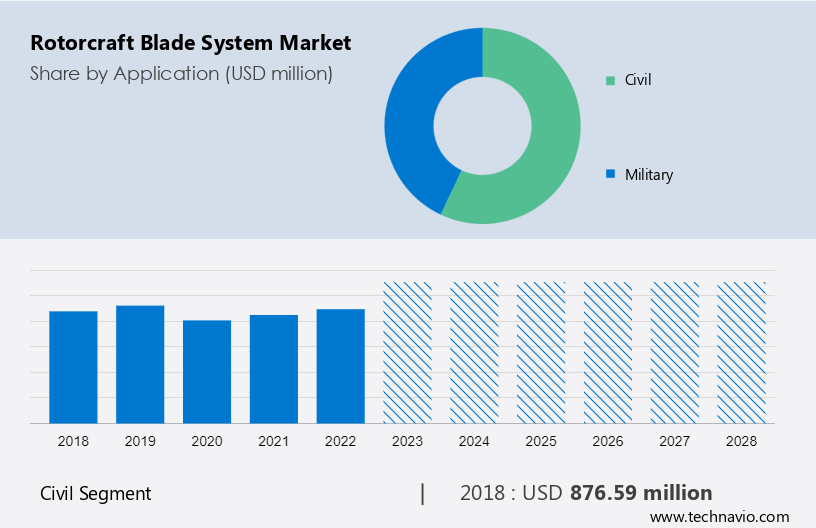
The civil segment will account for a major share of the market's growth during the forecast period.?In civil aviation, rotor blades play an important role as they enable helicopters to safely and efficiently operate in a variety of civilian applications. The civil applications of a rotorcraft encompass several mission profiles, such as search and rescue (SAR), humanitarian aid, disaster relief, peacekeeping support, and scientific operations. Civil helicopters are further categorized based on their load-carrying capacity, otherwise called lift platforms, and feature a traditional main rotor-tail rotor configuration powered by rotorcraft engines of varying output ranges.
Get a Customised Report as per your requirements for FREE!
The civil segment was valued at USD 876.59 million in 2018. The emergence of strict emission norms for aviation has led to the widespread development of hybrid powertrain systems. Moreover, technological developments in the engine and airframe systems have augmented their performance, made them more resilient to weather, and enhanced their control responsiveness. Hence, these applications of rotorcraft blade systems in civil aviation will propel the growth of the market during the forecast period.
Distribution Channel Segment Analysis
Based on the distribution channel, the market has been segmented into OEM and aftermarket. The OEM segment will account for the largest share of this segment.? The original equipment market (OEMs) specializes in the creation, production, and sale of blade systems to aircraft manufacturers or as components of rotorcraft assemblies. OEMs are essential distributors of rotorcraft blade systems, providing aircraft manufacturers with the highest quality, most advanced, and dependable blade systems. Original equipment manufacturers (OEMs) possess a wealth of experience in material selection, advanced manufacturing techniques, and quality assurance. Thus, such factors will propel the growth of the OEM segment of the market during the forecast period.
Regional Analysis
For more insights on the market share of various regions View PDF Sample now!
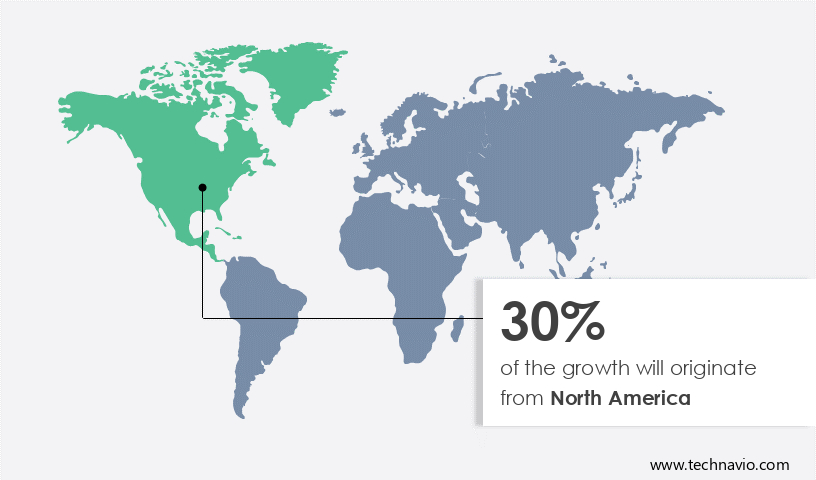
North America is estimated to contribute 30% to the growth by 2027. Technavio’s analysts have elaborately explained the regional trends, drivers, and challenges that are expected to shape the market during the forecast period. The US military imagines helicopters as a crucial component of effective battlefield strategy. The region has been investing significantly in the procurement of new rotorcraft for catering to defense and civil requirements.
Moreover, the government of Canada ordered 28 CH-144 Cyclone choppers, out of which Canada has received 24 of these choppers as of March 2022. The regional procurement of rotorcraft for civil and military applications, such as emergency medical services and very important person (VIP) transportation, is anticipated to drive the growth of the rotorcraft blade system market in North America during the forecast period.
COVID Recovery Analysis:
The COVID-19 pandemic negatively affected the regional market in 2020. However, in 2021, the initiation of large-scale vaccination drives?lifted the lockdown and travel restrictions, which led to the resumption of supply chain activities. The increase in public interaction in the aviation industry post-2022 will lead to an increase in demand for rotorcraft blade systems. All these factors will expand the growth of the market in focus during the forecast period.
Who are the Major Rotorcraft Blade System Market Companies?
Companies are implementing various strategies, such as strategic alliances, partnerships, mergers and acquisitions, geographical expansion, and product/service launches, to enhance their presence in the market.
- Advanced Technologies Inc.: The company offers rotorcraft blade systems such as full-scale experimental and Faa-certified composite rotor blades.
We also have detailed analyses of the market’s competitive landscape and offer information on 20 market companies, including:
Airbus SE, aircraftspruce, Carson Helicopters Inc., Ducommun Inc., Erickson Inc., General Electric Co., Hindustan Aeronautics Ltd., Kaman Corp., Lockheed Martin Corp., Nordex SE, Robinson Helicopter Co. Inc., The Boeing Co., and Van Horn Aviation LLC
Technavio report provides an in-depth analysis of the market and its players through combined qualitative and quantitative data. The analysis classifies companies into categories based on their business approaches, including pure-play, category-focused, industry-focused, and diversified. Companies are specially categorized into dominant, leading, strong, tentative, and weak, based on their quantitative data analysis.
Segment Overview
The rotorcraft blade system market report forecasts market growth by revenue at global, regional & country levels and provides an analysis of the latest trends and growth opportunities from 2018 to 2028.
- Application Outlook (USD Million, 2018 - 2028)
- Civil
- Military
- Distribution Channel Outlook (USD Million, 2018 - 2028)
- OEM
- Aftermarket
- Region Outlook (USD Million, 2018 - 2028)
- North America
- The U.S.
- Canada
- Europe
- The U.K.
- Germany
- France
- Rest of Europe
- APAC
- China
- India
- South America
- Chile
- Brazil
- Argentina
- Middle East & Africa
- Saudi Arabia
- South Africa
- Rest of the Middle East & Africa
- North America
|
Rotorcraft Blade System Market Scope |
|
|
Report Coverage |
Details |
|
Page number |
160 |
|
Base year |
2023 |
|
Historic period |
2018-2022 |
|
Forecast period |
2024-2028 |
|
Growth momentum & CAGR |
Accelerate at a CAGR of 6.07% |
|
Market Growth 2024-2028 |
USD 592.91 million |
|
Market structure |
Concentrated |
|
YoY growth 2023-2024(%) |
5.92 |
|
Regional analysis |
North America, Europe, APAC, South America, and Middle East and Africa |
|
Performing market contribution |
North America at 30% |
|
Key countries |
US, China, Japan, Germany, and France |
|
Competitive landscape |
Leading Companies, Market Positioning of Companies, Competitive Strategies, and Industry Risks |
|
Key companies profiled |
Advanced Technologies Inc., Airbus SE, aircraftspruce, Carson Helicopters Inc., Ducommun Inc., Erickson Inc., General Electric Co., Hindustan Aeronautics Ltd., Kaman Corp., Lockheed Martin Corp., Nordex SE, Robinson Helicopter Co. Inc., The Boeing Co., and Van Horn Aviation LLC |
|
Market dynamics |
Parent market analysis, Market growth inducers and obstacles, Fast-growing and slow-growing segment analysis, COVID-19 impact and recovery analysis and future consumer dynamics, and Market condition analysis for the forecast period. |
|
Customization purview |
If our report has not included the data that you are looking for, you can reach out to our analysts and get segments customized. |
What are the Key Data Covered in this Rotorcraft Blade System Market Research Report?
- CAGR of the market during the forecast period
- Detailed information on factors that will drive the growth of the rotorcraft blade system market between 2024 and 2028
- Precise estimation of the rotorcraft blade system market size and its contribution to the market in focus on the parent market
- Accurate predictions about upcoming trends and changes in consumer behavior
- Growth of the market across North America, Europe, APAC, South America, and Middle East and Africa
- A thorough analysis of the market’s competitive landscape and detailed information about companies
- Comprehensive analysis of factors that will challenge the growth of rotorcraft blade system market companies
We can help! Our analysts can customize this market research report to meet your requirements. Get in touch
 RIA -
RIA - 
