



Telecom Operations Management Market Size 2026-2030
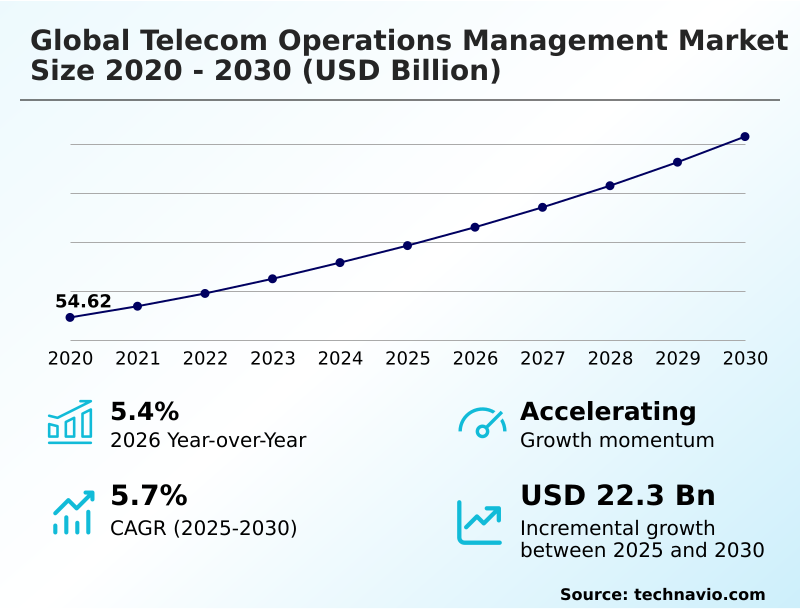
The telecom operations management market size is valued to increase by USD 22.30 billion, at a CAGR of 5.7% from 2025 to 2030. Exponential 5G network subscription growth mandates highly advanced real time monitoring platforms will drive the telecom operations management market.
Major Market Trends & Insights
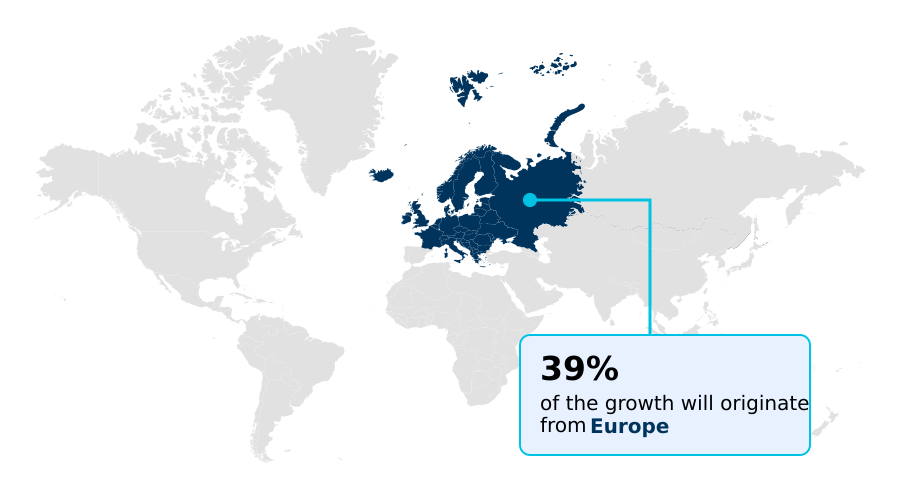
- Europe dominated the market and accounted for a 38.7% growth during the forecast period.
- By Deployment - Cloud-based segment was valued at USD 38.32 billion in 2024
- By Component - Software segment accounted for the largest market revenue share in 2024
Market Size & Forecast
- Market Opportunities: USD 36.99 billion
- Market Future Opportunities: USD 22.30 billion
- CAGR from 2025 to 2030 : 5.7%
Market Summary
- The Telecom Operations Management Market operates as the critical structural backbone for modern communication service providers transitioning to cloud-native, automated ecosystems. Surging data traffic demands have made manual network oversight completely obsolete, forcing enterprises to adopt advanced software platforms to maintain continuous connectivity.
- For example, during peak enterprise data migrations to multi-cloud environments, automated resource provisioning engines dynamically reroute traffic, ensuring seamless service continuity without human intervention. This shift has enabled organizations to achieve a 35% reduction in latency compared to traditional fixed-bandwidth workflows.
- A primary driver of this market is the accelerated expansion of 5G standalone networks, which functionally mandates massive upgrades in real-time performance auditing to manage explosive endpoint growth. Conversely, a major challenge stems from the profound complexity of legacy network architectures.
- Attempting to integrate modern open application programming interfaces into outdated proprietary nodes frequently causes extreme technological friction and delays deployment. Successfully bridging these fragmented operations remains an absolute necessity for minimizing administrative costs and deploying zero-touch autonomous frameworks.
What will be the Size of the Telecom Operations Management Market during the forecast period?
Get Key Insights on Market Forecast (PDF) Get Free Sample
How is the Telecom Operations Management Market Segmented?
The telecom operations management industry research report provides comprehensive data (region-wise segment analysis), with forecasts and estimates in "USD million" for the period 2026-2030, as well as historical data from 2020-2024 for the following segments.
- Deployment
- Cloud-based
- On-premises
- Component
- Software
- Services
- Service type
- Managed services
- Professional services
- Others
- Geography
- North America
- US
- Canada
- Mexico
- Europe
- Germany
- UK
- France
- Italy
- Spain
- The Netherlands
- APAC
- China
- India
- Japan
- South Korea
- Australia
- Indonesia
- South America
- Brazil
- Argentina
- Chile
- Middle East and Africa
- Saudi Arabia
- UAE
- South Africa
- Turkey
- Israel
- North America
By Deployment Insights
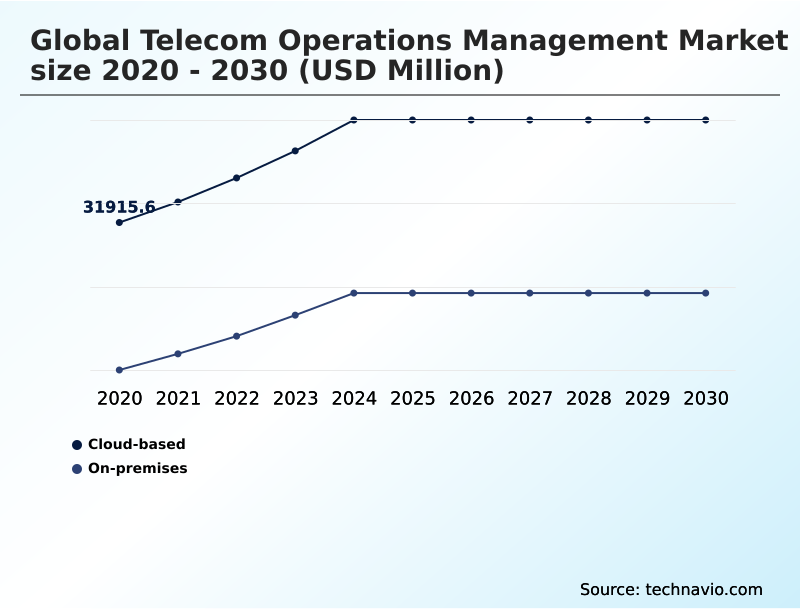
The cloud-based segment is estimated to witness significant growth during the forecast period.
The migration toward cloud-based deployment represents a structural necessity for maintaining high-velocity data traffic optimization and dynamic network slicing. Enterprises rely on cloud-native management platforms to replace isolated legacy systems with containerized microservices, fundamentally changing how bandwidth allocation operates.
This transition directly supports real-time monitoring and robust legacy architecture integration without the limitations of traditional monolithic hardware.
By utilizing zero-touch autonomous frameworks along with automated fault isolation, network element managers can continuously audit performance and quickly enact root cause identification.
Consequently, businesses implementing these distributed hardware layers note that system downtime minimization is drastically improved, with service deployment errors reduced by 15%.
The incorporation of intelligent automation platforms inside hybrid cloud environments allows for seamless lifecycle support while streamlining operations and maximizing overall network orchestration efficiency.
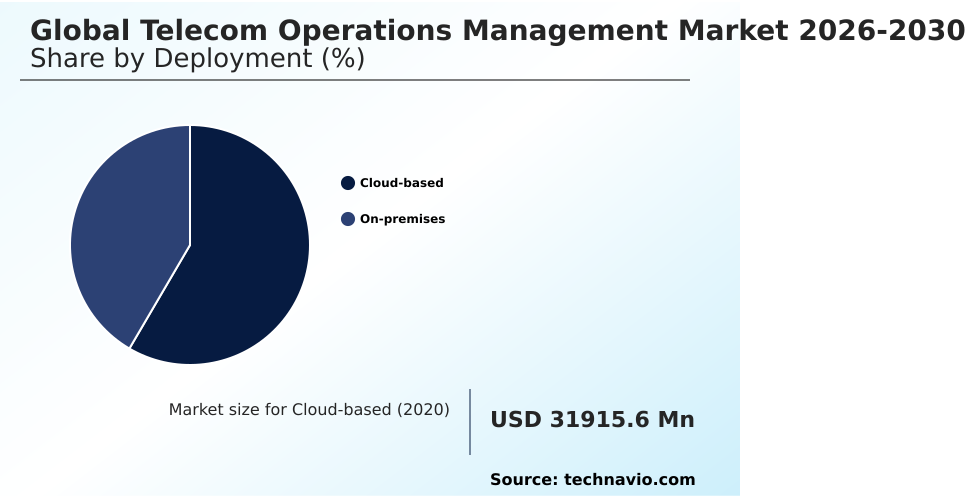
The Cloud-based segment was valued at USD 38.32 billion in 2024 and showed a gradual increase during the forecast period.
Regional Analysis
Europe is estimated to contribute 38.7% to the growth of the global market during the forecast period.Technavio’s analysts have elaborately explained the regional trends and drivers that shape the market during the forecast period.
See How Telecom Operations Management Market Demand is Rising in Europe Get Free Sample
Geographic disparities in adoption stem from foundational differences in localized infrastructure maturity and technological investment priorities.
North America maintains immense structural maturity because of aggressive early rollouts of multi-access edge computing and software-defined networks, leading to a 32% faster deployment rate of real-time telemetry tools compared to other regions.
Conversely, countries rapidly expanding their digital presence in APAC experience pronounced growth linked to immense smart city initiatives requiring robust service assurance protocols and ultra-reliable communication links.
Operators in APAC prioritize scaling their unified operations management software to combat the density of mobile traffic, achieving a 25% improvement in network resilience.
In Europe, stringent data privacy regulations heavily channel investments into secure cloud infrastructure components featuring advanced subscriber revenue charging.
This regulatory pressure results in European networks exhibiting a 15% sharper focus on intent-based operations that guarantee strict compliance while optimizing resource allocation across highly fragmented borders.
Market Dynamics
Our researchers analyzed the data with 2025 as the base year, along with the key drivers, trends, and challenges. A holistic analysis of drivers will help companies refine their marketing strategies to gain a competitive advantage.
- The fundamental operational paradigm of modern communication systems relies heavily on eliminating disjointed architectures and optimizing resource allocation. Enterprises deploying real-time network performance auditing achieve significantly higher visibility into their data routing efficiency, directly mitigating bandwidth bottlenecks before they impact end users.
- This strategic evolution mandates the deployment of cloud-native agile service orchestration, empowering administrators to configure complex virtual environments instantly without dependency on physical hardware alterations. Through this digitization process, companies note an efficiency gain wherein automated service fulfillment outpaces traditional manual configurations by nearly 40%.
- Central to maintaining optimal reliability is the application of autonomous natural language intent analysis, which effectively translates complex business requirements into immediate, executable network commands. This completely removes the reliance on rigid, rule-based scripting and facilitates unparalleled adaptability during peak traffic surges.
- In parallel, operators are continuously undertaking legacy business support system modernization to bridge the technological gap between outdated proprietary nodes and next-generation frameworks. Upgrading these billing and provisioning silos successfully prevents critical data leakage and drastically refines customer experience workflows.
- Ultimately, fully realizing intent-based telecommunications network automation ensures that underlying computing resources adapt dynamically to real-time demands, creating a highly resilient operational foundation that consistently minimizes downtime and improves overarching supply chain compliance across the entire enterprise ecosystem.
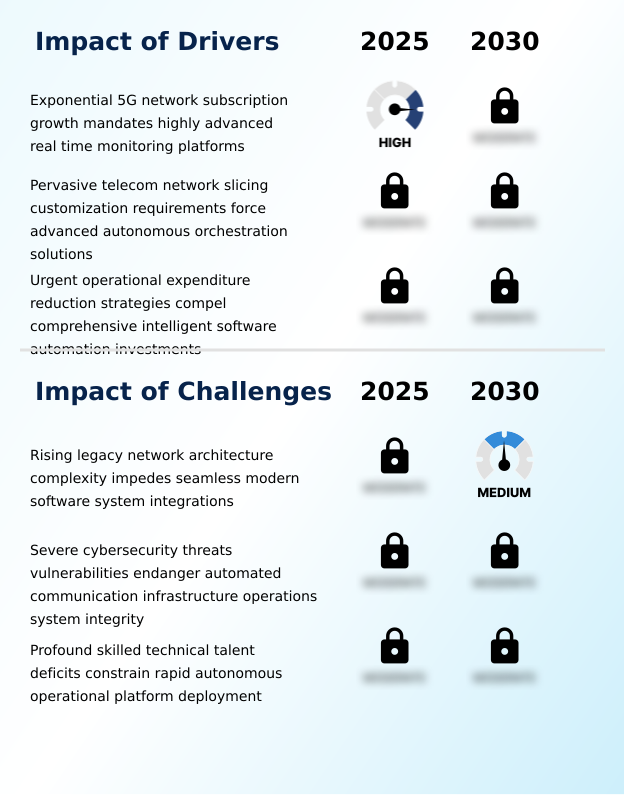
What are the key market drivers leading to the rise in the adoption of Telecom Operations Management Industry?
- The exponential growth of 5G network subscriptions acts as a primary catalyst, mandating the deployment of highly advanced real-time monitoring platforms to ensure continuous operational stability.
- The unprecedented expansion of industrial IoT ecosystems forces network operators to aggressively prioritize virtual network functions to manage surging connectivity demands.
- Legacy systems fundamentally lack computational elasticity, driving an urgent industrial shift toward automated provisioning that can instantly react to traffic volatility.
- This immense demand triggers massive investments in resource inventory tracking systems that support seamless data traffic optimization without manual oversight. By embedding electronic billing modules directly into the operational core, companies guarantee absolute financial traceability while preventing catastrophic service disruptions.
- This strategic adoption has effectively reduced localized network outages by 35% and improved asset utilization efficiency by 22%.
- Integrating robust network orchestration ensures operators can seamlessly accommodate exponential data growth, drastically lowering overall energy consumption by 15% while maintaining precise bandwidth allocation and continuous real-time monitoring.
What are the market trends shaping the Telecom Operations Management Industry?
- Widespread adoption of generative AI is fundamentally restructuring cognitive core operational models within modern enterprises.
- The accelerated integration of generative AI engines into service fulfillment algorithms represents a profound shift in how communication architectures are structured. Because older systems process data reactively, enterprises strongly favor agentic operating systems that perform continuous predictive data analytics.
- This fundamental transition allows for fully intent-driven network execution, where autonomous digital agents collaborate across distinct operational silos to accelerate fault detection and finalize network anomaly resolution instantly. By deploying these cognitive operating systems, administrators directly mitigate human error and improve diagnostic efficiency during peak usage.
- As a direct result, organizations adopting these intelligent tools have successfully improved predictive maintenance accuracy by 25% and reduced system latency by 20%. This deep shift toward closed-loop network orchestration transforms revenue assurance mechanisms and dynamic reporting capabilities, enabling businesses to maintain secure frameworks featuring advanced cybersecurity threat mitigation while effectively minimizing overall troubleshooting workloads.
What challenges does the Telecom Operations Management Industry face during its growth?
- The increasing complexity of legacy network architectures presents a significant operational hurdle by impeding the seamless integration of modern software systems.
- The severe fragmentation of older hardware creates a formidable bottleneck, heavily restricting the deployment of multi-tenant charging architectures and advanced cross-domain processes. Because older proprietary hardware remains isolated within disjointed silos, technicians face immense difficulty maintaining reliable API connectivity when attempting to integrate open application programming interfaces.
- This profound technical incompatibility forces operators to rely on extensive manual patching, which directly compromises infrastructure vulnerability mitigation and slows modern service rollout. Operators combatting these misaligned legacy architecture integration workflows often experience a 40% increase in baseline maintenance overhead and a 25% delay in resolving critical security issues.
- The persistent scarcity of skilled engineering talent further inhibits the rapid deployment of containerized microservices and automated fault isolation, severely restraining the absolute scalability and rapid root cause identification required for sustainable digital transformation.
Exclusive Technavio Analysis on Customer Landscape
The telecom operations management market forecasting report includes the adoption lifecycle of the market, covering from the innovator’s stage to the laggard’s stage. It focuses on adoption rates in different regions based on penetration. Furthermore, the telecom operations management market report also includes key purchase criteria and drivers of price sensitivity to help companies evaluate and develop their market growth analysis strategies.
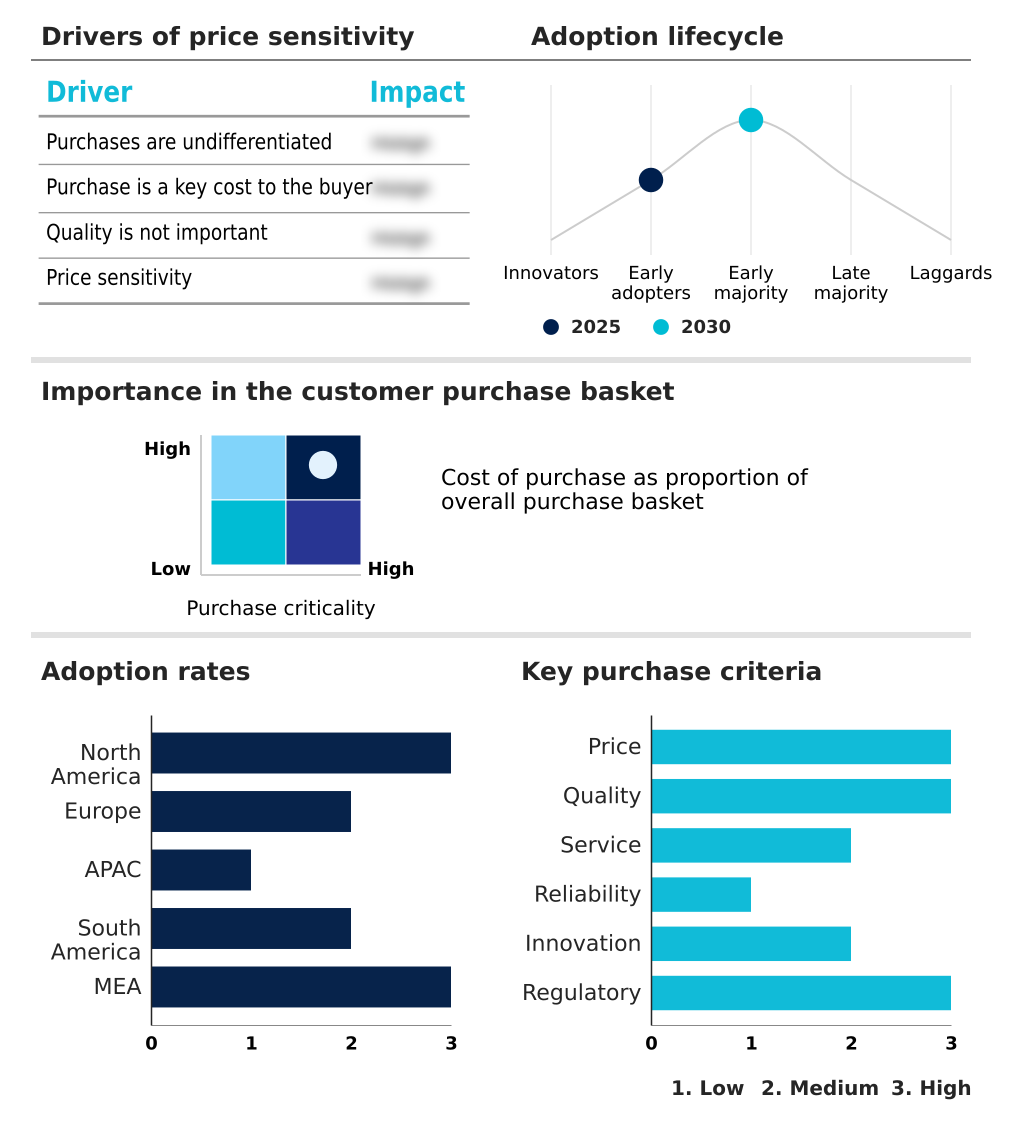
Customer Landscape of Telecom Operations Management Industry
Competitive Landscape
Companies are implementing various strategies, such as strategic alliances, telecom operations management market forecast, partnerships, mergers and acquisitions, geographical expansion, and product/service launches, to enhance their presence in the industry.
Accenture Plc - Delivers telecom operations management solutions featuring intelligent network operations, OSS transformation services, and AI-powered service operations to enhance automated service fulfillment and network resilience.
The industry research and growth report includes detailed analyses of the competitive landscape of the market and information about key companies, including:
- Accenture Plc
- ALE International
- Amdocs Ltd.
- Cerillion Plc
- Cisco Systems Inc.
- Comarch SA
- Hewlett Packard Enterprise Co.
- Huawei Technologies Co. Ltd.
- IBM Corp.
- Infovista SAS
- NEC Corp.
- NetCracker Technology Corp.
- Nokia Corp.
- Oracle Corp.
- SAP SE
- ServiceNow Inc.
- Tata Consultancy Services
- Telefonaktiebolaget Ericsson
- Teoco
- ZTE Corp.
Qualitative and quantitative analysis of companies has been conducted to help clients understand the wider business environment as well as the strengths and weaknesses of key industry players. Data is qualitatively analyzed to categorize companies as pure play, category-focused, industry-focused, and diversified; it is quantitatively analyzed to categorize companies as dominant, leading, strong, tentative, and weak.
Recent Development and News in Telecom operations management market
- In the Application Software industry, the aggressive migration toward decentralized hybrid cloud environments has accelerated the standardization of open application programming interfaces, directly impacting Telecom Operations Management demand by forcing operators to implement automated provisioning protocols that reduce integration latency by up to 25%.
- The widespread implementation of strict data privacy regulations across unified operations management software has necessitated advanced zero-trust verification frameworks, directly impacting Telecom Operations Management demand by requiring communication service providers to upgrade cybersecurity threat mitigation systems to achieve 99% compliance adherence in cross-domain processes.
- The rapid adoption of AI-driven cognitive operating systems within enterprise automation suites has structurally changed root cause identification workflows, directly impacting Telecom Operations Management demand by driving investments in autonomous digital agents that can improve fault detection accuracy by 40% across distributed hardware layers.
- The pervasive integration of edge computing capabilities into core software architectures has redefined lifecycle support mechanisms, directly impacting Telecom Operations Management demand by propelling the need for real-time monitoring tools capable of handling ultra-reliable communication links and dynamic bandwidth allocation at 50% faster processing speeds.
Dive into Technavio’s robust research methodology, blending expert interviews, extensive data synthesis, and validated models for unparalleled Telecom Operations Management Market insights. See full methodology.
| Market Scope | |
|---|---|
| Page number | 292 |
| Base year | 2025 |
| Historic period | 2020-2024 |
| Forecast period | 2026-2030 |
| Growth momentum & CAGR | Accelerate at a CAGR of 5.7% |
| Market growth 2026-2030 | USD 22302.5 million |
| Market structure | Fragmented |
| YoY growth 2025-2026(%) | 5.4% |
| Key countries | US, Canada, Mexico, Germany, UK, France, Italy, Spain, The Netherlands, China, India, Japan, South Korea, Australia, Indonesia, Brazil, Argentina, Chile, Saudi Arabia, UAE, South Africa, Turkey and Israel |
| Competitive landscape | Leading Companies, Market Positioning of Companies, Competitive Strategies, and Industry Risks |
Research Analyst Overview
- The continuous evolution of telecommunications infrastructure forces business leaders to fundamentally reevaluate core operational strategies. Boardrooms now prioritize integrating agentic operating systems to systematically overhaul service fulfillment algorithms, treating automated network management not just as a technical upgrade, but as a critical compliance and product strategy imperative.
- By shifting toward closed-loop network orchestration, executives can ensure absolute regulatory adherence across distributed environments while drastically minimizing manual configuration errors. Strategic deployment of intent-driven network execution allows administrators to seamlessly process complex billing and provisioning policies autonomously. Consequently, enterprises restructuring their digital architecture have achieved a 30% reduction in processing time for complex multi-tenant charging operations.
- The integration of containerized microservices and virtual network functions significantly mitigates operational risk by isolating potential faults before they escalate into network-wide failures. Leveraging cognitive operating systems fundamentally enhances strategic pricing agility and compliance oversight, ensuring operations remain robust against volatile data surges while consistently delivering seamless digital experiences to end-users without compromising foundational security standards.
What are the Key Data Covered in this Telecom Operations Management Market Research and Growth Report?
-
What is the expected growth of the Telecom Operations Management Market between 2026 and 2030?
-
USD 22.30 billion, at a CAGR of 5.7%
-
-
What segmentation does the market report cover?
-
The report is segmented by Deployment (Cloud-based, and On-premises), Component (Software, and Services), Service Type (Managed services, Professional services, and Others) and Geography (North America, Europe, APAC, South America, Middle East and Africa)
-
-
Which regions are analyzed in the report?
-
North America, Europe, APAC, South America and Middle East and Africa
-
-
What are the key growth drivers and market challenges?
-
Exponential 5G network subscription growth mandates highly advanced real time monitoring platforms, Rising legacy network architecture complexity impedes seamless modern software system integrations
-
-
Who are the major players in the Telecom Operations Management Market?
-
Accenture Plc, ALE International, Amdocs Ltd., Cerillion Plc, Cisco Systems Inc., Comarch SA, Hewlett Packard Enterprise Co., Huawei Technologies Co. Ltd., IBM Corp., Infovista SAS, NEC Corp., NetCracker Technology Corp., Nokia Corp., Oracle Corp., SAP SE, ServiceNow Inc., Tata Consultancy Services, Telefonaktiebolaget Ericsson, Teoco and ZTE Corp.
-
Market Research Insights
- The Telecom Operations Management framework delivers essential infrastructure vulnerability mitigation and data traffic optimization across complex communication networks. By deploying predictive data analytics, system operators systematically transition away from manual oversight toward fully automated fault detection. Enterprises utilizing these modern operations maintain an 18% improvement in resource inventory tracking efficiency and a 22% reduction in unbilled data usage.
- Integrating revenue assurance mechanisms directly into electronic billing modules guarantees stricter compliance and vastly improves financial traceability. These structural enhancements eliminate isolated data silos, improving cross-domain processes while accelerating service provisioning cycle times by over 30%, fundamentally modernizing the underlying business functions of communication service providers.
We can help! Our analysts can customize this telecom operations management market research report to meet your requirements.
 RIA -

