



Telecom Operations Management Market Size 2024-2028
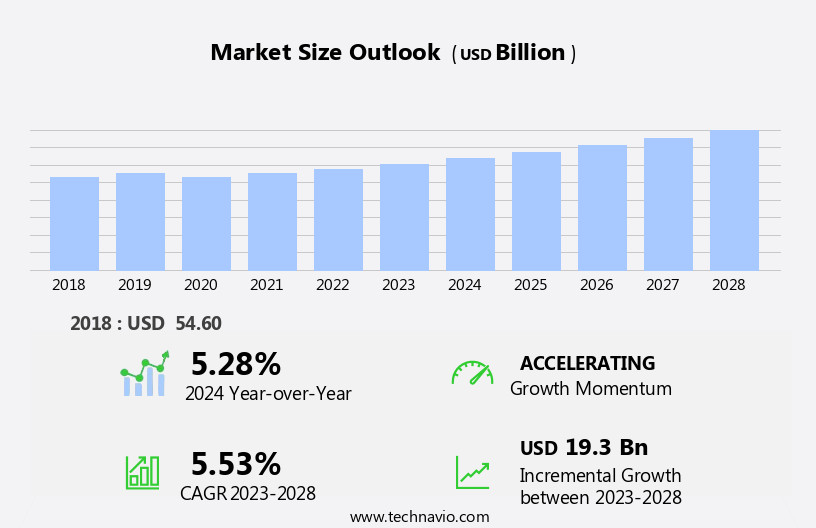
The telecom operations management market size is forecast to increase by USD 19.3 billion at a CAGR of 5.53% between 2023 and 2028.
- The market is experiencing significant growth due to the rapid advances in technologies that are driving demand for scalable solutions. The increasing use of enterprise mobile applications is a key trend, as businesses seek to improve communication and collaboration among their workforce. However, this trend also presents challenges, as the proliferation of mobile devices and applications increases the risk of data security breaches. As a result, telecom operations management solutions that offer robust security features are in high demand. Additionally, the increasing complexity of telecom networks and the need for real-time monitoring and management are other factors fueling market growth.
- Companies seeking to capitalize on these opportunities must stay abreast of emerging technologies and trends, while also addressing the challenges of data security and network complexity. Effective operational planning and strategic decision-making are essential for success in this dynamic market.
What will be the Size of the Telecom Operations Management Market during the forecast period?
- Telecom operations management encompasses various functions essential to delivering high-quality telecom services. These functions include revenue management, network inventory, deployment, event management, fault management, network availability, problem management, network management, request fulfilment, and customer service support (CSS). Telecom services cater to diverse customer requirements, necessitating effective on-premise software solutions for access management and provisioning issues. The transition to cloud-based infrastructure is a significant trend, with inventory management playing a crucial role in 5G networks' successful deployment.
- Mobile Network Operators (MNOs) and telecom companies leverage advanced telecom operation strategies to manage incident management, department budgetary codes, and network performance in the context of evolving customer expectations and 5G networks' implementation.
How is this Telecom Operations Management Industry segmented?
The telecom operations management industry research report provides comprehensive data (region-wise segment analysis), with forecasts and estimates in "USD billion" for the period 2024-2028, as well as historical data from 2018-2022 for the following segments.
- Deployment
- Cloud-based
- On-premises
- Geography
- North America
- US
- Canada
- Europe
- Germany
- UK
- Middle East and Africa
- APAC
- China
- South America
- Rest of World (ROW)
- North America
By Deployment Insights
The cloud-based segment is estimated to witness significant growth during the forecast period.
The market experienced significant growth in 2023, with cloud-based solutions leading the way. Enterprise Resource Planning (ERP) systems and Communication Service Providers (CSPs) have increasingly adopted cloud platforms for managing their telecom operations. Department budgetary codes, telecom operations management, and inventory management are streamlined through cloud deployment, enabling operational efficiencies and real-time data access. Rapid digitization and expansion of IT and retail sectors, as well as other businesses, have fueled the demand for cloud-based telecom operations management. This solution offers numerous advantages, including ongoing and on-time telecom audits, increased efficiency in inventory management, enhanced end-to-end invoice processing and payment systems, and detailed general ledger coding of telecom expenses.
Moreover, cloud-based telecom operations management provides access management capabilities, ensuring secure and controlled access to critical data. Machine Learning and Artificial Intelligence technologies integrated into these platforms offer data-driven experiences, enabling predictive problem management and incident management. Industry investors continue to show interest in the telecommunication industry, particularly in the deployment of 5G networks and the development of service delivery platforms. Network availability and management, as well as inventory management, are crucial aspects of these investments. Big Data analytics plays a significant role in optimizing network performance and customer experience. Network Management and Inventory Management are integral components of telecom operations, with cloud platforms offering scalable and flexible solutions.
CSPs and Mobile Network Operators (MNOs) rely on these systems to manage their telecom services, ensuring network availability and addressing customer requirements. In conclusion, the market is evolving, with cloud-based solutions offering numerous advantages to businesses. The integration of advanced technologies, such as Machine Learning and Artificial Intelligence, is transforming the industry, enabling operational efficiencies, predictive problem management, and improved customer experiences.

Get a glance at the market report of share of various segments Request Free Sample
The Cloud-based segment was valued at USD 31.90 billion in 2018 and showed a gradual increase during the forecast period.
Regional Analysis
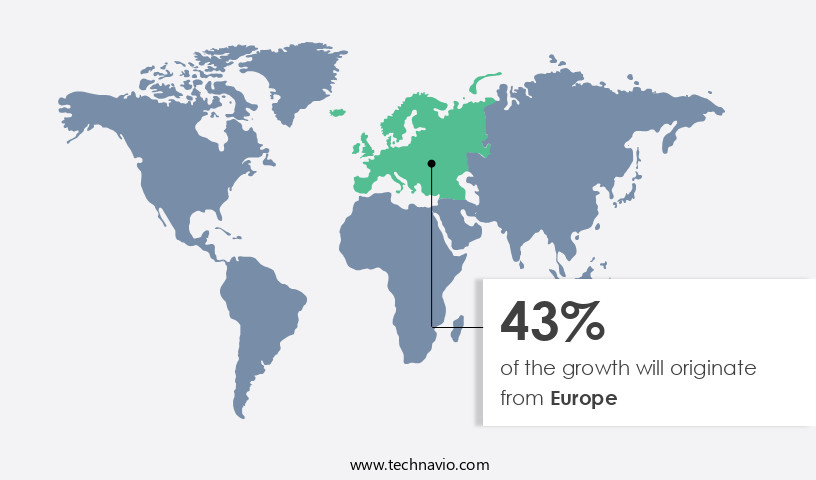
Europe is estimated to contribute 43% to the growth of the global market during the forecast period.Technavio’s analysts have elaborately explained the regional trends and drivers that shape the market during the forecast period.
For more insights on the market size of various regions, Request Free Sample
In the North American market, telecom operations management holds a significant share due to the increasing remote work trend. Advanced smartphones, laptops, and improved telecommunication bandwidths enable employees to work from anywhere. However, managing and maintaining telecom inventory for businesses is becoming increasingly complex. Telecom service rates and equipment plans are subject to constant revision, while new technologies and hardware innovations from device manufacturers continue to emerge. Additionally, the adoption of cloud computing services and the Internet of Things (IoT) in business operations further complicates inventory management. In response, enterprises in this region are increasing their telecommunication spending to meet the demands of remote work, providing employees with the necessary hardware and mobile data to boost productivity.
Telecom companies and business support systems are integrating cloud platforms, operational efficiencies, and data-driven experiences to streamline their operations. Network inventory and management, as well as inventory management, are crucial aspects of telecom operations. Big Data, machine learning, and artificial intelligence are being employed to enhance network availability and fault management, ensuring telecom services run smoothly. Industry investors and communication service providers are collaborating to deploy 5G networks, which will revolutionize telecommunications and create new opportunities for growth. Access management and problem management are essential components of telecom operations, ensuring network and service delivery platforms function optimally. Customer requirements and mobile internet users continue to drive the telecommunication industry forward, necessitating continuous improvement and innovation.
Revenue management and incident management are also critical elements of telecom operations, ensuring financial success and minimizing disruptions. Overall, the market is evolving, with a focus on improving network management, inventory management, and operational efficiencies.
Market Dynamics
Our researchers analyzed the data with 2023 as the base year, along with the key drivers, trends, and challenges. A holistic analysis of drivers will help companies refine their marketing strategies to gain a competitive advantage.
What are the key market drivers leading to the rise in the adoption of Telecom Operations Management Industry?
- Rapid advances in technologies driving demand for scalable telecom management solutions is the key driver of the market.
- The integration of advanced technologies, including IoT, artificial intelligence (AI), 5G, and machine-to-machine (M2M) communications, is significantly advancing productivity and efficiency in businesses. Managing the increasing number of connected devices and extracting data from them necessitates substantial computing power and sophisticated analytics. Moreover, implementing and managing large-scale deployments of these technologies involves substantial capital investment. To help enterprises manage the costs associated with IoT deployments, telecom expense management solutions have become essential.
- These solutions facilitate the tracking, collection, processing, and management of information related to multiple invoices and network costs. By streamlining these processes, businesses can optimize their telecom expenses and improve overall financial management.
What are the market trends shaping the Telecom Operations Management Industry?
- Increasing use of enterprise mobile applications is the upcoming market trend.
- Enterprise mobile applications, utilized in business organizations for enhancing data accessibility, are increasingly popular due to the growing trend of Bring Your Own Device (BYOD) policies. These applications are intricate and substantial software platforms that boost workplace efficiency and decrease the need for company-owned devices, thereby reducing associated costs. The proliferation of smartphone users worldwide has made mobile access to corporate information a priority for enterprises.
- Consequently, the demand for telecom expense management solutions is projected to escalate during the forecast period, given the increasing reliance on mobile devices for enterprise applications usage.
What challenges does the Telecom Operations Management Industry face during its growth?
- Increasing data security issues is a key challenge affecting the industry growth.
- The market is experiencing significant growth due to the increasing adoption of cloud-based services. Cloud services offer numerous benefits, including affordability, scalability, and ease of use. Functionalities provided by these services include reliability, enriched IT services, and increased flexibility in accessing data. However, the adoption of cloud-based solutions is not without challenges. Security and compliance concerns are major deterrents, as cloud services have limited security measures and are accessible to multiple tenants through the internet. Regulations such as the General Data Protection Regulation (GDPR) impose certain limitations on data storage.
- Despite these challenges, the market is expected to grow, driven by the demand for efficient and cost-effective solutions. Organizations are implementing robust security measures to mitigate risks and ensure compliance with regulations. The market is dynamic, with ongoing research and innovation aimed at addressing security concerns and enhancing the functionality of cloud-based services.
Exclusive Customer Landscape
The telecom operations management market forecasting report includes the adoption lifecycle of the market, covering from the innovator’s stage to the laggard’s stage. It focuses on adoption rates in different regions based on penetration. Furthermore, the telecom operations management market report also includes key purchase criteria and drivers of price sensitivity to help companies evaluate and develop their market growth analysis strategies.

Customer Landscape
Key Companies & Market Insights
Companies are implementing various strategies, such as strategic alliances, telecom operations management market forecast, partnerships, mergers and acquisitions, geographical expansion, and product/service launches, to enhance their presence in the industry.
Accenture Plc - The company specializes in telecom operations management, delivering advanced Cloud-based network solutions for businesses worldwide. These technologies, underpinned by cutting-edge innovation, streamline network management and enhance operational efficiency. By leveraging the power of the Cloud, businesses can optimize resources, ensure seamless connectivity, and adapt to evolving industry demands.
The industry research and growth report includes detailed analyses of the competitive landscape of the market and information about key companies, including:
- Accenture Plc
- ALE International
- Amdocs Ltd.
- Beta Systems Software AG
- Cisco Systems Inc.
- Comarch SA
- Enhanced Telecommunications
- Hewlett Packard Enterprise Co.
- Huawei Technologies Co. Ltd.
- International Business Machines Corp.
- NEC Corp.
- Nokia Corp.
- Oman Telecommunications Co
- Oracle Corp.
- SAP SE
- ServiceNow Inc.
- Tata Consultancy Services Ltd.
- Telefonaktiebolaget LM Ericsson
- ZTE Corp.
Qualitative and quantitative analysis of companies has been conducted to help clients understand the wider business environment as well as the strengths and weaknesses of key industry players. Data is qualitatively analyzed to categorize companies as pure play, category-focused, industry-focused, and diversified; it is quantitatively analyzed to categorize companies as dominant, leading, strong, tentative, and weak.
Research Analyst Overview
Telecom operations management has emerged as a critical function in the rapidly digitizing communication service provider (CSP) industry. Enterprise resource planning (ERP) systems have become essential tools for managing departmental budgetary codes and ensuring operational efficiencies in telecom operations. These systems enable CSPs to streamline their processes and improve network inventory and management, problem and incident management, and request fulfillment. The telecom industry is undergoing a significant transformation, driven by the increasing demand for mobile internet services and the deployment of next-generation 5G networks. CSPs are investing heavily in cloud platforms and operational technologies to enhance network availability and deliver data-driven experiences to their customers.
Event management is another critical area of focus for telecom operations management. Machine learning algorithms are being used to analyze network data and identify potential issues before they become major incidents. Access management is also a priority, with CSPs implementing robust security measures to protect their networks and customer data. Industry investors are closely watching the telecom operations management landscape, recognizing the potential for significant returns in this sector. Telecom operations management solutions that leverage artificial intelligence and big data are particularly attractive, as they offer the potential for significant operational improvements and cost savings. Network management and inventory management are key components of telecom operations management.
CSPs must ensure that their networks are optimally configured and that their inventory is accurately tracked and managed. This requires a high degree of automation and integration between various systems, including business support systems and service delivery platforms. Revenue management is another critical area of focus for telecom operations management. CSps must ensure that they are accurately billing their customers and that their billing systems are integrated with their network and inventory management systems. This requires a high degree of data accuracy and real-time processing capabilities. Provisioning issues continue to be a challenge for telecom operations management. CSps must ensure that new services are provisioned quickly and efficiently, while minimizing errors and ensuring network availability.
This requires a high degree of automation and integration between various systems, including provisioning systems and network management systems. Software solutions are a key component of telecom operations management, with many companies offering specialized solutions for network management, inventory management, revenue management, and problem management. These solutions must be integrated with each other and with the CSP's existing systems to ensure seamless operation. In conclusion, telecom operations management is a critical function in the rapidly evolving communication service provider industry. CSps must invest in advanced technologies and solutions to manage their networks, inventory, revenue, and customer requirements effectively. This requires a high degree of automation, integration, and data accuracy, as well as a focus on operational efficiencies and customer experience.
|
Market Scope |
|
|
Report Coverage |
Details |
|
Page number |
145 |
|
Base year |
2023 |
|
Historic period |
2018-2022 |
|
Forecast period |
2024-2028 |
|
Growth momentum & CAGR |
Accelerate at a CAGR of 5.53% |
|
Market growth 2024-2028 |
USD 19.3 billion |
|
Market structure |
Fragmented |
|
YoY growth 2023-2024(%) |
5.28 |
|
Key countries |
US, China, Germany, Canada, and UK |
|
Competitive landscape |
Leading Companies, Market Positioning of Companies, Competitive Strategies, and Industry Risks |
What are the Key Data Covered in this Telecom Operations Management Market Research and Growth Report?
- CAGR of the Telecom Operations Management industry during the forecast period
- Detailed information on factors that will drive the growth and forecasting between 2024 and 2028
- Precise estimation of the size of the market and its contribution of the industry in focus to the parent market
- Accurate predictions about upcoming growth and trends and changes in consumer behaviour
- Growth of the market across North America, Europe, APAC, South America, and Middle East and Africa
- Thorough analysis of the market’s competitive landscape and detailed information about companies
- Comprehensive analysis of factors that will challenge the telecom operations management market growth of industry companies
We can help! Our analysts can customize this telecom operations management market research report to meet your requirements.