


US Low-capacity Portable Generator Market Size 2026-2030
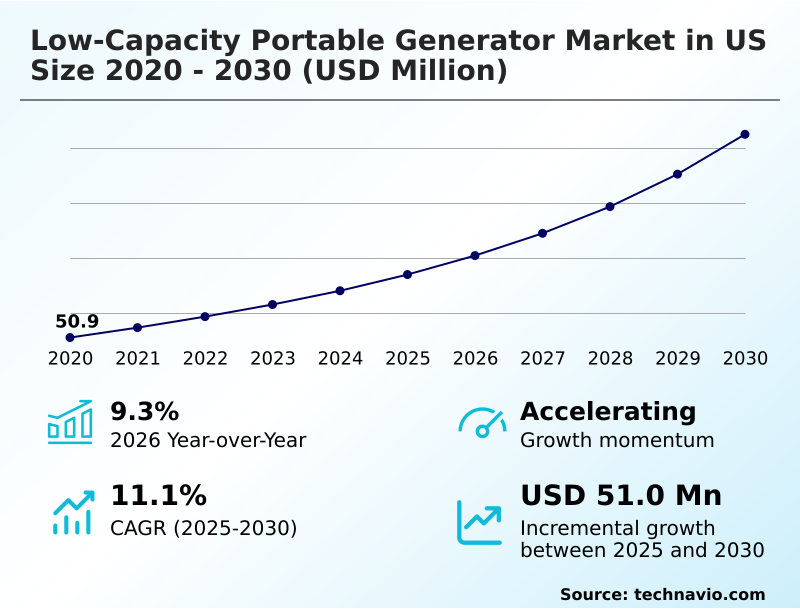
The us low-capacity portable generator market size is valued to increase by USD 51 million, at a CAGR of 11.1% from 2025 to 2030. Increasing frequency of power outages and extreme weather events driving demand for backup power will drive the us low-capacity portable generator market.
Major Market Trends & Insights
- By Product - Conventional generator segment was valued at USD 37 million in 2024
- By Type - Gasoline segment accounted for the largest market revenue share in 2024
Market Size & Forecast
- Market Opportunities: USD 73.9 million
- Market Future Opportunities: USD 51 million
- CAGR from 2025 to 2030 : 11.1%
Market Summary
- The low-capacity portable generator market in US is characterized by a persistent demand for dependable energy solutions, driven by aging power grids and an increase in weather-related disruptions. Key industry trends include a significant shift toward models with inverter technology, which provide the THD for clean power required by modern electronics, and a focus on user-friendly generator features.
- Innovations in dual fuel capability allow for greater operational flexibility, a crucial factor for both residential and small commercial users. For instance, a mobile food vendor relying on temporary job site power can switch between fuel sources to manage costs and ensure uninterrupted service, showcasing the practical application of these advancements.
- At the same time, the market faces a challenge from the rise of battery-based power stations, which appeal to consumers seeking quiet operation generator models. This dynamic pushes manufacturers to enhance fuel efficiency and develop low emission generator models to maintain a competitive edge and meet evolving consumer expectations for both performance and environmental responsibility in their off-grid electricity sources.
What will be the Size of the US Low-capacity Portable Generator Market during the forecast period?
Get Key Insights on Market Forecast (PDF) Get Free Sample
How is the US Low-capacity Portable Generator Market Segmented?
The us low-capacity portable generator industry research report provides comprehensive data (region-wise segment analysis), with forecasts and estimates in "USD million" for the period 2026-2030, as well as historical data from 2020-2024 for the following segments.
- Product
- Conventional generator
- Inverter generator
- Type
- Gasoline
- Gas
- Diesel
- End-user
- Residential
- Commercial
- Geography
- North America
- US
- North America
By Product Insights
The conventional generator segment is estimated to witness significant growth during the forecast period.
The low-capacity portable generator market in US is segmented by product, type, and end-user. Conventional generators represent a significant segment, valued for their cost-effectiveness and durability.
These units, which often feature robust combustion systems, are a practical choice for users needing reliable backup power without the higher upfront cost of advanced models.
Their design simplicity allows for easier maintenance, a key factor for residential users and small businesses. However, they are typically heavier and produce more noise, often operating above 65 decibels, which can be a limitation in some settings.
While they lack the clean power for electronics provided by inverter technology, their steady power output remains sufficient for many essential applications, securing their role in the market for affordable portable power.
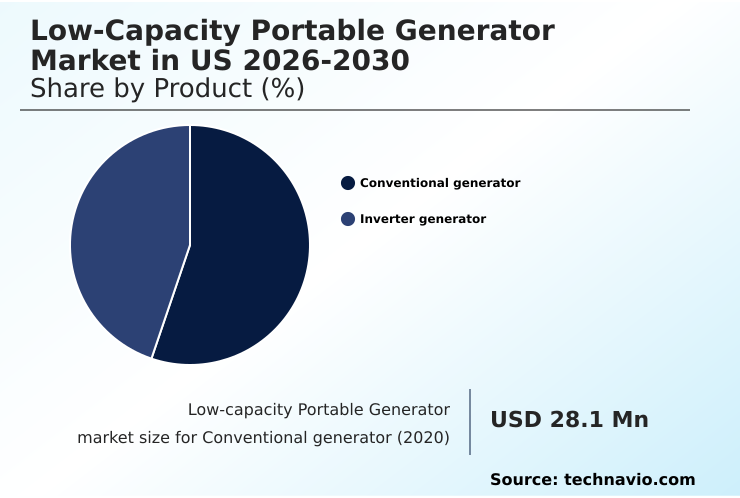
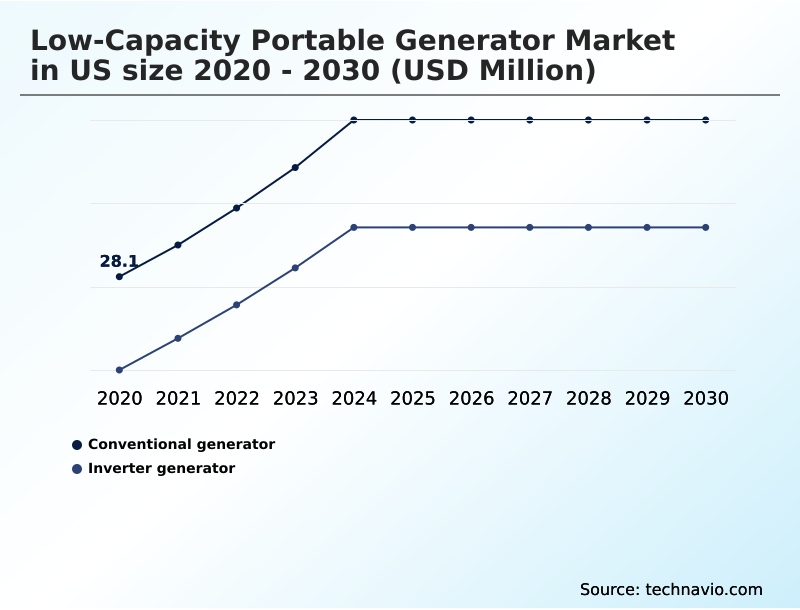
The Conventional generator segment was valued at USD 37 million in 2024 and showed a gradual increase during the forecast period.
Market Dynamics
Our researchers analyzed the data with 2025 as the base year, along with the key drivers, trends, and challenges. A holistic analysis of drivers will help companies refine their marketing strategies to gain a competitive advantage.
- Analyzing the low-capacity portable generator market in US 2026-2030 reveals distinct consumer priorities shaping product development. For outdoor enthusiasts, the quest for the best portable generator for camping often leads to lightweight, compact designs, while those with recreational vehicles look specifically for a dual fuel generator for RV to maximize fuel flexibility on the road.
- In residential settings, the demand is for the quietest inverter generator for home, a unit that can power essential home appliances without causing neighborhood disturbances. The core technology enabling this is the inverter generator for sensitive electronics, which provides stable, clean energy. Manufacturers must also navigate stringent low emission generator regulations, which influence engine design and material choices.
- A key decision for consumers involves the gasoline vs propane portable generators debate, where factors like fuel storage safety and availability come into play. Ultimately, portable generator fuel efficiency comparison is a critical metric for assessing long-term operating costs. Businesses find that having emergency preparedness power solutions reduces operational downtime by a significant margin compared to reactive measures.
- Understanding conventional generator maintenance requirements, small business portable power needs, and the generator noise level decibel rating is crucial for making informed purchasing decisions, especially as eco-mode fuel saving technology becomes a standard feature for optimizing diesel portable generator extended runtime.
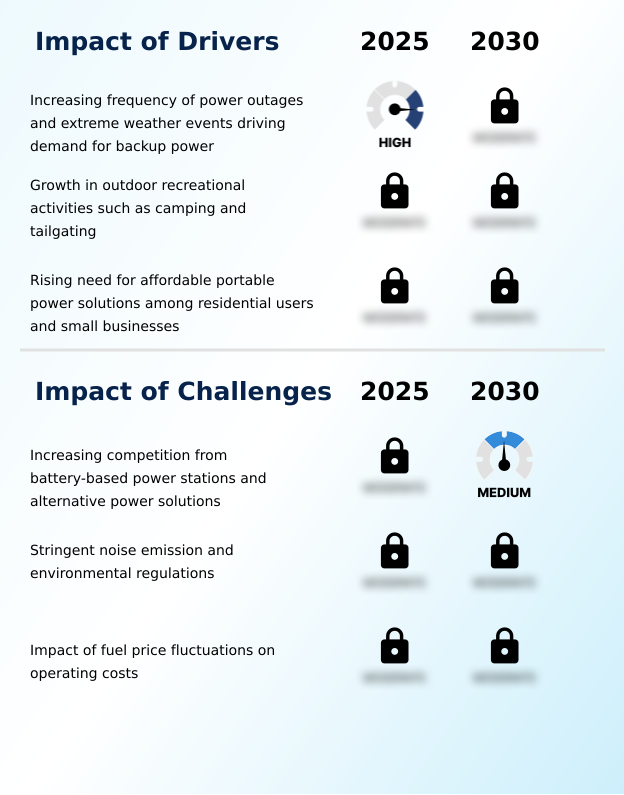
What are the key market drivers leading to the rise in the adoption of US Low-capacity Portable Generator Industry?
- A key market driver is the increasing frequency of power outages and extreme weather events, which fuels the demand for reliable backup power solutions.
- Market growth is primarily fueled by the increasing need for reliable backup power due to unpredictable weather events and an aging electrical grid. This has solidified the role of affordable portable power solutions for both residential and small business continuity.
- For small businesses, access to a backup power source can prevent revenue loss, with data indicating a potential to retain over 90% of daily income during short-term outages.
- Additionally, the rise in outdoor recreational power needs for activities like camping and tailgating has expanded the consumer base significantly.
- Retailers often report a seasonal sales uplift of over 40% for compact and mobile power solutions, highlighting the importance of this lifestyle-driven demand segment. This reinforces the market's trajectory toward versatile and accessible power sources.
What are the market trends shaping the US Low-capacity Portable Generator Industry?
- The market is witnessing a significant trend toward the growing adoption of inverter-based low-capacity generators. This shift is driven by consumer demand for quieter operation and stable power output suitable for sensitive electronics.
- Key trends are reshaping the market, with a notable shift towards advanced inverter technology and lightweight generator designs. The demand for quiet operation generator models is driving innovation in noise reduction technologies, making units more suitable for residential settings and outdoor events.
- This focus on user experience is coupled with a push for low emission generator models, as regulatory standards become more stringent. The adoption of these cleaner technologies has improved fuel efficiency by an average of 18%, a significant factor for both recreational and emergency use.
- Furthermore, user-friendly generator features and compact generator footprints are becoming key differentiators, improving setup efficiency for mobile businesses by 30% and appealing to a broader consumer base seeking convenience and portability in their off-grid electricity solutions.
What challenges does the US Low-capacity Portable Generator Industry face during its growth?
- A significant challenge affecting industry growth is the increasing competition from battery-based power stations and other alternative power solutions.
- The market faces considerable challenges from multiple fronts, primarily the increasing competition from battery-based power stations, which are perceived as cleaner and more convenient short-term power solutions. This forces traditional manufacturers to innovate rapidly.
- Concurrently, stringent regulations necessitate significant R&D investment in emission compliant components and sound dampening designs, with compliance-related costs for developing low emission generator models rising by an estimated 20%. Another significant headwind is fuel price volatility, which can increase generator operating costs by over 30% during price spikes.
- This uncertainty impacts total cost of ownership calculations and can deter potential buyers, pushing them toward alternatives with more predictable energy costs.
Exclusive Technavio Analysis on Customer Landscape
The us low-capacity portable generator market forecasting report includes the adoption lifecycle of the market, covering from the innovator’s stage to the laggard’s stage. It focuses on adoption rates in different regions based on penetration. Furthermore, the us low-capacity portable generator market report also includes key purchase criteria and drivers of price sensitivity to help companies evaluate and develop their market growth analysis strategies.
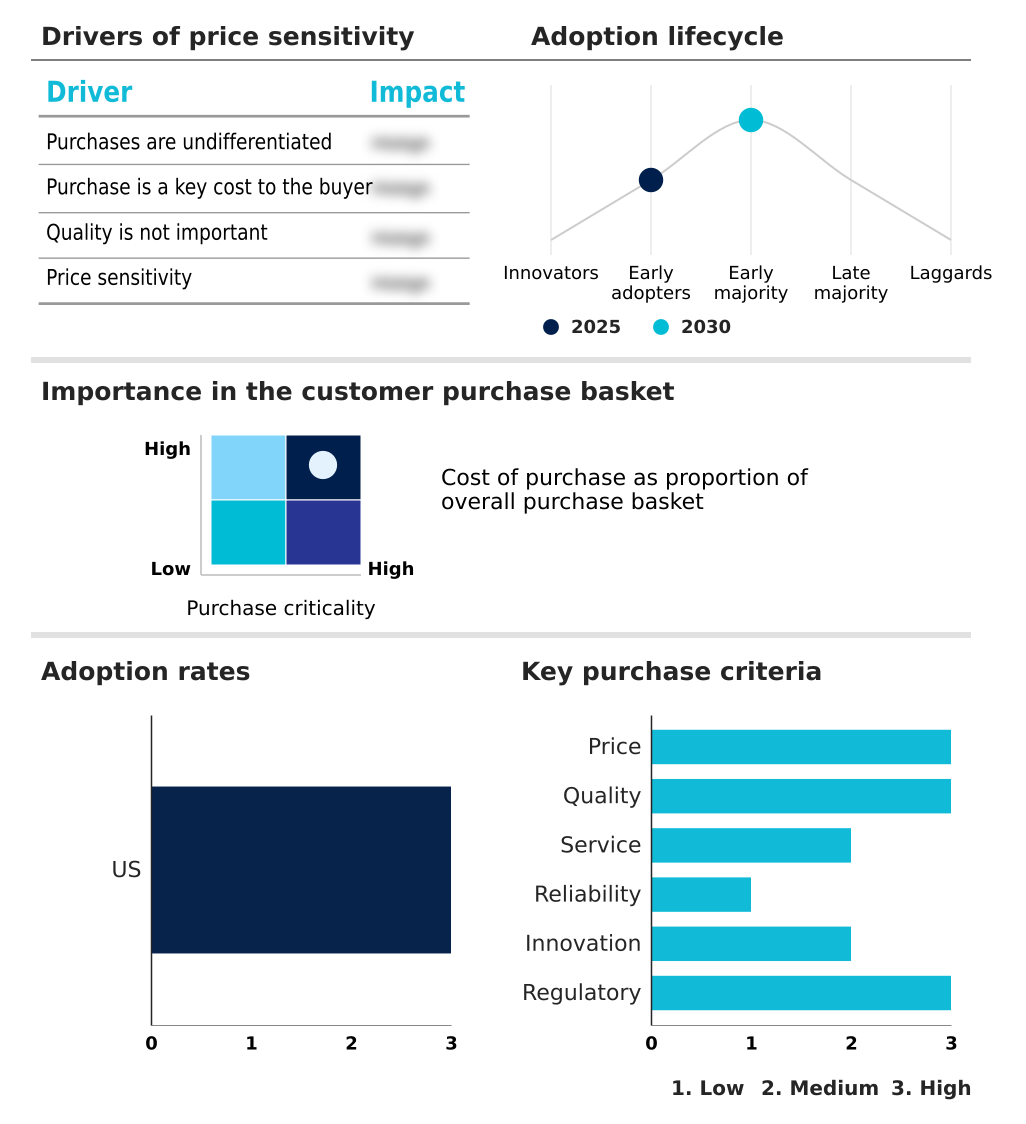
Customer Landscape of US Low-capacity Portable Generator Industry
Competitive Landscape
Companies are implementing various strategies, such as strategic alliances, us low-capacity portable generator market forecast, partnerships, mergers and acquisitions, geographical expansion, and product/service launches, to enhance their presence in the industry.
Briggs and Stratton Corp. - Offers compact, user-friendly portable power solutions, emphasizing advanced safety innovations like integrated CO Guard technology for enhanced operational security in various applications.
The industry research and growth report includes detailed analyses of the competitive landscape of the market and information about key companies, including:
- Briggs and Stratton Corp.
- Caterpillar Inc.
- Champion Power Equipment Inc.
- Cummins Inc.
- Denyo Co. Ltd.
- Doosan Corp.
- DuroMax Power Equipment
- Firman Power Equipment
- Generac Power Systems Inc.
- Mitsubishi Electric Corp.
- Northern Tool and Equipment Co.
- PowerHouse Generators
- Pulsar Products Inc.
- WEN Products
- Westinghouse Electric Corp.
- Winco Inc.
- Yamaha Motor Co. Ltd.
Qualitative and quantitative analysis of companies has been conducted to help clients understand the wider business environment as well as the strengths and weaknesses of key industry players. Data is qualitatively analyzed to categorize companies as pure play, category-focused, industry-focused, and diversified; it is quantitatively analyzed to categorize companies as dominant, leading, strong, tentative, and weak.
Recent Development and News in Us low-capacity portable generator market
- In October 2024, Generac Power Systems Inc. introduced an upgraded lineup of six portable generators featuring enhanced engine durability and simplified maintenance, directly targeting homeowners seeking dependable short-term power solutions.
- In March 2025, Cummins Inc. received the Latest Product Award for its Centum Series Generators (1750-3000 Watts), recognizing the series' advanced transportable design and high-output reliability for large-scale temporary power applications.
- In April 2025, Westinghouse Electric Corp.'s 5000 Peak Watt Super Quiet Dual Fuel Portable Inverter Generator gained significant consumer attention amid heightened emergency preparedness awareness, reinforcing its position as a reliable backup power solution.
- In May 2025, Champion Power Equipment expanded its inverter generator portfolio with the launch of the 97001i EU 7500-Watt Inverter Generator, designed to meet growing demand for high-performance, clean energy solutions suitable for sensitive electronics.
Dive into Technavio’s robust research methodology, blending expert interviews, extensive data synthesis, and validated models for unparalleled US Low-capacity Portable Generator Market insights. See full methodology.
| Market Scope | |
|---|---|
| Page number | 183 |
| Base year | 2025 |
| Historic period | 2020-2024 |
| Forecast period | 2026-2030 |
| Growth momentum & CAGR | Accelerate at a CAGR of 11.1% |
| Market growth 2026-2030 | USD 51.0 million |
| Market structure | Fragmented |
| YoY growth 2025-2026(%) | 9.3% |
| Key countries | US |
| Competitive landscape | Leading Companies, Market Positioning of Companies, Competitive Strategies, and Industry Risks |
Research Analyst Overview
- The low-capacity portable generator market in US continues to evolve, driven by a focus on enhancing power output and fuel efficiency through advanced inverter technology. Boardroom decisions are increasingly centered on R&D investments to develop emission compliant components and advanced combustion systems, with the integration of such technologies improving fuel efficiency by over 15% in the latest models.
- Key features such as CO guard, push button start, and parallel port connectivity are becoming standard, reflecting a market-wide push toward user safety and convenience. The emphasis is on delivering low THD for clean power suitable for sensitive electronics, often achieved through load-sensing technology and brushless AC generator designs with damper winding.
- Innovations like eco-mode, extended runtime, and dual fuel capability address both economic and environmental concerns. As regulations tighten, sound dampening designs and other noise reduction technologies are critical for market acceptance, shaping the development of the next generation of multi purpose engines.
What are the Key Data Covered in this US Low-capacity Portable Generator Market Research and Growth Report?
-
What is the expected growth of the US Low-capacity Portable Generator Market between 2026 and 2030?
-
USD 51 million, at a CAGR of 11.1%
-
-
What segmentation does the market report cover?
-
The report is segmented by Product (Conventional generator, and Inverter generator), Type (Gasoline, Gas, and Diesel), End-user (Residential, and Commercial) and Geography (North America)
-
-
Which regions are analyzed in the report?
-
North America
-
-
What are the key growth drivers and market challenges?
-
Increasing frequency of power outages and extreme weather events driving demand for backup power, Increasing competition from battery-based power stations and alternative power solutions
-
-
Who are the major players in the US Low-capacity Portable Generator Market?
-
Briggs and Stratton Corp., Caterpillar Inc., Champion Power Equipment Inc., Cummins Inc., Denyo Co. Ltd., Doosan Corp., DuroMax Power Equipment, Firman Power Equipment, Generac Power Systems Inc., Mitsubishi Electric Corp., Northern Tool and Equipment Co., PowerHouse Generators, Pulsar Products Inc., WEN Products, Westinghouse Electric Corp., Winco Inc. and Yamaha Motor Co. Ltd.
-
Market Research Insights
- The market dynamics are increasingly shaped by the demand for affordable portable power and reliable backup power, especially for residential use. The adoption of user-friendly generator features and the availability of short-term power solutions are expanding the consumer base. Innovations such as dual-fuel models provide cost savings of up to 15% depending on fuel price differentials, enhancing their appeal.
- Furthermore, the emphasis on a compact generator footprint caters to recreational power needs and users with limited storage. Integrating eco-mode functions can extend runtime by 25% on a single tank, a significant efficiency gain that addresses both economic and environmental concerns for those seeking backup power for home or mobile power solutions.
We can help! Our analysts can customize this us low-capacity portable generator market research report to meet your requirements.
 RIA -
RIA - 
