
Vacuum Insulation Panels Market Analysis APAC, North America, Europe, South America, Middle East and Africa - US, China, UK, Germany, Japan - Size and Forecast 2024-2028

Vacuum Insulation Panels Market Analysis APAC, North America, Europe, South America, Middle East and Africa - US, China, UK, Germany, Japan - Size and Forecast 2024-2028

Published: Oct 2024 173 Pages SKU: IRTNTR43296

Market Overview at a Glance

$1.96 B
Market Opportunity
4.5%
CAGR
4.2
YoY growth 2023-2024(%)

Vacuum Insulation Panels Market Size 2024-2028

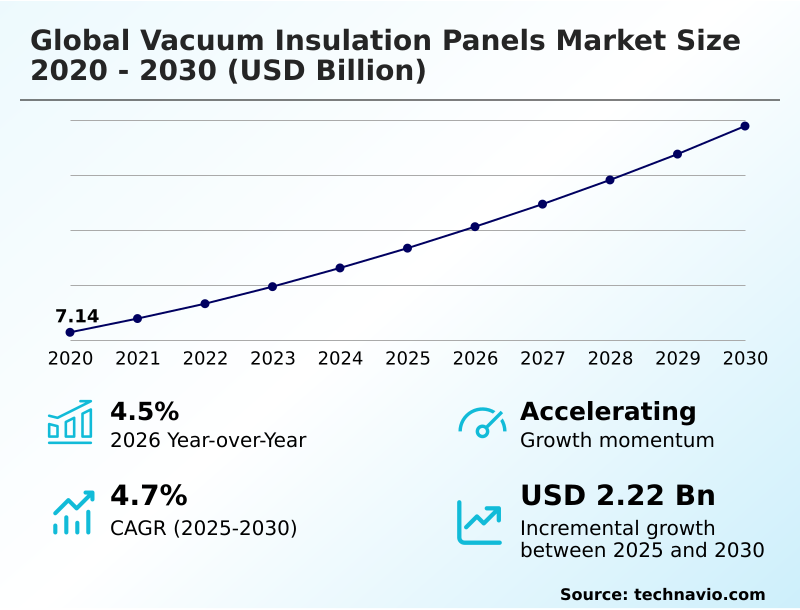
The vacuum insulation panels market size is forecast to increase by USD 1.96 billion at a CAGR of 4.5% between 2023 and 2028.

  • The Vacuum Insulation Panels (VIP) market is experiencing significant growth due to increased urbanization and infrastructure development, particularly in emerging economies. This trend is driving demand for energy-efficient and cost-effective insulation solutions, making VIPs an attractive option for construction projects. However, the market is not without challenges. Price and material trends, including the rising cost of raw materials and increasing competition, are putting pressure on manufacturers to maintain profitability. Furthermore, the lack of efficient logistic support in some emerging economies presents a significant challenge for market expansion. To capitalize on opportunities and navigate these challenges effectively, companies in the VIP market must focus on innovation, cost reduction, and strategic partnerships.
  • By improving production processes, developing new applications, and expanding their distribution networks, companies can differentiate themselves and capture a larger share of the market. Additionally, collaborating with governments and industry associations to promote energy efficiency and incentivize the adoption of VIPs can help create a favorable business environment and drive long-term growth.

What will be the Size of the Vacuum Insulation Panels Market during the forecast period?
Vacuum Insulation Panels Market Size

 Request Free Sample

  • Vacuum Insulation Panels (VIPs) have gained significant attention in the insulation market due to their advanced thermal properties. These panels utilize both gas diffusion and evacuated pressure to minimize heat transfer, making them more effective than conventional insulating materials. The core material's low gas permeability is crucial in maintaining the panels' insulating performance. Laminate films, facer foils, and heat transfer modeling are essential components in the manufacturing process. Thermal conductivity and air penetration are critical factors in evaluating VIPs' efficiency. An impermeable gas barrier, such as a laminate film, ensures the panels' longevity by preventing gas leakage. Quality control and analytical models are essential in assessing VIPs' service life.
  • Ageing and radiative transfer are crucial factors affecting their performance over time. Solid conduction and getter materials, like nanoporous silicas, help maintain the panels' thermal properties. Vacuum Insulation Panels play a vital role in building construction, offering superior thermal insulating potential compared to traditional insulating materials. Desiccant and moisture penetration are essential considerations in their application. Thermal bridges, which can compromise insulation performance, must be carefully addressed. Despite their fragile nature, VIPs' thermal properties make them an attractive alternative for businesses seeking energy efficiency and reduced carbon emissions in their operations.

How is this Vacuum Insulation Panels Industry segmented?

The vacuum insulation panels industry research report provides comprehensive data (region-wise segment analysis), with forecasts and estimates in "USD million" for the period 2024-2028, as well as historical data from 2018-2022 for the following segments.

  • End-user
    • Construction
    • Logistics
    • Cooling and freezing devices
    • Others
  • Material
    • Silica
    • Fiberglass
    • Others
  • Geography
    • North America
      • US
    • Europe
      • Germany
      • UK
    • Middle East and Africa
      • APAC
        • China
        • Japan
      • South America
        • Rest of World (ROW)

        By End-user Insights

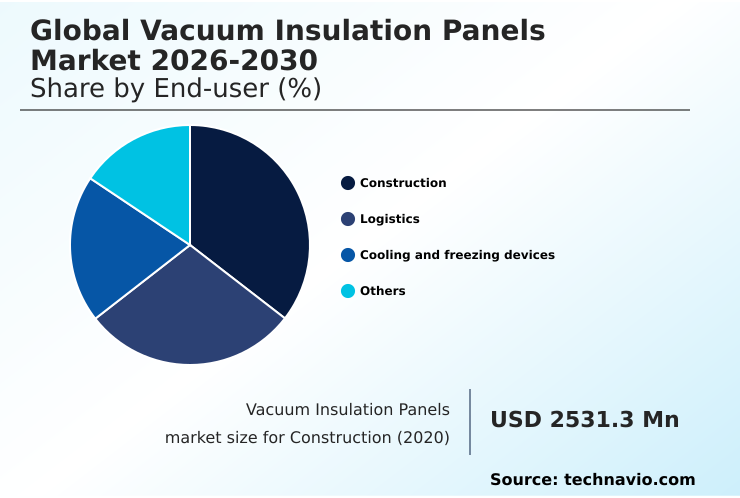
        The construction segment is estimated to witness significant growth during the forecast period.

        Vacuum insulation panels, a high-performance thermal insulation solution, have gained significant attention in the building construction industry due to their ability to reduce energy consumption and improve energy efficiency. In China, where energy consumption in buildings accounts for approximately one-third of the total energy consumption, the adoption of vacuum insulation panels is on the rise. The low thermal conductivity of these panels, which results in minimal heat transfer through solid conduction and thermal bridges, makes them an attractive option for energy-efficient building designs. The demand for energy-efficient buildings is increasing globally, driven by stringent energy regulations and growing awareness of sustainability.

        This trend is expected to continue, leading to increased demand for vacuum insulation panels in the building construction sector. The panels' advanced thermal insulating potential, achieved through the removal of air and the use of high-performance materials such as nanoporous silicas and getter, makes them a valuable addition to the insulation solutions portfolio of specialized industries. The manufacturing process for vacuum insulation panels involves heat transfer modeling, quality assurance, and validation to ensure the panels meet the required thermal insulating potential and low gas permeability. The panels' impermeable gas barrier, which prevents the intrusion of moisture and air, further enhances their thermal insulating potential and service life.

        The use of advanced technologies, such as energy-efficient technologies and analytical models, in the manufacturing process ensures the production of high-quality panels. Intellectual property rights play a crucial role in the market, with companies investing in research and development to innovate and differentiate their offerings. For instance, the development of high-barrier films, laminate films, and desiccant materials has led to the creation of value-added chain opportunities. The use of advanced materials and manufacturing techniques has also resulted in the creation of international awards and recognition for leading companies in the market. In conclusion, the market is poised for growth due to the increasing demand for energy-efficient buildings and the advanced thermal insulating potential of vacuum insulation panels.

        The market's growth is driven by the adoption of innovative technologies, the development of high-performance materials, and the focus on improving energy efficiency and reducing energy consumption in buildings.

        Vacuum Insulation Panels Market Size

        Get a glance at the market report of share of various segments Request Free Sample

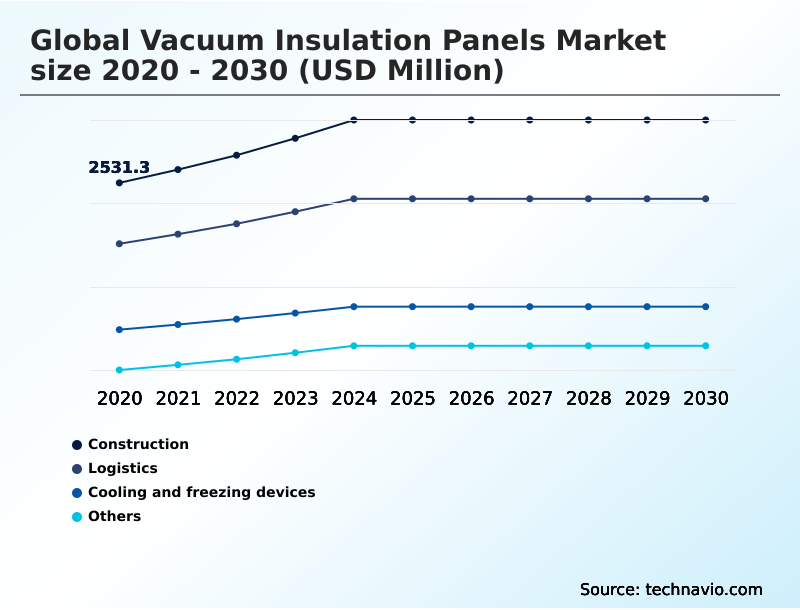
        The Construction segment was valued at USD 2.53 billion in 2018 and showed a gradual increase during the forecast period.
        Regional Analysis

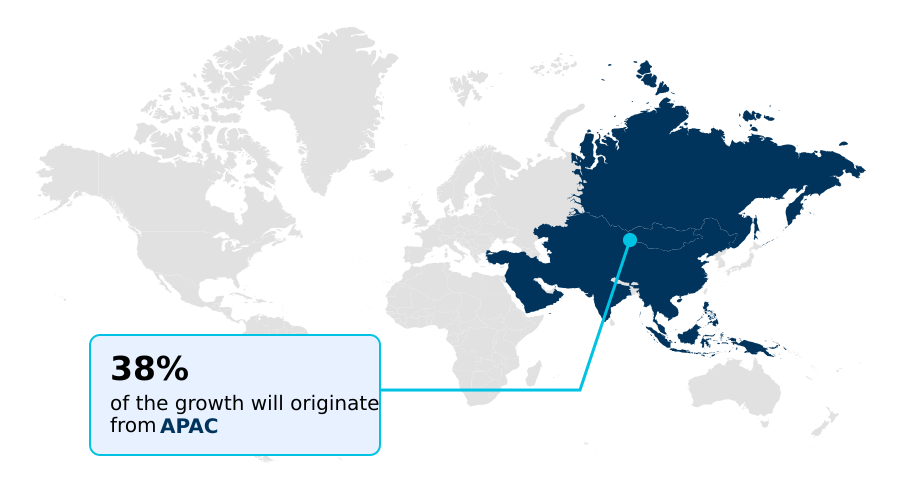
        APAC is estimated to contribute 50% to the growth of the global market during the forecast period.Technavio’s analysts have elaborately explained the regional trends and drivers that shape the market during the forecast period.
        Vacuum Insulation Panels Market Share by Geography

        For more insights on the market size of various regions, Request Free Sample

        The market is witnessing significant growth, with APAC leading the charge. In 2023, APAC accounted for the largest market share, a trend that is anticipated to continue due to the region's high growth rate. The construction industry's expansion, driven by urbanization and increasing population, is a key factor fueling this growth. For instance, the World Bank Group reports that India's urban population rose from 31% to 34% between 2001 and 2011, necessitating the construction of more residential buildings and healthcare facilities. Vacuum insulation panels offer superior thermal insulating potential compared to conventional insulating materials.

        They consist of a series of gas-filled pockets separated by thin, impermeable gas barriers. These barriers prevent the escape of gas, ensuring low thermal conductivity through solid conduction and radiative transfer. Moreover, the use of nanoporous silicas and desiccants enhances the panels' thermal insulating potential and moisture resistance. Quality control and validation play crucial roles in the manufacturing process of vacuum insulation panels. Test procedures ensure the panels meet specifications for thermal conductivity, air penetration, and service life. Intellectual property rights and innovation lead to continuous advancements in the technology, with VIP development resulting in high-barrier films and laminate structures.

        In building construction, vacuum insulation panels are used in cold storage applications, heat storage systems, and insulation solutions for energy-efficient technologies. Their low gas permeability and thermal insulating potential make them an attractive alternative to conventional insulating materials. Additionally, their use in various industries, such as specialized industries and ageing infrastructure, further expands their market potential. Innovation continues to drive the market, with advancements in heat transfer modeling, heat physics, and analytical models contributing to improved performance and efficiency. National awards and international recognition further validate the technology's value in the market. Overall, the market is poised for continued growth, driven by its ability to provide superior thermal insulation and energy efficiency solutions.

        Market Dynamics

        Our researchers analyzed the data with 2023 as the base year, along with the key drivers, trends, and challenges. A holistic analysis of drivers will help companies refine their marketing strategies to gain a competitive advantage.

        What are the key market drivers leading to the rise in the adoption of Vacuum Insulation Panels Industry?

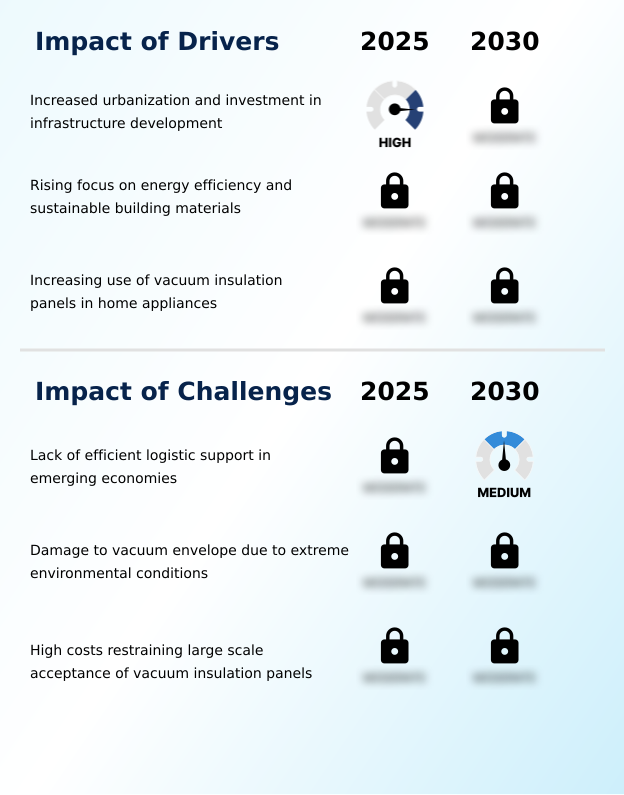
        • Increased urbanization and investment in infrastructure development is the key driver of the market. 

        • The market is experiencing significant growth due to the increasing urban population and infrastructure development investments. With over 70% of the world's population projected to reside in urban areas by 2050, the demand for infrastructure development is escalating. This includes the construction of residential and non-residential projects, leading to a surge in demand for vacuum insulation panels for thermal insulation in various applications such as roofs, doors, windows, and walls.
        • The global construction market is anticipated to reach approximately USD16 trillion by 2025, further fueling market expansion. Urbanization necessitates the development of public and private sector infrastructure, including schools, hospitals, and commercial buildings, which in turn increases the demand for vacuum insulation panels.

        What are the market trends shaping the Vacuum Insulation Panels Industry?

        • Price and materials trends is the upcoming market trend. 

        • Vacuum insulation panels offer superior insulation compared to traditional methods, with R-values significantly higher than conventional insulation. However, their cost is notably greater, averaging between USD10 and USD12 per panel, compared to USD6.90 for polystyrene. The price gap is expected to narrow, with the cost of vacuum insulation panels projected to reach USD3 to USD4 by the end of the forecast period. Research institutions are actively working on developing cost-effective foam board insulation, capable of achieving R-12 per inch.
        • Another promising technology, modified atmosphere insulation, is undergoing testing and is anticipated to enter the market soon. Despite the higher initial investment, vacuum insulation panels' energy savings and long-term cost benefits make them an attractive option for energy-efficient buildings.

        What challenges does the Vacuum Insulation Panels Industry face during its growth?

        • Lack of efficient logistic support in emerging economies is a key challenge affecting the industry growth. 

        • The refrigerated warehousing and transportation market face challenges due to insufficient logistics support systems. This issue increases the likelihood of product recalls and food wastage, as cold chain logistics plays a crucial role in maintaining the integrity of temperature-sensitive goods. The companies in this market are required to adhere to stringent regulations during the transfer of items between producers and end-users, which involves continual handling and inter-state or inter-region transit. The lack of infrastructure facilities for logistics support contributes to the challenges in the refrigerated transportation market.
        • To mitigate these issues, companies must invest in advanced logistics solutions and services to ensure the efficient and timely transfer of goods, thereby reducing product recalls and minimizing food wastage. Compliance with regulatory requirements is essential to maintain the quality and safety of temperature-sensitive goods throughout the supply chain.

        Exclusive Customer Landscape

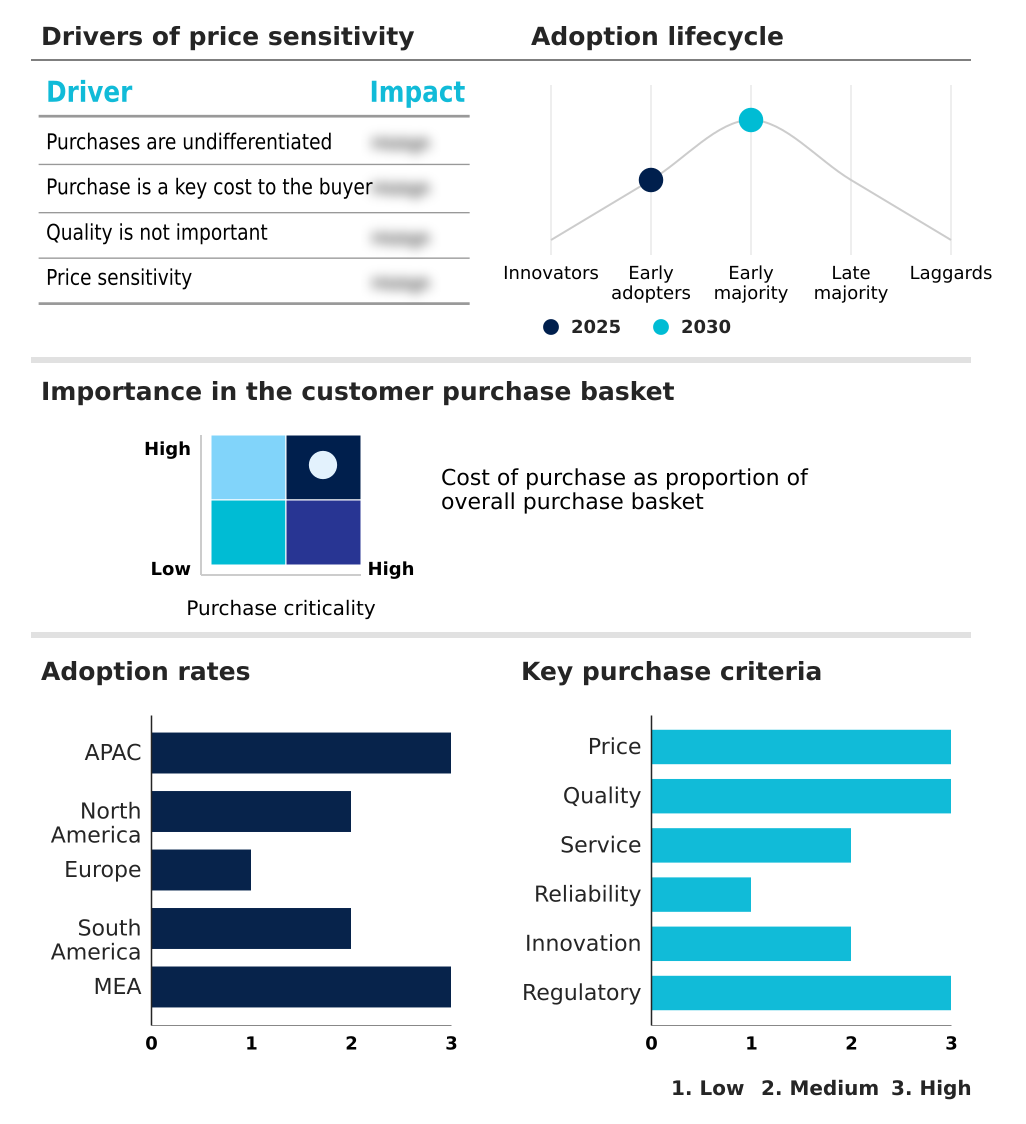
        The vacuum insulation panels market forecasting report includes the adoption lifecycle of the market, covering from the innovator’s stage to the laggard’s stage. It focuses on adoption rates in different regions based on penetration. Furthermore, the vacuum insulation panels market report also includes key purchase criteria and drivers of price sensitivity to help companies evaluate and develop their market growth analysis strategies.
        Vacuum Insulation Panels Market Share by Geography

         Customer Landscape

        Key Companies & Market Insights

        Companies are implementing various strategies, such as strategic alliances, vacuum insulation panels market forecast, partnerships, mergers and acquisitions, geographical expansion, and product/service launches, to enhance their presence in the industry.

        Alfatherm Insulations - Vacuum insulation panels, such as Slentite, serve as an effective solution for customized climate management. Slentite, an insulating material, offers superior thermal performance due to its unique vacuum insulation technology. This advanced insulation material is ideal for various industries requiring precise temperature control, including aerospace, pharmaceuticals, and food processing. By trapping air molecules in a near-perfect vacuum, Slentite significantly reduces heat transfer, ensuring optimal energy efficiency and consistent temperature maintenance. The company's commitment to innovation and sustainability drives the development and implementation of these advanced insulation solutions.

        The industry research and growth report includes detailed analyses of the competitive landscape of the market and information about key companies, including:

        • Alfatherm Insulations
        • Avery Dennison Corp.
        • BASF
        • Bridgestone Corp.
        • Etex NV
        • Evonik Industries AG
        • Hitachi Ltd.
        • Kingspan Group Plc
        • Knauf Digital GmbH
        • LG Electronics Inc.
        • Morgan Advanced Materials Plc
        • NanoPore Inc.
        • OCI Co. Ltd.
        • Panasonic Holdings Corp.
        • ROCKWOOL International AS
        • Sealed Air Corp.
        • Stiferite Spa
        • Thermal Visions
        • TURNA doo

        Qualitative and quantitative analysis of companies has been conducted to help clients understand the wider business environment as well as the strengths and weaknesses of key industry players. Data is qualitatively analyzed to categorize companies as pure play, category-focused, industry-focused, and diversified; it is quantitatively analyzed to categorize companies as dominant, leading, strong, tentative, and weak.

        Research Analyst Overview

        Vacuum Insulation Panels (VIPs) have gained significant attention in the insulation industry due to their exceptional thermal insulating potential. These panels utilize the principle of vacuum insulation to minimize thermal conductivity, thereby reducing heat transfer and enhancing energy efficiency. The market for VIPs is witnessing dynamic growth, driven by the increasing demand for energy-efficient insulation solutions in various specialized industries. One of the critical components of VIPs is the impermeable gas barrier, which prevents the entry of moisture and gases. The gas barrier plays a crucial role in maintaining the low gas permeability of the panels, ensuring their thermal insulating potential remains unaltered over an extended period.

        The development of advanced high-barrier films and laminate films has been instrumental in enhancing the performance of VIPs. Thermal bridges, which are conduits for heat transfer, pose a significant challenge to the overall insulating performance of VIPs. The use of specialized materials, such as nanoporous silicas, in the core material of VIPs has been an effective solution to mitigate the impact of thermal bridges. Moreover, the design strategy of VIPs incorporates the use of evacuated pressure and heat storage to further improve their thermal insulating properties. Quality control is a critical aspect of the VIP manufacturing process. Test procedures have been established to ensure the validation of VIPs' thermal conductivity, air penetration, and service life.

        Intellectual property rights and innovation leadership are essential factors that differentiate VIP manufacturers. The ageing of VIPs is a significant concern in the industry. Research on the impact of radiative transfer and heat transfer modeling is ongoing to understand the long-term performance of VIPs. Furthermore, the development of desiccant-based VIPs has shown promise in mitigating the effects of moisture penetration. The value-added chain of VIPs involves various entities, including raw material suppliers, manufacturers, and end-users. National awards and international recognition have been received by several companies for their contributions to the VIP industry. The use of VIPs extends beyond building construction to cold storage applications.

        The low gas pressure required for their operation makes them an ideal choice for maintaining low temperatures while minimizing energy consumption. Despite their advantages, VIPs face challenges, such as their fragile nature and the complexity of their manufacturing process. Continuous innovation and improvement are essential to address these challenges and expand the market for VIPs. In conclusion, the VIP market is a dynamic and evolving industry, driven by the demand for energy-efficient insulation solutions. The use of advanced materials, such as nanoporous silicas and high-barrier films, and the development of innovative manufacturing processes are key to enhancing the performance and reducing the cost of VIPs.

        The ongoing research on the impact of ageing and the expansion of applications beyond building construction are essential to the future growth of the VIP market.

        Market Scope

        Report Coverage

        Details

        Page number

        173

        Base year

        2023

        Historic period

        2018-2022

        Forecast period

        2024-2028

        Growth momentum & CAGR

        Accelerate at a CAGR of 4.5%

        Market growth 2024-2028

        USD 1961.1 million

        Market structure

        Fragmented

        YoY growth 2023-2024(%)

        4.2

        Key countries

        US, China, UK, Germany, and Japan

        Competitive landscape

        Leading Companies, Market Positioning of Companies, Competitive Strategies, and Industry Risks

        Request Free Sample

        What are the Key Data Covered in this Vacuum Insulation Panels Market Research and Growth Report?

        • CAGR of the Vacuum Insulation Panels industry during the forecast period
        • Detailed information on factors that will drive the growth and forecasting between 2024 and 2028
        • Precise estimation of the size of the market and its contribution of the industry in focus to the parent market
        • Accurate predictions about upcoming growth and trends and changes in consumer behaviour
        • Growth of the market across APAC, North America, Europe, South America, and Middle East and Africa
        • Thorough analysis of the market’s competitive landscape and detailed information about companies
        • Comprehensive analysis of factors that will challenge the vacuum insulation panels market growth of industry companies

        We can help! Our analysts can customize this vacuum insulation panels market research report to meet your requirements.

        Get in touch


        1 Executive Summary

        • 1.1 Market overview
          • Executive Summary - Chart on Market Overview
          • Executive Summary - Data Table on Market Overview
          • Executive Summary - Chart on Global Market Characteristics
          • Executive Summary - Chart on Market by Geography
          • Executive Summary - Chart on Market Segmentation by End-user
          • Executive Summary - Chart on Market Segmentation by Material
          • Executive Summary - Chart on Incremental Growth
          • Executive Summary - Data Table on Incremental Growth
          • Executive Summary - Chart on Company Market Positioning

        2 Market Landscape

        • 2.1 Market ecosystem
          • Parent Market
          • Data Table on - Parent Market
        • 2.2 Market characteristics
          • Market characteristics analysis
        • 2.3 Value chain analysis
          • Value Chain Analysis

        3 Market Sizing

        • 3.1 Market definition
          • Offerings of companies included in the market definition
        • 3.2 Market segment analysis
          • Market segments
        • 3.3 Market size 2023
          • 3.4 Market outlook: Forecast for 2023-2028
            • Chart on Global - Market size and forecast 2023-2028 ($ million)
            • Data Table on Global - Market size and forecast 2023-2028 ($ million)
            • Chart on Global Market: Year-over-year growth 2023-2028 (%)
            • Data Table on Global Market: Year-over-year growth 2023-2028 (%)

          4 Historic Market Size

          • 4.1 Global Vacuum Insulation Panels Market 2018 - 2022
            • Historic Market Size - Data Table on Global Vacuum Insulation Panels Market 2018 - 2022 ($ million)
          • 4.2 End-user segment analysis 2018 - 2022
            • Historic Market Size - End-user Segment 2018 - 2022 ($ million)
          • 4.3 Material segment analysis 2018 - 2022
            • Historic Market Size - Material Segment 2018 - 2022 ($ million)
          • 4.4 Geography segment analysis 2018 - 2022
            • Historic Market Size - Geography Segment 2018 - 2022 ($ million)
          • 4.5 Country segment analysis 2018 - 2022
            • Historic Market Size - Country Segment 2018 - 2022 ($ million)

          5 Five Forces Analysis

          • 5.1 Five forces summary
            • Five forces analysis - Comparison between 2023 and 2028
          • 5.2 Bargaining power of buyers
            • Bargaining power of buyers - Impact of key factors 2023 and 2028
          • 5.3 Bargaining power of suppliers
            • Bargaining power of suppliers - Impact of key factors in 2023 and 2028
          • 5.4 Threat of new entrants
            • Threat of new entrants - Impact of key factors in 2023 and 2028
          • 5.5 Threat of substitutes
            • Threat of substitutes - Impact of key factors in 2023 and 2028
          • 5.6 Threat of rivalry
            • Threat of rivalry - Impact of key factors in 2023 and 2028
          • 5.7 Market condition
            • Chart on Market condition - Five forces 2023 and 2028

          6 Market Segmentation by End-user

          • 6.1 Market segments
            • Chart on End-user - Market share 2023-2028 (%)
            • Data Table on End-user - Market share 2023-2028 (%)
          • 6.2 Comparison by End-user
            • Chart on Comparison by End-user
            • Data Table on Comparison by End-user
          • 6.3 Construction - Market size and forecast 2023-2028
            • Chart on Construction - Market size and forecast 2023-2028 ($ million)
            • Data Table on Construction - Market size and forecast 2023-2028 ($ million)
            • Chart on Construction - Year-over-year growth 2023-2028 (%)
            • Data Table on Construction - Year-over-year growth 2023-2028 (%)
          • 6.4 Logistics - Market size and forecast 2023-2028
            • Chart on Logistics - Market size and forecast 2023-2028 ($ million)
            • Data Table on Logistics - Market size and forecast 2023-2028 ($ million)
            • Chart on Logistics - Year-over-year growth 2023-2028 (%)
            • Data Table on Logistics - Year-over-year growth 2023-2028 (%)
          • 6.5 Cooling and freezing devices - Market size and forecast 2023-2028
            • Chart on Cooling and freezing devices - Market size and forecast 2023-2028 ($ million)
            • Data Table on Cooling and freezing devices - Market size and forecast 2023-2028 ($ million)
            • Chart on Cooling and freezing devices - Year-over-year growth 2023-2028 (%)
            • Data Table on Cooling and freezing devices - Year-over-year growth 2023-2028 (%)
          • 6.6 Others - Market size and forecast 2023-2028
            • Chart on Others - Market size and forecast 2023-2028 ($ million)
            • Data Table on Others - Market size and forecast 2023-2028 ($ million)
            • Chart on Others - Year-over-year growth 2023-2028 (%)
            • Data Table on Others - Year-over-year growth 2023-2028 (%)
          • 6.7 Market opportunity by End-user
            • Market opportunity by End-user ($ million)
            • Data Table on Market opportunity by End-user ($ million)

          7 Market Segmentation by Material

          • 7.1 Market segments
            • Chart on Material - Market share 2023-2028 (%)
            • Data Table on Material - Market share 2023-2028 (%)
          • 7.2 Comparison by Material
            • Chart on Comparison by Material
            • Data Table on Comparison by Material
          • 7.3 Silica - Market size and forecast 2023-2028
            • Chart on Silica - Market size and forecast 2023-2028 ($ million)
            • Data Table on Silica - Market size and forecast 2023-2028 ($ million)
            • Chart on Silica - Year-over-year growth 2023-2028 (%)
            • Data Table on Silica - Year-over-year growth 2023-2028 (%)
          • 7.4 Fiberglass - Market size and forecast 2023-2028
            • Chart on Fiberglass - Market size and forecast 2023-2028 ($ million)
            • Data Table on Fiberglass - Market size and forecast 2023-2028 ($ million)
            • Chart on Fiberglass - Year-over-year growth 2023-2028 (%)
            • Data Table on Fiberglass - Year-over-year growth 2023-2028 (%)
          • 7.5 Others - Market size and forecast 2023-2028
            • Chart on Others - Market size and forecast 2023-2028 ($ million)
            • Data Table on Others - Market size and forecast 2023-2028 ($ million)
            • Chart on Others - Year-over-year growth 2023-2028 (%)
            • Data Table on Others - Year-over-year growth 2023-2028 (%)
          • 7.6 Market opportunity by Material
            • Market opportunity by Material ($ million)
            • Data Table on Market opportunity by Material ($ million)

          8 Customer Landscape

          • 8.1 Customer landscape overview
            • Analysis of price sensitivity, lifecycle, customer purchase basket, adoption rates, and purchase criteria

          9 Geographic Landscape

          • 9.1 Geographic segmentation
            • Chart on Market share by geography 2023-2028 (%)
            • Data Table on Market share by geography 2023-2028 (%)
          • 9.2 Geographic comparison
            • Chart on Geographic comparison
            • Data Table on Geographic comparison
          • 9.3 APAC - Market size and forecast 2023-2028
            • Chart on APAC - Market size and forecast 2023-2028 ($ million)
            • Data Table on APAC - Market size and forecast 2023-2028 ($ million)
            • Chart on APAC - Year-over-year growth 2023-2028 (%)
            • Data Table on APAC - Year-over-year growth 2023-2028 (%)
          • 9.4 North America - Market size and forecast 2023-2028
            • Chart on North America - Market size and forecast 2023-2028 ($ million)
            • Data Table on North America - Market size and forecast 2023-2028 ($ million)
            • Chart on North America - Year-over-year growth 2023-2028 (%)
            • Data Table on North America - Year-over-year growth 2023-2028 (%)
          • 9.5 Europe - Market size and forecast 2023-2028
            • Chart on Europe - Market size and forecast 2023-2028 ($ million)
            • Data Table on Europe - Market size and forecast 2023-2028 ($ million)
            • Chart on Europe - Year-over-year growth 2023-2028 (%)
            • Data Table on Europe - Year-over-year growth 2023-2028 (%)
          • 9.6 South America - Market size and forecast 2023-2028
            • Chart on South America - Market size and forecast 2023-2028 ($ million)
            • Data Table on South America - Market size and forecast 2023-2028 ($ million)
            • Chart on South America - Year-over-year growth 2023-2028 (%)
            • Data Table on South America - Year-over-year growth 2023-2028 (%)
          • 9.7 Middle East and Africa - Market size and forecast 2023-2028
            • Chart on Middle East and Africa - Market size and forecast 2023-2028 ($ million)
            • Data Table on Middle East and Africa - Market size and forecast 2023-2028 ($ million)
            • Chart on Middle East and Africa - Year-over-year growth 2023-2028 (%)
            • Data Table on Middle East and Africa - Year-over-year growth 2023-2028 (%)
          • 9.8 US - Market size and forecast 2023-2028
            • Chart on US - Market size and forecast 2023-2028 ($ million)
            • Data Table on US - Market size and forecast 2023-2028 ($ million)
            • Chart on US - Year-over-year growth 2023-2028 (%)
            • Data Table on US - Year-over-year growth 2023-2028 (%)
          • 9.9 China - Market size and forecast 2023-2028
            • Chart on China - Market size and forecast 2023-2028 ($ million)
            • Data Table on China - Market size and forecast 2023-2028 ($ million)
            • Chart on China - Year-over-year growth 2023-2028 (%)
            • Data Table on China - Year-over-year growth 2023-2028 (%)
          • 9.10 UK - Market size and forecast 2023-2028
            • Chart on UK - Market size and forecast 2023-2028 ($ million)
            • Data Table on UK - Market size and forecast 2023-2028 ($ million)
            • Chart on UK - Year-over-year growth 2023-2028 (%)
            • Data Table on UK - Year-over-year growth 2023-2028 (%)
          • 9.11 Germany - Market size and forecast 2023-2028
            • Chart on Germany - Market size and forecast 2023-2028 ($ million)
            • Data Table on Germany - Market size and forecast 2023-2028 ($ million)
            • Chart on Germany - Year-over-year growth 2023-2028 (%)
            • Data Table on Germany - Year-over-year growth 2023-2028 (%)
          • 9.12 Japan - Market size and forecast 2023-2028
            • Chart on Japan - Market size and forecast 2023-2028 ($ million)
            • Data Table on Japan - Market size and forecast 2023-2028 ($ million)
            • Chart on Japan - Year-over-year growth 2023-2028 (%)
            • Data Table on Japan - Year-over-year growth 2023-2028 (%)
          • 9.13 Market opportunity by geography
            • Market opportunity by geography ($ million)
            • Data Tables on Market opportunity by geography ($ million)

          10 Drivers, Challenges, and Opportunity/Restraints

          • 10.1 Market drivers
            • 10.2 Market challenges
              • 10.3 Impact of drivers and challenges
                • Impact of drivers and challenges in 2023 and 2028
              • 10.4 Market opportunities/restraints

                11 Competitive Landscape

                • 11.1 Overview
                  • 11.2 Competitive Landscape
                    • Overview on criticality of inputs and factors of differentiation
                  • 11.3 Landscape disruption
                    • Overview on factors of disruption
                  • 11.4 Industry risks
                    • Impact of key risks on business

                  12 Competitive Analysis

                  • 12.1 Companies profiled
                    • Companies covered
                  • 12.2 Market positioning of companies
                    • Matrix on companies position and classification
                  • 12.3 BASF
                    • BASF - Overview
                    • BASF - Business segments
                    • BASF - Key news
                    • BASF - Key offerings
                    • BASF - Segment focus
                  • 12.4 Evonik Industries AG
                    • Evonik Industries AG - Overview
                    • Evonik Industries AG - Business segments
                    • Evonik Industries AG - Key news
                    • Evonik Industries AG - Key offerings
                    • Evonik Industries AG - Segment focus
                  • 12.5 Hitachi Ltd.
                    • Hitachi Ltd. - Overview
                    • Hitachi Ltd. - Business segments
                    • Hitachi Ltd. - Key news
                    • Hitachi Ltd. - Key offerings
                    • Hitachi Ltd. - Segment focus
                  • 12.6 LG Electronics Inc.
                    • LG Electronics Inc. - Overview
                    • LG Electronics Inc. - Product / Service
                    • LG Electronics Inc. - Key offerings
                  • 12.7 OCI Co. Ltd.
                    • OCI Co. Ltd. - Overview
                    • OCI Co. Ltd. - Business segments
                    • OCI Co. Ltd. - Key offerings
                    • OCI Co. Ltd. - Segment focus
                  • 12.8 Panasonic Holdings Corp.
                    • Panasonic Holdings Corp. - Overview
                    • Panasonic Holdings Corp. - Business segments
                    • Panasonic Holdings Corp. - Key news
                    • Panasonic Holdings Corp. - Key offerings
                    • Panasonic Holdings Corp. - Segment focus
                  • 12.9 ROCKWOOL International AS
                    • ROCKWOOL International AS - Overview
                    • ROCKWOOL International AS - Business segments
                    • ROCKWOOL International AS - Key offerings
                    • ROCKWOOL International AS - Segment focus
                  • 12.10 Sealed Air Corp.
                    • Sealed Air Corp. - Overview
                    • Sealed Air Corp. - Business segments
                    • Sealed Air Corp. - Key news
                    • Sealed Air Corp. - Key offerings
                    • Sealed Air Corp. - Segment focus
                  • 12.11 Stiferite Spa
                    • Stiferite Spa - Overview
                    • Stiferite Spa - Product / Service
                    • Stiferite Spa - Key offerings
                  • 12.12 Thermal Visions
                    • Thermal Visions - Overview
                    • Thermal Visions - Product / Service
                    • Thermal Visions - Key offerings

                  13 Appendix

                  • 13.1 Scope of the report
                    • 13.2 Inclusions and exclusions checklist
                      • Inclusions checklist
                      • Exclusions checklist
                    • 13.3 Currency conversion rates for US$
                      • Currency conversion rates for US$
                    • 13.4 Research methodology
                      • Research methodology
                    • 13.5 Data procurement
                      • Information sources
                    • 13.6 Data validation
                      • Data validation
                    • 13.7 Validation techniques employed for market sizing
                      • Validation techniques employed for market sizing
                    • 13.8 Data synthesis
                      • Data synthesis
                    • 13.9 360 degree market analysis
                      • 360 degree market analysis
                    • 13.10 List of abbreviations
                      • List of abbreviations

                    Research Methodology

                    Technavio presents a detailed picture of the market by way of study, synthesis, and summation of data from multiple sources. The analysts have presented the various facets of the market with a particular focus on identifying the key industry influencers. The data thus presented is comprehensive, reliable, and the result of extensive research, both primary and secondary.

                    INFORMATION SOURCES

                    Primary sources

                    • Manufacturers and suppliers
                    • Channel partners
                    • Industry experts
                    • Strategic decision makers

                    Secondary sources

                    • Industry journals and periodicals
                    • Government data
                    • Financial reports of key industry players
                    • Historical data
                    • Press releases

                    DATA ANALYSIS

                    Data Synthesis

                    • Collation of data
                    • Estimation of key figures
                    • Analysis of derived insights

                    Data Validation

                    • Triangulation with data models
                    • Reference against proprietary databases
                    • Corroboration with industry experts

                    REPORT WRITING

                    Qualitative

                    • Market drivers
                    • Market challenges
                    • Market trends
                    • Five forces analysis

                    Quantitative

                    • Market size and forecast
                    • Market segmentation
                    • Geographical insights
                    • Competitive landscape

                    Interested in this report?

                    Get your sample now to see our research methodology and insights!

                    Download Now

                    Frequently Asked Questions

                    Vacuum Insulation Panels market growth will increase by $ 1961.1 mn during 2024-2028 .

                    The Vacuum Insulation Panels market is expected to grow at a CAGR of 4.5% during 2024-2028 .

                    Vacuum Insulation Panels market is segmented by End-user( Construction, Logistics, Cooling and freezing devices, Others) Material( Silica, Fiberglass, Others, South America, MEA)

                    Alfatherm Insulations, Avery Dennison Corp., BASF, Bridgestone Corp., Etex NV, Evonik Industries AG, Hitachi Ltd., Kingspan Group Plc, Knauf Digital GmbH, LG Electronics Inc., Morgan Advanced Materials Plc, NanoPore Inc., OCI Co. Ltd., Panasonic Holdings Corp., ROCKWOOL International AS, Sealed Air Corp., Stiferite Spa, Thermal Visions, TURNA doo are a few of the key vendors in the Vacuum Insulation Panels market.

                    APAC will register the highest growth rate of 50% among the other regions. Therefore, the Vacuum Insulation Panels market in APAC is expected to garner significant business opportunities for the vendors during the forecast period.

                    US, China, UK, Germany, Japan

                    • Increased urbanization and investment in infrastructure developmentThe growth in urbanization and increased investments in infrastructure development are driving the global vacuum insulation panels market. These panels are used for various building and construction applications is the driving factor this market.
                    • including roofs is the driving factor this market.
                    • doors is the driving factor this market.
                    • windows is the driving factor this market.
                    • walls is the driving factor this market.
                    • and others for thermal insulation.  The global urban population is expected to rise to more than 70% by 2050. This will boost the need for infrastructure development is the driving factor this market.
                    • thereby increasing the construction of residential and non-residential projects. The global construction market is expected to reach approximately $16 trillion by 2025 is the driving factor this market.
                    • thus fostering market growth.  The growth in urbanization creates a huge demand for the development of public and private sector infrastructure is the driving factor this market.
                    • such as schools is the driving factor this market.
                    • hospitals is the driving factor this market.
                    • residential buildings is the driving factor this market.
                    • and commercial buildings. The global construction market is expected to post a CAGR of 3%-4% during the forecast period. Developing countries have witnessed a rise in the per capita income of the people. Therefore is the driving factor this market.
                    • rapid urbanization and rising consumer confidence are increasing the number of construction projects. The demand for vacuum insulation panels is increasing due to the changes in lifestyles (increased consumption of frozen food products and use of cooling equipment) and the need for housing.The growth in the global construction industry is also driving the demand for vacuum insulation panels. Governments in emerging economies are investing huge amounts in improving the infrastructure in their respective countries. APAC comprises the highest number of emerging economies is the driving factor this market.
                    • such as Indonesia is the driving factor this market.
                    • Malaysia is the driving factor this market.
                    • Vietnam is the driving factor this market.
                    • Japan is the driving factor this market.
                    • and the Philippines. Thus is the driving factor this market.
                    • growing urbanization and increasing investments in infrastructure development will induce the growth of the global vacuum insulation panels market during the forecast period.  is the driving factor this market.

                    The Vacuum Insulation Panels market vendors should focus on grabbing business opportunities from the Construction segment as it accounted for the largest market share in the base year.