



Magnetic Materials Market Size 2026-2030
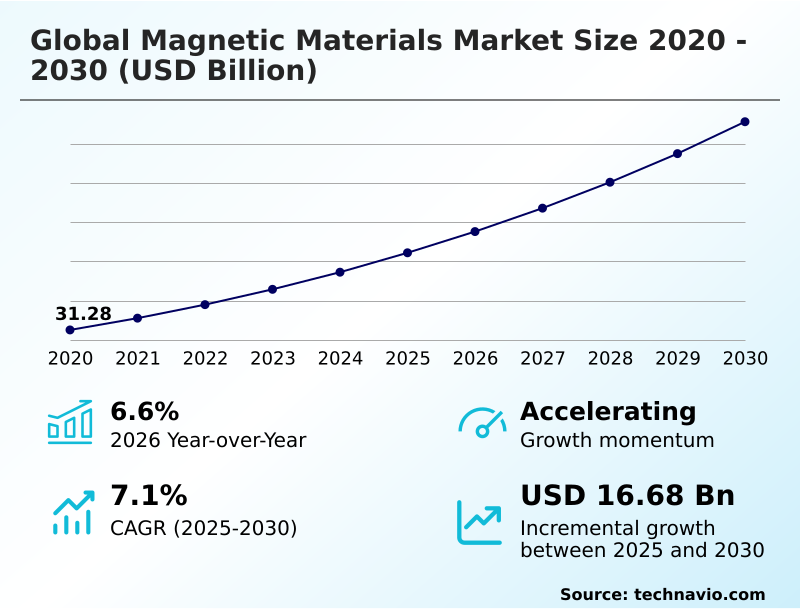
The magnetic materials market size is valued to increase by USD 16.68 billion, at a CAGR of 7.1% from 2025 to 2030. Rising demand from automotive electric vehicle applications globally will drive the magnetic materials market.
Major Market Trends & Insights
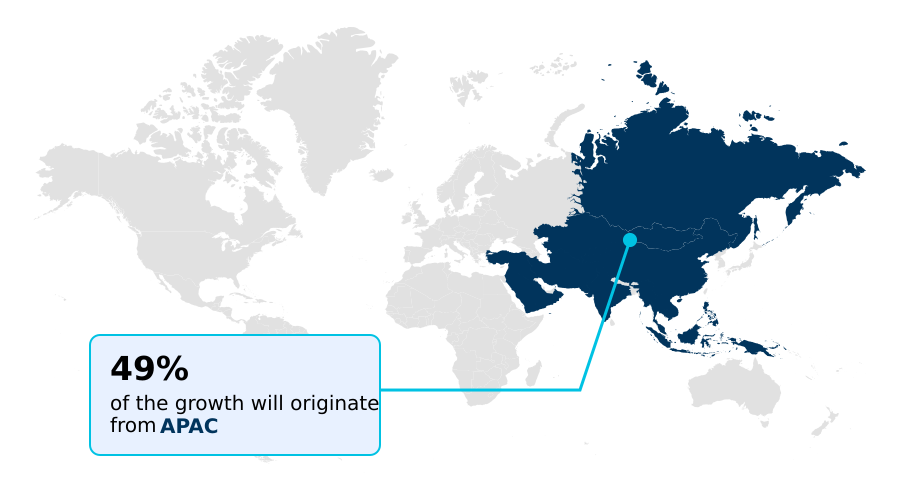
- APAC dominated the market and accounted for a 48.8% growth during the forecast period.
- By Application - Automotive and transportation segment was valued at USD 14.16 billion in 2024
- By Product - Hard magnetic materials segment accounted for the largest market revenue share in 2024
Market Size & Forecast
- Market Opportunities: USD 26.51 billion
- Market Future Opportunities: USD 16.68 billion
- CAGR from 2025 to 2030 : 7.1%
Market Summary
- The magnetic materials market is undergoing significant evolution, driven by demand from high-technology sectors. These materials are fundamental to modern engineering, enabling energy conversion, signal processing, and electromechanical functions in applications from electric vehicles to renewable energy systems. A key driver is the pursuit of higher efficiency, which relies on materials with superior magnetic permeability and low hysteresis loss.
- Innovations in powder metallurgy processing and grain boundary engineering are leading to materials with enhanced properties. For instance, a logistics company optimizing its automated warehouse robotics can achieve operational gains by using motors with high-performance sintered magnets, reducing energy consumption per task.
- However, the market also contends with supply chain vulnerabilities, particularly concerning rare earth elements, which are critical for high-strength permanent magnets. This dynamic pushes research toward developing alternative materials and robust recycling methods to ensure supply stability and manage costs, shaping the industry's strategic direction.
What will be the Size of the Magnetic Materials Market during the forecast period?
Get Key Insights on Market Forecast (PDF) Get Free Sample
How is the Magnetic Materials Market Segmented?
The magnetic materials industry research report provides comprehensive data (region-wise segment analysis), with forecasts and estimates in "USD million" for the period 2026-2030, as well as historical data from 2020-2024 for the following segments.
- Application
- Automotive and transportation
- Electronics and instrumentation
- Industrial
- Others
- Product
- Hard magnetic materials
- Soft magnetic materials
- Material
- Neodymium-iron-boron (NdFeB)
- Ferrite
- Samarium-cobalt (SmCo)
- Aluminum-nickel-cobalt (AlNiCo)
- Others
- Geography
- APAC
- China
- Japan
- India
- North America
- US
- Canada
- Mexico
- Europe
- Germany
- UK
- France
- South America
- Brazil
- Argentina
- Middle East and Africa
- Saudi Arabia
- UAE
- South Africa
- Rest of World (ROW)
- APAC
By Application Insights
The automotive and transportation segment is estimated to witness significant growth during the forecast period.
The automotive and transportation segment's demand for magnetic materials is driven by the shift toward electrification. Electric vehicle (EV) powertrains depend on high-performance permanent magnet motors for optimal efficiency and torque density.
The use of advanced hard magnetic materials like neodymium-iron-boron in traction motors is standard, as they enhance performance and enable compact designs. Beyond motors, magnetic sensor technology is essential for modern vehicle safety and control systems.
Innovations in magnetic circuit design have led to efficiency improvements, with some motor configurations achieving a 15% increase in torque density optimization.
This reliance on specialized materials like sintered magnets and advancements in powder metallurgy processing underscores the segment's critical role in the market.
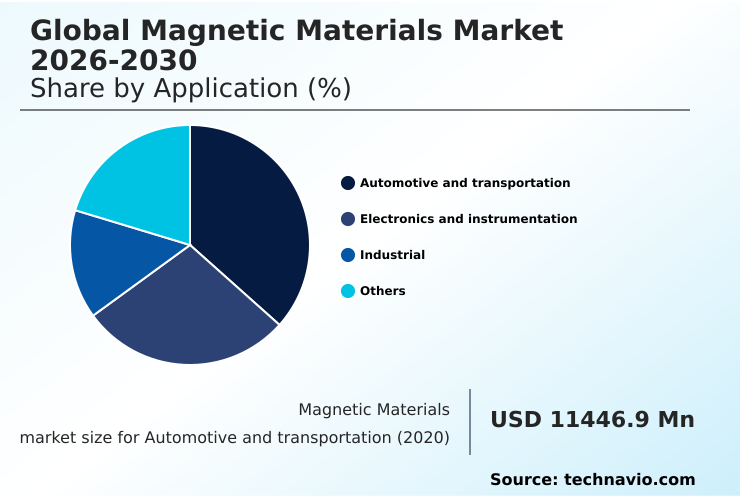
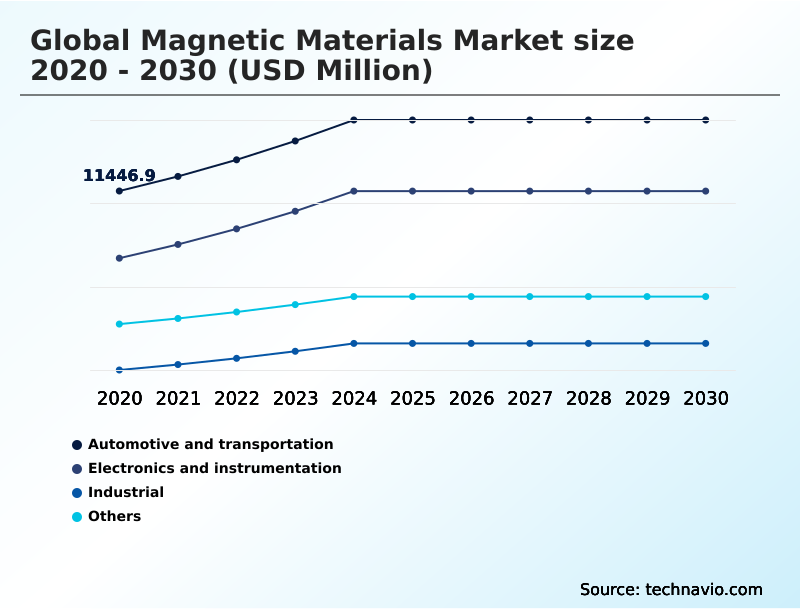
The Automotive and transportation segment was valued at USD 14.16 billion in 2024 and showed a gradual increase during the forecast period.
Regional Analysis
APAC is estimated to contribute 48.8% to the growth of the global market during the forecast period.Technavio’s analysts have elaborately explained the regional trends and drivers that shape the market during the forecast period.
See How Magnetic Materials Market Demand is Rising in APAC Get Free Sample
The geographic landscape of the magnetic materials market is characterized by regional specialization and strategic importance. APAC dominates production and consumption, driven by its massive electronics and automotive manufacturing sectors, and holds 48.8% of the market's incremental growth potential.
Countries in this region are central to the supply of rare earth elements and the production of high-performance neodymium-iron-boron magnets.
North America and Europe are significant markets focused on high-value applications in aerospace, medical technology, and automotive R&D, leveraging advanced materials like samarium-cobalt for their high-temperature resilience.
Investment in these regions is geared toward securing supply chains and fostering innovation in rare earth-free permanent magnets to mitigate geopolitical risks. The development of advanced magnetic materials is a global priority, essential for a wide range of modern technologies.
Market Dynamics
Our researchers analyzed the data with 2025 as the base year, along with the key drivers, trends, and challenges. A holistic analysis of drivers will help companies refine their marketing strategies to gain a competitive advantage.
- The global magnetic materials market 2026-2030 is defined by complex technical and economic factors. A primary concern is the impact of raw material volatility on magnet pricing, which directly influences manufacturing costs for applications ranging from consumer electronics to industrial motors.
- Decision-makers often weigh the high-temperature performance of alnico vs smco magnets for specialized aerospace or military applications, where thermal stability is paramount. The manufacturing processes for bonded neodymium magnets are being refined to offer greater design flexibility compared to their sintered counterparts.
- Concurrently, the role of soft magnetic composites in power electronics is expanding, enabling more compact and efficient high-frequency devices. There is also a significant push toward advancements in rare earth free permanent magnets to alleviate supply chain pressures. This has intensified focus on challenges in recycling neodymium magnets from e-waste, a critical step for a circular economy.
- In practice, comparing sintered vs bonded magnet applications reveals trade-offs between magnetic strength and manufacturability. For instance, supply chains integrating advanced recycling methods have demonstrated the potential to recover materials at a 25% lower energy cost than primary extraction, presenting a viable path to sustainability.
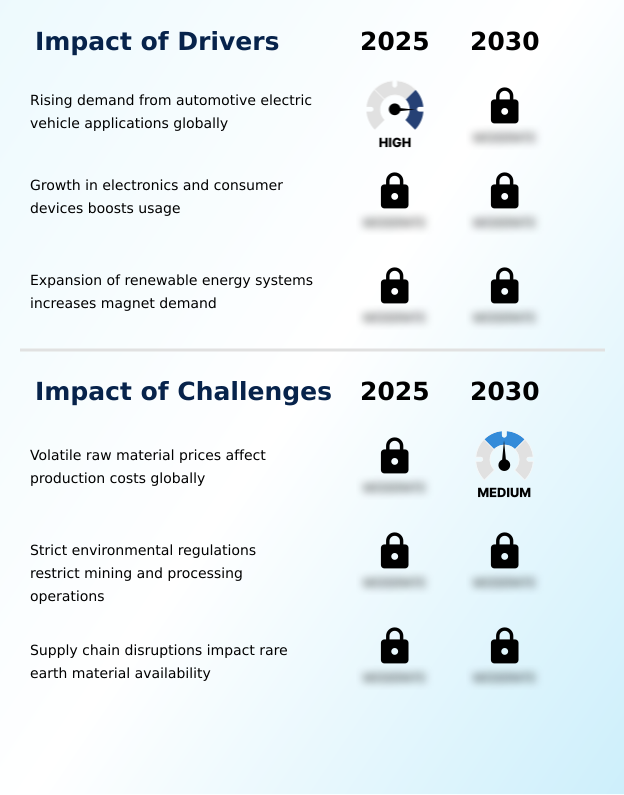
What are the key market drivers leading to the rise in the adoption of Magnetic Materials Industry?
- The rising global demand from automotive electric vehicle applications is a key driver for the magnetic materials market.
- The market is propelled by robust demand from key industrial sectors. The global push for electric mobility is a primary driver, as EVs rely on permanent magnet motors using materials like neodymium-iron-boron for high torque density and efficiency.
- The expansion of renewable energy, particularly wind turbines, also fuels demand for large volumes of high-performance magnets, with new designs increasing energy conversion efficiency by 5%.
- In consumer electronics, the need for miniaturization and improved performance in devices drives the consumption of compact, high-strength magnets.
- The use of injection molding magnets and cryocooling systems in advanced industrial and scientific equipment further underscores the market's growth, where technologies like magnetoresistive random-access memory (MRAM) and spintronic devices are becoming more prevalent.
What are the market trends shaping the Magnetic Materials Industry?
- The increasing adoption of rare magnetic materials, driven by their superior performance in high-tech applications, is a prominent market trend.
- Key trends are shaping the magnetic materials market, driven by technological advancements and new applications. The adoption of AI is accelerating the discovery of novel materials, with simulations enabling the design of geometries that can reduce energy loss in magnetic cores by up to 15%. This has led to the development of components like high-frequency inductors with superior performance.
- In the biomedical field, the use of magnetic nanocrystalline particles for targeted drug delivery and hyperthermia is expanding, leveraging the magnetocaloric effect for therapeutic benefit. Furthermore, there is a growing emphasis on recycling and the use of rare-earth-free materials, driving innovation in alloys with intermediate coercivity for applications in braking systems and sensors, where demagnetization resistance is key.
What challenges does the Magnetic Materials Industry face during its growth?
- Volatile raw material prices, which globally affect production costs, present a key challenge to the industry's growth.
- The magnetic materials market faces significant challenges related to supply chain volatility and stringent regulations. The prices of rare earth elements are subject to sharp fluctuations, which can increase production costs for permanent magnets by over 20% in a short period, impacting manufacturers' margins. This volatility makes long-term planning difficult.
- Furthermore, strict environmental regulations on mining and processing increase operational costs and can delay projects. For example, compliance with new waste disposal protocols can add up to 10% to a project's capital expenditure.
- These factors create pressure to develop alternative materials and improve recycling technologies, such as those for magnetic fluid hyperthermia applications, to ensure a stable and sustainable supply chain.
Exclusive Technavio Analysis on Customer Landscape
The magnetic materials market forecasting report includes the adoption lifecycle of the market, covering from the innovator’s stage to the laggard’s stage. It focuses on adoption rates in different regions based on penetration. Furthermore, the magnetic materials market report also includes key purchase criteria and drivers of price sensitivity to help companies evaluate and develop their market growth analysis strategies.
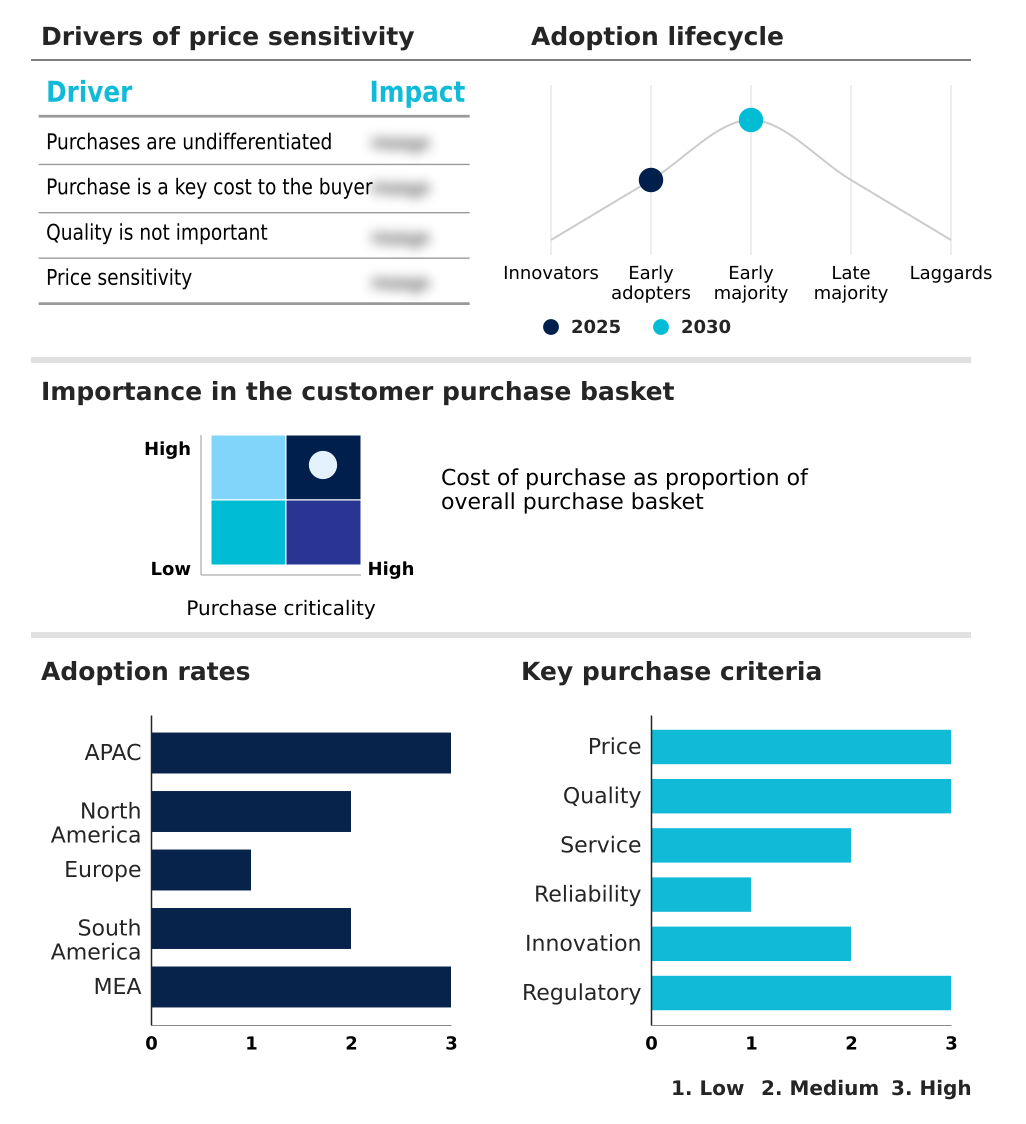
Customer Landscape of Magnetic Materials Industry
Competitive Landscape
Companies are implementing various strategies, such as strategic alliances, magnetic materials market forecast, partnerships, mergers and acquisitions, geographical expansion, and product/service launches, to enhance their presence in the industry.
Adams Magnetic Products Co. - Key offerings include high-performance rare earth, ceramic, and flexible magnetic materials, alongside custom-engineered magnetic assemblies for diverse industrial applications.
The industry research and growth report includes detailed analyses of the competitive landscape of the market and information about key companies, including:
- Adams Magnetic Products Co.
- Arnold Magnetic Technologies
- Bunting Magnetics Co.
- Daido Steel Co. Ltd.
- Dexter Magnetic Technologies
- Electron Energy Corp
- Goudsmit Magnetics Groep BV
- Hengdian Group DMEGC Magnetics
- JL MAG Rare Earth Co. Ltd.
- Lynas Rare Earths Ltd.
- Mitsubishi Materials Corp.
- Neo Performance Materials Inc.
- Ningbo Jinji Strong Magnetic
- Ningbo Yunsheng Co. Ltd.
- Proterial Ltd.
- Shin Etsu Chemical Co. Ltd.
- TDK Corp.
- Toshiba Materials Co. Ltd.
- Vacuumschmelze GmbH and Co. KG
Qualitative and quantitative analysis of companies has been conducted to help clients understand the wider business environment as well as the strengths and weaknesses of key industry players. Data is qualitatively analyzed to categorize companies as pure play, category-focused, industry-focused, and diversified; it is quantitatively analyzed to categorize companies as dominant, leading, strong, tentative, and weak.
Recent Development and News in Magnetic materials market
- In April, 2025, Tesla Inc. expanded its supply agreements for high-efficiency permanent magnets to support the increased production capacity of electric vehicles across its global manufacturing facilities.
- In March, 2025, Siemens Gamesa Renewable Energy increased its procurement of permanent magnet materials to support the expansion of offshore wind projects across Europe and Asia.
- In March, 2025, MP Materials reported increased input cost pressure in its supply chain update, highlighting ongoing volatility in rare earth pricing conditions affecting global magnet production economics.
- In February, 2025, Samsung Electronics expanded its use of high-performance magnetic materials in next-generation audio and sensor systems for its premium smartphones, demonstrating a growing reliance on advanced magnet technology.
Dive into Technavio’s robust research methodology, blending expert interviews, extensive data synthesis, and validated models for unparalleled Magnetic Materials Market insights. See full methodology.
| Market Scope | |
|---|---|
| Page number | 307 |
| Base year | 2025 |
| Historic period | 2020-2024 |
| Forecast period | 2026-2030 |
| Growth momentum & CAGR | Accelerate at a CAGR of 7.1% |
| Market growth 2026-2030 | USD 16684.4 million |
| Market structure | Fragmented |
| YoY growth 2025-2026(%) | 6.6% |
| Key countries | China, Japan, India, South Korea, Australia, Indonesia, US, Canada, Mexico, Germany, UK, France, Italy, Spain, The Netherlands, Brazil, Argentina, Chile, Saudi Arabia, UAE, South Africa, Israel and Turkey |
| Competitive landscape | Leading Companies, Market Positioning of Companies, Competitive Strategies, and Industry Risks |
Research Analyst Overview
- The magnetic materials market is propelled by relentless innovation in material science, crucial for next-generation technologies. Core materials like neodymium-iron-boron, ferrite magnets, and samarium-cobalt are fundamental to applications demanding high performance. The industry's focus is on enhancing properties such as magnetic permeability, coercivity, and remanence while minimizing hysteresis loss and eddy current loss.
- Advances in grain boundary engineering and the development of nanocrystalline materials are pushing performance boundaries. For boardroom considerations, the volatility of rare earth elements sourcing presents a significant strategic challenge, directly impacting product roadmaps and budgeting. Companies are mitigating this by exploring amorphous alloys and electrical steel alternatives.
- For instance, a shift to optimized soft magnetic materials in industrial transformers has been shown to reduce energy waste by up to 12%. The development of materials with superior flux density, magnetostriction control, and high Curie temperature remains a key R&D focus, directly influencing the efficiency and viability of future products.
What are the Key Data Covered in this Magnetic Materials Market Research and Growth Report?
-
What is the expected growth of the Magnetic Materials Market between 2026 and 2030?
-
USD 16.68 billion, at a CAGR of 7.1%
-
-
What segmentation does the market report cover?
-
The report is segmented by Application (Automotive and transportation, Electronics and instrumentation, Industrial, and Others), Product (Hard magnetic materials, and Soft magnetic materials), Material (Neodymium-iron-boron (NdFeB), Ferrite, Samarium-cobalt (SmCo), Aluminum-nickel-cobalt (AlNiCo), and Others) and Geography (APAC, North America, Europe, South America, Middle East and Africa)
-
-
Which regions are analyzed in the report?
-
APAC, North America, Europe, South America and Middle East and Africa
-
-
What are the key growth drivers and market challenges?
-
Rising demand from automotive electric vehicle applications globally, Volatile raw material prices affect production costs globally
-
-
Who are the major players in the Magnetic Materials Market?
-
Adams Magnetic Products Co., Arnold Magnetic Technologies, Bunting Magnetics Co., Daido Steel Co. Ltd., Dexter Magnetic Technologies, Electron Energy Corp, Goudsmit Magnetics Groep BV, Hengdian Group DMEGC Magnetics, JL MAG Rare Earth Co. Ltd., Lynas Rare Earths Ltd., Mitsubishi Materials Corp., Neo Performance Materials Inc., Ningbo Jinji Strong Magnetic, Ningbo Yunsheng Co. Ltd., Proterial Ltd., Shin Etsu Chemical Co. Ltd., TDK Corp., Toshiba Materials Co. Ltd. and Vacuumschmelze GmbH and Co. KG
-
Market Research Insights
- The market's dynamics are shaped by the dual demands of performance and efficiency, with innovations in magnetic core efficiency enabling significant operational gains. Advanced magnetic materials are integral to technologies where high-frequency inductors and effective electromagnetic shielding are critical.
- For instance, the adoption of soft magnetic composites in power electronics has been shown to reduce core losses by up to 30%, directly impacting energy consumption. Concurrently, the use of specialized components like Hall effect sensors is growing, with some industrial automation systems reporting a 20% improvement in positional accuracy.
- This drive for precision and efficiency highlights the market's focus on material science advancements to meet the stringent requirements of modern applications, balancing performance with sustainability and cost-effectiveness.
We can help! Our analysts can customize this magnetic materials market research report to meet your requirements.
 RIA -
RIA - 
