
Video Surveillance As A Service (vsaas) Market Analysis, Size, and Forecast 2026-2030: North America (US, Canada, and Mexico), APAC (China, Japan, and India), Europe (Germany, UK, and France), South America (Brazil, Argentina, and Chile), Middle East and Africa (Saudi Arabia, UAE, and South Africa), and Rest of World (ROW)

Video Surveillance As A Service (vsaas) Market Analysis, Size, and Forecast 2026-2030:
North America (US, Canada, and Mexico), APAC (China, Japan, and India), Europe (Germany, UK, and France), South America (Brazil, Argentina, and Chile), Middle East and Africa (Saudi Arabia, UAE, and South Africa), and Rest of World (ROW)

Published: Oct 2026 316 Pages SKU: IRTNTR43281

Market Overview at a Glance

$8.07 B
Market Opportunity
18.3%
CAGR 2025 - 2030
35.3%
North America Growth
$2.37 B
Hosted segment 2024

Video Surveillance As A Service (Vsaas) Market Size 2026-2030

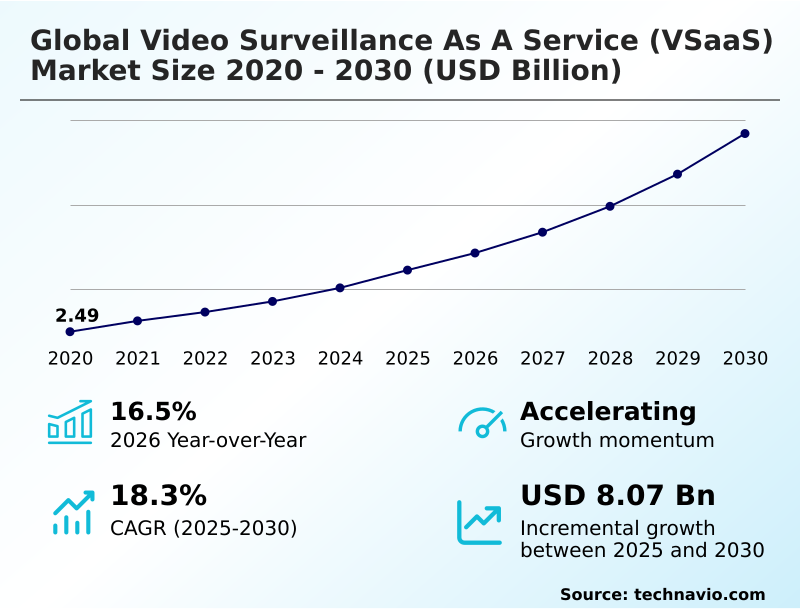
The video surveillance as a service (vsaas) market size is valued to increase by USD 8.07 billion, at a CAGR of 18.3% from 2025 to 2030. Accelerating enterprise migration to cloud platforms will drive the video surveillance as a service (vsaas) market.

Major Market Trends & Insights

  • North America dominated the market and accounted for a 35.3% growth during the forecast period.
  • By Solution - Hosted segment was valued at USD 2.37 billion in 2024
  • By End-user - Commercial segment accounted for the largest market revenue share in 2024

Market Size & Forecast

  • Market Opportunities: USD 11.71 billion
  • Market Future Opportunities: USD 8.07 billion
  • CAGR from 2025 to 2030 : 18.3%

Market Summary

  • The Video Surveillance As A Service (VSaaS) Market experiences rapid structural transformation as commercial enterprises replace capital-intensive on-premises servers with flexible, subscription-based cloud platforms. Organizations increasingly deploy these scalable architectures to optimize multi-site supply chain operations, allowing logistics managers to track inventory transit and monitor warehouse loading docks remotely through a single browser interface.
  • Transitioning to cloud-native platforms enables businesses to reduce initial hardware deployment costs by 45% compared to maintaining traditional localized recording appliances. Accelerating enterprise migration to cloud infrastructure drives market expansion, as organizations demand unified physical security frameworks that seamlessly integrate access control panels with remote visual monitoring.
  • Conversely, uplink bandwidth bottlenecks severely challenge continuous system reliability, as transmitting high-resolution optical data over saturated local broadband connections induces latency and packet loss. Robust security protocols secure data integrity in transit, ensuring alignment with strict privacy statutes.
  • Ultimately, integrating advanced analytics transforms passive forensic archives into proactive intelligence networks, drastically improving overall incident response protocols and minimizing expensive physical guard requirements.

What will be the Size of the Video Surveillance As A Service (Vsaas) Market during the forecast period?
Get Key Insights on Market Forecast (PDF) Get Free Sample

How is the Video Surveillance As A Service (Vsaas) Market Segmented?

The video surveillance as a service (vsaas) industry research report provides comprehensive data (region-wise segment analysis), with forecasts and estimates in "USD million" for the period 2026-2030, as well as historical data from 2020-2024 for the following segments.

  • Solution
    • Hosted
    • Managed
    • Hybrid
  • End-user
    • Commercial
    • Industrial
    • Residential
  • Technology
    • IP-based surveillance
    • Analog surveillance
  • Deployment
    • Cloud based
    • On-premises
  • Geography
    • North America
      • US
      • Canada
      • Mexico
    • APAC
      • China
      • Japan
      • India
      • South Korea
      • Australia
      • Indonesia
    • Europe
      • Germany
      • UK
      • France
      • Italy
      • Spain
      • The Netherlands
    • South America
      • Brazil
      • Argentina
      • Chile
    • Middle East and Africa
      • Saudi Arabia
      • UAE
      • South Africa
      • Israel
      • Turkey

By Solution Insights

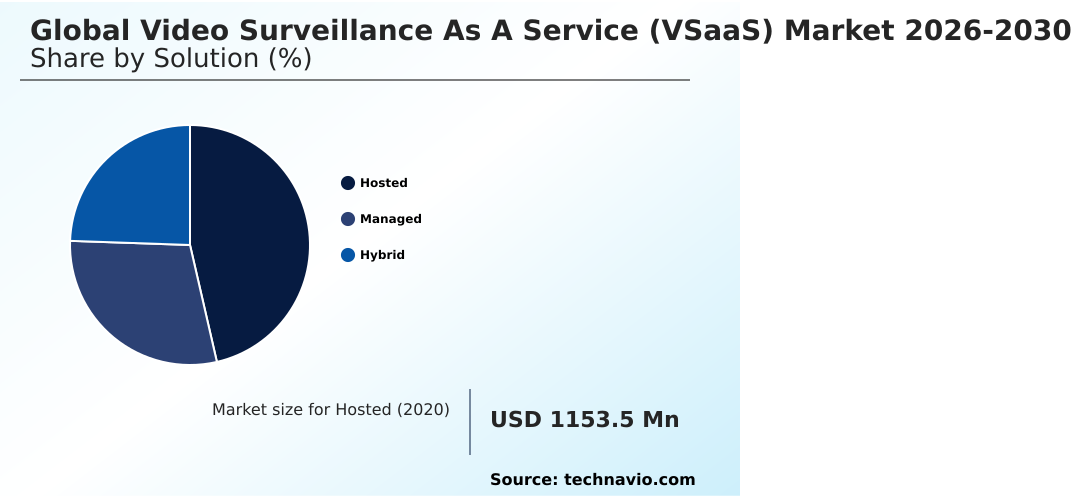
The hosted segment is estimated to witness significant growth during the forecast period.

The hosted segment of the global video surveillance as a service (VSaaS) market 2026-2030 centers on cloud-native security architectures where raw footage transmits directly to centralized cloud repositories managed by third-party providers.

This infrastructure eliminates the requirement for local network video recorders, shifting capital expenditures to predictable operational expenses. By leveraging cloud storage elasticity, organizations achieve multi site scalability without maintaining local servers.

Directing these visual assets through remote perimeter monitoring optimizes spatial awareness while integrating edge computing resilience ensures continuous operation. Businesses adopting these models report a 35% improvement in multi-site operational efficiency by centralizing administrative tasks.

Integrating cloud computing resources with automated anomaly detection enables security teams to deploy firmware deployment automation seamlessly across hardware agnostic software environments. This scalable architecture supports dynamic business requirements while ensuring uninterrupted threat detection capabilities without localized maintenance bottlenecks.
Get Free Sample

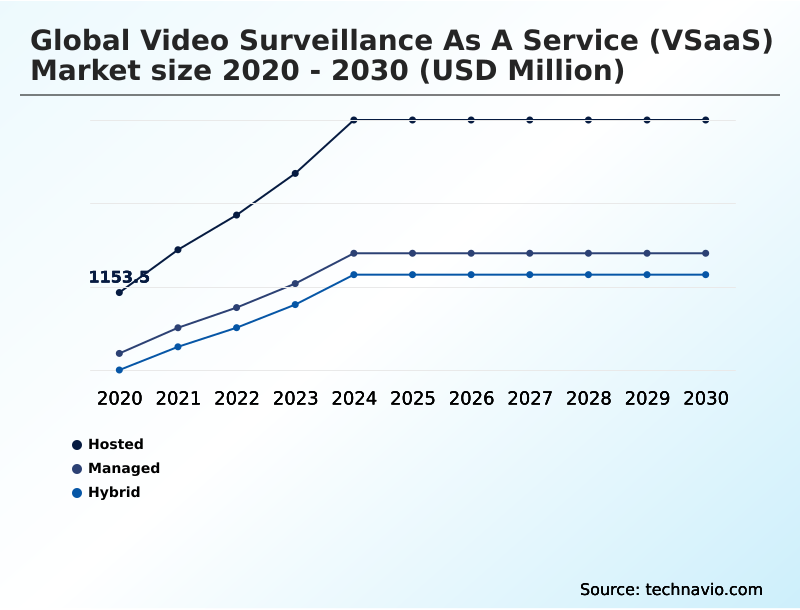
The Hosted segment was valued at USD 2.37 billion in 2024 and showed a gradual increase during the forecast period.
Get Free Sample

Regional Analysis

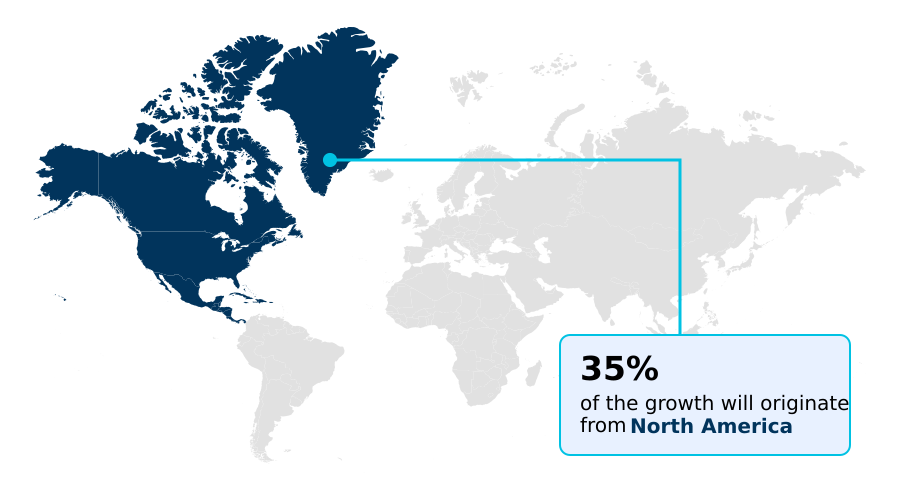
North America is estimated to contribute 35.3% to the growth of the global market during the forecast period.Technavio’s analysts have elaborately explained the regional trends and drivers that shape the market during the forecast period.
See How Video Surveillance As A Service (Vsaas) Market Demand is Rising in North America Get Free Sample

The geographic landscape of the global video surveillance as a service (VSaaS) market 2026-2030 reveals stark contrast in cloud adoption velocities and infrastructure readiness between North America and APAC.

North America demonstrates advanced digital maturity, achieving a 40% higher penetration rate of hybrid cloud surveillance compared to APAC.

This rapid integration of edge video analytics helps American enterprises reduce localized security overhead by 25% while streamlining multi-site incident response through direct to cloud streaming.

APAC expands aggressively through smart city infrastructure, although fragmented broadband networks constrain pure cloud deployments. To overcome these constraints, organizations in APAC increasingly utilize metadata video archiving and cloud connector appliances to limit bandwidth saturation.

European markets prioritize stringent video anonymization tools and zero trust architecture to navigate complex privacy regulations, reducing compliance audit processing times by 30%.

These regional disparities compel multinational enterprises to deploy adaptive cloud video management strategies, blending digital floor plan integration with reliable off site data redundancy.

Market Dynamics

Our researchers analyzed the data with 2025 as the base year, along with the key drivers, trends, and challenges. A holistic analysis of drivers will help companies refine their marketing strategies to gain a competitive advantage.

  • The operational framework of the Video Surveillance As A Service (VSaaS) Market reflects a fundamental shift from reactive security monitoring to proactive intelligence gathering. Enterprises evaluating a hybrid cloud video security deployment often weigh the benefits of local storage against the elasticity of cloud infrastructure.
  • By adopting an edge AI surveillance cost optimization strategy, organizations can process complex visual data directly at the camera level, transferring only critical event metadata to external servers. This distributed computing approach reduces network congestion and delivers a bandwidth efficiency improvement nearly double that of traditional continuous-streaming architectures.
  • Managing a multi site cloud video architecture provides retail and logistics directors with a unified dashboard to oversee physical security and compliance operations across geographically diverse facilities, significantly accelerating emergency coordination compared to siloed regional systems.
  • Integrating enterprise cloud video analytics integration allows businesses to extract actionable insights such as queue density and spatial heat mapping, which directly optimize staffing allocation and floor layouts. Furthermore, implementing remote automated perimeter threat monitoring empowers central station operators to verify intrusions instantly and issue live voice challenges, preempting property damage and reducing false alarm dispatch penalties.
  • These integrated capabilities ensure that modern video surveillance functions not merely as a liability mitigation tool but as a critical driver of operational agility and sustained business intelligence.
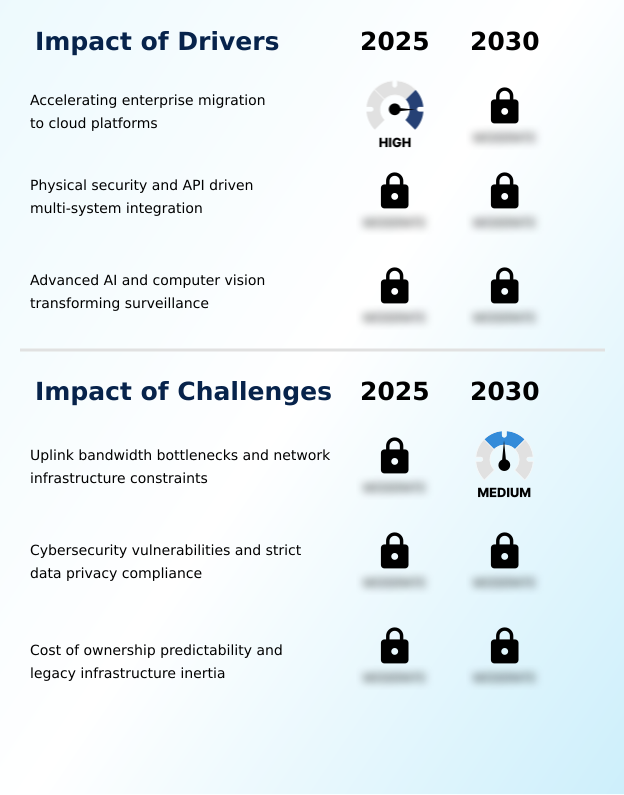
What are the key market drivers leading to the rise in the adoption of Video Surveillance As A Service (Vsaas) Industry?

  • Accelerating enterprise migration to cloud platforms acts as a primary catalyst, propelling scalable physical security modernization and reducing operational overhead.

  • The escalating need for centralized security administration across distributed corporate footprints heavily drives the global video surveillance as a service (VSaaS) market 2026-2030.
  • Organizations migrate to unified security dashboard interfaces to eliminate disjointed monitoring silos, cutting initial infrastructure deployment costs by 40%.
  • The capability to establish sophisticated incident response workflows ensures that operators can neutralize threats rapidly through live voice intervention and advanced threat detection systems.
  • By utilizing motion triggered event recording alongside end to end video encryption, enterprises protect critical evidentiary footage from interception, enhancing post-incident recovery speeds by 25%.
  • This continuous transition to hosted video management software enables IT directors to standardize multi factor authentication globally.
  • Furthermore, integrating queue density analytics and automated machinery inspection into these flexible cloud architectures allows business leaders to minimize localized maintenance burdens, ensuring continuous security visibility.

What are the market trends shaping the Video Surveillance As A Service (Vsaas) Industry?

  • Remote video monitoring and central station automation constitute a prominent trend. These technologies elevate proactive threat mitigation and operational efficiency across distributed commercial footprints.

  • Artificial intelligence integration within cloud video ecosystems represents a decisive trend reshaping the global video surveillance as a service (VSaaS) market 2026-2030. Commercial end users actively transition from passive recording to automated intelligence by deploying object classification models that process visual data instantaneously.
  • This technological shift enables organizations to execute continuous occupational safety verification across industrial environments, reducing reportable safety violations by 25%. Expanding access control integration allows enterprises to manage geographically dispersed facilities through centralized portals, elevating situational awareness tracking capabilities significantly.
  • Furthermore, incorporating predictive behavioral profiling identifies potential perimeter breaches before they escalate, improving overall threat interception rates by 18% and ensuring substantial false alarm reduction for central station workflows. Because businesses require real-time operational insights like spatial heat mapping, integrating dynamic privacy controls ensures that these advanced analytics comply with stringent global regulations.

What challenges does the Video Surveillance As A Service (Vsaas) Industry face during its growth?

  • Uplink bandwidth bottlenecks and network infrastructure constraints represent significant obstacles, impeding the continuous transmission of high-definition video across distributed facilities.

  • Severe uplink bandwidth limitations and inconsistent broadband infrastructure actively constrain the global video surveillance as a service (VSaaS) market 2026-2030 across remote operational environments. Transmitting high definition resolution streams continuously from hundreds of edge cameras frequently saturates local enterprise networks, leading to a 20% degradation in overall IT network performance during peak operational hours.
  • To mitigate these disruptions, organizations must implement aggressive bandwidth consumption throttling, which occasionally compromises the clarity of visual pixel streams required for advanced neural network processing and computer vision algorithms. Furthermore, navigating complex cross-border data sovereignty laws necessitates rigorous compliance audit trails, increasing administrative processing costs by 15% for multinational corporations.
  • The reliance on external network connectivity introduces severe vulnerabilities, as broadband outages paralyze first responder data sharing unless robust edge recording capabilities and low latency connectivity failovers are properly configured.

Exclusive Technavio Analysis on Customer Landscape

The video surveillance as a service (vsaas) market forecasting report includes the adoption lifecycle of the market, covering from the innovator’s stage to the laggard’s stage. It focuses on adoption rates in different regions based on penetration. Furthermore, the video surveillance as a service (vsaas) market report also includes key purchase criteria and drivers of price sensitivity to help companies evaluate and develop their market growth analysis strategies.
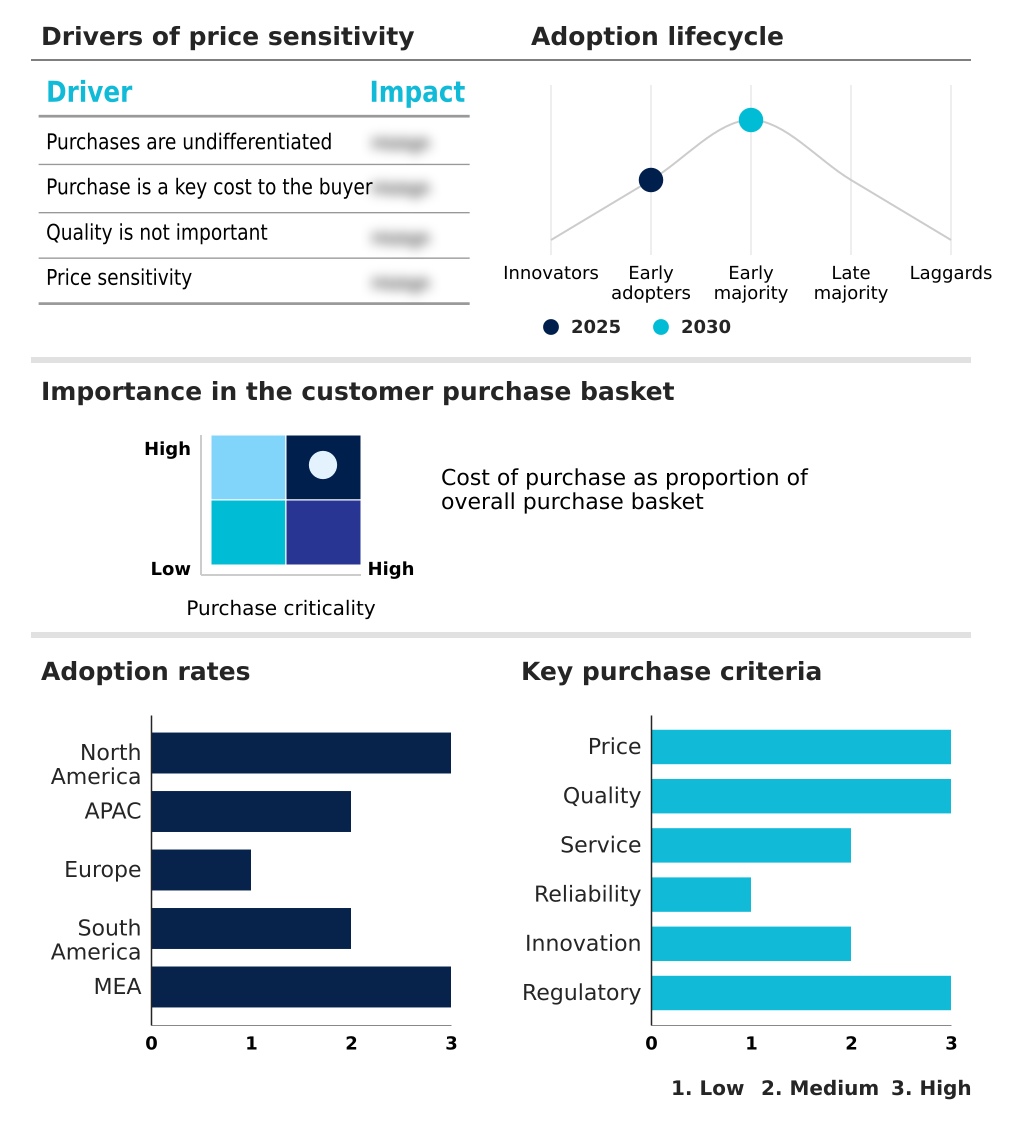
Customer Landscape of Video Surveillance As A Service (Vsaas) Industry

Competitive Landscape

Companies are implementing various strategies, such as strategic alliances, video surveillance as a service (vsaas) market forecast, partnerships, mergers and acquisitions, geographical expansion, and product/service launches, to enhance their presence in the industry.

ADT Inc. - Provides remote business security camera management platforms and cloud video storage solutions delivering comprehensive automated monitoring systems to enhance operational visibility and incident response capabilities for commercial properties.

The industry research and growth report includes detailed analyses of the competitive landscape of the market and information about key companies, including:

  • ADT Inc.
  • Alarm.com Holdings Inc.
  • Avigilon Corp.
  • Bosch Sicherheitssysteme GmbH
  • Brivo Inc.
  • Camcloud Inc.
  • Cisco Systems Inc.
  • Cloudastructure Inc.
  • Dahua Technology Co. Ltd.
  • Digital Watchdog
  • Eagle Eye Networks Inc.
  • Genetec Inc.
  • Hangzhou Hikvision Digital
  • Honeywell International Inc.
  • Johnson Controls International
  • March Networks Corp.
  • Milestone Systems AS
  • Motorola Solutions Inc.
  • Qognify Ltd.
  • Spot AI
  • Verkada Inc.

Qualitative and quantitative analysis of companies has been conducted to help clients understand the wider business environment as well as the strengths and weaknesses of key industry players. Data is qualitatively analyzed to categorize companies as pure play, category-focused, industry-focused, and diversified; it is quantitatively analyzed to categorize companies as dominant, leading, strong, tentative, and weak.

Recent Development and News in Video surveillance as a service (vsaas) market

  • In the Internet Services and Infrastructure industry, the expansion of high capacity hyperscale data centers improved low latency connectivity for enterprise networks, directly impacting Video Surveillance As A Service (VSaaS) demand by enabling real-time visual pixel streams and off site data redundancy across global operational footprints.
  • The widespread adoption of edge recording capabilities within decentralized IoT networks reduced bandwidth consumption throttling requirements, accelerating the deployment of threat detection systems that rely on high definition resolution streams for accurate spatial intelligence and situational awareness tracking.
  • Stricter compliance audit trails enforced through national data sovereignty regulations compelled infrastructure providers to deploy dynamic privacy controls and hardware agnostic software, increasing enterprise reliance on cloud connector appliances for secure cross-border video management software integration.
  • The integration of automated machinery inspection protocols and live voice intervention tools into centralized IT networks drove demand for incident response workflows, allowing facilities to automate central station workflows while achieving sustained false alarm reduction and occupational safety verification.

Dive into Technavio’s robust research methodology, blending expert interviews, extensive data synthesis, and validated models for unparalleled Video Surveillance As A Service (Vsaas) Market insights. See full methodology.

Market Scope
Page number 316
Base year 2025
Historic period 2020-2024
Forecast period 2026-2030
Growth momentum & CAGR Accelerate at a CAGR of 18.3%
Market growth 2026-2030 USD 8069.0 million
Market structure Fragmented
YoY growth 2025-2026(%) 16.5%
Key countries US, Canada, Mexico, China, Japan, India, South Korea, Australia, Indonesia, Germany, UK, France, Italy, Spain, The Netherlands, Brazil, Argentina, Chile, Saudi Arabia, UAE, South Africa, Israel and Turkey
Competitive landscape Leading Companies, Market Positioning of Companies, Competitive Strategies, and Industry Risks

Request Free Sample

Research Analyst Overview

  • The Video Surveillance As A Service (VSaaS) Market undergoes continuous structural evolution as intelligent cloud platforms subsume traditional physical security frameworks. Strategic boardroom discussions increasingly prioritize the integration of advanced video infrastructure within corporate security budgets, shifting investments from static hardware to dynamic, software-defined ecosystems.
  • By embedding intelligent analytics directly into surveillance architectures, organizations transform raw visual data into actionable spatial intelligence, directly informing commercial real estate layout decisions and staffing optimization. This fundamental transition has enabled corporate operators to realize a 30% reduction in manual incident processing time by automating event verification workflows.
  • Connecting access control frameworks with cloud-native monitoring provides facility directors with instantaneous visual context during perimeter breaches, streamlining overarching compliance mandates. Furthermore, the implementation of robust network protections shields sensitive enterprise footage against cyber intrusion across distributed operational locations.
  • The continuous deployment of motion-driven recording minimizes unnecessary storage consumption, cementing cloud video platforms as a critical component for maintaining operational resilience and proactive risk mitigation.

What are the Key Data Covered in this Video Surveillance As A Service (Vsaas) Market Research and Growth Report?

  • What is the expected growth of the Video Surveillance As A Service (Vsaas) Market between 2026 and 2030?

    • USD 8.07 billion, at a CAGR of 18.3%

  • What segmentation does the market report cover?

    • The report is segmented by Solution (Hosted, Managed, and Hybrid), End-user (Commercial, Industrial, and Residential), Technology (IP-based surveillance, and Analog surveillance), Deployment (Cloud based, and On-premises) and Geography (North America, APAC, Europe, South America, Middle East and Africa)

  • Which regions are analyzed in the report?

    • North America, APAC, Europe, South America and Middle East and Africa

  • What are the key growth drivers and market challenges?

    • Accelerating enterprise migration to cloud platforms, Uplink bandwidth bottlenecks and network infrastructure constraints

  • Who are the major players in the Video Surveillance As A Service (Vsaas) Market?

    • ADT Inc., Alarm.com Holdings Inc., Avigilon Corp., Bosch Sicherheitssysteme GmbH, Brivo Inc., Camcloud Inc., Cisco Systems Inc., Cloudastructure Inc., Dahua Technology Co. Ltd., Digital Watchdog, Eagle Eye Networks Inc., Genetec Inc., Hangzhou Hikvision Digital, Honeywell International Inc., Johnson Controls International, March Networks Corp., Milestone Systems AS, Motorola Solutions Inc., Qognify Ltd., Spot AI and Verkada Inc.

Market Research Insights

  • The Video Surveillance As A Service (VSaaS) Market operates at the intersection of physical security and advanced IT infrastructure, transforming passive recording into active operational intelligence. By leveraging integrated cloud platforms, municipal and commercial enterprises have improved emergency dispatch precision by 35%, significantly reducing localized response times.
  • Organizations integrating smart video management with predictive tracking report a 20% enhancement in threat detection accuracy, drastically minimizing reliance on physical security patrols. Furthermore, the adoption of edge-based gateways enables legacy hardware transition, yielding a 40% reduction in equipment replacement costs.
  • These interconnected capabilities empower commercial facility operators to automate incident workflows, optimizing overall resource allocation and continuously reinforcing enterprise risk management strategies.

We can help! Our analysts can customize this video surveillance as a service (vsaas) market research report to meet your requirements.

Get in touch

1. Executive Summary

1.1 Market overview

Executive Summary - Chart on Market Overview
Executive Summary - Data Table on Market Overview
Executive Summary - Chart on Global Market Characteristics
Executive Summary - Chart on Market by Geography
Executive Summary - Chart on Market Segmentation by Solution
Executive Summary - Chart on Market Segmentation by End-user
Executive Summary - Chart on Market Segmentation by Technology
Executive Summary - Chart on Market Segmentation by Deployment
Executive Summary - Chart on Incremental Growth
Executive Summary - Data Table on Incremental Growth
Executive Summary - Chart on Company Market Positioning

2. Technavio Analysis

2.1 Analysis of price sensitivity, lifecycle, customer purchase basket, adoption rates, and purchase criteria

2.2 Criticality of inputs and Factors of differentiation

Chart on Overview on criticality of inputs and factors of differentiation

2.3 Factors of disruption

Chart on Overview on factors of disruption

2.4 Impact of drivers and challenges

Chart on Impact of drivers and challenges in 2025 and 2030

3. Market Landscape

3.1 Market ecosystem

Chart on Parent Market
Data Table on - Parent Market

3.2 Market characteristics

Chart on Market characteristics analysis

3.3 Value chain analysis

Chart on Value chain analysis

4. Market Sizing

4.1 Market definition

Data Table on Offerings of companies included in the market definition

4.2 Market segment analysis

Market segments

4.3 Market size 2025

4.4 Market outlook: Forecast for 2025-2030

Chart on Global - Market size and forecast 2025-2030 ($ million)
Data Table on Global - Market size and forecast 2025-2030 ($ million)
Chart on Global Market: Year-over-year growth 2025-2030 (%)
Data Table on Global Market: Year-over-year growth 2025-2030 (%)

5. Historic Market Size

5.1 Global Video Surveillance As A Service (VSaaS) Market 2020 - 2024

Historic Market Size - Data Table on Global Video Surveillance As A Service (VSaaS) Market 2020 - 2024 ($ million)

5.2 Solution segment analysis 2020 - 2024

Historic Market Size - Solution Segment 2020 - 2024 ($ million)

5.3 End-user segment analysis 2020 - 2024

Historic Market Size - End-user Segment 2020 - 2024 ($ million)

5.4 Technology segment analysis 2020 - 2024

Historic Market Size - Technology Segment 2020 - 2024 ($ million)

5.5 Deployment segment analysis 2020 - 2024

Historic Market Size - Deployment Segment 2020 - 2024 ($ million)

5.6 Geography segment analysis 2020 - 2024

Historic Market Size - Geography Segment 2020 - 2024 ($ million)

5.7 Country segment analysis 2020 - 2024

Historic Market Size - Country Segment 2020 - 2024 ($ million)

6. Qualitative Analysis

6.1 Impact of AI on Global Video Surveillance as a Service (VSaaS) Market

6.2 Impact of Geopolitical Conflicts on Global Video Surveillance as a Service (VSaaS) Market

7. Five Forces Analysis

7.1 Five forces summary

Five forces analysis - Comparison between 2025 and 2030

7.2 Bargaining power of buyers

Bargaining power of buyers - Impact of key factors 2025 and 2030

7.3 Bargaining power of suppliers

Bargaining power of suppliers - Impact of key factors in 2025 and 2030

7.4 Threat of new entrants

Threat of new entrants - Impact of key factors in 2025 and 2030

7.5 Threat of substitutes

Threat of substitutes - Impact of key factors in 2025 and 2030

7.6 Threat of rivalry

Threat of rivalry - Impact of key factors in 2025 and 2030

7.7 Market condition

Chart on Market condition - Five forces 2025 and 2030

8. Market Segmentation by Solution

8.1 Market segments

Chart on Solution - Market share 2025-2030 (%)
Data Table on Solution - Market share 2025-2030 (%)

8.2 Comparison by Solution

Chart on Comparison by Solution
Data Table on Comparison by Solution

8.3 Hosted - Market size and forecast 2025-2030

Chart on Hosted - Market size and forecast 2025-2030 ($ million)
Data Table on Hosted - Market size and forecast 2025-2030 ($ million)
Chart on Hosted - Year-over-year growth 2025-2030 (%)
Data Table on Hosted - Year-over-year growth 2025-2030 (%)

8.4 Managed - Market size and forecast 2025-2030

Chart on Managed - Market size and forecast 2025-2030 ($ million)
Data Table on Managed - Market size and forecast 2025-2030 ($ million)
Chart on Managed - Year-over-year growth 2025-2030 (%)
Data Table on Managed - Year-over-year growth 2025-2030 (%)

8.5 Hybrid - Market size and forecast 2025-2030

Chart on Hybrid - Market size and forecast 2025-2030 ($ million)
Data Table on Hybrid - Market size and forecast 2025-2030 ($ million)
Chart on Hybrid - Year-over-year growth 2025-2030 (%)
Data Table on Hybrid - Year-over-year growth 2025-2030 (%)

8.6 Market opportunity by Solution

Market opportunity by Solution ($ million)
Data Table on Market opportunity by Solution ($ million)

9. Market Segmentation by End-user

9.1 Market segments

Chart on End-user - Market share 2025-2030 (%)
Data Table on End-user - Market share 2025-2030 (%)

9.2 Comparison by End-user

Chart on Comparison by End-user
Data Table on Comparison by End-user

9.3 Commercial - Market size and forecast 2025-2030

Chart on Commercial - Market size and forecast 2025-2030 ($ million)
Data Table on Commercial - Market size and forecast 2025-2030 ($ million)
Chart on Commercial - Year-over-year growth 2025-2030 (%)
Data Table on Commercial - Year-over-year growth 2025-2030 (%)

9.4 Industrial - Market size and forecast 2025-2030

Chart on Industrial - Market size and forecast 2025-2030 ($ million)
Data Table on Industrial - Market size and forecast 2025-2030 ($ million)
Chart on Industrial - Year-over-year growth 2025-2030 (%)
Data Table on Industrial - Year-over-year growth 2025-2030 (%)

9.5 Residential - Market size and forecast 2025-2030

Chart on Residential - Market size and forecast 2025-2030 ($ million)
Data Table on Residential - Market size and forecast 2025-2030 ($ million)
Chart on Residential - Year-over-year growth 2025-2030 (%)
Data Table on Residential - Year-over-year growth 2025-2030 (%)

9.6 Market opportunity by End-user

Market opportunity by End-user ($ million)
Data Table on Market opportunity by End-user ($ million)

10. Market Segmentation by Technology

10.1 Market segments

Chart on Technology - Market share 2025-2030 (%)
Data Table on Technology - Market share 2025-2030 (%)

10.2 Comparison by Technology

Chart on Comparison by Technology
Data Table on Comparison by Technology

10.3 IP-based surveillance - Market size and forecast 2025-2030

Chart on IP-based surveillance - Market size and forecast 2025-2030 ($ million)
Data Table on IP-based surveillance - Market size and forecast 2025-2030 ($ million)
Chart on IP-based surveillance - Year-over-year growth 2025-2030 (%)
Data Table on IP-based surveillance - Year-over-year growth 2025-2030 (%)

10.4 Analog surveillance - Market size and forecast 2025-2030

Chart on Analog surveillance - Market size and forecast 2025-2030 ($ million)
Data Table on Analog surveillance - Market size and forecast 2025-2030 ($ million)
Chart on Analog surveillance - Year-over-year growth 2025-2030 (%)
Data Table on Analog surveillance - Year-over-year growth 2025-2030 (%)

10.5 Market opportunity by Technology

Market opportunity by Technology ($ million)
Data Table on Market opportunity by Technology ($ million)

11. Market Segmentation by Deployment

11.1 Market segments

Chart on Deployment - Market share 2025-2030 (%)
Data Table on Deployment - Market share 2025-2030 (%)

11.2 Comparison by Deployment

Chart on Comparison by Deployment
Data Table on Comparison by Deployment

11.3 Cloud based - Market size and forecast 2025-2030

Chart on Cloud based - Market size and forecast 2025-2030 ($ million)
Data Table on Cloud based - Market size and forecast 2025-2030 ($ million)
Chart on Cloud based - Year-over-year growth 2025-2030 (%)
Data Table on Cloud based - Year-over-year growth 2025-2030 (%)

11.4 On-premises - Market size and forecast 2025-2030

Chart on On-premises - Market size and forecast 2025-2030 ($ million)
Data Table on On-premises - Market size and forecast 2025-2030 ($ million)
Chart on On-premises - Year-over-year growth 2025-2030 (%)
Data Table on On-premises - Year-over-year growth 2025-2030 (%)

11.5 Market opportunity by Deployment

Market opportunity by Deployment ($ million)
Data Table on Market opportunity by Deployment ($ million)

12. Customer Landscape

12.1 Customer landscape overview

Analysis of price sensitivity, lifecycle, customer purchase basket, adoption rates, and purchase criteria

13. Geographic Landscape

13.1 Geographic segmentation

Chart on Market share by geography 2025-2030 (%)
Data Table on Market share by geography 2025-2030 (%)

13.2 Geographic comparison

Chart on Geographic comparison
Data Table on Geographic comparison

13.3 North America - Market size and forecast 2025-2030

Chart on North America - Market size and forecast 2025-2030 ($ million)
Data Table on North America - Market size and forecast 2025-2030 ($ million)
Chart on North America - Year-over-year growth 2025-2030 (%)
Data Table on North America - Year-over-year growth 2025-2030 (%)
Chart on Regional Comparison - North America
Data Table on Regional Comparison - North America

13.3.1 US - Market size and forecast 2025-2030

Chart on US - Market size and forecast 2025-2030 ($ million)
Data Table on US - Market size and forecast 2025-2030 ($ million)
Chart on US - Year-over-year growth 2025-2030 (%)
Data Table on US - Year-over-year growth 2025-2030 (%)

13.3.2 Canada - Market size and forecast 2025-2030

Chart on Canada - Market size and forecast 2025-2030 ($ million)
Data Table on Canada - Market size and forecast 2025-2030 ($ million)
Chart on Canada - Year-over-year growth 2025-2030 (%)
Data Table on Canada - Year-over-year growth 2025-2030 (%)

13.3.3 Mexico - Market size and forecast 2025-2030

Chart on Mexico - Market size and forecast 2025-2030 ($ million)
Data Table on Mexico - Market size and forecast 2025-2030 ($ million)
Chart on Mexico - Year-over-year growth 2025-2030 (%)
Data Table on Mexico - Year-over-year growth 2025-2030 (%)

13.4 APAC - Market size and forecast 2025-2030

Chart on APAC - Market size and forecast 2025-2030 ($ million)
Data Table on APAC - Market size and forecast 2025-2030 ($ million)
Chart on APAC - Year-over-year growth 2025-2030 (%)
Data Table on APAC - Year-over-year growth 2025-2030 (%)
Chart on Regional Comparison - APAC
Data Table on Regional Comparison - APAC

13.4.1 China - Market size and forecast 2025-2030

Chart on China - Market size and forecast 2025-2030 ($ million)
Data Table on China - Market size and forecast 2025-2030 ($ million)
Chart on China - Year-over-year growth 2025-2030 (%)
Data Table on China - Year-over-year growth 2025-2030 (%)

13.4.2 Japan - Market size and forecast 2025-2030

Chart on Japan - Market size and forecast 2025-2030 ($ million)
Data Table on Japan - Market size and forecast 2025-2030 ($ million)
Chart on Japan - Year-over-year growth 2025-2030 (%)
Data Table on Japan - Year-over-year growth 2025-2030 (%)

13.4.3 India - Market size and forecast 2025-2030

Chart on India - Market size and forecast 2025-2030 ($ million)
Data Table on India - Market size and forecast 2025-2030 ($ million)
Chart on India - Year-over-year growth 2025-2030 (%)
Data Table on India - Year-over-year growth 2025-2030 (%)

13.4.4 South Korea - Market size and forecast 2025-2030

Chart on South Korea - Market size and forecast 2025-2030 ($ million)
Data Table on South Korea - Market size and forecast 2025-2030 ($ million)
Chart on South Korea - Year-over-year growth 2025-2030 (%)
Data Table on South Korea - Year-over-year growth 2025-2030 (%)

13.4.5 Australia - Market size and forecast 2025-2030

Chart on Australia - Market size and forecast 2025-2030 ($ million)
Data Table on Australia - Market size and forecast 2025-2030 ($ million)
Chart on Australia - Year-over-year growth 2025-2030 (%)
Data Table on Australia - Year-over-year growth 2025-2030 (%)

13.4.6 Indonesia - Market size and forecast 2025-2030

Chart on Indonesia - Market size and forecast 2025-2030 ($ million)
Data Table on Indonesia - Market size and forecast 2025-2030 ($ million)
Chart on Indonesia - Year-over-year growth 2025-2030 (%)
Data Table on Indonesia - Year-over-year growth 2025-2030 (%)

13.5 Europe - Market size and forecast 2025-2030

Chart on Europe - Market size and forecast 2025-2030 ($ million)
Data Table on Europe - Market size and forecast 2025-2030 ($ million)
Chart on Europe - Year-over-year growth 2025-2030 (%)
Data Table on Europe - Year-over-year growth 2025-2030 (%)
Chart on Regional Comparison - Europe
Data Table on Regional Comparison - Europe

13.5.1 Germany - Market size and forecast 2025-2030

Chart on Germany - Market size and forecast 2025-2030 ($ million)
Data Table on Germany - Market size and forecast 2025-2030 ($ million)
Chart on Germany - Year-over-year growth 2025-2030 (%)
Data Table on Germany - Year-over-year growth 2025-2030 (%)

13.5.2 UK - Market size and forecast 2025-2030

Chart on UK - Market size and forecast 2025-2030 ($ million)
Data Table on UK - Market size and forecast 2025-2030 ($ million)
Chart on UK - Year-over-year growth 2025-2030 (%)
Data Table on UK - Year-over-year growth 2025-2030 (%)

13.5.3 France - Market size and forecast 2025-2030

Chart on France - Market size and forecast 2025-2030 ($ million)
Data Table on France - Market size and forecast 2025-2030 ($ million)
Chart on France - Year-over-year growth 2025-2030 (%)
Data Table on France - Year-over-year growth 2025-2030 (%)

13.5.4 Italy - Market size and forecast 2025-2030

Chart on Italy - Market size and forecast 2025-2030 ($ million)
Data Table on Italy - Market size and forecast 2025-2030 ($ million)
Chart on Italy - Year-over-year growth 2025-2030 (%)
Data Table on Italy - Year-over-year growth 2025-2030 (%)

13.5.5 Spain - Market size and forecast 2025-2030

Chart on Spain - Market size and forecast 2025-2030 ($ million)
Data Table on Spain - Market size and forecast 2025-2030 ($ million)
Chart on Spain - Year-over-year growth 2025-2030 (%)
Data Table on Spain - Year-over-year growth 2025-2030 (%)

13.5.6 The Netherlands - Market size and forecast 2025-2030

Chart on The Netherlands - Market size and forecast 2025-2030 ($ million)
Data Table on The Netherlands - Market size and forecast 2025-2030 ($ million)
Chart on The Netherlands - Year-over-year growth 2025-2030 (%)
Data Table on The Netherlands - Year-over-year growth 2025-2030 (%)

13.6 South America - Market size and forecast 2025-2030

Chart on South America - Market size and forecast 2025-2030 ($ million)
Data Table on South America - Market size and forecast 2025-2030 ($ million)
Chart on South America - Year-over-year growth 2025-2030 (%)
Data Table on South America - Year-over-year growth 2025-2030 (%)
Chart on Regional Comparison - South America
Data Table on Regional Comparison - South America

13.6.1 Brazil - Market size and forecast 2025-2030

Chart on Brazil - Market size and forecast 2025-2030 ($ million)
Data Table on Brazil - Market size and forecast 2025-2030 ($ million)
Chart on Brazil - Year-over-year growth 2025-2030 (%)
Data Table on Brazil - Year-over-year growth 2025-2030 (%)

13.6.2 Argentina - Market size and forecast 2025-2030

Chart on Argentina - Market size and forecast 2025-2030 ($ million)
Data Table on Argentina - Market size and forecast 2025-2030 ($ million)
Chart on Argentina - Year-over-year growth 2025-2030 (%)
Data Table on Argentina - Year-over-year growth 2025-2030 (%)

13.6.3 Chile - Market size and forecast 2025-2030

Chart on Chile - Market size and forecast 2025-2030 ($ million)
Data Table on Chile - Market size and forecast 2025-2030 ($ million)
Chart on Chile - Year-over-year growth 2025-2030 (%)
Data Table on Chile - Year-over-year growth 2025-2030 (%)

13.7 Middle East and Africa - Market size and forecast 2025-2030

Chart on Middle East and Africa - Market size and forecast 2025-2030 ($ million)
Data Table on Middle East and Africa - Market size and forecast 2025-2030 ($ million)
Chart on Middle East and Africa - Year-over-year growth 2025-2030 (%)
Data Table on Middle East and Africa - Year-over-year growth 2025-2030 (%)
Chart on Regional Comparison - Middle East and Africa
Data Table on Regional Comparison - Middle East and Africa

13.7.1 Saudi Arabia - Market size and forecast 2025-2030

Chart on Saudi Arabia - Market size and forecast 2025-2030 ($ million)
Data Table on Saudi Arabia - Market size and forecast 2025-2030 ($ million)
Chart on Saudi Arabia - Year-over-year growth 2025-2030 (%)
Data Table on Saudi Arabia - Year-over-year growth 2025-2030 (%)

13.7.2 UAE - Market size and forecast 2025-2030

Chart on UAE - Market size and forecast 2025-2030 ($ million)
Data Table on UAE - Market size and forecast 2025-2030 ($ million)
Chart on UAE - Year-over-year growth 2025-2030 (%)
Data Table on UAE - Year-over-year growth 2025-2030 (%)

13.7.3 South Africa - Market size and forecast 2025-2030

Chart on South Africa - Market size and forecast 2025-2030 ($ million)
Data Table on South Africa - Market size and forecast 2025-2030 ($ million)
Chart on South Africa - Year-over-year growth 2025-2030 (%)
Data Table on South Africa - Year-over-year growth 2025-2030 (%)

13.7.4 Israel - Market size and forecast 2025-2030

Chart on Israel - Market size and forecast 2025-2030 ($ million)
Data Table on Israel - Market size and forecast 2025-2030 ($ million)
Chart on Israel - Year-over-year growth 2025-2030 (%)
Data Table on Israel - Year-over-year growth 2025-2030 (%)

13.7.5 Turkey - Market size and forecast 2025-2030

Chart on Turkey - Market size and forecast 2025-2030 ($ million)
Data Table on Turkey - Market size and forecast 2025-2030 ($ million)
Chart on Turkey - Year-over-year growth 2025-2030 (%)
Data Table on Turkey - Year-over-year growth 2025-2030 (%)

13.8 Market opportunity by geography

Market opportunity by geography ($ million)
Data Tables on Market opportunity by geography ($ million)

14. Drivers, Challenges, and Opportunity

14.1 Market drivers

Accelerating enterprise migration to cloud platforms
Physical security and API driven multi-system integration
Advanced AI and computer vision transforming surveillance

14.2 Market challenges

Uplink bandwidth bottlenecks and network infrastructure constraints
Cybersecurity vulnerabilities and strict data privacy compliance
Cost of ownership predictability and legacy infrastructure inertia

14.3 Impact of drivers and challenges

Impact of drivers and challenges in 2025 and 2030

14.4 Market opportunities

Remote video monitoring and central station automation
First responder communications and data sharing
Pricing structures through zero-appliance deployment models

15. Competitive Landscape

15.1 Overview

15.2

Overview on criticality of inputs and factors of differentiation

15.3 Landscape disruption

Overview on factors of disruption

15.4 Industry risks

Impact of key risks on business

16. Competitive Analysis

16.1 Companies profiled

Companies covered

16.2 Company ranking index

16.3 Market positioning of companies

Matrix on companies position and classification

16.4 ADT Inc.

ADT Inc. - Overview
ADT Inc. - Business segments
ADT Inc. - Key offerings
ADT Inc. - Segment focus
SWOT

16.5 Alarm.com Holdings Inc.

Alarm.com Holdings Inc. - Overview
Alarm.com Holdings Inc. - Business segments
Alarm.com Holdings Inc. - Key offerings
Alarm.com Holdings Inc. - Segment focus
SWOT

16.6 Bosch Sicherheitssysteme GmbH

Bosch Sicherheitssysteme GmbH - Overview
Bosch Sicherheitssysteme GmbH - Product / Service
Bosch Sicherheitssysteme GmbH - Key offerings
SWOT

16.7 Brivo Inc.

Brivo Inc. - Overview
Brivo Inc. - Product / Service
Brivo Inc. - Key offerings
SWOT

16.8 Camcloud Inc.

Camcloud Inc. - Overview
Camcloud Inc. - Product / Service
Camcloud Inc. - Key offerings
SWOT

16.9 Cisco Systems Inc.

Cisco Systems Inc. - Overview
Cisco Systems Inc. - Business segments
Cisco Systems Inc. - Key news
Cisco Systems Inc. - Key offerings
Cisco Systems Inc. - Segment focus
SWOT

16.10 Dahua Technology Co. Ltd.

Dahua Technology Co. Ltd. - Overview
Dahua Technology Co. Ltd. - Product / Service
Dahua Technology Co. Ltd. - Key offerings
SWOT

16.11 Eagle Eye Networks Inc.

Eagle Eye Networks Inc. - Overview
Eagle Eye Networks Inc. - Product / Service
Eagle Eye Networks Inc. - Key offerings
SWOT

16.12 Genetec Inc.

Genetec Inc. - Overview
Genetec Inc. - Product / Service
Genetec Inc. - Key offerings
SWOT

16.13 Hangzhou Hikvision Digital

Hangzhou Hikvision Digital - Overview
Hangzhou Hikvision Digital - Business segments
Hangzhou Hikvision Digital - Key news
Hangzhou Hikvision Digital - Key offerings
Hangzhou Hikvision Digital - Segment focus
SWOT

16.14 Honeywell International Inc.

Honeywell International Inc. - Overview
Honeywell International Inc. - Business segments
Honeywell International Inc. - Key news
Honeywell International Inc. - Key offerings
Honeywell International Inc. - Segment focus
SWOT

16.15 Johnson Controls International

Johnson Controls International - Overview
Johnson Controls International - Business segments
Johnson Controls International - Key news
Johnson Controls International - Key offerings
Johnson Controls International - Segment focus
SWOT

16.16 Motorola Solutions Inc.

Motorola Solutions Inc. - Overview
Motorola Solutions Inc. - Business segments
Motorola Solutions Inc. - Key news
Motorola Solutions Inc. - Key offerings
Motorola Solutions Inc. - Segment focus
SWOT

16.17 Qognify Ltd.

Qognify Ltd. - Overview
Qognify Ltd. - Product / Service
Qognify Ltd. - Key offerings
SWOT

16.18 Verkada Inc.

Verkada Inc. - Overview
Verkada Inc. - Product / Service
Verkada Inc. - Key offerings
SWOT

17. Appendix

17.1 Scope of the report

Market definition
Objectives
Notes and caveats

17.2 Inclusions and exclusions checklist

Inclusions checklist
Exclusions checklist

17.3 Currency conversion rates for US$

17.4 Research methodology

17.5 Data procurement

Information sources

17.6 Data validation

17.7 Validation techniques employed for market sizing

17.8 Data synthesis

17.9 360 degree market analysis

17.10 List of abbreviations

Research Methodology

Technavio presents a detailed picture of the market by way of study, synthesis, and summation of data from multiple sources. The analysts have presented the various facets of the market with a particular focus on identifying the key industry influencers. The data thus presented is comprehensive, reliable, and the result of extensive research, both primary and secondary.

INFORMATION SOURCES

Primary sources

  • Manufacturers and suppliers
  • Channel partners
  • Industry experts
  • Strategic decision makers

Secondary sources

  • Industry journals and periodicals
  • Government data
  • Financial reports of key industry players
  • Historical data
  • Press releases

DATA ANALYSIS

Data Synthesis

  • Collation of data
  • Estimation of key figures
  • Analysis of derived insights

Data Validation

  • Triangulation with data models
  • Reference against proprietary databases
  • Corroboration with industry experts

REPORT WRITING

Qualitative

  • Market drivers
  • Market challenges
  • Market trends
  • Five forces analysis

Quantitative

  • Market size and forecast
  • Market segmentation
  • Geographical insights
  • Competitive landscape

Interested in this report?

Get your sample now to see our research methodology and insights!

Download Now

Frequently Asked Questions

Video Surveillance As A Service (Vsaas) market growth will increase by USD 8069.0 million during 2026-2030.

The Video Surveillance As A Service (Vsaas) market is expected to grow at a CAGR of 18.3% during 2026-2030.

Video Surveillance As A Service (Vsaas) market is segmented by Solution (Hosted, Managed, Hybrid) End-user (Commercial, Industrial, Residential) Technology (IP-based surveillance, Analog surveillance) Deployment (Cloud based, On-premises)

ADT Inc., Alarm.com Holdings Inc., Avigilon Corp., Bosch Sicherheitssysteme GmbH, Brivo Inc., Camcloud Inc., Cisco Systems Inc., Cloudastructure Inc., Dahua Technology Co. Ltd., Digital Watchdog, Eagle Eye Networks Inc., Genetec Inc., Hangzhou Hikvision Digital, Honeywell International Inc., Johnson Controls International, March Networks Corp., Milestone Systems AS, Motorola Solutions Inc., Qognify Ltd., Spot AI, Verkada Inc. are a few of the key vendors in the Video Surveillance As A Service (Vsaas) market.

North America will register the highest growth rate of 35.3% among the other regions. Therefore, the Video Surveillance As A Service (Vsaas) market in North America is expected to garner significant business opportunities for the vendors during the forecast period.

US, Canada, Mexico, China, Japan, India, South Korea, Australia, Indonesia, Germany, UK, France, Italy, Spain, The Netherlands, Brazil, Argentina, Chile, Saudi Arabia, UAE, South Africa, Israel, Turkey

  • Accelerating enterprise migration to cloud platforms is the driving factor this market.

The Video Surveillance As A Service (Vsaas) market vendors should focus on grabbing business opportunities from the Solution segment as it accounted for the largest market share in the base year.
RIA - Research AI Assistant
Ask RIA
