



The aerospace 3D printing market share is expected to increase by USD 3.82 billion from 2020 to 2025, and the market’s growth momentum will accelerate at a CAGR of 32.98%.
This aerospace 3D printing market research report provides valuable insights on the post COVID-19 impact on the market, which will help companies evaluate their business approaches. Furthermore, this report extensively covers aerospace 3D printing market segmentation by aircraft parts (aircraft components, airframe, and others) and geography (North America, Europe, APAC, South America, and MEA). The aerospace 3D printing market report also offers information on several market vendors, including 3D Systems Corp., Aerojet Rocketdyne Holdings Inc., EnvisionTEC GmBH, EOS GmbH Electro Optical Systems, General Electric Co., Hoganas AB, Materialise NV, Stratasys Ltd., The Boeing Co., and The ExOne Company among others.
What will the Aerospace 3D Printing Market Size be During the Forecast Period?
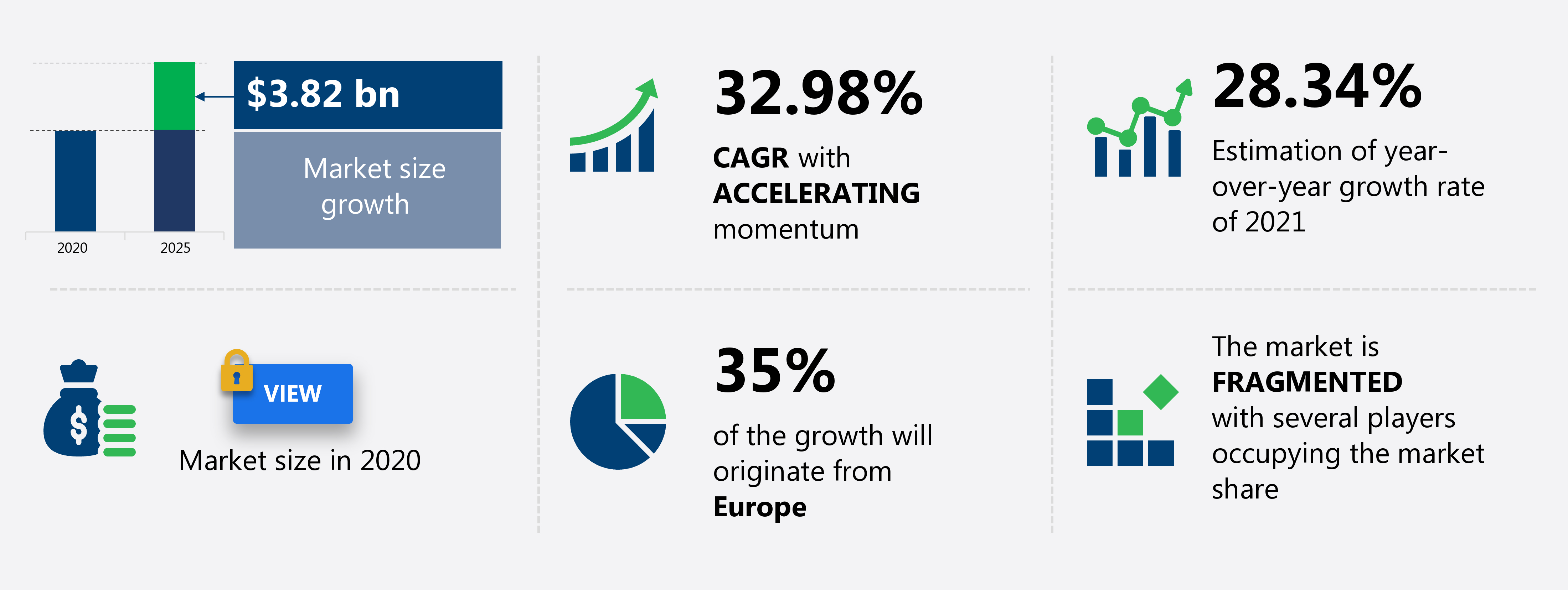
Download the Free Report Sample to Unlock the Aerospace 3D Printing Market Size for the Forecast Period and Other Important Statistics
"The expansion of facilities and extensive use of 3D printing technology for different components and parts will facilitate the commercial aerospace 3D printing market growth in North America over the forecast period."
Aerospace 3D Printing Market: Key Drivers, Trends, and Challenges
The improved parts performance with weight reduction is notably driving the aerospace 3D printing market growth, although factors such as restriction for buildup envelope and product size may impede market growth. Our research analysts have studied the historical data and deduced the key market drivers and the COVID-19 pandemic impact on the aerospace 3D printing industry. The holistic analysis of the drivers will help in deducing end goals and refining marketing strategies to gain a competitive edge.
Key Aerospace 3D Printing Market Driver
The improved parts performance with weight reduction is one of the key drivers supporting the aerospace 3D printing market growth. With 3D printing, it is feasible to produce lightweight structures for prototyping the final product. The technology enables the creation of intricate geometries that can drastically reduce the weight of a component while maintaining its structural strength. The reduction in weight helps designers achieve lower material costs, along with fuel savings. In the aerospace industry, reducing the overall weight of components is crucial to lowering fuel consumption and carbon dioxide emissions. On that note, Airbus is trying to attain certification for its lighter cabin partitions. Hence, the newly developed design for the A320 partition weighs 66.13 pounds less than the traditional one, indicating a 45% reduction in weight. Such developments are anticipated to drive market growth during the forecast period.
Key Aerospace 3D Printing Market Trend
Combining 3D printing with traditional manufacturing is another factor supporting the aerospace 3D printing market growth. For instance, Siemens offers the new NX Hybrid additive manufacturing software that uses conventional manufacturing and additive manufacturing for production. It is a hybrid process that combines conventional processes such as boring, milling, and grinding with additive manufacturing such as 3D printing. The company used the laser deposition process for building burner heads of gas turbines with metal powder. The burner was developed in innovative shapes, including honeycomb. It allowed the conversion of a solid structure to a hollow shape, with relative weight savings. Thus, the hybrid process helped reduce the manufacturing time by 90% and increased the dimensional accuracy of the component. Such recent technological improvements in 3D printers that can work with metal and aluminum will likely increase the acceptance of these printers in this industry.
Key Aerospace 3D Printing Market Challenge
Restriction for buildup envelope and product size is one of the factors hindering the aerospace 3D printing market growth. Most technologies offer systems with a limited building scope, which makes 3D printing applicable for only small components. This is applicable to almost all 3D printing processes, but the major issue in aircraft is with the powder bed fusion process, a widely applied technology for metal printing. Moreover, the biggest building scope for standard metal printing with the powder fusion bed process measures 0.8X0.4X0.5 m. There is a possibility to customize machines for customers, but this incurs high costs. The aerospace industry is focusing on upgrading the current technology for the printing of larger products. For instance, Oak Ridge National Laboratory and Boeing holds a world record for manufacturing the largest solid 3D-printed object called the trim and drill tool, which is used to create the wings of Boeing's Next-Generation 777X jet. Thus, the inability of 3D printers to produce large components hinders its wide-scale adoption in the aerospace industry.
This aerospace 3D printing market analysis report also provides detailed information on other upcoming trends and challenges that will have a far-reaching effect on the market growth. The actionable insights on the trends and challenges will help companies evaluate and develop growth strategies for 2021-2025.
Parent Market Analysis
Technavio categorizes the aerospace 3D printing market as a part of the global aerospace and defense market. Our research report has extensively covered external factors influencing the parent market growth potential in the coming years, which will determine the levels of growth of the aerospace 3D printing market during the forecast period.
Who are the Major Aerospace 3D Printing Market Vendors?
The report analyzes the market’s competitive landscape and offers information on several market vendors, including:
- 3D Systems Corp.
- Aerojet Rocketdyne Holdings Inc.
- EnvisionTEC GmBH
- EOS GmbH Electro Optical Systems
- General Electric Co.
- Hoganas AB
- Materialise NV
- Stratasys Ltd.
- The Boeing Co.
- The ExOne Company
This statistical study of the aerospace 3D printing market encompasses successful business strategies deployed by the key vendors. The aerospace 3D printing market is fragmented and the vendors are deploying organic and inorganic growth strategies to compete in the market.
Product Insights and News
- 3D Systems Corp. - It is a public company that is headquartered in the US. It is a global company that generated a revenue of $687.66 million and had around 2,620 employees. Its revenue from the global aerospace 3D printing market contributes to its overall revenues, along with its other offerings, but is not a key revenue stream for the company.
- 3D Systems Corp - The company offers aerospace 3D printing for additive manufacturing applications for aerospace and defense.
To make the most of the opportunities and recover from post COVID-19 impact, market vendors should focus more on the growth prospects in the fast-growing segments, while maintaining their positions in the slow-growing segments.
The aerospace 3D printing market forecast report offers in-depth insights into key vendor profiles. The profiles include information on the production, sustainability, and prospects of the leading companies.
Aerospace 3D Printing Market Value Chain Analysis
Our report provides extensive information on the value chain analysis for the aerospace 3D printing market, which vendors can leverage to gain a competitive advantage during the forecast period. The end-to-end understanding of the value chain is essential in profit margin optimization and evaluation of business strategies. The data available in our value chain analysis segment can help vendors drive costs and enhance customer services during the forecast period.
The value chain of the aerospace and defense market includes the following core components:
- Inputs
- Inbound logistics
- Operations
- Marketing and sales
- Aftermarket and service
The report has further elucidated on other innovative approaches being followed by manufacturers to ensure a sustainable market presence.
Which are the Key Regions for Aerospace 3D Printing Market?
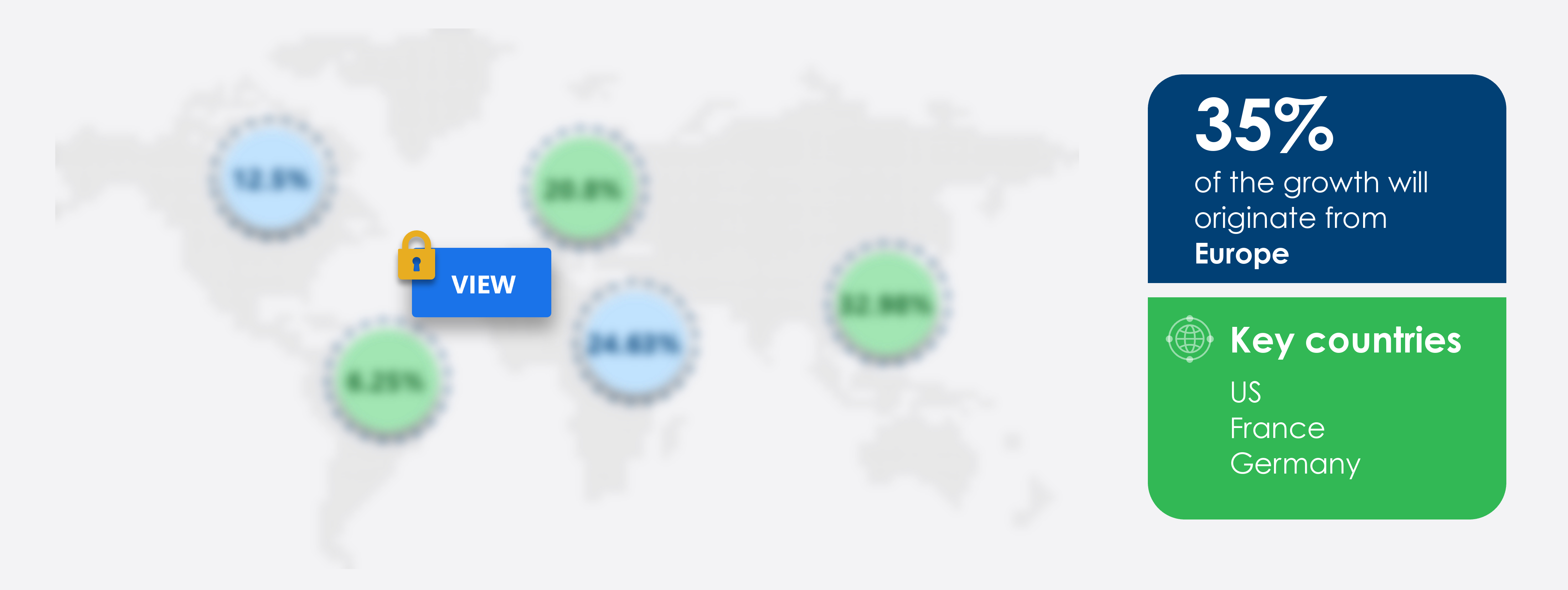
For more insights on the market share of various regions Request for a FREE sample now!
35% of the market’s growth will originate from Europe during the forecast period. France and Germany are the key markets for aerospace 3D printing market in Europe. Market growth in this region will be faster than the growth of the market in other regions.
Another key region offering significant growth opportunities to the vendors is North America. The expansion of facilities and the extensive use of 3D printing technology for different components and parts will facilitate the aerospace 3D printing market growth in North America over the forecast period. This market research report entails detailed information on the competitive intelligence, marketing gaps, and regional opportunities in store for vendors, which will assist in creating efficient business plans.
COVID Impact and Recovery Analysis
The outbreak of COVID-19 in the region severely impacted the regional aviation industry. However, in June 2020, airlines carried over 93% more passengers as compared with May 2020, owing to relaxation in travel restrictions. This, in turn, is expected to propel the demand for aircraft manufacturing, thereby driving the growth of the market in focus in North America. Furthermore, vaccination drives against COVID-19 have begun in the region, which will further boost market growth during the forecast period.
What are the Revenue-generating Aircraft Parts Segments in the Aerospace 3D Printing Market?

To gain further insights on the market contribution of various segments Request for a FREE sample
The aerospace 3D printing market share growth by the aircraft components segment will be significant during the forecast period. For instance, owing to the growing popularity of business jets, JBRND has strengthened the manufacturing capability of its plant located in San Antonio, Texas, US. It has initiated the use of 3D-printed prototypes and assembly guides to ramp up the development process of new components and parts. Such developments are expected to propel the adoption of additive manufacturing for the development of components and subsystems, which will drive the 3D printing aircraft components market globally during the forecast period.
This report provides an accurate prediction of the contribution of all the segments to the growth of the aerospace 3D printing market size and actionable market insights on post COVID-19 impact on each segment.
|
Aerospace 3D Printing Market Scope |
|
|
Report Coverage |
Details |
|
Page number |
120 |
|
Base year |
2020 |
|
Forecast period |
2021-2025 |
|
Growth momentum & CAGR |
Accelerate at a CAGR of 32.98% |
|
Market growth 2021-2025 |
$ 3.82 billion |
|
Market structure |
Fragmented |
|
YoY growth (%) |
28.34 |
|
Regional analysis |
North America, Europe, APAC, South America, and MEA |
|
Performing market contribution |
Europe at 35% |
|
Key consumer countries |
US, France, Germany, Canada, and UK |
|
Competitive landscape |
Leading companies, Competitive strategies, Consumer engagement scope |
|
Key companies profiled |
3D Systems Corp., Aerojet Rocketdyne Holdings Inc., EnvisionTEC GmBH, EOS GmbH Electro Optical Systems, General Electric Co., Hoganas AB, Materialise NV, Stratasys Ltd., The Boeing Co., and The ExOne Company |
|
Market dynamics |
Parent market analysis, Market growth inducers and obstacles, Fast-growing and slow-growing segment analysis, COVID 19 impact and recovery analysis and future consumer dynamics, Market condition analysis for forecast period |
|
Customization purview |
If our report has not included the data that you are looking for, you can reach out to our analysts and get segments customized. |
What are the Key Data Covered in this Aerospace 3D Printing Market Report?
- CAGR of the market during the forecast period 2021-2025
- Detailed information on factors that will drive aerospace 3D printing market growth during the next five years
- Precise estimation of the aerospace 3D printing market size and its contribution to the parent market
- Accurate predictions on upcoming trends and changes in consumer behavior
- The growth of the aerospace 3D printing industry across North America, Europe, APAC, South America, and MEA
- A thorough analysis of the market’s competitive landscape and detailed information on vendors
- Comprehensive details of factors that will challenge the growth of aerospace 3D printing market vendors
We can help! Our analysts can customize this report to meet your requirements. Get in touch
 RIA -
RIA - 
