
AI In Human Resources Market Size 2025-2029
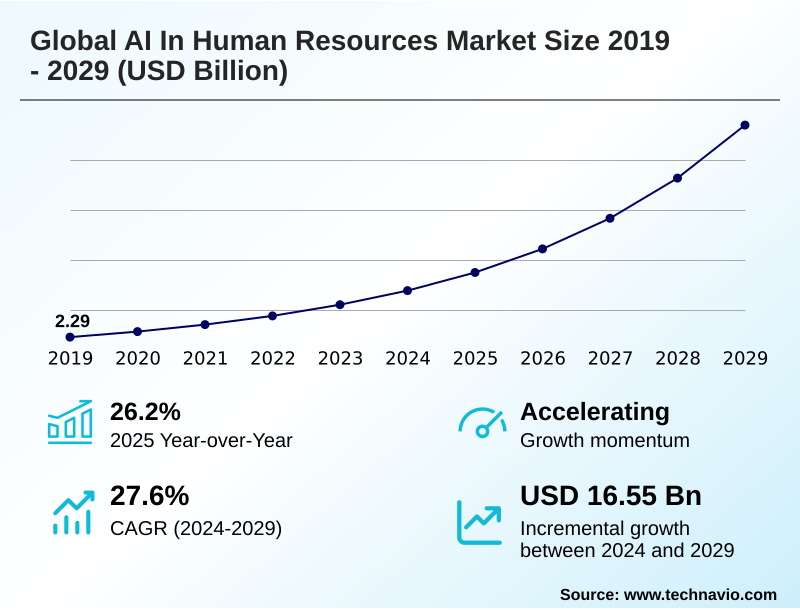
The ai in human resources market size is forecast to increase by USD 16.6 billion, at a CAGR of 27.6% between 2024 and 2029.
The global AI in human resources market is defined by the organizational need for operational efficiency and high-volume task automation. The integration of generative ai in hr transforms administrative responsibilities by introducing ai writing assistant software for tasks like generating job descriptions and performance feedback. This allows HR professionals to shift their focus toward strategic initiatives, including talent development and organizational culture. The application of human-centered ai principles ensures that these automated systems enhance, rather than replace, human capabilities. This focus on ai workload management is not merely about cost reduction but is a strategic move to create a more agile and responsive HR function that directly supports business objectives and employee well-being through advanced human resource (HR) technology.A primary trend shaping the market is the rapid adoption of generative AI and copilot assistants within core HR platforms, signifying a shift toward an interactive partnership between humans and machines. These intelligent assistants, acting as a personal ai assistant, augment the capabilities of recruiters and managers by creating new content, such as personalized outreach emails and structured interview questions. However, the use of these powerful tools introduces challenges related to data privacy and algorithmic bias. The concentration of sensitive employee data in AI platforms creates security risks, while models trained on historical data may perpetuate discriminatory outcomes. This necessitates robust ai consulting and artificial intelligence (AI) governance frameworks to ensure ethical deployment and regulatory compliance.
What will be the Size of the AI In Human Resources Market during the forecast period?
Explore in-depth regional segment analysis with market size data - historical 2019 - 2023 and forecasts 2025-2029 - in the full report.
Request Free Sample
The global AI in human resources market is advancing with the integration of algorithmic decision making and talent acquisition platforms, which streamline HR workflow automation. Systems are increasingly using automated resume screening and conversational AI chatbots to enhance efficiency. This evolution allows for a greater focus on employee sentiment analysis and predictive attrition modeling to inform retention strategies. Organizations are implementing these technologies to build a comprehensive workforce skills ontology, which is critical for future planning and development. The adoption of AI-powered skills intelligence and natural language processing is becoming standard for analyzing workforce data.The market's progression is further marked by the application of machine learning algorithms for data driven talent management. These systems facilitate the creation of an internal talent marketplace, which is crucial for employee growth and retention. The use of bias mitigation algorithms in automated candidate sourcing helps promote equitable hiring practices. Furthermore, generative AI copilots and personalized learning paths are reshaping employee development and engagement. The focus is shifting toward intelligent workforce planning and automated interview scheduling to create a more agile and strategic human capital function, with advancements in AI consulting becoming more prevalent.
How is this AI In Human Resources Industry segmented?
The ai in human resources industry research report provides comprehensive data (region-wise segment analysis), with forecasts and estimates in "USD million" for the period 2025-2029, as well as historical data from 2019 - 2023 for the following segments.
- Component
- Deployment
- Application
- Recruitment and hiring
- Employee onboarding and engagement
- Performance management
- Payroll processing
- Learning and development
- Geography
- North America
- Europe
- Germany
- UK
- France
- Italy
- The Netherlands
- Spain
- APAC
- China
- India
- Japan
- South Korea
- Australia
- Indonesia
- South America
- Middle East and Africa
- Rest of World (ROW)
By Component Insights
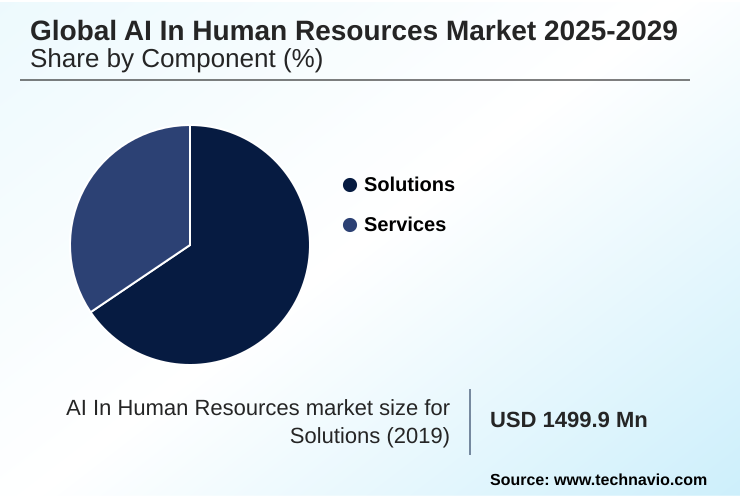
The solutions segment is estimated to witness significant growth during the forecast period.
The solutions segment is central to the global AI in human resources market, including software, platforms, and modules that automate HR functions. These tools are moving beyond simple automation to offer predictive insights for talent acquisition, management, and engagement. A key trend is the integration of these solutions into comprehensive Human Capital Management (HCM) suites, providing a unified data model for powerful analytics. South America is an emerging market, contributing around 4.5% to the global opportunity, with growing adoption in this segment.
The advent of generative AI is significantly impacting this segment, with its integration as an assistive copilot to augment human capabilities. These solutions help with tasks like generating career development recommendations and drafting performance feedback. This shift empowers HR professionals to focus on strategic initiatives by providing intelligent tools to managers and employees. Such advancements enhance productivity and organizational agility, transforming how human capital is managed and developed within enterprises across various industries.

Request Free Sample
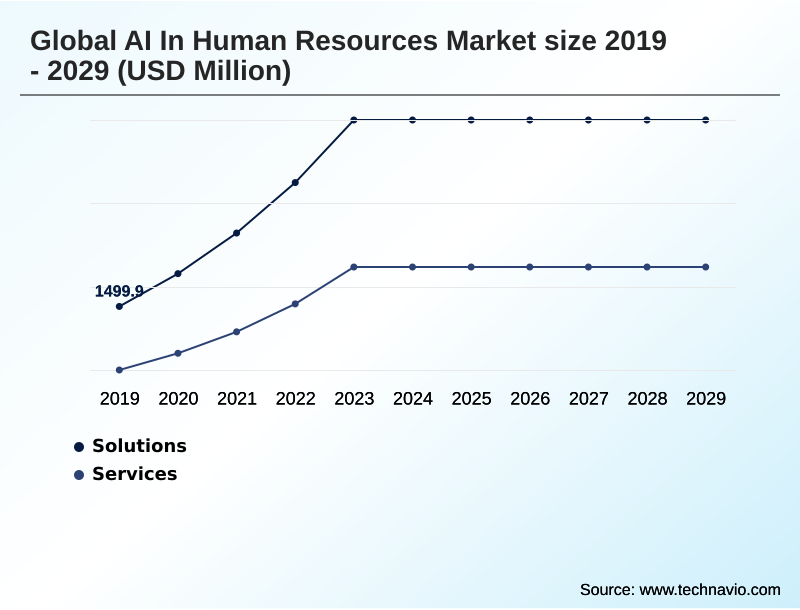
The Solutions segment was valued at USD 1.5 billion in 2019 and showed a gradual increase during the forecast period.
Regional Analysis
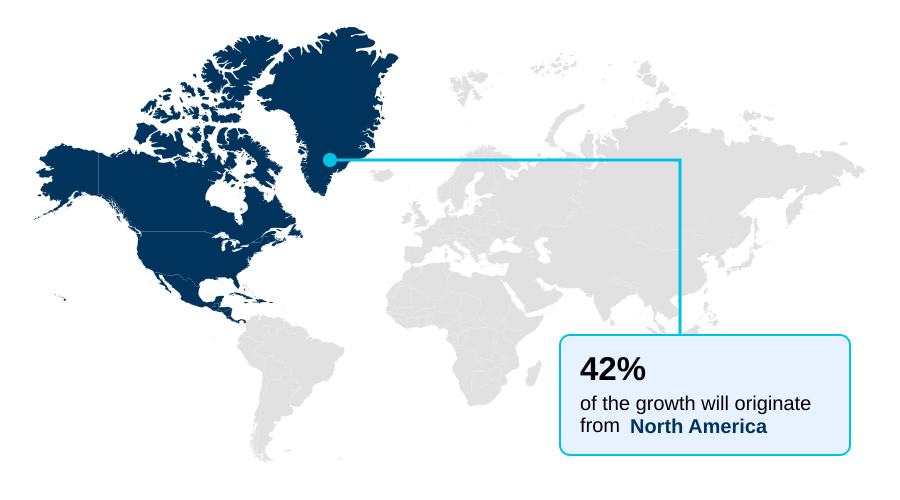
North America is estimated to contribute 42.3% to the growth of the global market during the forecast period.Technavio’s analysts have elaborately explained the regional trends and drivers that shape the market during the forecast period.
Request Free Sample
North America leads the global AI in human resources market, demonstrating high adoption rates and significant technological innovation. The region's dominance is driven by an intense focus on operational efficiency and a competitive talent landscape. Organizations in North America widely leverage AI to automate recruitment, reduce hiring times, and gain deep analytical insights into workforce productivity. The Middle East and Africa region accounts for over 3.5% of the geographic opportunity, showing potential for future growth as digitalization expands globally.
A strong emphasis on diversity, equity, and inclusion in North America has also spurred the adoption of AI tools designed to mitigate unconscious bias in hiring and promotion. The regulatory environment is another key factor, with jurisdictions implementing laws that mandate bias audits for automated employment decision tools. This proactive stance, combined with a technologically sophisticated enterprise base and a culture of early adoption, continues to fuel market expansion in the region, positioning it at the forefront of AI innovation in HR.
Market Dynamics
Our researchers analyzed the data with 2024 as the base year, along with the key drivers, trends, and challenges. A holistic analysis of drivers will help companies refine their marketing strategies to gain a competitive advantage.
The global AI in Human Resources market is expanding, driven by the need for greater operational efficiency and strategic talent management. Organizations are adopting sophisticated solutions like automated tools for recruitment and hiring and leveraging AI for data driven talent acquisition to gain a competitive edge. Post-hire, the focus shifts to retention and growth, with AI for enhancing employee onboarding and comprehensive AI powered employee experience platforms becoming standard. These platforms often use natural language processing for employee feedback to gauge sentiment, while AI powered platforms for employee engagement help foster a positive culture. Forward-thinking companies also apply machine learning for predictive attrition and integrate AI in strategic workforce planning to anticipate future needs, while generative AI for HR content creation streamlines communication, ultimately AI for enhancing operational efficiency.Internal talent development is also being revolutionized by AI driven internal talent mobility and new AI applications in performance management. A key strategy involves using AI for skills gap analysis, which directly informs applications for learning and development and enables AI for personalized employee development paths. On the administrative side, AI tools for payroll processing automation are reducing manual workloads. Enterprises can select from flexible cloud based AI HR solutions or secure on premises AI deployment models based on their needs. However, navigating this landscape requires careful attention to critical issues like algorithmic bias in HR systems and the broader ethical considerations in AI for HR to ensure fair and responsible implementation.

What are the key market drivers leading to the rise in the adoption of AI In Human Resources Industry?
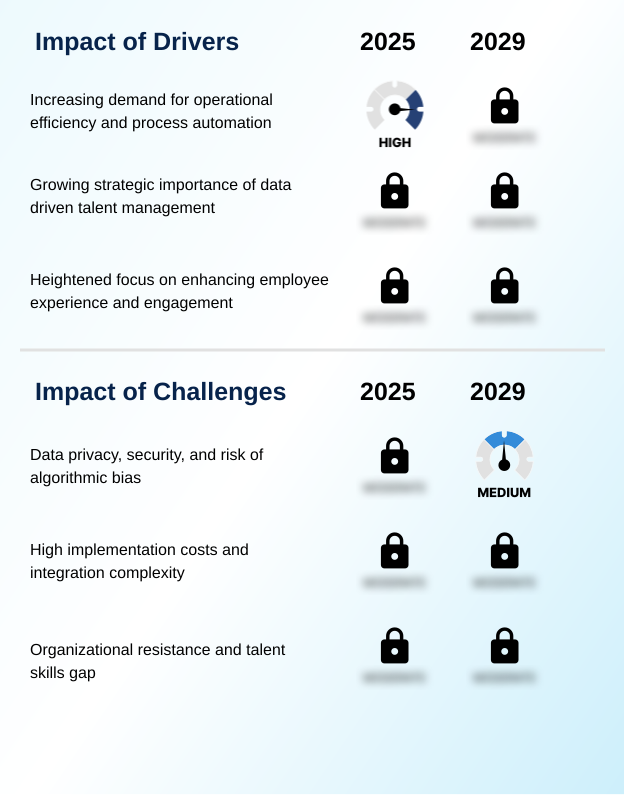
- The increasing demand for operational efficiency and process automation is a key driver for the market.
A primary driver for the AI in human resources market is the organizational push for operational efficiency and process automation. Companies are leveraging AI to handle high-volume, administrative tasks such as resume screening, interview scheduling, and routine employee inquiries. This automation allows HR professionals to reallocate their time to more strategic activities like talent development and succession planning. AI-powered applicant tracking systems and conversational AI chatbots enhance speed and accuracy, reducing the administrative load and improving the overall employee experience. This shift transforms the HR function from a cost center to a strategic business partner focused on activities that impact growth and well-being. For instance, North America is poised to capture over 42% of the market's incremental growth, indicating strong adoption in the region.The increasing strategic importance of data-driven talent management is another significant catalyst for AI adoption in HR. Organizations are moving away from intuitive decision-making toward an analytical, evidence-based approach to human capital management. AI platforms are crucial in this transition, as they can process and analyze vast, complex datasets from various sources, including performance reviews, engagement surveys, and skills assessments. By applying machine learning and predictive analytics, these systems uncover deep insights, such as identifying attributes of top performers, predicting employee attrition risk, and forecasting future skills gaps. This proactive approach enables businesses to align their talent strategy with corporate objectives, ensuring they have the right people and skills to succeed in a competitive environment.
What are the market trends shaping the AI In Human Resources Industry?
- The proliferation of generative AI and copilot assistants is an upcoming trend in the market.
A defining trend in the AI in human resources market is the rapid integration of generative AI and copilot assistants into core HR platforms. This evolution moves beyond predictive analytics to a more interactive and creative partnership between human and machine. These generative AI tools, functioning as a personal AI assistant, create new content to augment the capabilities of HR professionals, managers, and recruiters. Applications include drafting tailored job descriptions, generating personalized candidate outreach, and summarizing performance feedback. This trend is democratizing access to sophisticated AI, as users can interact with these systems using natural language. For instance, Europe is expected to contribute significantly, accounting for approximately 26% of the market opportunity. Such advancements are fundamentally changing HR workflows and enabling professionals to focus on strategic relationship-building.Another critical trend is the use of artificial intelligence to deliver a hyper-personalized employee experience. Organizations increasingly recognize that a one-size-fits-all approach to human capital management is ineffective for a diverse workforce. AI is the core technology enabling this shift, allowing companies to tailor experiences at scale across the employee lifecycle. In learning and development, AI algorithms recommend relevant courses and mentorship opportunities based on an employee's role, performance, and career goals. This level of personalization, supported by advancements in human resource (HR) technology and ai in learning and development, extends to career pathing, onboarding, and internal communications. The overarching goal is to make each employee feel uniquely valued and supported, which fosters both skill growth and engagement, leveraging technologies like ai talent management platforms.
What challenges does the AI In Human Resources Industry face during its growth?
- Data privacy, security, and the risk of algorithmic bias are key challenges affecting the market growth.
A formidable challenge impeding the adoption of AI in human resources involves data privacy, security, and the ethical risks of algorithmic decision-making. HR departments manage highly sensitive employee information, and concentrating this data into AI platforms creates a target for cyberattacks. Beyond security, AI models trained on historical data can learn and amplify latent biases related to gender, ethnicity, or age, leading to discriminatory outcomes in hiring and promotion. The 'black box' nature of some algorithms complicates validation and fairness assessments, creating significant legal and compliance risks. The APAC region presents a substantial market opportunity, representing over 23% of the geographic landscape, but companies there must also navigate these complex ethical and regulatory hurdles.The high implementation costs and integration complexity of AI solutions present another substantial barrier, especially for small and medium-sized enterprises. The total cost of ownership includes not just software fees but also infrastructure upgrades and the complex task of integrating new AI systems with existing enterprise software like HRIS and ATS. Without seamless integration, data silos can undermine the accuracy of analytical outputs. Furthermore, the success of AI depends on high-quality data, often requiring extensive and costly data cleansing and governance projects. This complexity necessitates reliance on specialized external consultants, further escalating costs and making AI deployment a major technological undertaking rather than a simple purchase.
Exclusive Customer Landscape
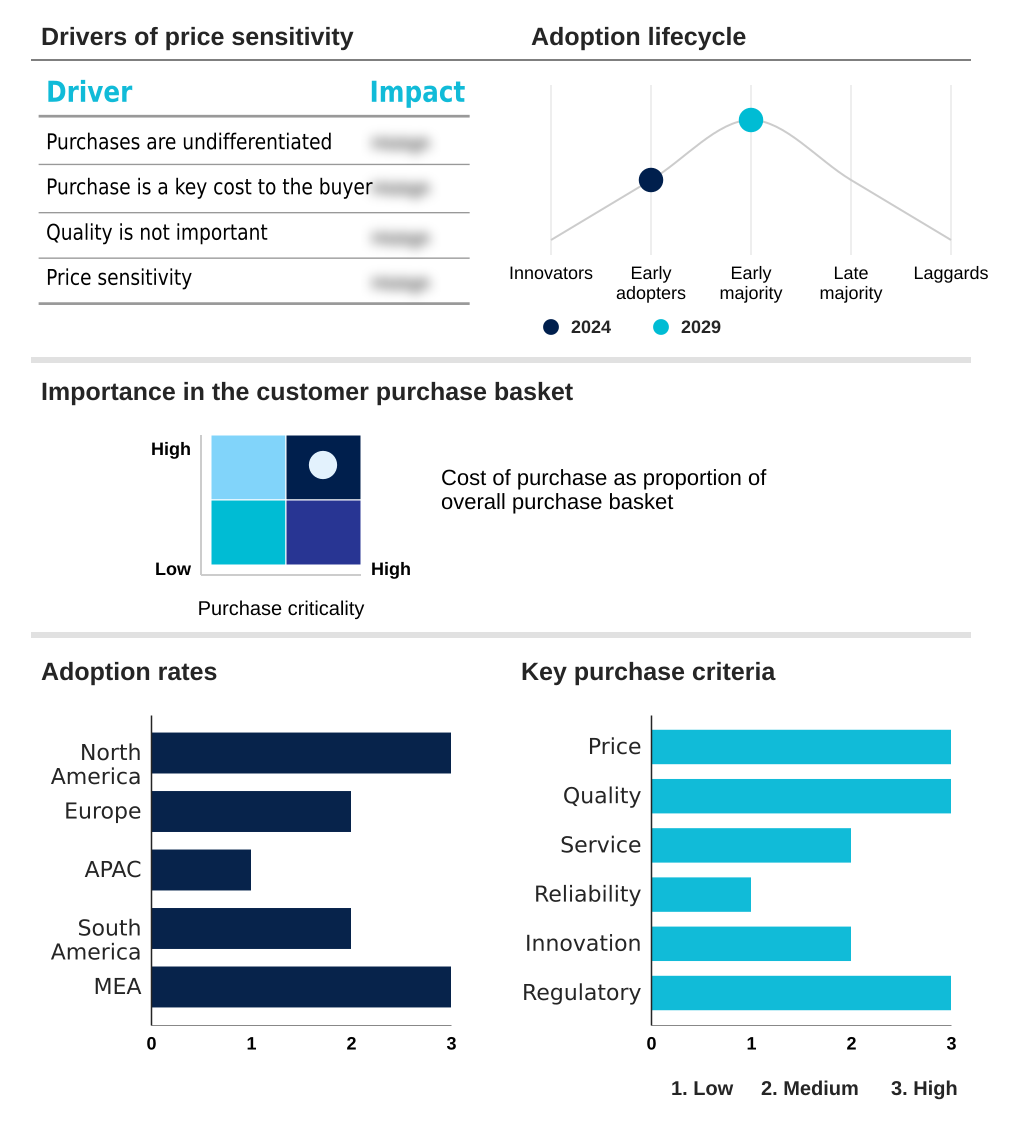
The ai in human resources market forecasting report includes the adoption lifecycle of the market, covering from the innovator’s stage to the laggard’s stage. It focuses on adoption rates in different regions based on penetration. Furthermore, the ai in human resources market report also includes key purchase criteria and drivers of price sensitivity to help companies evaluate and develop their market growth analysis strategies.
Customer Landscape
Key Companies & Market Insights
Companies are implementing various strategies, such as strategic alliances, ai in human resources market forecast, partnerships, mergers and acquisitions, geographical expansion, and product/service launches, to enhance their presence in the industry.
Aisera Inc. - The company provides AI in human resources, incorporating service automation, conversational AI, and workflow orchestration. Offerings include predictive analytics and intelligent search functionalities across HR and payroll processes. These solutions are designed to automate and enhance operations such as talent management, compliance services, and employment administration through a unified platform that leverages generative AI tools and domain-specific large language models.
The industry research and growth report includes detailed analyses of the competitive landscape of the market and information about key companies, including:
- Aisera Inc.
- Automatic Data Processing Inc.
- Bamboo HR LLC
- Beamery Inc.
- Betterworks Systems Inc.
- ClearCo. Inc.
- Effy AI
- Eightfold AI
- Gloat Inc.
- Hi bob Inc.
- HireVue Inc.
- iCIMS Inc.
- Legion Technologies, Inc.
- Nowsta, Inc.
- Personio SE and Co. KG
- Phenom People Inc.
- Simpplr
- Skillsoft Corp.
- Turbohire Technologies Pvt Ltd
- Workday Inc.
Qualitative and quantitative analysis of companies has been conducted to help clients understand the wider business environment as well as the strengths and weaknesses of key industry players. Data is qualitatively analyzed to categorize companies as pure play, category-focused, industry-focused, and diversified; it is quantitatively analyzed to categorize companies as dominant, leading, strong, tentative, and weak.
Recent Development and News in Ai In Human Resources Market
In April 2024, Workday Inc. announced new generative AI capabilities aimed at improving manager effectiveness by helping them draft career development goals and more impactful performance reviews.In February 2024, iCIMS Inc. launched a generative AI-powered recruiting copilot designed to enhance recruiter productivity by assisting with tasks such as sourcing, candidate engagement, and interview preparation.In February 2024, Phenom People Inc. announced its acquisition of TalentScribble, an employee-generated video platform, to integrate authentic employee stories into its AI-powered talent experience platform.
Research Analyst Overview
The global AI in human resources market is fundamentally reshaping talent acquisition processes. The integration of talent acquisition platforms powered by machine learning algorithms facilitates HR workflow automation from the outset. Automated candidate sourcing and automated resume screening are becoming standard, utilizing natural language processing to identify qualified individuals. Conversational AI chatbots manage initial candidate interactions, while automated interview scheduling streamlines logistics. This shift towards data driven talent management relies on AI based job matching and predictive hiring profiles to improve hiring precision. AI powered applicant tracking systems are evolving from simple databases into intelligent hubs for managing the initial phase of talent lifecycle management, demonstrating a clear move towards comprehensive HR process automation.Beyond acquisition, the focus extends to talent lifecycle management through data driven decision making. An internal talent marketplace, supported by AI powered skills intelligence and a workforce skills ontology, enables dynamic career pathing alongside automated onboarding workflows. Organizations utilize employee sentiment analysis and employee engagement analytics for proactive retention via predictive attrition modeling. Generative AI copilots and workforce productivity tools enhance daily tasks, while personalized learning paths address skills gap analysis. Continuous performance feedback and real time employee feedback inform AI driven compensation analysis. The emphasis on ethical AI deployment is critical, with bias mitigation algorithms, AI model transparency, and algorithmic fairness audits becoming integral to algorithmic decision making and intelligent workforce planning. Market expansion is anticipated to reflect an increase of over 30% in adoption rates.
Dive into Technavio’s robust research methodology, blending expert interviews, extensive data synthesis, and validated models for unparalleled AI In Human Resources Market insights. See full methodology.
|
Market Scope
|
|
Report Coverage
|
Details
|
|
Page number
|
293
|
|
Base year
|
2024
|
|
Historic period
|
2019 - 2023 |
|
Forecast period
|
2025-2029
|
|
Growth momentum & CAGR
|
Accelerating at a CAGR of 27.6%
|
|
Market growth 2024-2029
|
USD 16.6 billion
|
|
Market structure
|
Fragmented
|
|
YoY growth 2024-2029(%)
|
26.2%
|
|
Key countries
|
US, Canada, Mexico, Germany, UK, France, Italy, The Netherlands, Spain, China, India, Japan, South Korea, Australia, Indonesia, Brazil, Argentina, Colombia, Saudi Arabia, UAE, South Africa, Israel, Turkey
|
|
Competitive landscape
|
Leading Companies, Market Positioning of Companies, Competitive Strategies, and Industry Risks
|
Request Free Sample
What are the Key Data Covered in this AI In Human Resources Market Research and Growth Report?
- CAGR of the AI In Human Resources industry during the forecast period
- Detailed information on factors that will drive the growth and forecasting between 2024 and 2029
- Precise estimation of the size of the market and its contribution of the industry in focus to the parent market
- Accurate predictions about upcoming growth and trends and changes in consumer behaviour
- Growth of the market across North America, Europe, APAC, South America, Middle East and Africa
- Thorough analysis of the market’s competitive landscape and detailed information about companies
- Comprehensive analysis of factors that will challenge the ai in human resources market growth of industry companies
We can help! Our analysts can customize this ai in human resources market research report to meet your requirements.
Get in touch
1 Executive Summary
- 1 Executive Summary
- 1.1 Market overview
- Executive Summary - Chart on Market Overview
- Executive Summary - Data Table on Market Overview
- Executive Summary - Chart on Global Market Characteristics
- Executive Summary - Chart on Market by Geography
- Executive Summary - Chart on Market Segmentation by Component
- Executive Summary - Chart on Market Segmentation by Deployment
- Executive Summary - Chart on Market Segmentation by Application
- Executive Summary - Chart on Incremental Growth
- Executive Summary - Data Table on Incremental Growth
- Executive Summary - Chart on Company Market Positioning
2 Technavio Analysis
- 2 Technavio Analysis
- 2.1 Analysis of price sensitivity, lifecycle, customer purchase basket, adoption rates, and purchase criteria
- Analysis of price sensitivity, lifecycle, customer purchase basket, adoption rates, and purchase criteria
- 2.2 Criticality of inputs and Factors of differentiation
- Chart on Overview on criticality of inputs and factors of differentiation
- 2.3 Factors of disruption
- Chart on Overview on factors of disruption
- 2.4 Impact of drivers and challenges
- Chart on Impact of drivers and challenges in 2024 and 2029
3 Market Landscape
- 3 Market Landscape
- 3.1 Market ecosystem
- Chart on Parent Market
- Data Table on - Parent Market
- 3.2 Market characteristics
- Chart on Market characteristics analysis
- 3.3 Value chain analysis
- Chart on Value chain analysis
4 Market Sizing
- 4 Market Sizing
- 4.1 Market definition
- Data Table on Offerings of companies included in the market definition
- 4.2 Market segment analysis
- 4.3 Market size 2024
- 4.4 Market outlook: Forecast for 2024-2029
- Chart on Global - Market size and forecast 2024-2029 ($ billion)
- Data Table on Global - Market size and forecast 2024-2029 ($ billion)
- Chart on Global Market: Year-over-year growth 2024-2029 (%)
- Data Table on Global Market: Year-over-year growth 2024-2029 (%)
5 Historic Market Size
- 5 Historic Market Size
- 5.1 Global AI In Human Resources Market 2019 - 2023
- Historic Market Size - Data Table on Global AI In Human Resources Market 2019 - 2023 ($ billion)
- 5.2 Component segment analysis 2019 - 2023
- Historic Market Size - Component Segment 2019 - 2023 ($ billion)
- 5.3 Deployment segment analysis 2019 - 2023
- Historic Market Size - Deployment Segment 2019 - 2023 ($ billion)
- 5.4 Application segment analysis 2019 - 2023
- Historic Market Size - Application Segment 2019 - 2023 ($ billion)
- 5.5 Geography segment analysis 2019 - 2023
- Historic Market Size - Geography Segment 2019 - 2023 ($ billion)
- 5.6 Country segment analysis 2019 - 2023
- Historic Market Size - Country Segment 2019 - 2023 ($ billion)
6 Five Forces Analysis
- 6 Five Forces Analysis
- 6.1 Five forces summary
- Five forces analysis - Comparison between 2024 and 2029
- 6.2 Bargaining power of buyers
- Bargaining power of buyers - Impact of key factors 2024 and 2029
- 6.3 Bargaining power of suppliers
- Bargaining power of suppliers - Impact of key factors in 2024 and 2029
- 6.4 Threat of new entrants
- Threat of new entrants - Impact of key factors in 2024 and 2029
- 6.5 Threat of substitutes
- Threat of substitutes - Impact of key factors in 2024 and 2029
- 6.6 Threat of rivalry
- Threat of rivalry - Impact of key factors in 2024 and 2029
- 6.7 Market condition
- Chart on Market condition - Five forces 2024 and 2029
7 Market Segmentation by Component
- 7 Market Segmentation by Component
- 7.1 Market segments
- Chart on Component - Market share 2024-2029 (%)
- Data Table on Component - Market share 2024-2029 (%)
- 7.2 Comparison by Component
- Chart on Comparison by Component
- Data Table on Comparison by Component
- 7.3 Solutions - Market size and forecast 2024-2029
- Chart on Solutions - Market size and forecast 2024-2029 ($ billion)
- Data Table on Solutions - Market size and forecast 2024-2029 ($ billion)
- Chart on Solutions - Year-over-year growth 2024-2029 (%)
- Data Table on Solutions - Year-over-year growth 2024-2029 (%)
- 7.4 Services - Market size and forecast 2024-2029
- Chart on Services - Market size and forecast 2024-2029 ($ billion)
- Data Table on Services - Market size and forecast 2024-2029 ($ billion)
- Chart on Services - Year-over-year growth 2024-2029 (%)
- Data Table on Services - Year-over-year growth 2024-2029 (%)
- 7.5 Market opportunity by Component
- Market opportunity by Component ($ billion)
- Data Table on Market opportunity by Component ($ billion)
8 Market Segmentation by Deployment
- 8 Market Segmentation by Deployment
- 8.1 Market segments
- Chart on Deployment - Market share 2024-2029 (%)
- Data Table on Deployment - Market share 2024-2029 (%)
- 8.2 Comparison by Deployment
- Chart on Comparison by Deployment
- Data Table on Comparison by Deployment
- 8.3 Cloud - Market size and forecast 2024-2029
- Chart on Cloud - Market size and forecast 2024-2029 ($ billion)
- Data Table on Cloud - Market size and forecast 2024-2029 ($ billion)
- Chart on Cloud - Year-over-year growth 2024-2029 (%)
- Data Table on Cloud - Year-over-year growth 2024-2029 (%)
- 8.4 On premises - Market size and forecast 2024-2029
- Chart on On premises - Market size and forecast 2024-2029 ($ billion)
- Data Table on On premises - Market size and forecast 2024-2029 ($ billion)
- Chart on On premises - Year-over-year growth 2024-2029 (%)
- Data Table on On premises - Year-over-year growth 2024-2029 (%)
- 8.5 Market opportunity by Deployment
- Market opportunity by Deployment ($ billion)
- Data Table on Market opportunity by Deployment ($ billion)
9 Market Segmentation by Application
- 9 Market Segmentation by Application
- 9.1 Market segments
- Chart on Application - Market share 2024-2029 (%)
- Data Table on Application - Market share 2024-2029 (%)
- 9.2 Comparison by Application
- Chart on Comparison by Application
- Data Table on Comparison by Application
- 9.3 Recruitment and hiring - Market size and forecast 2024-2029
- Chart on Recruitment and hiring - Market size and forecast 2024-2029 ($ billion)
- Data Table on Recruitment and hiring - Market size and forecast 2024-2029 ($ billion)
- Chart on Recruitment and hiring - Year-over-year growth 2024-2029 (%)
- Data Table on Recruitment and hiring - Year-over-year growth 2024-2029 (%)
- 9.4 Employee onboarding and engagement - Market size and forecast 2024-2029
- Chart on Employee onboarding and engagement - Market size and forecast 2024-2029 ($ billion)
- Data Table on Employee onboarding and engagement - Market size and forecast 2024-2029 ($ billion)
- Chart on Employee onboarding and engagement - Year-over-year growth 2024-2029 (%)
- Data Table on Employee onboarding and engagement - Year-over-year growth 2024-2029 (%)
- 9.5 Performance management - Market size and forecast 2024-2029
- Chart on Performance management - Market size and forecast 2024-2029 ($ billion)
- Data Table on Performance management - Market size and forecast 2024-2029 ($ billion)
- Chart on Performance management - Year-over-year growth 2024-2029 (%)
- Data Table on Performance management - Year-over-year growth 2024-2029 (%)
- 9.6 Payroll processing - Market size and forecast 2024-2029
- Chart on Payroll processing - Market size and forecast 2024-2029 ($ billion)
- Data Table on Payroll processing - Market size and forecast 2024-2029 ($ billion)
- Chart on Payroll processing - Year-over-year growth 2024-2029 (%)
- Data Table on Payroll processing - Year-over-year growth 2024-2029 (%)
- 9.7 Learning and development - Market size and forecast 2024-2029
- Chart on Learning and development - Market size and forecast 2024-2029 ($ billion)
- Data Table on Learning and development - Market size and forecast 2024-2029 ($ billion)
- Chart on Learning and development - Year-over-year growth 2024-2029 (%)
- Data Table on Learning and development - Year-over-year growth 2024-2029 (%)
- 9.8 Market opportunity by Application
- Market opportunity by Application ($ billion)
- Data Table on Market opportunity by Application ($ billion)
10 Customer Landscape
- 10 Customer Landscape
- 10.1 Customer landscape overview
- Analysis of price sensitivity, lifecycle, customer purchase basket, adoption rates, and purchase criteria
11 Geographic Landscape
- 11 Geographic Landscape
- 11.1 Geographic segmentation
- Chart on Market share by geography 2024-2029 (%)
- Data Table on Market share by geography 2024-2029 (%)
- 11.2 Geographic comparison
- Chart on Geographic comparison
- Data Table on Geographic comparison
- 11.3 North America - Market size and forecast 2024-2029
- Chart on North America - Market size and forecast 2024-2029 ($ billion)
- Data Table on North America - Market size and forecast 2024-2029 ($ billion)
- Chart on North America - Year-over-year growth 2024-2029 (%)
- Data Table on North America - Year-over-year growth 2024-2029 (%)
- Chart on Regional Comparison - North America
- Data Table on Regional Comparison - North America
- 11.3.1 US - Market size and forecast 2024-2029
- Chart on US - Market size and forecast 2024-2029 ($ billion)
- Data Table on US - Market size and forecast 2024-2029 ($ billion)
- Chart on US - Year-over-year growth 2024-2029 (%)
- Data Table on US - Year-over-year growth 2024-2029 (%)
- 11.3.2 Canada - Market size and forecast 2024-2029
- Chart on Canada - Market size and forecast 2024-2029 ($ billion)
- Data Table on Canada - Market size and forecast 2024-2029 ($ billion)
- Chart on Canada - Year-over-year growth 2024-2029 (%)
- Data Table on Canada - Year-over-year growth 2024-2029 (%)
- 11.3.3 Mexico - Market size and forecast 2024-2029
- Chart on Mexico - Market size and forecast 2024-2029 ($ billion)
- Data Table on Mexico - Market size and forecast 2024-2029 ($ billion)
- Chart on Mexico - Year-over-year growth 2024-2029 (%)
- Data Table on Mexico - Year-over-year growth 2024-2029 (%)
- 11.4 Europe - Market size and forecast 2024-2029
- Chart on Europe - Market size and forecast 2024-2029 ($ billion)
- Data Table on Europe - Market size and forecast 2024-2029 ($ billion)
- Chart on Europe - Year-over-year growth 2024-2029 (%)
- Data Table on Europe - Year-over-year growth 2024-2029 (%)
- Chart on Regional Comparison - Europe
- Data Table on Regional Comparison - Europe
- 11.4.1 Germany - Market size and forecast 2024-2029
- Chart on Germany - Market size and forecast 2024-2029 ($ billion)
- Data Table on Germany - Market size and forecast 2024-2029 ($ billion)
- Chart on Germany - Year-over-year growth 2024-2029 (%)
- Data Table on Germany - Year-over-year growth 2024-2029 (%)
- 11.4.2 UK - Market size and forecast 2024-2029
- Chart on UK - Market size and forecast 2024-2029 ($ billion)
- Data Table on UK - Market size and forecast 2024-2029 ($ billion)
- Chart on UK - Year-over-year growth 2024-2029 (%)
- Data Table on UK - Year-over-year growth 2024-2029 (%)
- 11.4.3 France - Market size and forecast 2024-2029
- Chart on France - Market size and forecast 2024-2029 ($ billion)
- Data Table on France - Market size and forecast 2024-2029 ($ billion)
- Chart on France - Year-over-year growth 2024-2029 (%)
- Data Table on France - Year-over-year growth 2024-2029 (%)
- 11.4.4 Italy - Market size and forecast 2024-2029
- Chart on Italy - Market size and forecast 2024-2029 ($ billion)
- Data Table on Italy - Market size and forecast 2024-2029 ($ billion)
- Chart on Italy - Year-over-year growth 2024-2029 (%)
- Data Table on Italy - Year-over-year growth 2024-2029 (%)
- 11.4.5 The Netherlands - Market size and forecast 2024-2029
- Chart on The Netherlands - Market size and forecast 2024-2029 ($ billion)
- Data Table on The Netherlands - Market size and forecast 2024-2029 ($ billion)
- Chart on The Netherlands - Year-over-year growth 2024-2029 (%)
- Data Table on The Netherlands - Year-over-year growth 2024-2029 (%)
- 11.4.6 Spain - Market size and forecast 2024-2029
- Chart on Spain - Market size and forecast 2024-2029 ($ billion)
- Data Table on Spain - Market size and forecast 2024-2029 ($ billion)
- Chart on Spain - Year-over-year growth 2024-2029 (%)
- Data Table on Spain - Year-over-year growth 2024-2029 (%)
- 11.5 APAC - Market size and forecast 2024-2029
- Chart on APAC - Market size and forecast 2024-2029 ($ billion)
- Data Table on APAC - Market size and forecast 2024-2029 ($ billion)
- Chart on APAC - Year-over-year growth 2024-2029 (%)
- Data Table on APAC - Year-over-year growth 2024-2029 (%)
- Chart on Regional Comparison - APAC
- Data Table on Regional Comparison - APAC
- 11.5.1 China - Market size and forecast 2024-2029
- Chart on China - Market size and forecast 2024-2029 ($ billion)
- Data Table on China - Market size and forecast 2024-2029 ($ billion)
- Chart on China - Year-over-year growth 2024-2029 (%)
- Data Table on China - Year-over-year growth 2024-2029 (%)
- 11.5.2 India - Market size and forecast 2024-2029
- Chart on India - Market size and forecast 2024-2029 ($ billion)
- Data Table on India - Market size and forecast 2024-2029 ($ billion)
- Chart on India - Year-over-year growth 2024-2029 (%)
- Data Table on India - Year-over-year growth 2024-2029 (%)
- 11.5.3 Japan - Market size and forecast 2024-2029
- Chart on Japan - Market size and forecast 2024-2029 ($ billion)
- Data Table on Japan - Market size and forecast 2024-2029 ($ billion)
- Chart on Japan - Year-over-year growth 2024-2029 (%)
- Data Table on Japan - Year-over-year growth 2024-2029 (%)
- 11.5.4 South Korea - Market size and forecast 2024-2029
- Chart on South Korea - Market size and forecast 2024-2029 ($ billion)
- Data Table on South Korea - Market size and forecast 2024-2029 ($ billion)
- Chart on South Korea - Year-over-year growth 2024-2029 (%)
- Data Table on South Korea - Year-over-year growth 2024-2029 (%)
- 11.5.5 Australia - Market size and forecast 2024-2029
- Chart on Australia - Market size and forecast 2024-2029 ($ billion)
- Data Table on Australia - Market size and forecast 2024-2029 ($ billion)
- Chart on Australia - Year-over-year growth 2024-2029 (%)
- Data Table on Australia - Year-over-year growth 2024-2029 (%)
- 11.5.6 Indonesia - Market size and forecast 2024-2029
- Chart on Indonesia - Market size and forecast 2024-2029 ($ billion)
- Data Table on Indonesia - Market size and forecast 2024-2029 ($ billion)
- Chart on Indonesia - Year-over-year growth 2024-2029 (%)
- Data Table on Indonesia - Year-over-year growth 2024-2029 (%)
- 11.6 South America - Market size and forecast 2024-2029
- Chart on South America - Market size and forecast 2024-2029 ($ billion)
- Data Table on South America - Market size and forecast 2024-2029 ($ billion)
- Chart on South America - Year-over-year growth 2024-2029 (%)
- Data Table on South America - Year-over-year growth 2024-2029 (%)
- Chart on Regional Comparison - South America
- Data Table on Regional Comparison - South America
- 11.6.1 Brazil - Market size and forecast 2024-2029
- Chart on Brazil - Market size and forecast 2024-2029 ($ billion)
- Data Table on Brazil - Market size and forecast 2024-2029 ($ billion)
- Chart on Brazil - Year-over-year growth 2024-2029 (%)
- Data Table on Brazil - Year-over-year growth 2024-2029 (%)
- 11.6.2 Argentina - Market size and forecast 2024-2029
- Chart on Argentina - Market size and forecast 2024-2029 ($ billion)
- Data Table on Argentina - Market size and forecast 2024-2029 ($ billion)
- Chart on Argentina - Year-over-year growth 2024-2029 (%)
- Data Table on Argentina - Year-over-year growth 2024-2029 (%)
- 11.6.3 Colombia - Market size and forecast 2024-2029
- Chart on Colombia - Market size and forecast 2024-2029 ($ billion)
- Data Table on Colombia - Market size and forecast 2024-2029 ($ billion)
- Chart on Colombia - Year-over-year growth 2024-2029 (%)
- Data Table on Colombia - Year-over-year growth 2024-2029 (%)
- 11.7 Middle East and Africa - Market size and forecast 2024-2029
- Chart on Middle East and Africa - Market size and forecast 2024-2029 ($ billion)
- Data Table on Middle East and Africa - Market size and forecast 2024-2029 ($ billion)
- Chart on Middle East and Africa - Year-over-year growth 2024-2029 (%)
- Data Table on Middle East and Africa - Year-over-year growth 2024-2029 (%)
- Chart on Regional Comparison - Middle East and Africa
- Data Table on Regional Comparison - Middle East and Africa
- 11.7.1 Saudi Arabia - Market size and forecast 2024-2029
- Chart on Saudi Arabia - Market size and forecast 2024-2029 ($ billion)
- Data Table on Saudi Arabia - Market size and forecast 2024-2029 ($ billion)
- Chart on Saudi Arabia - Year-over-year growth 2024-2029 (%)
- Data Table on Saudi Arabia - Year-over-year growth 2024-2029 (%)
- 11.7.2 UAE - Market size and forecast 2024-2029
- Chart on UAE - Market size and forecast 2024-2029 ($ billion)
- Data Table on UAE - Market size and forecast 2024-2029 ($ billion)
- Chart on UAE - Year-over-year growth 2024-2029 (%)
- Data Table on UAE - Year-over-year growth 2024-2029 (%)
- 11.7.3 South Africa - Market size and forecast 2024-2029
- Chart on South Africa - Market size and forecast 2024-2029 ($ billion)
- Data Table on South Africa - Market size and forecast 2024-2029 ($ billion)
- Chart on South Africa - Year-over-year growth 2024-2029 (%)
- Data Table on South Africa - Year-over-year growth 2024-2029 (%)
- 11.7.4 Israel - Market size and forecast 2024-2029
- Chart on Israel - Market size and forecast 2024-2029 ($ billion)
- Data Table on Israel - Market size and forecast 2024-2029 ($ billion)
- Chart on Israel - Year-over-year growth 2024-2029 (%)
- Data Table on Israel - Year-over-year growth 2024-2029 (%)
- 11.7.5 Turkey - Market size and forecast 2024-2029
- Chart on Turkey - Market size and forecast 2024-2029 ($ billion)
- Data Table on Turkey - Market size and forecast 2024-2029 ($ billion)
- Chart on Turkey - Year-over-year growth 2024-2029 (%)
- Data Table on Turkey - Year-over-year growth 2024-2029 (%)
- 11.8 Market opportunity by geography
- Market opportunity by geography ($ billion)
- Data Tables on Market opportunity by geography ($ billion)
12 Drivers, Challenges, and Opportunity
- 12 Drivers, Challenges, and Opportunity
- 12.1 Market drivers
- Increasing demand for operational efficiency and process automation
- Growing strategic importance of data driven talent management
- Heightened focus on enhancing employee experience and engagement
- 12.2 Market challenges
- Data privacy, security, and risk of algorithmic bias
- High implementation costs and integration complexity
- Organizational resistance and talent skills gap
- 12.3 Impact of drivers and challenges
- Impact of drivers and challenges in 2024 and 2029
- 12.4 Market opportunities
- Proliferation of generative AI and copilot assistants
- Shift toward hyper-personalization of employee experience
- Focus on AI-powered skills intelligence and internal mobility
13 Competitive Landscape
- 13 Competitive Landscape
- 13.1 Overview
- 13.2 Competitive Landscape
- Overview on criticality of inputs and factors of differentiation
- 13.3 Landscape disruption
- Overview on factors of disruption
- 13.4 Industry risks
- Impact of key risks on business
14 Competitive Analysis
- 14 Competitive Analysis
- 14.1 Companies profiled
- 14.2 Company ranking index
- 14.3 Market positioning of companies
- Matrix on companies position and classification
- 14.4 Aisera Inc.
- Aisera Inc. - Overview
- Aisera Inc. - Product / Service
- Aisera Inc. - Key offerings
- SWOT
- 14.5 Automatic Data Processing Inc.
- Automatic Data Processing Inc. - Overview
- Automatic Data Processing Inc. - Business segments
- Automatic Data Processing Inc. - Key news
- Automatic Data Processing Inc. - Key offerings
- Automatic Data Processing Inc. - Segment focus
- SWOT
- 14.6 Bamboo HR LLC
- Bamboo HR LLC - Overview
- Bamboo HR LLC - Product / Service
- Bamboo HR LLC - Key offerings
- SWOT
- 14.7 Beamery Inc.
- Beamery Inc. - Overview
- Beamery Inc. - Product / Service
- Beamery Inc. - Key offerings
- SWOT
- 14.8 Betterworks Systems Inc.
- Betterworks Systems Inc. - Overview
- Betterworks Systems Inc. - Product / Service
- Betterworks Systems Inc. - Key offerings
- SWOT
- 14.9 Eightfold AI
- Eightfold AI - Overview
- Eightfold AI - Product / Service
- Eightfold AI - Key offerings
- SWOT
- 14.10 Gloat Inc.
- Gloat Inc. - Overview
- Gloat Inc. - Product / Service
- Gloat Inc. - Key offerings
- SWOT
- 14.11 HireVue Inc.
- HireVue Inc. - Overview
- HireVue Inc. - Product / Service
- HireVue Inc. - Key offerings
- SWOT
- 14.12 iCIMS Inc.
- iCIMS Inc. - Overview
- iCIMS Inc. - Product / Service
- iCIMS Inc. - Key offerings
- SWOT
- 14.13 Legion Technologies, Inc.
- Legion Technologies, Inc. - Overview
- Legion Technologies, Inc. - Product / Service
- Legion Technologies, Inc. - Key offerings
- SWOT
- 14.14 Personio SE and Co. KG
- Personio SE and Co. KG - Overview
- Personio SE and Co. KG - Product / Service
- Personio SE and Co. KG - Key offerings
- SWOT
- 14.15 Phenom People Inc.
- Phenom People Inc. - Overview
- Phenom People Inc. - Product / Service
- Phenom People Inc. - Key offerings
- SWOT
- 14.16 Simpplr
- Simpplr - Overview
- Simpplr - Product / Service
- Simpplr - Key offerings
- SWOT
- 14.17 Turbohire Technologies Pvt Ltd
- Turbohire Technologies Pvt Ltd - Overview
- Turbohire Technologies Pvt Ltd - Product / Service
- Turbohire Technologies Pvt Ltd - Key offerings
- SWOT
- 14.18 Workday Inc.
- Workday Inc. - Overview
- Workday Inc. - Product / Service
- Workday Inc. - Key news
- Workday Inc. - Key offerings
- SWOT
15 Appendix
- 15 Appendix
- 15.1 Scope of the report
- Market definition
- Objectives
- Notes and caveats
- 15.2 Inclusions and exclusions checklist
- Inclusions checklist
- Exclusions checklist
- 15.3 Currency conversion rates for US$
- Currency conversion rates for US$
- 15.4 Research methodology
- 15.5 Data procurement
- 15.6 Data validation
- 15.7 Validation techniques employed for market sizing
- Validation techniques employed for market sizing
- 15.8 Data synthesis
- 15.9 360 degree market analysis
- 360 degree market analysis
- 15.10 List of abbreviations