
AI In Pharma And Biotech Market Size 2025-2029
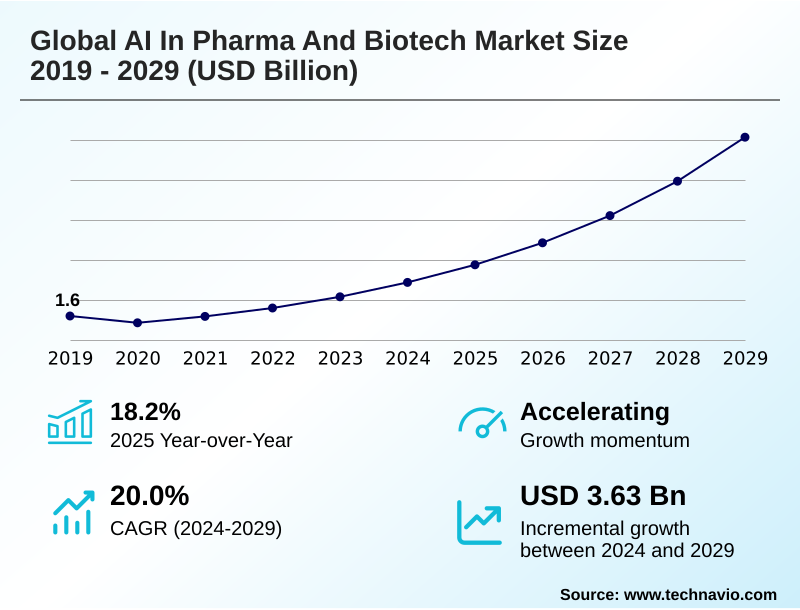
The ai in pharma and biotech market size is forecast to increase by USD 3.6 billion, at a CAGR of 20.0% between 2024 and 2029.
The global AI in pharma and biotech market is driven by the need to resolve diminishing R&D productivity. This addresses the high costs and failure rates of traditional drug development, leveraging artificial intelligence in drug discovery. The shift toward integrated, industrial-scale R&D platforms marks a significant trend, moving from isolated AI projects to end-to-end systems for therapeutic innovation. This industrialization aims to make drug discovery a more predictable and scalable process through continuous learning and prediction. Such platforms use interconnected AI models for hypothesis generation, target identification, and de novo molecule design. These systems are central to AI in genomics and AI in precision medicine.However, the market is constrained by significant data-related issues. The utility of AI models is limited by poor data quality, fragmented data silos, and a lack of standardization in biomedical information. This problem of 'garbage in, garbage out' requires extensive data preprocessing, cleaning, and annotation before AI can be effectively applied in areas like AI in pathology or applied AI in healthcare. These data wrangling activities represent a substantial portion of the time and cost of any AI project, creating a foundational barrier to unlocking the full potential of AI in chemicals and drug development.
What will be the Size of the AI In Pharma And Biotech Market during the forecast period?
Explore in-depth regional segment analysis with market size data - historical 2019 - 2023 and forecasts 2025-2029 - in the full report.
Request Free Sample
The global AI in pharma and biotech market is shaped by the application of AI-based target validation and federated learning for data privacy. Advances in AI-powered pathology analysis and computational drug repurposing are redefining diagnostic and therapeutic strategies. High-performance computing for AI is essential for processing complex datasets, while AI in biologics manufacturing streamlines production.Development of AI-driven companion diagnostics and AI models for ADMET prediction is critical for advancing personalized treatments. The use of generative AI for de novo molecule design and AI in multi-omics data integration enables the creation of novel therapeutic candidates. This progress is supported by efforts to improve AI model interpretability and explainability, ensuring trust in computational outcomes.The modernization of clinical trials is advanced through AI-driven clinical trial modernization and AI in patient monitoring. These technologies leverage AI-generated synthetic patient data and real-world evidence analysis to create more efficient and representative studies. Furthermore, AI-enhanced supply chain management optimizes logistics, ensuring that innovative treatments reach patients effectively and contributing to the growth of AI in oncology and AI in genomics.
How is this AI In Pharma And Biotech Industry segmented?
The ai in pharma and biotech industry research report provides comprehensive data (region-wise segment analysis), with forecasts and estimates in "USD million" for the period 2025-2029, as well as historical data from 2019 - 2023 for the following segments.
- Type
- Small molecules
- Large molecules
- Vaccines
- Cell and gene therapies
- Technology
- Machine learning
- Deep learning
- NLP
- Computer vision
- Generative AI
- Application
- Drug discovery
- Preclinical and clinical trials
- Regulatory compliance and pharmacovigilance
- Others
- Geography
- North America
- Europe
- Germany
- UK
- France
- The Netherlands
- Italy
- Spain
- APAC
- China
- Japan
- India
- South Korea
- Australia
- Indonesia
- South America
- Middle East and Africa
- Rest of World (ROW)
By Type Insights
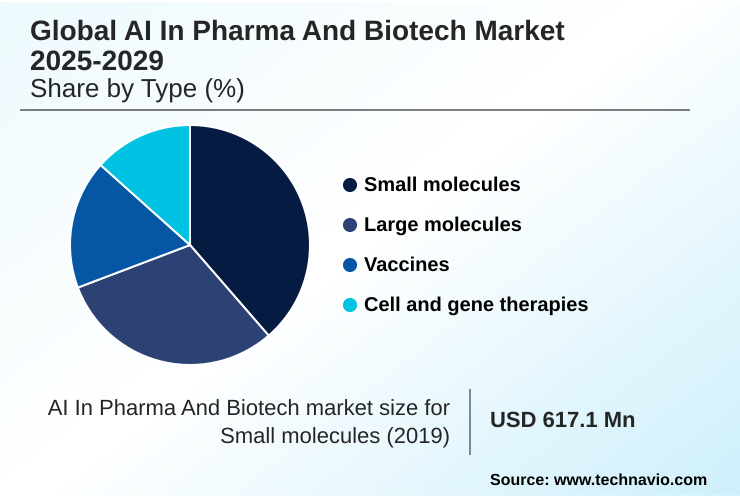
The small molecules segment is estimated to witness significant growth during the forecast period.
The discovery and development of small molecules is the most mature segment, where AI is transforming a process plagued by high attrition rates and immense costs. AI addresses these issues by shifting from serendipitous screening to rational, predictive design. Generative AI algorithms are at the forefront, enabling the de novo design of novel chemical entities optimized for specific disease targets. This in-silico creation is significantly faster than traditional high-throughput screening. This rational design approach is critical, as more than 2.96% of the market's opportunities are linked to improving early-stage discovery efficiency through computational methods.
Beyond generation, predictive machine learning models are indispensable for early-stage de-risking and ADMET prediction. These algorithms forecast a compound's absorption, distribution, metabolism, excretion, and toxicity properties, allowing researchers to computationally filter out candidates with unfavorable profiles. This capability to 'fail fast and fail cheap' avoids significant investment in unpromising molecules. The strategic value of this is underscored by major pharmaceutical companies directing substantial resources toward these platforms, validating AI's role in creating high-quality, viable small molecule candidates through AI-based target validation.

Request Free Sample
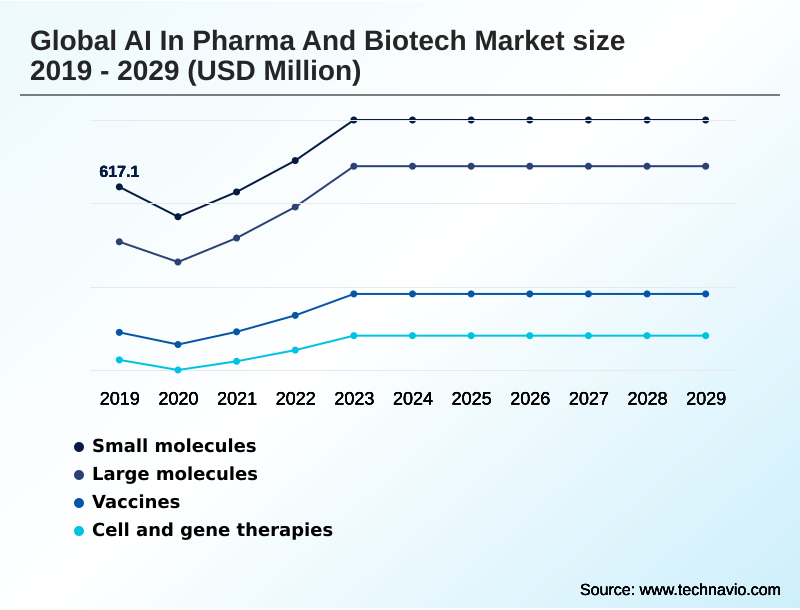
The Small molecules segment was valued at USD 617.10 million in 2019 and showed a gradual increase during the forecast period.
Regional Analysis
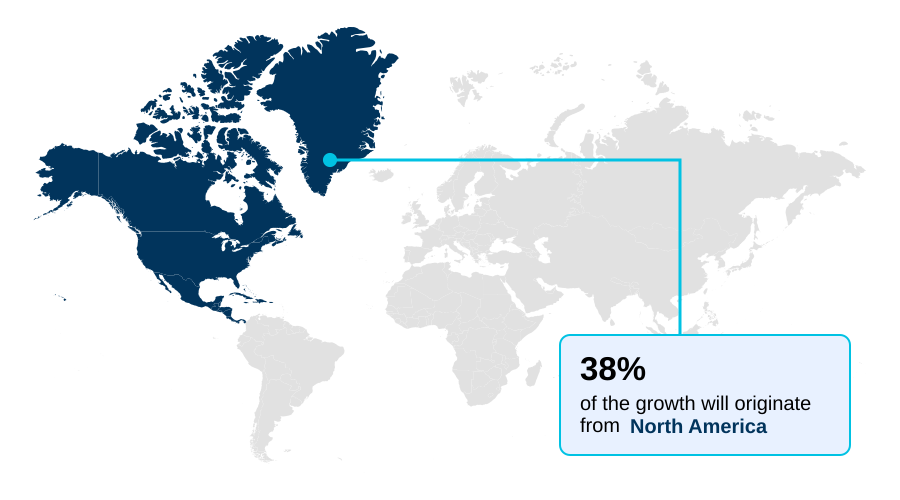
North America is estimated to contribute 37.9% to the growth of the global market during the forecast period.Technavio’s analysts have elaborately explained the regional trends and drivers that shape the market during the forecast period.
Request Free Sample
North America, led by the United States, is the undisputed global leader in the AI in pharma and biotech market. The region's dominance is built on a powerful, self-reinforcing ecosystem that combines a well-capitalized pharmaceutical sector, the world's leading technology companies, and a vibrant venture capital landscape. This environment in North America fosters a dense network of AI-native biotech startups, particularly in life science hubs. The market is driven by immense pressure to innovate and overcome the economic challenges of traditional drug development. The region's growth is substantial, with over 2.43% of global opportunities concentrated here.
US-based pharmaceutical giants in North America are among the most aggressive adopters of AI, engaging in high-value collaborations and strategic acquisitions to integrate cutting-edge computational capabilities. The regulatory environment has been progressively supportive of digital health technologies, encouraging investment. The region's leadership is exemplified by the scale of its strategic partnerships, which underscore the trend of deep integration between big pharma and elite AI enterprises. Furthermore, North America possesses an unparalleled concentration of elite academic institutions that produce foundational research and specialized talent, fueling the industry's growth through advancements in federated learning and high-performance computing.
Market Dynamics
Our researchers analyzed the data with 2024 as the base year, along with the key drivers, trends, and challenges. A holistic analysis of drivers will help companies refine their marketing strategies to gain a competitive advantage.
The global AI in pharma and biotech market is experiencing explosive growth, driven by innovations across the entire value chain. In early stages, AI in preclinical research is revolutionizing processes like AI in small molecule discovery and leveraging generative AI for de novo molecule design. Companies are increasingly using AI-based target validation and robust AI models for ADMET prediction to de-risk development. The integration of complex datasets is managed through AI in multi-omics data integration, all supported by significant investments in high-performance computing for AI. These capabilities accelerate the initial phases, promising a higher success rate for novel therapeutics.Beyond discovery, the market is expanding through AI-driven clinical trial modernization, which utilizes AI-generated synthetic patient data and extensive real-world evidence analysis. The development of predictive models for drug efficacy is crucial, often paired with AI-powered diagnostic development. This synergy creates opportunities for AI-driven companion diagnostics and enhances AI-powered pathology analysis. As these solutions mature, ensuring AI model interpretability and explainability becomes paramount, alongside employing federated learning for data privacy. Furthermore, applications in computational drug repurposing, AI in biologics manufacturing, continuous AI in patient monitoring, and AI-enhanced supply chain management are optimizing costs and extending market reach.

What are the key market drivers leading to the rise in the adoption of AI In Pharma And Biotech Industry?
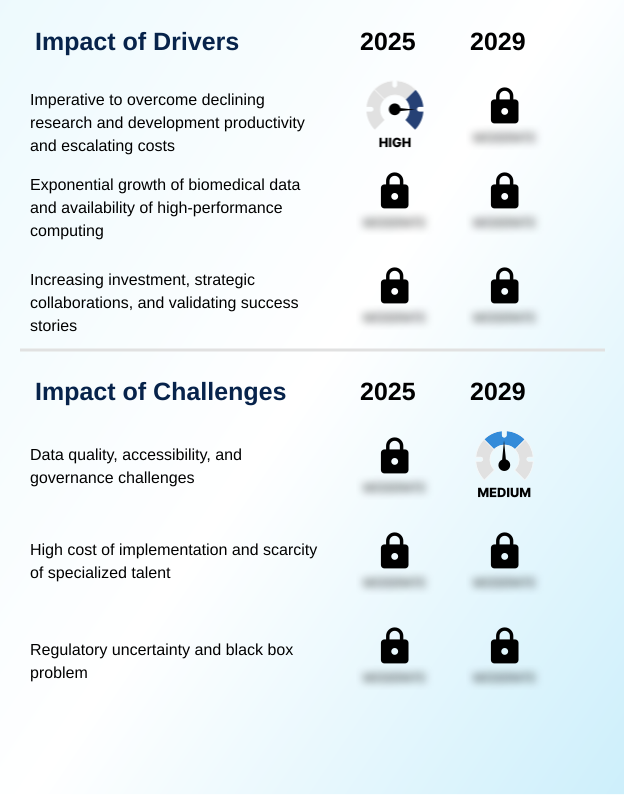
- The imperative to overcome declining research and development productivity and escalating costs is a key driver for the market.
A primary driver is the urgent need to reverse declining R&D productivity and counter escalating development costs. Traditional pharmaceutical R&D is characterized by long timelines, staggering expenses, and high attrition rates, creating an unsustainable economic model. AI offers a solution by re-engineering the value chain. In drug discovery, AI platforms identify and validate novel biological targets with enhanced speed and precision. Generative models design molecules from scratch, reducing reliance on expensive high-throughput screening. Predictive machine learning for ADMET properties allows for early de-risking of candidates at the in-silico stage, terminating unpromising projects before significant capital is invested. By addressing core drivers of cost and failure, AI is becoming an indispensable strategic asset. More than 37.9% of the market's incremental growth is projected to originate from this drive for efficiency.The second major driver is the convergence of massive biomedical data availability and advancements in high-performance computing. The industry is experiencing a data revolution, with access to vast multi-modal datasets from genomics, medical imaging, and real-world evidence. The scale and complexity of this information have surpassed human analytical capabilities. AI, particularly deep learning, can harness this resource by identifying intricate patterns and non-linear relationships to uncover novel biological insights and predictive models. This is enabled by the democratization of high-performance computing through scalable cloud platforms and specialized hardware like GPUs. This synergy creates a virtuous cycle where more data leads to better models, and enhanced computing power accelerates their development.
What are the market trends shaping the AI In Pharma And Biotech Industry?
- A key market trend is the industrialization of discovery through scalable, AI-powered research and development platforms.
A dominant trend is the shift from project-based AI deployment to building integrated, industrial-scale R&D platforms. This evolution moves AI from a point solution to a central operating system for therapeutic innovation. The goal is to make drug discovery a more predictable and scalable engineering discipline. These platforms create a continuous, automated loop of learning and prediction, integrating massive, multimodal datasets into a unified architecture. This foundation supports a suite of interconnected AI models that optimize the entire workflow, including hypothesis generation, target identification, and de novo molecule design. This platform-centric approach is changing the strategic calculus of pharmaceutical companies. This trend significantly influences the market, which contributes to 29.29% of the growth from the region. This is particularly relevant for artificial intelligence in biotechnology and generative AI in life sciences.A second crucial trend is the intensive application of AI to accelerate biomarker discovery and enable the scaling of precision medicine. This marks a shift from the one-size-fits-all model toward a targeted approach where treatments are tailored to individual patient characteristics. AI's ability to analyze high-dimensional, multi-modal data is key to identifying complex patterns predictive of disease or treatment response. Machine learning algorithms sift through massive datasets from multi-omics and digital pathology to uncover novel biomarkers. These AI-identified biomarkers help validate drug targets and are essential for patient stratification in clinical development, enabling smaller, faster trials. This trend is crucial for de-risking the R&D process and delivering more effective medicines, making AI in clinical trials a reality.
What challenges does the AI In Pharma And Biotech Industry face during its growth?
- Data quality, accessibility, and governance challenges are a key challenge for the market.
A primary challenge is the multifaceted issue of data quality, accessibility, and governance. While the industry generates immense information, its utility for training robust AI models is constrained by these fundamental problems. The predictive power of any algorithm depends on the integrity of its training data. A major hurdle is the prevalence of data silos, where critical information is fragmented across disparate departments and stored in non-communicable formats. This fragmentation prevents the creation of integrated datasets most valuable for AI. This issue impacts over 27.42% of the market across various regions, limiting the full potential of AI-driven insights. This is a significant concern for both AI-based target validation and federated learning models.The successful integration of AI carries significant financial costs and is constrained by a critical shortage of specialized talent. Implementing AI requires a long-term strategic commitment to building a sophisticated and expensive technology stack, including investments in high-performance computing infrastructure and modern data architecture. These costs can be a significant barrier to entry. An even more acute challenge is the intense global competition for a limited pool of qualified professionals with interdisciplinary skills in computer science and life sciences. This talent scarcity creates a bottleneck that can slow down or stall AI initiatives. The challenge of integrating these new teams into traditional, hypothesis-driven R&D cultures further complicates widespread AI deployment, affecting both ADMET prediction and AI-powered diagnostic development.
Exclusive Customer Landscape
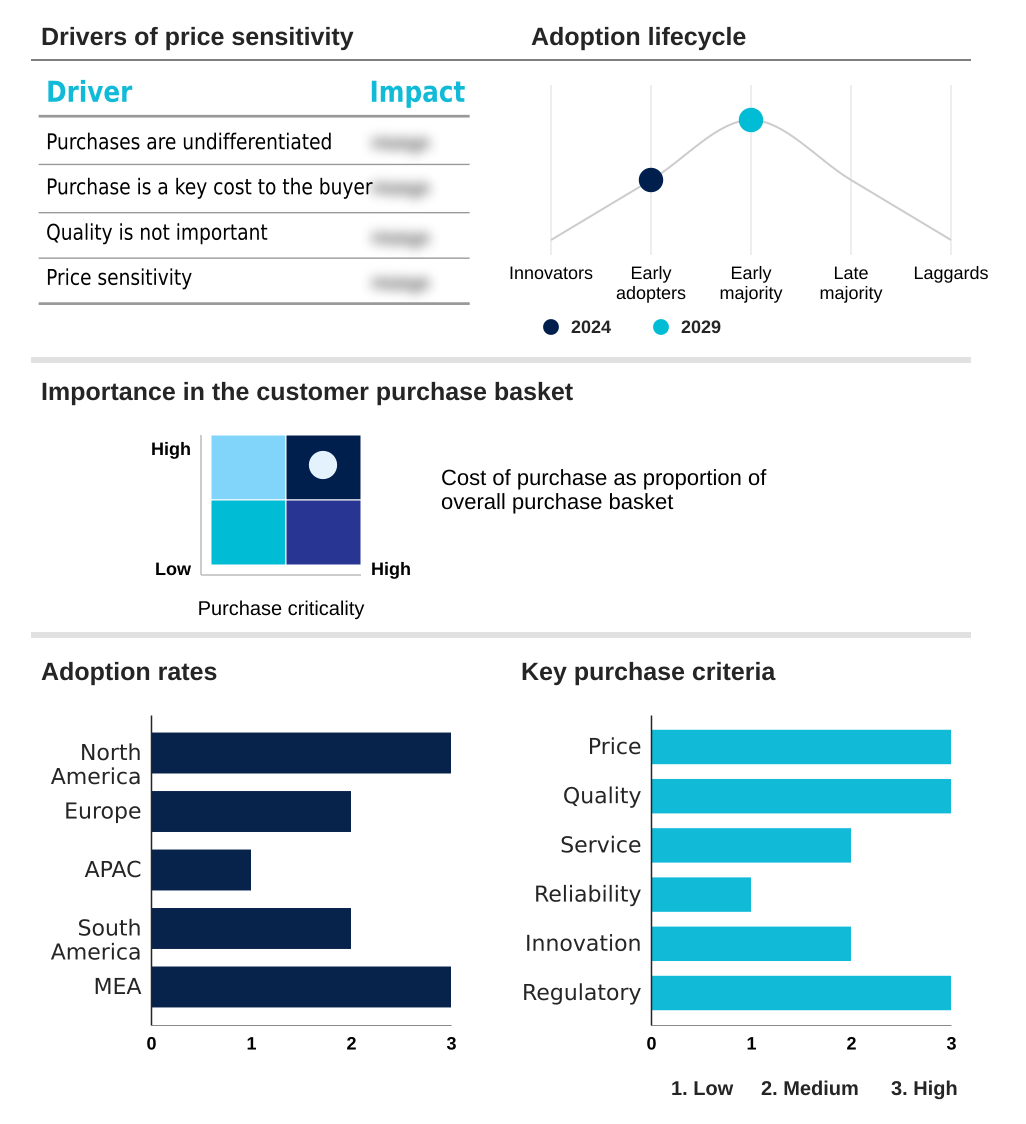
The ai in pharma and biotech market forecasting report includes the adoption lifecycle of the market, covering from the innovator’s stage to the laggard’s stage. It focuses on adoption rates in different regions based on penetration. Furthermore, the ai in pharma and biotech market report also includes key purchase criteria and drivers of price sensitivity to help companies evaluate and develop their market growth analysis strategies.
Customer Landscape
Key Companies & Market Insights
Companies are implementing various strategies, such as strategic alliances, ai in pharma and biotech market forecast, partnerships, mergers and acquisitions, geographical expansion, and product/service launches, to enhance their presence in the industry.
Aria Intelligent Solutions - The company provides an AI-driven solution for the pharmaceutical and biotechnology sectors, utilizing an advanced platform to integrate and analyze diverse biomedical data. This capability is specifically geared toward accelerating the discovery of novel small molecule therapies, enabling a more efficient and targeted approach to early-stage drug development.
The industry research and growth report includes detailed analyses of the competitive landscape of the market and information about key companies, including:
- Aria Intelligent Solutions
- Arzeda Corp.
- Atomwise Inc.
- Auransa Inc.
- BenevolentAI
- BioAge Labs Inc.
- Cloud Pharmaceuticals Inc.
- Deep Genomics Inc.
- Exscientia plc
- Healx Ltd.
- Insilico Medicine
- Owkin Inc.
- PathAI Inc.
- Recursion Pharmaceuticals Inc.
- Schrodinger Inc.
- Turbine Ltd.
- Valo Health
- Verge Analytics Inc.
- XtalPi
Qualitative and quantitative analysis of companies has been conducted to help clients understand the wider business environment as well as the strengths and weaknesses of key industry players. Data is qualitatively analyzed to categorize companies as pure play, category-focused, industry-focused, and diversified; it is quantitatively analyzed to categorize companies as dominant, leading, strong, tentative, and weak.
Recent Development and News in Ai In Pharma And Biotech Market
In April 2024, Insilico Medicine announced the first AI-discovered and AI-designed drug for idiopathic pulmonary fibrosis (IPF) has completed its Phase II trials with positive topline results.In February 2024, Recursion Pharmaceuticals announced a new AI-guided drug discovery collaboration with a major pharmaceutical partner to identify novel treatments for oncology.In January 2024, Exscientia plc announced a strategic research collaboration with a major pharmaceutical company to discover and develop novel small molecule drug candidates in oncology and immunology, leveraging its AI-driven platform.In May 2024, Verge Genomics announced the initiation of a Phase 1b clinical trial for VRG50635, a potential treatment for amyotrophic lateral sclerosis (ALS) that was discovered using its all-in-human, AI-powered platform.
Research Analyst Overview
The integration of artificial intelligence is fundamentally altering the drug discovery value chain, moving from traditional screening methods to a more predictive and accelerated framework. Advanced machine learning algorithms and deep learning models are being deployed for target identification and the validation of novel biological targets. This shift is heavily reliant on computational biology and the power of high-performance computing, especially graphics processing units, to process vast datasets. Within the in-silico stage, generative AI models are instrumental in tasks like protein structure prediction and de novo molecule design, enabling the creation of molecules with desired properties. This evolution supports a more efficient end-to-end drug discovery process, redefining how potential therapeutics are conceptualized and developed.Beyond initial discovery, AI-powered platforms are critical for clinical trial optimization and enhancing pharmacovigilance systems, with market expansion expectations exceeding 30%. The utilization of large language models and natural language processing helps analyze unstructured data, while computer vision platforms advance digital pathology. Predictive modeling on multi-omics datasets facilitates patient stratification and biomarker discovery, which are essential for developing companion diagnostics. The use of real-world evidence supports the creation of synthetic control arms, and federated learning addresses data silos. However, data governance challenges and the demand for explainable AI persist as specialized applications like AAV vector design and codon optimization emerge, driven by increasingly sophisticated AI foundation models used for drug repurposing.
Dive into Technavio’s robust research methodology, blending expert interviews, extensive data synthesis, and validated models for unparalleled AI In Pharma And Biotech Market insights. See full methodology.
|
Market Scope
|
|
Report Coverage
|
Details
|
|
Page number
|
310
|
|
Base year
|
2024
|
|
Historic period
|
2019 - 2023 |
|
Forecast period
|
2025-2029
|
|
Growth momentum & CAGR
|
Accelerating at a CAGR of 20.0%
|
|
Market growth 2024-2029
|
USD 3.6 billion
|
|
Market structure
|
Fragmented
|
|
YoY growth 2024-2029(%)
|
18.2%
|
|
Key countries
|
US, Canada, Mexico, Germany, UK, France, The Netherlands, Italy, Spain, China, Japan, India, South Korea, Australia, Indonesia, Brazil, Argentina, Colombia, Saudi Arabia, UAE, South Africa, Turkey, Israel
|
|
Competitive landscape
|
Leading Companies, Market Positioning of Companies, Competitive Strategies, and Industry Risks
|
Request Free Sample
What are the Key Data Covered in this AI In Pharma And Biotech Market Research and Growth Report?
- CAGR of the AI In Pharma And Biotech industry during the forecast period
- Detailed information on factors that will drive the growth and forecasting between 2024 and 2029
- Precise estimation of the size of the market and its contribution of the industry in focus to the parent market
- Accurate predictions about upcoming growth and trends and changes in consumer behaviour
- Growth of the market across North America, Europe, APAC, South America, Middle East and Africa
- Thorough analysis of the market’s competitive landscape and detailed information about companies
- Comprehensive analysis of factors that will challenge the ai in pharma and biotech market growth of industry companies
We can help! Our analysts can customize this ai in pharma and biotech market research report to meet your requirements.
Get in touch
1 Executive Summary
- 1 Executive Summary
- 1.1 Market overview
- Executive Summary - Chart on Market Overview
- Executive Summary - Data Table on Market Overview
- Executive Summary - Chart on Global Market Characteristics
- Executive Summary - Chart on Market by Geography
- Executive Summary - Chart on Market Segmentation by Type
- Executive Summary - Chart on Market Segmentation by Technology
- Executive Summary - Chart on Market Segmentation by Application
- Executive Summary - Chart on Incremental Growth
- Executive Summary - Data Table on Incremental Growth
- Executive Summary - Chart on Company Market Positioning
2 Technavio Analysis
- 2 Technavio Analysis
- 2.1 Analysis of price sensitivity, lifecycle, customer purchase basket, adoption rates, and purchase criteria
- Analysis of price sensitivity, lifecycle, customer purchase basket, adoption rates, and purchase criteria
- 2.2 Criticality of inputs and Factors of differentiation
- Chart on Overview on criticality of inputs and factors of differentiation
- 2.3 Factors of disruption
- Chart on Overview on factors of disruption
- 2.4 Impact of drivers and challenges
- Chart on Impact of drivers and challenges in 2024 and 2029
3 Market Landscape
- 3 Market Landscape
- 3.1 Market ecosystem
- Chart on Parent Market
- Data Table on - Parent Market
- 3.2 Market characteristics
- Chart on Market characteristics analysis
- 3.3 Value chain analysis
- Chart on Value chain analysis
4 Market Sizing
- 4 Market Sizing
- 4.1 Market definition
- Data Table on Offerings of companies included in the market definition
- 4.2 Market segment analysis
- 4.3 Market size 2024
- 4.4 Market outlook: Forecast for 2024-2029
- Chart on Global - Market size and forecast 2024-2029 ($ billion)
- Data Table on Global - Market size and forecast 2024-2029 ($ billion)
- Chart on Global Market: Year-over-year growth 2024-2029 (%)
- Data Table on Global Market: Year-over-year growth 2024-2029 (%)
5 Historic Market Size
- 5 Historic Market Size
- 5.1 Global AI In Pharma And Biotech Market 2019 - 2023
- Historic Market Size - Data Table on Global AI In Pharma And Biotech Market 2019 - 2023 ($ billion)
- 5.2 Type segment analysis 2019 - 2023
- Historic Market Size - Type Segment 2019 - 2023 ($ billion)
- 5.3 Technology segment analysis 2019 - 2023
- Historic Market Size - Technology Segment 2019 - 2023 ($ billion)
- 5.4 Application segment analysis 2019 - 2023
- Historic Market Size - Application Segment 2019 - 2023 ($ billion)
- 5.5 Geography segment analysis 2019 - 2023
- Historic Market Size - Geography Segment 2019 - 2023 ($ billion)
- 5.6 Country segment analysis 2019 - 2023
- Historic Market Size - Country Segment 2019 - 2023 ($ billion)
6 Five Forces Analysis
- 6 Five Forces Analysis
- 6.1 Five forces summary
- Five forces analysis - Comparison between 2024 and 2029
- 6.2 Bargaining power of buyers
- Bargaining power of buyers - Impact of key factors 2024 and 2029
- 6.3 Bargaining power of suppliers
- Bargaining power of suppliers - Impact of key factors in 2024 and 2029
- 6.4 Threat of new entrants
- Threat of new entrants - Impact of key factors in 2024 and 2029
- 6.5 Threat of substitutes
- Threat of substitutes - Impact of key factors in 2024 and 2029
- 6.6 Threat of rivalry
- Threat of rivalry - Impact of key factors in 2024 and 2029
- 6.7 Market condition
- Chart on Market condition - Five forces 2024 and 2029
7 Market Segmentation by Type
- 7 Market Segmentation by Type
- 7.1 Market segments
- Chart on Type - Market share 2024-2029 (%)
- Data Table on Type - Market share 2024-2029 (%)
- 7.2 Comparison by Type
- Chart on Comparison by Type
- Data Table on Comparison by Type
- 7.3 Small molecules - Market size and forecast 2024-2029
- Chart on Small molecules - Market size and forecast 2024-2029 ($ billion)
- Data Table on Small molecules - Market size and forecast 2024-2029 ($ billion)
- Chart on Small molecules - Year-over-year growth 2024-2029 (%)
- Data Table on Small molecules - Year-over-year growth 2024-2029 (%)
- 7.4 Large molecules - Market size and forecast 2024-2029
- Chart on Large molecules - Market size and forecast 2024-2029 ($ billion)
- Data Table on Large molecules - Market size and forecast 2024-2029 ($ billion)
- Chart on Large molecules - Year-over-year growth 2024-2029 (%)
- Data Table on Large molecules - Year-over-year growth 2024-2029 (%)
- 7.5 Vaccines - Market size and forecast 2024-2029
- Chart on Vaccines - Market size and forecast 2024-2029 ($ billion)
- Data Table on Vaccines - Market size and forecast 2024-2029 ($ billion)
- Chart on Vaccines - Year-over-year growth 2024-2029 (%)
- Data Table on Vaccines - Year-over-year growth 2024-2029 (%)
- 7.6 Cell and gene therapies - Market size and forecast 2024-2029
- Chart on Cell and gene therapies - Market size and forecast 2024-2029 ($ billion)
- Data Table on Cell and gene therapies - Market size and forecast 2024-2029 ($ billion)
- Chart on Cell and gene therapies - Year-over-year growth 2024-2029 (%)
- Data Table on Cell and gene therapies - Year-over-year growth 2024-2029 (%)
- 7.7 Market opportunity by Type
- Market opportunity by Type ($ billion)
- Data Table on Market opportunity by Type ($ billion)
8 Market Segmentation by Technology
- 8 Market Segmentation by Technology
- 8.1 Market segments
- Chart on Technology - Market share 2024-2029 (%)
- Data Table on Technology - Market share 2024-2029 (%)
- 8.2 Comparison by Technology
- Chart on Comparison by Technology
- Data Table on Comparison by Technology
- 8.3 Machine learning - Market size and forecast 2024-2029
- Chart on Machine learning - Market size and forecast 2024-2029 ($ billion)
- Data Table on Machine learning - Market size and forecast 2024-2029 ($ billion)
- Chart on Machine learning - Year-over-year growth 2024-2029 (%)
- Data Table on Machine learning - Year-over-year growth 2024-2029 (%)
- 8.4 Deep learning - Market size and forecast 2024-2029
- Chart on Deep learning - Market size and forecast 2024-2029 ($ billion)
- Data Table on Deep learning - Market size and forecast 2024-2029 ($ billion)
- Chart on Deep learning - Year-over-year growth 2024-2029 (%)
- Data Table on Deep learning - Year-over-year growth 2024-2029 (%)
- 8.5 NLP - Market size and forecast 2024-2029
- Chart on NLP - Market size and forecast 2024-2029 ($ billion)
- Data Table on NLP - Market size and forecast 2024-2029 ($ billion)
- Chart on NLP - Year-over-year growth 2024-2029 (%)
- Data Table on NLP - Year-over-year growth 2024-2029 (%)
- 8.6 Computer vision - Market size and forecast 2024-2029
- Chart on Computer vision - Market size and forecast 2024-2029 ($ billion)
- Data Table on Computer vision - Market size and forecast 2024-2029 ($ billion)
- Chart on Computer vision - Year-over-year growth 2024-2029 (%)
- Data Table on Computer vision - Year-over-year growth 2024-2029 (%)
- 8.7 Generative AI - Market size and forecast 2024-2029
- Chart on Generative AI - Market size and forecast 2024-2029 ($ billion)
- Data Table on Generative AI - Market size and forecast 2024-2029 ($ billion)
- Chart on Generative AI - Year-over-year growth 2024-2029 (%)
- Data Table on Generative AI - Year-over-year growth 2024-2029 (%)
- 8.8 Market opportunity by Technology
- Market opportunity by Technology ($ billion)
- Data Table on Market opportunity by Technology ($ billion)
9 Market Segmentation by Application
- 9 Market Segmentation by Application
- 9.1 Market segments
- Chart on Application - Market share 2024-2029 (%)
- Data Table on Application - Market share 2024-2029 (%)
- 9.2 Comparison by Application
- Chart on Comparison by Application
- Data Table on Comparison by Application
- 9.3 Drug discovery - Market size and forecast 2024-2029
- Chart on Drug discovery - Market size and forecast 2024-2029 ($ billion)
- Data Table on Drug discovery - Market size and forecast 2024-2029 ($ billion)
- Chart on Drug discovery - Year-over-year growth 2024-2029 (%)
- Data Table on Drug discovery - Year-over-year growth 2024-2029 (%)
- 9.4 Preclinical and clinical trials - Market size and forecast 2024-2029
- Chart on Preclinical and clinical trials - Market size and forecast 2024-2029 ($ billion)
- Data Table on Preclinical and clinical trials - Market size and forecast 2024-2029 ($ billion)
- Chart on Preclinical and clinical trials - Year-over-year growth 2024-2029 (%)
- Data Table on Preclinical and clinical trials - Year-over-year growth 2024-2029 (%)
- 9.5 Regulatory compliance and pharmacovigilance - Market size and forecast 2024-2029
- Chart on Regulatory compliance and pharmacovigilance - Market size and forecast 2024-2029 ($ billion)
- Data Table on Regulatory compliance and pharmacovigilance - Market size and forecast 2024-2029 ($ billion)
- Chart on Regulatory compliance and pharmacovigilance - Year-over-year growth 2024-2029 (%)
- Data Table on Regulatory compliance and pharmacovigilance - Year-over-year growth 2024-2029 (%)
- 9.6 Others - Market size and forecast 2024-2029
- Chart on Others - Market size and forecast 2024-2029 ($ billion)
- Data Table on Others - Market size and forecast 2024-2029 ($ billion)
- Chart on Others - Year-over-year growth 2024-2029 (%)
- Data Table on Others - Year-over-year growth 2024-2029 (%)
- 9.7 Market opportunity by Application
- Market opportunity by Application ($ billion)
- Data Table on Market opportunity by Application ($ billion)
10 Customer Landscape
- 10 Customer Landscape
- 10.1 Customer landscape overview
- Analysis of price sensitivity, lifecycle, customer purchase basket, adoption rates, and purchase criteria
11 Geographic Landscape
- 11 Geographic Landscape
- 11.1 Geographic segmentation
- Chart on Market share by geography 2024-2029 (%)
- Data Table on Market share by geography 2024-2029 (%)
- 11.2 Geographic comparison
- Chart on Geographic comparison
- Data Table on Geographic comparison
- 11.3 North America - Market size and forecast 2024-2029
- Chart on North America - Market size and forecast 2024-2029 ($ billion)
- Data Table on North America - Market size and forecast 2024-2029 ($ billion)
- Chart on North America - Year-over-year growth 2024-2029 (%)
- Data Table on North America - Year-over-year growth 2024-2029 (%)
- Chart on Regional Comparison - North America
- Data Table on Regional Comparison - North America
- 11.3.1 US - Market size and forecast 2024-2029
- Chart on US - Market size and forecast 2024-2029 ($ billion)
- Data Table on US - Market size and forecast 2024-2029 ($ billion)
- Chart on US - Year-over-year growth 2024-2029 (%)
- Data Table on US - Year-over-year growth 2024-2029 (%)
- 11.3.2 Canada - Market size and forecast 2024-2029
- Chart on Canada - Market size and forecast 2024-2029 ($ billion)
- Data Table on Canada - Market size and forecast 2024-2029 ($ billion)
- Chart on Canada - Year-over-year growth 2024-2029 (%)
- Data Table on Canada - Year-over-year growth 2024-2029 (%)
- 11.3.3 Mexico - Market size and forecast 2024-2029
- Chart on Mexico - Market size and forecast 2024-2029 ($ billion)
- Data Table on Mexico - Market size and forecast 2024-2029 ($ billion)
- Chart on Mexico - Year-over-year growth 2024-2029 (%)
- Data Table on Mexico - Year-over-year growth 2024-2029 (%)
- 11.4 Europe - Market size and forecast 2024-2029
- Chart on Europe - Market size and forecast 2024-2029 ($ billion)
- Data Table on Europe - Market size and forecast 2024-2029 ($ billion)
- Chart on Europe - Year-over-year growth 2024-2029 (%)
- Data Table on Europe - Year-over-year growth 2024-2029 (%)
- Chart on Regional Comparison - Europe
- Data Table on Regional Comparison - Europe
- 11.4.1 Germany - Market size and forecast 2024-2029
- Chart on Germany - Market size and forecast 2024-2029 ($ billion)
- Data Table on Germany - Market size and forecast 2024-2029 ($ billion)
- Chart on Germany - Year-over-year growth 2024-2029 (%)
- Data Table on Germany - Year-over-year growth 2024-2029 (%)
- 11.4.2 UK - Market size and forecast 2024-2029
- Chart on UK - Market size and forecast 2024-2029 ($ billion)
- Data Table on UK - Market size and forecast 2024-2029 ($ billion)
- Chart on UK - Year-over-year growth 2024-2029 (%)
- Data Table on UK - Year-over-year growth 2024-2029 (%)
- 11.4.3 France - Market size and forecast 2024-2029
- Chart on France - Market size and forecast 2024-2029 ($ billion)
- Data Table on France - Market size and forecast 2024-2029 ($ billion)
- Chart on France - Year-over-year growth 2024-2029 (%)
- Data Table on France - Year-over-year growth 2024-2029 (%)
- 11.4.4 The Netherlands - Market size and forecast 2024-2029
- Chart on The Netherlands - Market size and forecast 2024-2029 ($ billion)
- Data Table on The Netherlands - Market size and forecast 2024-2029 ($ billion)
- Chart on The Netherlands - Year-over-year growth 2024-2029 (%)
- Data Table on The Netherlands - Year-over-year growth 2024-2029 (%)
- 11.4.5 Italy - Market size and forecast 2024-2029
- Chart on Italy - Market size and forecast 2024-2029 ($ billion)
- Data Table on Italy - Market size and forecast 2024-2029 ($ billion)
- Chart on Italy - Year-over-year growth 2024-2029 (%)
- Data Table on Italy - Year-over-year growth 2024-2029 (%)
- 11.4.6 Spain - Market size and forecast 2024-2029
- Chart on Spain - Market size and forecast 2024-2029 ($ billion)
- Data Table on Spain - Market size and forecast 2024-2029 ($ billion)
- Chart on Spain - Year-over-year growth 2024-2029 (%)
- Data Table on Spain - Year-over-year growth 2024-2029 (%)
- 11.5 APAC - Market size and forecast 2024-2029
- Chart on APAC - Market size and forecast 2024-2029 ($ billion)
- Data Table on APAC - Market size and forecast 2024-2029 ($ billion)
- Chart on APAC - Year-over-year growth 2024-2029 (%)
- Data Table on APAC - Year-over-year growth 2024-2029 (%)
- Chart on Regional Comparison - APAC
- Data Table on Regional Comparison - APAC
- 11.5.1 China - Market size and forecast 2024-2029
- Chart on China - Market size and forecast 2024-2029 ($ billion)
- Data Table on China - Market size and forecast 2024-2029 ($ billion)
- Chart on China - Year-over-year growth 2024-2029 (%)
- Data Table on China - Year-over-year growth 2024-2029 (%)
- 11.5.2 Japan - Market size and forecast 2024-2029
- Chart on Japan - Market size and forecast 2024-2029 ($ billion)
- Data Table on Japan - Market size and forecast 2024-2029 ($ billion)
- Chart on Japan - Year-over-year growth 2024-2029 (%)
- Data Table on Japan - Year-over-year growth 2024-2029 (%)
- 11.5.3 India - Market size and forecast 2024-2029
- Chart on India - Market size and forecast 2024-2029 ($ billion)
- Data Table on India - Market size and forecast 2024-2029 ($ billion)
- Chart on India - Year-over-year growth 2024-2029 (%)
- Data Table on India - Year-over-year growth 2024-2029 (%)
- 11.5.4 South Korea - Market size and forecast 2024-2029
- Chart on South Korea - Market size and forecast 2024-2029 ($ billion)
- Data Table on South Korea - Market size and forecast 2024-2029 ($ billion)
- Chart on South Korea - Year-over-year growth 2024-2029 (%)
- Data Table on South Korea - Year-over-year growth 2024-2029 (%)
- 11.5.5 Australia - Market size and forecast 2024-2029
- Chart on Australia - Market size and forecast 2024-2029 ($ billion)
- Data Table on Australia - Market size and forecast 2024-2029 ($ billion)
- Chart on Australia - Year-over-year growth 2024-2029 (%)
- Data Table on Australia - Year-over-year growth 2024-2029 (%)
- 11.5.6 Indonesia - Market size and forecast 2024-2029
- Chart on Indonesia - Market size and forecast 2024-2029 ($ billion)
- Data Table on Indonesia - Market size and forecast 2024-2029 ($ billion)
- Chart on Indonesia - Year-over-year growth 2024-2029 (%)
- Data Table on Indonesia - Year-over-year growth 2024-2029 (%)
- 11.6 South America - Market size and forecast 2024-2029
- Chart on South America - Market size and forecast 2024-2029 ($ billion)
- Data Table on South America - Market size and forecast 2024-2029 ($ billion)
- Chart on South America - Year-over-year growth 2024-2029 (%)
- Data Table on South America - Year-over-year growth 2024-2029 (%)
- Chart on Regional Comparison - South America
- Data Table on Regional Comparison - South America
- 11.6.1 Brazil - Market size and forecast 2024-2029
- Chart on Brazil - Market size and forecast 2024-2029 ($ billion)
- Data Table on Brazil - Market size and forecast 2024-2029 ($ billion)
- Chart on Brazil - Year-over-year growth 2024-2029 (%)
- Data Table on Brazil - Year-over-year growth 2024-2029 (%)
- 11.6.2 Argentina - Market size and forecast 2024-2029
- Chart on Argentina - Market size and forecast 2024-2029 ($ billion)
- Data Table on Argentina - Market size and forecast 2024-2029 ($ billion)
- Chart on Argentina - Year-over-year growth 2024-2029 (%)
- Data Table on Argentina - Year-over-year growth 2024-2029 (%)
- 11.6.3 Colombia - Market size and forecast 2024-2029
- Chart on Colombia - Market size and forecast 2024-2029 ($ billion)
- Data Table on Colombia - Market size and forecast 2024-2029 ($ billion)
- Chart on Colombia - Year-over-year growth 2024-2029 (%)
- Data Table on Colombia - Year-over-year growth 2024-2029 (%)
- 11.7 Middle East and Africa - Market size and forecast 2024-2029
- Chart on Middle East and Africa - Market size and forecast 2024-2029 ($ billion)
- Data Table on Middle East and Africa - Market size and forecast 2024-2029 ($ billion)
- Chart on Middle East and Africa - Year-over-year growth 2024-2029 (%)
- Data Table on Middle East and Africa - Year-over-year growth 2024-2029 (%)
- Chart on Regional Comparison - Middle East and Africa
- Data Table on Regional Comparison - Middle East and Africa
- 11.7.1 Saudi Arabia - Market size and forecast 2024-2029
- Chart on Saudi Arabia - Market size and forecast 2024-2029 ($ billion)
- Data Table on Saudi Arabia - Market size and forecast 2024-2029 ($ billion)
- Chart on Saudi Arabia - Year-over-year growth 2024-2029 (%)
- Data Table on Saudi Arabia - Year-over-year growth 2024-2029 (%)
- 11.7.2 UAE - Market size and forecast 2024-2029
- Chart on UAE - Market size and forecast 2024-2029 ($ billion)
- Data Table on UAE - Market size and forecast 2024-2029 ($ billion)
- Chart on UAE - Year-over-year growth 2024-2029 (%)
- Data Table on UAE - Year-over-year growth 2024-2029 (%)
- 11.7.3 South Africa - Market size and forecast 2024-2029
- Chart on South Africa - Market size and forecast 2024-2029 ($ billion)
- Data Table on South Africa - Market size and forecast 2024-2029 ($ billion)
- Chart on South Africa - Year-over-year growth 2024-2029 (%)
- Data Table on South Africa - Year-over-year growth 2024-2029 (%)
- 11.7.4 Turkey - Market size and forecast 2024-2029
- Chart on Turkey - Market size and forecast 2024-2029 ($ billion)
- Data Table on Turkey - Market size and forecast 2024-2029 ($ billion)
- Chart on Turkey - Year-over-year growth 2024-2029 (%)
- Data Table on Turkey - Year-over-year growth 2024-2029 (%)
- 11.7.5 Israel - Market size and forecast 2024-2029
- Chart on Israel - Market size and forecast 2024-2029 ($ billion)
- Data Table on Israel - Market size and forecast 2024-2029 ($ billion)
- Chart on Israel - Year-over-year growth 2024-2029 (%)
- Data Table on Israel - Year-over-year growth 2024-2029 (%)
- 11.8 Market opportunity by geography
- Market opportunity by geography ($ billion)
- Data Tables on Market opportunity by geography ($ billion)
12 Drivers, Challenges, and Opportunity
- 12 Drivers, Challenges, and Opportunity
- 12.1 Market drivers
- Imperative to overcome declining research and development productivity and escalating costs
- Exponential growth of biomedical data and availability of high-performance computing
- Increasing investment, strategic collaborations, and validating success stories
- 12.2 Market challenges
- Data quality, accessibility, and governance challenges
- High cost of implementation and scarcity of specialized talent
- Regulatory uncertainty and black box problem
- 12.3 Impact of drivers and challenges
- Impact of drivers and challenges in 2024 and 2029
- 12.4 Market opportunities
- Industrialization of discovery through scalable, AI-powered research and development platforms
- AI-driven biomarker discovery and scaling of precision medicine
- Increasing integration of AI with real-world evidence and clinical trial modernization
13 Competitive Landscape
- 13 Competitive Landscape
- 13.1 Overview
- 13.2 Competitive Landscape
- Overview on criticality of inputs and factors of differentiation
- 13.3 Landscape disruption
- Overview on factors of disruption
- 13.4 Industry risks
- Impact of key risks on business
14 Competitive Analysis
- 14 Competitive Analysis
- 14.1 Companies profiled
- 14.2 Company ranking index
- 14.3 Market positioning of companies
- Matrix on companies position and classification
- 14.4 Aria Intelligent Solutions
- Aria Intelligent Solutions - Overview
- Aria Intelligent Solutions - Product / Service
- Aria Intelligent Solutions - Key offerings
- SWOT
- 14.5 Auransa Inc.
- Auransa Inc. - Overview
- Auransa Inc. - Product / Service
- Auransa Inc. - Key offerings
- SWOT
- 14.6 BenevolentAI
- BenevolentAI - Overview
- BenevolentAI - Product / Service
- BenevolentAI - Key offerings
- SWOT
- 14.7 BioAge Labs Inc.
- BioAge Labs Inc. - Overview
- BioAge Labs Inc. - Product / Service
- BioAge Labs Inc. - Key offerings
- SWOT
- 14.8 Cloud Pharmaceuticals Inc.
- Cloud Pharmaceuticals Inc. - Overview
- Cloud Pharmaceuticals Inc. - Product / Service
- Cloud Pharmaceuticals Inc. - Key offerings
- SWOT
- 14.9 Exscientia plc
- Exscientia plc - Overview
- Exscientia plc - Product / Service
- Exscientia plc - Key offerings
- SWOT
- 14.10 Insilico Medicine
- Insilico Medicine - Overview
- Insilico Medicine - Product / Service
- Insilico Medicine - Key offerings
- SWOT
- 14.11 Owkin Inc.
- Owkin Inc. - Overview
- Owkin Inc. - Product / Service
- Owkin Inc. - Key offerings
- SWOT
- 14.12 PathAI Inc.
- PathAI Inc. - Overview
- PathAI Inc. - Product / Service
- PathAI Inc. - Key offerings
- SWOT
- 14.13 Recursion Pharmaceuticals Inc.
- Recursion Pharmaceuticals Inc. - Overview
- Recursion Pharmaceuticals Inc. - Product / Service
- Recursion Pharmaceuticals Inc. - Key offerings
- SWOT
- 14.14 Schrodinger Inc.
- Schrodinger Inc. - Overview
- Schrodinger Inc. - Business segments
- Schrodinger Inc. - Key offerings
- Schrodinger Inc. - Segment focus
- SWOT
- 14.15 Turbine Ltd.
- Turbine Ltd. - Overview
- Turbine Ltd. - Product / Service
- Turbine Ltd. - Key offerings
- SWOT
- 14.16 Valo Health
- Valo Health - Overview
- Valo Health - Product / Service
- Valo Health - Key offerings
- SWOT
- 14.17 Verge Analytics Inc.
- Verge Analytics Inc. - Overview
- Verge Analytics Inc. - Product / Service
- Verge Analytics Inc. - Key offerings
- SWOT
- 14.18 XtalPi
- XtalPi - Overview
- XtalPi - Product / Service
- XtalPi - Key offerings
- SWOT
15 Appendix
- 15 Appendix
- 15.1 Scope of the report
- Market definition
- Objectives
- Notes and caveats
- 15.2 Inclusions and exclusions checklist
- Inclusions checklist
- Exclusions checklist
- 15.3 Currency conversion rates for US$
- Currency conversion rates for US$
- 15.4 Research methodology
- 15.5 Data procurement
- 15.6 Data validation
- 15.7 Validation techniques employed for market sizing
- Validation techniques employed for market sizing
- 15.8 Data synthesis
- 15.9 360 degree market analysis
- 360 degree market analysis
- 15.10 List of abbreviations