



CNC Horizontal Machining Centres Market Size 2026-2030
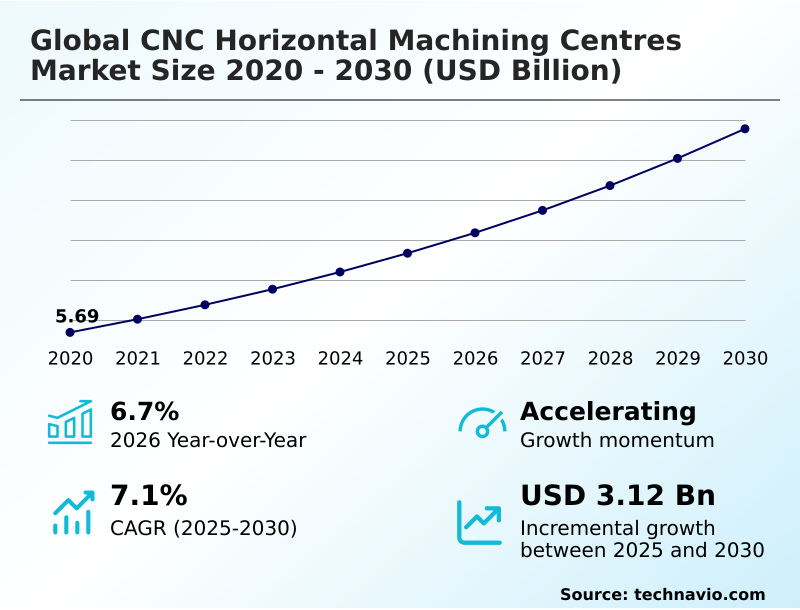
The cnc horizontal machining centres market size is valued to increase by USD 3.12 billion, at a CAGR of 7.1% from 2025 to 2030. Pervasive demand for automation and enhanced manufacturing productivity will drive the cnc horizontal machining centres market.
Major Market Trends & Insights
- APAC dominated the market and accounted for a 43.2% growth during the forecast period.
- By End-user - Automotive segment was valued at USD 2.92 billion in 2024
- By Product - Less than 5-axis segment accounted for the largest market revenue share in 2024
Market Size & Forecast
- Market Opportunities: USD 5.10 billion
- Market Future Opportunities: USD 3.12 billion
- CAGR from 2025 to 2030 : 7.1%
Market Summary
- The CNC horizontal machining centres market is defined by the relentless pursuit of productivity and precision in industrial manufacturing. A primary driver is the increasing complexity of components in the aerospace and automotive sectors, where multi-axis machines are essential for producing lightweight, high-strength parts from advanced materials.
- This trend is complemented by the push toward full automation and lights-out manufacturing, where integrated pallet systems and robotics enable continuous production with minimal human intervention. For instance, an aerospace supplier utilizes 5-axis HMCs to machine a complex structural airframe part from a single block of titanium, consolidating what was once an assembly of multiple components.
- This 'done-in-one' approach not only improves structural integrity but also drastically reduces lead times and manufacturing costs. However, the market faces challenges related to the high capital investment required for these advanced systems and the persistent shortage of skilled programmers and operators capable of maximizing their potential.
- Consequently, the industry is moving toward more intuitive control systems and comprehensive training programs to broaden technology adoption and ensure a higher return on investment for manufacturers.
What will be the Size of the CNC Horizontal Machining Centres Market during the forecast period?
Get Key Insights on Market Forecast (PDF) Get Free Sample
How is the CNC Horizontal Machining Centres Market Segmented?
The cnc horizontal machining centres industry research report provides comprehensive data (region-wise segment analysis), with forecasts and estimates in "USD million" for the period 2026-2030, as well as historical data from 2020-2024 for the following segments.
- End-user
- Automotive
- Aerospace
- Metal fabrication
- Others
- Product
- Less than 5-axis
- Equal to 5-axis and more
- Application
- General applications
- High end
- Special purpose
- Geography
- APAC
- China
- Japan
- South Korea
- Europe
- UK
- Germany
- France
- North America
- US
- Canada
- Mexico
- South America
- Brazil
- Argentina
- Colombia
- Middle East and Africa
- Saudi Arabia
- UAE
- South Africa
- Rest of World (ROW)
- APAC
By End-user Insights
The automotive segment is estimated to witness significant growth during the forecast period.
The automotive sector's demand for CNC horizontal machining centres is driven by the industry's shift toward vehicle electrification manufacturing. High-volume production of components like engine blocks and transmission cases relies on the core capabilities of these machines.
The integration of an automatic pallet changer with a b-axis rotary table is essential for mass production efficiency, enabling continuous operation and reducing non-productive spindle downtime by over 90%.
As manufacturers adopt gigacasting machining for lightweight EV structures, the need for machines with high-speed spindles and sophisticated machining strategies intensifies.
This evolution requires advanced gantry transfer integration and a focus on precision engineering to meet the stringent quality and throughput demands of modern automotive assembly lines.
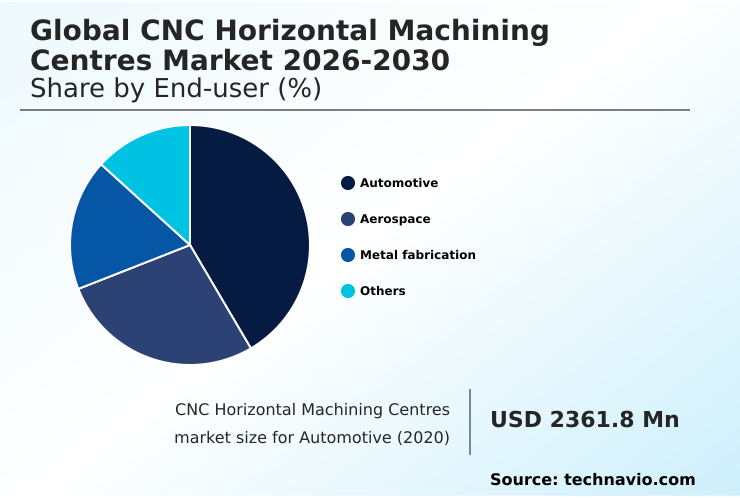
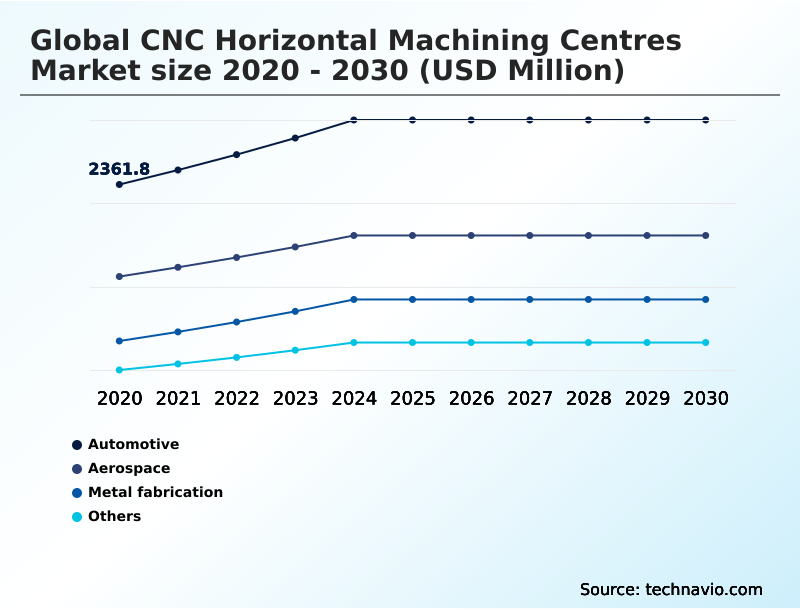
The Automotive segment was valued at USD 2.92 billion in 2024 and showed a gradual increase during the forecast period.
Regional Analysis
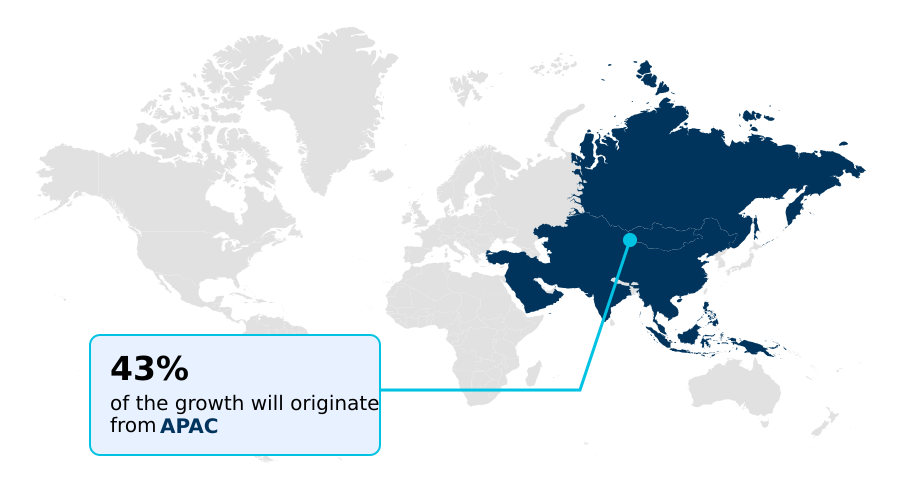
APAC is estimated to contribute 43.2% to the growth of the global market during the forecast period.Technavio’s analysts have elaborately explained the regional trends and drivers that shape the market during the forecast period.
See How CNC Horizontal Machining Centres Market Demand is Rising in APAC Get Free Sample
The geographic landscape is led by APAC, which accounts for over 43% of the market's incremental growth and exhibits a growth rate that outpaces North America's by nearly 14%.
This dynamism is fueled by the region's vast industrial base, where machines with a horizontally oriented spindle are critical for high-volume production, benefiting from gravity-assisted chip evacuation.
In North America and Europe, the focus is on high-value manufacturing, with investments in machines featuring advanced thermal stability controls and robust box-in-box construction for ultra-high precision applications.
Leading manufacturers are integrating technologies such as direct drive rotary axes and linear motor drives to meet demands for speed and accuracy.
This regional specialization reflects a global trend where industrial automation solutions are tailored to specific economic drivers, from mass production in APAC to complex, high-mix manufacturing in Western economies.
Market Dynamics
Our researchers analyzed the data with 2025 as the base year, along with the key drivers, trends, and challenges. A holistic analysis of drivers will help companies refine their marketing strategies to gain a competitive advantage.
- The strategic adoption of advanced machining technologies is reshaping manufacturing across key sectors. The transition to electric vehicles is a primary catalyst, creating immense demand for CNC horizontal machining for EV components, particularly for machining large aluminum battery trays with high speed and precision.
- In parallel, the aerospace industry continues to push the boundaries of design, relying on the 5-axis HMC for aerospace structural parts and developing new techniques for machining titanium alloys with HMCs. To meet these demands, companies are focused on operational excellence.
- Automating production with linear pallet pools and reducing cycle times with pallet changers are key strategies for achieving lights-out manufacturing with HMC systems. However, this requires a careful assessment of the total cost of ownership analysis HMC to justify capital investment in HMC technology.
- Improving accuracy with single-setup machining delivers part consistency that is twice as reliable as multi-machine processes, but success hinges on overcoming the skilled programmer shortage for 5-axis machines. Integrating HMCs with MES systems is crucial for building smart factories, while predictive maintenance for HMC spindles and reducing tooling in HMC operations are vital for cost control.
- The focus on honing thermal stability in precision machining and honing complex hydraulic manifolds highlights the technology's versatility. Ultimately, these efforts support greater supply chain resilience via reshoring by enabling efficient, localized production.
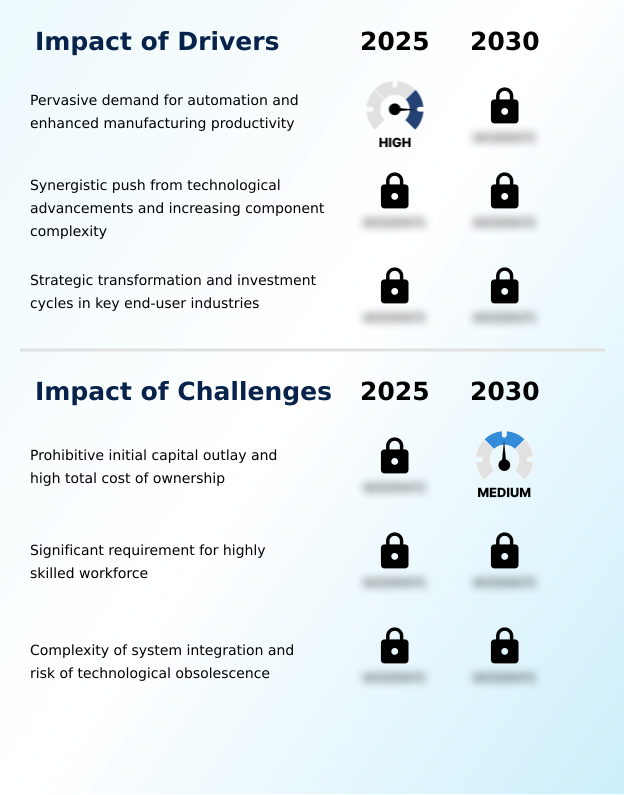
What are the key market drivers leading to the rise in the adoption of CNC Horizontal Machining Centres Industry?
- The pervasive demand for automation and enhanced manufacturing productivity is a primary driver fueling the adoption of CNC horizontal machining centres.
- Market growth is intrinsically linked to technological advancements in both machine tool technology and end-user product design, particularly in aerospace component production and heavy industrial machinery parts.
- The adoption of 5-axis horizontal machining centres is accelerating, driven by the trend of monolithic design, which can reduce component weight by 25% while increasing structural integrity.
- These subtractive manufacturing processes, enabled by high-torque spindles and advanced cutting tool technology, are essential for realizing complex geometries in difficult-to-machine materials. Furthermore, strategic reshoring initiatives are fueling new capital investment cycles, as companies seek to enhance supply chain localization.
- This synergy between design complexity and manufacturing capability ensures sustained demand for high-performance machines that facilitate done-in-one manufacturing and shorten production lead times.
What are the market trends shaping the CNC Horizontal Machining Centres Industry?
- The deep integration with Industry 4.0 marks a transformative trend, evolving CNC horizontal machining centres into intelligent nodes within comprehensive smart factory ecosystems.
- The market is rapidly advancing toward the smart factory, where the integration of digital twin technology is becoming standard. These virtual replicas allow for offline process optimization and simulation, improving first-part-right production by over 25%.
- Advanced CNC controls now function as powerful edge computing devices, enabling real-time data analysis for predictive maintenance algorithms that can reduce unplanned machine downtime by up to 40%. The focus is on creating a seamless digital manufacturing ecosystem where machines communicate with higher-level enterprise systems.
- This shift transforms the purchasing decision, elevating the importance of a machine's connectivity and its ability to serve as a valuable data source, ultimately impacting its lifecycle performance and reducing system integration complexity.
What challenges does the CNC Horizontal Machining Centres Industry face during its growth?
- The prohibitive initial capital outlay combined with a high total cost of ownership presents a significant challenge to market expansion.
- A formidable market challenge is the substantial capital investment required, with the total cost of ownership often exceeding three times the initial machine price. This financial barrier is compounded by the technological obsolescence risk, where rapid advancements can diminish a machine's value over its lifecycle.
- Furthermore, the industry faces a significant skilled workforce requirement, as programming and operating these systems for unattended operation demands a high level of expertise. This shortage directly impacts the ability to machine complex prismatic parts and difficult-to-machine materials effectively.
- The complexity of integrating advanced workholding systems and implementing robust tool breakage detection adds another layer of operational difficulty, making the capital investment cycle a carefully managed, risk-averse process for many organizations.
Exclusive Technavio Analysis on Customer Landscape
The cnc horizontal machining centres market forecasting report includes the adoption lifecycle of the market, covering from the innovator’s stage to the laggard’s stage. It focuses on adoption rates in different regions based on penetration. Furthermore, the cnc horizontal machining centres market report also includes key purchase criteria and drivers of price sensitivity to help companies evaluate and develop their market growth analysis strategies.
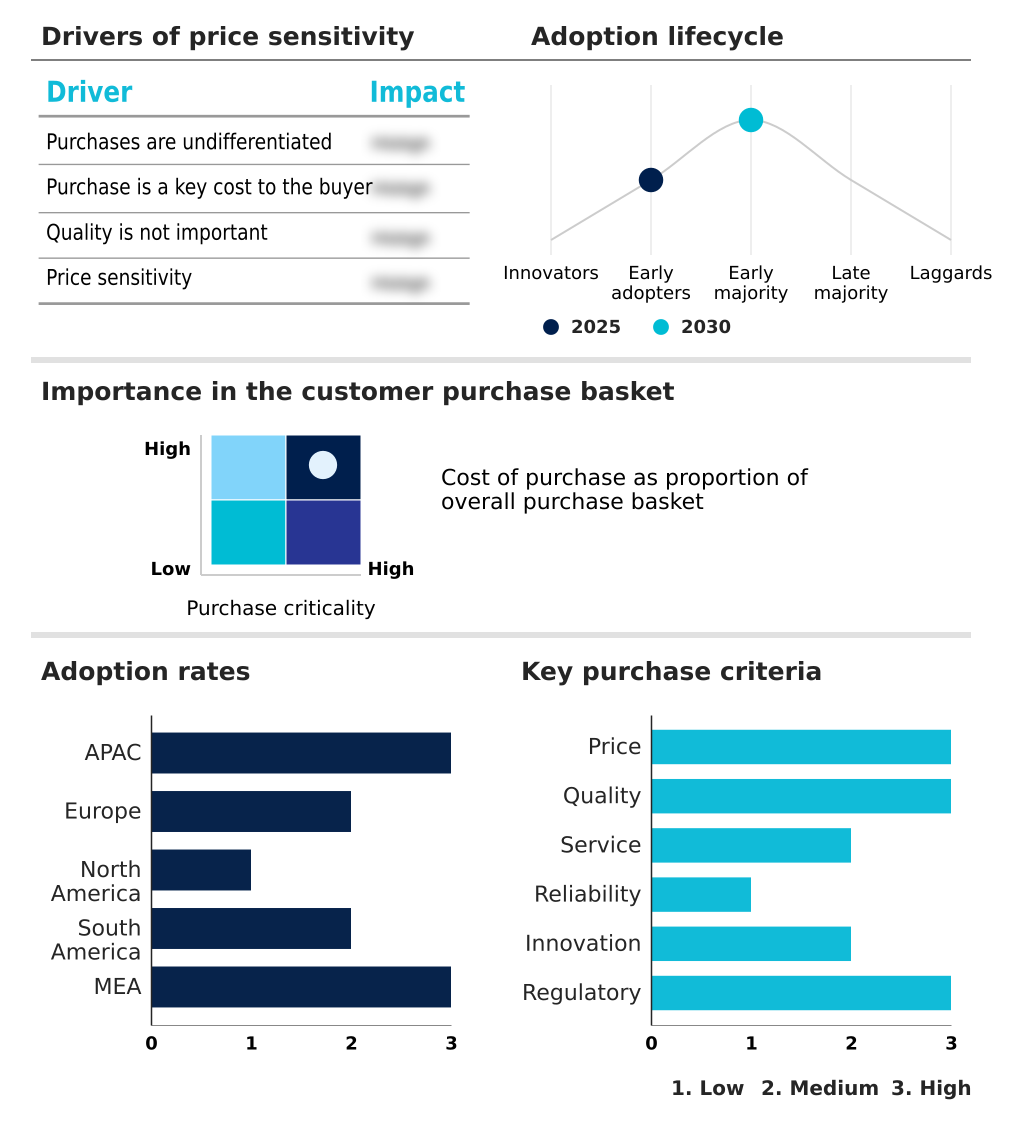
Customer Landscape of CNC Horizontal Machining Centres Industry
Competitive Landscape
Companies are implementing various strategies, such as strategic alliances, cnc horizontal machining centres market forecast, partnerships, mergers and acquisitions, geographical expansion, and product/service launches, to enhance their presence in the industry.
DMG MORI Co. Ltd. - Offerings include CNC horizontal machining centres with advanced automation and hybrid additive-subtractive capabilities, designed for high-complexity production.
The industry research and growth report includes detailed analyses of the competitive landscape of the market and information about key companies, including:
- DMG MORI Co. Ltd.
- DN Solutions Co. Ltd.
- FFG European and Americas
- Fryer Machine Systems Inc.
- Gebr. Heller Maschinenfabrik
- Haas Automation Inc.
- Hurco Companies Inc.
- Hyundai Wia Corp.
- Jiuh Yeh Precision Machinery
- JTEKT Machinery Americas Corp.
- Jyoti CNC Automation Ltd.
- KNUTH Werkzeugmaschinen GmbH.
- Komatsu Ltd.
- Makino Inc.
- Okuma Corp.
- SCM GROUP Spa
- StarragTornos Group
- Yamazaki Mazak Corp.
Qualitative and quantitative analysis of companies has been conducted to help clients understand the wider business environment as well as the strengths and weaknesses of key industry players. Data is qualitatively analyzed to categorize companies as pure play, category-focused, industry-focused, and diversified; it is quantitatively analyzed to categorize companies as dominant, leading, strong, tentative, and weak.
Recent Development and News in Cnc horizontal machining centres market
- In October 2024, Yamazaki Mazak Corp. announced a strategic collaboration with a leading robotics firm to develop pre-engineered, fully integrated automation cells for its HMC line, aiming to reduce integration complexity for end-users.
- In January 2025, Makino Inc. launched a new series of 5-axis HMCs specifically designed for machining large monolithic components for the electric vehicle industry, featuring enhanced thermal stability and a larger work envelope.
- In March 2025, DMG MORI Co. Ltd. acquired a specialized software company focused on digital twin technology to deepen the integration of its machines within Industry 4.0 ecosystems, enhancing predictive analytics and process simulation capabilities.
- In April 2025, Haas Automation Inc. announced the expansion of its primary manufacturing facility to increase production capacity by 20%, directly responding to growing demand from reshoring initiatives in North America.
Dive into Technavio’s robust research methodology, blending expert interviews, extensive data synthesis, and validated models for unparalleled CNC Horizontal Machining Centres Market insights. See full methodology.
| Market Scope | |
|---|---|
| Page number | 292 |
| Base year | 2025 |
| Historic period | 2020-2024 |
| Forecast period | 2026-2030 |
| Growth momentum & CAGR | Accelerate at a CAGR of 7.1% |
| Market growth 2026-2030 | USD 3115.2 million |
| Market structure | Fragmented |
| YoY growth 2025-2026(%) | 6.7% |
| Key countries | China, Japan, South Korea, India, Australia, Indonesia, UK, Germany, France, Italy, Spain, The Netherlands, US, Canada, Mexico, Brazil, Argentina, Colombia, Saudi Arabia, UAE, South Africa, Egypt and Turkey |
| Competitive landscape | Leading Companies, Market Positioning of Companies, Competitive Strategies, and Industry Risks |
Research Analyst Overview
- The CNC horizontal machining centres market is evolving from providing standalone equipment to delivering integrated systems central to the smart factory. A modern machine, defined by its horizontally oriented spindle and automatic pallet changer, now incorporates advanced CNC controls and in-process probing for unattended operation.
- The industry is advancing with 5-axis horizontal machining centres that enable monolithic design, a critical capability for sectors demanding lightweight, high-strength components. This machine tool technology, featuring high-torque spindles and high-pressure coolant delivery, is essential for new machining strategies. Integrating digital twin technology allows for advanced process optimization and predictive maintenance algorithms, addressing the need for lights-out manufacturing.
- For corporate strategy, investing in such systems, which can reduce new product introduction cycles by 30%, is a key decision impacting long-term capital expenditure and competitive positioning. Firms must weigh the benefits of these technologies against the need for advanced workholding systems, cutting tool technology, and mitigating tool breakage detection to ensure a high return on investment.
What are the Key Data Covered in this CNC Horizontal Machining Centres Market Research and Growth Report?
-
What is the expected growth of the CNC Horizontal Machining Centres Market between 2026 and 2030?
-
USD 3.12 billion, at a CAGR of 7.1%
-
-
What segmentation does the market report cover?
-
The report is segmented by End-user (Automotive, Aerospace, Metal fabrication, and Others), Product (Less than 5-axis, and Equal to 5-axis and more), Application (General applications, High end, and Special purpose) and Geography (APAC, Europe, North America, South America, Middle East and Africa)
-
-
Which regions are analyzed in the report?
-
APAC, Europe, North America, South America and Middle East and Africa
-
-
What are the key growth drivers and market challenges?
-
Pervasive demand for automation and enhanced manufacturing productivity, Prohibitive initial capital outlay and high total cost of ownership
-
-
Who are the major players in the CNC Horizontal Machining Centres Market?
-
DMG MORI Co. Ltd., DN Solutions Co. Ltd., FFG European and Americas, Fryer Machine Systems Inc., Gebr. Heller Maschinenfabrik, Haas Automation Inc., Hurco Companies Inc., Hyundai Wia Corp., Jiuh Yeh Precision Machinery, JTEKT Machinery Americas Corp., Jyoti CNC Automation Ltd., KNUTH Werkzeugmaschinen GmbH., Komatsu Ltd., Makino Inc., Okuma Corp., SCM GROUP Spa, StarragTornos Group and Yamazaki Mazak Corp.
-
Market Research Insights
- The market dynamics are shaped by a strategic pivot toward comprehensive industrial automation solutions, moving beyond standalone machines to integrated lights-out production cells. This evolution is driven by the need to maximize operational efficiency, with advanced systems boosting machine utilization rates by over 40% through unattended operation.
- The adoption of a digital manufacturing ecosystem, where machines provide real-time data, enhances process control and improves part consistency to over 99%. Firms are increasingly focused on lifecycle performance and turnkey production solutions to justify capital-intensive investments.
- This focus ensures that the high initial outlay is offset by a lower total cost of ownership and a more rapid return on investment, aligning technology adoption with long-term financial and operational goals.
We can help! Our analysts can customize this cnc horizontal machining centres market research report to meet your requirements.
 RIA -
RIA - 
