


Digital Printing And Dyeing Machines Market Size 2024-2028
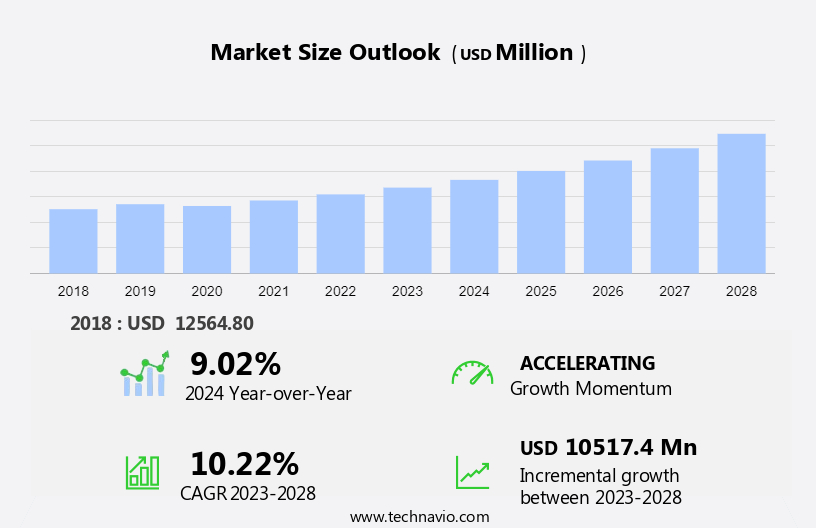
The digital printing and dyeing machines market size is forecast to increase by USD 10.52 billion at a CAGR of 10.22% between 2023 and 2028.
- The market is experiencing significant growth due to several key trends. The global demand for textiles is on the rise, leading to increased production and the need for advanced technologies like digital printing and dyeing machines. Automation of the dyeing process is another major trend, as it helps reduce labor costs and improve efficiency. Smart textiles, incorporating sensors, nanotechnology, and materials science, are gaining popularity in the industry due to their ability to integrate electronics and design innovation. However, the textile industry faces a lack of skilled labor, making the adoption of automated solutions even more crucial. These trends are driving the market's growth, with digital printing and dyeing machines becoming increasingly popular due to their ability to produce high-quality, customized textiles cost-effectively and efficiently. Additionally, digital printing technology offers the advantage of shorter production runs and quicker turnaround times, making it an attractive option for fashion brands and retailers. Overall, the market is poised for continued growth in the coming years.
What will be the Size of the Digital Printing And Dyeing Machines Market During the Forecast Period?
- The market is experiencing significant growth due to the increasing demand for customized and sustainable textile production. Digital printers and dyeing machines enable the production of intricate designs and patterns on various fabric types, including normal textiles and emerging smart textiles made from non-woven materials. These advanced technologies offer benefits such as reduced water and energy consumption, lower temperature requirements, and increased automation.
- Quantitative data indicates a steady rise in market size, driven by the adoption of digital sources for textile design and production. Qualitative data reveals that ink cost, initial investment, installation costs, and maintenance costs are key factors influencing market growth. The market is expected to continue expanding at the country level, with continued advancements in technology and the increasing demand for customized and sustainable textile solutions.
How is this Digital Printing And Dyeing Machines Industry segmented and which is the largest segment?
The digital printing and dyeing machines industry research report provides comprehensive data (region-wise segment analysis), with forecasts and estimates in "USD billion" for the period 2024-2028, as well as historical data from 2018-2022 for the following segments.
- Distribution Channel
- OEM
- Indirect sales
- Type
- Digital printing machines
- Dyeing machines
- Geography
- APAC
- China
- India
- Europe
- UK
- North America
- US
- South America
- Brazil
- Middle East and Africa
- APAC
By Distribution Channel Insights
- The OEM segment is estimated to witness significant growth during the forecast period.
The market experienced significant growth in 2023, with Original Equipment Manufacturers (OEMs) accounting for the largest market share. OEMs provide numerous benefits to businesses, including reduced overhead costs, efficient business operations, and personalized customer attention through direct sales. By purchasing digital printing and dyeing machines directly from OEMs, companies can streamline their operations and focus on their core competencies.
Additionally, advancements in technology, such as nanotechnology and materials science, have led to the development of smart textiles and innovative design capabilities, further driving market growth. Despite the initial high investment costs, the cost of ink and maintenance costs are offset by the benefits of increased productivity and design flexibility.
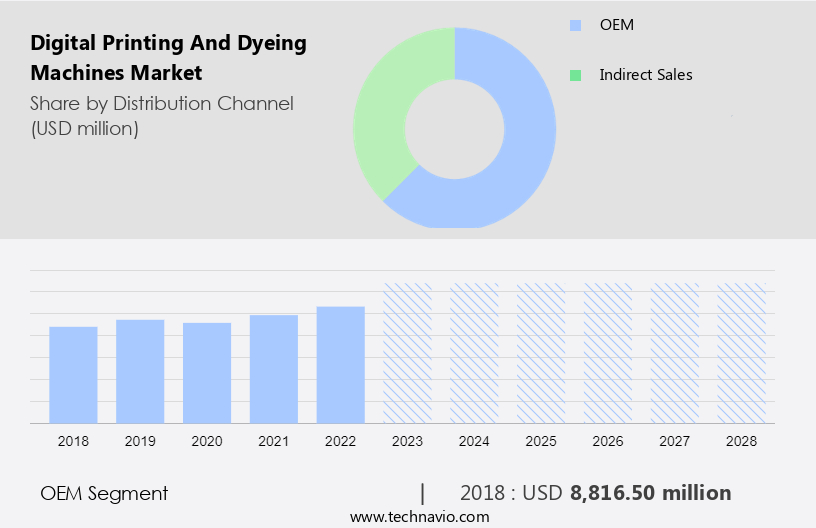
Get a glance at the Digital Printing And Dyeing Machines Industry report of share of various segments Request Free Sample
The OEM segment was valued at USD 8.82 billion in 2018 and showed a gradual increase during the forecast period.
Regional Analysis
- APAC is estimated to contribute 56% to the growth of the global market during the forecast period.
Technavio's analysts have elaborately explained the regional trends and drivers that shape the market during the forecast period.
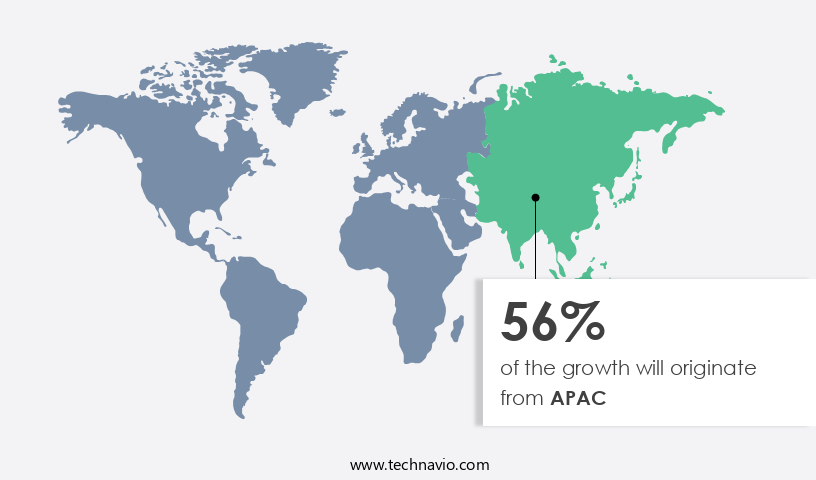
For more insights on the market share of various regions, Request Free Sample
The Asia Pacific (APAC) region, particularly China, India, Japan, Pakistan, South Korea, and Bangladesh, holds a significant footprint in the global textile industry due to the availability of low-cost labor, a large rural population, and favorable climatic conditions. China, as the world's largest textile and garment manufacturer for over three decades, produces approximately 4.8 billion meters of clothing fabric monthly, with an average textile production of around 2 billion meters. Digital printing and dyeing machines play a crucial role in this industry, enabling cost-effective and efficient production. Micro-economic factors, such as increasing consumer demand for customized and sustainable textiles, and external factors, including technological advancements and trade policies, influence the market's growth.
Market Dynamics
Our digital printing and dyeing machines market researchers analyzed the data with 2023 as the base year, along with the key drivers, trends, and challenges. A holistic analysis of drivers will help companies refine their marketing strategies to gain a competitive advantage.
What are the key market drivers leading to the rise in the adoption of Digital Printing And Dyeing Machines Industry?
Growing global demand for textiles is the key driver of the market.
- The market is witnessing significant growth due to the increasing demand for textiles in developing economies, such as China, India, Brazil, Mexico, the Philippines, and Indonesia. The economic improvement in these countries is leading to an increase in the purchasing power of their residents, resulting in rising per capita consumption of textiles. This trend is driving the demand for digital printing and dyeing machines, as they offer cost-effective and efficient solutions for producing high-quality textiles. Manufacturers are shifting their manufacturing bases to these countries to take advantage of factors such as easy access to raw materials, cost-effective labor, and lenient regulations.
- The digital printing method is gaining popularity due to its ability to produce intricate designs, superior fabric quality, and scalability. The industry footprint of digital printing and dyeing machines is expanding, with major players investing in research and development to innovate and offer advanced product features and functions. Micro-economic factors, such as initial investment, installation costs, ink cost, and maintenance costs, are important considerations for businesses in the market. External factors, such as political and social scenarios, can also impact the market dynamics. For instance, the adoption of smart textiles and nanotechnology in the textile industry is expected to create new opportunities for digital printing and dyeing machines.
What are the market trends shaping the Digital Printing And Dyeing Machines Industry?
Automation of the dyeing process is the upcoming trend in the market.
- The market is experiencing significant growth due to the increasing demand for high-quality textiles in various industries. The digital printing method, which utilizes computer images and real numbers for output, offers several advantages over traditional printing techniques, including greater product customization, reduced material waste, and improved fabric quality. The cost of digital printing machines and dyeing machines, including initial investment, installation costs, and ink costs, can be high, but the benefits, such as scalability and the ability to produce new designs and non-woven fabrics, often outweigh these expenses. Micro-economic factors, such as the financial position of businesses and maintenance costs, as well as external factors, such as political and social scenarios, can impact the market's growth.
- The industry footprint of digital printing and dyeing machines is expanding, with companies like Ace Matrix leading the way as innovators in the field. Product features and functions, such as automation and UV-cured printing, are driving the market's growth. Quantitative data indicates a steady increase in demand for digital printers and dyeing machines, while qualitative data suggests that the packaging system, including plastic films, release liners, and materials, is also a significant child market. Business strategy plays a crucial role in the market's growth, with direct sales and indirect sales channels being used to reach customers. The value chain analysis of the market includes various stages, such as design, materials science, and print work.
What challenges does Digital Printing And Dyeing Machines Industry face during its growth?
The lack of skilled labor in the textile industry is a key challenge affecting the industry's growth.
- The market is experiencing significant growth due to the increasing demand for customized and high-quality textile products. The digital printing method, using computer images, offers exceptional detail, clarity, and flexibility, making it an attractive alternative to traditional printing methods. However, the market's expansion is influenced by various internal and external factors. Major internal factors include the financial position of textile businesses, which can impact their ability to make the significant initial investment and installation costs for digital printing and dyeing machines. Additionally, the cost of ink and maintenance costs are ongoing expenses that must be considered. External factors, such as economic conditions, political instability, and social scenarios, can also impact the market's growth.
- For instance, economic downturns can lead to decreased demand for textiles, while political instability can disrupt supply chains. Moreover, the textile industry's reliance on skilled labor and support staff is a significant challenge. The shortage of skilled labor can lead to production delays and increased costs, while the lack of electricians, hydraulic, and pneumatic machinery technicians can hinder the maintenance and upkeep of digital printing and dyeing machines. The market's regional footprint is diverse, with major players in Asia, Europe, and North America. Product features and functions, such as scalability, automation, and the ability to print on various fabrics, including non-woven and smart textiles, are driving innovation in the market.
Exclusive Customer Landscape
The digital printing and dyeing machines market forecasting report includes the adoption lifecycle of the market, covering from the innovator's stage to the laggard's stage. It focuses on adoption rates in different regions based on penetration. Furthermore, the market report also includes key purchase criteria and drivers of price sensitivity to help companies evaluate and develop their market growth analysis strategies.
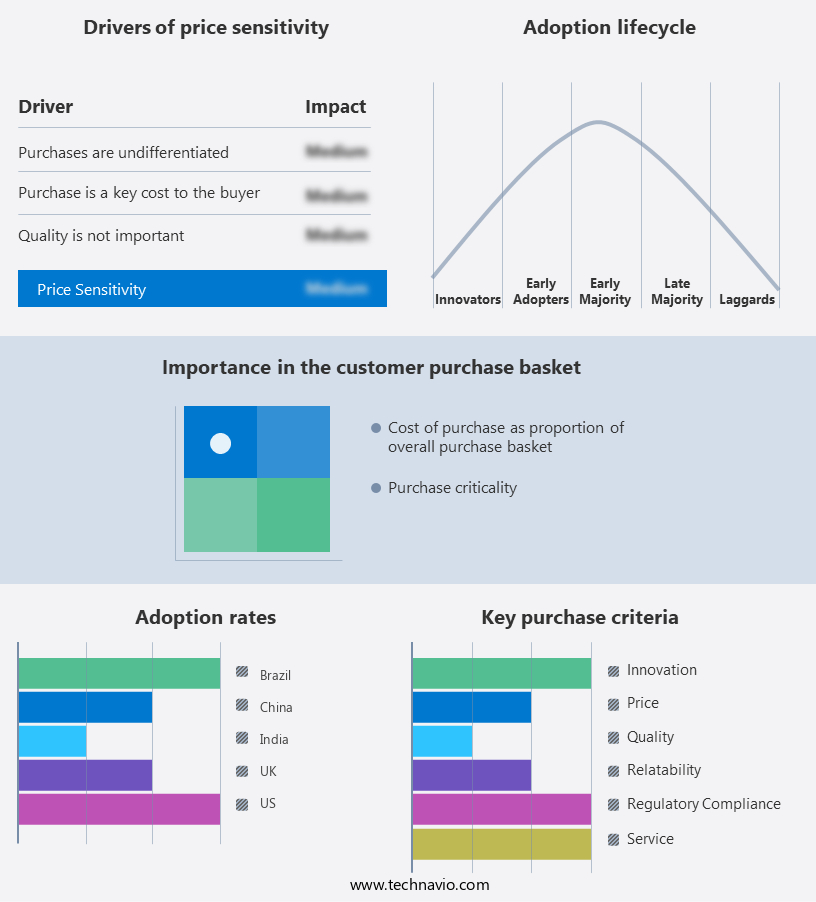
Customer Landscape
Key Companies & Market Insights
Companies are implementing various strategies, such as strategic alliances, market forecast, partnerships, mergers and acquisitions, geographical expansion, and product/service launches, to enhance their presence in the industry. The digital printing and dyeing machines industry research and growth report includes detailed analyses of the competitive landscape of the market and information about key companies, including:
- Acme Machinery Co. Pvt. Ltd.
- Alliance Machines Textiles
- Applied Separations Inc.
- Colorjet Group
- Cubotex Srl
- Flainox Srl
- FONGS Europe GmbH
- FUJIFILM Corp.
- HGS Machines Pvt. Ltd.
- J. Zimmer Maschinenbau GmbH
- Konica Minolta Inc.
- Kornit Digital Ltd.
- La Meccanica Spa
- Loris Bellini Srl
- Mimaki Engineering Co. Ltd.
- Ricoh Co. Ltd.
- Roland DG Corp.
- Seiko Epson Corp.
- SPGPrints
- Xerox Holdings Corp.
Qualitative and quantitative analysis of companies has been conducted to help clients understand the wider business environment as well as the strengths and weaknesses of key industry players. Data is qualitatively analyzed to categorize companies as pure play, category-focused, industry-focused, and diversified; it is quantitatively analyzed to categorize companies as dominant, leading, strong, tentative, and weak.
Research Analyst Overview
The market represents a significant segment within the broader textile industry. This market is characterized by continuous innovation, driven by both internal and external factors. Digital printing, a cutting-edge technology, has revolutionized the textile industry. It allows for the production of high-quality, intricately designed fabrics with minimal waste. The cost of digital printing machines has become increasingly affordable, making it an attractive option for businesses of all sizes. Fabric is the primary input for digital printing and dyeing machines. The choice of fabric significantly influences the market dynamics.
For instance, non-woven fabrics have gained popularity due to their versatility and ease of processing. However, the temperature requirements for dyeing these fabrics can be challenging. Micro-economic factors, such as the cost of ink and maintenance costs, play a crucial role in the financial position of businesses operating in this market. Scalability is another essential factor, as businesses strive to meet increasing demand while maintaining efficiency. Business strategy is a key internal factor influencing the market. Innovators in this space are constantly seeking to differentiate themselves through product features and functions. For example, some companies focus on direct sales, while others rely on indirect sales channels.
Furthermore, external factors, such as political and economic conditions, can significantly impact the market. For instance, changes in trade policies can affect the cost of raw materials and the competitiveness of certain regions. Social scenarios, such as changing consumer preferences for sustainable and eco-friendly textiles, can also influence market trends. The industry footprint of digital printing and dyeing machines is vast. It extends beyond the textile industry to include packaging systems. Digital sources, such as computer, have become essential in the design process, enabling businesses to create new designs quickly and efficiently. Automation is a significant trend in this market, with many businesses investing in advanced technologies to streamline their operations and reduce labor costs.
|
Digital Printing And Dyeing Machines Market Scope |
|
|
Report Coverage |
Details |
|
Page number |
165 |
|
Base year |
2023 |
|
Historic period |
2018-2022 |
|
Forecast period |
2024-2028 |
|
Growth momentum & CAGR |
Accelerate at a CAGR of 10.22% |
|
Market Growth 2024-2028 |
USD 10.52 billion |
|
Market structure |
Fragmented |
|
YoY growth 2023-2024(%) |
9.02 |
|
Key countries |
China, US, India, UK, and Brazil |
|
Competitive landscape |
Leading Companies, Market Positioning of Companies, Competitive Strategies, and Industry Risks |
What are the Key Data Covered in this Market Research and Growth Report?
- CAGR of the Digital Printing And Dyeing Machines industry during the forecast period
- Detailed information on factors that will drive the market growth and forecasting between 2024 and 2028
- Precise estimation of the size of the market and its contribution of the industry in focus to the parent market
- Accurate predictions about upcoming market growth and trends and changes in consumer behaviour
- Growth of the market across APAC, Europe, North America, South America, and Middle East and Africa
- Thorough analysis of the market's competitive landscape and detailed information about companies
- Comprehensive analysis of factors that will challenge the growth of industry companies
We can help! Our analysts can customize this market research report to meet your requirements. Get in touch
 RIA -
RIA - 
