


Dolomite Market Analysis APAC, North America, Europe, South America, Middle East and Africa - US, China, India, Japan, The Netherlands - Size and Forecast 2024-2028

Dolomite Market Analysis APAC, North America, Europe, South America, Middle East and Africa - US, China, India, Japan, The Netherlands - Size and Forecast 2024-2028

Published: Jul 2024 134 Pages SKU: IRTNTR74052

Market Overview at a Glance

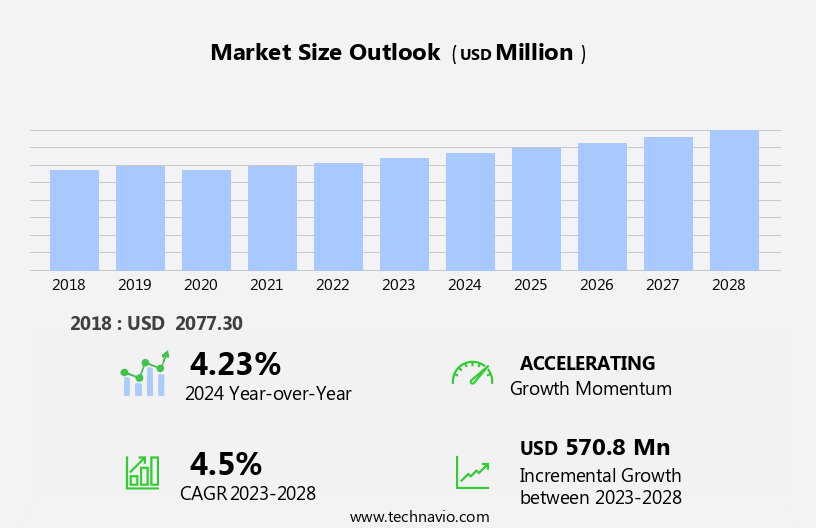
$570.8 Mn
Market Opportunity
4.5%
CAGR
4.23
YoY growth 2023-2024(%)

Dolomite Market Size 2024-2028

The dolomite market size is forecast to increase by USD 570.8 million at a CAGR of 4.5% between 2023 and 2028.

  • The market is experiencing significant growth due to several key factors. The increasing prices of construction aggregates have led to a surge in demand for dolomite as an alternative, cost-effective solution. Furthermore, the rising demand for refractory materials in various industries, including steel and cement, is driving market growth. The cement industry, in particular, is a major consumer of dolomite due to its use as a flux In the production process. These trends are expected to continue, making the market an attractive investment opportunity for businesses in North America. Additionally, the versatility of dolomite in various applications, such as agriculture and water treatment, further expands its market potential.
  • However, challenges such as the availability of substitutes and fluctuations in raw material prices may pose a threat to market growth. Overall, the market is poised for steady expansion In the coming years.
  • What will be the Size of the Dolomite Market During the Forecast Period?
    Dolomite Market Size

     Request Free Sample

  • The market encompasses the global production and trade of this essential carbonate mineral. Dolomite is a critical raw material in various industries, including steel production, energy, and mining and metallurgy. In steel manufacturing, calcined dolomite is utilized as a flux and furnace lining In the production of sintered products and refractories. The energy sector employs dolomite as a crucial component In the cement and power industries. Additionally, dolomite finds applications In the construction sector, agrochemicals, pharma and healthcare, glass and ceramics sectors, and the portland cement industry. The market for dolomite and its derivatives is experiencing robust growth due to increasing demand from the aforementioned sectors.
  • The mining and metallurgy industry's expansion, fiscal stimulus, and the growing importance of carbonate minerals in diverse applications further bolster market prospects.
  • How is this Dolomite Industry segmented and which is the largest segment?

    The dolomite industry research report provides comprehensive data (region-wise segment analysis), with forecasts and estimates in "USD million" for the period 2024-2028, as well as historical data from 2018-2022 for the following segments.

    • Product
      • Calcined
      • Sintered
      • Agglomerated
    • Geography
      • APAC
        • China
        • India
        • Japan
      • North America
        • US
      • Europe
        • South America
          • Middle East and Africa

          By Product Insights

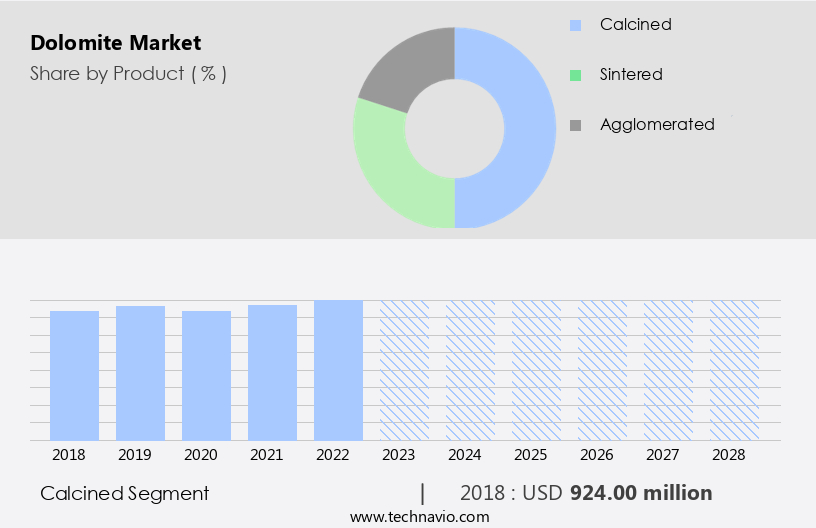
          • The calcined segment is estimated to witness significant growth during the forecast period.

          Calcined dolomite, derived from calcium carbonate and magnesium minerals through calcination, holds the largest market share, surpassing 44% in 2023. This product significantly contributes to the steel industry as a crucial component in protective agents and refractory linings. In the agriculture sector, calcined dolomite functions as a soil conditioner and water treatment agent. The expansion of the construction and infrastructure sectors globally has driven cement consumption, subsequently increasing the demand for calcined dolomite. Its utilization in cement production not only decreases carbon emissions but also generates less waste, making it a preferred choice for industry players. The growth trajectory of the construction sector, fueled by economic growth, monetary policy normalization, and government-led fiscal stimulus, further bolsters the market expansion for calcined dolomite.

          Additionally, its application extends to various industries such as glass manufacturing, animal feed, and steel facilities.
          Dolomite Market Size

          Get a glance at the  Dolomite Industry report of share of various segments Request Free Sample

          The Calcined segment was valued at USD 924.00 million in 2018 and showed a gradual increase during the forecast period.

          Regional Analysis

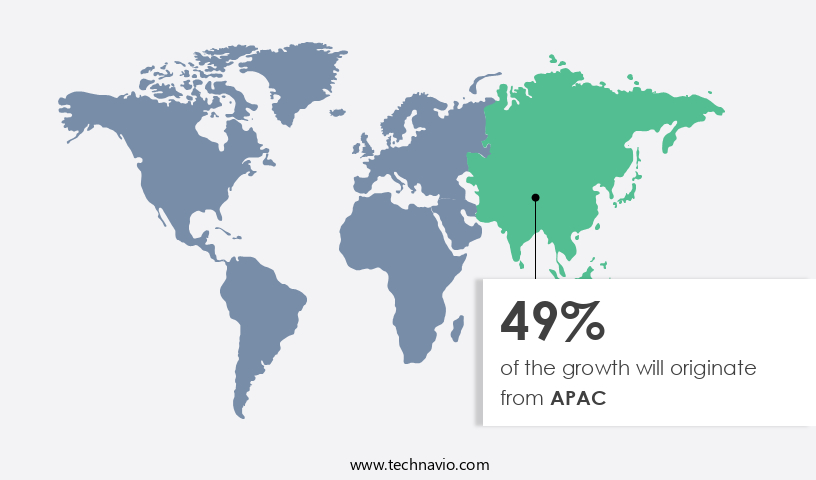
          • APAC is estimated to contribute 49% to the growth of the global market during the forecast period.

          Technavio’s analysts have elaborately explained the regional trends and drivers that shape the market during the forecast period.
          Dolomite Market Share by Geography

          For more insights on the market share of various regions, Request Free Sample

          The Asia Pacific region is expected to dominate The market due to its significant role in cement production. China, as the world's leading cement manufacturer, is the largest consumer of dolomite. The country's construction sector, particularly in residential and infrastructure development, has experienced growth in recent years. India, the second-largest cement producer In the region, is also witnessing a construction industry expansion. The Indian government's emphasis on infrastructure development contributes to the increasing demand for cement and, consequently, dolomite. Dolomite is a crucial raw material in steel production, used as a flux and furnace lining. The steel industry's output growth in North America, driven by economic recovery, monetary policy normalization, and fiscal stimulus, is expected to boost the demand for dolomite.

          The construction sector's spending increase, urbanization, and growth in industries like food & beverages, tourism, and mining & metallurgy further contribute to the market's expansion. Additionally, the demand for low-carbon steel products and synthetic fluxes made from dolomite is increasing due to environmental concerns and technological advancements.

          Market Dynamics

          Our  researchers analyzed the data with 2023 as the base year, along with the key drivers, trends, and challenges. A holistic analysis of drivers will help companies refine their marketing strategies to gain a competitive advantage.

          What are the key market drivers leading to the rise In the adoption of Dolomite Industry?

          Increase in prices of construction aggregates is the key driver of the market.

        • The market is experiencing significant growth due to its role as a crucial raw material In the production of steel and cement. In the steel industry, calcined dolomite is used as a flux and furnace lining, while sintered products serve as refractories. The energy sector's expansion, driven by economic growth and monetary policy normalization, has led to an increase in steel output, boosting the demand for dolomite. The construction sector's growth, fueled by government-led fiscal stimulus, investor spending, and urbanization, is another key factor driving the market. Construction spending on infrastructure projects, low-carbon steel production, and the production of synthetic fluxes such as gypsum, calcined clay, magnesite, and limestone, have all contributed to the demand for dolomite.
        • The construction sector's expansion is also leading to increased demand for dolomite as a construction aggregate and in water treatment applications, including reverse osmosis. The calcined segment of the market, which includes basic refractories, is expected to dominate the market due to its wide application in various industries, including iron & steel, glass manufacturing, animal feed, and steel facilities. The demand for dolomite is not limited to developed economies, with emerging markets In the Middle East & Africa and the tourism industry also showing strong growth. The food & beverages industry, agrochemicals, mining & metallurgy, pharma & healthcare, glass & ceramics sectors, and the infrastructure sector are also significant consumers of dolomite.
        • The Carbonate Minerals market, which includes dolomite, is projected to grow at a steady pace due to its wide range of applications and the increasing demand for cement and steel in various industries. The market is expected to remain strong during the forecast period, driven by the ongoing infrastructure development and industrialization trends.
        • What are the market trends shaping the Dolomite Industry?

          Rising demand for refractory materials is the upcoming market trend.

        • Refractory materials play a crucial role In the steel industry, accounting for approximately 2-3% of steel production costs. The steel sector represents around three-quarters of the global refractory market demand and is expected to remaIn the primary driver during the forecast period. Despite the global steel industry's oversupply challenges, there has been a steady recovery in 2021. Investment In the steel industry is projected to increase in developing countries, such as India and China, as these regions focus on self-sufficiency and reducing imports. The energy industry also contributes significantly to the demand for refractory materials, particularly In the production of calcined dolomite used as a flux In the steel industry.
        • Calcined dolomite is essential for steel production, as it lowers the melting point of iron and reduces the amount of coke required. Additionally, refractory materials are used in various applications, including furnace linings, converter linings, electric furnace walls, and refractory bricks. In North America, the steel output is expected to grow with economic recovery and monetary policy normalization, leading to increased demand for refractory materials. The construction sector is another significant consumer of refractory materials, with construction spending projected to increase due to government-led fiscal stimulus and investor spending. Refractory materials are also used in various industries, including the manufacturing of low-carbon steel products, glass manufacturing, animal feed, and tourism.
        • In the mining and metallurgy sector, refractory materials are used in sintered products, such as LD converter linings and agglomerated products, to improve the efficiency of the mining process. In the infrastructure sector, refractory materials are used In the production of concrete and cement, while In the water treatment industry, they are used in reverse osmosis systems for drinking water. The carbonate minerals market, which includes dolomite, is expected to grow due to increasing demand from various industries, including the pharmaceutical and healthcare sectors, agrochemicals, and glass and ceramics sectors. In conclusion, the refractory materials market is expected to grow due to increasing demand from the steel industry, the energy industry, and various other industries.
        • The recovery of the steel industry, increasing investment in developing countries, and government-led fiscal stimulus are expected to drive the growth of the refractory materials market In the coming years.
        • What challenges does the Dolomite Industry face during its growth?

          Rising demand from cement industry is a key challenge affecting the industry growth.

        • The market holds significance in various industries, particularly In the steel production sector where it is utilized as a flux and furnace lining In the iron and steel industry. In the energy sector, calcined dolomite is employed as a raw material In the production of low-carbon steel products. The North America market for dolomite is expected to grow due to economic growth, monetary policy normalization, and government-led fiscal stimulus, leading to increased steel output and investor spending. The construction sector's expansion, driven by construction spending, also contributes to the demand for dolomite In the form of sintered products and refractories.
        • In the infrastructure sector, dolomite's applications extend to concrete and cement production, making it an indispensable raw material. The construction sector's growth, fueled by urbanization, tourism, food & beverages, and other industries, necessitates the use of dolomite in various applications. Additionally, dolomite is used in water treatment, such as reverse osmosis, drinking water, and industrial processes, further expanding its market potential. The calcined dolomite segment, which includes basic refractories, converter lining, electric furnace walls, and magnesium oxide (MgO) refractory bricks, holds a significant market share. The demand for dolomite In the mining and metallurgy, pharma & healthcare, glass & ceramics sectors, and agrochemicals also contributes to the market's growth.
        • The carbonate minerals market, which includes dolomite, is expected to witness steady growth due to its wide range of applications. In conclusion, the market's growth is driven by various industries, including steel production, energy, construction, and infrastructure. Its versatility and wide applicability make it an essential raw material, and its demand is expected to continue growing due to the expansion of these industries.
        • Exclusive Customer Landscape

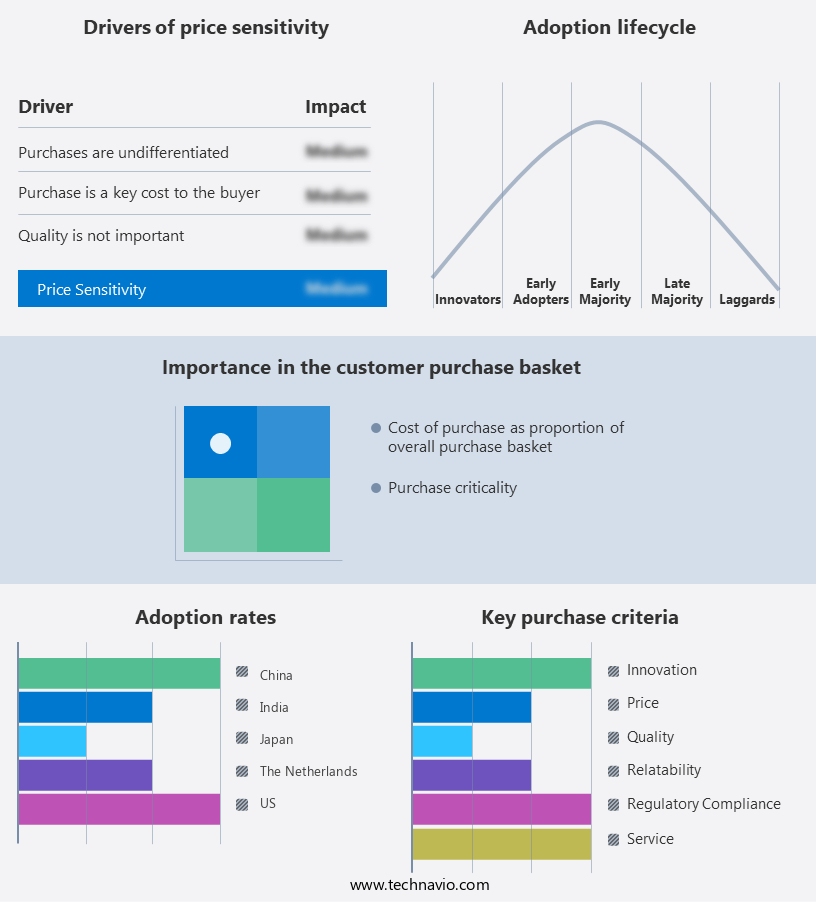
          The dolomite market forecasting report includes the adoption lifecycle of the market, covering from the innovator’s stage to the laggard’s stage. It focuses on adoption rates in different regions based on penetration. Furthermore, the dolomite market report also includes key purchase criteria and drivers of price sensitivity to help companies evaluate and develop their market growth analysis strategies.
          Dolomite Market Share by Geography

           Customer Landscape

          Key Companies & Market Insights

          Companies are implementing various strategies, such as strategic alliances, dolomite market forecast, partnerships, mergers and acquisitions, geographical expansion, and product/service launches, to enhance their presence In the industry.

          Arihant Min chem - The company specializes In the production and supply of dolomite products, specifically magnesium carbonate minerals, catering to various industries. These minerals derive from the naturally occurring mineral dolomite and undergo refining processes to yield high-purity magnesium carbonate. This product line is integral to numerous applications, including pharmaceuticals, agriculture, and water treatment, among others. The company's commitment to quality and consistency ensures the delivery of superior magnesium carbonate minerals to its clientele.

          The industry research and growth report includes detailed analyses of the competitive landscape of the market and information about key companies, including:

          • Arihant Min chem
          • Calcinor SA
          • Carmeuse Coordination Center SA
          • Dolomine de villers le Gambon SA
          • E. Dillon and Co.
          • Essel Mining and Industries Ltd.
          • Imerys S.A.
          • Inca Mining Pty Ltd.
          • JFE Mineral and Alloy Co. Ltd.
          • Lhoist SA
          • Liaoning Beihai Industry Group Co. Ltd.
          • Longcliffe Quarries Ltd.
          • Minerals Technologies Inc.
          • Nordkalk Corp.
          • Omya International AG
          • Raw Edge Industrial Solutions Ltd.
          • RHI Magnesita GmbH
          • SCR Sibelco NV

          Qualitative and quantitative analysis of companies has been conducted to help clients understand the wider business environment as well as the strengths and weaknesses of key industry players. Data is qualitatively analyzed to categorize companies as pure play, category-focused, industry-focused, and diversified; it is quantitatively analyzed to categorize companies as dominant, leading, strong, tentative, and weak.

          Research Analyst Overview

          Dolomite, a calcium magnesium carbonate mineral, plays a significant role in various industries due to its unique properties. This mineral is widely used as a raw material In the production of steel and other metals, serving as a flux and furnace lining material. In the context of steel production, dolomite's ability to lower the melting point of iron and reduce the amount of impurities makes it an essential component. The demand for dolomite is driven by the economic growth and development in various sectors. The steel industry, in particular, has been a major consumer of dolomite due to the increasing steel production.

          The steel output has been on an upward trend in recent years, fueled by infrastructure development, urbanization, and industrialization. Moreover, the shift towards low-carbon steel production has further boosted the demand for dolomite. Synthetic fluxes, such as dolomitic limestone, have gained popularity In the steel industry as they help reduce the carbon footprint of the production process. Beyond the steel industry, dolomite finds applications in various sectors, including refractories, construction aggregate, water treatment, and agriculture. In the refractories industry, dolomite is used to produce magnesia oxide (MGO), refractory bricks, and converter linings for electric furnaces and steel facilities.

          In the construction sector, dolomite is used as a raw material for cement production and as a construction aggregate. In the water treatment industry, dolomite is used for water softening and as a source of magnesium in drinking water. In agriculture, dolomite is used as a soil conditioner and as a source of magnesium for livestock feed. In the glass manufacturing industry, dolomite is used as a flux and as a raw material for the production of glass and ceramics. The market dynamics for dolomite are influenced by various factors, including economic conditions, government policies, and technological advancements.

          Monetary policy normalization and fiscal stimulus measures can impact the demand for dolomite In the steel industry. The construction sector's spending patterns and urbanization trends can influence the demand for dolomite In the construction sector. The carbonate minerals market, which includes dolomite, limestone, magnesite, and gypsum, is expected to grow at a steady pace due to the increasing demand from various industries. The infrastructure sector's growth, particularly in emerging economies, is expected to drive the demand for dolomite In the construction sector. The pharma & healthcare and food & beverages industries are also expected to contribute to the growth of the carbonate minerals market.

          The mining and metallurgy sector's technological advancements, such as single-cell research and microfluidic technology, can lead to new applications for dolomite and other carbonate minerals. The start-up ecosystem's focus on innovation and sustainability can also lead to new applications for dolomite and other minerals. In conclusion, dolomite is a versatile mineral with a wide range of applications in various industries. Its demand is driven by the economic growth and development in various sectors, particularly the steel industry and the construction sector. The market dynamics for dolomite are influenced by various factors, including economic conditions, government policies, and technological advancements.

          The carbonate minerals market, which includes dolomite, is expected to grow at a steady pace due to the increasing demand from various industries.

          Market Scope

          Report Coverage

          Details

          Page number

          134

          Base year

          2023

          Historic period

          2018-2022

          Forecast period

          2024-2028

          Growth momentum & CAGR

          Accelerate at a CAGR of 4.5%

          Market growth 2024-2028

          USD 570.8 million

          Market structure

          Fragmented

          YoY growth 2023-2024(%)

          4.23

          Key countries

          US, China, India, Japan, and The Netherlands

          Competitive landscape

          Leading Companies, Market Positioning of Companies, Competitive Strategies, and Industry Risks

          Request Free Sample

          What are the Key Data Covered in this Dolomite Market Research and Growth Report?

          • CAGR of the Dolomite industry during the forecast period
          • Detailed information on factors that will drive the growth and forecasting between 2024 and 2028
          • Precise estimation of the size of the market and its contribution of the industry in focus to the parent market
          • Accurate predictions about upcoming growth and trends and changes in consumer behaviour
          • Growth of the market across APAC, North America, Europe, South America, and Middle East and Africa
          • Thorough analysis of the market’s competitive landscape and detailed information about companies
          • Comprehensive analysis of factors that will challenge the dolomite market growth of industry companies

          We can help! Our analysts can customize this dolomite market research report to meet your requirements.

          Get in touch


          Table of Contents not available.

          Research Methodology

          Technavio presents a detailed picture of the market by way of study, synthesis, and summation of data from multiple sources. The analysts have presented the various facets of the market with a particular focus on identifying the key industry influencers. The data thus presented is comprehensive, reliable, and the result of extensive research, both primary and secondary.

          INFORMATION SOURCES

          Primary sources

          • Manufacturers and suppliers
          • Channel partners
          • Industry experts
          • Strategic decision makers

          Secondary sources

          • Industry journals and periodicals
          • Government data
          • Financial reports of key industry players
          • Historical data
          • Press releases

          DATA ANALYSIS

          Data Synthesis

          • Collation of data
          • Estimation of key figures
          • Analysis of derived insights

          Data Validation

          • Triangulation with data models
          • Reference against proprietary databases
          • Corroboration with industry experts

          REPORT WRITING

          Qualitative

          • Market drivers
          • Market challenges
          • Market trends
          • Five forces analysis

          Quantitative

          • Market size and forecast
          • Market segmentation
          • Geographical insights
          • Competitive landscape

          Interested in this report?

          Get your sample now to see our research methodology and insights!

          Download Now

          Frequently Asked Questions

          Dolomite market growth will increase by $ 570.8 mn during 2024-2028.

          The Dolomite market is expected to grow at a CAGR of 4.5% during 2024-2028.

          Dolomite market is segmented by Product( Calcined, Sintered, Agglomerated)

          Arihant Min chem, Calcinor SA, Carmeuse Coordination Center SA, Dolomine de villers le Gambon SA, E. Dillon and Co., Essel Mining and Industries Ltd., Imerys S.A., Inca Mining Pty Ltd., JFE Mineral and Alloy Co. Ltd., Lhoist SA, Liaoning Beihai Industry Group Co. Ltd., Longcliffe Quarries Ltd., Minerals Technologies Inc., Nordkalk Corp., Omya International AG, Raw Edge Industrial Solutions Ltd., RHI Magnesita GmbH, SCR Sibelco NV are a few of the key vendors in the Dolomite market.

          APAC will register the highest growth rate of 49% among the other regions. Therefore, the Dolomite market in APAC is expected to garner significant business opportunities for the vendors during the forecast period.

          US, China, India, Japan, The Netherlands

          • Increase in prices of construction aggregatesThe demand for cement is being fueled by the industry's rapid rise in the construction and infrastructure sectors. Concrete with a high mechanical strength that can support large weights is made using dolomite. The demand for dolomite in civil construction is rising as a result of investments in infrastructure is the driving factor this market.
          • particularly in developing countries is the driving factor this market.
          • such as India and China. Hence is the driving factor this market.
          • dolomite sales are rising is the driving factor this market.
          • and the trend is anticipated to remain the same during the forecast period. Growing commercial and industrial construction activities are booming globally. Popular interest rates in the world decreased is the driving factor this market.
          • living standards increased is the driving factor this market.
          • per capita income increased is the driving factor this market.
          • and industrialization and infrastructure developed led to an increase in construction activities is the driving factor this market.
          • stimulating the demand for cement is the driving factor this market.
          • thus boosting the global dolomite market. Key players favor using dolomite to create cement because it reduces waste creation and carbon emissions. This lowers the total cost of production and aids businesses in attaining their sustainability objectives. For instance is the driving factor this market.
          • China's cement manufacturing expanded dramatically during the past ten years is the driving factor this market.
          • which raised the need for dolomite. In the coming years is the driving factor this market.
          • it is projected that an increase in cement manufacturing will accelerate dolomite use is the driving factor this market.
          • which is the driving factor this market.
          • in turn is the driving factor this market.
          • will fuel the market in focus growth during the forecast period is the driving factor this market.

          The Dolomite market vendors should focus on grabbing business opportunities from the Calcined segment as it accounted for the largest market share in the base year.
