



Duty-Free Retailing Market Size 2025-2029
The duty-free retailing market size is valued to increase by USD 22.74 billion, at a CAGR of 8.3% from 2024 to 2029. Growing international tourism will drive the duty-free retailing market.
Major Market Trends & Insights
- APAC dominated the market and accounted for a 45% growth during the forecast period.
- By Product - Cosmetics and perfumes segment was valued at USD 15.77 billion in 2023
- By Distribution Channel - Airport segment accounted for the largest market revenue share in 2023
Market Size & Forecast
- Market Opportunities: USD 80.00 billion
- Market Future Opportunities: USD 22737.10 billion
- CAGR from 2024 to 2029 : 8.3%
Market Summary
- The market experiences continuous expansion, driven by the surge in international tourism and the increasing emphasis on enhancing the shopping experience for travelers. The global duty-free retail sales amounted to approximately USD 74 billion in 2020. Despite this growth, the industry faces challenges from stringent government regulations, particularly concerning duty-free tobacco products. To cater to evolving consumer preferences, retailers invest in innovative strategies, such as omnichannel offerings, personalized services, and technology integration. Duty-free retailers are leveraging advanced technologies like RFID and beacons to create interactive shopping experiences, enabling travelers to locate products and receive real-time promotions.
- Additionally, partnerships with local brands and duty-paid retailers offer unique shopping experiences, making duty-free retail an essential component of the global travel industry. As international travel resumes, the market is expected to rebound, with retailers focusing on adapting to the new normal through contactless payment options, social distancing measures, and enhanced hygiene protocols. The future of duty-free retail lies in seamless integration of technology, personalized services, and a focus on creating memorable shopping experiences for travelers.
What will be the Size of the Duty-Free Retailing Market during the forecast period?

Get Key Insights on Market Forecast (PDF) Request Free Sample
How is the Duty-Free Retailing Market Segmented?
The duty-free retailing industry research report provides comprehensive data (region-wise segment analysis), with forecasts and estimates in "USD billion" for the period 2025-2029, as well as historical data from 2019-2023 for the following segments.
- Product
- Cosmetics and perfumes
- Fashion apparel and accessories
- Tobacco and alcoholic beverages
- Confectionery and fine foods
- Distribution Channel
- Airport
- Border/downtown/hotel
- Others
- End-User
- International Travelers
- Domestic Travelers
- Price Range
- Budget
- Mid-range
- Premium
- Geography
- North America
- US
- Canada
- Europe
- France
- Germany
- Italy
- Spain
- UK
- Middle East and Africa
- UAE
- APAC
- China
- India
- Japan
- South Korea
- South America
- Brazil
- Rest of World (ROW)
- North America
By Product Insights
The cosmetics and perfumes segment is estimated to witness significant growth during the forecast period.
The market is witnessing continuous evolution, with various segments, including cosmetics and perfumes, showcasing significant growth. International travelers' increasing number and their penchant for luxury shopping during travel, the rising disposable income of middle-class travelers, and urbanization are key factors driving this trend. In 2020, the cosmetics and perfumes segment accounted for over 30% of the market revenue. Travelers from the APAC and Middle East regions were the primary contributors to this segment's high sales growth. Leading cosmetic and perfume brands like L'Oreal, Chanel, Christian Dior, Estée Lauder, and Guerlain dominate the market.
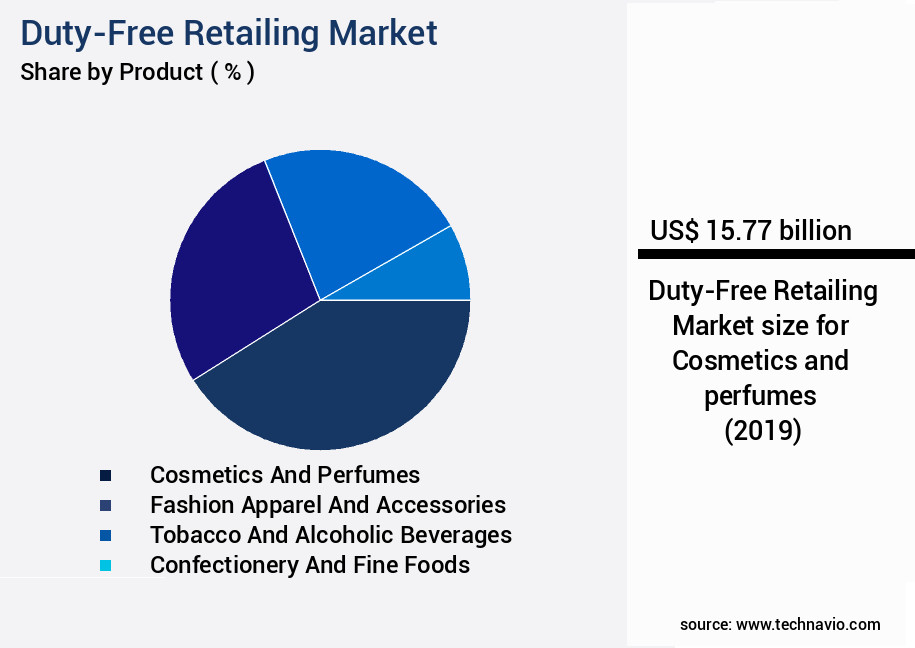
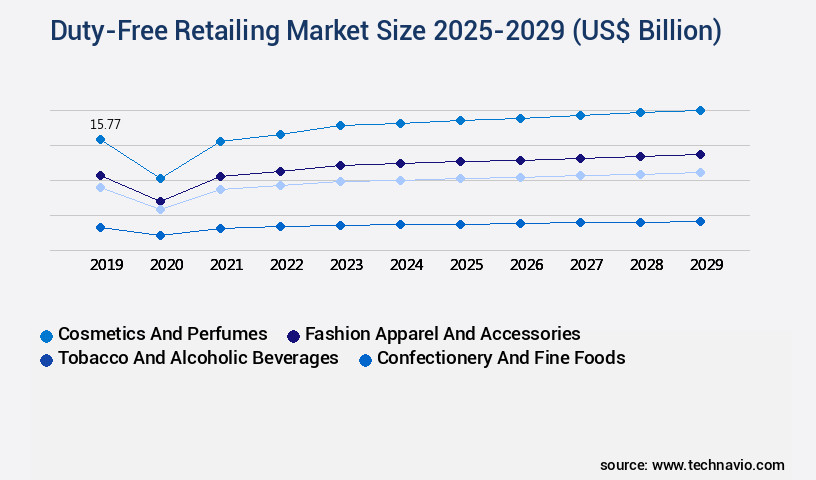
The Cosmetics and perfumes segment was valued at USD 15.77 billion in 2019 and showed a gradual increase during the forecast period.
L'Oreal, in particular, holds a substantial market share. Business intelligence tools, mobile payment processing, and automated checkout systems are essential for airport retail operations, enabling data-driven decision making and customer relationship management. Additionally, customer retention strategies, such as personalized shopping experiences, loyalty program management, and inventory management software, are crucial for market success. Other trends include pricing optimization strategies, passenger flow management, and real-time inventory updates. Furthermore, digital signage solutions, e-commerce platform integration, and omni-channel retail strategies are becoming increasingly popular. The market also prioritizes fraud prevention systems, queue management systems, customer segmentation techniques, and sales performance metrics for operational efficiency and customer satisfaction. Compliance with duty-free regulations is also essential.
Regional Analysis
APAC is estimated to contribute 45% to the growth of the global market during the forecast period. Technavio's analysts have elaborately explained the regional trends and drivers that shape the market during the forecast period.

See How Duty-Free Retailing Market Demand is Rising in APAC Request Free Sample
The market in the Asia Pacific (APAC) region is a significant contributor to the global industry, with the airport segment being the largest application. According to recent studies, APAC accounted for over 40% of the global duty-free retail sales in 2020. Some of the prominent international airports in APAC with thriving duty-free retail operations include Hong Kong International Airport, Jakarta Soekarno-Hatta International Airport, Bali Ngurah Rai International Airport, and Changi Airport Group Singapore, among others.
Additionally, duty-free retailing at cruise centers, such as Singapore Cruise Centre, Tanah Merah, and HarbourFront, is also gaining popularity in the region. These figures underscore the growing significance of the APAC market and its potential for further expansion.
Market Dynamics
Our researchers analyzed the data with 2024 as the base year, along with the key drivers, trends, and challenges. A holistic analysis of drivers will help companies refine their marketing strategies to gain a competitive advantage.
The market is experiencing significant growth, driven by the increasing number of international travelers and the expanding range of products offered. To stay competitive in this dynamic industry, retailers are implementing advanced technologies to enhance the shopping experience and optimize operations. Airport retailers are integrating point of sale systems to streamline transactions and ensure seamless integration with global payment gateways for travel retail operations. Duty-free ecommerce platforms are being implemented with strategic focus, enabling retailers to reach a wider customer base and offer a consistent shopping experience across channels. Customer relationship management software is essential for duty-free retailers to manage and analyze customer data, segmenting shoppers for targeted marketing efforts. Real-time inventory management systems help maintain accurate stock levels and minimize stockouts, while mobile payment processing enables contactless transactions at airport duty-free shops. An omni-channel retail strategy is crucial for luxury goods duty-free retailers, requiring pricing optimization software to set competitive prices and sales forecasting models to anticipate demand. Business intelligence tools provide data-driven insights for decision making, while passenger flow management systems and queue management technology help manage customer traffic and reduce wait times. Customer retention strategies, such as personalized offers and loyalty programs, are essential in the duty-free environment. Loss prevention measures and high-value goods handling procedures ensure security and minimize shrinkage. Automated checkout systems and digital signage solutions enhance the shopping experience and provide real-time information to travelers. In conclusion, the market is undergoing digital transformation, with retailers adopting advanced technologies to optimize operations, enhance the shopping experience, and drive growth in this competitive industry.
The duty-free retailing market is undergoing a digital transformation, as operators seek to enhance operational efficiency and deliver seamless shopping experiences across international airport terminals. A foundational aspect of this evolution is airport retail point of sale system integration, which ensures smooth coordination between front-end transactions and back-end inventory, pricing, and customer data systems. As consumer behavior shifts toward digital convenience, duty-free ecommerce platform implementation strategy has become critical. Travel retailers are investing in platforms that allow travelers to browse and pre-order products online, with options for in-terminal pickup or delivery, thus expanding sales beyond traditional physical spaces.
Handling transactions across various currencies and regions requires a robust financial infrastructure. Implementing a global payment gateway for travel retail operations enables secure, real-time processing of international payments, increasing conversion rates and enhancing customer satisfaction. For long-term customer engagement, deploying customer relationship management software for duty free operations allows businesses to collect and leverage passenger data. This supports personalized marketing campaigns, loyalty programs, and targeted promotions based on travel behavior and purchase history.
A key logistical challenge in airport environments is maintaining accurate stock levels. The integration of a real time inventory management system duty free retail helps retailers track product availability, minimize stockouts, and respond rapidly to sales trends, all while optimizing warehousing within tight airport constraints. With the growing adoption of contactless technology, mobile payment processing for airport duty free shops is now an essential feature. Support for QR code payments, digital wallets, and NFC technologies accelerates checkout times and caters to global travelers' expectations for convenience.
In today's competitive market, an omni channel retail strategy for luxury goods duty free is proving to be a game-changer. By harmonizing in-store, online, and mobile channels, retailers can create consistent brand experiences, streamline promotions, and drive cross-platform sales. Profitability also depends on effective pricing tactics. Utilizing pricing optimization software for duty free retailers allows for dynamic pricing based on factors such as passenger demographics, time of day, seasonal demand, and competitor pricing—all contributing to maximized revenue.
To plan strategically, businesses rely on accurate demand forecasting. A well-calibrated sales forecasting model for travel retail businesses can predict traffic-driven purchasing patterns, enabling smarter stock management and marketing spend allocation. Understanding different traveler profiles is essential for targeted offerings. Through customer segmentation techniques for duty free shoppers, retailers can tailor product assortments, pricing strategies, and engagement methods based on age, nationality, spending habits, and travel purpose.
Finally, efficient passenger movement is vital for retail success. The deployment of passenger flow management systems for airport terminals enables airports and retailers to analyze foot traffic, identify high-engagement zones, and strategically position promotional displays and high-demand products. As global travel rebounds, the duty-free retailing market is poised for innovation-driven growth, supported by integrated digital systems, data analytics, and a renewed focus on traveler experience and convenience.
What are the key market drivers leading to the rise in the adoption of Duty-Free Retailing Industry?
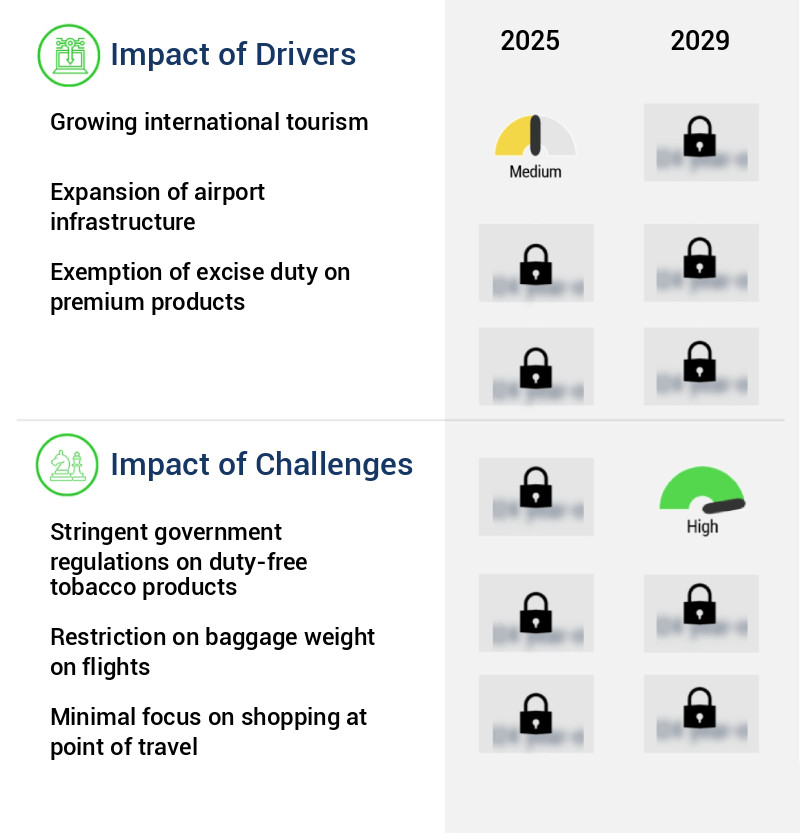
- International tourism growth is the primary catalyst for market expansion. With an increasing number of travelers exploring new destinations and experiencing different cultures, businesses in the travel and hospitality industries stand to benefit significantly from this global trend.
- The market has experienced significant growth due to the increasing number of international and domestic tourists. Business, leisure, and sports trips have driven this expansion, with major contributors being global sports events such as the Summer Olympic Games, UEFA Euro, UEFA Champions League, and Premier Leagues. These tournaments attract participants from various nations, leading to an increase in international tourists and visitors. This surge in travelers results in a boost to retail sales, particularly for luxury and branded products, often purchased through duty-free outlets.
- The duty-free retailing sector's growth is a robust trend in the retail industry, contributing significantly to the global economy.
What are the market trends shaping the Duty-Free Retailing Industry?
- The increasing priority given to enhancing the shopping experience for travelers represents a significant market trend. This focus on customer satisfaction is a key trend shaping the retail industry.
- The market is undergoing a transformative phase, fueled by the increasing focus on enhancing travelers' shopping experiences. Duty-free retailers are adopting innovative strategies to cater to the evolving preferences and expectations of modern consumers. One significant trend is the integration of advanced technology and digital solutions, which streamline the shopping process and offer personalized experiences. For instance, mobile apps enable travelers to pre-order products, while interactive displays provide real-time product information. Additionally, there is a noticeable trend toward creating visually appealing and experiential store environments that captivate travelers and encourage exploration. According to recent studies, the duty-free retail market is expected to reach a value of over USD 100 billion by 2026, growing at a steady pace.
- Another report suggests that digital sales in the duty-free sector are projected to account for approximately 20% of total sales by 2025.
What challenges does the Duty-Free Retailing Industry face during its growth?
- The strict government regulations imposed on the sale and production of duty-free tobacco products represent a significant challenge to the industry's growth trajectory.
- The market is undergoing significant transformations due to increasing regulatory restrictions on tobacco sales. Strict government regulations, including quantity limitations and stringent age verification procedures, pose substantial barriers to market expansion. These regulations not only impact tobacco sales but also influence the growth of other product categories within the duty-free sector. According to recent estimates, tobacco products account for approximately 30% of the total revenue in the market.
- With these regulations, duty-free retailers face challenges in attracting customers and generating substantial revenue from tobacco sales. Innovative strategies and partnerships are essential for retailers to navigate this regulatory environment effectively and maintain growth potential in the market.
Exclusive Technavio Analysis on Customer Landscape
The duty-free retailing market forecasting report includes the adoption lifecycle of the market, covering from the innovator's stage to the laggard's stage. It focuses on adoption rates in different regions based on penetration. Furthermore, the duty-free retailing market report also includes key purchase criteria and drivers of price sensitivity to help companies evaluate and develop their market growth analysis strategies.

Customer Landscape of Duty-Free Retailing Industry
Competitive Landscape
Companies are implementing various strategies, such as strategic alliances, duty-free retailing market forecast, partnerships, mergers and acquisitions, geographical expansion, and product/service launches, to enhance their presence in the industry.
Aer Rianta International - The company specializes in duty-free retailing, providing customized solutions for cosmetics, liquor, tobacco, fashion, and confectionery through strategic partnerships, including joint ventures, airport collaborations, and brand alliances.
The industry research and growth report includes detailed analyses of the competitive landscape of the market and information about key companies, including:
- Aer Rianta International
- Avolta AG
- Changi Airport Group Singapore Pte. Ltd.
- China International Travel Service Co. Ltd.
- Delhi Duty Free Services Pvt. Ltd.
- DFS Group Ltd.
- Dubai Duty Free
- Duty Free Americas Inc.
- Ever Rich Duty Free Shop
- Flemingo International
- Gebr. Heinemann SE and Co. KG
- Hyundai Department Store Group Co. Ltd.
- James Richardson Group
- Japan Airport Terminal Co. Ltd.
- King Power Group
- Lagardere SA
- Lotte Corp.
- Mumbai Duty Free
- Qatar Airways Group Q.C.S.C.
- The Shilla Duty free
Qualitative and quantitative analysis of companies has been conducted to help clients understand the wider business environment as well as the strengths and weaknesses of key industry players. Data is qualitatively analyzed to categorize companies as pure play, category-focused, industry-focused, and diversified; it is quantitatively analyzed to categorize companies as dominant, leading, strong, tentative, and weak.
Recent Development and News in Duty-Free Retailing Market
- In January 2024, Duty Free Americas, a leading player in the duty-free retail market, announced the launch of its new mobile application, 'DFAMobile,' allowing customers to pre-order duty-free items before arriving at the airport (Source: BusinessWire). This innovation aimed to streamline the shopping experience and increase sales.
- In March 2024, Dufry, the world's largest airport retailer, entered into a strategic partnership with Alibaba's Hema supermarkets to offer Chinese travelers duty-free shopping in China through Alibaba's platform (Source: Reuters). This collaboration targeted the growing Chinese outbound tourism market.
- In April 2025, Duty Free Shoppers, a subsidiary of the Hellenic Duty Free Shops SA, completed the acquisition of 100% shares of the Italian duty-free retailer, Duty Free Shopping Italy (Source: Athens Stock Exchange News). This acquisition expanded Duty Free Shoppers' European footprint and increased its market share.
- In May 2025, World Duty Free Group, a leading UK-based duty-free retailer, secured regulatory approval from the European Commission to acquire the duty-free retail business of Brussels Airport Company (Source: European Commission Press Release). This acquisition strengthened World Duty Free's position in the European market and expanded its airport presence.
Dive into Technavio's robust research methodology, blending expert interviews, extensive data synthesis, and validated models for unparalleled Duty-Free Retailing Market insights. See full methodology.
|
Market Scope |
|
|
Report Coverage |
Details |
|
Page number |
204 |
|
Base year |
2024 |
|
Historic period |
2019-2023 |
|
Forecast period |
2025-2029 |
|
Growth momentum & CAGR |
Accelerate at a CAGR of 8.3% |
|
Market growth 2025-2029 |
USD 22.74 billion |
|
Market structure |
Fragmented |
|
YoY growth 2024-2025(%) |
7.8 |
|
Key countries |
US, China, Germany, Canada, India, South Korea, France, Japan, Italy, Brazil, UAE, UK, and Spain |
|
Competitive landscape |
Leading Companies, Market Positioning of Companies, Competitive Strategies, and Industry Risks |
Research Analyst Overview
- The market continues to evolve, driven by advancements in technology and shifting consumer preferences. Promotional campaign tracking and data-driven decision making are increasingly important for customer retention strategies. Business intelligence tools, such as retail analytics dashboards and real-time inventory updates, enable retailers to optimize pricing and manage passenger flow more effectively. Airport retail operations have seen significant changes with the adoption of mobile payment processing, automated checkout systems, and digital signage solutions. Currency exchange software and global payment gateways facilitate seamless transactions for international travelers. Personalized shopping experiences, enabled by customer relationship management systems and e-commerce platform integration, are becoming the norm.
- Retailers also prioritize fraud prevention systems, queue management, and compliance with duty-free regulations. Customer segmentation techniques and loyalty program management help retailers cater to diverse customer needs. Sales forecasting models and customer satisfaction surveys provide valuable insights for continuous improvement. An example of the market's dynamic nature is the significant increase in sales for a major duty-free retailer due to the implementation of an omni-channel retail strategy and foot traffic analytics. The industry is expected to grow at a robust rate of 5% annually, driven by these technological innovations and changing consumer behaviors.
What are the Key Data Covered in this Duty-Free Retailing Market Research and Growth Report?
-
What is the expected growth of the Duty-Free Retailing Market between 2025 and 2029?
-
USD 22.74 billion, at a CAGR of 8.3%
-
-
What segmentation does the market report cover?
-
The report is segmented by Product (Cosmetics and perfumes, Fashion apparel and accessories, Tobacco and alcoholic beverages, and Confectionery and fine foods), Distribution Channel (Airport, Border/downtown/hotel, and Others), Geography (APAC, Europe, North America, Middle East and Africa, and South America), End-User (International Travelers and Domestic Travelers), and Price Range (Budget, Mid-range, and Premium)
-
-
Which regions are analyzed in the report?
-
APAC, Europe, North America, Middle East and Africa, and South America
-
-
What are the key growth drivers and market challenges?
-
Growing international tourism, Stringent government regulations on duty-free tobacco products
-
-
Who are the major players in the Duty-Free Retailing Market?
-
Aer Rianta International, Avolta AG, Changi Airport Group Singapore Pte. Ltd., China International Travel Service Co. Ltd., Delhi Duty Free Services Pvt. Ltd., DFS Group Ltd., Dubai Duty Free, Duty Free Americas Inc., Ever Rich Duty Free Shop, Flemingo International, Gebr. Heinemann SE and Co. KG, Hyundai Department Store Group Co. Ltd., James Richardson Group, Japan Airport Terminal Co. Ltd., King Power Group, Lagardere SA, Lotte Corp., Mumbai Duty Free, Qatar Airways Group Q.C.S.C., and The Shilla Duty free
-
Market Research Insights
- The market continues to adapt and innovate, driven by advancements in technology and shifting consumer preferences. Two notable developments include the integration of marketing automation platforms to personalize customer experiences and the implementation of inventory control systems to optimize retail space. According to industry reports, these initiatives are expected to contribute to a compound annual growth rate of 6% over the next five years. For instance, a major duty-free retailer saw a 10% increase in sales by leveraging customer journey mapping and data visualization tools to analyze passenger profiling data and travel retail analytics.
- This enabled them to tailor promotional discounts and shopping experience enhancements to specific customer segments, resulting in higher conversions and repeat business.
We can help! Our analysts can customize this duty-free retailing market research report to meet your requirements.
 RIA -
RIA - 
