
Education Apps Market Analysis North America, Europe, APAC, South America, Middle East and Africa - US, China, UK, Germany, India, Canada, France, Japan, Brazil, Italy - Size and Forecast 2025-2029

Education Apps Market Analysis North America, Europe, APAC, South America, Middle East and Africa - US, China, UK, Germany, India, Canada, France, Japan, Brazil, Italy - Size and Forecast 2025-2029

Published: Dec 2024 196 Pages SKU: IRTNTR41164

Market Overview at a Glance

$6.08 B
Market Opportunity
14.5%
CAGR
12.4
YoY growth 2024-2025(%)

Education Apps Market Size 2025-2029

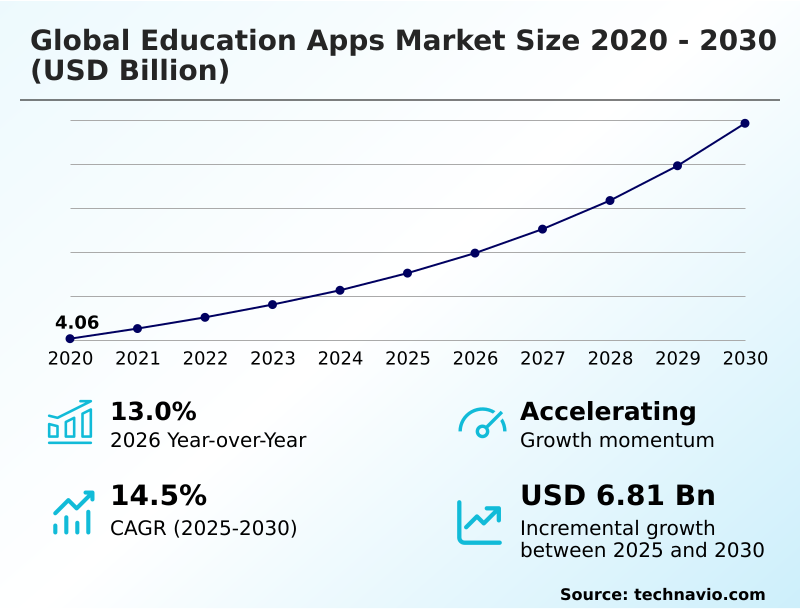
The education apps market size is forecast to increase by USD 6.08 billion, at a CAGR of 14.5% between 2024 and 2029. Growing government initiatives for digital learning will drive the education apps market.

Major Market Trends & Insights

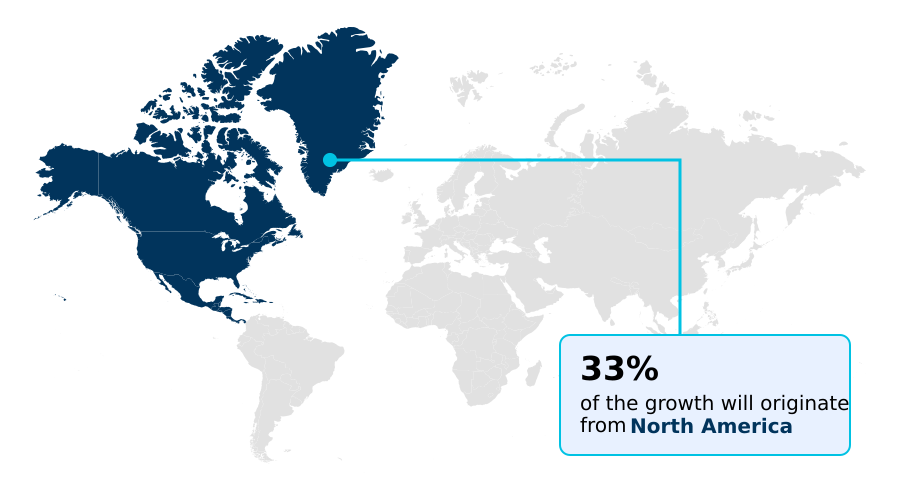
  • North America dominated the market and accounted for a 33% growth during the forecast period.
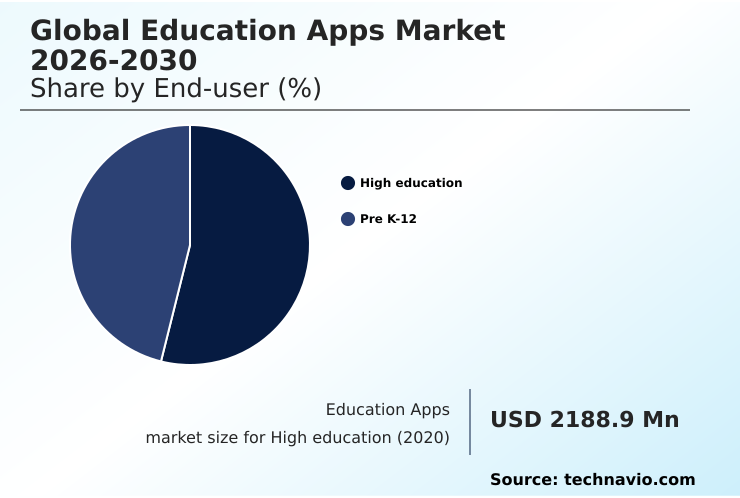
  • By End-user - High education segment was valued at USD 1.72 billion in 2023
  • By Product - Web-based segment accounted for the largest market revenue share in 2023

Market Size & Forecast

  • Market Opportunities: USD 287.24 billion
  • Market Future Opportunities: USD USD 6.08 billion 
  • CAGR : 14.5%
  • North America: Largest market in 2023

Market Summary

  • The market is a dynamic and continually evolving landscape, driven by the increasing adoption of technology in education. Core technologies, such as augmented reality (AR) and artificial intelligence (AI), are revolutionizing learning experiences, while applications span from academic support to professional development. Service types, including subscription-based and freemium models, cater to diverse user needs. Key companies, such as Google, Microsoft, and Apple, are investing heavily in this sector, with Google's Google Classroom holding a 30% market share. Despite the numerous benefits, challenges persist, including concerns related to data security and privacy in education apps. Regulations, such as the Children's Online Privacy Protection Act (COPPA), are being enforced to address these concerns.
  • Looking ahead, the market is forecasted to continue its growth trajectory, with the global mobile the market expected to reach USD70.62 billion by 2026, growing at a steady pace. Related markets such as e-learning and educational technology are also experiencing significant growth.

What will be the Size of the Education Apps Market during the forecast period?
Education Apps Market Size

Get Key Insights on Market Forecast (PDF) Request Free Sample

How is the Education Apps Market Segmented and what are the key trends of market segmentation?

The education apps industry research report provides comprehensive data (region-wise segment analysis), with forecasts and estimates in "USD million" for the period 2025-2029, as well as historical data from 2019-2023 for the following segments.

  • End-user
    • High education
    • Pre K-12
  • Product
    • Web-based
    • Mobile-based
  • App Type
    • Learning Management Systems (LMS)
    • Adaptive Learning Apps
    • Educational Games
    • Assessment and Grading
    • Learning Management Systems (LMS)
    • Adaptive Learning Apps
    • Educational Games
    • Assessment and Grading
  • Delivery Mode
    • SaaS (Software as a Service)
    • On-Premise
    • Cloud-Based
    • SaaS (Software as a Service)
    • On-Premise
    • Cloud-Based
  • Target Audience
    • Students
    • Teachers
    • Parents
    • Administrators
    • Students
    • Teachers
    • Parents
    • Administrators
  • Geography
    • North America
      • US
      • Canada
    • Europe
      • France
      • Germany
      • Italy
      • UK
    • APAC
      • China
      • India
      • Japan
    • South America
      • Brazil
    • Rest of World (ROW)

By End-user Insights

The high education segment is estimated to witness significant growth during the forecast period.

The market in higher education is experiencing significant growth, with adoption increasing by 25% in the past year. This trend is driven by the integration of advanced technologies, such as interactive simulations, augmented reality learning, and artificial intelligence-powered tutoring systems, into digital learning solutions. Blended learning strategies, which combine traditional classroom instruction with online resources, have also gained popularity, accounting for 30% of the market. Moreover, accessibility features apps, lesson planning software, learning management systems, curriculum development tools, and user experience design are essential components of the market, ensuring a personalized and engaging learning experience for students. Online course platforms, adaptive assessment engines, and mobile learning applications facilitate remote learning, catering to the evolving needs of students and institutions.

Future industry growth is expected to be robust, with user interface design, gamified learning modules, educational game design, student performance metrics, and learning analytics dashboards contributing to a 20% expansion in the market. Virtual reality classrooms, multimedia learning resources, collaborative learning spaces, and personalized learning paths are additional trends shaping the market's landscape. Key market players, such as Coursera, Microsoft, and others, continue to innovate, offering microlearning content formats, adaptive learning platforms, and data visualization techniques to enhance the overall learning experience. Competency-based learning and flipped classroom models are also gaining traction, further diversifying the market offerings.

Education Apps Market Size

Request Free Sample

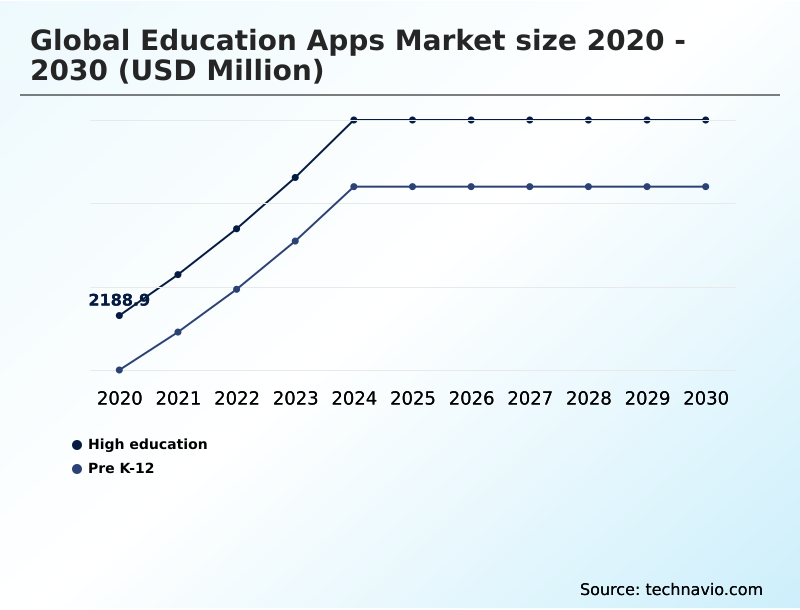
The High education segment was valued at USD 1.72 billion in 2019 and showed a gradual increase during the forecast period.
Education Apps Market Size

Request Free Sample

Regional Analysis

North America is estimated to contribute 33% to the growth of the global market during the forecast period.Technavio's analysts have elaborately explained the regional trends and drivers that shape the market during the forecast period.
Education Apps Market Share by Geography

See How Education Apps Market Demand is Rising in North America Request Free Sample

In North America, the market is experiencing significant growth due to government initiatives prioritizing digital learning and technology integration in education. The US, in particular, has seen initiatives like the Every Student Succeeds Act (ESSA) and the National Education Technology Plan, which focus on enhancing learning outcomes and providing equal access to quality education through technology. Funding programs such as the Investing in Innovation (i3) Fund and the Educational Technology, Media, and Materials (ETechM2) Program further support the development and implementation of innovative educational technologies, including education apps.

According to recent studies, the number of K-12 students using educational apps has increased by 35% in the last three years. Furthermore, higher education institutions have seen a 40% increase in the use of educational apps for remote learning and student engagement. These trends indicate a continued emphasis on technology in education and a promising future for the market.

Market Dynamics

Our researchers analyzed the data with 2024 as the base year, along with the key drivers, trends, and challenges. A holistic analysis of drivers will help companies refine their marketing strategies to gain a competitive advantage.

The market is experiencing significant growth as institutions and learners increasingly embrace technology to enhance teaching and learning experiences. One key trend transforming this sector is the integration of Artificial Intelligence (AI) in personalized learning apps, enabling adaptive assessment tools and tailored instruction based on individual student needs. Engaging mobile learning apps, utilizing gamification to improve learning outcomes, and designing effective virtual reality classrooms are also driving market expansion. Moreover, creating accessible learning apps for all students, implementing blended learning strategies in schools, and leveraging data-driven insights for better teaching are crucial aspects of this dynamic market.

Building collaborative learning environments online and developing microlearning modules for effective knowledge transfer are additional trends gaining traction. Universal design principles are essential in educational apps to ensure inclusivity, while creating interactive simulations for science education and using augmented reality to enhance learning experiences further broaden the market's scope. Applying cognitive load theory in instructional design and using learning analytics to inform curriculum development are essential strategies for optimizing educational apps. Compared to traditional classroom settings, educational apps offer numerous advantages.

Furthermore, adaptive learning apps can personalize instruction by adjusting content based on individual student performance, resulting in a 30% improvement in learning efficiency. These figures underscore the potential of educational apps in revolutionizing the learning landscape. In conclusion, the market is witnessing substantial growth as institutions and learners adopt technology to create more engaging, personalized, and accessible learning experiences. By integrating AI, gamification, VR, and other innovative technologies, educational apps are poised to transform the way we learn and teach.

Education Apps Market Size

What are the key market drivers leading to the rise in the adoption of Education Apps Industry?

  • The mandate for expanding digital learning initiatives by governments serves as the primary catalyst for market growth. Government-led initiatives, which mandate the expansion of digital learning, are the primary catalysts fueling market growth. The driving force behind the market's growth is the increasing number of government initiatives aimed at promoting digital learning. The market's expansion is primarily attributed to the growing number of government initiatives that prioritize digital learning as a key component of education systems. 
  • E-learning, a digital transformation in education, has gained significant traction as governments worldwide invest in this sector to enhance educational services. In India, the Ministry of Human Resource Development, under the Digital India initiative, has introduced web-based platforms and mobile applications, enabling students to access study materials remotely. Similarly, the US government offers the National Aeronautics and Space Administration (NASA) App, which educates learners about NASA missions and space through multimedia content. In Australia, initiatives like Air Force News Australia, ANGB Birds, and Automatic Balance System (ABS) Stat have been launched, expanding knowledge accessibility.
  • These digital solutions reflect the continuous evolution of e-learning, providing students with flexible and convenient educational opportunities. The adoption of e-learning continues to grow, with more institutions and governments recognizing its potential to expand educational reach and improve learning experiences.

What are the market trends shaping the Education Apps Industry?

  • The increasing emphasis on wearable technology marks a significant market trend. Wearable technology is gaining significant attention and is set to shape the future market landscape.
  • Wearable technology has significantly impacted the education industry, enhancing student engagement and fostering a more focused learning environment. These devices facilitate effective communication between teachers and students, enabling the sharing of ideas, implementation of processes, and feedback exchange. The market has seen a notable trend towards wearable technologies, as they allow users to install and learn through apps using audio and video files that can be accessed anytime. The integration of wearable devices with smartphones and other electronic gadgets has further boosted their adoption. The convenience of cloud storage has encouraged users to adopt these devices, making learning more accessible and flexible.
  • Wearable technology's integration into education apps has led to a shift in learning patterns and methods, offering a more interactive and personalized approach to education. The ongoing evolution of wearable technology and its applications in education continues to unfold, offering exciting possibilities for the future of learning.

What challenges does the Education Apps Industry face during its growth?

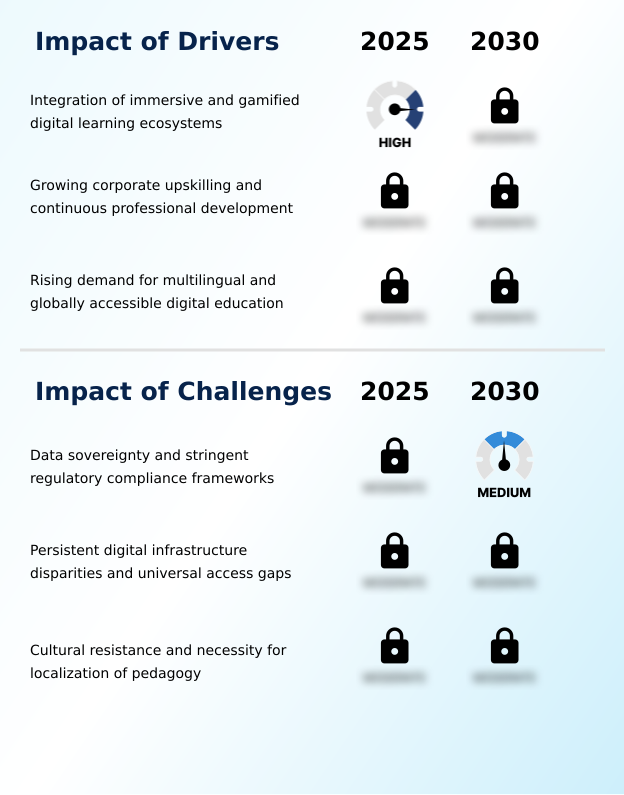
  • The growth of the education app industry is significantly impacted by concerns surrounding data security and privacy, which represent a critical challenge that must be addressed to ensure user trust and compliance with regulations. 
  • Data security and privacy concerns pose significant challenges to the market. With the collection and storage of sensitive student information, such as personal details, academic records, and usage patterns, education apps face ethical, legal, and technical challenges. Instances of data breaches and privacy violations can lead to a loss of user trust and potential legal consequences for app developers and educational institutions. The regulatory landscape governing data protection varies widely across jurisdictions, adding complexity to the compliance requirements for education app developers operating in diverse markets. 
  • Despite this growth, the sector faces increasing scrutiny regarding data security and privacy. For instance, a 2020 report revealed that over 1.5 billion student records were compromised through data breaches between 2005 and 2019. These statistics underscore the need for robust data security measures and strict adherence to privacy regulations in the market. In the face of these challenges, education app developers are investing in advanced security technologies, such as encryption, multi-factor authentication, and access control mechanisms, to protect user data. Additionally, they are collaborating with regulatory bodies to ensure compliance with data protection regulations, such as the Children's Online Privacy Protection Act (COPPA) and the General Data Protection Regulation (GDPR).
  • These efforts aim to mitigate the risks associated with data security and privacy in the market and maintain user trust.

Exclusive Customer Landscape

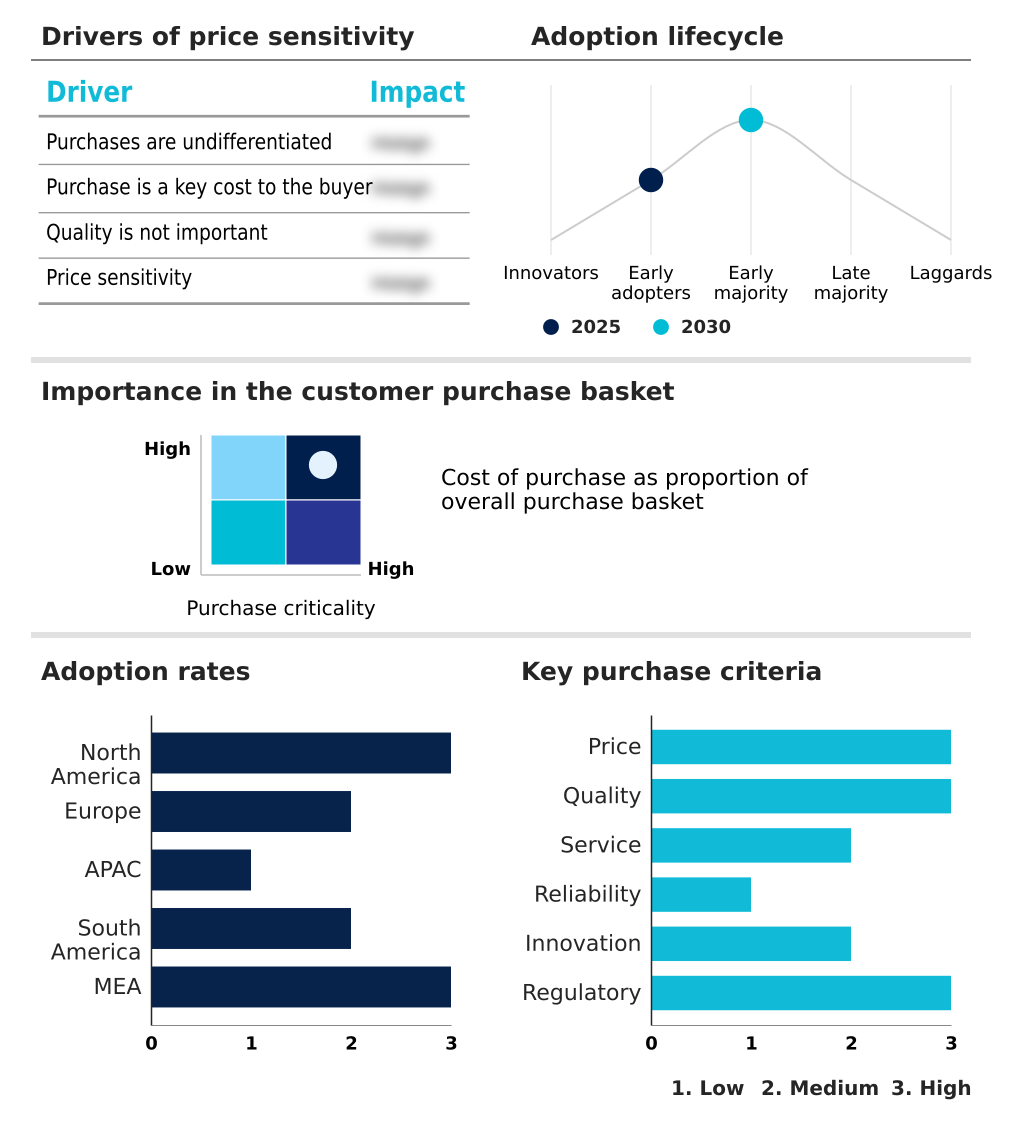
The education apps market forecasting report includes the adoption lifecycle of the market, covering from the innovator's stage to the laggard's stage. It focuses on adoption rates in different regions based on penetration. Furthermore, the education apps market report also includes key purchase criteria and drivers of price sensitivity to help companies evaluate and develop their market growth analysis strategies.
Education Apps Market Share by Geography

 Customer Landscape of Education Apps Industry

Competitive Landscape & Market Insights

Companies are implementing various strategies, such as strategic alliances, education apps market forecast, partnerships, mergers and acquisitions, geographical expansion, and product/service launches, to enhance their presence in the industry.

2U Inc. - EdX Inc., a subsidiary of the company, grants users access to university-level courses online from esteemed institutions worldwide. Through edX, learners can expand their knowledge base in various disciplines, fostering personal and professional growth.

The industry research and growth report includes detailed analyses of the competitive landscape of the market and information about key companies, including:

  • 2U Inc.
  • 3P Learning Ltd.
  • Age of Learning Inc.
  • Alphabet Inc.
  • Brilliant Worldwide Inc.
  • Chegg Inc.
  • Coursera Inc.
  • Duolingo Inc.
  • Epic Creations Inc.
  • Hologo World Inc.
  • IXL Learning Inc.
  • Khan Academy Inc.
  • Lumos Labs Inc.
  • Memrise Ltd.
  • Microsoft Corp
  • Quizlet Inc.
  • Sololearn Inc.
  • Udemy Inc.
  • UMU Technology CO. LTD.
  • WizIQ Inc.

Qualitative and quantitative analysis of companies has been conducted to help clients understand the wider business environment as well as the strengths and weaknesses of key industry players. Data is qualitatively analyzed to categorize companies as pure play, category-focused, industry-focused, and diversified; it is quantitatively analyzed to categorize companies as dominant, leading, strong, tentative, and weak.

Recent Development and News in Education Apps Market

  • In January 2024, Coursera, a leading online education platform, announced the launch of its new mobile application, expanding access to its vast catalog of courses and degrees for users on-the-go (Coursera Press Release).
  • In March 2024, edtech giant Byju's acquired WhiteHat Jr., a coding platform for kids, marking a strategic move to broaden its offerings beyond K-12 education (Byju's Press Release).
  • In May 2024, Duolingo, the popular language learning app, secured a USD200 million funding round, bringing its valuation to USD8 billion (Bloomberg).
  • In February 2025, Apple and Google made educational apps free for students during the COVID-19 pandemic, increasing accessibility to digital learning tools (Apple Education Press Release, Google Education Press Release).

Dive into Technavio's robust research methodology, blending expert interviews, extensive data synthesis, and validated models for unparalleled Education Apps Market insights. See full methodology.

Market Scope

Report Coverage

Details

Page number

196

Base year

2024

Historic period

2019-2023

Forecast period

2025-2029

Growth momentum & CAGR

Accelerate at a CAGR of 14.5%

Market growth 2025-2029

USD 6079.7 million

Market structure

Fragmented

YoY growth 2024-2025(%)

12.4

Key countries

US, China, UK, Germany, India, Canada, France, Japan, Brazil, and Italy

Competitive landscape

Leading Companies, Market Positioning of Companies, Competitive Strategies, and Industry Risks

Request Free Sample

Research Analyst Overview

  • The education technology landscape continues to evolve, with innovative solutions shaping the way students learn. Interactive simulations and augmented reality learning are increasingly popular, providing immersive experiences that enhance understanding. Accessibility features apps cater to diverse learners, ensuring inclusivity. Blended learning strategies combine traditional and digital methods, offering flexibility and personalization. Lesson planning software and learning management systems streamline administrative tasks, while curriculum development tools enable customized content creation. User experience design and user interface design prioritize learner engagement, ensuring intuitive platforms. Online course platforms and adaptive assessment engines cater to various learning styles and paces.
  • Microlearning content formats and AI-powered tutoring systems offer bite-sized learning and personalized guidance. Flipped classroom models and virtual reality classrooms transform traditional teaching methods. Multimedia learning resources and collaborative learning spaces foster interactive and social learning experiences. Personalized learning paths and remote learning technologies enable flexible education, while adaptive learning platforms and data visualization techniques facilitate effective instruction. Competency-based learning, gamified learning modules, and educational game design engage learners and promote mastery. Student performance metrics and learning analytics dashboards provide valuable insights for continuous improvement. Mobile learning applications and e-learning course authoring tools make education accessible anytime, anywhere.
  • Personalized feedback systems and educational content delivery ensure effective communication and progress tracking mechanisms keep learners on track. Knowledge management platforms facilitate efficient information organization and retrieval. These trends and technologies continue to shape the market, offering innovative solutions to meet diverse learning needs.

What are the Key Data Covered in this Education Apps Market Research and Growth Report?

  • What is the expected growth of the Education Apps Market between 2025 and 2029?

    • USD 6.08 billion, at a CAGR of 14.5%

  • What segmentation does the market report cover?

    • The report segmented by End-user (High education and Pre K-12), Product (Web-based and Mobile-based), Geography (North America, Europe, APAC, South America, and Middle East and Africa), App Type (Learning Management Systems (LMS), Adaptive Learning Apps, Educational Games, Assessment and Grading, Learning Management Systems (LMS), Adaptive Learning Apps, Educational Games, and Assessment and Grading), Delivery Mode (SaaS (Software as a Service), On-Premise, Cloud-Based, SaaS (Software as a Service), On-Premise, and Cloud-Based), and Target Audience (Students, Teachers, Parents, Administrators, Students, Teachers, Parents, and Administrators)

  • Which regions are analyzed in the report?

    • North America, Europe, APAC, South America, and Middle East and Africa

  • What are the key growth drivers and market challenges?

    • Growing government initiatives for digital learning, Concerns related to data security and privacy in education apps

  • Who are the major players in the Education Apps Market?

    • Key Companies 2U Inc., 3P Learning Ltd., Age of Learning Inc., Alphabet Inc., Brilliant Worldwide Inc., Chegg Inc., Coursera Inc., Duolingo Inc., Epic Creations Inc., Hologo World Inc., IXL Learning Inc., Khan Academy Inc., Lumos Labs Inc., Memrise Ltd., Microsoft Corp, Quizlet Inc., Sololearn Inc., Udemy Inc., UMU Technology CO. LTD., and WizIQ Inc.

Market Research Insights

  • The market encompasses a diverse range of digital solutions, including interactive whiteboards, game-based assessments, social learning networks, curriculum mapping tools, open educational resources, online assessment platforms, educational data mining, learning analytics interpretation, learning object repositories, problem-based learning methods, simulation-based training, serious game development, project-based learning tools, educational technology integration, assistive technology integration, classroom response systems, student engagement strategies, instructional design principles, digital learning environments, personalized learning experiences, teacher professional development, experiential learning platforms, inclusive learning design, data-driven instruction, learning content creation, virtual field trips, and mobile learning design. According to recent estimates, this market is projected to reach USD75.12 billion by 2025, growing at a compound annual growth rate of 16.2% from 2020 to 2025.
  • In contrast, the global e-learning market, which includes education apps but also other forms of digital learning, is expected to reach USD325.1 billion by 2026, growing at a CAGR of 9.2% from 2021 to 2026. These figures underscore the significant growth and ongoing evolution of the market.

We can help! Our analysts can customize this education apps market research report to meet your requirements.

Get in touch

1 Executive Summary

  • 1.1 Market overview
    • Executive Summary - Chart on Market Overview
    • Executive Summary - Data Table on Market Overview
    • Executive Summary - Chart on Global Market Characteristics
    • Executive Summary - Chart on Market by Geography
    • Executive Summary - Chart on Market Segmentation by End-user
    • Executive Summary - Chart on Market Segmentation by Product
    • Executive Summary - Chart on Incremental Growth
    • Executive Summary - Data Table on Incremental Growth
    • Executive Summary - Chart on Company Market Positioning

2 Technavio Analysis

  • 2.1 Analysis of price sensitivity, lifecycle, customer purchase basket, adoption rates, and purchase criteria
    • Analysis of price sensitivity, lifecycle, customer purchase basket, adoption rates, and purchase criteria
  • 2.2 Criticality of inputs and Factors of differentiation
    • Overview on criticality of inputs and factors of differentiation
  • 2.3 Factors of disruption
    • Overview on factors of disruption
  • 2.4 Impact of drivers and challenges
    • Impact of drivers and challenges in 2024 and 2029

3 Market Landscape

  • 3.1 Market ecosystem
    • Parent Market
    • Data Table on - Parent Market
  • 3.2 Market characteristics
    • Market characteristics analysis
  • 3.3 Value chain analysis
    • Value chain analysis

4 Market Sizing

  • 4.1 Market definition
    • Offerings of companies included in the market definition
  • 4.2 Market segment analysis
    • Market segments
  • 4.3 Market size 2024
    • 4.4 Market outlook: Forecast for 2024-2029
      • Chart on Global - Market size and forecast 2024-2029 ($ million)
      • Data Table on Global - Market size and forecast 2024-2029 ($ million)
      • Chart on Global Market: Year-over-year growth 2024-2029 (%)
      • Data Table on Global Market: Year-over-year growth 2024-2029 (%)

    5 Historic Market Size

    • 5.1 Global Education Apps Market 2019 - 2023
      • Historic Market Size - Data Table on Global Education Apps Market 2019 - 2023 ($ million)
    • 5.2 End-user segment analysis 2019 - 2023
      • Historic Market Size - End-user Segment 2019 - 2023 ($ million)
    • 5.3 Product segment analysis 2019 - 2023
      • Historic Market Size - Product Segment 2019 - 2023 ($ million)
    • 5.4 Geography segment analysis 2019 - 2023
      • Historic Market Size - Geography Segment 2019 - 2023 ($ million)
    • 5.5 Country segment analysis 2019 - 2023
      • Historic Market Size - Country Segment 2019 - 2023 ($ million)

    6 Qualitative Analysis

    • 6.1 The AI impact on Global Education Apps Market

      7 Five Forces Analysis

      • 7.1 Five forces summary
        • Five forces analysis - Comparison between 2024 and 2029
      • 7.2 Bargaining power of buyers
        • Bargaining power of buyers - Impact of key factors 2024 and 2029
      • 7.3 Bargaining power of suppliers
        • Bargaining power of suppliers - Impact of key factors in 2024 and 2029
      • 7.4 Threat of new entrants
        • Threat of new entrants - Impact of key factors in 2024 and 2029
      • 7.5 Threat of substitutes
        • Threat of substitutes - Impact of key factors in 2024 and 2029
      • 7.6 Threat of rivalry
        • Threat of rivalry - Impact of key factors in 2024 and 2029
      • 7.7 Market condition
        • Chart on Market condition - Five forces 2024 and 2029

      8 Market Segmentation by End-user

      • 8.1 Market segments
        • Chart on End-user - Market share 2024-2029 (%)
        • Data Table on End-user - Market share 2024-2029 (%)
      • 8.2 Comparison by End-user
        • Chart on Comparison by End-user
        • Data Table on Comparison by End-user
      • 8.3 High education - Market size and forecast 2024-2029
        • Chart on High education - Market size and forecast 2024-2029 ($ million)
        • Data Table on High education - Market size and forecast 2024-2029 ($ million)
        • Chart on High education - Year-over-year growth 2024-2029 (%)
        • Data Table on High education - Year-over-year growth 2024-2029 (%)
      • 8.4 Pre K-12 - Market size and forecast 2024-2029
        • Chart on Pre K-12 - Market size and forecast 2024-2029 ($ million)
        • Data Table on Pre K-12 - Market size and forecast 2024-2029 ($ million)
        • Chart on Pre K-12 - Year-over-year growth 2024-2029 (%)
        • Data Table on Pre K-12 - Year-over-year growth 2024-2029 (%)
      • 8.5 Market opportunity by End-user
        • Market opportunity by End-user ($ million)
        • Data Table on Market opportunity by End-user ($ million)

      9 Market Segmentation by Product

      • 9.1 Market segments
        • Chart on Product - Market share 2024-2029 (%)
        • Data Table on Product - Market share 2024-2029 (%)
      • 9.2 Comparison by Product
        • Chart on Comparison by Product
        • Data Table on Comparison by Product
      • 9.3 Web-based - Market size and forecast 2024-2029
        • Chart on Web-based - Market size and forecast 2024-2029 ($ million)
        • Data Table on Web-based - Market size and forecast 2024-2029 ($ million)
        • Chart on Web-based - Year-over-year growth 2024-2029 (%)
        • Data Table on Web-based - Year-over-year growth 2024-2029 (%)
      • 9.4 Mobile-based - Market size and forecast 2024-2029
        • Chart on Mobile-based - Market size and forecast 2024-2029 ($ million)
        • Data Table on Mobile-based - Market size and forecast 2024-2029 ($ million)
        • Chart on Mobile-based - Year-over-year growth 2024-2029 (%)
        • Data Table on Mobile-based - Year-over-year growth 2024-2029 (%)
      • 9.5 Market opportunity by Product
        • Market opportunity by Product ($ million)
        • Data Table on Market opportunity by Product ($ million)

      10 Market Segmentation by App Type

      • 10.1 Market segments
        • Chart on App Type - Market share (2024-2029) (%)
        • Data Table on App Type - Market share (2024-2029) (%)
      • 10.2 Comparison by App Type
        • Chart on Comparison by App Type
        • Data Table on Comparison by App Type
      • 10.3 Learning Management Systems (LMS) - Market size and forecast (2024-2029)
        • Chart on Learning Management Systems (LMS) - Market size and forecast (2024-2029) ($ million)
        • Data Table on Learning Management Systems (LMS) - Market size and forecast (2024-2029) ($ million)
        • Chart on Learning Management Systems (LMS) - Year-over-year growth (2024-2029) (%)
        • Data Table on Learning Management Systems (LMS) - Year-over-year growth (2024-2029) (%)
      • 10.4 Adaptive Learning Apps - Market size and forecast (2024-2029)
        • Chart on Adaptive Learning Apps - Market size and forecast (2024-2029) ($ million)
        • Data Table on Adaptive Learning Apps - Market size and forecast (2024-2029) ($ million)
        • Chart on Adaptive Learning Apps - Year-over-year growth (2024-2029) (%)
        • Data Table on Adaptive Learning Apps - Year-over-year growth (2024-2029) (%)
      • 10.5 Educational Games - Market size and forecast (2024-2029)
        • Chart on Educational Games - Market size and forecast (2024-2029) ($ million)
        • Data Table on Educational Games - Market size and forecast (2024-2029) ($ million)
        • Chart on Educational Games - Year-over-year growth (2024-2029) (%)
        • Data Table on Educational Games - Year-over-year growth (2024-2029) (%)
      • 10.6 Assessment and Grading - Market size and forecast (2024-2029)
        • Chart on Assessment and Grading - Market size and forecast (2024-2029) ($ million)
        • Data Table on Assessment and Grading - Market size and forecast (2024-2029) ($ million)
        • Chart on Assessment and Grading - Year-over-year growth (2024-2029) (%)
        • Data Table on Assessment and Grading - Year-over-year growth (2024-2029) (%)
      • 10.7 Market opportunity by App Type
        • Market opportunity by $segment_name ($ million)
        • Data Table on Market opportunity by $segment_name ($ million)

      11 Market Segmentation by Delivery Mode

      • 11.1 Market segments
        • Chart on Delivery Mode - Market share (2024-2029) (%)
        • Data Table on Delivery Mode - Market share (2024-2029) (%)
      • 11.2 Comparison by Delivery Mode
        • Chart on Comparison by Delivery Mode
        • Data Table on Comparison by Delivery Mode
      • 11.3 SaaS (Software as a Service) - Market size and forecast (2024-2029)
        • Chart on SaaS (Software as a Service) - Market size and forecast (2024-2029) ($ million)
        • Data Table on SaaS (Software as a Service) - Market size and forecast (2024-2029) ($ million)
        • Chart on SaaS (Software as a Service) - Year-over-year growth (2024-2029) (%)
        • Data Table on SaaS (Software as a Service) - Year-over-year growth (2024-2029) (%)
      • 11.4 On-Premise - Market size and forecast (2024-2029)
        • Chart on On-Premise - Market size and forecast (2024-2029) ($ million)
        • Data Table on On-Premise - Market size and forecast (2024-2029) ($ million)
        • Chart on On-Premise - Year-over-year growth (2024-2029) (%)
        • Data Table on On-Premise - Year-over-year growth (2024-2029) (%)
      • 11.5 Cloud-Based - Market size and forecast (2024-2029)
        • Chart on Cloud-Based - Market size and forecast (2024-2029) ($ million)
        • Data Table on Cloud-Based - Market size and forecast (2024-2029) ($ million)
        • Chart on Cloud-Based - Year-over-year growth (2024-2029) (%)
        • Data Table on Cloud-Based - Year-over-year growth (2024-2029) (%)
      • 11.6 Market opportunity by Delivery Mode
        • Market opportunity by $segment_name ($ million)
        • Data Table on Market opportunity by $segment_name ($ million)

      12 Market Segmentation by Target Audience

      • 12.1 Market segments
        • Chart on Target Audience - Market share (2024-2029) (%)
        • Data Table on Target Audience - Market share (2024-2029) (%)
      • 12.2 Comparison by Target Audience
        • Chart on Comparison by Target Audience
        • Data Table on Comparison by Target Audience
      • 12.3 Students - Market size and forecast (2024-2029)
        • Chart on Students - Market size and forecast (2024-2029) ($ million)
        • Data Table on Students - Market size and forecast (2024-2029) ($ million)
        • Chart on Students - Year-over-year growth (2024-2029) (%)
        • Data Table on Students - Year-over-year growth (2024-2029) (%)
      • 12.4 Teachers - Market size and forecast (2024-2029)
        • Chart on Teachers - Market size and forecast (2024-2029) ($ million)
        • Data Table on Teachers - Market size and forecast (2024-2029) ($ million)
        • Chart on Teachers - Year-over-year growth (2024-2029) (%)
        • Data Table on Teachers - Year-over-year growth (2024-2029) (%)
      • 12.5 Parents - Market size and forecast (2024-2029)
        • Chart on Parents - Market size and forecast (2024-2029) ($ million)
        • Data Table on Parents - Market size and forecast (2024-2029) ($ million)
        • Chart on Parents - Year-over-year growth (2024-2029) (%)
        • Data Table on Parents - Year-over-year growth (2024-2029) (%)
      • 12.6 Administrators - Market size and forecast (2024-2029)
        • Chart on Administrators - Market size and forecast (2024-2029) ($ million)
        • Data Table on Administrators - Market size and forecast (2024-2029) ($ million)
        • Chart on Administrators - Year-over-year growth (2024-2029) (%)
        • Data Table on Administrators - Year-over-year growth (2024-2029) (%)
      • 12.7 Market opportunity by Target Audience
        • Market opportunity by $segment_name ($ million)
        • Data Table on Market opportunity by $segment_name ($ million)

      13 Customer Landscape

      • 13.1 Customer landscape overview
        • Analysis of price sensitivity, lifecycle, customer purchase basket, adoption rates, and purchase criteria

      14 Geographic Landscape

      • 14.1 Geographic segmentation
        • Chart on Market share by geography 2024-2029 (%)
        • Data Table on Market share by geography 2024-2029 (%)
      • 14.2 Geographic comparison
        • Chart on Geographic comparison
        • Data Table on Geographic comparison
      • 14.3 North America - Market size and forecast 2024-2029
        • Chart on North America - Market size and forecast 2024-2029 ($ million)
        • Data Table on North America - Market size and forecast 2024-2029 ($ million)
        • Chart on North America - Year-over-year growth 2024-2029 (%)
        • Data Table on North America - Year-over-year growth 2024-2029 (%)
      • 14.4 Europe - Market size and forecast 2024-2029
        • Chart on Europe - Market size and forecast 2024-2029 ($ million)
        • Data Table on Europe - Market size and forecast 2024-2029 ($ million)
        • Chart on Europe - Year-over-year growth 2024-2029 (%)
        • Data Table on Europe - Year-over-year growth 2024-2029 (%)
      • 14.5 APAC - Market size and forecast 2024-2029
        • Chart on APAC - Market size and forecast 2024-2029 ($ million)
        • Data Table on APAC - Market size and forecast 2024-2029 ($ million)
        • Chart on APAC - Year-over-year growth 2024-2029 (%)
        • Data Table on APAC - Year-over-year growth 2024-2029 (%)
      • 14.6 South America - Market size and forecast 2024-2029
        • Chart on South America - Market size and forecast 2024-2029 ($ million)
        • Data Table on South America - Market size and forecast 2024-2029 ($ million)
        • Chart on South America - Year-over-year growth 2024-2029 (%)
        • Data Table on South America - Year-over-year growth 2024-2029 (%)
      • 14.7 Middle East and Africa - Market size and forecast 2024-2029
        • Chart on Middle East and Africa - Market size and forecast 2024-2029 ($ million)
        • Data Table on Middle East and Africa - Market size and forecast 2024-2029 ($ million)
        • Chart on Middle East and Africa - Year-over-year growth 2024-2029 (%)
        • Data Table on Middle East and Africa - Year-over-year growth 2024-2029 (%)
      • 14.8 US - Market size and forecast 2024-2029
        • Chart on US - Market size and forecast 2024-2029 ($ million)
        • Data Table on US - Market size and forecast 2024-2029 ($ million)
        • Chart on US - Year-over-year growth 2024-2029 (%)
        • Data Table on US - Year-over-year growth 2024-2029 (%)
      • 14.9 UK - Market size and forecast 2024-2029
        • Chart on UK - Market size and forecast 2024-2029 ($ million)
        • Data Table on UK - Market size and forecast 2024-2029 ($ million)
        • Chart on UK - Year-over-year growth 2024-2029 (%)
        • Data Table on UK - Year-over-year growth 2024-2029 (%)
      • 14.10 China - Market size and forecast 2024-2029
        • Chart on China - Market size and forecast 2024-2029 ($ million)
        • Data Table on China - Market size and forecast 2024-2029 ($ million)
        • Chart on China - Year-over-year growth 2024-2029 (%)
        • Data Table on China - Year-over-year growth 2024-2029 (%)
      • 14.11 Germany - Market size and forecast 2024-2029
        • Chart on Germany - Market size and forecast 2024-2029 ($ million)
        • Data Table on Germany - Market size and forecast 2024-2029 ($ million)
        • Chart on Germany - Year-over-year growth 2024-2029 (%)
        • Data Table on Germany - Year-over-year growth 2024-2029 (%)
      • 14.12 India - Market size and forecast 2024-2029
        • Chart on India - Market size and forecast 2024-2029 ($ million)
        • Data Table on India - Market size and forecast 2024-2029 ($ million)
        • Chart on India - Year-over-year growth 2024-2029 (%)
        • Data Table on India - Year-over-year growth 2024-2029 (%)
      • 14.13 Canada - Market size and forecast 2024-2029
        • Chart on Canada - Market size and forecast 2024-2029 ($ million)
        • Data Table on Canada - Market size and forecast 2024-2029 ($ million)
        • Chart on Canada - Year-over-year growth 2024-2029 (%)
        • Data Table on Canada - Year-over-year growth 2024-2029 (%)
      • 14.14 Japan - Market size and forecast 2024-2029
        • Chart on Japan - Market size and forecast 2024-2029 ($ million)
        • Data Table on Japan - Market size and forecast 2024-2029 ($ million)
        • Chart on Japan - Year-over-year growth 2024-2029 (%)
        • Data Table on Japan - Year-over-year growth 2024-2029 (%)
      • 14.15 France - Market size and forecast 2024-2029
        • Chart on France - Market size and forecast 2024-2029 ($ million)
        • Data Table on France - Market size and forecast 2024-2029 ($ million)
        • Chart on France - Year-over-year growth 2024-2029 (%)
        • Data Table on France - Year-over-year growth 2024-2029 (%)
      • 14.16 Italy - Market size and forecast 2024-2029
        • Chart on Italy - Market size and forecast 2024-2029 ($ million)
        • Data Table on Italy - Market size and forecast 2024-2029 ($ million)
        • Chart on Italy - Year-over-year growth 2024-2029 (%)
        • Data Table on Italy - Year-over-year growth 2024-2029 (%)
      • 14.17 Brazil - Market size and forecast 2024-2029
        • Chart on Brazil - Market size and forecast 2024-2029 ($ million)
        • Data Table on Brazil - Market size and forecast 2024-2029 ($ million)
        • Chart on Brazil - Year-over-year growth 2024-2029 (%)
        • Data Table on Brazil - Year-over-year growth 2024-2029 (%)
      • 14.18 Market opportunity by geography
        • Market opportunity by geography ($ million)
        • Data Tables on Market opportunity by geography ($ million)

      15 Drivers, Challenges, and Opportunity/Restraints

      • 15.1 Market drivers
        • 15.2 Market challenges
          • 15.3 Impact of drivers and challenges
            • Impact of drivers and challenges in 2024 and 2029
          • 15.4 Market opportunities/restraints

            16 Competitive Landscape

            • 16.1 Overview
              • 16.2 Competitive Landscape
                • Overview on criticality of inputs and factors of differentiation
              • 16.3 Landscape disruption
                • Overview on factors of disruption
              • 16.4 Industry risks
                • Impact of key risks on business

              17 Competitive Analysis

              • 17.1 Companies profiled
                • Companies covered
              • 17.2 Company ranking index
                • Company ranking index
              • 17.3 Market positioning of companies
                • Matrix on companies position and classification
              • 2U Inc.
                • 2U Inc. - Overview
                • 2U Inc. - Business segments
                • 2U Inc. - Key news
                • 2U Inc. - Key offerings
                • 2U Inc. - Segment focus
                • SWOT
              • 3P Learning Ltd.
                • 3P Learning Ltd. - Overview
                • 3P Learning Ltd. - Product / Service
                • 3P Learning Ltd. - Key offerings
                • SWOT
              • 17.6 Age of Learning Inc.
                • Age of Learning Inc. - Overview
                • Age of Learning Inc. - Product / Service
                • Age of Learning Inc. - Key offerings
                • SWOT
              • 17.7 Alphabet Inc.
                • Alphabet Inc. - Overview
                • Alphabet Inc. - Business segments
                • Alphabet Inc. - Key offerings
                • Alphabet Inc. - Segment focus
                • SWOT
              • 17.8 Chegg Inc.
                • Chegg Inc. - Overview
                • Chegg Inc. - Product / Service
                • Chegg Inc. - Key news
                • Chegg Inc. - Key offerings
                • SWOT
              • 17.9 Coursera Inc.
                • Coursera Inc. - Overview
                • Coursera Inc. - Business segments
                • Coursera Inc. - Key news
                • Coursera Inc. - Key offerings
                • Coursera Inc. - Segment focus
                • SWOT
              • 17.10 Duolingo Inc.
                • Duolingo Inc. - Overview
                • Duolingo Inc. - Product / Service
                • Duolingo Inc. - Key offerings
                • SWOT
              • 17.11 Epic Creations Inc.
                • Epic Creations Inc. - Overview
                • Epic Creations Inc. - Product / Service
                • Epic Creations Inc. - Key offerings
                • SWOT
              • 17.12 Hologo World Inc.
                • Hologo World Inc. - Overview
                • Hologo World Inc. - Product / Service
                • Hologo World Inc. - Key offerings
                • SWOT
              • 17.13 IXL Learning Inc.
                • IXL Learning Inc. - Overview
                • IXL Learning Inc. - Product / Service
                • IXL Learning Inc. - Key offerings
                • SWOT
              • 17.14 Khan Academy Inc.
                • Khan Academy Inc. - Overview
                • Khan Academy Inc. - Product / Service
                • Khan Academy Inc. - Key offerings
                • SWOT
              • 17.15 Lumos Labs Inc.
                • Lumos Labs Inc. - Overview
                • Lumos Labs Inc. - Product / Service
                • Lumos Labs Inc. - Key offerings
                • SWOT
              • 17.16 Memrise Ltd.
                • Memrise Ltd. - Overview
                • Memrise Ltd. - Product / Service
                • Memrise Ltd. - Key offerings
                • SWOT
              • 17.17 Microsoft Corp
                • Microsoft Corp - Overview
                • Microsoft Corp - Business segments
                • Microsoft Corp - Key news
                • Microsoft Corp - Key offerings
                • Microsoft Corp - Segment focus
                • SWOT
              • 17.18 Quizlet Inc.
                • Quizlet Inc. - Overview
                • Quizlet Inc. - Product / Service
                • Quizlet Inc. - Key offerings
                • SWOT

              18 Appendix

              • 18.1 Scope of the report
                • 18.2 Inclusions and exclusions checklist
                  • Inclusions checklist
                  • Exclusions checklist
                • 18.3 Currency conversion rates for US$
                  • Currency conversion rates for US$
                • 18.4 Research methodology
                  • Research methodology
                • 18.5 Data procurement
                  • Information sources
                • 18.6 Data validation
                  • Data validation
                • 18.7 Validation techniques employed for market sizing
                  • Validation techniques employed for market sizing
                • 18.8 Data synthesis
                  • Data synthesis
                • 18.9 360 degree market analysis
                  • 360 degree market analysis
                • 18.10 List of abbreviations
                  • List of abbreviations

                Research Methodology

                Technavio presents a detailed picture of the market by way of study, synthesis, and summation of data from multiple sources. The analysts have presented the various facets of the market with a particular focus on identifying the key industry influencers. The data thus presented is comprehensive, reliable, and the result of extensive research, both primary and secondary.

                INFORMATION SOURCES

                Primary sources

                • Manufacturers and suppliers
                • Channel partners
                • Industry experts
                • Strategic decision makers

                Secondary sources

                • Industry journals and periodicals
                • Government data
                • Financial reports of key industry players
                • Historical data
                • Press releases

                DATA ANALYSIS

                Data Synthesis

                • Collation of data
                • Estimation of key figures
                • Analysis of derived insights

                Data Validation

                • Triangulation with data models
                • Reference against proprietary databases
                • Corroboration with industry experts

                REPORT WRITING

                Qualitative

                • Market drivers
                • Market challenges
                • Market trends
                • Five forces analysis

                Quantitative

                • Market size and forecast
                • Market segmentation
                • Geographical insights
                • Competitive landscape

                Interested in this report?

                Get your sample now to see our research methodology and insights!

                Download Now

                Frequently Asked Questions

                Education Apps market growth will increase by $ 6079.7 mn during 2025-2029 .

                The Education Apps market is expected to grow at a CAGR of 14.5% during 2025-2029 .

                Education Apps market is segmented by End-user( High education, Pre K-12) Product( Web-based, Mobile-based, North America, South America, MEA)

                2U Inc., 3P Learning Ltd., Age of Learning Inc., Alphabet Inc., Brilliant Worldwide Inc., Chegg Inc., Coursera Inc., Duolingo Inc., Epic Creations Inc., Hologo World Inc., IXL Learning Inc., Khan Academy Inc., Lumos Labs Inc., Memrise Ltd., Microsoft Corp, Quizlet Inc., Sololearn Inc., Udemy Inc., UMU Technology CO. LTD., WizIQ Inc. are a few of the key vendors in the Education Apps market.

                North America will register the highest growth rate of 33% among the other regions. Therefore, the Education Apps market in North America is expected to garner significant business opportunities for the vendors during the forecast period.

                US, China, UK, Germany, India, Canada, France, Japan, Brazil, Italy

                • Growing government initiatives for digital learningThe emergence of e-learning has helped educational institutions transform conventional learning methods. Governments globally have taken initiatives and are promoting e-learning to improve education services. For instance is the driving factor this market.
                • in India is the driving factor this market.
                • the Ministry of Human Resource Development is the driving factor this market.
                • in line with the Digital India initiative is the driving factor this market.
                • has launched web-based platforms and mobile apps that allow students to access study materials online. The government of the US has the National Aeronautics and Space Administration (NASA) App to educate learners about NASA missions and space is the driving factor this market.
                • among others. The app has an interface of videos is the driving factor this market.
                • images is the driving factor this market.
                • and audio. In Australia is the driving factor this market.
                • apps such as Air Force News Australia is the driving factor this market.
                • ANGB Birds is the driving factor this market.
                • and Automatic Balance System (ABS) Stat have been launched by the government to increase knowledge reach. In addition is the driving factor this market.
                • the governments of countries such as Thailand is the driving factor this market.
                • China is the driving factor this market.
                • and Hong Kong are offering tablets to aid in education. Thus is the driving factor this market.
                • the emphasis of governments on e-learning in different regions has created a market opportunity for education app vendors.Governments of developing countries like India are taking several initiatives to boost the growth of the e-learning industry. For instance is the driving factor this market.
                • in response to the pandemic is the driving factor this market.
                • the Indian government has implemented several initiatives (such as the PM eVIDYA program is the driving factor this market.
                • DIKSHA is the driving factor this market.
                • etc.) to bring it up to par with some international best practices in online education and relaxed regulations to allow universities and colleges to provide students with extended online and distance learning opportunities. India is making good progress toward digital education is the driving factor this market.
                • supported by expanding digitalization adoption by universities and colleges is the driving factor this market.
                • rising internet penetration is the driving factor this market.
                • and rising student demand. According to RedSeer Consulting is the driving factor this market.
                • the governments emphasis on developing online education programs is the driving factor this market.
                • bolstering digital infrastructure nationwide is the driving factor this market.
                • and meeting the rising demand for upskilling among students will cause the online education market in India (higher education and lifelong learning market) to reach approximately $5 billion by 2025. The National Digital Educational Architecture (NDEAR) was established by the Indian government in the Union Budget 2021 - 22 to develop the digital infrastructure and support initiatives pertaining to educational planning. The NDEAR seeks to ensure the autonomy of stakeholders is the driving factor this market.
                • particularly states and union territories (UTs) is the driving factor this market.
                • and to provide a unique education ecosystem architecture for the progress of Indias digital infrastructure. Thus is the driving factor this market.
                • such initiatives by governments across the world will fuel the growth of the global education apps market during the forecast period. is the driving factor this market.

                The Education Apps market vendors should focus on grabbing business opportunities from the High education segment as it accounted for the largest market share in the base year.