
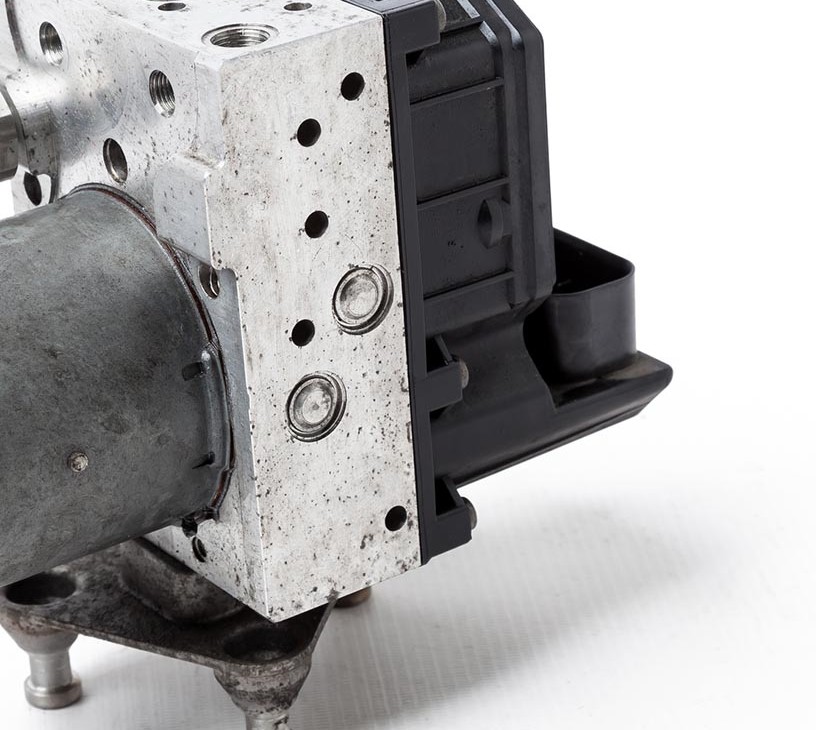


Electric Coolant Pump For Passenger Cars Market Size 2026-2030
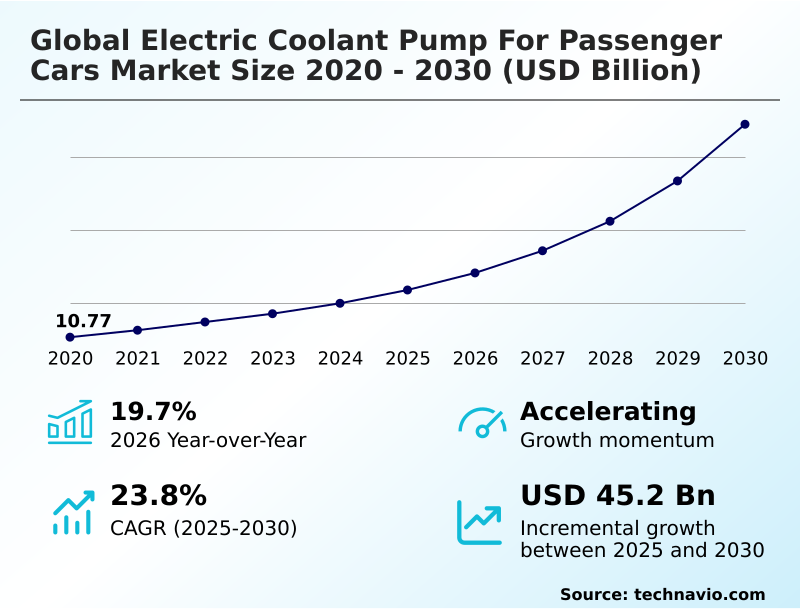
The electric coolant pump for passenger cars market size is valued to increase by USD 45.20 billion, at a CAGR of 23.8% from 2025 to 2030. Rapid electrification of mechanical components will drive the electric coolant pump for passenger cars market.
Major Market Trends & Insights
- APAC dominated the market and accounted for a 49.2% growth during the forecast period.
- By Application - ICE powertrain segment was valued at USD 16.10 billion in 2024
- By Type - Battery electric vehicle segment accounted for the largest market revenue share in 2024
Market Size & Forecast
- Market Opportunities: USD 58.07 billion
- Market Future Opportunities: USD 45.20 billion
- CAGR from 2025 to 2030 : 23.8%
Market Summary
- The electric coolant pump for passenger cars market is undergoing a significant transformation, driven by the shift towards electrification and more stringent emissions regulations. These pumps are critical mechatronic devices within a modern vehicle's thermal management system, providing precise on-demand coolant flow to vital areas like the battery, power electronics, and engine.
- Unlike traditional belt-driven pumps, their independent operation allows for optimized powertrain cooling, leading to improved fuel efficiency and reduced parasitic losses. A key trend is the development of intelligent pumps with CAN bus integration, enabling dynamic control and diagnostics.
- For instance, in a hybrid vehicle navigating heavy traffic, the system can prioritize high-voltage component cooling even when the engine is off, a scenario impossible with mechanical systems. However, the industry faces challenges related to the higher initial cost and the need for robust designs to prevent recalls.
- The push for more compact, lightweight, and efficient solutions using advanced materials continues to shape the competitive landscape, as suppliers work to meet the evolving demands of next-generation powertrain architecture.
What will be the Size of the Electric Coolant Pump For Passenger Cars Market during the forecast period?
Get Key Insights on Market Forecast (PDF) Get Free Sample
How is the Electric Coolant Pump For Passenger Cars Market Segmented?
The electric coolant pump for passenger cars industry research report provides comprehensive data (region-wise segment analysis), with forecasts and estimates in "USD million" for the period 2026-2030, as well as historical data from 2020-2024 for the following segments.
- Application
- ICE powertrain
- Hybrid and electric powertrain
- Type
- Battery electric vehicle
- Plug-in hybrid electric vehicle
- Hybrid electric vehicle
- Distribution channel
- OEMs
- Aftermarket
- Geography
- APAC
- China
- Japan
- India
- Europe
- Germany
- UK
- France
- North America
- US
- Canada
- Mexico
- South America
- Brazil
- Argentina
- Colombia
- Middle East and Africa
- South Africa
- UAE
- Saudi Arabia
- Rest of World (ROW)
- APAC
By Application Insights
The ice powertrain segment is estimated to witness significant growth during the forecast period.
The internal combustion engine (ICE) powertrain segment represents a transitional space for electric coolant pump adoption, primarily concentrated in the luxury vehicle category.
Unlike their mechanical counterparts, these advanced electromechanical components offer on-demand coolant flow, decoupling cooling performance from engine speed.
This capability is critical for optimizing engine temperature control and improving real-world driving efficiency, contributing to incremental gains in fuel economy and vehicular emissions reduction.
Although adoption is limited by a higher unit cost, which can be up to 300% greater than conventional pumps, the integration of these systems is a key strategy for automakers to meet stringent emissions control technology mandates.
The focus is on enhancing vehicle performance through precise powertrain cooling without a complete overhaul of the existing powertrain architecture.
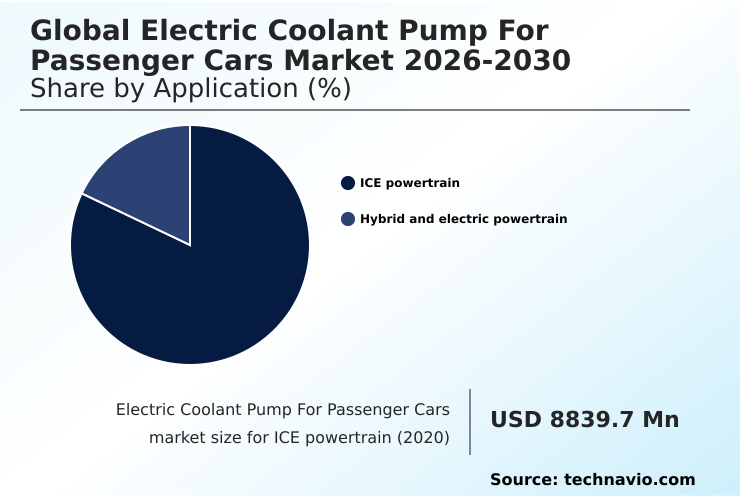
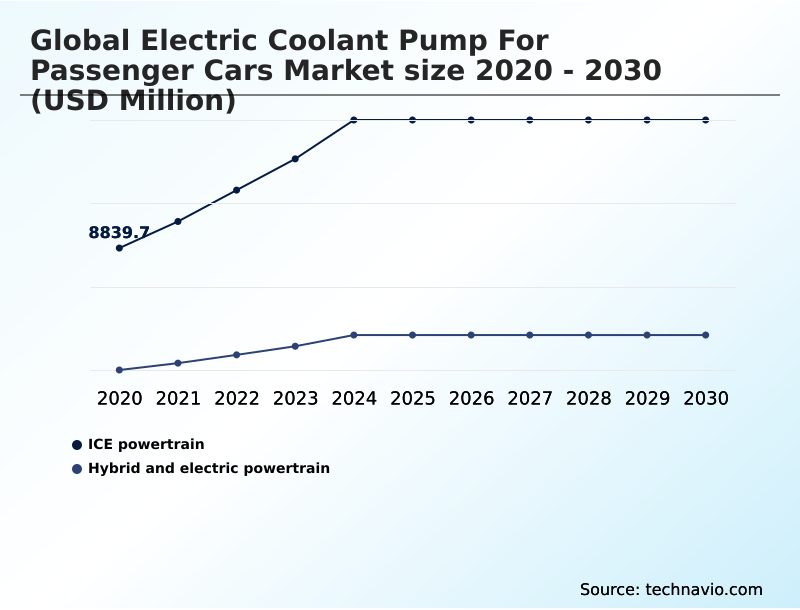
The ICE powertrain segment was valued at USD 16.10 billion in 2024 and showed a gradual increase during the forecast period.
Regional Analysis
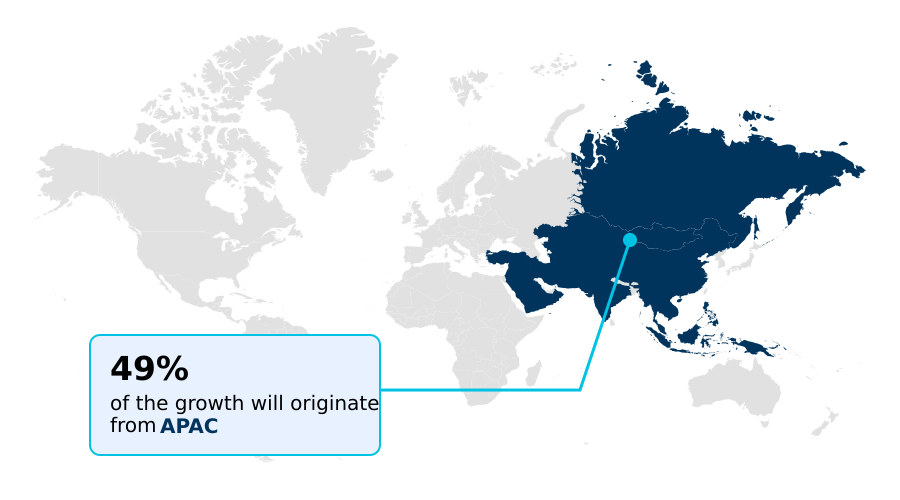
APAC is estimated to contribute 49.2% to the growth of the global market during the forecast period.Technavio’s analysts have elaborately explained the regional trends and drivers that shape the market during the forecast period.
See How Electric Coolant Pump For Passenger Cars Market Demand is Rising in APAC Get Free Sample
APAC is set to contribute 49% of the market's incremental growth, driven by massive investments in powertrain electrification.
In this region, advanced thermal architecture is evolving rapidly to support high-density batteries, with a focus on compact pump design and robust fluid transport systems for automotive electronics cooling.
In contrast, Europe's growth is propelled by stringent emission reduction technologies, mandating the use of systems that enhance real-world driving efficiency. North America is accelerating with significant investments in connected mobility solutions and domestic supply chains.
The development of advanced driver-assistance systems in all regions also creates new cooling demands, pushing for more sophisticated thermal front end modules and integrated automotive systems to manage multiple heat sources effectively.
Market Dynamics
Our researchers analyzed the data with 2025 as the base year, along with the key drivers, trends, and challenges. A holistic analysis of drivers will help companies refine their marketing strategies to gain a competitive advantage.
- Navigating the complexities of the global electric coolant pump for passenger cars market requires a deep understanding of evolving vehicle technologies. A primary focus is on the electric coolant pump for BEV battery cooling, a critical function for range and safety, especially with the rise of systems that must support fast charging.
- The challenges of electric coolant pump system integration are significant, as engineers work to combine the main vs auxiliary electric coolant pump function into cohesive thermal management in advanced hybrid powertrains.
- The benefits of a variable speed electric coolant pump, such as reducing parasitic loss with electric pumps, are a key driver for adoption, directly improving fuel efficiency with electric water pumps. The aftermarket electric coolant pump replacement cost remains a consideration for long-term ownership.
- From a technical perspective, the reliability testing for mechatronic coolant pumps is intense, and a brushless dc motor design for automotive pumps is now standard for efficiency. Diagnostics through a CAN bus controlled electric water pump are simplifying maintenance, though the impact of SiC modules on cooling systems introduces new thermal demands.
- This complexity is evident when comparing thermal designs; a modern BEV may employ up to three distinct cooling loops managed by intelligent pumps, whereas a traditional ICE vehicle uses just one, showcasing a threefold increase in system intricacy that directly impacts supply chain and service strategies.
What are the key market drivers leading to the rise in the adoption of Electric Coolant Pump For Passenger Cars Industry?
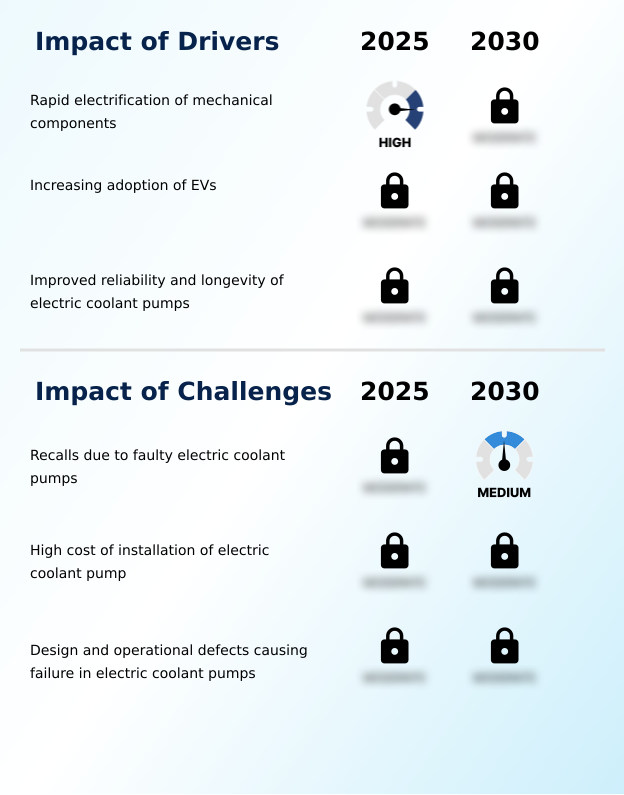
- The rapid electrification of mechanical components is a primary driver for the market, as automakers replace conventional parts with more efficient and controllable electronic systems.
- The rapid pace of powertrain electrification is the principal driver, compelling a shift to advanced thermal management. As automakers integrate more powerful electronics and pursue greater vehicle efficiency gains, the need for precise high-voltage component cooling becomes non-negotiable.
- Technologies like the silicon carbide power module are increasing thermal density management requirements, necessitating dedicated liquid cooling circuits. This move toward on-demand component operation, managed through electronic control unit integration, can improve system efficiency by up to 20%.
- The adoption of brushless DC motor designs with variable speed operation further supports these efficiency goals, making electric pumps essential for battery temperature regulation and achieving broader sustainable energy alternatives.
- The goal is a 10% reduction in parasitic losses compared to mechanical systems.
What are the market trends shaping the Electric Coolant Pump For Passenger Cars Industry?
- Improvements in automotive electric pump systems, including advanced designs and materials, represent a significant market trend. This evolution is enhancing vehicle performance and efficiency.
- A primary trend is the rising integration of electric pumps with comprehensive thermal management systems to achieve greater thermal management optimization. Automakers are shifting toward a holistic vehicle thermal architecture that incorporates integrated heat exchangers and advanced coolant formulations to improve efficient heat transfer by over 15%.
- This automotive system development involves using intelligent pump features with LIN bus communication for precise control. Innovations also focus on lightweight component design, with some new pumps achieving a weight reduction of 30% through the use of advanced composites.
- These improvements in hybrid vehicle cooling solutions and next-generation powertrain designs are critical for enhancing thermal stability solutions and overall EV thermal efficiency, enabling more compact and powerful vehicle platforms.
What challenges does the Electric Coolant Pump For Passenger Cars Industry face during its growth?
- Vehicle recalls stemming from faulty electric coolant pumps present a significant challenge, impacting manufacturer costs, brand reputation, and consumer confidence in the technology.
- A significant market challenge involves recalls due to design defects in the mechatronic device, which can increase warranty claim costs by over 40%. Failures linked to inadequate sealing compromise vehicle operational safety and demand stringent automotive-grade production standards for thermal event prevention.
- The complexity of CAN bus integration also presents hurdles for the independent repair sector, where accurate diagnosis often requires specific diagnostic equipment updates. Furthermore, the high cost of automotive aftermarket parts for these systems can deter timely replacements.
- Ensuring the reliability of redundant cooling circuits and the chemical resistance of materials without escalating costs remains a key engineering obstacle, vital for maintaining consumer trust and system longevity.
Exclusive Technavio Analysis on Customer Landscape
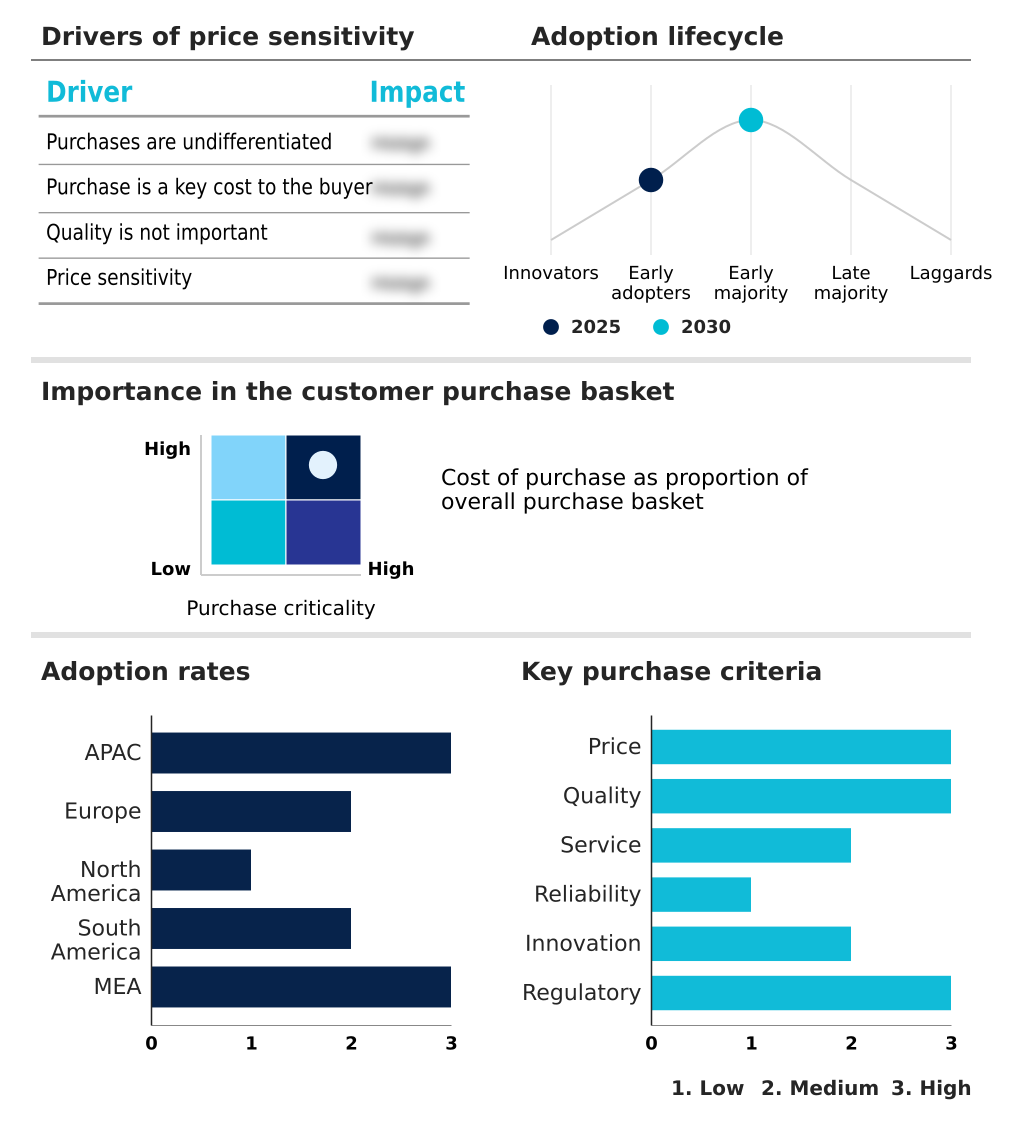
The electric coolant pump for passenger cars market forecasting report includes the adoption lifecycle of the market, covering from the innovator’s stage to the laggard’s stage. It focuses on adoption rates in different regions based on penetration. Furthermore, the electric coolant pump for passenger cars market report also includes key purchase criteria and drivers of price sensitivity to help companies evaluate and develop their market growth analysis strategies.
Customer Landscape of Electric Coolant Pump For Passenger Cars Industry
Competitive Landscape
Companies are implementing various strategies, such as strategic alliances, electric coolant pump for passenger cars market forecast, partnerships, mergers and acquisitions, geographical expansion, and product/service launches, to enhance their presence in the industry.
AISIN Corp. - Key offerings feature advanced thermal management systems, including intelligent electric coolant pumps designed for enhanced vehicle performance, efficiency gains, and powertrain component reliability across diverse automotive platforms.
The industry research and growth report includes detailed analyses of the competitive landscape of the market and information about key companies, including:
- AISIN Corp.
- Buhler Motor GmbH
- Continental AG
- Davies Craig Pty Ltd.
- Gates Corp.
- GMB CORP.
- Hanon Systems
- Johnson Electric Holdings Ltd.
- MAHLE GmbH
- Mikuni Corp.
- Nidec Corp.
- Rheinmetall AG
- Robert Bosch GmbH
- Sanhua Holding Group Co. Ltd.
- Schaeffler AG
- Sogefi Spa
- TI Fluid Systems Plc
- Valeo SA
- VOVYO TECHNOLOGY Co. Ltd.
Qualitative and quantitative analysis of companies has been conducted to help clients understand the wider business environment as well as the strengths and weaknesses of key industry players. Data is qualitatively analyzed to categorize companies as pure play, category-focused, industry-focused, and diversified; it is quantitatively analyzed to categorize companies as dominant, leading, strong, tentative, and weak.
Recent Development and News in Electric coolant pump for passenger cars market
- In August 2024, BMW initiated a recall for approximately 720,000 vehicles due to a fault where water ingress into the electric coolant pump's connector could cause short-circuiting and increase fire risk.
- In November 2024, Gates Corp. launched its next-generation electric water pump technology, featuring a more compact design optimized for hybrid and battery electric vehicle thermal management systems.
- In December 2024, the government of India launched a new Production Linked Incentive (PLI) scheme for the auto sector, specifically targeting domestic manufacturing of critical EV components, including electric pumps.
- In March 2025, MAHLE GmbH introduced a new line of smart electric coolant pumps with integrated sensor technology and a proprietary brushless DC motor, reducing weight and improving operational efficiency.
Dive into Technavio’s robust research methodology, blending expert interviews, extensive data synthesis, and validated models for unparalleled Electric Coolant Pump For Passenger Cars Market insights. See full methodology.
| Market Scope | |
|---|---|
| Page number | 293 |
| Base year | 2025 |
| Historic period | 2020-2024 |
| Forecast period | 2026-2030 |
| Growth momentum & CAGR | Accelerate at a CAGR of 23.8% |
| Market growth 2026-2030 | USD 45195.7 million |
| Market structure | Fragmented |
| YoY growth 2025-2026(%) | 19.7% |
| Key countries | China, Japan, India, South Korea, Australia, Indonesia, Germany, UK, France, Italy, Spain, The Netherlands, US, Canada, Mexico, Brazil, Argentina, Colombia, South Africa, UAE, Saudi Arabia, Israel and Turkey |
| Competitive landscape | Leading Companies, Market Positioning of Companies, Competitive Strategies, and Industry Risks |
Research Analyst Overview
- The market is fundamentally reshaping vehicle powertrain architecture. At its core, the electric coolant pump is a critical mechatronic device, enabling on-demand coolant flow essential for battery thermal management and high-voltage component cooling. Unlike legacy systems, the variable speed operation of a brushless DC motor allows for a significant reduction in parasitic losses, directly improving vehicle efficiency.
- The integration of these pumps into a broader thermal management system, often via CAN bus or LIN bus communication, is now standard. This shift supports advanced thermal architecture required for next-generation vehicles. Intelligent pump features, managed through electronic control unit integration, provide precise coolant flow regulation and enhance powertrain component reliability.
- For example, using lightweight pump materials in a compact pump design has been shown to reduce component weight by up to 30%, a critical factor in extending electric vehicle range. The industry's focus is on managing increased thermal density and improving heat transfer efficiency while ensuring the reliability of these complex systems.
What are the Key Data Covered in this Electric Coolant Pump For Passenger Cars Market Research and Growth Report?
-
What is the expected growth of the Electric Coolant Pump For Passenger Cars Market between 2026 and 2030?
-
USD 45.20 billion, at a CAGR of 23.8%
-
-
What segmentation does the market report cover?
-
The report is segmented by Application (ICE powertrain, and Hybrid and electric powertrain), Type (Battery electric vehicle, Plug-in hybrid electric vehicle, and Hybrid electric vehicle), Distribution Channel (OEMs, and Aftermarket) and Geography (APAC, Europe, North America, South America, Middle East and Africa)
-
-
Which regions are analyzed in the report?
-
APAC, Europe, North America, South America and Middle East and Africa
-
-
What are the key growth drivers and market challenges?
-
Rapid electrification of mechanical components, Recalls due to faulty electric coolant pumps
-
-
Who are the major players in the Electric Coolant Pump For Passenger Cars Market?
-
AISIN Corp., Buhler Motor GmbH, Continental AG, Davies Craig Pty Ltd., Gates Corp., GMB CORP., Hanon Systems, Johnson Electric Holdings Ltd., MAHLE GmbH, Mikuni Corp., Nidec Corp., Rheinmetall AG, Robert Bosch GmbH, Sanhua Holding Group Co. Ltd., Schaeffler AG, Sogefi Spa, TI Fluid Systems Plc, Valeo SA and VOVYO TECHNOLOGY Co. Ltd.
-
Market Research Insights
- The market's momentum is driven by the imperative for enhanced EV thermal efficiency and the adoption of sophisticated hybrid vehicle cooling solutions. The move towards advanced thermal management is delivering measurable outcomes, with some integrated systems reducing energy consumption by 15% compared to legacy designs.
- Intelligent pump control, a key element of this shift, contributes to a 10% improvement in battery temperature regulation under dynamic load conditions. This optimization of automotive electronics cooling is critical as automakers pursue greater powertrain component reliability.
- The ongoing refinement of these technologies is not just about performance but also about enabling new vehicle capabilities and meeting increasingly stringent environmental mandates across global markets.
We can help! Our analysts can customize this electric coolant pump for passenger cars market research report to meet your requirements.
 RIA -
RIA - 
