


Elevator And Escalator Market Size 2026-2030
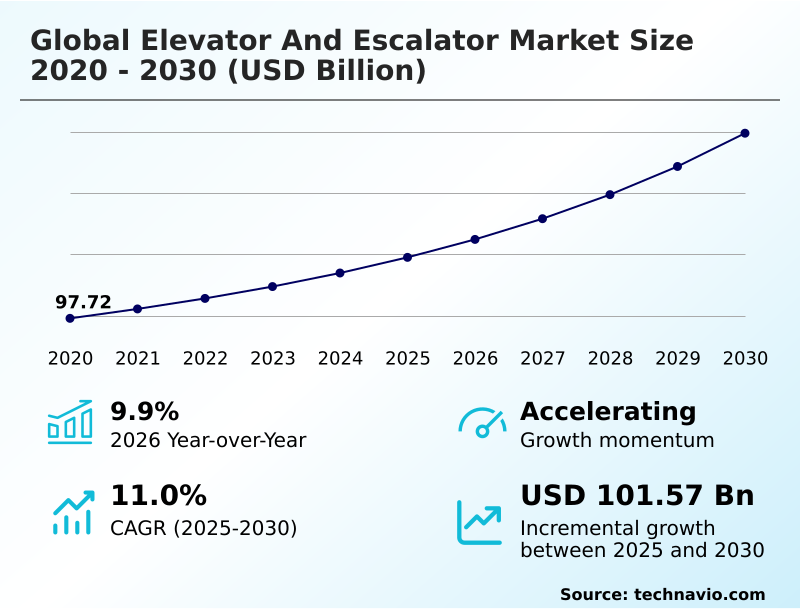
The elevator and escalator market size is valued to increase by USD 101.57 billion, at a CAGR of 11% from 2025 to 2030. Accelerated urbanization and vertical construction growth will drive the elevator and escalator market.
Major Market Trends & Insights
- APAC dominated the market and accounted for a 75.3% growth during the forecast period.
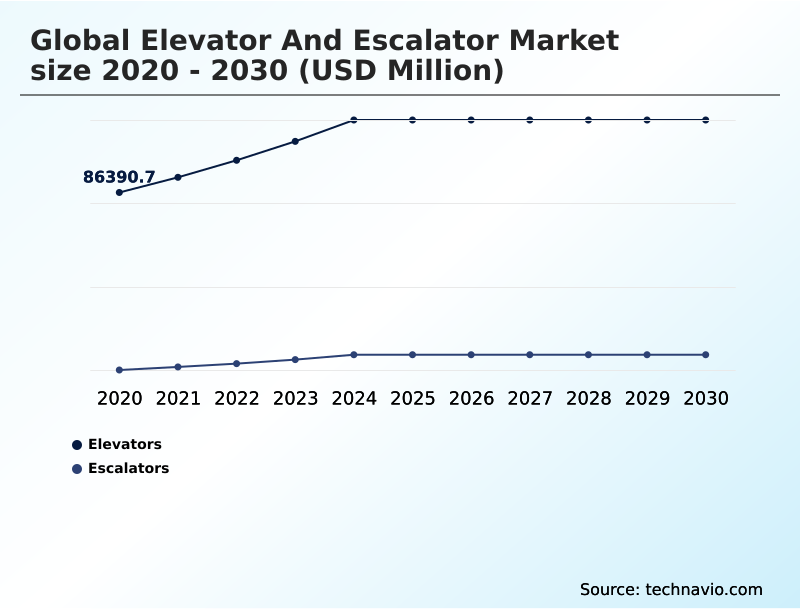
- By Product - Elevators segment was valued at USD 117.04 billion in 2024
- By Application - Commercial segment accounted for the largest market revenue share in 2024
Market Size & Forecast
- Market Opportunities: USD 151.47 billion
- Market Future Opportunities: USD 101.57 billion
- CAGR from 2025 to 2030 : 11%
Market Summary
- The elevator and escalator market remains an indispensable component of urban development, fundamentally enabling the vertical expansion of modern cities. Market momentum is sustained by dual forces: the relentless pace of new construction in urbanizing regions and the non-discretionary need to modernize aging infrastructure in mature economies.
- Trends are increasingly shaped by the integration of digital technologies, with a significant shift towards intelligent systems that offer enhanced efficiency and safety. For instance, a facility manager overseeing a portfolio of commercial properties now relies on predictive maintenance platforms, which use real-time data to anticipate equipment failures.
- This approach allows for proactive servicing, preventing costly unscheduled downtime and improving tenant satisfaction, thereby transforming a traditional cost center into a strategic asset management function. However, this technological evolution introduces challenges, as the demand for technicians with advanced diagnostic and software skills often outpaces supply, impacting service delivery and project timelines across the industry.
What will be the Size of the Elevator And Escalator Market during the forecast period?
Get Key Insights on Market Forecast (PDF) Get Free Sample
How is the Elevator And Escalator Market Segmented?
The elevator and escalator industry research report provides comprehensive data (region-wise segment analysis), with forecasts and estimates in "USD million" for the period 2026-2030, as well as historical data from 2020-2024 for the following segments.
- Product
- Elevators
- Escalators
- Application
- Commercial
- Residential
- Industrial
- Type
- Maintenance
- New equipment
- Modernization
- Geography
- APAC
- China
- India
- Japan
- Europe
- Germany
- UK
- France
- Middle East and Africa
- Saudi Arabia
- UAE
- South Africa
- North America
- US
- Canada
- Mexico
- South America
- Brazil
- Argentina
- Rest of World (ROW)
- APAC
By Product Insights
The elevators segment is estimated to witness significant growth during the forecast period.
The elevators segment constitutes the largest component of the market for vertical transportation systems, consistently driven by high-rise construction demand.
This segment's growth is supported by the prevalence of technologies like traction elevators and the increasing adoption of machine-room-less (MRL) elevators, which offer design flexibility and space efficiency.
Advanced solutions such as destination dispatch control are becoming standard in new commercial projects to facilitate improved passenger traffic flow optimization.
Representing over 85% of new equipment installations, elevators are fundamental to modern urban development, with innovation focused on enhancing both performance and the analysis of real-time operational data to improve system reliability and efficiency within increasingly complex buildings.
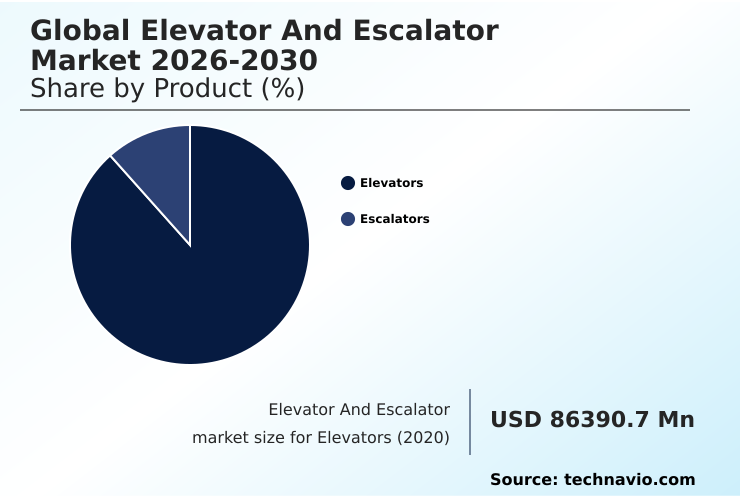
The Elevators segment was valued at USD 117.04 billion in 2024 and showed a gradual increase during the forecast period.
Regional Analysis
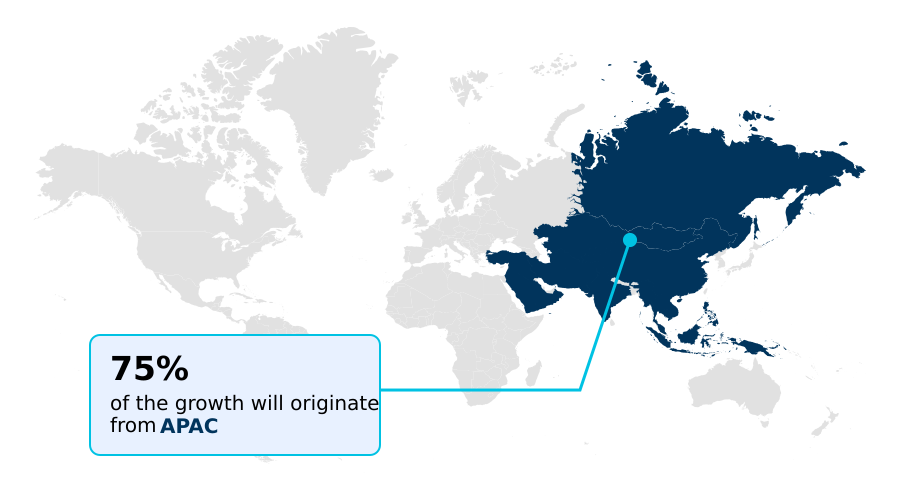
APAC is estimated to contribute 75.3% to the growth of the global market during the forecast period.Technavio’s analysts have elaborately explained the regional trends and drivers that shape the market during the forecast period.
See How Elevator And Escalator Market Demand is Rising in APAC Get Free Sample
The geographic landscape of the elevator and escalator market is defined by a distinct dual dynamic, with APAC driving approximately 75% of global incremental growth.
This expansion is fueled by massive urban infrastructure development and a strong focus on smart building integration.
In contrast, mature markets in North America and Europe are primarily focused on modernization, driven by stringent regulations and the need for green building certification alignment.
In these regions, the adoption of energy-saving technologies like regenerative drives and permanent magnet gearless motors is a key priority, as modernization projects can improve energy efficiency by over 50%.
The installation of heavy-duty escalators in new transit hubs and commercial centers remains a constant across all regions, reflecting ongoing global urbanization.
Market Dynamics
Our researchers analyzed the data with 2025 as the base year, along with the key drivers, trends, and challenges. A holistic analysis of drivers will help companies refine their marketing strategies to gain a competitive advantage.
- The global elevator and escalator market is transitioning from providing functional transport to delivering integrated building mobility solutions. This evolution necessitates a deeper analysis of the cost benefit of predictive maintenance, where the initial investment is weighed against long-term operational savings and enhanced safety.
- A key decision point for developers involves evaluating the energy efficiency of MRL elevators against traditional designs. Similarly, a direct otis gen2 vs schindler 3300 energy use comparison becomes a critical factor in procurement, reflecting a broader focus on lifecycle costs.
- Understanding the impact of iot on elevator service models is crucial for service providers aiming to offer differentiated, high-margin services. As technology advances, assessing a kone monospace vs tk evolution comparison moves beyond mechanics to include software capabilities and digital integration. For technicians and building managers, staying current with compliance requirements for asme a17.1 is non-negotiable.
- Furthermore, calculating regenerative drive roi and understanding destination dispatch system performance metrics are now standard practice. The industry is also addressing modernization options for aging hydraulic elevators and ensuring seamless smart elevator integration with access control, making these specialized knowledge areas vital for market competitiveness.
- The adoption of proactive service models has shown to improve technician deployment efficiency by nearly twofold over traditional, reactive approaches.
What are the key market drivers leading to the rise in the adoption of Elevator And Escalator Industry?
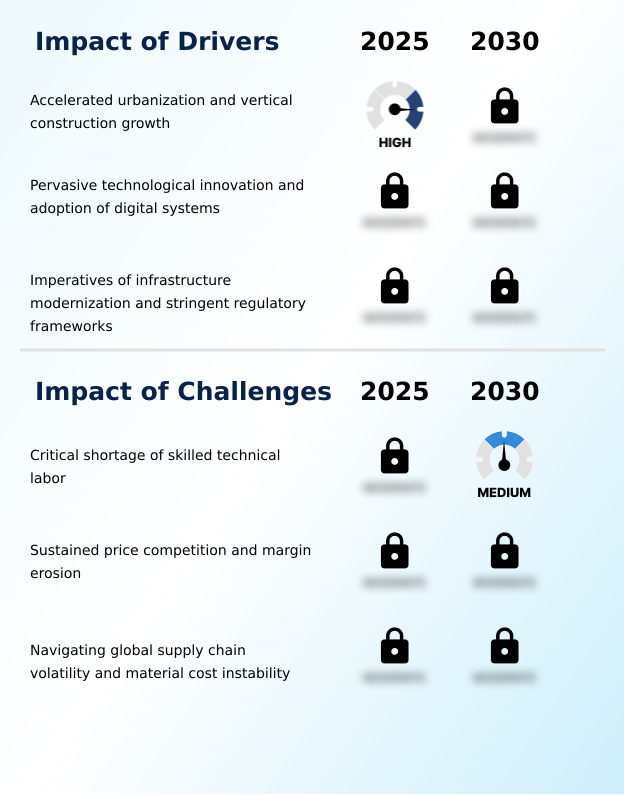
- Accelerated urbanization and the corresponding growth in vertical construction are the key drivers propelling the market forward.
- The market is propelled by a combination of new construction and the imperative to upgrade existing infrastructure.
- Regulation-driven modernization services mandate the inclusion of critical safety features like unintended car movement protection and door-lock monitoring systems, creating a stable, non-discretionary demand stream.
- For building owners, total cost of ownership modeling is a significant driver, with investments in technologies like variable frequency drives offering a clear return by reducing energy consumption by over 50%.
- This focus on long-term value reinforces the importance of comprehensive aftermarket service contracts.
- In the new equipment segment, architectural demands for aesthetic appeal and differentiation are driving the specification of features such as panoramic lifts, adding visual impact to commercial and public buildings.
What are the market trends shaping the Elevator And Escalator Industry?
- The market is increasingly defined by the ascendancy of smart elevators. This trend is driven by the widespread integration of IoT technologies throughout vertical transportation systems.
- Key trends are reshaping the elevator and escalator market, driven by digitalization and user-centric design. The adoption of iot connectivity solutions is central to this shift, enabling predictive maintenance platforms that facilitate proactive condition-based servicing. This approach has proven to reduce unexpected equipment downtime by over 40% in high-traffic commercial buildings.
- Data-driven energy management is another major trend, where real-time analytics optimize system performance to lower consumption. To improve the enhanced user experience design, manufacturers are widely implementing touchless control systems, a feature that has gained prominence for its convenience and hygiene benefits.
- In large public spaces, the installation of high-capacity moving walkways continues to be a priority for managing pedestrian flow efficiently.
What challenges does the Elevator And Escalator Industry face during its growth?
- The critical shortage of skilled technical labor presents a significant challenge to the industry's growth trajectory and service capabilities.
- The industry faces significant operational challenges, foremost among them being the shortage of hybrid skill set technicians capable of performing complex mechatronic system maintenance. This scarcity is intensified by the need for proprietary control system diagnostics, which complicates service across different brands and can extend project timelines by an average of 15%.
- Simultaneously, navigating supply chain volatility requires robust resilience strategies to ensure the availability of specialized parts, from explosion-proof components for industrial applications to seismic-resistant features for installations in active zones.
- The increasing complexity of automated guided vehicles integration in logistics environments adds another layer of technical challenge, while the large installed base of older hydraulic lift systems presents ongoing service and modernization difficulties.
Exclusive Technavio Analysis on Customer Landscape
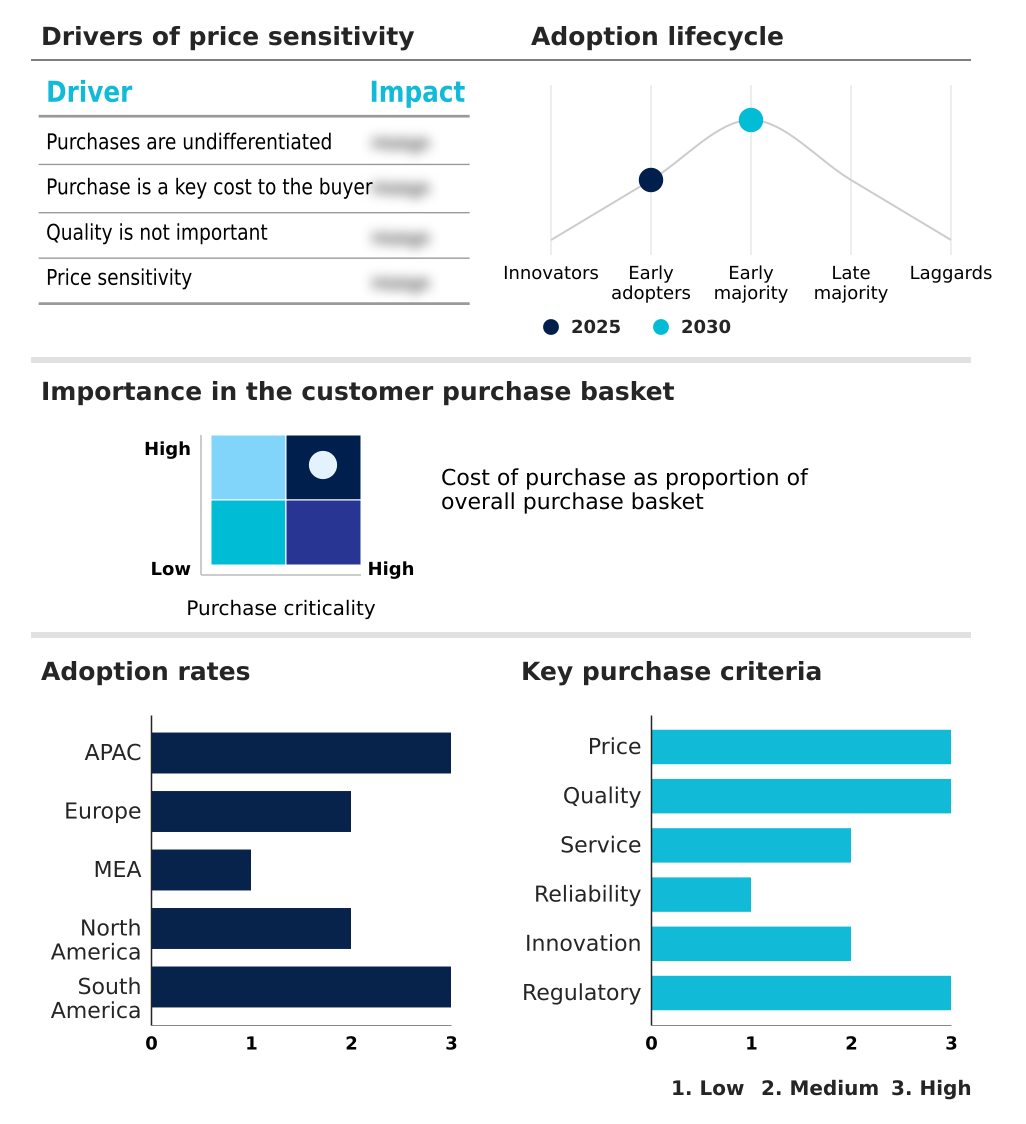
The elevator and escalator market forecasting report includes the adoption lifecycle of the market, covering from the innovator’s stage to the laggard’s stage. It focuses on adoption rates in different regions based on penetration. Furthermore, the elevator and escalator market report also includes key purchase criteria and drivers of price sensitivity to help companies evaluate and develop their market growth analysis strategies.
Customer Landscape of Elevator And Escalator Industry
Competitive Landscape
Companies are implementing various strategies, such as strategic alliances, elevator and escalator market forecast, partnerships, mergers and acquisitions, geographical expansion, and product/service launches, to enhance their presence in the industry.
Braun Elevator Co. Ltd. - Core offerings center on providing new equipment, comprehensive modernization services, and long-term maintenance contracts, forming an integrated lifecycle portfolio.
The industry research and growth report includes detailed analyses of the competitive landscape of the market and information about key companies, including:
- Braun Elevator Co. Ltd.
- Brobeil Aufzuge GmbH and Co. KG
- Escon Elevators Pvt. Ltd.
- FUJI Elevators Escalators Co.
- Fujitec Co. Ltd.
- Hitachi Ltd.
- Hyundai Elevator Co. Ltd.
- Kleemann Hellas SA
- KOHLER Elevator GmbH
- KONE Oyj
- Mitsubishi Electric Corp.
- Otis Worldwide Corp.
- Savaria Corp.
- Schindler Holding Ltd.
- Schumacher Elevator Co.
- TK Elevator GmbH
- Toshiba Corp.
- Weidmuller GmbH and Co. KG
- Wilhelm Schafer GmbH
- Wittur Holding GmbH
Qualitative and quantitative analysis of companies has been conducted to help clients understand the wider business environment as well as the strengths and weaknesses of key industry players. Data is qualitatively analyzed to categorize companies as pure play, category-focused, industry-focused, and diversified; it is quantitatively analyzed to categorize companies as dominant, leading, strong, tentative, and weak.
Recent Development and News in Elevator and escalator market
- In August, 2025, Schindler Group secured an exclusive contract to provide and install all elevators and escalators for the inaugural line of Bogota's new elevated railway system in Colombia.
- In September, 2025, Otis launched its Arise MOD Prime and Arise MOD Plus modernization solutions in Europe, offering flexible and phased upgrades for low to mid-rise buildings.
- In January, 2025, Mitsubishi Electric introduced an advanced regenerative drive system for its elevator lines, designed to significantly enhance energy efficiency in commercial and residential buildings.
- In April, 2025, Otis announced the acquisition of eight Urban Elevator service locations across the United States, expanding its maintenance and service footprint in key metropolitan areas.
Dive into Technavio’s robust research methodology, blending expert interviews, extensive data synthesis, and validated models for unparalleled Elevator And Escalator Market insights. See full methodology.
| Market Scope | |
|---|---|
| Page number | 299 |
| Base year | 2025 |
| Historic period | 2020-2024 |
| Forecast period | 2026-2030 |
| Growth momentum & CAGR | Accelerate at a CAGR of 11% |
| Market growth 2026-2030 | USD 101571.3 million |
| Market structure | Fragmented |
| YoY growth 2025-2026(%) | 9.9% |
| Key countries | China, India, Japan, South Korea, Indonesia, Australia, Germany, UK, France, Italy, Spain, The Netherlands, Saudi Arabia, UAE, South Africa, Egypt, Turkey, US, Canada, Mexico, Brazil, Argentina and Chile |
| Competitive landscape | Leading Companies, Market Positioning of Companies, Competitive Strategies, and Industry Risks |
Research Analyst Overview
- The global elevator and escalator market is undergoing a significant transformation, moving beyond its mechanical origins to become a sophisticated, service-oriented industry. The integration of vertical transportation systems with smart building integration frameworks is now a primary consideration.
- Boardroom-level decisions on capital expenditure are increasingly influenced by the strategic value of modernization, which incorporates technologies such as destination dispatch control, variable frequency drives, and regenerative drives.
- These upgrades are no longer just for compliance but are essential for asset enhancement, with buildings that adopt advanced dispatch systems reporting an average reduction in passenger wait times of up to 25% during peak hours. The adoption of predictive maintenance platforms, enabled by iot connectivity solutions and sophisticated door-lock monitoring systems, is redefining service models.
- This shift requires a focus on high-performance components like permanent magnet gearless motors and advanced touchless control systems. Safety remains paramount, with features like unintended car movement protection becoming standard in both traction elevators and hydraulic lift systems. Even aesthetic elements like panoramic lifts and functional systems like moving walkways are being integrated into the digitally connected ecosystem.
What are the Key Data Covered in this Elevator And Escalator Market Research and Growth Report?
-
What is the expected growth of the Elevator And Escalator Market between 2026 and 2030?
-
USD 101.57 billion, at a CAGR of 11%
-
-
What segmentation does the market report cover?
-
The report is segmented by Product (Elevators, and Escalators), Application (Commercial, Residential, and Industrial), Type (Maintenance, New equipment, and Modernization) and Geography (APAC, Europe, Middle East and Africa, North America, South America)
-
-
Which regions are analyzed in the report?
-
APAC, Europe, Middle East and Africa, North America and South America
-
-
What are the key growth drivers and market challenges?
-
Accelerated urbanization and vertical construction growth, Critical shortage of skilled technical labor
-
-
Who are the major players in the Elevator And Escalator Market?
-
Braun Elevator Co. Ltd., Brobeil Aufzuge GmbH and Co. KG, Escon Elevators Pvt. Ltd., FUJI Elevators Escalators Co., Fujitec Co. Ltd., Hitachi Ltd., Hyundai Elevator Co. Ltd., Kleemann Hellas SA, KOHLER Elevator GmbH, KONE Oyj, Mitsubishi Electric Corp., Otis Worldwide Corp., Savaria Corp., Schindler Holding Ltd., Schumacher Elevator Co., TK Elevator GmbH, Toshiba Corp., Weidmuller GmbH and Co. KG, Wilhelm Schafer GmbH and Wittur Holding GmbH
-
Market Research Insights
- Market dynamics are increasingly influenced by a strategic shift from equipment sales to long-term service relationships, underpinned by total cost of ownership modeling. This evolution is driven by the adoption of intelligent technologies that provide tangible operational benefits. For example, proactive condition-based servicing has been shown to reduce equipment downtime by up to 30% compared to traditional reactive maintenance schedules.
- Concurrently, the implementation of data-driven energy management and regenerative drive systems in modernization projects can decrease an elevator's energy consumption by as much as 75%, directly enhancing building management system (BMS) integration and aligning with sustainability goals. This focus on lifecycle value and operational efficiency is reshaping purchasing criteria and competitive strategies.
We can help! Our analysts can customize this elevator and escalator market research report to meet your requirements.
 RIA -
RIA - 
