



Enterprise Knowledge Graph Market Size 2026-2030
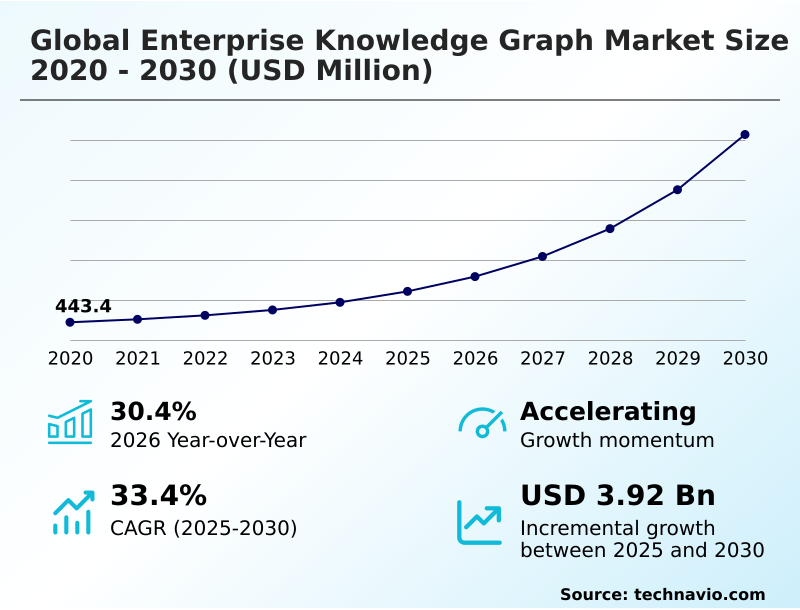
The enterprise knowledge graph market size is valued to increase by USD 3.92 billion, at a CAGR of 33.4% from 2025 to 2030. Proliferation of unstructured data and requirement for semantic connectivity will drive the enterprise knowledge graph market.
Major Market Trends & Insights
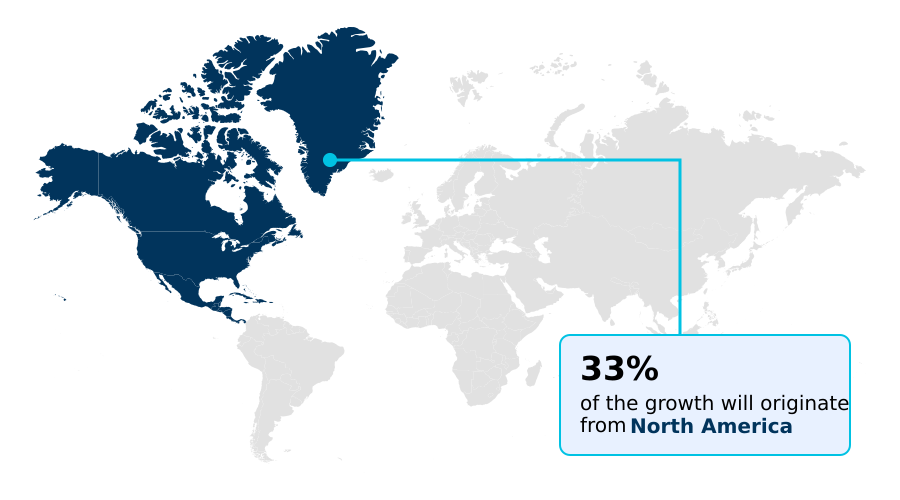
- North America dominated the market and accounted for a 33% growth during the forecast period.
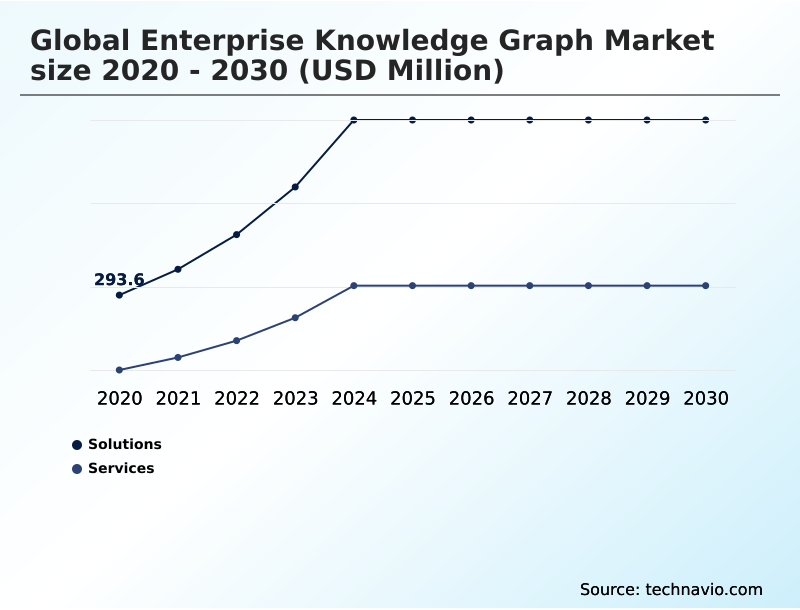
- By Component - Solutions segment was valued at USD 629.9 million in 2024
- By Application - Supply chain and inventory management segment accounted for the largest market revenue share in 2024
Market Size & Forecast
- Market Opportunities: USD 4.69 billion
- Market Future Opportunities: USD 3.92 billion
- CAGR from 2025 to 2030 : 33.4%
Market Summary
- The enterprise knowledge graph market signifies a pivotal shift in data management, moving beyond traditional databases to embrace interconnected information ecosystems. This evolution is driven by the need to create a unified, semantic layer over disparate data sources, enabling organizations to derive complex insights that were previously unattainable.
- Key trends include the integration of graph technology with generative AI to mitigate factual inaccuracies and the adoption of data fabric architectures for real-time, holistic views of operations. For instance, a financial services firm can leverage a knowledge graph to map subtle connections between entities, significantly improving its ability to detect sophisticated fraud networks that elude conventional systems.
- While the technical complexity of implementation and the scarcity of specialized talent present challenges, the strategic imperative for enhanced data governance, lineage tracking, and contextual understanding continues to fuel market adoption. The technology transforms data from a static asset into a dynamic, queryable network, providing a critical foundation for intelligent automation and competitive agility in a data-driven landscape.
- This market's trajectory is defined by the enterprise-wide pursuit of a single source of truth, enabling more resilient and informed decision-making processes across all business functions.
What will be the Size of the Enterprise Knowledge Graph Market during the forecast period?
Get Key Insights on Market Forecast (PDF) Get Free Sample
How is the Enterprise Knowledge Graph Market Segmented?
The enterprise knowledge graph industry research report provides comprehensive data (region-wise segment analysis), with forecasts and estimates in "USD million" for the period 2026-2030, as well as historical data from 2020-2024 for the following segments.
- Component
- Solutions
- Services
- Application
- Supply chain and inventory management
- Recommendation and personalization
- Knowledge management and collaboration
- Fraud detection and compliance
- Others
- End-user
- Large enterprises
- Small and medium enterprises
- Geography
- North America
- US
- Canada
- Mexico
- Europe
- Germany
- UK
- France
- APAC
- China
- Japan
- India
- Middle East and Africa
- Saudi Arabia
- UAE
- South Africa
- South America
- Brazil
- Argentina
- Colombia
- Rest of World (ROW)
- North America
By Component Insights
The solutions segment is estimated to witness significant growth during the forecast period.
The solutions segment provides the foundational platforms enabling a modern data-centric architecture. A core graph database management system supports a flexible graph-based data model, crucial for effective data silos integration and superior data quality management.
These platforms facilitate high-performance graph processing and semantic metadata management, allowing for seamless enterprise resource planning integration.
This approach improves data mapping efficiency by over 40% when connecting disparate sources, including customer relationship management tools, and supports advanced knowledge management systems that turn fragmented data into a cohesive, queryable asset.
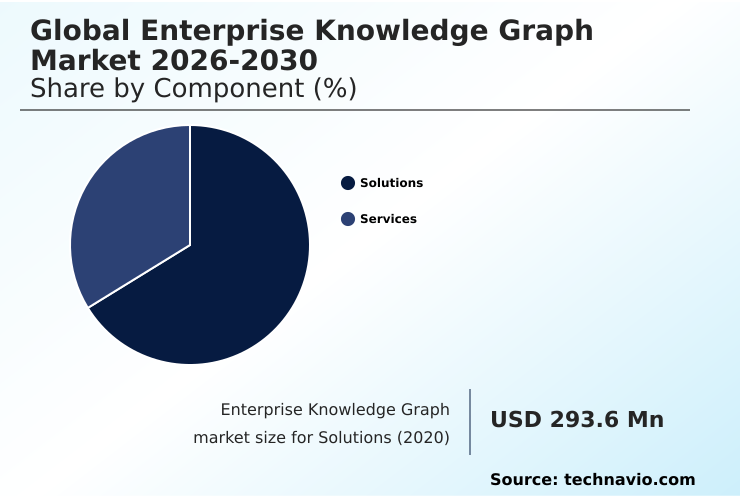
The Solutions segment was valued at USD 629.9 million in 2024 and showed a gradual increase during the forecast period.
Regional Analysis
North America is estimated to contribute 33% to the growth of the global market during the forecast period.Technavio’s analysts have elaborately explained the regional trends and drivers that shape the market during the forecast period.
See How Enterprise Knowledge Graph Market Demand is Rising in North America Get Free Sample
The global landscape is led by North America, which accounts for over 33% of market activity, driven by early adoption in its advanced technology and financial sectors.
Here, organizations utilize a semantic data layer and graph embeddings for complex analytics, enhancing product lifecycle management.
The APAC region is poised for the fastest expansion, with a growth rate nearly 2% higher than other regions, fueled by massive digital transformation projects.
In this region, ontology-driven graph construction and graph neural networks are critical for managing smart city data and large-scale e-commerce platforms. Key applications include improving supply chain visibility by 40% through enhanced data lineage tracking.
This allows a native parallel graph database to effectively map customer journey mapping and create a federated data infrastructure across diverse markets from the United States and Canada to China and India.
Market Dynamics
Our researchers analyzed the data with 2025 as the base year, along with the key drivers, trends, and challenges. A holistic analysis of drivers will help companies refine their marketing strategies to gain a competitive advantage.
- Strategic adoption defines the trajectory of the global enterprise knowledge graph market 2026-2030, as organizations move beyond foundational use cases to tackle complex operational challenges. Initially, many firms focus on targeted applications such as using a knowledge graph for fraud detection or deploying a knowledge graph for personalized marketing.
- Success in these areas often leads to broader initiatives, including leveraging a knowledge graph for master data management and implementing a knowledge graph for compliance reporting. A critical decision point involves the technology stack, with many evaluating a multi-model database vs graph database to determine the optimal architecture.
- As firms scale, they confront enterprise knowledge graph implementation challenges, necessitating clear best practices for knowledge graph development to ensure a positive enterprise knowledge graph ROI. Advanced applications like building knowledge graph from unstructured data and enabling generative AI with knowledge graph are becoming more common.
- These systems provide real-time analytics with knowledge graphs, especially in demanding sectors like knowledge graph in financial services, which require robust security and performance. The ultimate goal is creating a cohesive semantic layer for enterprise data, a task where firms using graph-based systems see a twofold improvement in data consistency over legacy methods.
- This evolution addresses everything from enterprise knowledge graph use cases in logistics, such as the enterprise knowledge graph for supply chain, to overarching strategies like scaling enterprise knowledge graphs for global operations and using a knowledge graph for data governance.
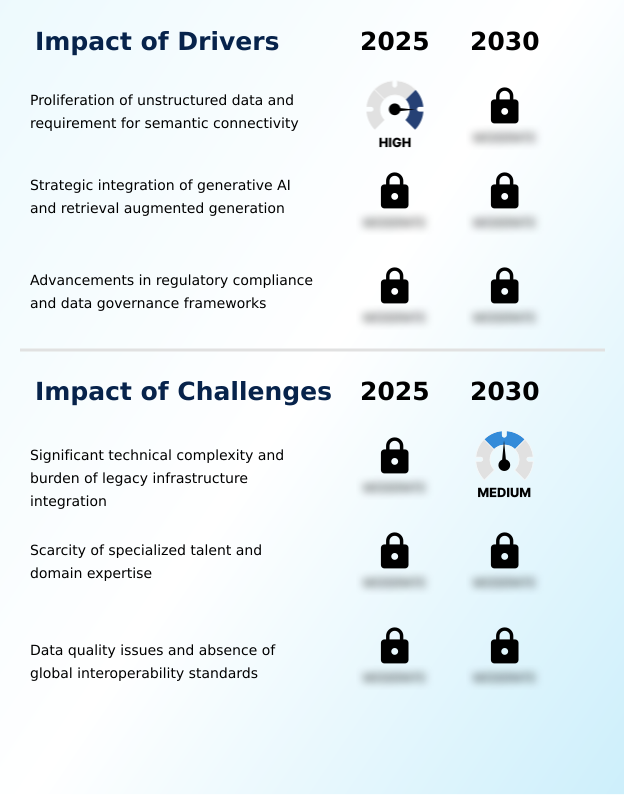
What are the key market drivers leading to the rise in the adoption of Enterprise Knowledge Graph Industry?
- The market's expansion is primarily driven by the proliferation of unstructured data and the corresponding enterprise requirement for semantic connectivity to unlock actionable insights.
- Market growth is fundamentally driven by the need for semantic interoperability across complex enterprise data ecosystems. Organizations are leveraging multi-model NoSQL database technologies and advanced automated entity resolution to create a cohesive, contextual data understanding from fragmented sources.
- This capability is critical for regulatory adherence, where data governance frameworks for anti-money laundering compliance are paramount. Firms using these approaches report a 25% improvement in regulatory reporting efficiency.
- The rise of neuro-symbolic AI and the demand for deep link analytics are also significant drivers, as these technologies can handle data query complexity that is 10 times greater than traditional systems.
- This unlocks new opportunities in areas like enhancing supply chain visibility and managing vast, interconnected data landscapes.
What are the market trends shaping the Enterprise Knowledge Graph Industry?
- A defining market trend is the strategic integration of large language models with structured knowledge bases. This convergence seeks to ground generative AI in factual, enterprise-specific data.
- Key market trends are centered on the fusion of AI and advanced data architectures. The adoption of retrieval augmented generation is a primary focus, with organizations reporting up to a 35% improvement in AI factual accuracy by grounding large language models in verified enterprise data.
- This synergy is enabled by a sophisticated data fabric architecture and emerging data mesh principles, which rely on graph technology for semantic search capabilities. This approach accelerates data discovery across disparate systems by over 50%. Furthermore, the push for explainable AI (XAI) and stricter governance is driving the use of collaborative graph editing and automated policy enforcement.
- This allows for transparent, real-time fraud detection and streamlined unstructured data processing within a federated data infrastructure, enhancing both security and customer journey mapping.
What challenges does the Enterprise Knowledge Graph Industry face during its growth?
- A primary challenge impacting market growth is the significant technical complexity and financial burden associated with integrating modern graph platforms into legacy IT infrastructures.
- Significant implementation hurdles continue to challenge market adoption, stemming from technical complexity and data quality issues. The transition to semantic web technologies requires a steep learning curve, as teams must master graph data modeling and new graph query languages.
- Integrating these modern platforms with legacy systems is a major barrier, with implementation cycles often running up to 60% longer than for traditional databases. Furthermore, the absence of universal standards for the resource description framework (RDF) and property graph model hinders cross-platform integration.
- Issues are compounded by the need for a sophisticated data virtualization layer and the high cost of talent, which can increase project budgets by an average of 20%. Managing digital twin modeling in a hybrid-cloud graph deployment with an in-memory graph database adds another layer of complexity.
Exclusive Technavio Analysis on Customer Landscape
The enterprise knowledge graph market forecasting report includes the adoption lifecycle of the market, covering from the innovator’s stage to the laggard’s stage. It focuses on adoption rates in different regions based on penetration. Furthermore, the enterprise knowledge graph market report also includes key purchase criteria and drivers of price sensitivity to help companies evaluate and develop their market growth analysis strategies.
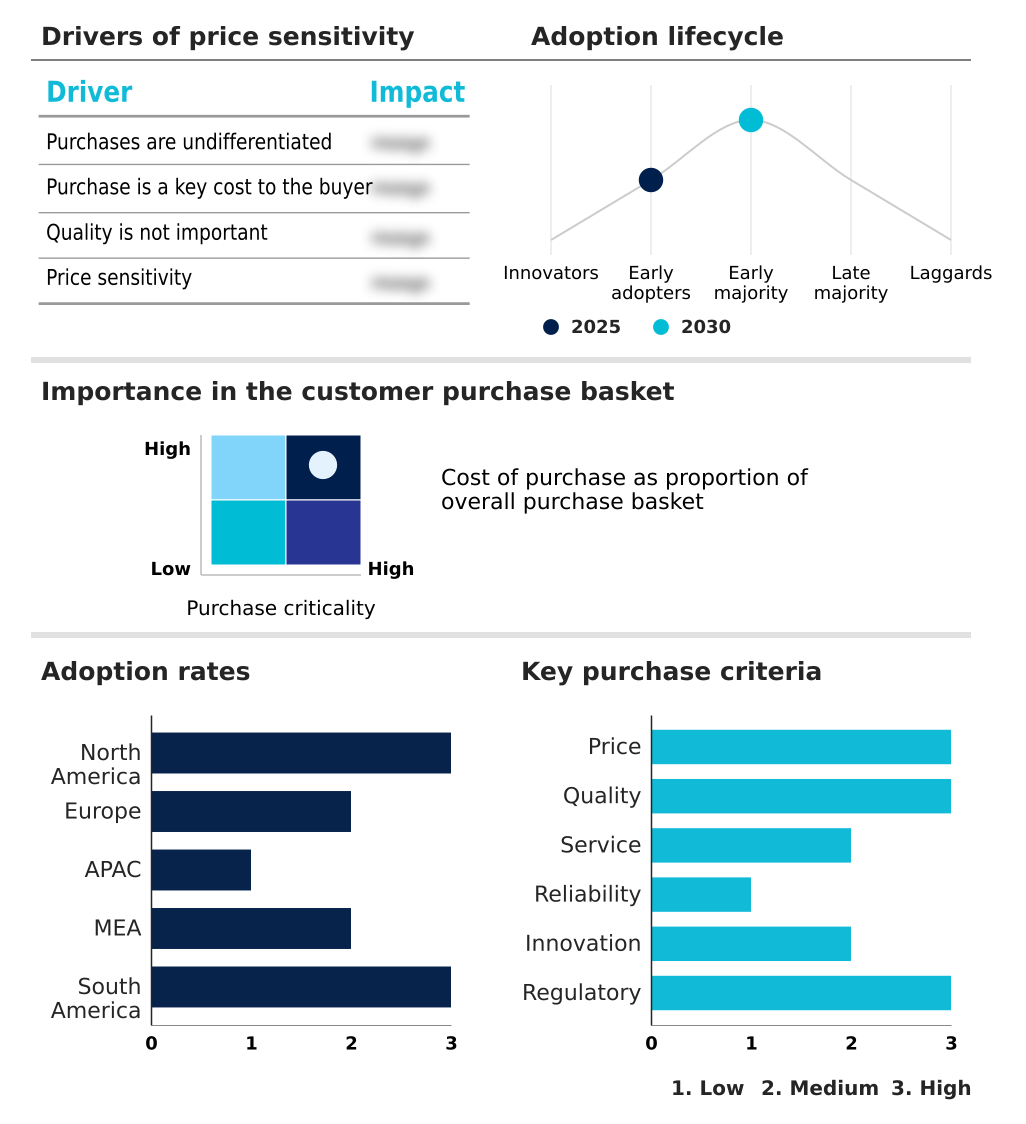
Customer Landscape of Enterprise Knowledge Graph Industry
Competitive Landscape
Companies are implementing various strategies, such as strategic alliances, enterprise knowledge graph market forecast, partnerships, mergers and acquisitions, geographical expansion, and product/service launches, to enhance their presence in the industry.
Altair Engineering Inc. - Vendors provide integrated graph platforms that create a semantic data layer, connect siloed information, and power advanced AI-driven analytics for modern enterprises.
The industry research and growth report includes detailed analyses of the competitive landscape of the market and information about key companies, including:
- Altair Engineering Inc.
- Amazon.com Inc.
- ArangoDB Inc.
- DATA.WORLD INC.
- Franz Inc.
- Google LLC
- IBM Corp.
- KATANA GRAPH INC.
- MarkLogic Corp.
- Memgraph Ltd.
- Microsoft Corp.
- Neo4j Inc.
- Ontotext USA Inc.
- Oracle Corp.
- Palantir Technologies Inc.
- ServiceNow Inc.
- Stardog Union Inc.
- TigerGraph
- Tom Sawyer Software
- TopQuadrant Inc.
Qualitative and quantitative analysis of companies has been conducted to help clients understand the wider business environment as well as the strengths and weaknesses of key industry players. Data is qualitatively analyzed to categorize companies as pure play, category-focused, industry-focused, and diversified; it is quantitatively analyzed to categorize companies as dominant, leading, strong, tentative, and weak.
Recent Development and News in Enterprise knowledge graph market
- In October 2025, Neo4j announced a significant investment to advance its platform's role as a foundational knowledge layer for generative AI and agentic systems, funding new product innovations.
- In October 2025, Mphasis launched its NeoIP AI platform, which integrates multiple proprietary innovations to enable enterprise transformation by leveraging organizational knowledge from legacy systems and data.
- In December 2025, Nuix Ltd. revealed an agreement to acquire Linkurious SAS, a graph intelligence firm, aiming to bolster its data analytics and visualization offerings as part of its innovation strategy.
- In January 2026, Squirro announced the general availability of its new Long-Term Support platform, featuring advanced capabilities designed to connect structured enterprise knowledge with ad-hoc user workflows.
Dive into Technavio’s robust research methodology, blending expert interviews, extensive data synthesis, and validated models for unparalleled Enterprise Knowledge Graph Market insights. See full methodology.
| Market Scope | |
|---|---|
| Page number | 301 |
| Base year | 2025 |
| Historic period | 2020-2024 |
| Forecast period | 2026-2030 |
| Growth momentum & CAGR | Accelerate at a CAGR of 33.4% |
| Market growth 2026-2030 | USD 3922.0 million |
| Market structure | Fragmented |
| YoY growth 2025-2026(%) | 30.4% |
| Key countries | US, Canada, Mexico, Germany, UK, France, Italy, The Netherlands, Spain, China, Japan, India, South Korea, Australia, Indonesia, Saudi Arabia, UAE, South Africa, Israel, Turkey, Brazil, Argentina and Colombia |
| Competitive landscape | Leading Companies, Market Positioning of Companies, Competitive Strategies, and Industry Risks |
Research Analyst Overview
- The enterprise knowledge graph market is evolving into the central nervous system for data-centric organizations. Its core value lies in creating a unified semantic data layer and employing a flexible graph-based data model, which are essential for modern data fabric architecture and data mesh principles.
- Leading solutions leverage a sophisticated graph database management system with semantic metadata management for high-performance graph processing. Boardroom decisions on AI investment are now directly tied to the adoption of retrieval augmented generation, which relies on these graph structures to ensure factual accuracy. This technology enables a 30% reduction in data processing time for complex analytics.
- The market's momentum is fueled by advancements in graph query languages, graph embeddings, and graph neural networks, which enhance semantic search capabilities. As organizations build out their data-centric architecture, the focus is on ontology-driven graph construction and automated entity resolution to create robust systems supporting everything from deep link analytics to neuro-symbolic AI.
- The integration of multi-model NoSQL database concepts with native parallel graph database designs and data virtualization layer techniques is becoming standard for achieving scalable semantic interoperability and effective graph data modeling.
What are the Key Data Covered in this Enterprise Knowledge Graph Market Research and Growth Report?
-
What is the expected growth of the Enterprise Knowledge Graph Market between 2026 and 2030?
-
USD 3.92 billion, at a CAGR of 33.4%
-
-
What segmentation does the market report cover?
-
The report is segmented by Component (Solutions, and Services), Application (Supply chain and inventory management, Recommendation and personalization, Knowledge management and collaboration, Fraud detection and compliance, and Others), End-user (Large enterprises, and Small and medium enterprises) and Geography (North America, Europe, APAC, Middle East and Africa, South America)
-
-
Which regions are analyzed in the report?
-
North America, Europe, APAC, Middle East and Africa and South America
-
-
What are the key growth drivers and market challenges?
-
Proliferation of unstructured data and requirement for semantic connectivity, Significant technical complexity and burden of legacy infrastructure integration
-
-
Who are the major players in the Enterprise Knowledge Graph Market?
-
Altair Engineering Inc., Amazon.com Inc., ArangoDB Inc., DATA.WORLD INC., Franz Inc., Google LLC, IBM Corp., KATANA GRAPH INC., MarkLogic Corp., Memgraph Ltd., Microsoft Corp., Neo4j Inc., Ontotext USA Inc., Oracle Corp., Palantir Technologies Inc., ServiceNow Inc., Stardog Union Inc., TigerGraph, Tom Sawyer Software and TopQuadrant Inc.
-
Market Research Insights
- The market is shaped by a strategic push toward cohesive enterprise data ecosystems, where data governance frameworks are paramount. Organizations are achieving a more contextual data understanding by integrating semantic web technologies, which facilitate complex data silos integration and enhance cross-platform integration capabilities.
- This shift supports advanced applications such as real-time fraud detection and anti-money laundering compliance, where firms report a 15% greater accuracy. Furthermore, by adopting collaborative graph editing and automated policy enforcement, businesses are strengthening their digital twin modeling and unstructured data processing, leading to a 25% reduction in compliance reporting costs.
- The use of hybrid-cloud graph deployment and in-memory graph database technologies enables superior supply chain visibility and customer journey mapping, providing a measurable competitive advantage in a dynamic global landscape.
We can help! Our analysts can customize this enterprise knowledge graph market research report to meet your requirements.
 RIA -
RIA - 
