

FMCG Market Analysis, Size, and Forecast 2026-2030: APAC (China, India, and Japan), North America (US, Canada, and Mexico), Europe (Germany, UK, and France), Middle East and Africa (Saudi Arabia, UAE, and South Africa), South America (Brazil, Argentina, and Colombia), and Rest of World (ROW)

FMCG Market Analysis, Size, and Forecast 2026-2030:
APAC (China, India, and Japan), North America (US, Canada, and Mexico), Europe (Germany, UK, and France), Middle East and Africa (Saudi Arabia, UAE, and South Africa), South America (Brazil, Argentina, and Colombia), and Rest of World (ROW)

Published: Mar 2026 299 Pages SKU: IRTNTR73645

Market Overview at a Glance

$480.6 B
Market Opportunity
3.2%
CAGR 2025 - 2030
42.6%
APAC Growth
$1414.7 B
Food and beverage segment 2024

FMCG Market Size 2026-2030

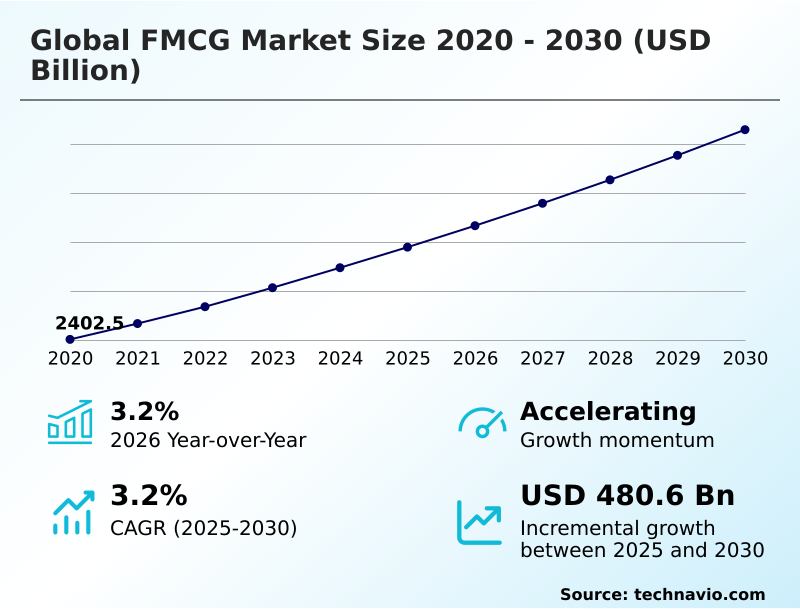
The fmcg market size is valued to increase by USD 480.6 billion, at a CAGR of 3.2% from 2025 to 2030. Accelerated digital transformation and AI integration will drive the fmcg market.

Major Market Trends & Insights

  • APAC dominated the market and accounted for a 42.6% growth during the forecast period.
  • By Type - Food and beverage segment was valued at USD 1414.7 billion in 2024
  • By Distribution Channel - Offline segment accounted for the largest market revenue share in 2024

Market Size & Forecast

  • Market Opportunities: USD 857.9 billion
  • Market Future Opportunities: USD 480.6 billion
  • CAGR from 2025 to 2030 : 3.2%

Market Summary

  • The FMCG market is navigating a landscape of profound change, shaped by evolving consumer purchasing behaviour and technological advancement. A core driver is the integration of predictive analytics and machine learning algorithms, which are revolutionizing demand forecasting and inventory management. This allows organizations to move from reactive to proactive models, optimizing supply chain logistics.
  • For instance, a company can now analyze real-time point of sale transactions and social media chatter through consumer sentiment analysis to dynamically adjust production, reducing waste by up to 15%. Concurrently, trends like the rise of quick commerce and the importance of digital shelf space are forcing a rethink of distribution.
  • Challenges persist, including raw material cost volatility and geopolitical tensions, which are met with strategies like nearshoring manufacturing and building resilient sourcing networks. This dynamic environment demands agility, with firms leveraging agentic commerce workflows and cloud data platforms to create hyper personalized consumer experiences and maintain a competitive edge.

What will be the Size of the FMCG Market during the forecast period?
Get Key Insights on Market Forecast (PDF) Request Free Sample

How is the FMCG Market Segmented?

The fmcg industry research report provides comprehensive data (region-wise segment analysis), with forecasts and estimates in "USD billion" for the period 2026-2030, as well as historical data from 2020-2024 for the following segments.

  • Type
    • Food and beverage
    • Personal and beauty care
    • Health and hygiene care
    • Home care
  • Distribution channel
    • Offline
    • Online
  • Product type
    • Premium
    • Mass market
    • Private label
  • Geography
    • APAC
      • China
      • India
      • Japan
    • North America
      • US
      • Canada
      • Mexico
    • Europe
      • Germany
      • UK
      • France
    • Middle East and Africa
      • Saudi Arabia
      • UAE
      • South Africa
    • South America
      • Brazil
      • Argentina
      • Colombia
    • Rest of World (ROW)

By Type Insights

The food and beverage segment is estimated to witness significant growth during the forecast period.

The food and beverage segment is undergoing a significant transformation, driven by evolving consumer dietary habits and a heightened focus on health and wellness.

Enterprises are moving beyond legacy products to embrace functional beverages, plant-based alternatives, and specialized nutritional formulations that address consumer demands for tangible benefits, including gut health categories.

This strategic pivot involves leveraging consumer sentiment analysis and generative design to accelerate innovation. Supply chain resilience is a key priority, with a focus on sustainable sourcing models to mitigate risk.

Many firms are implementing localized pricing strategies and optimizing portfolios, with some achieving a 15% improvement in forecast accuracy for new product launches through the use of predictive analytics and machine learning algorithms.
Request Free Sample

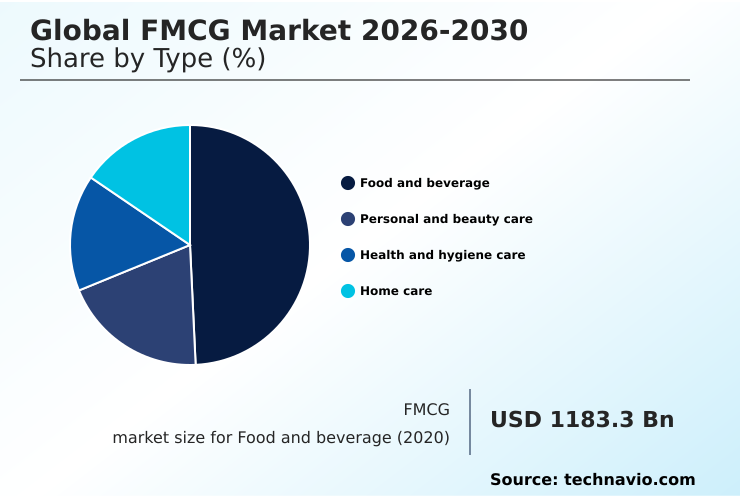
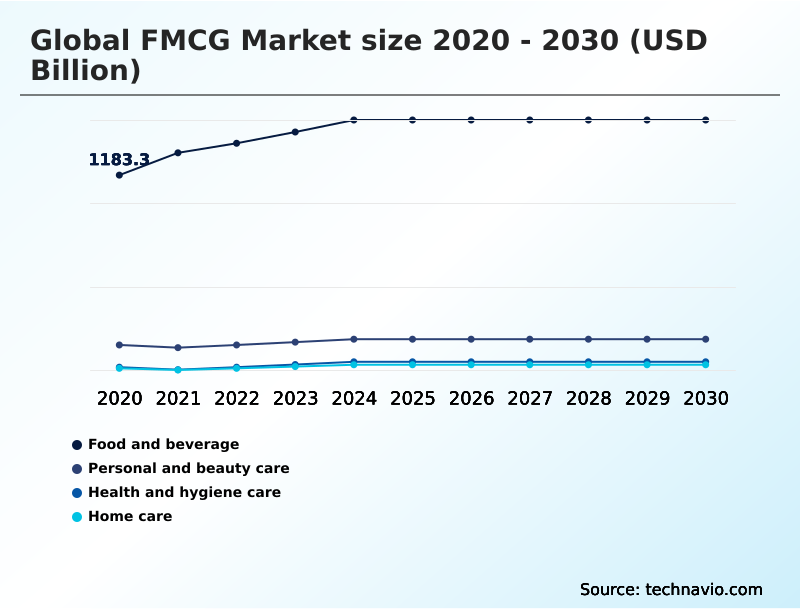
The Food and beverage segment was valued at USD 1414.7 billion in 2024 and showed a gradual increase during the forecast period.
Request Free Sample

Regional Analysis

APAC is estimated to contribute 42.6% to the growth of the global market during the forecast period.Technavio’s analysts have elaborately explained the regional trends and drivers that shape the market during the forecast period.
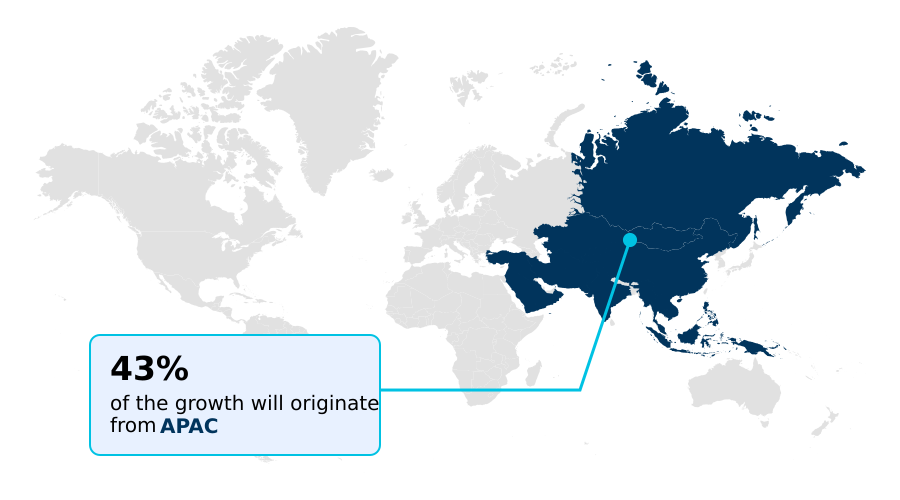
See How FMCG Market Demand is Rising in APAC Request Free Sample

The geographic landscape of the FMCG market is characterized by divergent regional growth trajectories, heavily influenced by local economic conditions and technological adoption rates.

In some developing markets, value growth has surged by over 13%, while more mature regions see modest gains. This disparity necessitates tailored approaches to market entry and expansion.

The proliferation of digital platforms is a unifying factor, with e-commerce now accounting for nearly 20% of total sales in certain advanced economies.

Success hinges on navigating regional complexities related to strategic corporate demergers, regenerative agriculture adoption, and adapting to unique consumer dietary habits. From active nutrition products in one region to the dominance of transactional platforms in another, localization is key.

Market Dynamics

Our researchers analyzed the data with 2025 as the base year, along with the key drivers, trends, and challenges. A holistic analysis of drivers will help companies refine their marketing strategies to gain a competitive advantage.

  • The Global FMCG Market 2026-2030 is at a critical juncture where the impact of AI on FMCG supply chains is becoming a primary determinant of competitive advantage. Firms are implementing FMCG market strategies for inflationary pressures by leveraging consumer sentiment for FMCG branding to justify pricing and maintain loyalty.
  • The role of quick commerce in FMCG growth cannot be overstated, fundamentally altering optimizing FMCG distribution channels and creating new challenges in FMCG e-commerce logistics. Sustainability is another core pillar, with sustainable packaging solutions in FMCG industry and regenerative agriculture for FMCG sourcing moving from niche concerns to mainstream strategic imperatives.
  • This reflects broader consumer trends in plant-based FMCG products and the overarching health and wellness impact on beverage market. Success requires deep digital transformation in FMCG retail, using data analytics for FMCG demand forecasting to mitigate the risks of managing raw material volatility in FMCG.
  • This data-driven approach is also crucial for AI-driven product innovation in FMCG and developing effective premiumization strategies in the personal care segment. Strategically, understanding the effects of demergers on FMCG portfolios and excelling at FMCG marketing on social commerce platforms are vital.
  • Effective cost optimization in FMCG manufacturing, which can improve margins by several percentage points more than traditional methods, is essential for combating supply chain disruptions in FMCG and ensuring FMCG brand loyalty in the digital age.
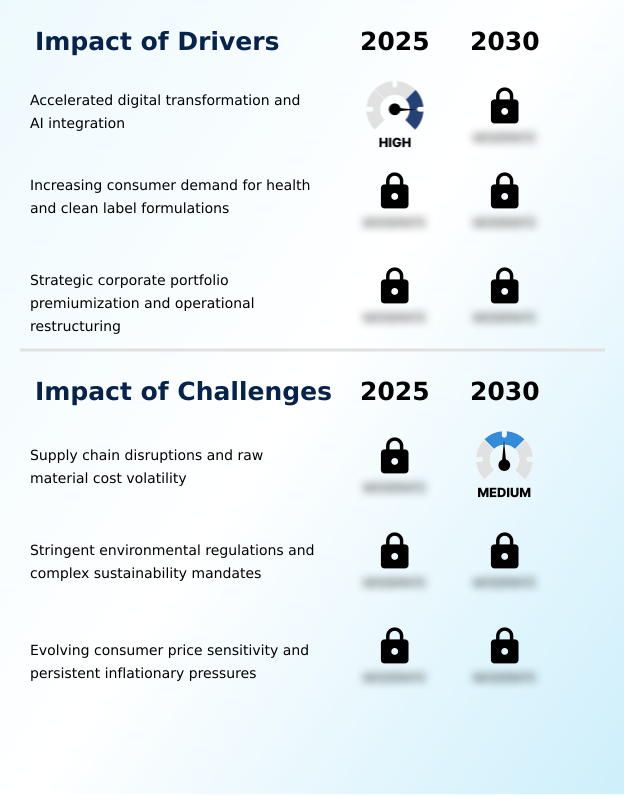
What are the key market drivers leading to the rise in the adoption of FMCG Industry?

  • Accelerated digital transformation, alongside the comprehensive integration of artificial intelligence, serves as a key driver for market expansion and operational efficiency.

  • Fundamental operational overhauls, driven by the integration of agentic commerce workflows and cloud data platforms, are a primary driver for market expansion.
  • The adoption of advanced cloud data platforms enables enterprises to process massive volumes of real-time data from point of sale transactions to social media trends.
  • This allows for the creation of hyper personalized consumer experiences, which has been shown to improve customer retention by up to 5%.
  • This technological pivot also facilitates corporate portfolio premiumization and core portfolio rationalization by providing clear data on product performance. Firms are also exploring nearshoring manufacturing and implementing resilient sourcing strategies to enhance agility and secure competitive advantages.

What are the market trends shaping the FMCG Industry?

  • The expansion of quick commerce, coupled with its deep integration into digital media networks, is emerging as a significant market trend. This development is fundamentally reshaping retail distribution hierarchies and traditional consumer purchasing behaviors.

  • The FMCG market is witnessing a profound structural shift driven by the exponential rise of quick commerce and deep integration with digital media networks. This has conditioned shoppers to expect unparalleled convenience, fundamentally altering consumer purchasing behaviour.
  • This hyper-convenient distribution model is also a massive catalyst for category premiumization, with a reported 25% higher average spend on impulse buys through these channels. The ability to intercept consumers at the intersection of discovery and transaction is critical, impacting digital marketing strategies and return on investment metrics.
  • To capitalize on this, organizations are investing in micro-fulfillment centers and demand forecasting technologies, reflecting a broader trend of operational restructuring across the industry.

What challenges does the FMCG Industry face during its growth?

  • Pervasive supply chain disruptions and the extreme volatility of raw material costs present a key challenge affecting the industry's growth and profitability.

  • The industry is grappling with unprecedented supply chain logistics challenges, including extreme raw material cost volatility and persistent logistical bottlenecks. Geopolitical tensions and climate-related disruptions have compromised the reliability of global supply chains for essential agricultural commodities and packaging materials. This has led to a surge in operational costs, with some companies seeing a 40% increase in transportation expenses alone.
  • These inflationary pressures are exacerbated by stringent environmental regulations and complex sustainability mandates. Consequently, balancing consumer price sensitivity with rising costs strains corporate financial resources, making efficient inventory management more critical than ever. The packaging sector remains particularly vulnerable to these disruptions.

Exclusive Technavio Analysis on Customer Landscape

The fmcg market forecasting report includes the adoption lifecycle of the market, covering from the innovator’s stage to the laggard’s stage. It focuses on adoption rates in different regions based on penetration. Furthermore, the fmcg market report also includes key purchase criteria and drivers of price sensitivity to help companies evaluate and develop their market growth analysis strategies.
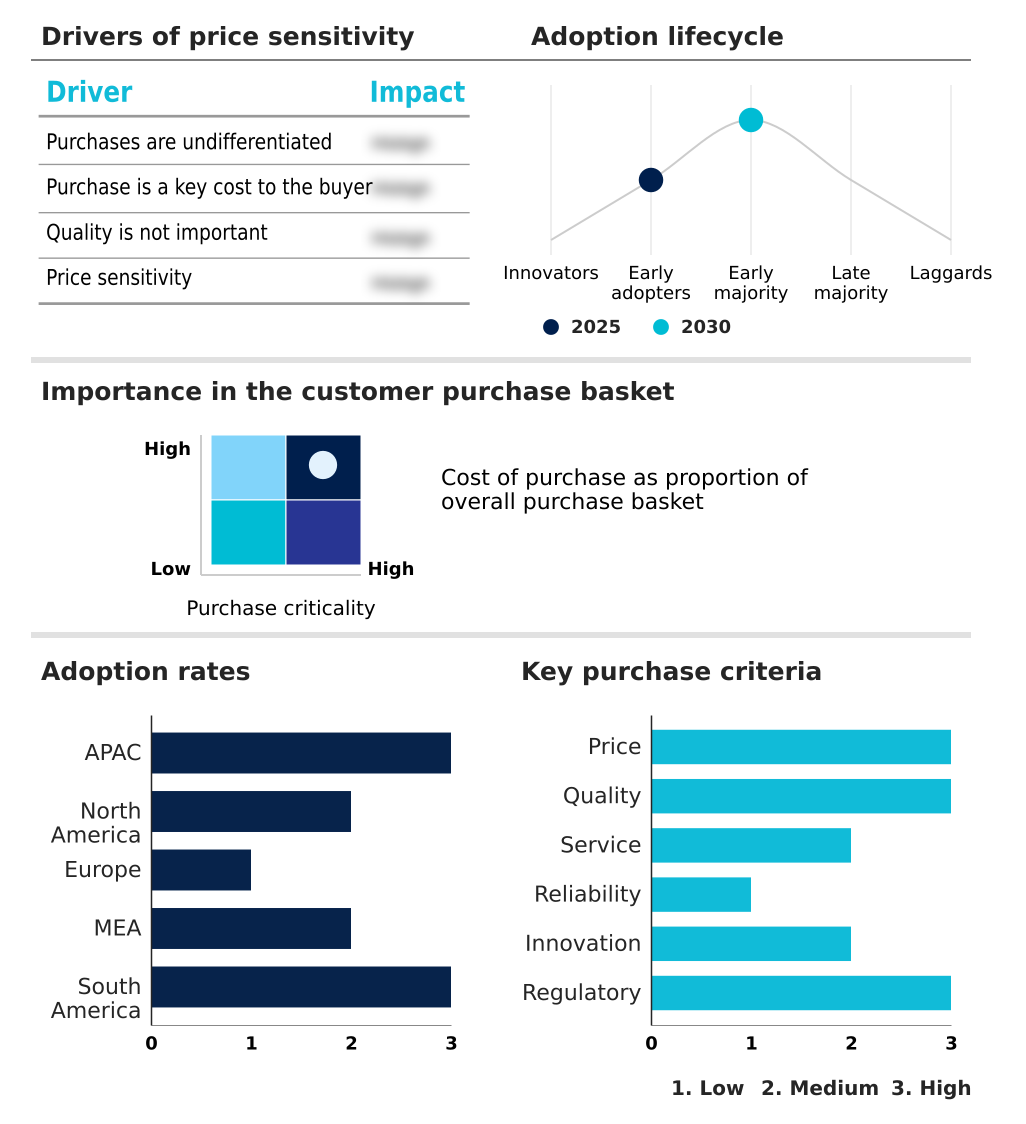
Customer Landscape of FMCG Industry

Competitive Landscape

Companies are implementing various strategies, such as strategic alliances, fmcg market forecast, partnerships, mergers and acquisitions, geographical expansion, and product/service launches, to enhance their presence in the industry.

Associated British Foods Plc - Offers a diversified portfolio of consumer staples, including grocery products, baking ingredients, breakfast cereals, edible oils, and sugar-based items for global households.

The industry research and growth report includes detailed analyses of the competitive landscape of the market and information about key companies, including:

  • Associated British Foods Plc
  • Beiersdorf AG
  • Colgate Palmolive Co.
  • Danone SA
  • Edgewell Personal Care Co.
  • General Mills Inc.
  • Haleon Plc
  • Henkel AG and Co. KGaA
  • Kao Corp.
  • Kimberly Clark Corp.
  • Lion Corp.
  • Mondelez International Inc.
  • Nestle SA
  • PepsiCo Inc.
  • Procter and Gamble Co.
  • Reckitt Benckiser Group Plc
  • Spectrum Brands Inc.
  • The Coca Cola Co.
  • The Kraft Heinz Co.
  • Unilever PLC

Qualitative and quantitative analysis of companies has been conducted to help clients understand the wider business environment as well as the strengths and weaknesses of key industry players. Data is qualitatively analyzed to categorize companies as pure play, category-focused, industry-focused, and diversified; it is quantitatively analyzed to categorize companies as dominant, leading, strong, tentative, and weak.

Recent Development and News in Fmcg market

  • In May 2025, PepsiCo announced the strategic acquisition of the probiotic soda enterprise Poppi, a move designed to expand its functional beverage portfolio and address consumer demand for gut health solutions.
  • In December 2025, Unilever completed the strategic demerger of its ice cream division, a move intended to allow the company to redirect resources and focus toward its high-growth premium beauty and wellness brands.
  • In February 2026, Unilever established a landmark five-year strategic partnership with Google Cloud to integrate advanced artificial intelligence, agentic commerce workflows, and cloud data platforms across its global brand portfolio.
  • In January 2026, Mars finalized the acquisition of Kellanova, a transaction that substantially expanded the combined organization's physical retail footprint and consolidated its shelf space dominance across major grocery networks.

Dive into Technavio’s robust research methodology, blending expert interviews, extensive data synthesis, and validated models for unparalleled FMCG Market insights. See full methodology.

Market Scope
Page number 299
Base year 2025
Historic period 2020-2024
Forecast period 2026-2030
Growth momentum & CAGR Accelerate at a CAGR of 3.2%
Market growth 2026-2030 USD 480.6 billion
Market structure Fragmented
YoY growth 2025-2026(%) 3.2%
Key countries China, India, Japan, Indonesia, Australia, South Korea, US, Canada, Mexico, Germany, UK, France, Italy, Spain, The Netherlands, Saudi Arabia, UAE, South Africa, Egypt, Turkey, Brazil, Argentina and Colombia
Competitive landscape Leading Companies, Market Positioning of Companies, Competitive Strategies, and Industry Risks

Request Free Sample

Research Analyst Overview

  • The FMCG market is undergoing a period of intense operational restructuring and core portfolio rationalization, driven by the need for greater agility. The integration of technologies like predictive analytics and machine learning algorithms is no longer optional, but essential for optimizing demand forecasting and managing point of sale transactions.
  • This technological pivot is evident in boardroom decisions, where investments in advanced cloud data platforms are being prioritized to build resilient sourcing capabilities; such initiatives have been shown to reduce supply chain disruptions by up to 20%.
  • The industry is leveraging generative design and consumer sentiment analysis to accelerate innovation, while agentic commerce workflows and cloud data platforms are enabling hyper personalized consumer experiences. Strategies such as corporate portfolio premiumization and localized pricing strategies are being adopted to navigate market complexities.
  • The rise of quick commerce is reshaping the concept of digital shelf space, and firms are adapting through strategic corporate demergers and establishing sustainable sourcing models to meet both consumer and regulatory demands in a landscape defined by shifting consumer purchasing behaviour and the push toward nearshoring manufacturing.

What are the Key Data Covered in this FMCG Market Research and Growth Report?

  • What is the expected growth of the FMCG Market between 2026 and 2030?

    • USD 480.6 billion, at a CAGR of 3.2%

  • What segmentation does the market report cover?

    • The report is segmented by Type (Food and beverage, Personal and beauty care, Health and hygiene care, and Home care), Distribution Channel (Offline, and Online), Product Type (Premium, Mass market, and Private label) and Geography (APAC, North America, Europe, Middle East and Africa, South America)

  • Which regions are analyzed in the report?

    • APAC, North America, Europe, Middle East and Africa and South America

  • What are the key growth drivers and market challenges?

    • Accelerated digital transformation and AI integration, Supply chain disruptions and raw material cost volatility

  • Who are the major players in the FMCG Market?

    • Associated British Foods Plc, Beiersdorf AG, Colgate Palmolive Co., Danone SA, Edgewell Personal Care Co., General Mills Inc., Haleon Plc, Henkel AG and Co. KGaA, Kao Corp., Kimberly Clark Corp., Lion Corp., Mondelez International Inc., Nestle SA, PepsiCo Inc., Procter and Gamble Co., Reckitt Benckiser Group Plc, Spectrum Brands Inc., The Coca Cola Co., The Kraft Heinz Co. and Unilever PLC

Market Research Insights

  • Market dynamics are increasingly influenced by a complex interplay of economic pressures and shifting consumer values. Intense inflationary pressures are heightening consumer price sensitivity, forcing brands to refine their value propositions. This has led to a reported 20% increase in the market share of private-label goods in some categories.
  • Simultaneously, a growing focus on health and wellness is steering consumer dietary habits towards functional beverages and plant-based alternatives. This shift is compelling companies to innovate in nutritional formulations and explore high-growth gut health categories.
  • Navigating these dynamics requires a delicate balance of cost control and investment in innovation, with successful firms demonstrating an average of 10% higher return on investment metrics on their new product development initiatives.

We can help! Our analysts can customize this fmcg market research report to meet your requirements.

Get in touch

1. Executive Summary

1.1 Market overview

Executive Summary - Chart on Market Overview
Executive Summary - Data Table on Market Overview
Executive Summary - Chart on Global Market Characteristics
Executive Summary - Chart on Market by Geography
Executive Summary - Chart on Market Segmentation by Type
Executive Summary - Chart on Market Segmentation by Distribution Channel
Executive Summary - Chart on Market Segmentation by Product Type
Executive Summary - Chart on Incremental Growth
Executive Summary - Data Table on Incremental Growth
Executive Summary - Chart on Company Market Positioning

2. Technavio Analysis

2.1 Analysis of price sensitivity, lifecycle, customer purchase basket, adoption rates, and purchase criteria

2.2 Criticality of inputs and Factors of differentiation

Chart on Overview on criticality of inputs and factors of differentiation

2.3 Factors of disruption

Chart on Overview on factors of disruption

2.4 Impact of drivers and challenges

Chart on Impact of drivers and challenges in 2025 and 2030

3. Market Landscape

3.1 Market ecosystem

Chart on Parent Market
Data Table on - Parent Market

3.2 Market characteristics

Chart on Market characteristics analysis

3.3 Value chain analysis

Chart on Value chain analysis

4. Market Sizing

4.1 Market definition

Data Table on Offerings of companies included in the market definition

4.2 Market segment analysis

Market segments

4.3 Market size 2025

4.4 Market outlook: Forecast for 2025-2030

Chart on Global - Market size and forecast 2025-2030 ($ billion)
Data Table on Global - Market size and forecast 2025-2030 ($ billion)
Chart on Global Market: Year-over-year growth 2025-2030 (%)
Data Table on Global Market: Year-over-year growth 2025-2030 (%)

5. Historic Market Size

5.1 Global FMCG Market 2020 - 2024

Historic Market Size - Data Table on Global FMCG Market 2020 - 2024 ($ billion)

5.2 Type segment analysis 2020 - 2024

Historic Market Size - Type Segment 2020 - 2024 ($ billion)

5.3 Distribution Channel segment analysis 2020 - 2024

Historic Market Size - Distribution Channel Segment 2020 - 2024 ($ billion)

5.4 Product Type segment analysis 2020 - 2024

Historic Market Size - Product Type Segment 2020 - 2024 ($ billion)

5.5 Geography segment analysis 2020 - 2024

Historic Market Size - Geography Segment 2020 - 2024 ($ billion)

5.6 Country segment analysis 2020 - 2024

Historic Market Size - Country Segment 2020 - 2024 ($ billion)

6. Qualitative Analysis

6.1 Impact of AI on the Global FMCG market

6.2 Impact of geopolitical conflict on Global FMCG Market

7. Five Forces Analysis

7.1 Five forces summary

Five forces analysis - Comparison between 2025 and 2030

7.2 Bargaining power of buyers

Bargaining power of buyers - Impact of key factors 2025 and 2030

7.3 Bargaining power of suppliers

Bargaining power of suppliers - Impact of key factors in 2025 and 2030

7.4 Threat of new entrants

Threat of new entrants - Impact of key factors in 2025 and 2030

7.5 Threat of substitutes

Threat of substitutes - Impact of key factors in 2025 and 2030

7.6 Threat of rivalry

Threat of rivalry - Impact of key factors in 2025 and 2030

7.7 Market condition

Chart on Market condition - Five forces 2025 and 2030

8. Market Segmentation by Type

8.1 Market segments

Chart on Type - Market share 2025-2030 (%)
Data Table on Type - Market share 2025-2030 (%)

8.2 Comparison by Type

Chart on Comparison by Type
Data Table on Comparison by Type

8.3 Food and beverage - Market size and forecast 2025-2030

Chart on Food and beverage - Market size and forecast 2025-2030 ($ billion)
Data Table on Food and beverage - Market size and forecast 2025-2030 ($ billion)
Chart on Food and beverage - Year-over-year growth 2025-2030 (%)
Data Table on Food and beverage - Year-over-year growth 2025-2030 (%)

8.4 Personal and beauty care - Market size and forecast 2025-2030

Chart on Personal and beauty care - Market size and forecast 2025-2030 ($ billion)
Data Table on Personal and beauty care - Market size and forecast 2025-2030 ($ billion)
Chart on Personal and beauty care - Year-over-year growth 2025-2030 (%)
Data Table on Personal and beauty care - Year-over-year growth 2025-2030 (%)

8.5 Health and hygiene care - Market size and forecast 2025-2030

Chart on Health and hygiene care - Market size and forecast 2025-2030 ($ billion)
Data Table on Health and hygiene care - Market size and forecast 2025-2030 ($ billion)
Chart on Health and hygiene care - Year-over-year growth 2025-2030 (%)
Data Table on Health and hygiene care - Year-over-year growth 2025-2030 (%)

8.6 Home care - Market size and forecast 2025-2030

Chart on Home care - Market size and forecast 2025-2030 ($ billion)
Data Table on Home care - Market size and forecast 2025-2030 ($ billion)
Chart on Home care - Year-over-year growth 2025-2030 (%)
Data Table on Home care - Year-over-year growth 2025-2030 (%)

8.7 Market opportunity by Type

Market opportunity by Type ($ billion)
Data Table on Market opportunity by Type ($ billion)

9. Market Segmentation by Distribution Channel

9.1 Market segments

Chart on Distribution Channel - Market share 2025-2030 (%)
Data Table on Distribution Channel - Market share 2025-2030 (%)

9.2 Comparison by Distribution Channel

Chart on Comparison by Distribution Channel
Data Table on Comparison by Distribution Channel

9.3 Offline - Market size and forecast 2025-2030

Chart on Offline - Market size and forecast 2025-2030 ($ billion)
Data Table on Offline - Market size and forecast 2025-2030 ($ billion)
Chart on Offline - Year-over-year growth 2025-2030 (%)
Data Table on Offline - Year-over-year growth 2025-2030 (%)

9.4 Online - Market size and forecast 2025-2030

Chart on Online - Market size and forecast 2025-2030 ($ billion)
Data Table on Online - Market size and forecast 2025-2030 ($ billion)
Chart on Online - Year-over-year growth 2025-2030 (%)
Data Table on Online - Year-over-year growth 2025-2030 (%)

9.5 Market opportunity by Distribution Channel

Market opportunity by Distribution Channel ($ billion)
Data Table on Market opportunity by Distribution Channel ($ billion)

10. Market Segmentation by Product Type

10.1 Market segments

Chart on Product Type - Market share 2025-2030 (%)
Data Table on Product Type - Market share 2025-2030 (%)

10.2 Comparison by Product Type

Chart on Comparison by Product Type
Data Table on Comparison by Product Type

10.3 Premium - Market size and forecast 2025-2030

Chart on Premium - Market size and forecast 2025-2030 ($ billion)
Data Table on Premium - Market size and forecast 2025-2030 ($ billion)
Chart on Premium - Year-over-year growth 2025-2030 (%)
Data Table on Premium - Year-over-year growth 2025-2030 (%)

10.4 Mass market - Market size and forecast 2025-2030

Chart on Mass market - Market size and forecast 2025-2030 ($ billion)
Data Table on Mass market - Market size and forecast 2025-2030 ($ billion)
Chart on Mass market - Year-over-year growth 2025-2030 (%)
Data Table on Mass market - Year-over-year growth 2025-2030 (%)

10.5 Private label - Market size and forecast 2025-2030

Chart on Private label - Market size and forecast 2025-2030 ($ billion)
Data Table on Private label - Market size and forecast 2025-2030 ($ billion)
Chart on Private label - Year-over-year growth 2025-2030 (%)
Data Table on Private label - Year-over-year growth 2025-2030 (%)

10.6 Market opportunity by Product Type

Market opportunity by Product Type ($ billion)
Data Table on Market opportunity by Product Type ($ billion)

11. Customer Landscape

11.1 Customer landscape overview

Analysis of price sensitivity, lifecycle, customer purchase basket, adoption rates, and purchase criteria

12. Geographic Landscape

12.1 Geographic segmentation

Chart on Market share by geography 2025-2030 (%)
Data Table on Market share by geography 2025-2030 (%)

12.2 Geographic comparison

Chart on Geographic comparison
Data Table on Geographic comparison

12.3 APAC - Market size and forecast 2025-2030

Chart on APAC - Market size and forecast 2025-2030 ($ billion)
Data Table on APAC - Market size and forecast 2025-2030 ($ billion)
Chart on APAC - Year-over-year growth 2025-2030 (%)
Data Table on APAC - Year-over-year growth 2025-2030 (%)
Chart on Regional Comparison - APAC
Data Table on Regional Comparison - APAC

12.3.1 China - Market size and forecast 2025-2030

Chart on China - Market size and forecast 2025-2030 ($ billion)
Data Table on China - Market size and forecast 2025-2030 ($ billion)
Chart on China - Year-over-year growth 2025-2030 (%)
Data Table on China - Year-over-year growth 2025-2030 (%)

12.3.2 India - Market size and forecast 2025-2030

Chart on India - Market size and forecast 2025-2030 ($ billion)
Data Table on India - Market size and forecast 2025-2030 ($ billion)
Chart on India - Year-over-year growth 2025-2030 (%)
Data Table on India - Year-over-year growth 2025-2030 (%)

12.3.3 Japan - Market size and forecast 2025-2030

Chart on Japan - Market size and forecast 2025-2030 ($ billion)
Data Table on Japan - Market size and forecast 2025-2030 ($ billion)
Chart on Japan - Year-over-year growth 2025-2030 (%)
Data Table on Japan - Year-over-year growth 2025-2030 (%)

12.3.4 Indonesia - Market size and forecast 2025-2030

Chart on Indonesia - Market size and forecast 2025-2030 ($ billion)
Data Table on Indonesia - Market size and forecast 2025-2030 ($ billion)
Chart on Indonesia - Year-over-year growth 2025-2030 (%)
Data Table on Indonesia - Year-over-year growth 2025-2030 (%)

12.3.5 Australia - Market size and forecast 2025-2030

Chart on Australia - Market size and forecast 2025-2030 ($ billion)
Data Table on Australia - Market size and forecast 2025-2030 ($ billion)
Chart on Australia - Year-over-year growth 2025-2030 (%)
Data Table on Australia - Year-over-year growth 2025-2030 (%)

12.3.6 South Korea - Market size and forecast 2025-2030

Chart on South Korea - Market size and forecast 2025-2030 ($ billion)
Data Table on South Korea - Market size and forecast 2025-2030 ($ billion)
Chart on South Korea - Year-over-year growth 2025-2030 (%)
Data Table on South Korea - Year-over-year growth 2025-2030 (%)

12.4 North America - Market size and forecast 2025-2030

Chart on North America - Market size and forecast 2025-2030 ($ billion)
Data Table on North America - Market size and forecast 2025-2030 ($ billion)
Chart on North America - Year-over-year growth 2025-2030 (%)
Data Table on North America - Year-over-year growth 2025-2030 (%)
Chart on Regional Comparison - North America
Data Table on Regional Comparison - North America

12.4.1 US - Market size and forecast 2025-2030

Chart on US - Market size and forecast 2025-2030 ($ billion)
Data Table on US - Market size and forecast 2025-2030 ($ billion)
Chart on US - Year-over-year growth 2025-2030 (%)
Data Table on US - Year-over-year growth 2025-2030 (%)

12.4.2 Canada - Market size and forecast 2025-2030

Chart on Canada - Market size and forecast 2025-2030 ($ billion)
Data Table on Canada - Market size and forecast 2025-2030 ($ billion)
Chart on Canada - Year-over-year growth 2025-2030 (%)
Data Table on Canada - Year-over-year growth 2025-2030 (%)

12.4.3 Mexico - Market size and forecast 2025-2030

Chart on Mexico - Market size and forecast 2025-2030 ($ billion)
Data Table on Mexico - Market size and forecast 2025-2030 ($ billion)
Chart on Mexico - Year-over-year growth 2025-2030 (%)
Data Table on Mexico - Year-over-year growth 2025-2030 (%)

12.5 Europe - Market size and forecast 2025-2030

Chart on Europe - Market size and forecast 2025-2030 ($ billion)
Data Table on Europe - Market size and forecast 2025-2030 ($ billion)
Chart on Europe - Year-over-year growth 2025-2030 (%)
Data Table on Europe - Year-over-year growth 2025-2030 (%)
Chart on Regional Comparison - Europe
Data Table on Regional Comparison - Europe

12.5.1 Germany - Market size and forecast 2025-2030

Chart on Germany - Market size and forecast 2025-2030 ($ billion)
Data Table on Germany - Market size and forecast 2025-2030 ($ billion)
Chart on Germany - Year-over-year growth 2025-2030 (%)
Data Table on Germany - Year-over-year growth 2025-2030 (%)

12.5.2 UK - Market size and forecast 2025-2030

Chart on UK - Market size and forecast 2025-2030 ($ billion)
Data Table on UK - Market size and forecast 2025-2030 ($ billion)
Chart on UK - Year-over-year growth 2025-2030 (%)
Data Table on UK - Year-over-year growth 2025-2030 (%)

12.5.3 France - Market size and forecast 2025-2030

Chart on France - Market size and forecast 2025-2030 ($ billion)
Data Table on France - Market size and forecast 2025-2030 ($ billion)
Chart on France - Year-over-year growth 2025-2030 (%)
Data Table on France - Year-over-year growth 2025-2030 (%)

12.5.4 Italy - Market size and forecast 2025-2030

Chart on Italy - Market size and forecast 2025-2030 ($ billion)
Data Table on Italy - Market size and forecast 2025-2030 ($ billion)
Chart on Italy - Year-over-year growth 2025-2030 (%)
Data Table on Italy - Year-over-year growth 2025-2030 (%)

12.5.5 Spain - Market size and forecast 2025-2030

Chart on Spain - Market size and forecast 2025-2030 ($ billion)
Data Table on Spain - Market size and forecast 2025-2030 ($ billion)
Chart on Spain - Year-over-year growth 2025-2030 (%)
Data Table on Spain - Year-over-year growth 2025-2030 (%)

12.5.6 The Netherlands - Market size and forecast 2025-2030

Chart on The Netherlands - Market size and forecast 2025-2030 ($ billion)
Data Table on The Netherlands - Market size and forecast 2025-2030 ($ billion)
Chart on The Netherlands - Year-over-year growth 2025-2030 (%)
Data Table on The Netherlands - Year-over-year growth 2025-2030 (%)

12.6 Middle East and Africa - Market size and forecast 2025-2030

Chart on Middle East and Africa - Market size and forecast 2025-2030 ($ billion)
Data Table on Middle East and Africa - Market size and forecast 2025-2030 ($ billion)
Chart on Middle East and Africa - Year-over-year growth 2025-2030 (%)
Data Table on Middle East and Africa - Year-over-year growth 2025-2030 (%)
Chart on Regional Comparison - Middle East and Africa
Data Table on Regional Comparison - Middle East and Africa

12.6.1 Saudi Arabia - Market size and forecast 2025-2030

Chart on Saudi Arabia - Market size and forecast 2025-2030 ($ billion)
Data Table on Saudi Arabia - Market size and forecast 2025-2030 ($ billion)
Chart on Saudi Arabia - Year-over-year growth 2025-2030 (%)
Data Table on Saudi Arabia - Year-over-year growth 2025-2030 (%)

12.6.2 UAE - Market size and forecast 2025-2030

Chart on UAE - Market size and forecast 2025-2030 ($ billion)
Data Table on UAE - Market size and forecast 2025-2030 ($ billion)
Chart on UAE - Year-over-year growth 2025-2030 (%)
Data Table on UAE - Year-over-year growth 2025-2030 (%)

12.6.3 South Africa - Market size and forecast 2025-2030

Chart on South Africa - Market size and forecast 2025-2030 ($ billion)
Data Table on South Africa - Market size and forecast 2025-2030 ($ billion)
Chart on South Africa - Year-over-year growth 2025-2030 (%)
Data Table on South Africa - Year-over-year growth 2025-2030 (%)

12.6.4 Egypt - Market size and forecast 2025-2030

Chart on Egypt - Market size and forecast 2025-2030 ($ billion)
Data Table on Egypt - Market size and forecast 2025-2030 ($ billion)
Chart on Egypt - Year-over-year growth 2025-2030 (%)
Data Table on Egypt - Year-over-year growth 2025-2030 (%)

12.6.5 Turkey - Market size and forecast 2025-2030

Chart on Turkey - Market size and forecast 2025-2030 ($ billion)
Data Table on Turkey - Market size and forecast 2025-2030 ($ billion)
Chart on Turkey - Year-over-year growth 2025-2030 (%)
Data Table on Turkey - Year-over-year growth 2025-2030 (%)

12.7 South America - Market size and forecast 2025-2030

Chart on South America - Market size and forecast 2025-2030 ($ billion)
Data Table on South America - Market size and forecast 2025-2030 ($ billion)
Chart on South America - Year-over-year growth 2025-2030 (%)
Data Table on South America - Year-over-year growth 2025-2030 (%)
Chart on Regional Comparison - South America
Data Table on Regional Comparison - South America

12.7.1 Brazil - Market size and forecast 2025-2030

Chart on Brazil - Market size and forecast 2025-2030 ($ billion)
Data Table on Brazil - Market size and forecast 2025-2030 ($ billion)
Chart on Brazil - Year-over-year growth 2025-2030 (%)
Data Table on Brazil - Year-over-year growth 2025-2030 (%)

12.7.2 Argentina - Market size and forecast 2025-2030

Chart on Argentina - Market size and forecast 2025-2030 ($ billion)
Data Table on Argentina - Market size and forecast 2025-2030 ($ billion)
Chart on Argentina - Year-over-year growth 2025-2030 (%)
Data Table on Argentina - Year-over-year growth 2025-2030 (%)

12.7.3 Colombia - Market size and forecast 2025-2030

Chart on Colombia - Market size and forecast 2025-2030 ($ billion)
Data Table on Colombia - Market size and forecast 2025-2030 ($ billion)
Chart on Colombia - Year-over-year growth 2025-2030 (%)
Data Table on Colombia - Year-over-year growth 2025-2030 (%)

12.8 Market opportunity by geography

Market opportunity by geography ($ billion)
Data Tables on Market opportunity by geography ($ billion)

13. Drivers, Challenges, and Opportunity

13.1 Market drivers

Accelerated digital transformation and AI integration
Increasing consumer demand for health and clean label formulations
Strategic corporate portfolio premiumization and operational restructuring

13.2 Market challenges

Supply chain disruptions and raw material cost volatility
Stringent environmental regulations and complex sustainability mandates
Evolving consumer price sensitivity and persistent inflationary pressures

13.3 Impact of drivers and challenges

Impact of drivers and challenges in 2025 and 2030

13.4 Market opportunities

Expansion of quick commerce and digital media integration
Strategic corporate demergers and core portfolio rationalization
Industry-wide adoption of regenerative agriculture and resilient sourcing

14. Competitive Landscape

14.1 Overview

14.2

Overview on criticality of inputs and factors of differentiation

14.3 Landscape disruption

Overview on factors of disruption

14.4 Industry risks

Impact of key risks on business

15. Competitive Analysis

15.1 Companies profiled

Companies covered

15.2 Company ranking index

15.3 Market positioning of companies

Matrix on companies position and classification

15.4 Associated British Foods Plc

Associated British Foods Plc - Overview
Associated British Foods Plc - Business segments
Associated British Foods Plc - Key offerings
Associated British Foods Plc - Segment focus
SWOT

15.5 Colgate Palmolive Co.

Colgate Palmolive Co. - Overview
Colgate Palmolive Co. - Business segments
Colgate Palmolive Co. - Key offerings
Colgate Palmolive Co. - Segment focus
SWOT

15.6 Danone SA

Danone SA - Overview
Danone SA - Business segments
Danone SA - Key offerings
Danone SA - Segment focus
SWOT

15.7 General Mills Inc.

General Mills Inc. - Overview
General Mills Inc. - Business segments
General Mills Inc. - Key offerings
General Mills Inc. - Segment focus
SWOT

15.8 Henkel AG and Co. KGaA

Henkel AG and Co. KGaA - Overview
Henkel AG and Co. KGaA - Business segments
Henkel AG and Co. KGaA - Key offerings
Henkel AG and Co. KGaA - Segment focus
SWOT

15.9 Kimberly Clark Corp.

Kimberly Clark Corp. - Overview
Kimberly Clark Corp. - Business segments
Kimberly Clark Corp. - Key offerings
Kimberly Clark Corp. - Segment focus
SWOT

15.10 Mondelez International Inc.

Mondelez International Inc. - Overview
Mondelez International Inc. - Business segments
Mondelez International Inc. - Key offerings
Mondelez International Inc. - Segment focus
SWOT

15.11 Nestle SA

Nestle SA - Overview
Nestle SA - Business segments
Nestle SA - Key news
Nestle SA - Key offerings
Nestle SA - Segment focus
SWOT

15.12 PepsiCo Inc.

PepsiCo Inc. - Overview
PepsiCo Inc. - Business segments
PepsiCo Inc. - Key news
PepsiCo Inc. - Key offerings
PepsiCo Inc. - Segment focus
SWOT

15.13 Procter and Gamble Co.

Procter and Gamble Co. - Overview
Procter and Gamble Co. - Business segments
Procter and Gamble Co. - Key offerings
Procter and Gamble Co. - Segment focus
SWOT

15.14 Reckitt Benckiser Group Plc

Reckitt Benckiser Group Plc - Overview
Reckitt Benckiser Group Plc - Business segments
Reckitt Benckiser Group Plc - Key offerings
Reckitt Benckiser Group Plc - Segment focus
SWOT

15.15 Spectrum Brands Inc.

Spectrum Brands Inc. - Overview
Spectrum Brands Inc. - Product / Service
Spectrum Brands Inc. - Key offerings
SWOT

15.16 The Coca Cola Co.

The Coca Cola Co. - Overview
The Coca Cola Co. - Business segments
The Coca Cola Co. - Key news
The Coca Cola Co. - Key offerings
The Coca Cola Co. - Segment focus
SWOT

15.17 The Kraft Heinz Co.

The Kraft Heinz Co. - Overview
The Kraft Heinz Co. - Business segments
The Kraft Heinz Co. - Key news
The Kraft Heinz Co. - Key offerings
The Kraft Heinz Co. - Segment focus
SWOT

15.18 Unilever PLC

Unilever PLC - Overview
Unilever PLC - Business segments
Unilever PLC - Key offerings
Unilever PLC - Segment focus
SWOT

16. Appendix

16.1 Scope of the report

Market definition
Objectives
Notes and caveats

16.2 Inclusions and exclusions checklist

Inclusions checklist
Exclusions checklist

16.3 Currency conversion rates for US$

16.4 Research methodology

16.5 Data procurement

Information sources

16.6 Data validation

16.7 Validation techniques employed for market sizing

16.8 Data synthesis

16.9 360 degree market analysis

16.10 List of abbreviations

Research Methodology

Technavio presents a detailed picture of the market by way of study, synthesis, and summation of data from multiple sources. The analysts have presented the various facets of the market with a particular focus on identifying the key industry influencers. The data thus presented is comprehensive, reliable, and the result of extensive research, both primary and secondary.

INFORMATION SOURCES

Primary sources

  • Manufacturers and suppliers
  • Channel partners
  • Industry experts
  • Strategic decision makers

Secondary sources

  • Industry journals and periodicals
  • Government data
  • Financial reports of key industry players
  • Historical data
  • Press releases

DATA ANALYSIS

Data Synthesis

  • Collation of data
  • Estimation of key figures
  • Analysis of derived insights

Data Validation

  • Triangulation with data models
  • Reference against proprietary databases
  • Corroboration with industry experts

REPORT WRITING

Qualitative

  • Market drivers
  • Market challenges
  • Market trends
  • Five forces analysis

Quantitative

  • Market size and forecast
  • Market segmentation
  • Geographical insights
  • Competitive landscape

Interested in this report?

Get your sample now to see our research methodology and insights!

Download Now

Frequently Asked Questions

FMCG market growth will increase by USD 480.6 billion during 2026-2030.

The FMCG market is expected to grow at a CAGR of 3.2% during 2026-2030.

FMCG market is segmented by Type (Food and beverage, Personal and beauty care, Health and hygiene care, Home care) Distribution channel (Offline, Online) Product type (Premium, Mass market, Private label)

Associated British Foods Plc, Beiersdorf AG, Colgate Palmolive Co., Danone SA, Edgewell Personal Care Co., General Mills Inc., Haleon Plc, Henkel AG and Co. KGaA, Kao Corp., Kimberly Clark Corp., Lion Corp., Mondelez International Inc., Nestle SA, PepsiCo Inc., Procter and Gamble Co., Reckitt Benckiser Group Plc, Spectrum Brands Inc., The Coca Cola Co., The Kraft Heinz Co., Unilever PLC are a few of the key vendors in the FMCG market.

APAC will register the highest growth rate of 42.6% among the other regions. Therefore, the FMCG market in APAC is expected to garner significant business opportunities for the vendors during the forecast period.

China, India, Japan, Indonesia, Australia, South Korea, US, Canada, Mexico, Germany, UK, France, Italy, Spain, The Netherlands, Saudi Arabia, UAE, South Africa, Egypt, Turkey, Brazil, Argentina, Colombia

  • Accelerated digital transformation and AI integration is the driving factor this market.

The FMCG market vendors should focus on grabbing business opportunities from the Type segment as it accounted for the largest market share in the base year.
RIA - Research AI Assistant
Ask RIA
