



Golf Balls Market Size 2026-2030
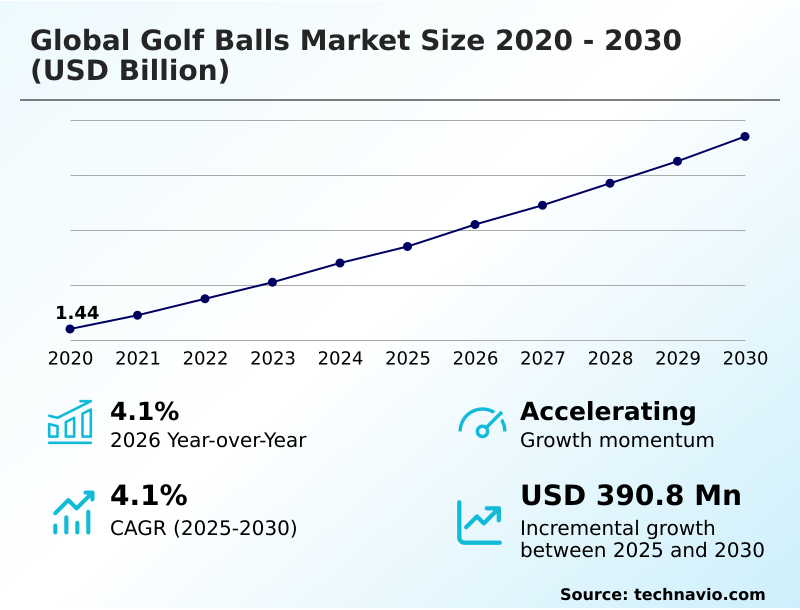
The golf balls market size is valued to increase by USD 390.8 million, at a CAGR of 4.1% from 2025 to 2030. Increasing global participation and expansion of off-course golfing venues will drive the golf balls market.
Major Market Trends & Insights
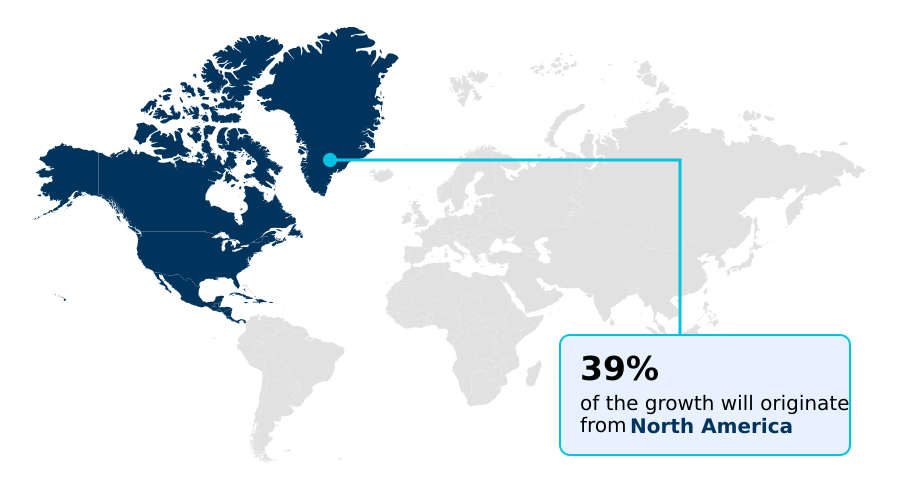
- North America dominated the market and accounted for a 38.9% growth during the forecast period.
- By Type - Two piece balls segment was valued at USD 739.6 million in 2024
- By Price Range - Mid-range balls segment accounted for the largest market revenue share in 2024
Market Size & Forecast
- Market Opportunities: USD 698.3 million
- Market Future Opportunities: USD 390.8 million
- CAGR from 2025 to 2030 : 4.1%
Market Summary
- The golf balls market is undergoing a significant transformation, driven by technological advancements and shifting consumer preferences. Core innovation is centered on multi-layered constructions and advanced material science, utilizing high-energy polybutadiene core designs and responsive urethane covers to optimize performance.
- Manufacturers leverage computational fluid dynamics for creating intricate aerodynamic dimple patterns that ensure a stable flight path and superior greenside spin control. A key driver is the rising popularity of off-course entertainment venues, which introduces the sport to a broader demographic and fuels demand for durable practice balls.
- Concurrently, the industry faces the challenge of adhering to the new distance rollback mandate from governing bodies, requiring substantial R&D investment to re-engineer products. A business scenario involves a mid-sized manufacturer reallocating its budget from marketing to material science to develop a compliant, high-performance ball using bio-based resins.
- This pivot aims to meet both regulatory requirements and the growing consumer demand for products aligned with circular economy principles.
What will be the Size of the Golf Balls Market during the forecast period?
Get Key Insights on Market Forecast (PDF) Get Free Sample
How is the Golf Balls Market Segmented?
The golf balls industry research report provides comprehensive data (region-wise segment analysis), with forecasts and estimates in "USD million" for the period 2026-2030, as well as historical data from 2020-2024 for the following segments.
- Type
- Two piece balls
- Three piece balls
- Four piece balls
- Others
- Price range
- Mid-range balls
- Premium balls
- Low-cost balls
- Distribution channel
- Offline
- Online
- Geography
- North America
- US
- Canada
- Mexico
- Europe
- Germany
- UK
- France
- APAC
- China
- Japan
- India
- Middle East and Africa
- Saudi Arabia
- UAE
- South Africa
- South America
- Brazil
- Argentina
- Colombia
- Rest of World (ROW)
- North America
By Type Insights
The two piece balls segment is estimated to witness significant growth during the forecast period.
The global golf balls market is segmented by construction, reflecting diverse player needs. The two-piece segment, with its robust polybutadiene core and durable ionomer resins, maximizes the coefficient of restitution for recreational leisure activities.
In contrast, three-piece architecture and four-piece design models use specialized mantle layer technology for nuanced greenside spin control and all-weather durability. Innovations like the high-velocity gradient core seek to improve feel without altering the core compression ratio.
This tiered approach allows manufacturers to build brand prestige, secure tour validation for premium lines, and offer bulk purchasing options for practice facilities, addressing the full spectrum of market demand.
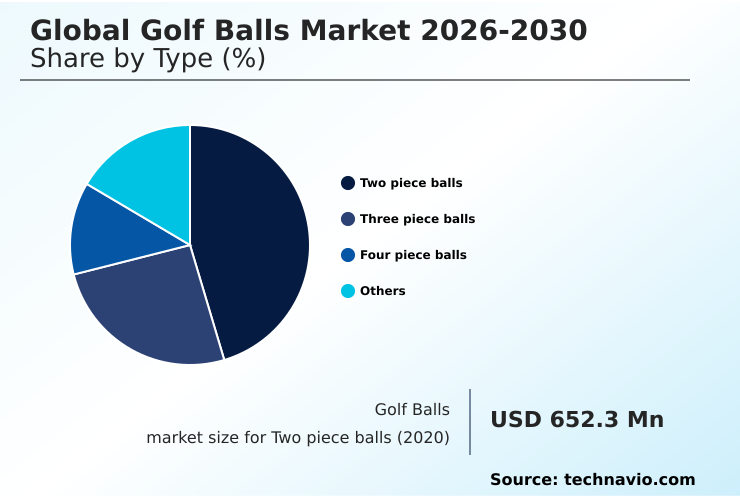
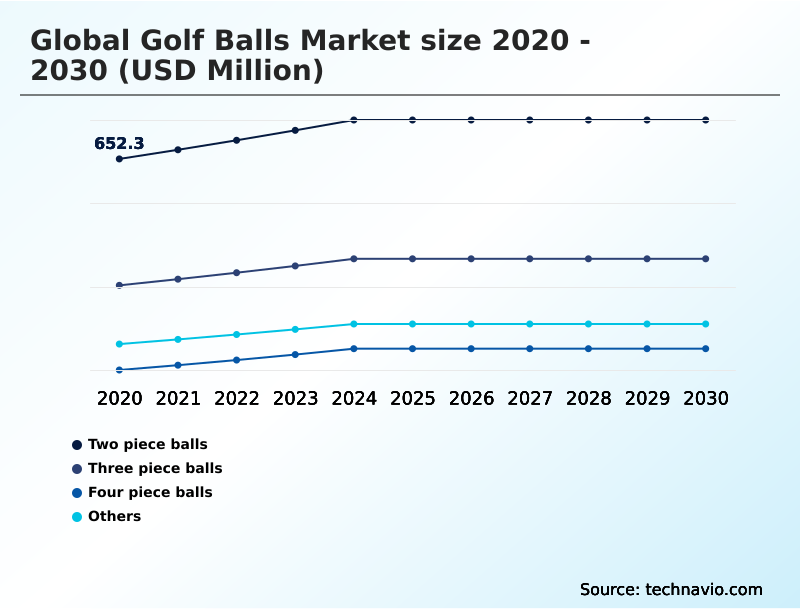
The Two piece balls segment was valued at USD 739.6 million in 2024 and showed a gradual increase during the forecast period.
Regional Analysis
North America is estimated to contribute 38.9% to the growth of the global market during the forecast period.Technavio’s analysts have elaborately explained the regional trends and drivers that shape the market during the forecast period.
See How Golf Balls Market Demand is Rising in North America Get Free Sample
The geographic landscape is led by North America, where high participation and high-technology driving ranges sustain demand.
Europe is heavily influenced by strict equipment regulations and the environmental impact of golf ball production, driving adoption of carbon-neutral manufacturing and ball recovery programs.
APAC is the fastest-growing region, with a focus on premium products featuring thermoplastic polyurethane and thermoset urethane covers. The rise of direct-to-consumer sales and subscription-based purchasing is a global phenomenon, prompting supply chain diversification.
Advanced technologies like perimeter weighting technology and dual-core systems are gaining traction worldwide, with R&D accelerated by 3d printing for prototyping. Innovations such as water-based coatings are being introduced to meet performance demands across diverse climates.
Market Dynamics
Our researchers analyzed the data with 2025 as the base year, along with the key drivers, trends, and challenges. A holistic analysis of drivers will help companies refine their marketing strategies to gain a competitive advantage.
- Understanding player needs is critical, from analyzing multi-layered golf balls for high swing speeds to selecting the right low compression golf balls for beginners. The debate over urethane vs ionomer cover performance continues to drive R&D, especially concerning golf ball construction for short game feel. Aerodynamics are paramount, with extensive testing on aerodynamic dimple patterns for wind resistance.
- The rise of technology is evident in the development of smart golf balls with gps tracking and determining the best golf balls for indoor simulators. Customization is a key trend, supported by advanced custom logo golf ball printing technology and the popularity of high visibility matte finish golf balls.
- For businesses, golf ball fitting for spin rate control has become a vital service. Key performance questions include two piece vs three piece ball distance and how dual core technology for lower spin impacts play. Consumers are increasingly conducting their own recycled golf balls performance comparison and questioning the biodegradable golf balls environmental impact.
- This shift influences the entire golf ball manufacturing process automation. Companies are responding with new models like the golf ball subscription service benefits and navigating complex golf ball regulations for professional tours. Internally, a shift toward sustainable sourcing has improved supply chain resilience by more than double that of competitors relying on single-source petrochemicals.
- This strategic alignment helps players understand how to choose golf ball compression while addressing the environmental impact of golf ball production and the demand for perimeter weighted golf ball accuracy.
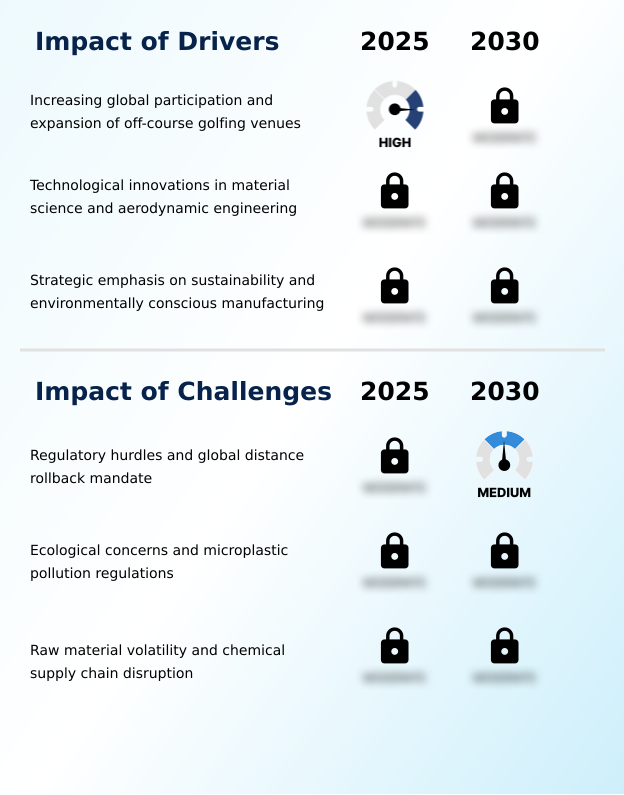
What are the key market drivers leading to the rise in the adoption of Golf Balls Industry?
- Increasing global participation, coupled with the expansion of off-course golfing venues, is a key driver for market growth.
- Technological innovation in material science is a primary market driver. The evolution from basic two-piece construction to advanced multi-layered constructions with high-energy cores and soft urethane covers allows for precise spin rate optimization.
- This enables swing speed optimization for both long-distance shots and short-game precision.
- Manufacturers utilize computational fluid dynamics to engineer aerodynamic dimple patterns, which has led to a 5% improvement in flight stability under windy conditions, ensuring a more stable flight path.
- These performance gains, critical for shot-shaping capability, are often validated through professional endorsements, which can boost a new product line's sales by 30% in its first quarter.
- This continuous pursuit of performance excellence ensures the market remains dynamic and responsive to the demands of elite players.
What are the market trends shaping the Golf Balls Industry?
- A strategic emphasis on sustainability is becoming a key market trend, increasingly influencing environmentally conscious manufacturing processes throughout the industry.
- A major trend is the convergence of personalization and digital technology, creating a more consumer-centric business model. The diversification into high-visibility colors and matte finish coatings is driven by player demand for better tracking. The use of custom alignment aids, designed via a digital customization portal, has been shown to improve putting accuracy for amateurs by up to 10%.
- Furthermore, the integration of embedded micro-sensors and radio frequency identification tags into balls allows for personalized performance data collection. This smart technology, used in advanced ball-tracking sensors at off-course entertainment venues and indoor golf simulators, provides insights that enhance data-driven fitting processes.
- This feedback loop improves player engagement and has increased repeat business at tech-enabled facilities by over 20%, blurring the line between recreational leisure activities and professional tournament play analytics.
What challenges does the Golf Balls Industry face during its growth?
- Regulatory hurdles, particularly the global distance rollback mandate, present a key challenge affecting industry growth.
- The industry faces significant headwinds from regulatory compliance and supply chain disruptions. The new distance rollback mandate requires costly redesigns, with R&D expenditures increasing by an estimated 25% for some firms to meet equipment regulations. Simultaneously, tightening microplastic pollution regulations are compelling a shift toward biodegradable components and bio-based resins, challenging manufacturers to maintain performance standards.
- Raw material volatility, driven by petrochemical industry fluctuations, poses another threat. Companies without localized supply chains have reported production delays of up to three weeks during recent disruptions. Proactive supply chain diversification is essential to mitigate the impact of shortages in materials like the synthetic polymer microparticles used in covers, ensuring operational stability.
Exclusive Technavio Analysis on Customer Landscape
The golf balls market forecasting report includes the adoption lifecycle of the market, covering from the innovator’s stage to the laggard’s stage. It focuses on adoption rates in different regions based on penetration. Furthermore, the golf balls market report also includes key purchase criteria and drivers of price sensitivity to help companies evaluate and develop their market growth analysis strategies.
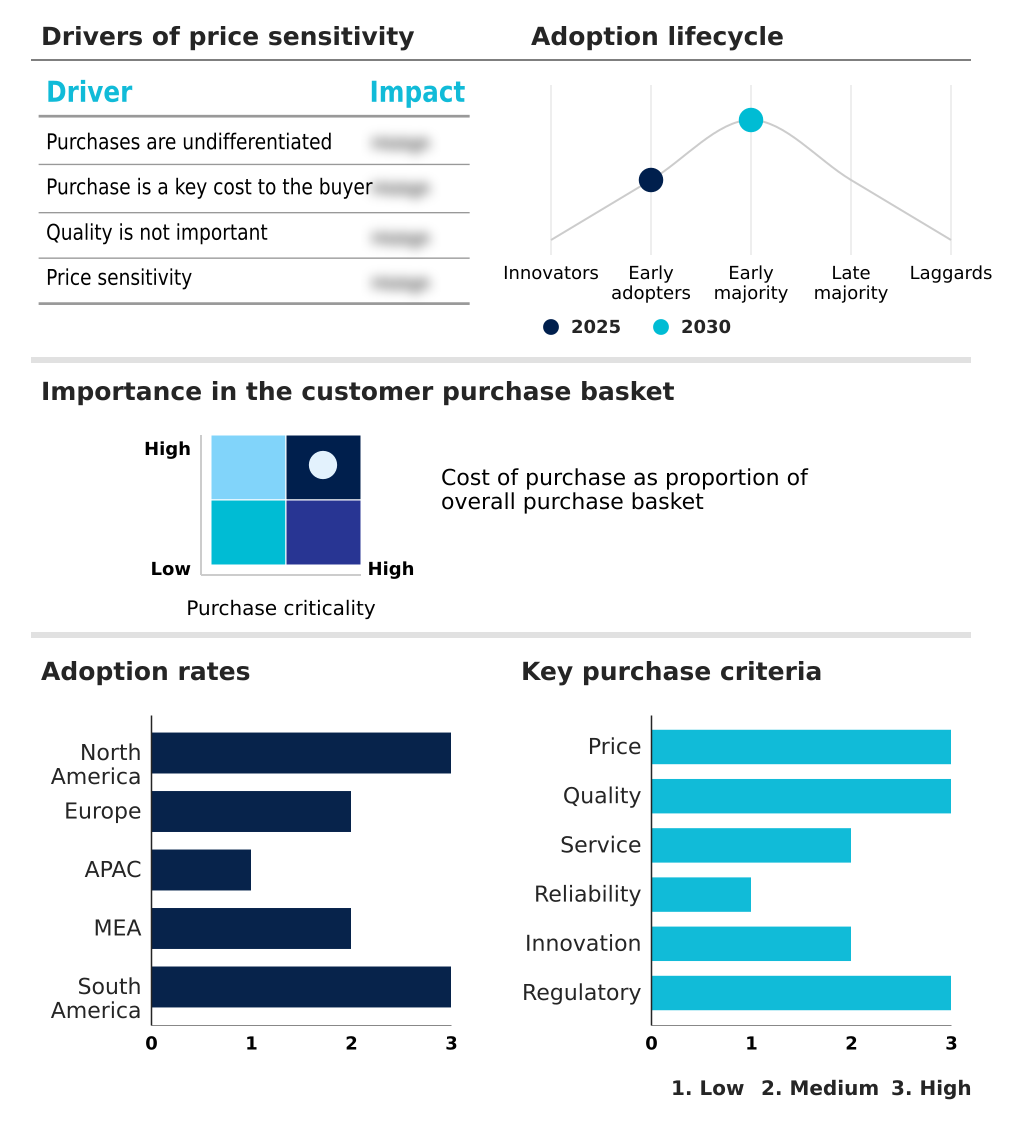
Customer Landscape of Golf Balls Industry
Competitive Landscape
Companies are implementing various strategies, such as strategic alliances, golf balls market forecast, partnerships, mergers and acquisitions, geographical expansion, and product/service launches, to enhance their presence in the industry.
Acushnet Holdings Corp. - A portfolio of performance-driven golf balls, including industry-benchmark models, is designed, manufactured, and distributed to meet the demands of competitive and recreational players.
The industry research and growth report includes detailed analyses of the competitive landscape of the market and information about key companies, including:
- Acushnet Holdings Corp.
- Bridgestone Golf Inc.
- Chromax Golf
- Costco Wholesale Corp.
- Cut Golf
- Decathlon SA
- Dixon Golf
- Honma Golf Co. Ltd.
- Nitro Golf
- OnCore Golf Tech.
- Pearl Golf
- Piper Golf
- RZN Golf
- Seed Golf
- Snell Golf
- Taylor Made Golf Co. Inc.
- Topgolf Callaway Brands Corp.
- Trust Golf
- Vice Sporting Goods GmbH
- Wilson Sporting Goods Co.
Qualitative and quantitative analysis of companies has been conducted to help clients understand the wider business environment as well as the strengths and weaknesses of key industry players. Data is qualitatively analyzed to categorize companies as pure play, category-focused, industry-focused, and diversified; it is quantitatively analyzed to categorize companies as dominant, leading, strong, tentative, and weak.
Recent Development and News in Golf balls market
- In August, 2024, Callaway Golf launched a comprehensive digital customization portal that allows users to visualize their personal alignment designs in a three-dimensional environment before the production process begins.
- In January, 2025, the United States Golf Association finalized a comprehensive update to the Procedure for Measuring the Velocity of Golf ball, which established more rigorous laboratory conditions for certification.
- In March, 2025, the European Environment Agency published a comprehensive set of new guidelines aimed at reducing synthetic waste in outdoor recreational areas, which prompted several major manufacturers to accelerate the development of eco-friendly product lines.
- In May, 2025, a major chemical production facility in East Asia, which serves as a primary source of high-grade resins for several global sporting brands, experienced a prolonged operational shutdown due to severe weather events.
Dive into Technavio’s robust research methodology, blending expert interviews, extensive data synthesis, and validated models for unparalleled Golf Balls Market insights. See full methodology.
| Market Scope | |
|---|---|
| Page number | 296 |
| Base year | 2025 |
| Historic period | 2020-2024 |
| Forecast period | 2026-2030 |
| Growth momentum & CAGR | Accelerate at a CAGR of 4.1% |
| Market growth 2026-2030 | USD 390.8 million |
| Market structure | Fragmented |
| YoY growth 2025-2026(%) | 4.1% |
| Key countries | US, Canada, Mexico, Germany, UK, France, Italy, The Netherlands, Spain, China, Japan, India, South Korea, Australia, Indonesia, Saudi Arabia, UAE, South Africa, Israel, Turkey, Brazil, Argentina and Colombia |
| Competitive landscape | Leading Companies, Market Positioning of Companies, Competitive Strategies, and Industry Risks |
Research Analyst Overview
- The market is characterized by intense R&D in multi-layered constructions, from two-piece construction to complex four-piece design models. These structures feature a polybutadiene core and a specialized mantle layer technology under either urethane covers or ionomer resins. Using computational fluid dynamics, engineers refine aerodynamic dimple patterns for spin rate optimization and control compression ratio.
- A critical boardroom focus is the shift toward sustainable manufacturing practices and circular economy principles. This involves adopting bio-based resins, biodegradable components, and recycled core material, a move that has enhanced brand reputation and improved supply chain resilience by over 15% for early adopters. Technological advancements include perimeter weighting technology, dual-core system designs, and novel water-based coating.
- The adoption of 3d printing for prototyping accelerates innovation for features like a high-velocity gradient core. Smart balls with radio frequency identification tags and embedded micro-sensors are becoming mainstream, supported by advanced ball-tracking sensors.
- Customization is booming, with digital customization portals offering custom alignment aids, high-visibility colors, and matte finish coatings produced through carbon-neutral manufacturing and precise laser etching technology, all contributing to ball recovery programs.
What are the Key Data Covered in this Golf Balls Market Research and Growth Report?
-
What is the expected growth of the Golf Balls Market between 2026 and 2030?
-
USD 390.8 million, at a CAGR of 4.1%
-
-
What segmentation does the market report cover?
-
The report is segmented by Type (Two piece balls, Three piece balls, Four piece balls, and Others), Price Range (Mid-range balls, Premium balls, and Low-cost balls), Distribution Channel (Offline, and Online) and Geography (North America, Europe, APAC, Middle East and Africa, South America)
-
-
Which regions are analyzed in the report?
-
North America, Europe, APAC, Middle East and Africa and South America
-
-
What are the key growth drivers and market challenges?
-
Increasing global participation and expansion of off-course golfing venues, Regulatory hurdles and global distance rollback mandate
-
-
Who are the major players in the Golf Balls Market?
-
Acushnet Holdings Corp., Bridgestone Golf Inc., Chromax Golf, Costco Wholesale Corp., Cut Golf, Decathlon SA, Dixon Golf, Honma Golf Co. Ltd., Nitro Golf, OnCore Golf Tech., Pearl Golf, Piper Golf, RZN Golf, Seed Golf, Snell Golf, Taylor Made Golf Co. Inc., Topgolf Callaway Brands Corp., Trust Golf, Vice Sporting Goods GmbH and Wilson Sporting Goods Co.
-
Market Research Insights
- Market dynamics are shaped by a dual focus on performance innovation and operational efficiency. The adoption of data-driven fitting processes has improved sales conversion rates by over 15% in specialized retail environments. Furthermore, the shift to direct-to-consumer sales models allows for enhanced brand prestige and has been shown to increase customer lifetime value by 20% compared to traditional wholesale channels.
- In response to raw material volatility, leading firms are implementing supply chain diversification strategies. This proactive sourcing has mitigated production delays, reducing downtime by an average of 10% during periods of geopolitical disruption. These strategic adjustments reflect a market that balances professional endorsements with the need for resilient and consumer-centric business models.
We can help! Our analysts can customize this golf balls market research report to meet your requirements.
 RIA -
RIA - 
