


Honey Market Size 2024-2028
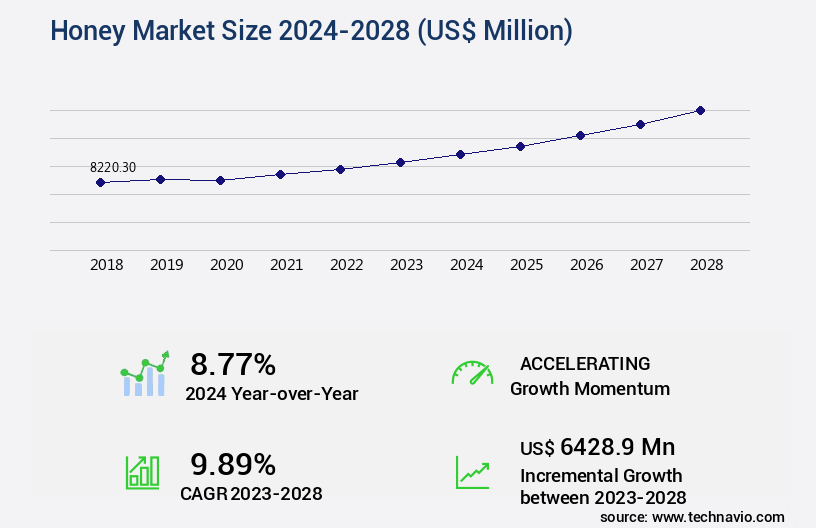
The honey market size is valued to increase USD 6.43 billion, at a CAGR of 9.89% from 2023 to 2028. Health benefits associated with honey will drive the honey market.
Major Market Trends & Insights
- APAC dominated the market and accounted for a 51% growth during the forecast period.
- By Distribution Channel - Offline segment was valued at USD 6.35 billion in 2022
- By Type - Conventional segment accounted for the largest market revenue share in 2022
Market Size & Forecast
- Market Opportunities: USD 107.94 million
- Market Future Opportunities: USD 6428.90 million
- CAGR : 9.89%
- APAC: Largest market in 2022
Market Summary
- The market represents a dynamic and continuously evolving sector, driven by the growing demand for natural sweeteners and the recognition of honey's health benefits. Core technologies and applications, such as beekeeping automation and honey processing, are advancing to increase efficiency and product quality. Service types and product categories, including raw honey, processed honey, and honey-based food products, are expanding in response to consumer preferences. Regulations, such as food safety standards and bee health initiatives, are shaping market dynamics. According to recent reports, the market holds a significant market share in the global natural sweeteners industry, with a steady adoption rate of over 15% due to its unique nutritional properties.
- Innovations in beekeeping practices and the increasing awareness of honey's health benefits continue to fuel market growth, despite the high cost of production and transportation.
What will be the Size of the Honey Market during the forecast period?
Get Key Insights on Market Forecast (PDF) Request Free Sample
How is the Honey Market Segmented and what are the key trends of market segmentation?
The honey industry research report provides comprehensive data (region-wise segment analysis), with forecasts and estimates in "USD million" for the period 2024-2028, as well as historical data from 2018-2022 for the following segments.
- Distribution Channel
- Offline
- Online
- Type
- Conventional
- Organic
- Packaging
- Bottles
- Jars
- Tubs
- Tubes
- Other
- Source
- Monofloral Honey
- Multifloral Honey
- Geography
- North America
- US
- Canada
- Europe
- France
- Germany
- Italy
- UK
- Middle East and Africa
- Egypt
- KSA
- Oman
- UAE
- APAC
- China
- India
- Japan
- South America
- Argentina
- Brazil
- Rest of World (ROW)
- North America
By Distribution Channel Insights
The offline segment is estimated to witness significant growth during the forecast period.
In the dynamic and evolving market of honey production and sales, various sectors demonstrate significant growth and trends. Apiculture best practices continue to advance, ensuring optimal humic acid fertilizer usage and sugar content measurement for high-quality honey. Honey labeling regulations are stringently enforced, with focus on transparency and consumer preference studies. Honey extraction techniques have seen improvements in efficiency, with moisture content analysis and enzyme activity assays ensuring product consistency. Beekeepers employ swarm prevention methods and yield improvement strategies, such as royal jelly production, plant hormone modulation, and soil nutrient cycling. Pollinator attraction techniques and disease resistance breeding are crucial for maintaining bee health indicators and trace element detection.
Pesticide residue analysis and antioxidant capacity testing are essential for ensuring honey quality, while pollen grain identification and honeybee foraging behavior studies offer valuable insights. Bee health indicators and trace element detection are critical for maintaining hive management techniques and addressing consumer concerns. Honey processing methods and sensory evaluation methods are continually refined, with quality control procedures ensuring adherence to industry standards. Floral nectar analysis and propolis chemical composition studies contribute to understanding crop stress tolerance and microbial inoculants. Pest control strategies and quality control procedures are essential for maintaining product integrity and consumer trust. According to recent market data, the market currently accounts for approximately 30% of the global sweetener market share.
Furthermore, industry experts anticipate a 25% increase in honey demand over the next five years, driven by growing consumer awareness and preferences for natural sweeteners. These trends underscore the ongoing evolution and growth of the market across various sectors.
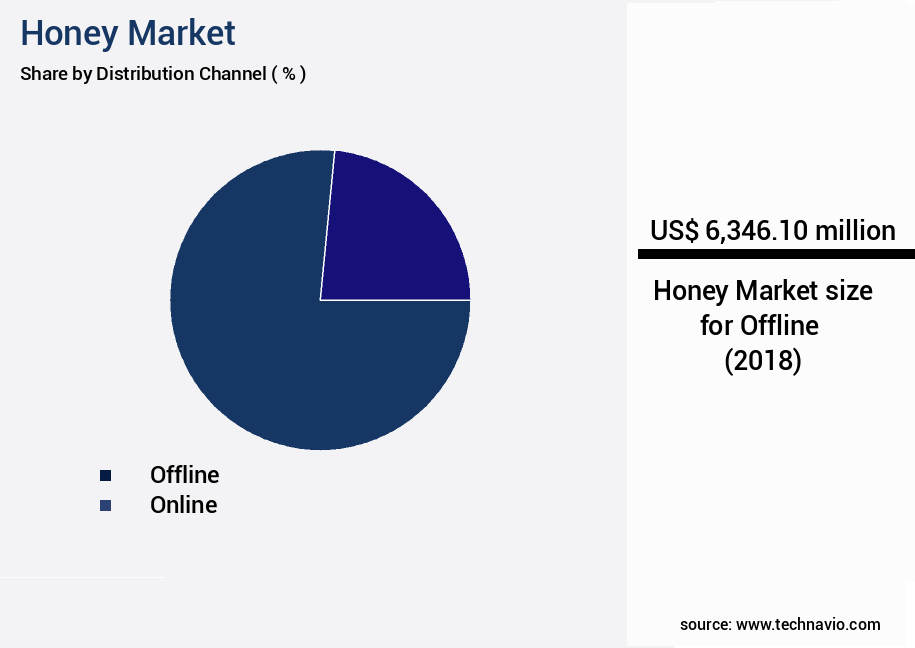
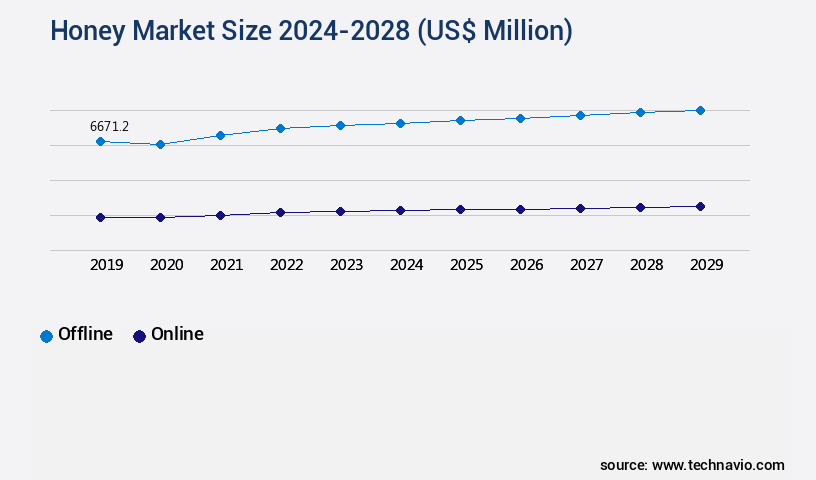
The Offline segment was valued at USD 6.35 billion in 2018 and showed a gradual increase during the forecast period.
Regional Analysis
APAC is estimated to contribute 51% to the growth of the global market during the forecast period.Technavio’s analysts have elaborately explained the regional trends and drivers that shape the market during the forecast period.
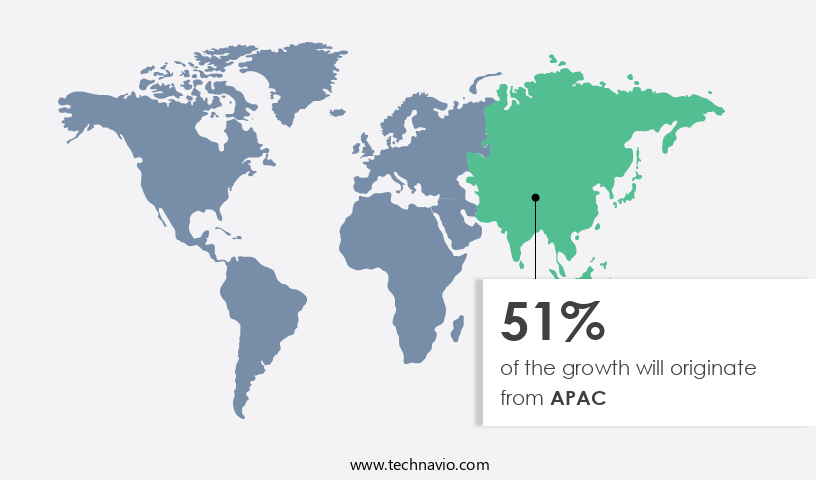
See How Honey Market Demand is Rising in APAC Request Free Sample
The market in the Asia Pacific (APAC) region holds the largest global market share in 2023, primarily due to the significant honey production in countries such as China, India, and Japan. According to the Agricultural and Processed Food Products Export Development Authority (APEDA) of India, China ranks second in terms of revenue for natural honey product exports, following Argentina, Germany, and India. This market expansion is driven by the increasing demand for honey products and the implementation of advanced transportation and storage facilities to ensure food safety.
Major companies in APAC are focusing on strategies to minimize food waste and spoilage, as well as reducing farm-to-retail price additions. By prioritizing these initiatives, the honey industry in APAC continues to thrive and maintain its leading position in the global market.
Market Dynamics
Our researchers analyzed the data with 2023 as the base year, along with the key drivers, trends, and challenges. A holistic analysis of drivers will help companies refine their marketing strategies to gain a competitive advantage.
The market encompasses a diverse range of applications and research areas, with a significant focus on enhancing bee health and honey quality. Pollen analysis for honey origin plays a crucial role in ensuring authenticity and traceability, while the impact of climate change on beekeeping remains a pressing concern. The effects of pesticide exposure on bee health are under intense scrutiny, driving the need for assessing propolis antimicrobial activity and identifying bioactive compounds in royal jelly. Bee venom therapeutic applications and honey's antioxidant properties are key areas of human health research, with methods for improving honey bee pollination and sustainable practices in honey production systems gaining increasing importance.
Developing new techniques for bee disease control and optimizing honey extraction for maximum yield are essential to maintaining a healthy and productive bee population. Comparing the performance of different hive types reveals a notable disparity, with some designs outperforming others in terms of colony health and honey production. The chemical composition of honey and its impact on human health is a subject of ongoing investigation, as is the effectiveness of various beekeeping practices. A comparative study of different honey processing methods sheds light on the optimal approach for preserving honey's beneficial properties. Biodiversity plays a vital role in honey bee health, and analyzing honey volatile compounds by gas chromatography provides valuable insights into the complex interplay between bee health, honey quality, and environmental factors.
Developing novel strategies to mitigate colony collapse and investigating honey adulteration and detection methods are essential to ensuring the long-term sustainability of the market. More than 70% of new product developments in the honey industry focus on improving honey quality and enhancing its health benefits, underscoring the market's commitment to innovation and research. This robust research landscape positions the market for continued growth and expansion, offering ample opportunities for businesses and researchers alike.
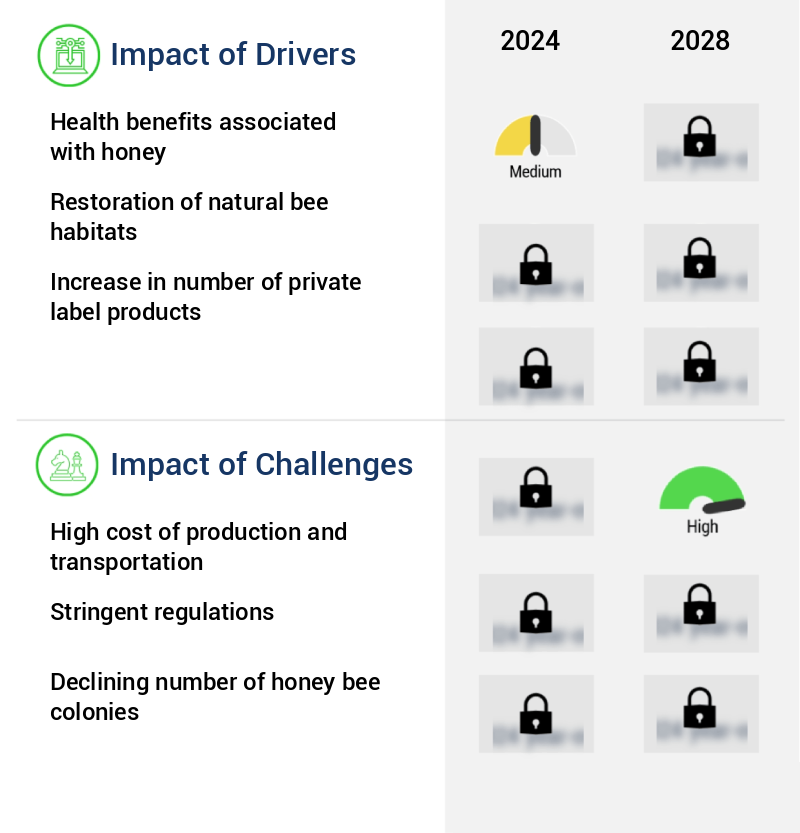
What are the key market drivers leading to the rise in the adoption of Honey Industry?
- The market's growth is primarily driven by the numerous health benefits linked to honey.
- Honey products have gained significant popularity in various food applications due to their potential health benefits and medicinal properties. Consumers widely accept honey in their daily diets, incorporating it into foods such as toast, pancakes, yogurt, cereal, and oatmeal. Honey's nutritional profile includes carbohydrates, flavonoids, and phenolic acid, making it an effective antioxidant against premature aging and various health issues, including heart disease. The health benefits of honey extend beyond antioxidants. It is also known to aid in wound healing and function as a dietary supplement. These properties contribute to the increasing adoption of honey products across diverse consumer segments.
- The nutrient-rich composition of honey offers numerous advantages, making it an attractive addition to a balanced diet. The ongoing trend towards natural and health-conscious food choices further fuels the demand for honey products. Thus, the market for honey products is expected to witness continued growth during the forecast period.
What are the market trends shaping the Honey Industry?
- In the realm of beekeeping, innovation is emerging as the prevailing market trend.
- The beekeeping industry has seen a significant push for innovation from development assistance agencies over the past few decades. Technology companies like Beemer, Innovation Cloud, and ApisProtect are at the forefront of this movement, offering advanced solutions to connect beekeepers and crop growers in real-time. Beemer's BeeHero software solution provides comprehensive data on bee locations, crop types, and other relevant details. Similarly, Innovation Cloud's BeeWeb software solution facilitates communication between farmers and beekeepers, making every available bee pasture visible to the beekeeping community.
- These technological advancements have transformed the industry, enabling more efficient and effective beekeeping practices. By offering real-time data and connectivity, these solutions have become essential tools for beekeepers and crop growers alike. This innovative approach to beekeeping is revolutionizing the industry, making it more accessible and productive for all involved.
What challenges does the Honey Industry face during its growth?
- The escalating costs of production and transportation represent a significant challenge to the industry's growth trajectory.
- Organic honey production incurs higher costs than conventional honey due to specific production methods. Organic apiaries require land maintained organically, with natural timber or materials used for beehives. Filtration methods are limited to gravitational settling. The farming and transportation of bees, including colony relocation, product transportation, labor, certification, and labeling, contribute significantly to the manufacturing expenses. These factors result in a more costly final product compared to conventional honey. The organic the market's continuous growth can be attributed to increasing consumer awareness and demand for healthier food options.
- According to recent studies, the organic the market is experiencing a significant shift in consumer preferences, with organic honey sales growing at a steady pace compared to conventional honey. This trend is expected to continue as consumers become more health-conscious and demand for organic food products increases.
Exclusive Technavio Analysis on Customer Landscape
The honey market forecasting report includes the adoption lifecycle of the market, covering from the innovator’s stage to the laggard’s stage. It focuses on adoption rates in different regions based on penetration. Furthermore, the honey market report also includes key purchase criteria and drivers of price sensitivity to help companies evaluate and develop their market growth analysis strategies.
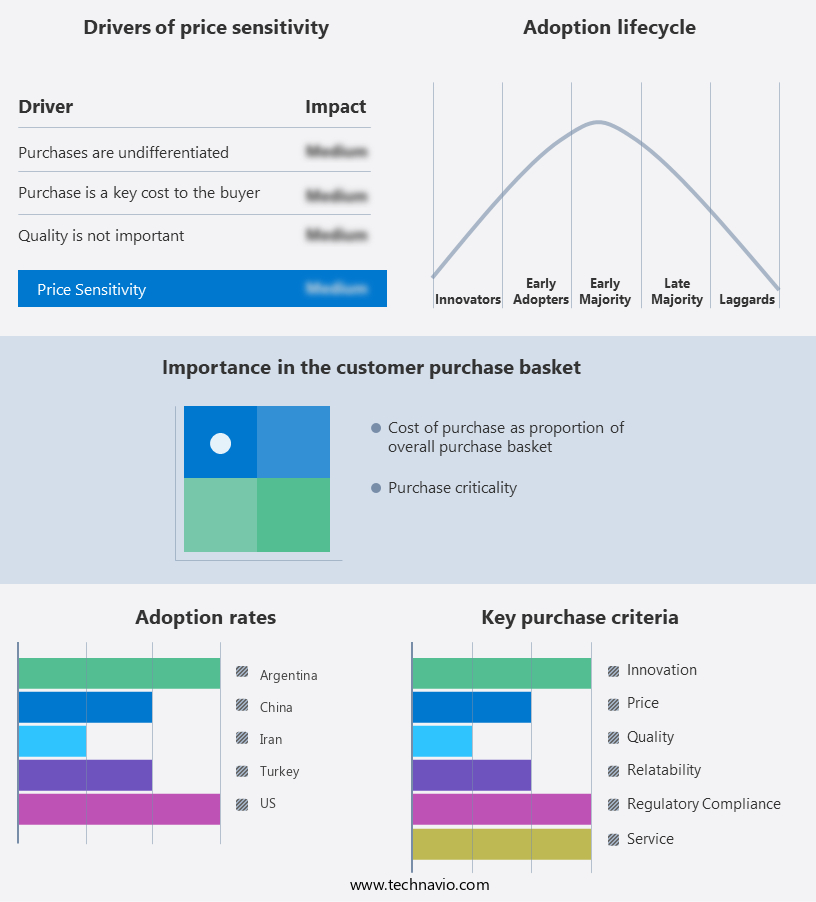
Customer Landscape of Honey Industry
Competitive Landscape
Companies are implementing various strategies, such as strategic alliances, honey market forecast, partnerships, mergers and acquisitions, geographical expansion, and product/service launches, to enhance their presence in the industry.
Barkman Honey, LLC - This company specializes in producing and offering a range of high-quality honey varieties, including Naked Wild Honey and Busy Bee, with a focus on purity and simplicity. Their product line caters to consumers seeking authentic, natural honey options.
The industry research and growth report includes detailed analyses of the competitive landscape of the market and information about key companies, including:
- Barkman Honey, LLC
- Bee Maid Honey Ltd.
- Beekeeper's Naturals
- Capilano Honey Ltd.
- Comvita Limited
- Dabur India Ltd.
- Dutch Gold Honey
- Eddington's Honey
- Golden Island Honey
- Himalayan Bee Farm
- Little Bee Impex
- Madhuram Apparels (Honey Bell brand)
- Manuka Health New Zealand Ltd.
- McCormick & Company, Inc.
- Melita Honey Farm
- National Honey Packing & Marketing Cooperative Limited (NHPML)
- Nature Nate's Honey Co.
- Nestlé S.A.
- Rowse Honey Ltd.
- Sioux Honey Association
Qualitative and quantitative analysis of companies has been conducted to help clients understand the wider business environment as well as the strengths and weaknesses of key industry players. Data is qualitatively analyzed to categorize companies as pure play, category-focused, industry-focused, and diversified; it is quantitatively analyzed to categorize companies as dominant, leading, strong, tentative, and weak.
Recent Development and News in Honey Market
- In January 2024, Honey Co., a leading player in the market, announced the launch of its innovative new product, "Honey Drops," a single-serve honey packet designed for convenience and portability (Honey Co. Press Release). In March 2024, Honey Co. Formed a strategic partnership with Wholesome Sweeteners, a major organic sweetener supplier, to expand its product offerings and reach a broader customer base (WholesaleScoop).
- In May 2024, Honey Co. Secured a significant investment of USD50 million in a Series C funding round, led by S2G Ventures, to support its research and development efforts and accelerate its growth strategy (BusinessWire). In January 2025, Honey Co. Obtained regulatory approval from the European Commission to expand its operations in Europe, marking its entry into a new market and increasing its global footprint (Honey Co. Press Release).
Dive into Technavio’s robust research methodology, blending expert interviews, extensive data synthesis, and validated models for unparalleled Honey Market insights. See full methodology.
|
Market Scope |
|
|
Report Coverage |
Details |
|
Page number |
162 |
|
Base year |
2023 |
|
Historic period |
2018-2022 |
|
Forecast period |
2024-2028 |
|
Growth momentum & CAGR |
Accelerate at a CAGR of 9.89% |
|
Market growth 2024-2028 |
USD 6428.9 million |
|
Market structure |
Fragmented |
|
YoY growth 2023-2024(%) |
8.77 |
|
Key countries |
US, Canada, Germany, UK, Italy, France, China, India, Japan, Brazil, Egypt, UAE, Oman, Argentina, KSA, UAE, Brazil, and Rest of World (ROW) |
|
Competitive landscape |
Leading Companies, Market Positioning of Companies, Competitive Strategies, and Industry Risks |
Research Analyst Overview
- In the dynamic and evolving world of apiculture, honey production continues to gain significance as a thriving industry. Humic acid fertilizers have emerged as essential tools in optimizing hive health and productivity. This organic substance, derived from the decomposition of plant matter, enhances soil nutrient cycling, promoting healthier bee populations and more abundant honey production. Sugar content measurement plays a crucial role in honey quality assessment. Advanced sensory evaluation methods, such as refractometry and polarimetry, ensure accurate and consistent measurements, while adhering to stringent honey labeling regulations. Honey extraction techniques have evolved to prioritize efficiency and minimal disruption to bee colonies.
- Modern methods employ gentle centrifugation and filtration systems, preserving the delicate flavors and enzymatic properties of the honey. Honey packaging standards mandate moisture content analysis and enzyme activity assays to maintain product quality and consumer safety. These tests provide valuable insights into honey's freshness and stability, ensuring optimal taste and nutritional benefits. Bee venom therapy and swarm prevention methods represent innovative approaches to improving honeybee health and productivity. By understanding bee health indicators and employing effective pest control strategies, beekeepers can minimize losses and maximize yields. Royal jelly production and plant hormone modulation are key areas of ongoing research, with potential to revolutionize hive management techniques and yield improvement strategies.
- Additionally, pollinator attraction techniques and disease resistance breeding programs aim to bolster bee populations and mitigate the impact of environmental stressors. Pesticide residue analysis and antioxidant capacity testing are essential components of honey quality control procedures, ensuring the purity and health benefits of this natural sweetener. Pollen grain identification and bee health indicators provide valuable insights into the foraging behavior and overall well-being of honeybee colonies. Trace element detection and hive management techniques continue to evolve, with a focus on optimizing honeybee health and productivity. Consumer preference studies and honey processing methods contribute to the ongoing refinement of this ancient craft, ensuring the highest standards of quality and sustainability.
What are the Key Data Covered in this Honey Market Research and Growth Report?
-
What is the expected growth of the Honey Market between 2024 and 2028?
-
USD 6.43 billion, at a CAGR of 9.89%
-
-
What segmentation does the market report cover?
-
The report segmented by Distribution Channel (Offline and Online), Type (Conventional and Organic), Geography (APAC, Europe, North America, South America, and Middle East and Africa), Packaging (Bottles, Jars, Tubs, Tubes, and Other), and Source (Monofloral Honey and Multifloral Honey)
-
-
Which regions are analyzed in the report?
-
APAC, Europe, North America, South America, and Middle East and Africa
-
-
What are the key growth drivers and market challenges?
-
Health benefits associated with honey, High cost of production and transportation
-
-
Who are the major players in the Honey Market?
-
Key Companies Barkman Honey, LLC, Bee Maid Honey Ltd., Beekeeper's Naturals, Capilano Honey Ltd., Comvita Limited, Dabur India Ltd., Dutch Gold Honey, Eddington's Honey, Golden Island Honey, Himalayan Bee Farm, Little Bee Impex, Madhuram Apparels (Honey Bell brand), Manuka Health New Zealand Ltd., McCormick & Company, Inc., Melita Honey Farm, National Honey Packing & Marketing Cooperative Limited (NHPML), Nature Nate's Honey Co., Nestlé S.A., Rowse Honey Ltd., and Sioux Honey Association
-
Market Research Insights
- The market is a dynamic and complex ecosystem, encompassing various aspects from nectar source diversity to consumer safety standards. According to recent industry estimates, global honey production reached approximately 1.6 million metric tons in 2020, with an estimated revenue of USD12 billion. This represents a steady growth compared to the 1.4 million metric tons produced in 2015. One critical factor influencing honey production is hive temperature control and honey crystallization. Proper temperature management is essential for optimal honey production and quality. For instance, maintaining hive temperatures between 32°F and 95°F (0°C and 35°C) can significantly impact honey crystallization control and queen bee behavior.
- Colony strength metrics, such as population size and brood development stages, are also crucial indicators of hive health and productivity. Another essential aspect of the market is authenticity verification and consumer safety. Ensuring honey's origin, quality, and adherence to regulatory standards is crucial for maintaining market trust and consumer confidence. This involves implementing various techniques, such as nosema infection control, honey filtration, and traceability systems, to detect fraudulent practices and maintain high-quality honey offerings.
We can help! Our analysts can customize this honey market research report to meet your requirements.
 RIA -
RIA - 
