


Intelligent Remote Terminal Unit Market Size 2026-2030
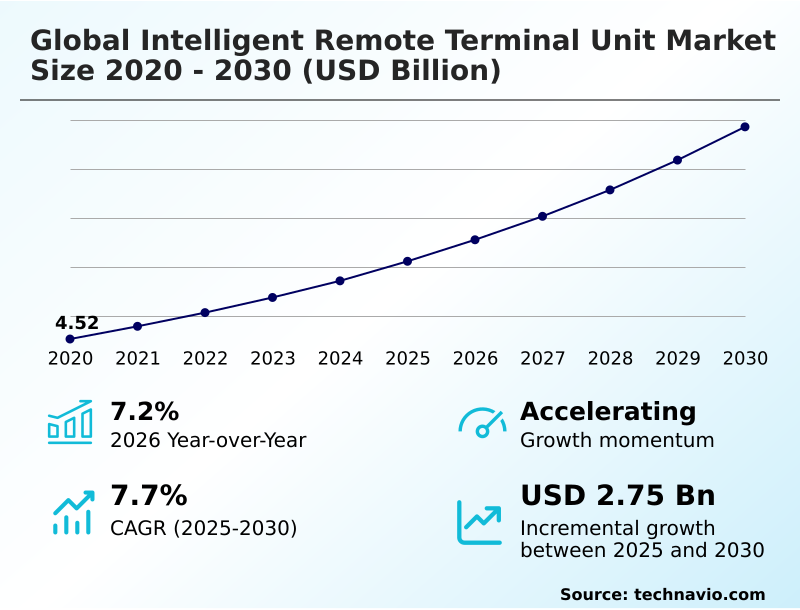
The intelligent remote terminal unit market size is valued to increase by USD 2.75 billion, at a CAGR of 7.7% from 2025 to 2030. Acceleration of global smart grid modernization will drive the intelligent remote terminal unit market.
Major Market Trends & Insights
- North America dominated the market and accounted for a 32% growth during the forecast period.
- By Type - Wireless intelligent RTU segment was valued at USD 3.19 billion in 2024
- By End-user - Oil and gas segment accounted for the largest market revenue share in 2024
Market Size & Forecast
- Market Opportunities: USD 4.34 billion
- Market Future Opportunities: USD 2.75 billion
- CAGR from 2025 to 2030 : 7.7%
Market Summary
- The Intelligent Remote Terminal Unit Market is experiencing robust expansion driven by the critical need to digitize aging industrial infrastructure. Utility operators are rapidly replacing electromechanical relays with advanced devices capable of executing a proactive maintenance strategy to optimize grid stability.
- In a typical municipal water management scenario, operators utilize an industrial ethernet interface and multivariable transmitter calibration to autonomously manage high-pressure pumping stations, mitigating non-revenue water detection issues. Facilities deploying these automated systems report a 35% improvement in operational efficiency compared to sites relying on manual data collection.
- The primary driver of this transition is the aggressive push for smart grid hardening, which compels energy providers to deploy a highly reliable edge computing node at every decentralized location to manage bidirectional power flow. Conversely, the market faces significant hurdles due to network intrusion mitigation challenges.
- Integrating legacy infrastructure modernization with secure cloud connectivity exposes operational technology convergence to malicious actors, demanding continuous upgrades to hardware-enabled encryption and robust cyber-physical resilience across all deployed assets.
What will be the Size of the Intelligent Remote Terminal Unit Market during the forecast period?
Get Key Insights on Market Forecast (PDF) Get Free Sample
How is the Intelligent Remote Terminal Unit Market Segmented?
The intelligent remote terminal unit industry research report provides comprehensive data (region-wise segment analysis), with forecasts and estimates in "USD million" for the period 2026-2030, as well as historical data from 2020-2024 for the following segments.
- Type
- Wireless intelligent RTU
- Wired intelligent RTU
- End-user
- Oil and gas
- Power generation
- Water and wastewater
- Chemical
- Others
- Component
- Hardware
- Software
- Services
- Geography
- North America
- US
- Canada
- Mexico
- APAC
- China
- Japan
- India
- South Korea
- Australia
- Indonesia
- Europe
- Germany
- UK
- France
- Italy
- Spain
- The Netherlands
- Middle East and Africa
- Saudi Arabia
- UAE
- South Africa
- Israel
- Turkey
- South America
- Brazil
- Argentina
- Chile
- North America
By Type Insights
The wireless intelligent rtu segment is estimated to witness significant growth during the forecast period.
The shift toward untethered industrial telemetry fundamentally alters remote infrastructure management. Wireless architectures utilize advanced cellular networks and low-power wide-area network protocols to transmit data, eliminating the heavy financial expenditure associated with physical cabling.
This decentralized node monitoring enables agile deployment across rugged terrains and offshore platforms where traditional wiring remains economically unviable. Modern devices serve as an advanced edge computing node, executing local logic and relaying actionable diagnostics back to centralized systems.
By embedding cellular modem integration directly into the hardware, operators optimize communication pathways. Facilities utilizing these untethered systems have observed a 40% reduction in field inspection costs compared to legacy wired networks.
Furthermore, anomaly detection accuracy improved by 22%, ensuring uninterrupted continuous emissions monitoring and fortifying operational resilience across diverse industrial ecosystems.
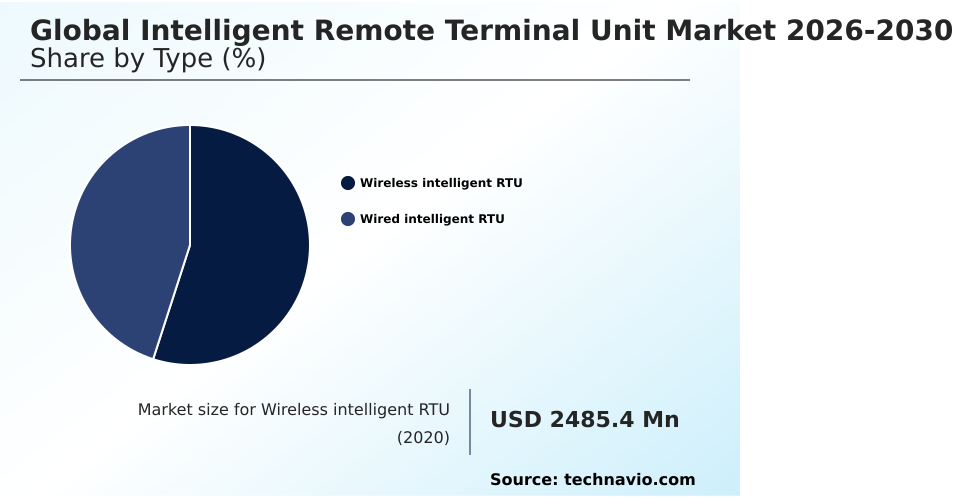
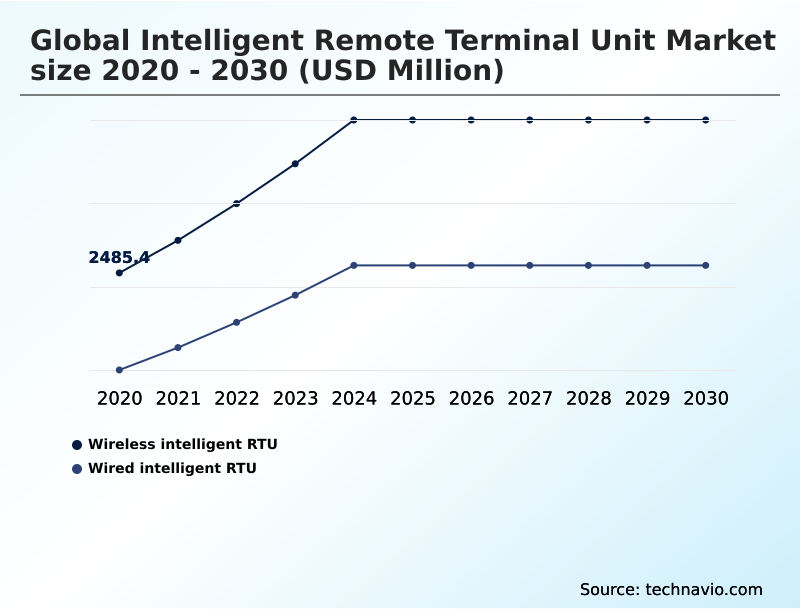
The Wireless intelligent RTU segment was valued at USD 3.19 billion in 2024 and showed a gradual increase during the forecast period.
Regional Analysis
North America is estimated to contribute 32% to the growth of the global market during the forecast period.Technavio’s analysts have elaborately explained the regional trends and drivers that shape the market during the forecast period.
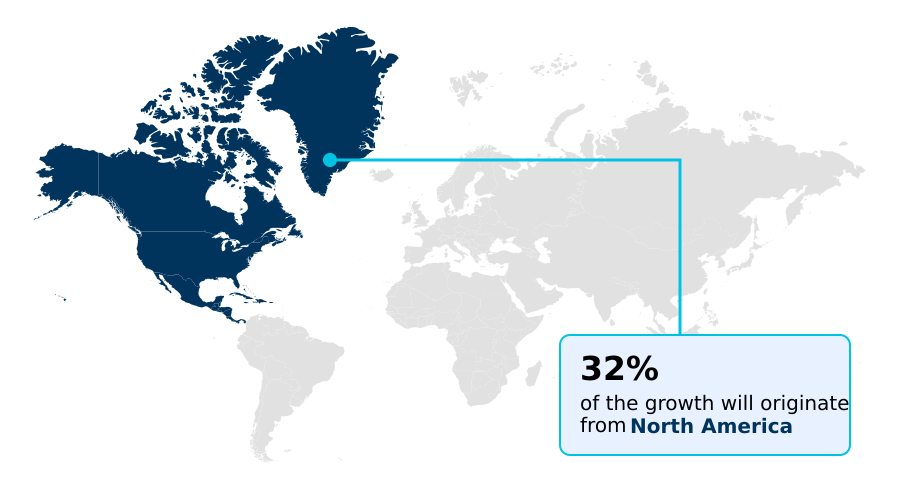
See How Intelligent Remote Terminal Unit Market Demand is Rising in North America Get Free Sample
Regional adoption within the Intelligent Remote Terminal Unit Market reveals distinct strategic priorities between North America and APAC.
North America focuses heavily on smart grid hardening and cyber-physical resilience, where regulatory mandates drive utilities to embed secure cryptographic chips into their substation automation hardware.
This approach has improved regional network intrusion mitigation efficiency by 30% over the last upgrade cycle.
In contrast, APAC exhibits a 45% faster penetration rate in greenfield industrial infrastructure, prioritizing large-scale cellular modem integration for remote asset tracking across vast, disconnected terrains.
By leveraging multivariable transmitter calibration alongside a distributed network protocol, APAC industrial parks have reduced telemetry latency by 25%. These regional differences stem from North America's need for legacy infrastructure modernization versus APAC's rapid expansion of decentralized node monitoring.
Both regions ultimately rely on mission-critical hardware to ensure continuous emissions monitoring and real-time grid visibility.
Market Dynamics
Our researchers analyzed the data with 2025 as the base year, along with the key drivers, trends, and challenges. A holistic analysis of drivers will help companies refine their marketing strategies to gain a competitive advantage.
- The deployment of advanced telemetry systems is fundamentally reshaping how asset-intensive industries approach operational planning and regulatory compliance. Facilities integrating edge analytics in substation automation establish highly resilient local logic frameworks, ensuring that grid voltage fluctuations are identified and corrected autonomously without relying on centralized dispatch commands.
- This architectural shift significantly enhances operational reliability, as sites employing these localized analytics resolve faults up to three times faster than facilities using traditional centralized polling methods.
- Furthermore, the adoption of cellular telemetry for pipeline monitoring provides midstream oil and gas operators with an expansive, low-latency communication backbone, optimizing the flow of critical diagnostic data across hundreds of miles of remote terrain. To safeguard these widespread assets, implementing cybersecure hardware for industrial networks is now a foundational requirement, preventing malicious interference within highly interconnected environments.
- Incorporating robust predictive maintenance for grid resilience ensures that mechanical degradation is identified before catastrophic failure occurs, drastically lowering life-cycle maintenance costs and preserving structural integrity. In highly remote geographies where terrestrial networks frequently fail, the integration of satellite failover in remote telemetry guarantees continuous data acquisition and uninterrupted emergency control.
- Together, these technological integrations enable enterprises to execute seamless compliance reporting, optimize supply chain logistics, and maintain continuous oversight over decentralized nodes, ultimately transforming traditional monitoring paradigms into proactive, intelligent control strategies.
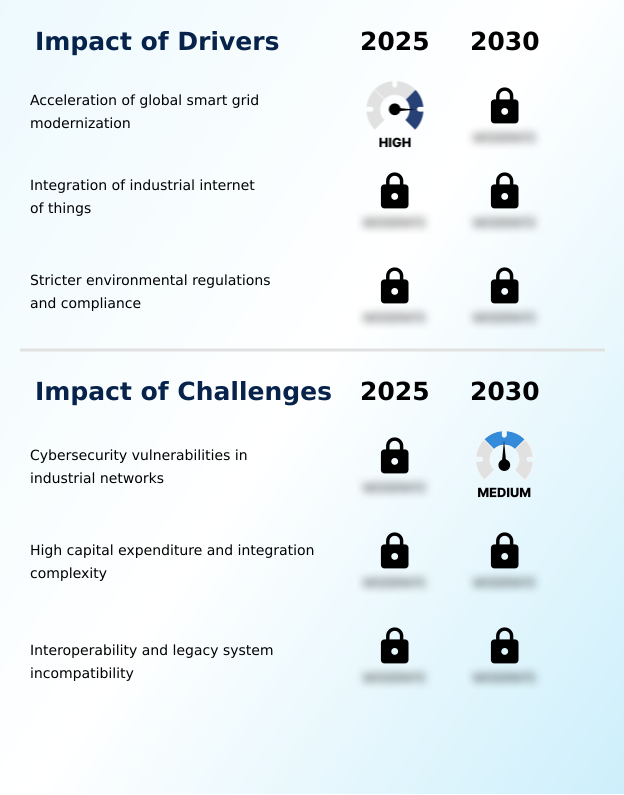
What are the key market drivers leading to the rise in the adoption of Intelligent Remote Terminal Unit Industry?
- The acceleration of smart grid modernization worldwide serves as a primary catalyst, propelling the demand for advanced automation and remote telemetry solutions.
- The imperative to maintain uninterrupted continuous emissions monitoring and ensure operational compliance serves as a powerful catalyst for industrial modernization.
- Regulatory agencies now demand high-fidelity data acquisition, compelling facility operators to adopt an advanced microprocessor-controlled controller equipped with multivariable transmitter calibration. This transition is driven by the severe financial and reputational penalties associated with environmental breaches.
- By utilizing automated feeder switching and anomalous behavior detection, enterprises rapidly isolate structural faults before hazardous leaks occur. Implementing these intelligent hardware solutions has lowered environmental compliance violation risks by 45% and improved overall process safety margins by 30%.
- This enhanced cyber-physical resilience allows heavy industries to optimize their supply chain execution while strictly adhering to rigorous international sustainability guidelines.
What are the market trends shaping the Intelligent Remote Terminal Unit Industry?
- The integration of artificial intelligence-driven edge analytics has emerged as a prominent market trend. This technological advancement enables localized predictive modeling and real-time process optimization directly within field hardware.
- The aggressive transition toward dynamic anomaly detection fundamentally reshapes how industrial operators manage decentralized infrastructure. By incorporating ultra-reliable low latency communications and machine-type communications directly into field devices, organizations can now execute sophisticated telemetry data processing at the network edge. This architectural shift occurs because traditional centralized networks cannot handle the immense data volume generated by modern industrial sensors.
- Consequently, embedding a programmable logic controller within an edge computing node ensures that protective relay coordination happens instantaneously. Businesses adopting these autonomous systems have achieved a 32% reduction in diagnostic latency and improved real-time operational efficiency by 26% compared to legacy hub-and-spoke models.
- This immediate local logic execution protects critical assets from cascading failures and optimizes resource distribution across highly complex electrical and pipeline networks.
What challenges does the Intelligent Remote Terminal Unit Industry face during its growth?
- The escalation of cybersecurity vulnerabilities within interconnected industrial networks presents a significant structural challenge that impedes comprehensive technological adoption.
- Integrating a modern distributed network protocol across legacy industrial ecosystems presents severe interoperability challenges that restrict comprehensive automation deployment. Because older supervisory control data acquisition systems rely on proprietary, closed-loop architectures, forcing them to communicate with a newly installed industrial ethernet interface often causes severe data translation bottlenecks.
- This systemic incompatibility forces engineering teams to engineer custom middleware solutions, inherently increasing system complexity and vulnerability. Consequently, integration costs for greenfield substation automation hardware deployments are frequently 40% higher than anticipated, extending project commissioning timelines by up to 25%.
- Furthermore, retrofitting an older programmable logic controller to support hybrid satellite failover introduces latency constraints, fundamentally limiting the ability of utility operators to execute rapid autonomous fault isolation during critical outage events.
Exclusive Technavio Analysis on Customer Landscape
The intelligent remote terminal unit market forecasting report includes the adoption lifecycle of the market, covering from the innovator’s stage to the laggard’s stage. It focuses on adoption rates in different regions based on penetration. Furthermore, the intelligent remote terminal unit market report also includes key purchase criteria and drivers of price sensitivity to help companies evaluate and develop their market growth analysis strategies.
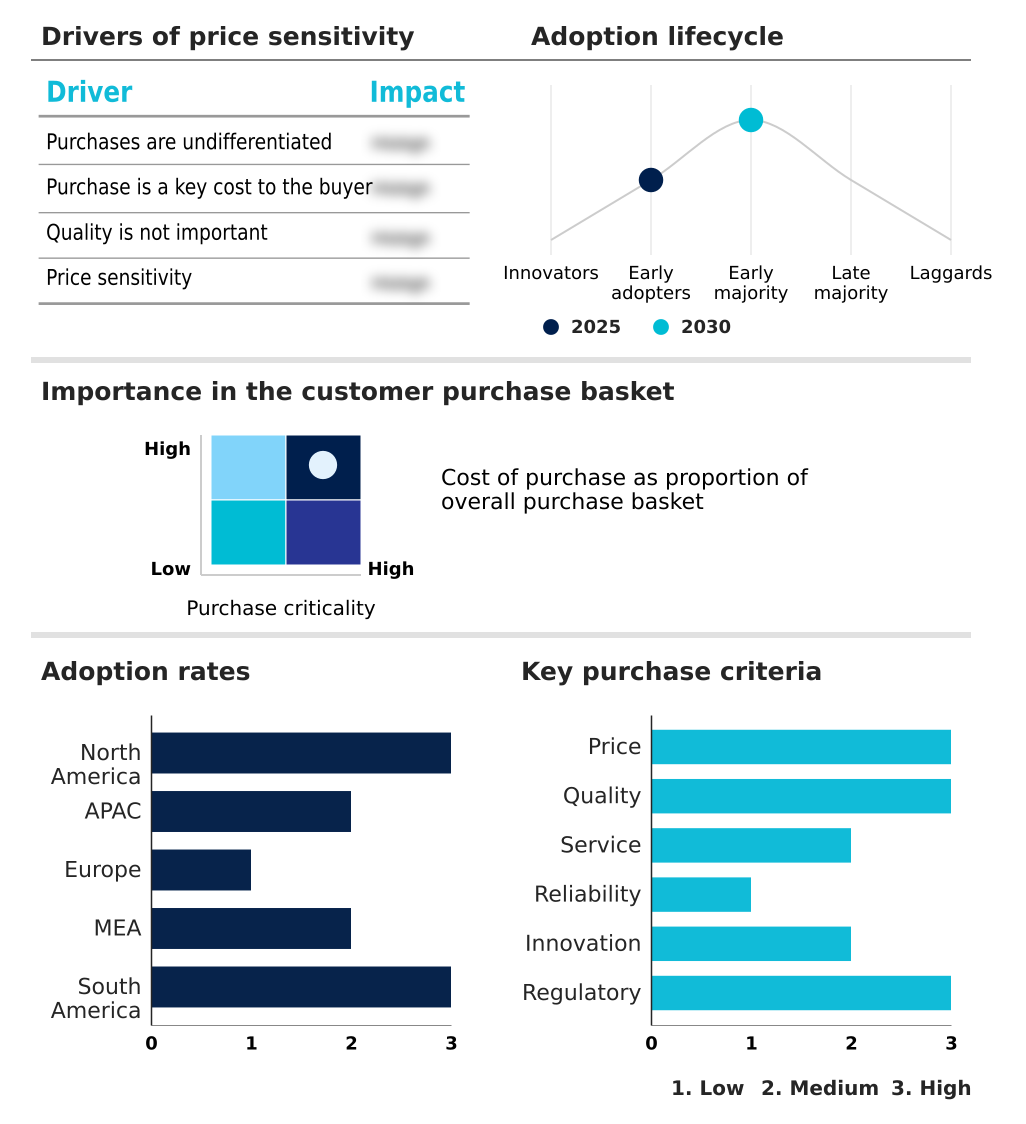
Customer Landscape of Intelligent Remote Terminal Unit Industry
Competitive Landscape
Companies are implementing various strategies, such as strategic alliances, intelligent remote terminal unit market forecast, partnerships, mergers and acquisitions, geographical expansion, and product/service launches, to enhance their presence in the industry.
ABB Ltd. - The manufacturer provides advanced automation hardware, specifically microprocessor-controlled electronic devices engineered for precise telemetry data processing and highly secure remote infrastructure management.
The industry research and growth report includes detailed analyses of the competitive landscape of the market and information about key companies, including:
- ABB Ltd.
- Advantech Co. Ltd.
- Arteche Lantegi Elkartea SA
- Brodersen Systems AS
- Eaton Corp. Plc
- Emerson Electric Co.
- FATEK Automation Corp.
- GE Vernova Inc.
- Hitachi Energy India Ltd.
- HMS Networks AB
- Honeywell International Inc.
- ICP DAS CO. LTD.
- Iskraemeco d.d.
- Mitsubishi Electric Corp.
- Motorola Solutions Inc.
- Moxa Inc.
- OMRON Corp.
- Phoenix Contact GmbH and Co.
- Rockwell Automation Inc.
- Schneider Electric SE
- Schweitzer Engineering
- Siemens AG
- WAGO GmbH and Co. KG
- Yokogawa Electric Corp.
Qualitative and quantitative analysis of companies has been conducted to help clients understand the wider business environment as well as the strengths and weaknesses of key industry players. Data is qualitatively analyzed to categorize companies as pure play, category-focused, industry-focused, and diversified; it is quantitatively analyzed to categorize companies as dominant, leading, strong, tentative, and weak.
Recent Development and News in Intelligent remote terminal unit market
- In the Electrical Components and Equipment industry, the aggressive transition toward decentralized energy generation has necessitated widespread substation automation hardware, directly impacting Intelligent Remote Terminal Unit demand by requiring localized processing capabilities for bidirectional power flow.
- The enforcement of stringent cybersecurity standards for operational technology convergence mandates the integration of hardware-enabled encryption within industrial controllers, compelling utility operators to replace legacy infrastructure with highly secure field devices.
- The rapid expansion of 5G infrastructure and machine-type communications across industrial corridors fundamentally reshapes telemetry capabilities, driving the deployment of hybrid satellite failover and advanced cellular telemetry units to optimize bandwidth consumption optimization.
- Stringent environmental regulations targeting industrial greenhouse gas output have catalyzed the adoption of continuous emissions monitoring systems, increasing the reliance on mission-critical hardware equipped with high-frequency sensor sampling to ensure proactive maintenance strategy execution.
Dive into Technavio’s robust research methodology, blending expert interviews, extensive data synthesis, and validated models for unparalleled Intelligent Remote Terminal Unit Market insights. See full methodology.
| Market Scope | |
|---|---|
| Page number | 314 |
| Base year | 2025 |
| Historic period | 2020-2024 |
| Forecast period | 2026-2030 |
| Growth momentum & CAGR | Accelerate at a CAGR of 7.7% |
| Market growth 2026-2030 | USD 2750.6 million |
| Market structure | Fragmented |
| YoY growth 2025-2026(%) | 7.2% |
| Key countries | US, Canada, Mexico, China, Japan, India, South Korea, Australia, Indonesia, Germany, UK, France, Italy, Spain, The Netherlands, Saudi Arabia, UAE, South Africa, Israel, Turkey, Brazil, Argentina and Chile |
| Competitive landscape | Leading Companies, Market Positioning of Companies, Competitive Strategies, and Industry Risks |
Research Analyst Overview
- The evolution of industrial automation fundamentally relies on the deployment of a highly sophisticated microprocessor-controlled controller to manage complex, distributed infrastructure. A critical trend shaping executive product strategy is the integration of a predictive maintenance algorithm directly into an edge computing node.
- This localization of intelligence allows organizations to process high-frequency diagnostic data on-site, empowering leadership to optimize maintenance budgets and enforce strict safety compliance without expanding operational headcount. By utilizing an industrial ethernet interface combined with a distributed network protocol, facilities achieve seamless telemetry data processing across disparate vendor systems.
- Enterprises implementing these advanced control frameworks report a 40% reduction in unanticipated mechanical failures compared to standard reactive maintenance models. To secure these critical assets, boardrooms mandate the inclusion of a secure cryptographic chip and a dedicated fiber-optic communication port within all newly deployed substation automation hardware.
- This strategic transition ensures autonomous fault isolation capabilities while safeguarding sensitive operational metrics from sophisticated external threats, driving profound efficiency gains across remote industrial environments.
What are the Key Data Covered in this Intelligent Remote Terminal Unit Market Research and Growth Report?
-
What is the expected growth of the Intelligent Remote Terminal Unit Market between 2026 and 2030?
-
USD 2.75 billion, at a CAGR of 7.7%
-
-
What segmentation does the market report cover?
-
The report is segmented by Type (Wireless intelligent RTU, and Wired intelligent RTU), End-user (Oil and gas, Power generation, Water and wastewater, Chemical, and Others), Component (Hardware, Software, and Services) and Geography (North America, APAC, Europe, Middle East and Africa, South America)
-
-
Which regions are analyzed in the report?
-
North America, APAC, Europe, Middle East and Africa and South America
-
-
What are the key growth drivers and market challenges?
-
Acceleration of global smart grid modernization, Cybersecurity vulnerabilities in industrial networks
-
-
Who are the major players in the Intelligent Remote Terminal Unit Market?
-
ABB Ltd., Advantech Co. Ltd., Arteche Lantegi Elkartea SA, Brodersen Systems AS, Eaton Corp. Plc, Emerson Electric Co., FATEK Automation Corp., GE Vernova Inc., Hitachi Energy India Ltd., HMS Networks AB, Honeywell International Inc., ICP DAS CO. LTD., Iskraemeco d.d., Mitsubishi Electric Corp., Motorola Solutions Inc., Moxa Inc., OMRON Corp., Phoenix Contact GmbH and Co., Rockwell Automation Inc., Schneider Electric SE, Schweitzer Engineering, Siemens AG, WAGO GmbH and Co. KG and Yokogawa Electric Corp.
-
Market Research Insights
- The Intelligent Remote Terminal Unit Market relies on mission-critical hardware to execute comprehensive legacy infrastructure modernization across the energy and utility sectors. By integrating secure cloud connectivity, industrial enterprises optimize bandwidth consumption optimization for remote asset tracking. Deploying these units in harsh environmental deployment scenarios has improved real-time grid visibility by 42% compared to traditional polling-based telemetry architectures.
- Furthermore, proactive maintenance strategy implementation has driven a 28% reduction in unplanned downtime reduction across offshore drilling operations. The convergence of operational technology and information technology enables automated fault isolation, ensuring that decentralized node monitoring achieves a 35% higher response accuracy in dynamic industrial environments.
We can help! Our analysts can customize this intelligent remote terminal unit market research report to meet your requirements.
 RIA -