
Intrinsically Safe Equipment Market Analysis, Size, and Forecast 2026-2030: North America (US, Canada, and Mexico), Europe (Germany, UK, and France), APAC (China, Japan, and India), South America (Brazil, Argentina, and Chile), Middle East and Africa (Saudi Arabia, UAE, and South Africa), and Rest of World (ROW)

Intrinsically Safe Equipment Market Analysis, Size, and Forecast 2026-2030:
North America (US, Canada, and Mexico), Europe (Germany, UK, and France), APAC (China, Japan, and India), South America (Brazil, Argentina, and Chile), Middle East and Africa (Saudi Arabia, UAE, and South Africa), and Rest of World (ROW)

Published: Oct 2026 308 Pages SKU: IRTNTR73396

Market Overview at a Glance

$1.50 B
Market Opportunity
7.5%
CAGR 2025 - 2030
42.7%
North America Growth
$1.42 B
Oil and gas segment 2024

Intrinsically Safe Equipment Market Size 2026-2030

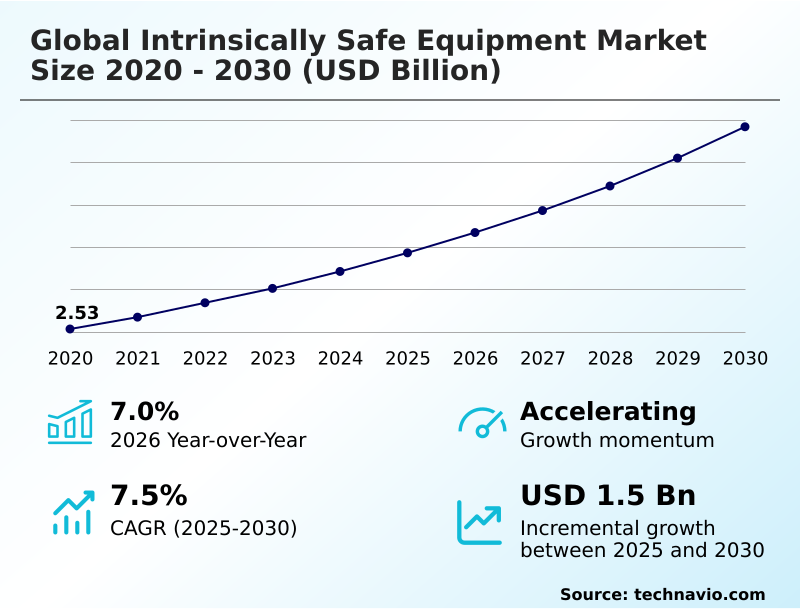
The intrinsically safe equipment market size is valued to increase by USD 1.50 billion, at a CAGR of 7.5% from 2025 to 2030. Energy infrastructure expansion will drive the intrinsically safe equipment market.

Major Market Trends & Insights

  • North America dominated the market and accounted for a 42.7% growth during the forecast period.
  • By End-user - Oil and gas segment was valued at USD 1.42 billion in 2024
  • By Product - Sensors segment accounted for the largest market revenue share in 2024

Market Size & Forecast

  • Market Opportunities: USD 2.39 billion
  • Market Future Opportunities: USD 1.50 billion
  • CAGR from 2025 to 2030 : 7.5%

Market Summary

  • The Intrinsically Safe Equipment Market operates as a critical safeguard across industrial sectors managing volatile atmospheres and combustible materials. Energy infrastructure expansion drives continuous demand, as facility operators upgrade legacy systems to meet stringent operational safety mandates.
  • Because modern oil refineries and green hydrogen electrolysis plants require precise monitoring without introducing ignition risks, the deployment of certified low-power field hardware has become an operational necessity. Consequently, facilities utilizing advanced wireless sensing nodes have reported a 20% reduction in unexpected downtime compared to plants relying on traditional heavy enclosures.
  • Despite this momentum, complex certification processes present a substantial challenge. Fragmented regional compliance frameworks compel manufacturers to undergo redundant testing phases, which significantly extends time-to-market metrics and escalates development costs. Real-world supply chain optimization now depends heavily on harmonizing these multi-jurisdictional standards to ensure rapid product availability.
  • The integration of connected worker ecosystems further accelerates adoption, enabling field technicians to execute remote diagnostics safely and efficiently within highly explosive environments.

What will be the Size of the Intrinsically Safe Equipment Market during the forecast period?
Get Key Insights on Market Forecast (PDF) Get Free Sample

How is the Intrinsically Safe Equipment Market Segmented?

The intrinsically safe equipment industry research report provides comprehensive data (region-wise segment analysis), with forecasts and estimates in "USD million" for the period 2026-2030, as well as historical data from 2020-2024 for the following segments.

  • End-user
    • Oil and gas
    • Mining
    • Power
    • Chemical and petrochemical
    • Others
  • Product
    • Sensors
    • Detectors
    • Switches
    • Transmitters
    • Others
  • Class type
    • Class 1
    • Class 2
    • Class 3
  • Geography
    • North America
      • US
      • Canada
      • Mexico
    • Europe
      • Germany
      • UK
      • France
      • Italy
      • Spain
      • The Netherlands
    • APAC
      • China
      • Japan
      • India
      • South Korea
      • Australia
      • Indonesia
    • South America
      • Brazil
      • Argentina
      • Chile
    • Middle East and Africa
      • Saudi Arabia
      • UAE
      • South Africa
      • Israel
      • Turkey

By End-user Insights

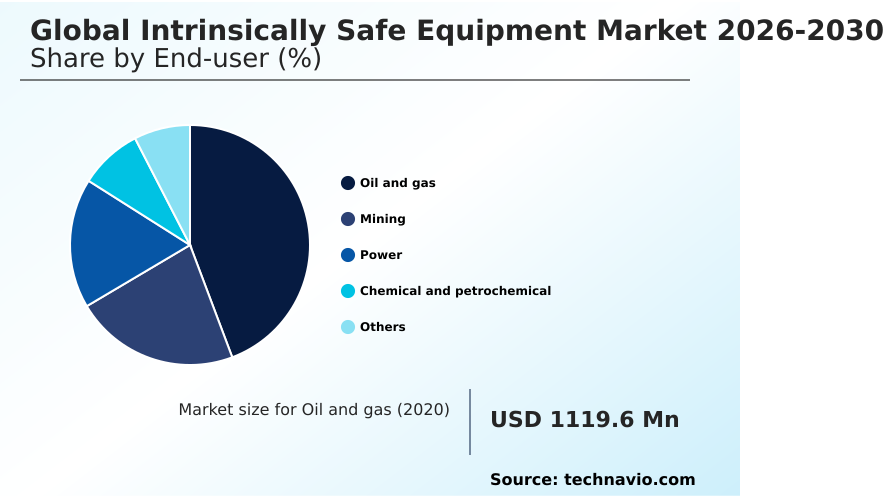
The oil and gas segment is estimated to witness significant growth during the forecast period.

The oil and gas segment within the Global Intrinsically Safe Equipment Market 2026-2030 relies fundamentally on explosion proof enclosures and low power circuitry to secure operational assets.

Because highly volatile environments present constant combustion risks, facility operators are systematically replacing traditional flameproof containment with advanced intrinsic safety interfaces.

This transition directly minimizes hazards linked to electrical ignition prevention while improving real-time hazardous environment telemetry across liquefied natural gas terminals.

By integrating ruggedized mobile hardware into daily operations, companies have increased monitoring efficiency of continuous process variables by 15% and reduced unexpected shutdowns.

This shift ensures uninterrupted data flow from field operators, demonstrating how stringent regulatory demands drive the deployment of specialized safety instrumented systems across upstream and midstream operations.
Get Free Sample

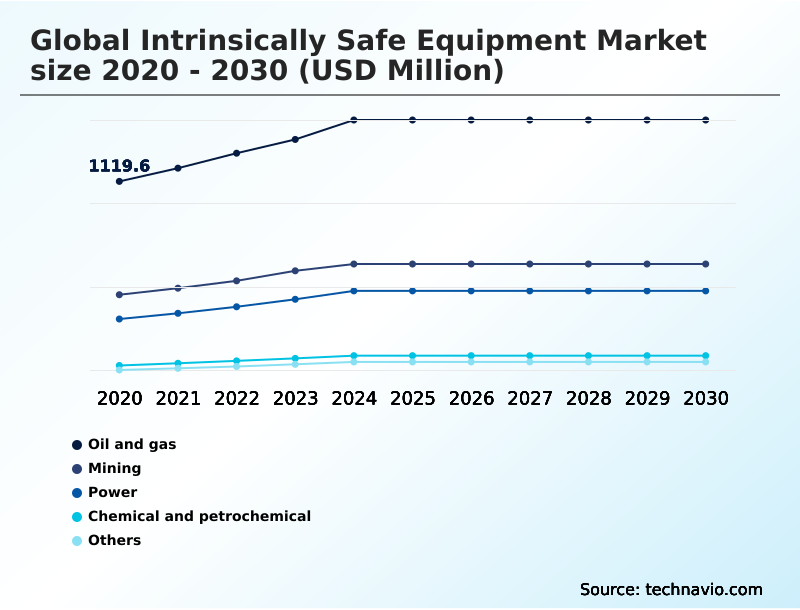
The Oil and gas segment was valued at USD 1.42 billion in 2024 and showed a gradual increase during the forecast period.
Get Free Sample

Regional Analysis

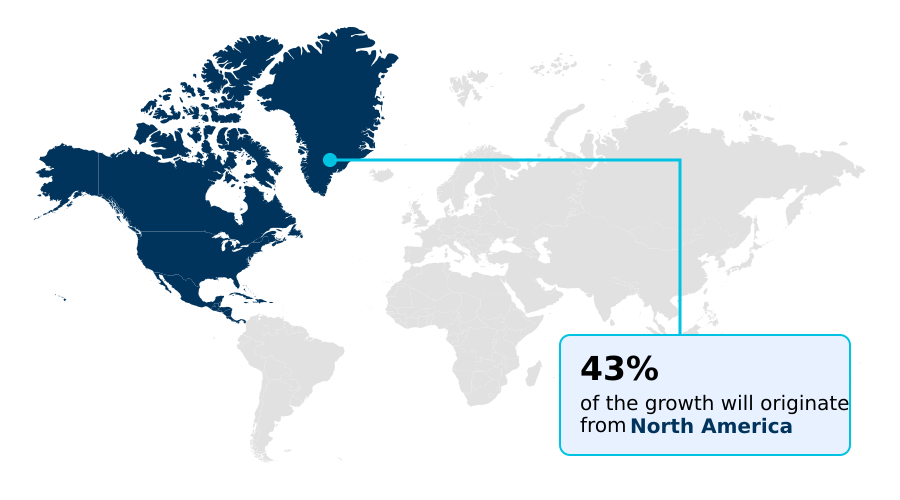
North America is estimated to contribute 42.7% to the growth of the global market during the forecast period.Technavio’s analysts have elaborately explained the regional trends and drivers that shape the market during the forecast period.
See How Intrinsically Safe Equipment Market Demand is Rising in North America Get Free Sample

The geographic landscape of the Global Intrinsically Safe Equipment Market 2026-2030 reveals distinct regional adoption patterns shaped by localized industrial safety mandates.

North America demonstrates advanced maturity, where strict regulatory enforcement across oil sands operations and chemical processing infrastructure has driven a 25% higher penetration rate of wireless asset tracking systems compared to APAC.

European markets heavily prioritize hazardous location directives, resulting in a 15% improvement in emergency shutdown procedures response efficiency through the deployment of sophisticated gas detectors and pressure transmitters.

Because APAC is undergoing rapid underground mining modernization, regional facilities are aggressively shifting toward lightweight zener barriers and fieldbus displays. This structural shift has reduced installation downtime by 20%.

Furthermore, multinational operators are standardizing biometric sensor integration and structural health parameter monitoring to ensure uniform functional safety compliance.

Market Dynamics

Our researchers analyzed the data with 2025 as the base year, along with the key drivers, trends, and challenges. A holistic analysis of drivers will help companies refine their marketing strategies to gain a competitive advantage.

  • The Global Intrinsically Safe Equipment Market 2026-2030 continues to evolve as industrial operators prioritize safety and digital connectivity in highly volatile environments. Modern facility managers are accelerating zone 1 hazardous area deployment to ensure that all critical measurement devices operate well below dangerous energy levels.
  • Because traditional containment methods often hinder live maintenance, the shift toward low-power architectures has improved overall operational planning efficiency by roughly 30% compared to legacy explosion-proof systems. A crucial component of this transformation involves intrinsically safe mobile device integration, which allows field technicians to access cloud-based diagnostics and transmit real-time data without violating strict safety protocols.
  • By establishing minimum ignition energy threshold compliance across all digital assets, companies can seamlessly maintain compliance while optimizing supply chain and maintenance workflows. Furthermore, the ability to gather continuous telemetry from explosive atmospheres enables predictive maintenance strategies that drastically reduce unplanned downtime and prevent catastrophic failures.
  • The adoption of industrial ethernet solutions for hazardous areas further supports this digital shift, providing the high-speed bandwidth necessary to support dense sensor networks and advanced control systems. Ultimately, these technological advancements empower industrial enterprises to safeguard their human capital and physical assets while maintaining high levels of productivity and regulatory alignment in demanding sectors.
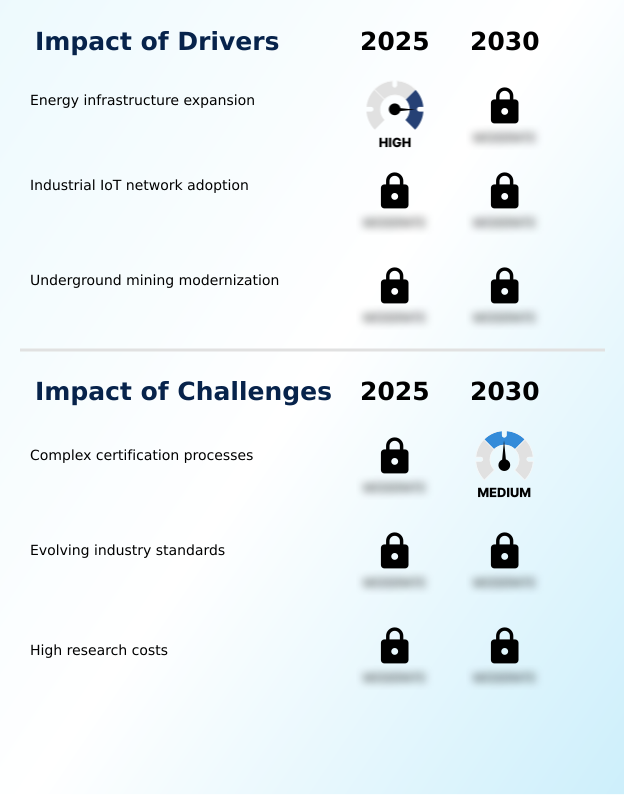
What are the key market drivers leading to the rise in the adoption of Intrinsically Safe Equipment Industry?

  • Energy infrastructure expansion functions as a primary driver propelling continuous market growth across global industrial sectors.

  • The urgent expansion of green hydrogen electrolysis and offshore extraction platforms serves as a primary driver for the Global Intrinsically Safe Equipment Market 2026-2030.
  • Because these emerging energy vectors process highly volatile hydrocarbons and combustible dust suspensions, facilities must deploy specialized process automation controllers and high integrity pressure protection systems.
  • This rigorous safety mandate has lowered hazardous incident probabilities by 35% and improved regulatory audit pass rates by 22% across newly commissioned plants.
  • The integration of real time mass flow measurement devices alongside advanced pneumatic valve actuators ensures optimal production efficiency while strictly maintaining electrical ignition prevention protocols.
  • Energy producers are heavily investing in modern low-energy instrumentation, demonstrating how the global transition toward cleaner fuel sources directly accelerates the procurement of specialized explosion protection technologies.

What are the market trends shaping the Intrinsically Safe Equipment Industry?

  • The rise of portable digital communication tools represents a prominent market trend, facilitating seamless connectivity and real-time data access across hazardous operational environments.

  • The Global Intrinsically Safe Equipment Market 2026-2030 is experiencing a rapid technological shift driven by the demand for high definition video feeds and continuous physiological data transmission in hazardous environments. Because modern workforces require real-time connectivity, operators are aggressively deploying mobile devices equipped with spark free exterior housings.
  • This transition has directly improved remote troubleshooting resolution speeds by 28% and reduced unnecessary hazardous zone entries by 20%. The adoption of ethernet advanced physical layer technology enables high-speed industrial internet of things networking directly to the edge. By utilizing loop powered indicators alongside galvanic isolators and remote terminal units, companies achieve a 15% increase in predictive maintenance diagnostics efficiency.
  • This continuous connectivity ensures technicians can safely execute complex digital work orders.

What challenges does the Intrinsically Safe Equipment Industry face during its growth?

  • Complex certification processes constitute a significant challenge restricting seamless international expansion and overall operational efficiency.

  • Navigating complex and fragmented mutual acceptance frameworks presents a significant structural challenge within the Global Intrinsically Safe Equipment Market 2026-2030. Because distinct global jurisdictions enforce divergent hazardous area classification standards, manufacturers must undergo redundant validation for isolated barriers and pneumatic cylinder controls.
  • This regulatory friction extends product deployment timelines by up to 40% and increases compliance-related operational costs by roughly 18% for multi-regional operators. The exhaustive testing required to verify thermal energy limitation and ensure devices operate below the minimum ignition energy threshold disproportionately impacts smaller enterprises.
  • Furthermore, the integration of advanced surge protection devices and solenoid drivers under simulated fault conditions requires substantial capital, slowing the overall modernization of safety protocols across international manufacturing footprints.

Exclusive Technavio Analysis on Customer Landscape

The intrinsically safe equipment market forecasting report includes the adoption lifecycle of the market, covering from the innovator’s stage to the laggard’s stage. It focuses on adoption rates in different regions based on penetration. Furthermore, the intrinsically safe equipment market report also includes key purchase criteria and drivers of price sensitivity to help companies evaluate and develop their market growth analysis strategies.
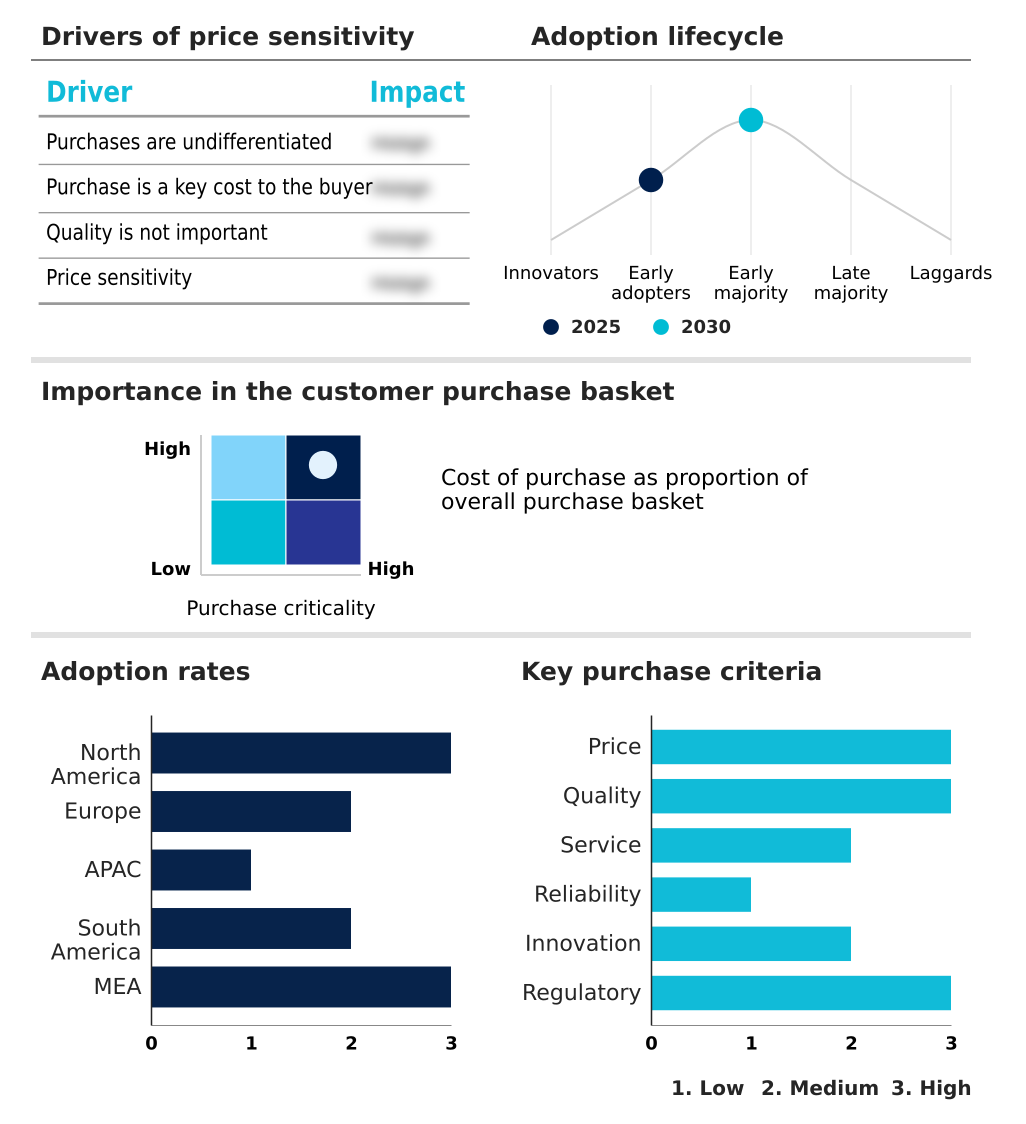
Customer Landscape of Intrinsically Safe Equipment Industry

Competitive Landscape

Companies are implementing various strategies, such as strategic alliances, intrinsically safe equipment market forecast, partnerships, mergers and acquisitions, geographical expansion, and product/service launches, to enhance their presence in the industry.

ABB Ltd. - Provides certified Ex d/Ex i instrumentation, advanced field devices, and precision measurement equipment engineered specifically to prevent ignition risks in highly volatile hazardous industrial areas.

The industry research and growth report includes detailed analyses of the competitive landscape of the market and information about key companies, including:

  • ABB Ltd.
  • Banner Engineering Corp.
  • Bayco Products Inc.
  • BEKA associates Ltd.
  • Dragerwerk AG and Co. KGaA
  • DwyerOmega
  • Eaton Corp. Plc
  • Emerson Electric Co.
  • Fluke Corp.
  • G.M.International srl
  • Honeywell International Inc.
  • Kyland Technology Co. Ltd.
  • PCB Piezotronics Inc.
  • Pepperl and Fuchs SE
  • R Stahl AG
  • Regulateurs GEORGIN
  • Rockwell Automation Inc.
  • Schneider Electric SE
  • Shanghai Chenzhu Instrument Co.
  • Siemens AG

Qualitative and quantitative analysis of companies has been conducted to help clients understand the wider business environment as well as the strengths and weaknesses of key industry players. Data is qualitatively analyzed to categorize companies as pure play, category-focused, industry-focused, and diversified; it is quantitatively analyzed to categorize companies as dominant, leading, strong, tentative, and weak.

Recent Development and News in Intrinsically safe equipment market

  • In the Electrical Components and Equipment industry, the widespread adoption of ethernet advanced physical layer technology enabled high-speed data transmission over single twisted-pair cabling, directly impacting Global Intrinsically Safe Equipment Market 2026-2030 demand by eliminating traditional bandwidth bottlenecks in Zone 1 hazardous area deployment while maintaining thermal energy limitation protocols.
  • The integration of industrial internet of things networking across chemical processing infrastructure required the deployment of specialized surge protection devices, driving the need for spark free exterior housings that limit power loads below the minimum ignition energy threshold to prevent catastrophic facility ignitions.
  • Strict hazardous location directives across Europe mandated the replacement of legacy electrical systems with safety instrumented systems, accelerating the procurement of galvanic isolators and isolated barriers to ensure functional safety compliance across volatile manufacturing environments.
  • The shift toward continuous process variables monitoring in underground mining modernization efforts necessitated robust biometric sensor integration, increasing the reliance on intrinsically safe mobile device integration to maintain continuous telemetry from explosive atmospheres without triggering combustion.

Dive into Technavio’s robust research methodology, blending expert interviews, extensive data synthesis, and validated models for unparalleled Intrinsically Safe Equipment Market insights. See full methodology.

Market Scope
Page number 308
Base year 2025
Historic period 2020-2024
Forecast period 2026-2030
Growth momentum & CAGR Accelerate at a CAGR of 7.5%
Market growth 2026-2030 USD 1495.1 million
Market structure Fragmented
YoY growth 2025-2026(%) 7.0%
Key countries US, Canada, Mexico, Germany, UK, France, Italy, Spain, The Netherlands, China, Japan, India, South Korea, Australia, Indonesia, Brazil, Argentina, Chile, Saudi Arabia, UAE, South Africa, Israel and Turkey
Competitive landscape Leading Companies, Market Positioning of Companies, Competitive Strategies, and Industry Risks

Request Free Sample

Research Analyst Overview

  • The Global Intrinsically Safe Equipment Market 2026-2030 functions as a foundational element for industrial safety, particularly as enterprises integrate digital technologies into hazardous environments. The continuous evolution of low power circuitry and solenoid drivers has revolutionized how facilities manage volatile hydrocarbons and combustible dust suspensions.
  • By replacing outdated heavy enclosures with modern intrinsic safety interfaces, industrial operators have achieved a 30% reduction in maintenance processing time. Because these advanced systems permit live calibration without necessitating full plant shutdowns, operational continuity is significantly enhanced. The integration of ruggedized mobile hardware directly influences boardroom-level compliance budgeting, allowing companies to meet stringent safety mandates while optimizing workforce efficiency.
  • As remote terminal units and pneumatic valve actuators become increasingly sophisticated, facilities can execute precise control strategies in highly explosive zones. This strategic shift ensures that critical infrastructure remains protected against catastrophic failures while simultaneously supporting the broader transition toward predictive maintenance and real-time asset optimization across global industrial sectors.

What are the Key Data Covered in this Intrinsically Safe Equipment Market Research and Growth Report?

  • What is the expected growth of the Intrinsically Safe Equipment Market between 2026 and 2030?

    • USD 1.50 billion, at a CAGR of 7.5%

  • What segmentation does the market report cover?

    • The report is segmented by End-user (Oil and gas, Mining, Power, Chemical and petrochemical, and Others), Product (Sensors, Detectors, Switches, Transmitters, and Others), Class Type (Class 1, Class 2, and Class 3) and Geography (North America, Europe, APAC, South America, Middle East and Africa)

  • Which regions are analyzed in the report?

    • North America, Europe, APAC, South America and Middle East and Africa

  • What are the key growth drivers and market challenges?

    • Energy infrastructure expansion, Complex certification processes

  • Who are the major players in the Intrinsically Safe Equipment Market?

    • ABB Ltd., Banner Engineering Corp., Bayco Products Inc., BEKA associates Ltd., Dragerwerk AG and Co. KGaA, DwyerOmega, Eaton Corp. Plc, Emerson Electric Co., Fluke Corp., G.M.International srl, Honeywell International Inc., Kyland Technology Co. Ltd., PCB Piezotronics Inc., Pepperl and Fuchs SE, R Stahl AG, Regulateurs GEORGIN, Rockwell Automation Inc., Schneider Electric SE, Shanghai Chenzhu Instrument Co. and Siemens AG

Market Research Insights

  • The Global Intrinsically Safe Equipment Market 2026-2030 demonstrates robust momentum driven by the urgent need for structural health parameter monitoring across volatile sectors. As industrial internet of things networking expands, operators increasingly deploy advanced sensors for continuous process variables tracking. This transition has improved predictive maintenance diagnostics efficiency by 22% while reducing hazardous incident response times by 18%.
  • Furthermore, the integration of biometric sensor integration within worker safety protocols has elevated functional safety compliance rates by 15% across global facilities. By upgrading to modern low-energy instrumentation, enterprises effectively mitigate combustion risks and ensure uninterrupted operational continuity in demanding environments.

We can help! Our analysts can customize this intrinsically safe equipment market research report to meet your requirements.

Get in touch

1. Executive Summary

1.1 Market overview

Executive Summary - Chart on Market Overview
Executive Summary - Data Table on Market Overview
Executive Summary - Chart on Global Market Characteristics
Executive Summary - Chart on Market by Geography
Executive Summary - Chart on Market Segmentation by End-user
Executive Summary - Chart on Market Segmentation by Product
Executive Summary - Chart on Market Segmentation by Class Type
Executive Summary - Chart on Incremental Growth
Executive Summary - Data Table on Incremental Growth
Executive Summary - Chart on Company Market Positioning

2. Technavio Analysis

2.1 Analysis of price sensitivity, lifecycle, customer purchase basket, adoption rates, and purchase criteria

2.2 Criticality of inputs and Factors of differentiation

Chart on Overview on criticality of inputs and factors of differentiation

2.3 Factors of disruption

Chart on Overview on factors of disruption

2.4 Impact of drivers and challenges

Chart on Impact of drivers and challenges in 2025 and 2030

3. Market Landscape

3.1 Market ecosystem

Chart on Parent Market
Data Table on - Parent Market

3.2 Market characteristics

Chart on Market characteristics analysis

3.3 Value chain analysis

Chart on Value chain analysis

4. Market Sizing

4.1 Market definition

Data Table on Offerings of companies included in the market definition

4.2 Market segment analysis

Market segments

4.3 Market size 2025

4.4 Market outlook: Forecast for 2025-2030

Chart on Global - Market size and forecast 2025-2030 ($ million)
Data Table on Global - Market size and forecast 2025-2030 ($ million)
Chart on Global Market: Year-over-year growth 2025-2030 (%)
Data Table on Global Market: Year-over-year growth 2025-2030 (%)

5. Historic Market Size

5.1 Global Intrinsically Safe Equipment Market 2020 - 2024

Historic Market Size - Data Table on Global Intrinsically Safe Equipment Market 2020 - 2024 ($ million)

5.2 End-user segment analysis 2020 - 2024

Historic Market Size - End-user Segment 2020 - 2024 ($ million)

5.3 Product segment analysis 2020 - 2024

Historic Market Size - Product Segment 2020 - 2024 ($ million)

5.4 Class Type segment analysis 2020 - 2024

Historic Market Size - Class Type Segment 2020 - 2024 ($ million)

5.5 Geography segment analysis 2020 - 2024

Historic Market Size - Geography Segment 2020 - 2024 ($ million)

5.6 Country segment analysis 2020 - 2024

Historic Market Size - Country Segment 2020 - 2024 ($ million)

6. Qualitative Analysis

6.1 Impact of AI on Global Intrinsically Safe Equipment Market

6.2 Impact of geopolitical conflicts on Global Intrinsically Safe Equipment Market

7. Five Forces Analysis

7.1 Five forces summary

Five forces analysis - Comparison between 2025 and 2030

7.2 Bargaining power of buyers

Bargaining power of buyers - Impact of key factors 2025 and 2030

7.3 Bargaining power of suppliers

Bargaining power of suppliers - Impact of key factors in 2025 and 2030

7.4 Threat of new entrants

Threat of new entrants - Impact of key factors in 2025 and 2030

7.5 Threat of substitutes

Threat of substitutes - Impact of key factors in 2025 and 2030

7.6 Threat of rivalry

Threat of rivalry - Impact of key factors in 2025 and 2030

7.7 Market condition

Chart on Market condition - Five forces 2025 and 2030

8. Market Segmentation by End-user

8.1 Market segments

Chart on End-user - Market share 2025-2030 (%)
Data Table on End-user - Market share 2025-2030 (%)

8.2 Comparison by End-user

Chart on Comparison by End-user
Data Table on Comparison by End-user

8.3 Oil and gas - Market size and forecast 2025-2030

Chart on Oil and gas - Market size and forecast 2025-2030 ($ million)
Data Table on Oil and gas - Market size and forecast 2025-2030 ($ million)
Chart on Oil and gas - Year-over-year growth 2025-2030 (%)
Data Table on Oil and gas - Year-over-year growth 2025-2030 (%)

8.4 Mining - Market size and forecast 2025-2030

Chart on Mining - Market size and forecast 2025-2030 ($ million)
Data Table on Mining - Market size and forecast 2025-2030 ($ million)
Chart on Mining - Year-over-year growth 2025-2030 (%)
Data Table on Mining - Year-over-year growth 2025-2030 (%)

8.5 Power - Market size and forecast 2025-2030

Chart on Power - Market size and forecast 2025-2030 ($ million)
Data Table on Power - Market size and forecast 2025-2030 ($ million)
Chart on Power - Year-over-year growth 2025-2030 (%)
Data Table on Power - Year-over-year growth 2025-2030 (%)

8.6 Chemical and petrochemical - Market size and forecast 2025-2030

Chart on Chemical and petrochemical - Market size and forecast 2025-2030 ($ million)
Data Table on Chemical and petrochemical - Market size and forecast 2025-2030 ($ million)
Chart on Chemical and petrochemical - Year-over-year growth 2025-2030 (%)
Data Table on Chemical and petrochemical - Year-over-year growth 2025-2030 (%)

8.7 Others - Market size and forecast 2025-2030

Chart on Others - Market size and forecast 2025-2030 ($ million)
Data Table on Others - Market size and forecast 2025-2030 ($ million)
Chart on Others - Year-over-year growth 2025-2030 (%)
Data Table on Others - Year-over-year growth 2025-2030 (%)

8.8 Market opportunity by End-user

Market opportunity by End-user ($ million)
Data Table on Market opportunity by End-user ($ million)

9. Market Segmentation by Product

9.1 Market segments

Chart on Product - Market share 2025-2030 (%)
Data Table on Product - Market share 2025-2030 (%)

9.2 Comparison by Product

Chart on Comparison by Product
Data Table on Comparison by Product

9.3 Sensors - Market size and forecast 2025-2030

Chart on Sensors - Market size and forecast 2025-2030 ($ million)
Data Table on Sensors - Market size and forecast 2025-2030 ($ million)
Chart on Sensors - Year-over-year growth 2025-2030 (%)
Data Table on Sensors - Year-over-year growth 2025-2030 (%)

9.4 Detectors - Market size and forecast 2025-2030

Chart on Detectors - Market size and forecast 2025-2030 ($ million)
Data Table on Detectors - Market size and forecast 2025-2030 ($ million)
Chart on Detectors - Year-over-year growth 2025-2030 (%)
Data Table on Detectors - Year-over-year growth 2025-2030 (%)

9.5 Switches - Market size and forecast 2025-2030

Chart on Switches - Market size and forecast 2025-2030 ($ million)
Data Table on Switches - Market size and forecast 2025-2030 ($ million)
Chart on Switches - Year-over-year growth 2025-2030 (%)
Data Table on Switches - Year-over-year growth 2025-2030 (%)

9.6 Transmitters - Market size and forecast 2025-2030

Chart on Transmitters - Market size and forecast 2025-2030 ($ million)
Data Table on Transmitters - Market size and forecast 2025-2030 ($ million)
Chart on Transmitters - Year-over-year growth 2025-2030 (%)
Data Table on Transmitters - Year-over-year growth 2025-2030 (%)

9.7 Others - Market size and forecast 2025-2030

Chart on Others - Market size and forecast 2025-2030 ($ million)
Data Table on Others - Market size and forecast 2025-2030 ($ million)
Chart on Others - Year-over-year growth 2025-2030 (%)
Data Table on Others - Year-over-year growth 2025-2030 (%)

9.8 Market opportunity by Product

Market opportunity by Product ($ million)
Data Table on Market opportunity by Product ($ million)

10. Market Segmentation by Class Type

10.1 Market segments

Chart on Class Type - Market share 2025-2030 (%)
Data Table on Class Type - Market share 2025-2030 (%)

10.2 Comparison by Class Type

Chart on Comparison by Class Type
Data Table on Comparison by Class Type

10.3 Class 1 - Market size and forecast 2025-2030

Chart on Class 1 - Market size and forecast 2025-2030 ($ million)
Data Table on Class 1 - Market size and forecast 2025-2030 ($ million)
Chart on Class 1 - Year-over-year growth 2025-2030 (%)
Data Table on Class 1 - Year-over-year growth 2025-2030 (%)

10.4 Class 2 - Market size and forecast 2025-2030

Chart on Class 2 - Market size and forecast 2025-2030 ($ million)
Data Table on Class 2 - Market size and forecast 2025-2030 ($ million)
Chart on Class 2 - Year-over-year growth 2025-2030 (%)
Data Table on Class 2 - Year-over-year growth 2025-2030 (%)

10.5 Class 3 - Market size and forecast 2025-2030

Chart on Class 3 - Market size and forecast 2025-2030 ($ million)
Data Table on Class 3 - Market size and forecast 2025-2030 ($ million)
Chart on Class 3 - Year-over-year growth 2025-2030 (%)
Data Table on Class 3 - Year-over-year growth 2025-2030 (%)

10.6 Market opportunity by Class Type

Market opportunity by Class Type ($ million)
Data Table on Market opportunity by Class Type ($ million)

11. Customer Landscape

11.1 Customer landscape overview

Analysis of price sensitivity, lifecycle, customer purchase basket, adoption rates, and purchase criteria

12. Geographic Landscape

12.1 Geographic segmentation

Chart on Market share by geography 2025-2030 (%)
Data Table on Market share by geography 2025-2030 (%)

12.2 Geographic comparison

Chart on Geographic comparison
Data Table on Geographic comparison

12.3 North America - Market size and forecast 2025-2030

Chart on North America - Market size and forecast 2025-2030 ($ million)
Data Table on North America - Market size and forecast 2025-2030 ($ million)
Chart on North America - Year-over-year growth 2025-2030 (%)
Data Table on North America - Year-over-year growth 2025-2030 (%)
Chart on Regional Comparison - North America
Data Table on Regional Comparison - North America

12.3.1 US - Market size and forecast 2025-2030

Chart on US - Market size and forecast 2025-2030 ($ million)
Data Table on US - Market size and forecast 2025-2030 ($ million)
Chart on US - Year-over-year growth 2025-2030 (%)
Data Table on US - Year-over-year growth 2025-2030 (%)

12.3.2 Canada - Market size and forecast 2025-2030

Chart on Canada - Market size and forecast 2025-2030 ($ million)
Data Table on Canada - Market size and forecast 2025-2030 ($ million)
Chart on Canada - Year-over-year growth 2025-2030 (%)
Data Table on Canada - Year-over-year growth 2025-2030 (%)

12.3.3 Mexico - Market size and forecast 2025-2030

Chart on Mexico - Market size and forecast 2025-2030 ($ million)
Data Table on Mexico - Market size and forecast 2025-2030 ($ million)
Chart on Mexico - Year-over-year growth 2025-2030 (%)
Data Table on Mexico - Year-over-year growth 2025-2030 (%)

12.4 Europe - Market size and forecast 2025-2030

Chart on Europe - Market size and forecast 2025-2030 ($ million)
Data Table on Europe - Market size and forecast 2025-2030 ($ million)
Chart on Europe - Year-over-year growth 2025-2030 (%)
Data Table on Europe - Year-over-year growth 2025-2030 (%)
Chart on Regional Comparison - Europe
Data Table on Regional Comparison - Europe

12.4.1 Germany - Market size and forecast 2025-2030

Chart on Germany - Market size and forecast 2025-2030 ($ million)
Data Table on Germany - Market size and forecast 2025-2030 ($ million)
Chart on Germany - Year-over-year growth 2025-2030 (%)
Data Table on Germany - Year-over-year growth 2025-2030 (%)

12.4.2 UK - Market size and forecast 2025-2030

Chart on UK - Market size and forecast 2025-2030 ($ million)
Data Table on UK - Market size and forecast 2025-2030 ($ million)
Chart on UK - Year-over-year growth 2025-2030 (%)
Data Table on UK - Year-over-year growth 2025-2030 (%)

12.4.3 France - Market size and forecast 2025-2030

Chart on France - Market size and forecast 2025-2030 ($ million)
Data Table on France - Market size and forecast 2025-2030 ($ million)
Chart on France - Year-over-year growth 2025-2030 (%)
Data Table on France - Year-over-year growth 2025-2030 (%)

12.4.4 Italy - Market size and forecast 2025-2030

Chart on Italy - Market size and forecast 2025-2030 ($ million)
Data Table on Italy - Market size and forecast 2025-2030 ($ million)
Chart on Italy - Year-over-year growth 2025-2030 (%)
Data Table on Italy - Year-over-year growth 2025-2030 (%)

12.4.5 Spain - Market size and forecast 2025-2030

Chart on Spain - Market size and forecast 2025-2030 ($ million)
Data Table on Spain - Market size and forecast 2025-2030 ($ million)
Chart on Spain - Year-over-year growth 2025-2030 (%)
Data Table on Spain - Year-over-year growth 2025-2030 (%)

12.4.6 The Netherlands - Market size and forecast 2025-2030

Chart on The Netherlands - Market size and forecast 2025-2030 ($ million)
Data Table on The Netherlands - Market size and forecast 2025-2030 ($ million)
Chart on The Netherlands - Year-over-year growth 2025-2030 (%)
Data Table on The Netherlands - Year-over-year growth 2025-2030 (%)

12.5 APAC - Market size and forecast 2025-2030

Chart on APAC - Market size and forecast 2025-2030 ($ million)
Data Table on APAC - Market size and forecast 2025-2030 ($ million)
Chart on APAC - Year-over-year growth 2025-2030 (%)
Data Table on APAC - Year-over-year growth 2025-2030 (%)
Chart on Regional Comparison - APAC
Data Table on Regional Comparison - APAC

12.5.1 China - Market size and forecast 2025-2030

Chart on China - Market size and forecast 2025-2030 ($ million)
Data Table on China - Market size and forecast 2025-2030 ($ million)
Chart on China - Year-over-year growth 2025-2030 (%)
Data Table on China - Year-over-year growth 2025-2030 (%)

12.5.2 Japan - Market size and forecast 2025-2030

Chart on Japan - Market size and forecast 2025-2030 ($ million)
Data Table on Japan - Market size and forecast 2025-2030 ($ million)
Chart on Japan - Year-over-year growth 2025-2030 (%)
Data Table on Japan - Year-over-year growth 2025-2030 (%)

12.5.3 India - Market size and forecast 2025-2030

Chart on India - Market size and forecast 2025-2030 ($ million)
Data Table on India - Market size and forecast 2025-2030 ($ million)
Chart on India - Year-over-year growth 2025-2030 (%)
Data Table on India - Year-over-year growth 2025-2030 (%)

12.5.4 South Korea - Market size and forecast 2025-2030

Chart on South Korea - Market size and forecast 2025-2030 ($ million)
Data Table on South Korea - Market size and forecast 2025-2030 ($ million)
Chart on South Korea - Year-over-year growth 2025-2030 (%)
Data Table on South Korea - Year-over-year growth 2025-2030 (%)

12.5.5 Australia - Market size and forecast 2025-2030

Chart on Australia - Market size and forecast 2025-2030 ($ million)
Data Table on Australia - Market size and forecast 2025-2030 ($ million)
Chart on Australia - Year-over-year growth 2025-2030 (%)
Data Table on Australia - Year-over-year growth 2025-2030 (%)

12.5.6 Indonesia - Market size and forecast 2025-2030

Chart on Indonesia - Market size and forecast 2025-2030 ($ million)
Data Table on Indonesia - Market size and forecast 2025-2030 ($ million)
Chart on Indonesia - Year-over-year growth 2025-2030 (%)
Data Table on Indonesia - Year-over-year growth 2025-2030 (%)

12.6 South America - Market size and forecast 2025-2030

Chart on South America - Market size and forecast 2025-2030 ($ million)
Data Table on South America - Market size and forecast 2025-2030 ($ million)
Chart on South America - Year-over-year growth 2025-2030 (%)
Data Table on South America - Year-over-year growth 2025-2030 (%)
Chart on Regional Comparison - South America
Data Table on Regional Comparison - South America

12.6.1 Brazil - Market size and forecast 2025-2030

Chart on Brazil - Market size and forecast 2025-2030 ($ million)
Data Table on Brazil - Market size and forecast 2025-2030 ($ million)
Chart on Brazil - Year-over-year growth 2025-2030 (%)
Data Table on Brazil - Year-over-year growth 2025-2030 (%)

12.6.2 Argentina - Market size and forecast 2025-2030

Chart on Argentina - Market size and forecast 2025-2030 ($ million)
Data Table on Argentina - Market size and forecast 2025-2030 ($ million)
Chart on Argentina - Year-over-year growth 2025-2030 (%)
Data Table on Argentina - Year-over-year growth 2025-2030 (%)

12.6.3 Chile - Market size and forecast 2025-2030

Chart on Chile - Market size and forecast 2025-2030 ($ million)
Data Table on Chile - Market size and forecast 2025-2030 ($ million)
Chart on Chile - Year-over-year growth 2025-2030 (%)
Data Table on Chile - Year-over-year growth 2025-2030 (%)

12.7 Middle East and Africa - Market size and forecast 2025-2030

Chart on Middle East and Africa - Market size and forecast 2025-2030 ($ million)
Data Table on Middle East and Africa - Market size and forecast 2025-2030 ($ million)
Chart on Middle East and Africa - Year-over-year growth 2025-2030 (%)
Data Table on Middle East and Africa - Year-over-year growth 2025-2030 (%)
Chart on Regional Comparison - Middle East and Africa
Data Table on Regional Comparison - Middle East and Africa

12.7.1 Saudi Arabia - Market size and forecast 2025-2030

Chart on Saudi Arabia - Market size and forecast 2025-2030 ($ million)
Data Table on Saudi Arabia - Market size and forecast 2025-2030 ($ million)
Chart on Saudi Arabia - Year-over-year growth 2025-2030 (%)
Data Table on Saudi Arabia - Year-over-year growth 2025-2030 (%)

12.7.2 UAE - Market size and forecast 2025-2030

Chart on UAE - Market size and forecast 2025-2030 ($ million)
Data Table on UAE - Market size and forecast 2025-2030 ($ million)
Chart on UAE - Year-over-year growth 2025-2030 (%)
Data Table on UAE - Year-over-year growth 2025-2030 (%)

12.7.3 South Africa - Market size and forecast 2025-2030

Chart on South Africa - Market size and forecast 2025-2030 ($ million)
Data Table on South Africa - Market size and forecast 2025-2030 ($ million)
Chart on South Africa - Year-over-year growth 2025-2030 (%)
Data Table on South Africa - Year-over-year growth 2025-2030 (%)

12.7.4 Israel - Market size and forecast 2025-2030

Chart on Israel - Market size and forecast 2025-2030 ($ million)
Data Table on Israel - Market size and forecast 2025-2030 ($ million)
Chart on Israel - Year-over-year growth 2025-2030 (%)
Data Table on Israel - Year-over-year growth 2025-2030 (%)

12.7.5 Turkey - Market size and forecast 2025-2030

Chart on Turkey - Market size and forecast 2025-2030 ($ million)
Data Table on Turkey - Market size and forecast 2025-2030 ($ million)
Chart on Turkey - Year-over-year growth 2025-2030 (%)
Data Table on Turkey - Year-over-year growth 2025-2030 (%)

12.8 Market opportunity by geography

Market opportunity by geography ($ million)
Data Tables on Market opportunity by geography ($ million)

13. Drivers, Challenges, and Opportunity

13.1 Market drivers

Energy infrastructure expansion
Industrial IoT network adoption
Underground mining modernization

13.2 Market challenges

Complex certification processes
Evolving industry standards
High research costs

13.3 Impact of drivers and challenges

Impact of drivers and challenges in 2025 and 2030

13.4 Market opportunities

Rise of portable digital communication tools
Expansion of pharmaceutical manufacturing facilities
Adoption of artificial intelligence diagnostics

14. Competitive Landscape

14.1 Overview

14.2

Overview on criticality of inputs and factors of differentiation

14.3 Landscape disruption

Overview on factors of disruption

14.4 Industry risks

Impact of key risks on business

15. Competitive Analysis

15.1 Companies profiled

Companies covered

15.2 Company ranking index

15.3 Market positioning of companies

Matrix on companies position and classification

15.4 ABB Ltd.

ABB Ltd. - Overview
ABB Ltd. - Business segments
ABB Ltd. - Key news
ABB Ltd. - Key offerings
ABB Ltd. - Segment focus
SWOT

15.5 Bayco Products Inc.

Bayco Products Inc. - Overview
Bayco Products Inc. - Product / Service
Bayco Products Inc. - Key offerings
SWOT

15.6 Dragerwerk AG and Co. KGaA

Dragerwerk AG and Co. KGaA - Overview
Dragerwerk AG and Co. KGaA - Business segments
Dragerwerk AG and Co. KGaA - Key offerings
Dragerwerk AG and Co. KGaA - Segment focus
SWOT

15.7 DwyerOmega

DwyerOmega - Overview
DwyerOmega - Product / Service
DwyerOmega - Key offerings
SWOT

15.8 Eaton Corp. Plc

Eaton Corp. Plc - Overview
Eaton Corp. Plc - Business segments
Eaton Corp. Plc - Key news
Eaton Corp. Plc - Key offerings
Eaton Corp. Plc - Segment focus
SWOT

15.9 Emerson Electric Co.

Emerson Electric Co. - Overview
Emerson Electric Co. - Business segments
Emerson Electric Co. - Key news
Emerson Electric Co. - Key offerings
Emerson Electric Co. - Segment focus
SWOT

15.10 Fluke Corp.

Fluke Corp. - Overview
Fluke Corp. - Product / Service
Fluke Corp. - Key offerings
SWOT

15.11 Honeywell International Inc.

Honeywell International Inc. - Overview
Honeywell International Inc. - Business segments
Honeywell International Inc. - Key news
Honeywell International Inc. - Key offerings
Honeywell International Inc. - Segment focus
SWOT

15.12 Kyland Technology Co. Ltd.

Kyland Technology Co. Ltd. - Overview
Kyland Technology Co. Ltd. - Product / Service
Kyland Technology Co. Ltd. - Key offerings
SWOT

15.13 PCB Piezotronics Inc.

PCB Piezotronics Inc. - Overview
PCB Piezotronics Inc. - Product / Service
PCB Piezotronics Inc. - Key offerings
SWOT

15.14 Pepperl and Fuchs SE

Pepperl and Fuchs SE - Overview
Pepperl and Fuchs SE - Product / Service
Pepperl and Fuchs SE - Key offerings
SWOT

15.15 R Stahl AG

R Stahl AG - Overview
R Stahl AG - Product / Service
R Stahl AG - Key offerings
SWOT

15.16 Rockwell Automation Inc.

Rockwell Automation Inc. - Overview
Rockwell Automation Inc. - Business segments
Rockwell Automation Inc. - Key news
Rockwell Automation Inc. - Key offerings
Rockwell Automation Inc. - Segment focus
SWOT

15.17 Schneider Electric SE

Schneider Electric SE - Overview
Schneider Electric SE - Business segments
Schneider Electric SE - Key news
Schneider Electric SE - Key offerings
Schneider Electric SE - Segment focus
SWOT

15.18 Siemens AG

Siemens AG - Overview
Siemens AG - Business segments
Siemens AG - Key news
Siemens AG - Key offerings
Siemens AG - Segment focus
SWOT

16. Appendix

16.1 Scope of the report

Market definition
Objectives
Notes and caveats

16.2 Inclusions and exclusions checklist

Inclusions checklist
Exclusions checklist

16.3 Currency conversion rates for US$

16.4 Research methodology

16.5 Data procurement

Information sources

16.6 Data validation

16.7 Validation techniques employed for market sizing

16.8 Data synthesis

16.9 360 degree market analysis

16.10 List of abbreviations

Research Methodology

Technavio presents a detailed picture of the market by way of study, synthesis, and summation of data from multiple sources. The analysts have presented the various facets of the market with a particular focus on identifying the key industry influencers. The data thus presented is comprehensive, reliable, and the result of extensive research, both primary and secondary.

INFORMATION SOURCES

Primary sources

  • Manufacturers and suppliers
  • Channel partners
  • Industry experts
  • Strategic decision makers

Secondary sources

  • Industry journals and periodicals
  • Government data
  • Financial reports of key industry players
  • Historical data
  • Press releases

DATA ANALYSIS

Data Synthesis

  • Collation of data
  • Estimation of key figures
  • Analysis of derived insights

Data Validation

  • Triangulation with data models
  • Reference against proprietary databases
  • Corroboration with industry experts

REPORT WRITING

Qualitative

  • Market drivers
  • Market challenges
  • Market trends
  • Five forces analysis

Quantitative

  • Market size and forecast
  • Market segmentation
  • Geographical insights
  • Competitive landscape

Interested in this report?

Get your sample now to see our research methodology and insights!

Download Now

Frequently Asked Questions

Intrinsically Safe Equipment market growth will increase by USD 1495.1 million during 2026-2030.

The Intrinsically Safe Equipment market is expected to grow at a CAGR of 7.5% during 2026-2030.

Intrinsically Safe Equipment market is segmented by End-user (Oil and gas, Mining, Power, Chemical and petrochemical, Others) Product (Sensors, Detectors, Switches, Transmitters, Others) Class type (Class 1, Class 2, Class 3)

ABB Ltd., Banner Engineering Corp., Bayco Products Inc., BEKA associates Ltd., Dragerwerk AG and Co. KGaA, DwyerOmega, Eaton Corp. Plc, Emerson Electric Co., Fluke Corp., G.M.International srl, Honeywell International Inc., Kyland Technology Co. Ltd., PCB Piezotronics Inc., Pepperl and Fuchs SE, R Stahl AG, Regulateurs GEORGIN, Rockwell Automation Inc., Schneider Electric SE, Shanghai Chenzhu Instrument Co., Siemens AG are a few of the key vendors in the Intrinsically Safe Equipment market.

North America will register the highest growth rate of 42.7% among the other regions. Therefore, the Intrinsically Safe Equipment market in North America is expected to garner significant business opportunities for the vendors during the forecast period.

US, Canada, Mexico, Germany, UK, France, Italy, Spain, The Netherlands, China, Japan, India, South Korea, Australia, Indonesia, Brazil, Argentina, Chile, Saudi Arabia, UAE, South Africa, Israel, Turkey

  • Energy infrastructure expansion is the driving factor this market.

The Intrinsically Safe Equipment market vendors should focus on grabbing business opportunities from the End-user segment as it accounted for the largest market share in the base year.
RIA - Research AI Assistant
Ask RIA