



Multimodal Ai Development Platforms Market Size and Growth Forecast 2026-2030
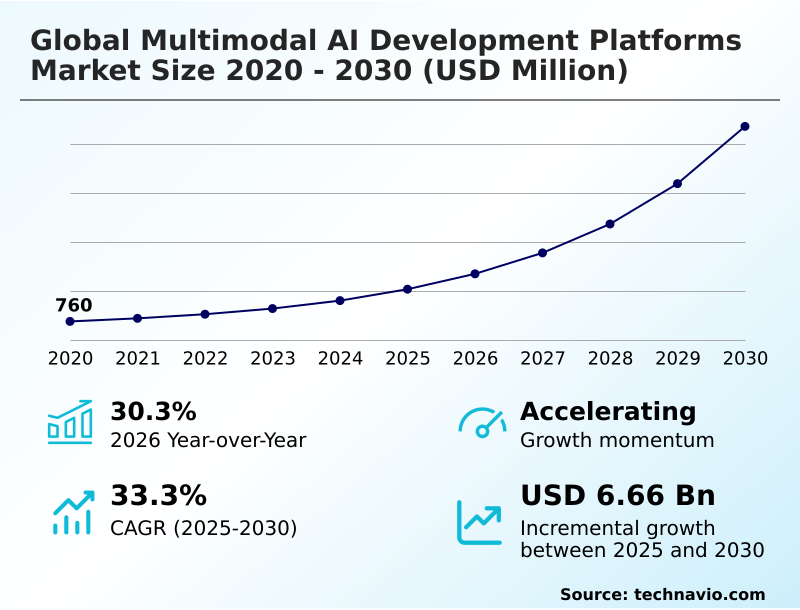
The Multimodal Ai Development Platforms Market size was valued at USD 2.08 billion in 2025 growing at a CAGR of 33.3% during the forecast period 2026-2030.
North America accounts for 39.5% of incremental growth during the forecast period. The Solutions segment by Component was valued at USD 1.18 billion in 2024, while the IT and telecommunication segment holds the largest revenue share by End-user.
The market is projected to grow by USD 7.98 billion from 2020 to 2030, with USD 6.66 billion of the growth expected during the forecast period of 2025 to 2030.
Get Key Insights on Market Forecast (PDF) Request Free Sample
Multimodal Ai Development Platforms Market Overview
The multimodal AI development platforms market is defined by the enterprise necessity for sophisticated data synthesis, where North America is projected to account for 39.5% of incremental growth. Organizations are moving beyond single-data-stream analysis to integrated systems that leverage cross-modal attention mechanisms for a deeper contextual understanding. A tangible application is seen in advanced manufacturing facilities, where quality control processes fuse high-resolution camera feeds with acoustic sensor data from production lines. In such a scenario, a vision-language model can detect micro-fractures in a component while simultaneously correlating the defect to a specific auditory anomaly from a malfunctioning machine, reducing false positives and enabling predictive maintenance. This level of multimodal machine learning, which combines visual and auditory inputs, is critical. The market's trajectory is influenced by the availability of large multimodal models and the ongoing development of specialized hardware like neural processing units, which are essential for handling the computational demands of these complex architectures.
Drivers, Trends, and Challenges in the Multimodal Ai Development Platforms Market
The global multimodal AI development platforms market is driven by the strategic need to process and understand interconnected, multi-format data. The total cost of ownership for multimodal AI platforms remains a significant consideration for procurement decision-makers, as it encompasses not just licensing but also the extensive computational resources needed for model training and inference.
For instance, an automotive OEM implementing a platform to enhance in-cabin driver-assistance systems must account for the high cost of specialized hardware for real-time sensor fusion. Decisions on multimodal AI platform adoption for industrial automation often hinge on whether the technology can deliver a quantifiable reduction in operational downtime, which can be 30% more effective than unimodal predictive maintenance systems.
Compliance with frameworks like the EU AI Act further complicates deployment, requiring features for MLOps for multimodal AI models to ensure transparency and mitigate algorithmic bias.
The choice between open-source multimodal AI models and proprietary enterprise AI platforms is another critical factor, with the former offering flexibility and the latter providing integrated support and security, impacting the overall AI development lifecycle management.
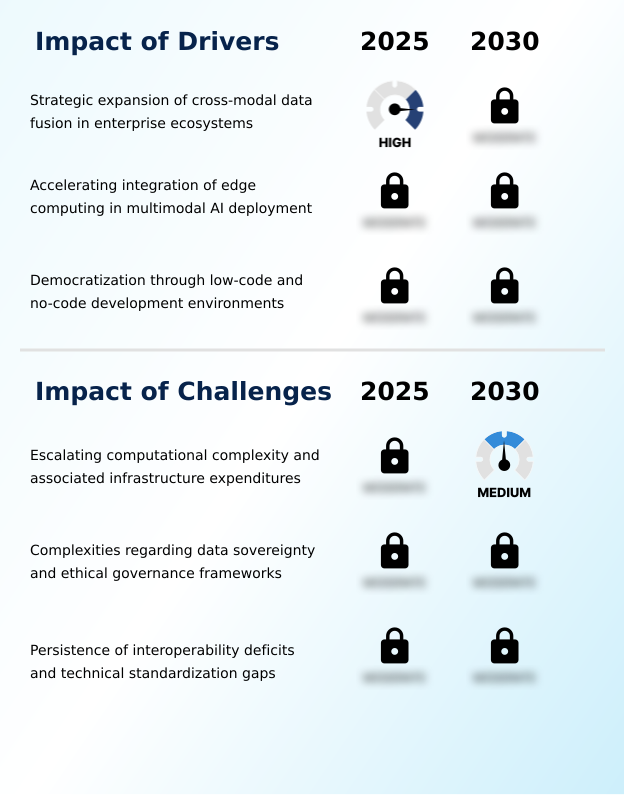
Primary Growth Driver: The strategic expansion of cross-modal data fusion within enterprise ecosystems is the key driver for the market, enabling a more holistic understanding of complex, unstructured data.
The market's expansion is fundamentally driven by the enterprise need for cross-modal data fusion, which allows organizations to derive deeper insights from unstructured data assets.
The second major driver is the integration of edge computing into deployment strategies, as the proliferation of IoT devices necessitates real-time processing to avoid latency issues found in centralized cloud architectures.
This is particularly relevant in industrial automation, where processing diverse signals at the source enables predictive maintenance. The third driver is the democratization of AI development through low-code and no-code functionalities.
These platforms empower non-specialists to build, train, and deploy multimodal models, accelerating innovation and addressing the global shortage of specialized data scientists, which is critical for scaling AI solutions.
Emerging Market Trend: The institutional adoption of federated multimodal learning frameworks is a significant market trend. This is driven by the need to train on sensitive, decentralized data while complying with stringent privacy regulations.
A primary trend is the shift toward domain-specific foundation models, as general-purpose systems struggle with the nuanced terminology of sectors like legal services and heavy manufacturing. These specialized platforms offer pre-trained weights and architectural templates tailored to niche data structures, such as fusing text-based electronic health records with 3D diagnostic imagery.
This specialization improves the accuracy of insights and is a key focus for MLOps for multimodal AI models. Another development is the expansion of specialized evaluation and observability benchmarks.
The industry is moving toward nuanced observability tools that can assess how well a model grounds its textual outputs in visual or auditory evidence, which is vital for building trust in high-stakes applications and mitigating model hallucinations.
Key Industry Challenge: Escalating computational complexity and the associated infrastructure expenditures present a key challenge, limiting market accessibility and impacting the total cost of ownership for multimodal AI systems.
A primary challenge is the immense computational complexity and associated infrastructure costs required to train and maintain multimodal systems, which often excludes smaller organizations. These high expenditures contribute to a significant total cost of ownership for multimodal AI platforms. The second challenge involves navigating the intricate landscape of data sovereignty and ethical governance.
Multimodal systems require access to sensitive information, raising privacy concerns and creating compliance hurdles with regulations such as GDPR. The potential for amplified algorithmic bias in multimodal systems adds another layer of complexity.
Finally, the market is hindered by a lack of technical standardization and persistent interoperability gaps between proprietary tools, which creates friction in the development process and vendor lock-in, complicating AI development lifecycle management.
Explore Full Market Dynamics Analysis Request Free Sample
Multimodal Ai Development Platforms Market Segmentation
The multimodal ai development platforms industry research report provides comprehensive data including region-wise segment analysis, with forecasts and analysis for the period 2026-2030, as well as historical data from 2020-2024 for the following segments.
Component Segment Analysis
The solutions segment is estimated to witness significant growth during the forecast period.
The multimodal AI development platforms market is segmented by component and end-user. The solutions segment, which includes software frameworks and APIs, constitutes the majority of the market, reflecting enterprise investment in foundational technologies for cross-modal data fusion.
These solutions enable the development of systems that perform multimodal video search and leverage vision-language models to process unstructured data. The services segment, encompassing consulting and system integration, supports adoption by bridging internal talent gaps.
End-user segmentation reveals significant adoption in the IT and telecommunication sector, which accounts for over a quarter of demand, followed by healthcare and life sciences, where applications such as multimodal machine learning for diagnostics are critical.
The automotive sector utilizes these platforms for in-cabin systems and autonomous navigation through sensor fusion techniques.
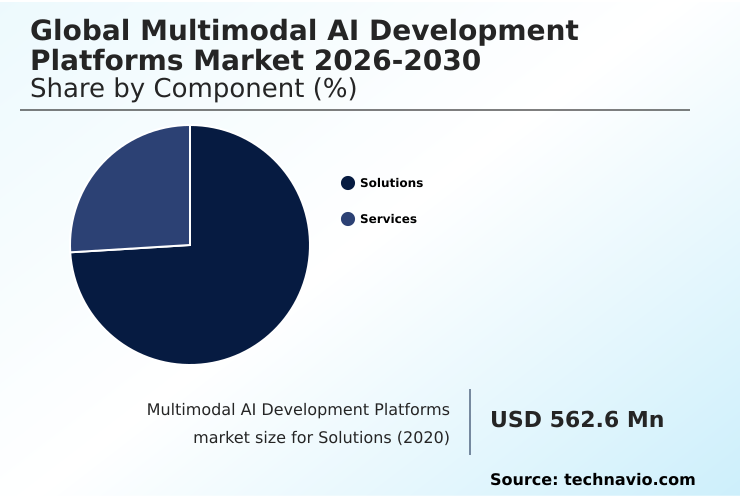
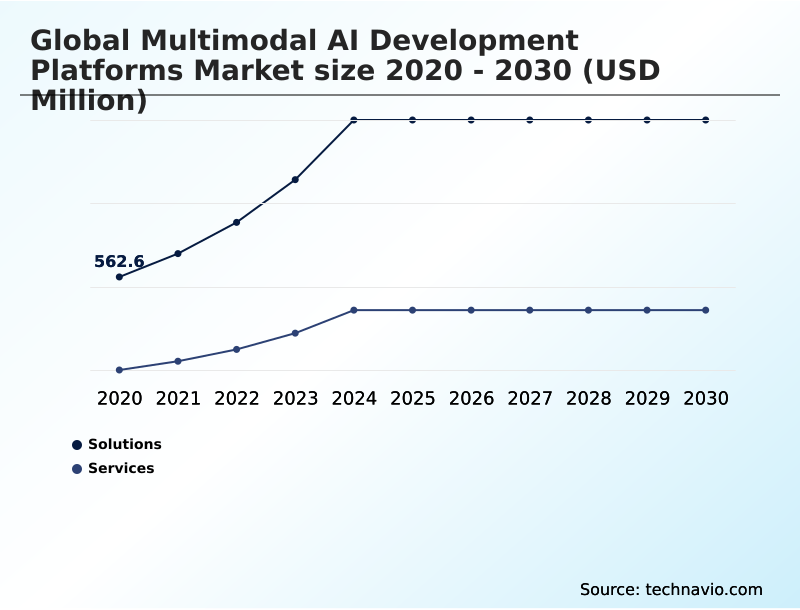
The Solutions segment was valued at USD 1.18 billion in 2024 and showed a gradual increase during the forecast period.
Multimodal Ai Development Platforms Market by Region: North America Leads with 39.5% Growth Share
North America is estimated to contribute 39.5% to the growth of the global market during the forecast period.
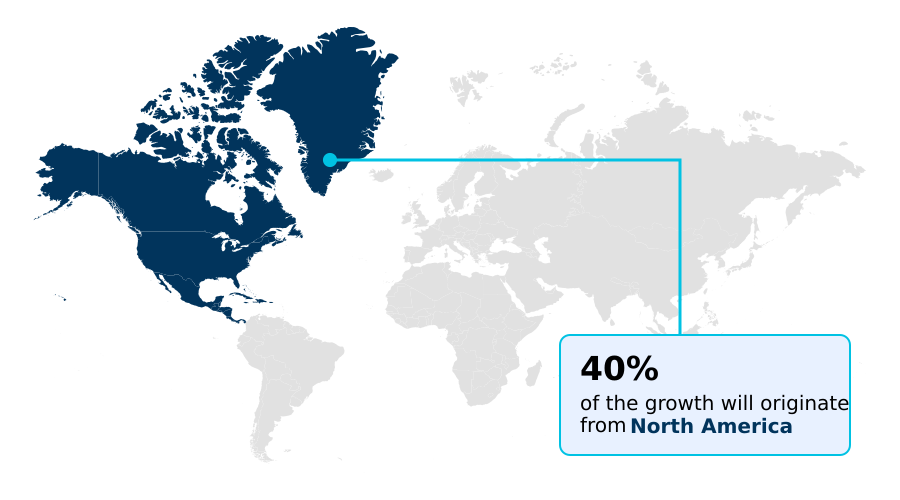
The geographic landscape of the multimodal AI development platforms market is led by North America, which accounts for the largest share of incremental growth, driven by a high concentration of technology firms and robust venture capital investment.
The region's focus is on deploying large multimodal models for commercial applications.
In contrast, the APAC region, projected to have the fastest growth rate at 34.5%, is capitalizing on its hardware manufacturing strengths, particularly in producing the neural processing units essential for edge deployments.
Europe's market is distinguished by a strong emphasis on regulatory compliance, with development adhering to the AI Act, which prioritizes ethical governance and model transparency. This leads to a focus on developing explainable and secure federated multimodal learning systems.
South America and the Middle East and Africa represent smaller but growing markets, with adoption focused on solving specific industrial challenges in agriculture and urban infrastructure.
Customer Landscape Analysis for the Multimodal Ai Development Platforms Market
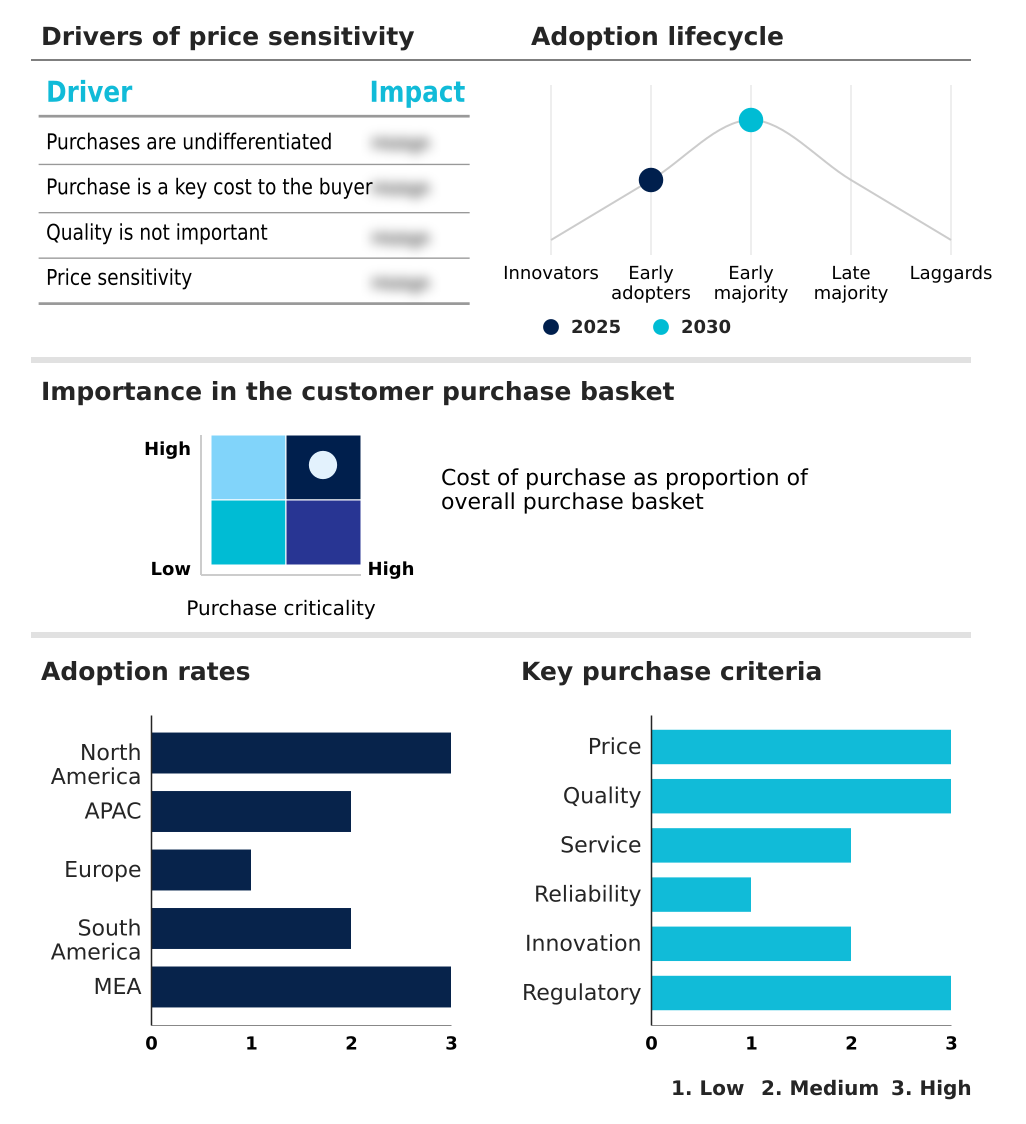
The multimodal ai development platforms market forecasting report includes the adoption lifecycle of the market, covering from the innovator’s stage to the laggard’s stage. It focuses on adoption rates in different regions based on penetration. Furthermore, the multimodal ai development platforms market report also includes key purchase criteria and drivers of price sensitivity to help companies evaluate and develop their market growth analysis strategies.
Competitive Landscape of the Multimodal Ai Development Platforms Market
Companies are implementing various strategies, such as strategic alliances, partnerships, mergers and acquisitions, geographical expansion, and product/service launches, to enhance their presence in the multimodal ai development platforms market industry.
Amazon.com Inc. - Offerings provide ecosystems for developing, training, and deploying models that synthesize diverse data inputs, including text, image, and audio, into a unified architectural framework.
The industry research and growth report includes detailed analyses of the competitive landscape of the market and information about key companies, including:
- Amazon.com Inc.
- Anthropic
- Apple Inc.
- Baidu Inc.
- Cohere
- Databricks Inc.
- Google LLC
- Hugging Face Inc.
- Jina AI GmbH
- Labelbox
- Meta Platforms Inc.
- Microsoft Corp.
- Mistral AI
- NVIDIA Corp.
- OpenAI
- Qualcomm Inc.
- Runway AI Inc.
- Snowflake Inc.
- TwelveLabs Inc.
- Weights and Biases Inc.
Qualitative and quantitative analysis of companies has been conducted to help clients understand the wider business environment as well as the strengths and weaknesses of key industry players. Data is qualitatively analyzed to categorize companies as pure play, category-focused, industry-focused, and diversified; it is quantitatively analyzed to categorize companies as dominant, leading, strong, tentative, and weak.
Recent Developments in the Multimodal Ai Development Platforms Market
- In September 2024, NVIDIA Corp. announced an expanded partnership with Databricks Inc. to integrate its NIM microservices directly into the Mosaic AI platform, optimizing training workflows for large-scale vision-language models on next-generation NVIDIA GPUs.
- In November 2024, Microsoft Corp. launched an updated version of Azure AI Studio, introducing native support for its Phi-3-vision model and advanced low-code tools tailored for building real-time multimodal applications on edge devices, enhancing its enterprise offerings.
- In January 2025, TwelveLabs Inc. successfully closed a significant funding round aimed at scaling its specialized APIs and proprietary foundation models for deep video understanding, focusing on improving multimodal video search capabilities for enterprise and media clients.
- In April 2025, Mistral AI released an advanced version of its open-weight multimodal model, demonstrating superior performance on cross-modal alignment benchmarks and making it available via the Hugging Face Inc. platform to foster community-driven fine-tuning and application development.
Research Analyst Overview: Multimodal Ai Development Platforms Market
Boardroom decisions regarding capital expenditure are increasingly influenced by the operational advantages of multimodal AI systems, which go beyond simple automation to enable sophisticated, cross-domain analysis. The solutions segment currently dominates the multimodal AI development platforms market, reflecting a foundational enterprise strategy to invest in robust software frameworks capable of cross-modal data fusion.
This emphasis is driven by the need to build systems that can perform complex tasks, such as interpreting a combination of diagnostic images and clinical notes in healthcare—a use case governed by strict data handling protocols.
The imperative to comply with regulations like the EU AI Act is shaping platform architecture, demanding greater model transparency and accountability in training vision-language models. Consequently, vendor qualification criteria now heavily weigh a platform’s built-in tools for ethical governance and its ability to manage the entire AI development lifecycle, from data labeling to monitoring for model drift in production environments.
Dive into Technavio’s robust research methodology, blending expert interviews, extensive data synthesis, and validated models for unparalleled Multimodal Ai Development Platforms Market insights. See full methodology.
| Market Scope | |
|---|---|
| Page number | 299 |
| Base year | 2025 |
| Historic period | 2020-2024 |
| Forecast period | 2026-2030 |
| Growth momentum & CAGR | Accelerate at a CAGR of 33.3% |
| Market growth 2026-2030 | USD 6660.5 million |
| Market structure | Fragmented |
| YoY growth 2025-2026(%) | 30.3% |
| Key countries | US, Canada, Mexico, China, India, Japan, Australia, South Korea, Indonesia, Germany, UK, France, Italy, The Netherlands, Spain, Brazil, Argentina, Colombia, Saudi Arabia, UAE, South Africa, Israel and Turkey |
| Competitive landscape | Leading Companies, Market Positioning of Companies, Competitive Strategies, and Industry Risks |
Multimodal Ai Development Platforms Market: Key Questions Answered in This Report
-
What is the expected growth of the Multimodal Ai Development Platforms Market between 2026 and 2030?
-
The Multimodal Ai Development Platforms Market is expected to grow by USD 6.66 billion during 2026-2030, registering a CAGR of 33.3%. Year-over-year growth in 2026 is estimated at 30.3%%. This acceleration is shaped by strategic expansion of cross-modal data fusion in enterprise ecosystems, which is intensifying demand across multiple end-use verticals covered in the report.
-
-
What segmentation does the market report cover?
-
The report is segmented by Component (Solutions, and Services), End-user (IT and telecommunication, Healthcare and life sciences, Automotive and mobility, Retail and ecommerce, and Media and entertainment), Deployment (Cloud-based, On-premises, and Hybrid) and Geography (North America, APAC, Europe, South America, Middle East and Africa). Among these, the Solutions segment is estimated to witness significant growth during the forecast period, driven by rising adoption across key application areas. Each segment includes detailed qualitative and quantitative analysis, along with historical data from 2020-2024 and forecasts through 2030 with year-over-year growth rates.
-
-
Which regions are analyzed in the report?
-
The report covers North America, APAC, Europe, South America and Middle East and Africa. North America is estimated to contribute 39.5% to market growth during the forecast period. Country-level analysis includes US, Canada, Mexico, China, India, Japan, Australia, South Korea, Indonesia, Germany, UK, France, Italy, The Netherlands, Spain, Brazil, Argentina, Colombia, Saudi Arabia, UAE, South Africa, Israel and Turkey, with dedicated market size tables and year-over-year growth for each.
-
-
What are the key growth drivers and market challenges?
-
The primary driver is strategic expansion of cross-modal data fusion in enterprise ecosystems, which is accelerating investment and industry demand. The main challenge is escalating computational complexity and associated infrastructure expenditures, creating operational barriers for key market participants. The report quantifies the impact of each driver and challenge across 2026 and 2030 with comparative analysis.
-
-
Who are the major players in the Multimodal Ai Development Platforms Market?
-
Key vendors include Amazon.com Inc., Anthropic, Apple Inc., Baidu Inc., Cohere, Databricks Inc., Google LLC, Hugging Face Inc., Jina AI GmbH, Labelbox, Meta Platforms Inc., Microsoft Corp., Mistral AI, NVIDIA Corp., OpenAI, Qualcomm Inc., Runway AI Inc., Snowflake Inc., TwelveLabs Inc. and Weights and Biases Inc.. The report provides qualitative and quantitative analysis categorizing companies as dominant, leading, strong, tentative, and weak based on their market positioning. Company profiles include business segment analysis, SWOT assessment, key offerings, and recent strategic developments.
-
Multimodal Ai Development Platforms Market Research Insights
Market dynamics are shaped by the dual pressures of technological advancement and regulatory compliance. The demand for cross-modal data fusion to create more intuitive human-computer interfaces is a primary driver.
However, this is tempered by data sovereignty requirements, particularly under frameworks like the EU's General Data Protection Regulation (GDPR), which governs the handling of personal data used in training vision-language models. In practice, a financial services firm deploying a multimodal AI system for customer verification must balance the processing of voice patterns and facial recognition data with strict privacy mandates.
The solutions segment significantly outweighs the services segment in market contribution, highlighting the focus on acquiring foundational software. This dynamic forces platform providers to innovate on both model capability and built-in governance tools to ensure market viability.
We can help! Our analysts can customize this multimodal ai development platforms market research report to meet your requirements.
 RIA -
RIA - 
