
Offshore Decommissioning Market Analysis Europe, North America, APAC, South America, Middle East and Africa - US, UK, Norway, Denmark, Brazil, Germany, Australia, France, Italy, China - Size and Forecast 2025-2029

Offshore Decommissioning Market Analysis Europe, North America, APAC, South America, Middle East and Africa - US, UK, Norway, Denmark, Brazil, Germany, Australia, France, Italy, China - Size and Forecast 2025-2029

Published: Feb 2025 241 Pages SKU: IRTNTR44314

Market Overview at a Glance

$3.19 B
Market Opportunity
7.9%
CAGR
7.1
YoY growth 2024-2025(%)

Offshore Decommissioning Market Size 2025-2029

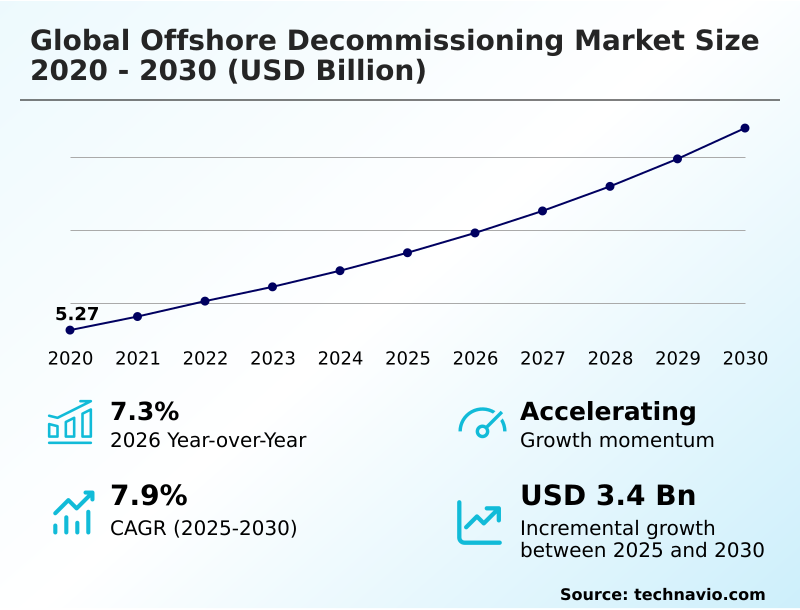
The offshore decommissioning market size is forecast to increase by USD 3.19 billion at a CAGR of 7.9% between 2024 and 2029.

  • The market is experiencing significant growth driven by the maturation of oil and gas fields and the increasing number of aging platforms reaching the end of their operational life. This trend is particularly prominent in regions with a long history of offshore oil and gas production, such as the North Sea. However, the market is not without challenges. The high costs associated with offshore decommissioning projects, which can reach billions of dollars, pose a significant barrier to entry for many companies. Additionally, the shift towards renewable energy sources is reducing the demand for new offshore oil and gas projects, further impacting the market's growth.
  • Despite these challenges, there are opportunities for companies to capitalize on the market's growth. Strategic partnerships, innovative technologies, and cost-effective approaches can help reduce the financial burden of decommissioning projects and make them more attractive to investors. Companies seeking to navigate this market effectively must stay informed of regulatory requirements, technological advancements, and market trends to position themselves for success.

What will be the Size of the Offshore Decommissioning Market during the forecast period?
Offshore Decommissioning Market Size

 Request Free Sample

  • The market encompasses the process of retiring and dismantling infrastructure from oil and gas exploration and production facilities in marine environments. This market includes activities such as pipeline decommissioning, abandoned oil wells, and platform removal. The primary phase focuses on the physical removal of structures, while the secondary phase addresses materials disposal, site clearance, and environmental restoration. Offshore decommissioning involves various processes, including conductor removal, derrick barge utilization, and cement plug installation. Fluid-bearing formations and crude oil require specialized techniques, while natural gas and renewable energy sources may necessitate gas injection or power cable removal. Operational costs, including project management, engineering planning, permitting and regulatory compliance, and international footprints, significantly impact market dynamics.
  • Factors such as crude oil prices, quarantine restrictions, and aging platforms contribute to the market's growth. The supply chain for offshore decommissioning includes manufacturing facilities, engineering services, and specialized equipment providers. Market trends include the increasing importance of environmental impact assessments and the adoption of artificial aid technologies to enhance operational efficiency. Mature fields in shallow water and deepwater environments, as well as gas fields and oil fields, require decommissioning as they reach the end of their operational life. Enhanced oil recovery techniques and engineering planning play crucial roles in minimizing operational costs and ensuring a safe and efficient decommissioning process.

How is this Offshore Decommissioning Industry segmented?

The offshore decommissioning industry research report provides comprehensive data (region-wise segment analysis), with forecasts and estimates in "USD million" for the period 2025-2029, as well as historical data from 2019-2023 for the following segments.

  • Type
    • Shallow water
    • Deepwater
  • Service
    • Well plugging and abandonment
    • Platform removal
    • Permitting and regulatory compliance
    • Platform preparation
    • Others
  • Application
    • Topside
    • Substructure
  • Business Segment
    • Complete removal
    • Partial removal
    • Leave in place
  • Geography
    • Europe
      • Denmark
      • France
      • Germany
      • Italy
      • Norway
      • UK
    • North America
      • US
    • APAC
      • Australia
      • China
    • South America
      • Brazil
    • Middle East and Africa

    By Type Insights

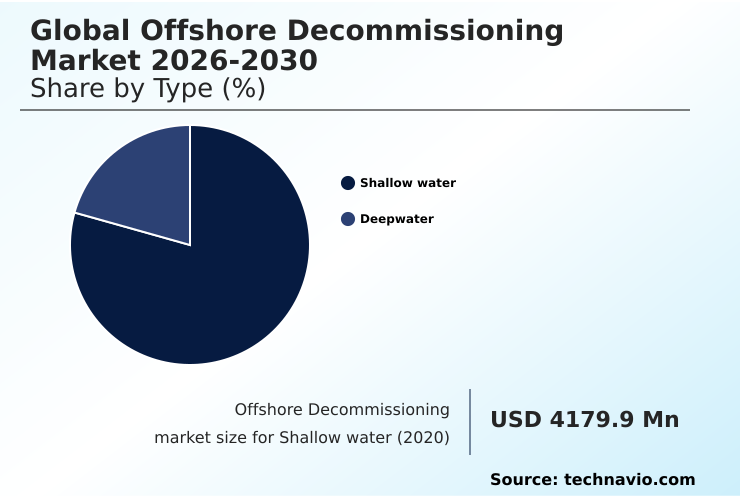
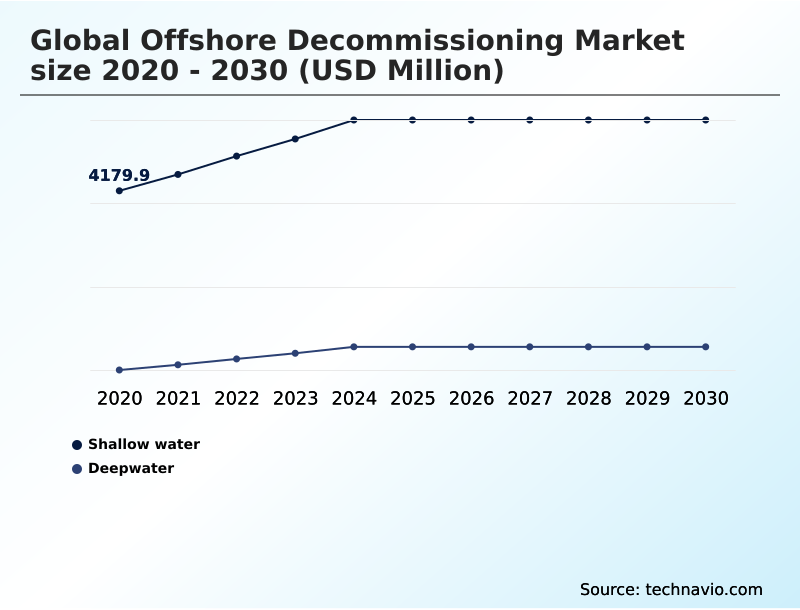
    The shallow water segment is estimated to witness significant growth during the forecast period.

    Offshore decommissioning refers to the process of removing and disposing of offshore structures and infrastructure once their primary production phase has ended. This includes abandoned oil wells, pipelines, and platforms. In the offshore industry, decommissioning projects are typically categorized into primary and secondary phases. During the primary phase, platform preparation involves the removal of equipment and materials for reuse or disposal. This may include the extraction of remaining oil through enhanced recovery techniques such as gas injection, fluidbearing formations, and polymer insertion. Cement plugs are used to seal abandoned wells. In the secondary phase, the actual removal of the structure takes place.

    Derrick barges are commonly used for this purpose in ultradeepwater depths. Sub-infrastructure such as pipelines and power cables must be removed and disposed of properly. Site clearance is crucial to ensure the safety of future operations. The market is influenced by various factors, including crude oil prices, permitting and regulatory requirements, and the availability of skilled operators. Operational costs can be significant, making project management essential. Offshore regions with international footprints, such as the North Sea, have a high number of decommissioning projects due to aging infrastructure. Supply chain logistics and material disposal are also critical considerations.

    Quarantine restrictions and lockdown measures due to the COVID-19 pandemic have affected the offshore decommissioning industry, causing delays and increased costs. Despite these challenges, the market is expected to grow as more offshore structures reach the end of their operational life.

    Offshore Decommissioning Market Size

    Get a glance at the market report of share of various segments Request Free Sample

    The Shallow water segment was valued at USD 4.9 billion in 2019 and showed a gradual increase during the forecast period.
    Regional Analysis

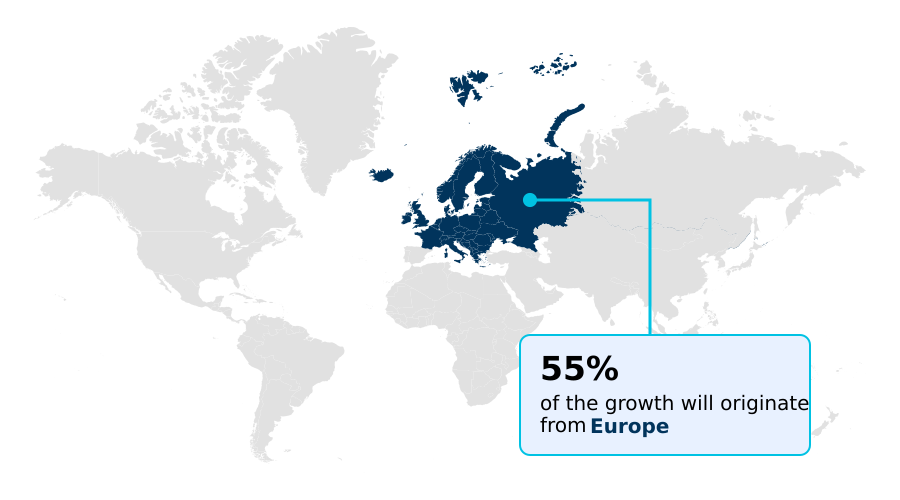
    Europe is estimated to contribute 44% to the growth of the global market during the forecast period.Technavio’s analysts have elaborately explained the regional trends and drivers that shape the market during the forecast period.
    Offshore Decommissioning Market Share by Geography

    For more insights on the market size of various regions, Request Free Sample

    The European the market is expected to witness significant growth due to the increasing number of mature offshore infrastructures in the North Sea. Key contributing countries include the UK, Norway, and Denmark, where several oil and gas fields are approaching the end of their production cycle. Strict regulatory environments in these countries are also driving the demand for offshore decommissioning. In the UKCS alone, numerous assets are set for decommissioning during the forecast period. Decommissioning activities involve various processes such as platform preparation, pipeline decommissioning, cement plugs, conductor removal, and site clearance. These tasks require skilled operators, materials disposal, and project management.

    In ultradeepwater depths, derrick barges and other specialized equipment are utilized. Enhanced oil recovery techniques, including gas injection, fluidbearing formations, and polymer insertion, are also employed during the primary and secondary phases of decommissioning. Offshore decommissioning also involves the removal of artificial aids and power cables. Permitting and regulatory processes, quarantine restrictions, and operational costs are significant challenges in this market. Manufacturing facilities and supply chain management are crucial aspects of offshore decommissioning projects. Natural gas and shallow water projects are also subject to decommissioning.

    Market Dynamics

    Our researchers analyzed the data with 2024 as the base year, along with the key drivers, trends, and challenges. A holistic analysis of drivers will help companies refine their marketing strategies to gain a competitive advantage.

    What are the key market drivers leading to the rise in the adoption of Offshore Decommissioning Industry?

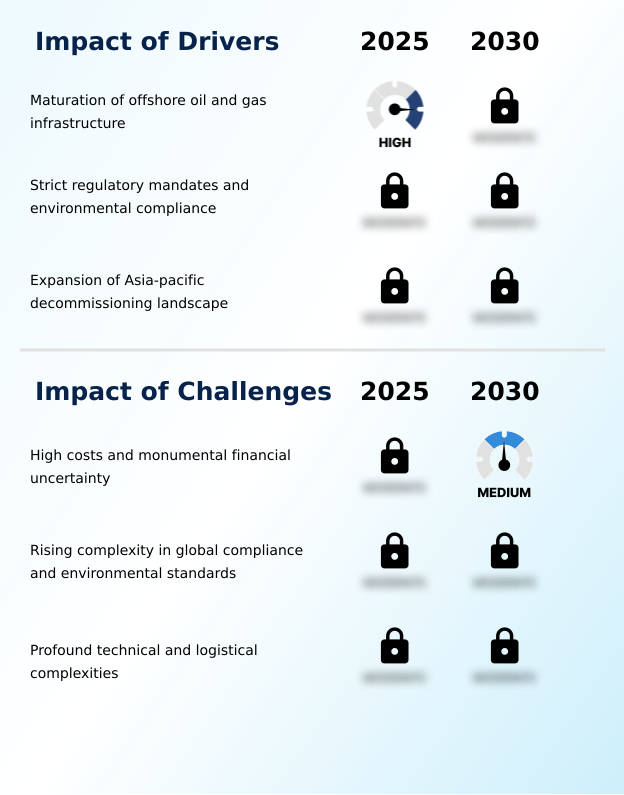
    • Maturing oil and gas fields and aging platforms is the key driver of the market. 

    • Offshore decommissioning refers to the process of dismantling and removing offshore oil and gas structures once they have reached the end of their productive life. The primary driver for decommissioning is the economic viability of continuing operations. When the cost of operating an offshore facility exceeds the revenue generated from selling crude oil or natural gas, the structure becomes a liability for the oil company. According to , about two-thirds of global oil and gas production comes from mature fields. In the current market landscape, oil and gas operators face the challenge of maximizing returns on existing assets due to the decline in new and major discoveries of oil and gas reserves.
    • As a result, decommissioning has emerged as an essential aspect of the industry's lifecycle management strategy. The decommissioning process involves several stages, including planning, preparation, execution, and verification, and requires careful planning and coordination to ensure safety, environmental sustainability, and cost-effectiveness.

    What are the market trends shaping the Offshore Decommissioning Industry?

    • Rising investments in renewable energy is the upcoming market trend. 

    • The transition from traditional fossil fuels to renewable energy sources, such as wind, solar, and geothermal, is a significant global trend. According to the US Energy Information Administration (EIA), renewable energy consumption is projected to expand at an annual rate of 3.1% from 2024 to 2050, contrasting the 0.6% annual growth rate for petroleum and other liquids, 0.4% for coal, and 1.1% for natural gas.
    • This increasing demand for renewable energy sources will likely impede the growth of the oil and gas industry, thereby fostering market expansion. Numerous countries have already adopted renewables as their primary energy source, further propelling this trend.

    What challenges does the Offshore Decommissioning Industry face during its growth?

    • High cost associated with offshore decommissioning projects is a key challenge affecting the industry growth. 

    • Offshore decommissioning refers to the process of removing and disposing of structures and equipment used in the extraction of crude oil or natural gas from the seabed. As offshore assets reach the end of their productive life, the high operating costs often outweigh the revenue generated. According to industry research, the weight of materials to be removed is a significant cost determinant in offshore decommissioning projects. The OSPAR Convention stipulates that the owner of an offshore oil or gas well is responsible for the equipment used during operations, adding to the financial burden of decommissioning.
    • The high costs associated with offshore decommissioning hinder market expansion. To minimize operational expenses, the primary focus should be on disconnection and removal, which account for a substantial portion of the project cost. By optimizing these processes, offshore decommissioning costs can be significantly reduced.

    Exclusive Customer Landscape

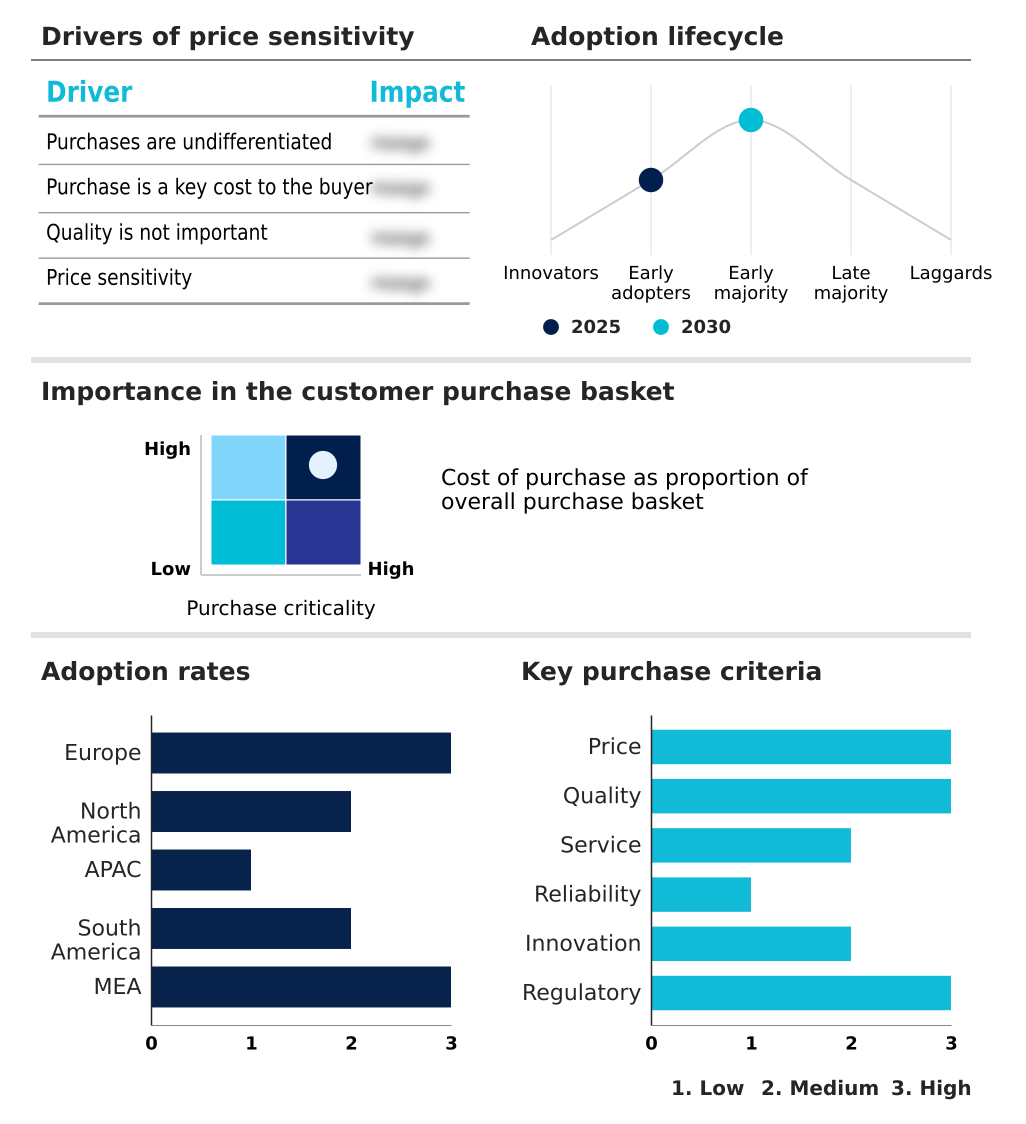
    The offshore decommissioning market forecasting report includes the adoption lifecycle of the market, covering from the innovator’s stage to the laggard’s stage. It focuses on adoption rates in different regions based on penetration. Furthermore, the offshore decommissioning market report also includes key purchase criteria and drivers of price sensitivity to help companies evaluate and develop their market growth analysis strategies.
    Offshore Decommissioning Market Share by Geography

     Customer Landscape

    Key Companies & Market Insights

    Companies are implementing various strategies, such as strategic alliances, offshore decommissioning market forecast, partnerships, mergers and acquisitions, geographical expansion, and product/service launches, to enhance their presence in the industry.

    Able UK Ltd. - The company, a leading provider of offshore decommissioning services, operates through AF Offshore Decom. Our expertise lies in executing complex decommissioning projects, ensuring environmental compliance and maximizing asset recovery. Utilizing advanced technologies and innovative approaches, we deliver cost-effective and efficient solutions to clients worldwide. Our team of experienced professionals ensures safe and successful project completion, adhering to stringent industry standards.

    The industry research and growth report includes detailed analyses of the competitive landscape of the market and information about key companies, including:

    • Able UK Ltd.
    • AF Gruppen Norge AS
    • Aker Solutions ASA
    • Allseas Group SA
    • Baker Hughes Co.
    • Boskalis
    • DeepOcean Group Holding BV
    • DNV Group AS
    • Halliburton Co.
    • Heerema International Group
    • John Wood Group PLC
    • Oceaneering International Inc.
    • Perenco
    • Petrofac Ltd.
    • Ramboll Group AS
    • Saipem S.p.A.
    • Schlumberger Ltd.
    • Subsea 7 SA
    • TechnipFMC plc
    • Weatherford International Plc

    Qualitative and quantitative analysis of companies has been conducted to help clients understand the wider business environment as well as the strengths and weaknesses of key industry players. Data is qualitatively analyzed to categorize companies as pure play, category-focused, industry-focused, and diversified; it is quantitatively analyzed to categorize companies as dominant, leading, strong, tentative, and weak.

    Research Analyst Overview

    Offshore decommissioning refers to the process of safely and efficiently dismantling and removing offshore oil and gas structures once they have reached the end of their productive life. This complex and intricate process involves various stages, from platform preparation to materials disposal, and requires a significant amount of planning, coordination, and execution. The market is driven by several factors, including the maturity of oil and gas fields, regulatory requirements, and technological advancements. As oil and gas reserves in offshore regions become depleted, the need for decommissioning increases. Additionally, regulatory bodies worldwide are imposing stricter regulations on offshore structures to ensure safety and environmental sustainability.

    One of the significant challenges in offshore decommissioning is the logistical complexity of the process. Derrick barges and other specialized vessels are used to transport and install equipment required for the decommissioning process, such as cement plugs and conductor removal tools. In ultradeepwater depths, the use of sub-infrastructure, including pipelines and power cables, adds to the complexity. Manufacturing facilities play a crucial role in the decommissioning process, producing the necessary equipment and components. However, the global supply chain can be affected by various factors, including permitting and regulatory requirements, quarantine restrictions, and lockdown measures. The primary phase of offshore decommissioning involves preparing the platform for removal.

    This includes the installation of artificial aids, such as buoyancy systems, and the injection of fluids, such as gas or polymers, to support the structure during the removal process. The secondary phase focuses on the removal of the platform and the disposal of materials. Offshore decommissioning projects can be costly, with operational costs varying depending on factors such as water depth, platform size, and location. Natural gas fields, which often have smaller structures and shallower water depths, may have lower decommissioning costs compared to crude oil fields. Offshore regions worldwide have international footprints, with various countries and companies operating in different areas.

    As such, collaboration and coordination between stakeholders are essential to ensure a successful decommissioning project. Project management plays a critical role in ensuring that all aspects of the process are executed efficiently and safely. In , the market is a complex and dynamic industry driven by various factors, including the maturity of oil and gas fields, regulatory requirements, and technological advancements. The process involves several stages, from platform preparation to materials disposal, and requires a significant amount of planning, coordination, and execution. The logistical complexity of the process, coupled with the need for collaboration between stakeholders, highlights the importance of effective project management in ensuring a successful decommissioning project.

    Market Scope

    Report Coverage

    Details

    Page number

    241

    Base year

    2024

    Historic period

    2019-2023

    Forecast period

    2025-2029

    Growth momentum & CAGR

    Accelerate at a CAGR of 7.9%

    Market growth 2025-2029

    USD 3189 million

    Market structure

    Fragmented

    YoY growth 2024-2025(%)

    7.1

    Key countries

    US, UK, Norway, Denmark, Brazil, Germany, Australia, France, Italy, and China

    Competitive landscape

    Leading Companies, Market Positioning of Companies, Competitive Strategies, and Industry Risks

    Request Free Sample

    What are the Key Data Covered in this Offshore Decommissioning Market Research and Growth Report?

    • CAGR of the Offshore Decommissioning industry during the forecast period
    • Detailed information on factors that will drive the growth and forecasting between 2025 and 2029
    • Precise estimation of the size of the market and its contribution of the industry in focus to the parent market
    • Accurate predictions about upcoming growth and trends and changes in consumer behaviour
    • Growth of the market across Europe, North America, APAC, South America, and Middle East and Africa
    • Thorough analysis of the market’s competitive landscape and detailed information about companies
    • Comprehensive analysis of factors that will challenge the offshore decommissioning market growth of industry companies

    We can help! Our analysts can customize this offshore decommissioning market research report to meet your requirements.

    Get in touch


    1 Executive Summary

    • 1.1 Market overview
      • Executive Summary - Chart on Market Overview
      • Executive Summary - Data Table on Market Overview
      • Executive Summary - Chart on Global Market Characteristics
      • Executive Summary - Chart on Market by Geography
      • Executive Summary - Chart on Market Segmentation by Type
      • Executive Summary - Chart on Market Segmentation by Service
      • Executive Summary - Chart on Market Segmentation by Application
      • Executive Summary - Chart on Market Segmentation by Business Segment
      • Executive Summary - Chart on Incremental Growth
      • Executive Summary - Data Table on Incremental Growth
      • Executive Summary - Chart on Company Market Positioning

    2 Technavio Analysis

    • 2.1 Analysis of price sensitivity, lifecycle, customer purchase basket, adoption rates, and purchase criteria
      • Analysis of price sensitivity, lifecycle, customer purchase basket, adoption rates, and purchase criteria
    • 2.2 Criticality of inputs and Factors of differentiation
      • Overview on criticality of inputs and factors of differentiation
    • 2.3 Factors of disruption
      • Overview on factors of disruption
    • 2.4 Impact of drivers and challenges
      • Impact of drivers and challenges in 2024 and 2029

    3 Market Landscape

    • 3.1 Market ecosystem
      • Parent Market
      • Data Table on - Parent Market
    • 3.2 Market characteristics
      • Market characteristics analysis
    • 3.3 Value chain analysis
      • Value chain analysis

    4 Market Sizing

    • 4.1 Market definition
      • Offerings of companies included in the market definition
    • 4.2 Market segment analysis
      • Market segments
    • 4.3 Market size 2024
      • 4.4 Market outlook: Forecast for 2024-2029
        • Chart on Global - Market size and forecast 2024-2029 ($ million)
        • Data Table on Global - Market size and forecast 2024-2029 ($ million)
        • Chart on Global Market: Year-over-year growth 2024-2029 (%)
        • Data Table on Global Market: Year-over-year growth 2024-2029 (%)

      5 Historic Market Size

      • 5.1 Global Offshore Decommissioning Market 2019 - 2023
        • Historic Market Size - Data Table on Global Offshore Decommissioning Market 2019 - 2023 ($ million)
      • 5.2 Type segment analysis 2019 - 2023
        • Historic Market Size - Type Segment 2019 - 2023 ($ million)
      • 5.3 Service segment analysis 2019 - 2023
        • Historic Market Size - Service Segment 2019 - 2023 ($ million)
      • 5.4 Application segment analysis 2019 - 2023
        • Historic Market Size - Application Segment 2019 - 2023 ($ million)
      • 5.5 Business segment analysis 2019 - 2023
        • Historic Market Size - Business Segment 2019 - 2023 ($ million)
      • 5.6 Geography segment analysis 2019 - 2023
        • Historic Market Size - Geography Segment 2019 - 2023 ($ million)
      • 5.7 Country segment analysis 2019 - 2023
        • Historic Market Size - Country Segment 2019 - 2023 ($ million)

      6 Qualitative Analysis

      • 6.1 Impact of AI on global offshore decommissioning market

        7 Five Forces Analysis

        • 7.1 Five forces summary
          • Five forces analysis - Comparison between 2024 and 2029
        • 7.2 Bargaining power of buyers
          • Bargaining power of buyers - Impact of key factors 2024 and 2029
        • 7.3 Bargaining power of suppliers
          • Bargaining power of suppliers - Impact of key factors in 2024 and 2029
        • 7.4 Threat of new entrants
          • Threat of new entrants - Impact of key factors in 2024 and 2029
        • 7.5 Threat of substitutes
          • Threat of substitutes - Impact of key factors in 2024 and 2029
        • 7.6 Threat of rivalry
          • Threat of rivalry - Impact of key factors in 2024 and 2029
        • 7.7 Market condition
          • Chart on Market condition - Five forces 2024 and 2029

        8 Market Segmentation by Type

        • 8.1 Market segments
          • Chart on Type - Market share 2024-2029 (%)
          • Data Table on Type - Market share 2024-2029 (%)
        • 8.2 Comparison by Type
          • Chart on Comparison by Type
          • Data Table on Comparison by Type
        • 8.3 Shallow water - Market size and forecast 2024-2029
          • Chart on Shallow water - Market size and forecast 2024-2029 ($ million)
          • Data Table on Shallow water - Market size and forecast 2024-2029 ($ million)
          • Chart on Shallow water - Year-over-year growth 2024-2029 (%)
          • Data Table on Shallow water - Year-over-year growth 2024-2029 (%)
        • 8.4 Deepwater - Market size and forecast 2024-2029
          • Chart on Deepwater - Market size and forecast 2024-2029 ($ million)
          • Data Table on Deepwater - Market size and forecast 2024-2029 ($ million)
          • Chart on Deepwater - Year-over-year growth 2024-2029 (%)
          • Data Table on Deepwater - Year-over-year growth 2024-2029 (%)
        • 8.5 Market opportunity by Type
          • Market opportunity by Type ($ million)
          • Data Table on Market opportunity by Type ($ million)

        9 Market Segmentation by Service

        • 9.1 Market segments
          • Chart on Service - Market share 2024-2029 (%)
          • Data Table on Service - Market share 2024-2029 (%)
        • 9.2 Comparison by Service
          • Chart on Comparison by Service
          • Data Table on Comparison by Service
        • 9.3 Well plugging and abandonment - Market size and forecast 2024-2029
          • Chart on Well plugging and abandonment - Market size and forecast 2024-2029 ($ million)
          • Data Table on Well plugging and abandonment - Market size and forecast 2024-2029 ($ million)
          • Chart on Well plugging and abandonment - Year-over-year growth 2024-2029 (%)
          • Data Table on Well plugging and abandonment - Year-over-year growth 2024-2029 (%)
        • 9.4 Platform removal - Market size and forecast 2024-2029
          • Chart on Platform removal - Market size and forecast 2024-2029 ($ million)
          • Data Table on Platform removal - Market size and forecast 2024-2029 ($ million)
          • Chart on Platform removal - Year-over-year growth 2024-2029 (%)
          • Data Table on Platform removal - Year-over-year growth 2024-2029 (%)
        • 9.5 Permitting and regulatory compliance - Market size and forecast 2024-2029
          • Chart on Permitting and regulatory compliance - Market size and forecast 2024-2029 ($ million)
          • Data Table on Permitting and regulatory compliance - Market size and forecast 2024-2029 ($ million)
          • Chart on Permitting and regulatory compliance - Year-over-year growth 2024-2029 (%)
          • Data Table on Permitting and regulatory compliance - Year-over-year growth 2024-2029 (%)
        • 9.6 Platform preparation - Market size and forecast 2024-2029
          • Chart on Platform preparation - Market size and forecast 2024-2029 ($ million)
          • Data Table on Platform preparation - Market size and forecast 2024-2029 ($ million)
          • Chart on Platform preparation - Year-over-year growth 2024-2029 (%)
          • Data Table on Platform preparation - Year-over-year growth 2024-2029 (%)
        • 9.7 Others - Market size and forecast 2024-2029
          • Chart on Others - Market size and forecast 2024-2029 ($ million)
          • Data Table on Others - Market size and forecast 2024-2029 ($ million)
          • Chart on Others - Year-over-year growth 2024-2029 (%)
          • Data Table on Others - Year-over-year growth 2024-2029 (%)
        • 9.8 Market opportunity by Service
          • Market opportunity by Service ($ million)
          • Data Table on Market opportunity by Service ($ million)

        10 Market Segmentation by Application

        • 10.1 Market segments
          • Chart on Application - Market share 2024-2029 (%)
          • Data Table on Application - Market share 2024-2029 (%)
        • 10.2 Comparison by Application
          • Chart on Comparison by Application
          • Data Table on Comparison by Application
        • 10.3 Topside - Market size and forecast 2024-2029
          • Chart on Topside - Market size and forecast 2024-2029 ($ million)
          • Data Table on Topside - Market size and forecast 2024-2029 ($ million)
          • Chart on Topside - Year-over-year growth 2024-2029 (%)
          • Data Table on Topside - Year-over-year growth 2024-2029 (%)
        • 10.4 Substructure - Market size and forecast 2024-2029
          • Chart on Substructure - Market size and forecast 2024-2029 ($ million)
          • Data Table on Substructure - Market size and forecast 2024-2029 ($ million)
          • Chart on Substructure - Year-over-year growth 2024-2029 (%)
          • Data Table on Substructure - Year-over-year growth 2024-2029 (%)
        • 10.5 Market opportunity by Application
          • Market opportunity by Application ($ million)
          • Data Table on Market opportunity by Application ($ million)

        11 Market Segmentation by Business Segment

        • 11.1 Market segments
          • Chart on Market Segmentation by Business Segment - Market share 2024-2029 (%)
          • Data Table on Market Segmentation by Business Segment - Market share 2024-2029 (%)
        • 11.2 Comparison by Market Segmentation by Business Segment
          • Chart on Comparison by Market Segmentation by Business Segment
          • Data Table on Comparison by Market Segmentation by Business Segment
        • 11.3 Complete removal - Market size and forecast 2024-2029
          • Chart on Complete removal - Market size and forecast 2024-2029 ($ million)
          • Data Table on Complete removal - Market size and forecast 2024-2029 ($ million)
          • Chart on Complete removal - Year-over-year growth 2024-2029 (%)
          • Data Table on Complete removal - Year-over-year growth 2024-2029 (%)
        • 11.4 Partial removal - Market size and forecast 2024-2029
          • Chart on Partial removal - Market size and forecast 2024-2029 ($ million)
          • Data Table on Partial removal - Market size and forecast 2024-2029 ($ million)
          • Chart on Partial removal - Year-over-year growth 2024-2029 (%)
          • Data Table on Partial removal - Year-over-year growth 2024-2029 (%)
        • 11.5 Leave in place - Market size and forecast 2024-2029
          • Chart on Leave in place - Market size and forecast 2024-2029 ($ million)
          • Data Table on Leave in place - Market size and forecast 2024-2029 ($ million)
          • Chart on Leave in place - Year-over-year growth 2024-2029 (%)
          • Data Table on Leave in place - Year-over-year growth 2024-2029 (%)
        • 11.6 Market opportunity by Market Segmentation by Business Segment
          • Market opportunity by Market Segmentation by Business Segment ($ million)
          • Data Table on Market opportunity by Market Segmentation by Business Segment ($ million)

        12 Customer Landscape

        • 12.1 Customer landscape overview
          • Analysis of price sensitivity, lifecycle, customer purchase basket, adoption rates, and purchase criteria

        13 Geographic Landscape

        • 13.1 Geographic segmentation
          • Chart on Market share by geography 2024-2029 (%)
          • Data Table on Market share by geography 2024-2029 (%)
        • 13.2 Geographic comparison
          • Chart on Geographic comparison
          • Data Table on Geographic comparison
        • 13.3 Europe - Market size and forecast 2024-2029
          • Chart on Europe - Market size and forecast 2024-2029 ($ million)
          • Data Table on Europe - Market size and forecast 2024-2029 ($ million)
          • Chart on Europe - Year-over-year growth 2024-2029 (%)
          • Data Table on Europe - Year-over-year growth 2024-2029 (%)
        • 13.4 North America - Market size and forecast 2024-2029
          • Chart on North America - Market size and forecast 2024-2029 ($ million)
          • Data Table on North America - Market size and forecast 2024-2029 ($ million)
          • Chart on North America - Year-over-year growth 2024-2029 (%)
          • Data Table on North America - Year-over-year growth 2024-2029 (%)
        • 13.5 APAC - Market size and forecast 2024-2029
          • Chart on APAC - Market size and forecast 2024-2029 ($ million)
          • Data Table on APAC - Market size and forecast 2024-2029 ($ million)
          • Chart on APAC - Year-over-year growth 2024-2029 (%)
          • Data Table on APAC - Year-over-year growth 2024-2029 (%)
        • 13.6 South America - Market size and forecast 2024-2029
          • Chart on South America - Market size and forecast 2024-2029 ($ million)
          • Data Table on South America - Market size and forecast 2024-2029 ($ million)
          • Chart on South America - Year-over-year growth 2024-2029 (%)
          • Data Table on South America - Year-over-year growth 2024-2029 (%)
        • 13.7 Middle East and Africa - Market size and forecast 2024-2029
          • Chart on Middle East and Africa - Market size and forecast 2024-2029 ($ million)
          • Data Table on Middle East and Africa - Market size and forecast 2024-2029 ($ million)
          • Chart on Middle East and Africa - Year-over-year growth 2024-2029 (%)
          • Data Table on Middle East and Africa - Year-over-year growth 2024-2029 (%)
        • 13.8 US - Market size and forecast 2024-2029
          • Chart on US - Market size and forecast 2024-2029 ($ million)
          • Data Table on US - Market size and forecast 2024-2029 ($ million)
          • Chart on US - Year-over-year growth 2024-2029 (%)
          • Data Table on US - Year-over-year growth 2024-2029 (%)
        • 13.9 UK - Market size and forecast 2024-2029
          • Chart on UK - Market size and forecast 2024-2029 ($ million)
          • Data Table on UK - Market size and forecast 2024-2029 ($ million)
          • Chart on UK - Year-over-year growth 2024-2029 (%)
          • Data Table on UK - Year-over-year growth 2024-2029 (%)
        • 13.10 Norway - Market size and forecast 2024-2029
          • Chart on Norway - Market size and forecast 2024-2029 ($ million)
          • Data Table on Norway - Market size and forecast 2024-2029 ($ million)
          • Chart on Norway - Year-over-year growth 2024-2029 (%)
          • Data Table on Norway - Year-over-year growth 2024-2029 (%)
        • 13.11 Denmark - Market size and forecast 2024-2029
          • Chart on Denmark - Market size and forecast 2024-2029 ($ million)
          • Data Table on Denmark - Market size and forecast 2024-2029 ($ million)
          • Chart on Denmark - Year-over-year growth 2024-2029 (%)
          • Data Table on Denmark - Year-over-year growth 2024-2029 (%)
        • 13.12 Brazil - Market size and forecast 2024-2029
          • Chart on Brazil - Market size and forecast 2024-2029 ($ million)
          • Data Table on Brazil - Market size and forecast 2024-2029 ($ million)
          • Chart on Brazil - Year-over-year growth 2024-2029 (%)
          • Data Table on Brazil - Year-over-year growth 2024-2029 (%)
        • 13.13 Germany - Market size and forecast 2024-2029
          • Chart on Germany - Market size and forecast 2024-2029 ($ million)
          • Data Table on Germany - Market size and forecast 2024-2029 ($ million)
          • Chart on Germany - Year-over-year growth 2024-2029 (%)
          • Data Table on Germany - Year-over-year growth 2024-2029 (%)
        • 13.14 Australia - Market size and forecast 2024-2029
          • Chart on Australia - Market size and forecast 2024-2029 ($ million)
          • Data Table on Australia - Market size and forecast 2024-2029 ($ million)
          • Chart on Australia - Year-over-year growth 2024-2029 (%)
          • Data Table on Australia - Year-over-year growth 2024-2029 (%)
        • 13.15 France - Market size and forecast 2024-2029
          • Chart on France - Market size and forecast 2024-2029 ($ million)
          • Data Table on France - Market size and forecast 2024-2029 ($ million)
          • Chart on France - Year-over-year growth 2024-2029 (%)
          • Data Table on France - Year-over-year growth 2024-2029 (%)
        • 13.16 China - Market size and forecast 2024-2029
          • Chart on China - Market size and forecast 2024-2029 ($ million)
          • Data Table on China - Market size and forecast 2024-2029 ($ million)
          • Chart on China - Year-over-year growth 2024-2029 (%)
          • Data Table on China - Year-over-year growth 2024-2029 (%)
        • 13.17 Italy - Market size and forecast 2024-2029
          • Chart on Italy - Market size and forecast 2024-2029 ($ million)
          • Data Table on Italy - Market size and forecast 2024-2029 ($ million)
          • Chart on Italy - Year-over-year growth 2024-2029 (%)
          • Data Table on Italy - Year-over-year growth 2024-2029 (%)
        • 13.18 Market opportunity by geography
          • Market opportunity by geography ($ million)
          • Data Tables on Market opportunity by geography ($ million)

        14 Drivers, Challenges, and Opportunity/Restraints

        • 14.1 Market drivers
          • 14.2 Market challenges
            • 14.3 Impact of drivers and challenges
              • Impact of drivers and challenges in 2024 and 2029
            • 14.4 Market opportunities/restraints

              15 Competitive Landscape

              • 15.1 Overview
                • 15.2 Competitive Landscape
                  • Overview on criticality of inputs and factors of differentiation
                • 15.3 Landscape disruption
                  • Overview on factors of disruption
                • 15.4 Industry risks
                  • Impact of key risks on business

                16 Competitive Analysis

                • 16.1 Companies profiled
                  • Companies covered
                • 16.2 Company ranking index
                  • Company ranking index
                • 16.3 Market positioning of companies
                  • Matrix on companies position and classification
                • 16.4 AF Gruppen Norge AS
                  • AF Gruppen Norge AS - Overview
                  • AF Gruppen Norge AS - Business segments
                  • AF Gruppen Norge AS - Key offerings
                  • AF Gruppen Norge AS - Segment focus
                  • SWOT
                • 16.5 Aker Solutions ASA
                  • Aker Solutions ASA - Overview
                  • Aker Solutions ASA - Business segments
                  • Aker Solutions ASA - Key news
                  • Aker Solutions ASA - Key offerings
                  • Aker Solutions ASA - Segment focus
                  • SWOT
                • 16.6 Baker Hughes Co.
                  • Baker Hughes Co. - Overview
                  • Baker Hughes Co. - Business segments
                  • Baker Hughes Co. - Key news
                  • Baker Hughes Co. - Key offerings
                  • Baker Hughes Co. - Segment focus
                  • SWOT
                • 16.7 Boskalis
                  • Boskalis - Overview
                  • Boskalis - Product / Service
                  • Boskalis - Key offerings
                  • SWOT
                • 16.8 DeepOcean Group Holding BV
                  • DeepOcean Group Holding BV - Overview
                  • DeepOcean Group Holding BV - Product / Service
                  • DeepOcean Group Holding BV - Key offerings
                  • SWOT
                • 16.9 Halliburton Co.
                  • Halliburton Co. - Overview
                  • Halliburton Co. - Business segments
                  • Halliburton Co. - Key news
                  • Halliburton Co. - Key offerings
                  • Halliburton Co. - Segment focus
                  • SWOT
                • 16.10 Heerema International Group
                  • Heerema International Group - Overview
                  • Heerema International Group - Product / Service
                  • Heerema International Group - Key offerings
                  • SWOT
                • 16.11 John Wood Group PLC
                  • John Wood Group PLC - Overview
                  • John Wood Group PLC - Business segments
                  • John Wood Group PLC - Key offerings
                  • John Wood Group PLC - Segment focus
                  • SWOT
                • 16.12 Oceaneering International Inc.
                  • Oceaneering International Inc. - Overview
                  • Oceaneering International Inc. - Product / Service
                  • Oceaneering International Inc. - Key offerings
                  • SWOT
                • 16.13 Petrofac Ltd.
                  • Petrofac Ltd. - Overview
                  • Petrofac Ltd. - Business segments
                  • Petrofac Ltd. - Key offerings
                  • Petrofac Ltd. - Segment focus
                  • SWOT
                • 16.14 Ramboll Group AS
                  • Ramboll Group AS - Overview
                  • Ramboll Group AS - Product / Service
                  • Ramboll Group AS - Key offerings
                  • SWOT
                • 16.15 Schlumberger Ltd.
                  • Schlumberger Ltd. - Overview
                  • Schlumberger Ltd. - Business segments
                  • Schlumberger Ltd. - Key news
                  • Schlumberger Ltd. - Key offerings
                  • Schlumberger Ltd. - Segment focus
                  • SWOT
                • 16.16 Subsea 7 SA
                  • Subsea 7 SA - Overview
                  • Subsea 7 SA - Business segments
                  • Subsea 7 SA - Key offerings
                  • Subsea 7 SA - Segment focus
                  • SWOT
                • 16.17 TechnipFMC plc
                  • TechnipFMC plc - Overview
                  • TechnipFMC plc - Business segments
                  • TechnipFMC plc - Key news
                  • TechnipFMC plc - Key offerings
                  • TechnipFMC plc - Segment focus
                  • SWOT
                • 16.18 Weatherford International Plc
                  • Weatherford International Plc - Overview
                  • Weatherford International Plc - Business segments
                  • Weatherford International Plc - Key news
                  • Weatherford International Plc - Key offerings
                  • Weatherford International Plc - Segment focus
                  • SWOT

                17 Appendix

                • 17.1 Scope of the report
                  • 17.2 Inclusions and exclusions checklist
                    • Inclusions checklist
                    • Exclusions checklist
                  • 17.3 Currency conversion rates for US$
                    • Currency conversion rates for US$
                  • 17.4 Research methodology
                    • Research methodology
                  • 17.5 Data procurement
                    • Information sources
                  • 17.6 Data validation
                    • Data validation
                  • 17.7 Validation techniques employed for market sizing
                    • Validation techniques employed for market sizing
                  • 17.8 Data synthesis
                    • Data synthesis
                  • 17.9 360 degree market analysis
                    • 360 degree market analysis
                  • 17.10 List of abbreviations
                    • List of abbreviations

                  Research Methodology

                  Technavio presents a detailed picture of the market by way of study, synthesis, and summation of data from multiple sources. The analysts have presented the various facets of the market with a particular focus on identifying the key industry influencers. The data thus presented is comprehensive, reliable, and the result of extensive research, both primary and secondary.

                  INFORMATION SOURCES

                  Primary sources

                  • Manufacturers and suppliers
                  • Channel partners
                  • Industry experts
                  • Strategic decision makers

                  Secondary sources

                  • Industry journals and periodicals
                  • Government data
                  • Financial reports of key industry players
                  • Historical data
                  • Press releases

                  DATA ANALYSIS

                  Data Synthesis

                  • Collation of data
                  • Estimation of key figures
                  • Analysis of derived insights

                  Data Validation

                  • Triangulation with data models
                  • Reference against proprietary databases
                  • Corroboration with industry experts

                  REPORT WRITING

                  Qualitative

                  • Market drivers
                  • Market challenges
                  • Market trends
                  • Five forces analysis

                  Quantitative

                  • Market size and forecast
                  • Market segmentation
                  • Geographical insights
                  • Competitive landscape

                  Interested in this report?

                  Get your sample now to see our research methodology and insights!

                  Download Now

                  Frequently Asked Questions

                  Offshore Decommissioning market growth will increase by $ 3189 mn during 2025-2029 .

                  The Offshore Decommissioning market is expected to grow at a CAGR of 7.9% during 2025-2029 .

                  Offshore Decommissioning market is segmented by Type( Shallow water, Deepwater, Others) Service( Well plugging and abandonment, Platform removal, Permitting and regulatory compliance, Platform preparation, Others) Application( Topside, Substructure, APAC, South America, Middle East and Africa)

                  Able UK Ltd., AF Gruppen Norge AS, Aker Solutions ASA, Allseas Group SA, Baker Hughes Co., Boskalis, DeepOcean Group Holding BV, DNV Group AS, Halliburton Co., Heerema International Group, John Wood Group PLC, Oceaneering International Inc., Perenco, Petrofac Ltd., Ramboll Group AS, Saipem S.p.A., Schlumberger Ltd., Subsea 7 SA, TechnipFMC plc, Weatherford International Plc are a few of the key vendors in the Offshore Decommissioning market.

                  Europe will register the highest growth rate of 44% among the other regions. Therefore, the Offshore Decommissioning market in Europe is expected to garner significant business opportunities for the vendors during the forecast period.

                  US, UK, Norway, Denmark, Brazil, Germany, Australia, France, Italy, China

                  • Maturing oil and gas fields and aging platformsThe need for decommissioning an oil field is primarily due to a decline in crude oil or natural gas production from the well. When production declines to a level where the operating cost involved in running the offshore facility is high is the driving factor this market.
                  • and the revenue generated by selling the crude oil is low is the driving factor this market.
                  • the oil well becomes a liability for the oil company as it is no longer economically feasible to continue with the operations.Mature oil and gas fields account for around two-thirds of global oil and gas production. Current challenges faced by oil and gas operators are increasing the returns on existing assets as they need to mitigate the challenge due to the decline in new and major findings of oil and gas reserves. Increasing the hydrocarbon recovery from mature fields involves extending the life of the well through secondary and tertiary recovery methods. However is the driving factor this market.
                  • when the production is low despite the use of enhanced oil recovery (EOR) techniques is the driving factor this market.
                  • it becomes crucial to decommission as the profits from the well deteriorate. The North Sea is an example of a mature offshore oil producing region. Thus is the driving factor this market.
                  • the increasing number of mature hydrocarbon assets around the globe is anticipated to drive the growth of the global offshore decommissioning market.Several aging oil and gas offshore facilities is the driving factor this market.
                  • including the offshore platform is the driving factor this market.
                  • subsea wells is the driving factor this market.
                  • and other related assets is the driving factor this market.
                  • are increasing at a steady rate and are required to be decommissioned during the forecast period. Many of the aging offshore platforms are from the North Sea and the Gulf of Mexico is the driving factor this market.
                  • which is expected to increase the market potential in these regions. Such factors are likely to increase the market potential for offshore decommissioning during the forecast period. is the driving factor this market.

                  The Offshore Decommissioning market vendors should focus on grabbing business opportunities from the Shallow water segment as it accounted for the largest market share in the base year.