



Product-based Sales Training Market Size 2026-2030
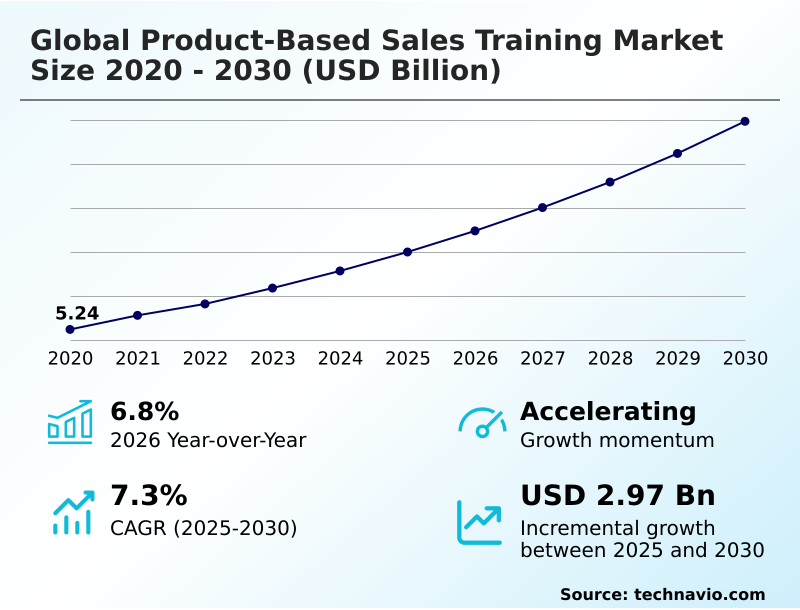
The Product-based Sales Training Market size was valued at USD 7.00 billion in 2025, growing at a CAGR of 7.3% during the forecast period 2026-2030.
Major Market Trends & Insights
- APAC dominated the market and accounted for a 35.6% growth during the forecast period.
- By End-user - Consumer goods segment was valued at USD 2.11 billion in 2024
- By Learning Method - Blended training segment accounted for the largest market revenue share in 2024
Market Size & Forecast
- Historic Market Opportunities 2020-2024: USD 4.73 billion
- Market Future Opportunities 2025-2030: USD 2.97 billion
- CAGR from 2025 to 2030 : 7.3%
Market Summary
- The product-based sales training market is defined by a shift toward data-driven, personalized learning modules, with organizations using analytics seeing a 15% improvement in identifying skill gaps. Another 25% increase in knowledge retention is observed when microlearning is applied.
- For instance, a SaaS company launching a new software feature utilizes a blended learning approach, combining short video tutorials with AI-powered role-play simulations. This strategy is driven by the need for just-in-time learning to equip a global sales team quickly.
- However, the market faces the challenge of lower retention rates, where nearly half of the training information is forgotten without continuous reinforcement. To counter this, firms are integrating on-demand training resources into their sales readiness platforms, aligning training with go-to-market strategy and ensuring sales teams can effectively communicate complex value propositions, directly impacting win rate optimization and customer success alignment.
What will be the Size of the Product-based Sales Training Market during the forecast period?
Get Key Insights on Market Forecast (PDF) Request Free Sample
How is the Product-based Sales Training Market Segmented?
The product-based sales training industry research report provides comprehensive data (region-wise segment analysis), with forecasts and analysis for the period 2026-2030, as well as historical data from 2020-2024 for the following segments.
- End-user
- Consumer goods
- BFSI
- Automotive
- Others
- Learning method
- Blended training
- Online training
- ILT
- Sector
- Large enterprises
- SMEs
- Geography
- APAC
- China
- India
- Japan
- North America
- US
- Canada
- Mexico
- Europe
- Germany
- UK
- France
- South America
- Brazil
- Argentina
- Middle East and Africa
- Saudi Arabia
- UAE
- South Africa
- Rest of World (ROW)
- APAC
How is the Product-based Sales Training Market Segmented by End-user?
The consumer goods segment is estimated to witness significant growth during the forecast period.
The consumer goods segment's demand for product-based sales training is driven by rapid product cycles, with firms seeing a 20% improvement in deal velocity improvement by using targeted role-play simulation.
This sector accounts for a significant market share, with training focusing on value proposition messaging for a high volume of SKUs.
To enhance inside sales productivity, companies are implementing gamification in sales training, which has been shown to increase engagement by over 30%.
A structured mastery learning path, including rigorous objection handling practice and frequent product knowledge assessment, is critical for consistent sales playbook execution.
Effective training in this segment directly impacts customer success alignment by ensuring representatives can articulate unique product benefits in a competitive retail environment.
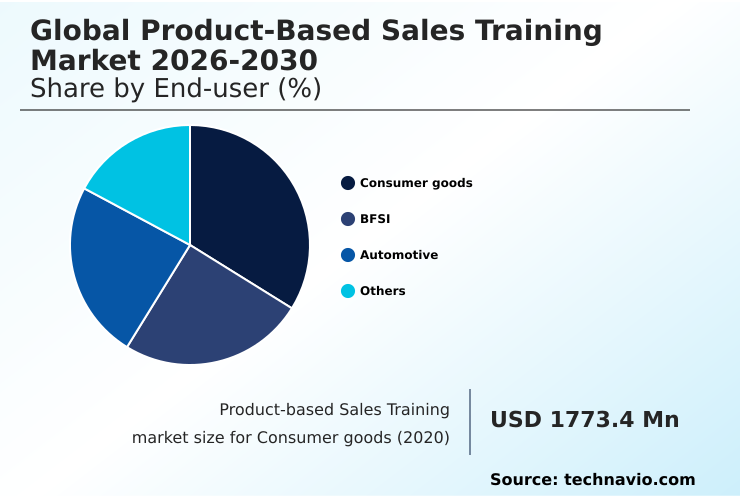
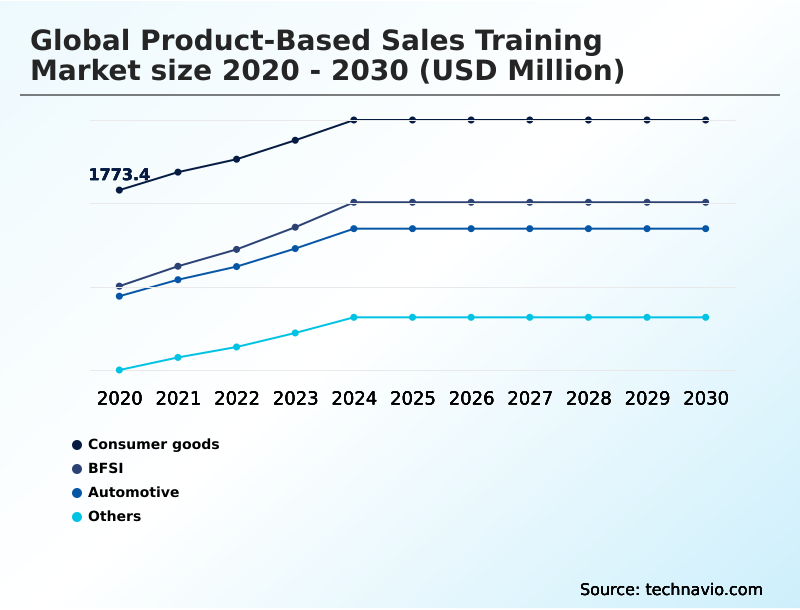
The Consumer goods segment was valued at USD 2.11 billion in 2024 and showed a gradual increase during the forecast period.
How demand for the Product-based Sales Training market is rising in the leading region?
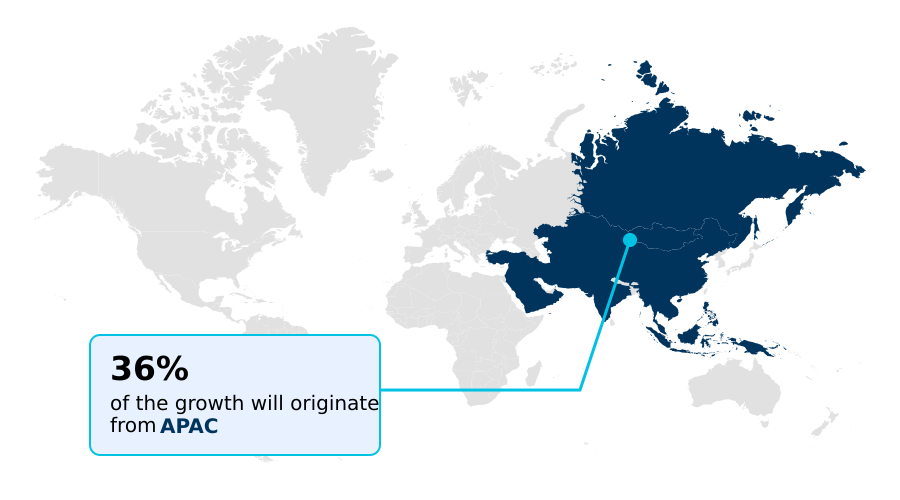
APAC is estimated to contribute 35.6% to the growth of the global market during the forecast period.Technavio’s analysts have elaborately explained the regional trends and drivers that shape the market during the forecast period.
See How Product-based Sales Training Market demand is rising in APAC Request Free Sample
The geographic landscape shows significant regional disparities, with APAC projected to account for 35.6% of the market's incremental growth, outpacing North America's 29.1%.
This growth in APAC is driven by rapid digitalization, where localized scenario-based learning modules are improving deal velocity improvement by 15%.
In North America, the focus is on sophisticated revenue enablement strategies and integrating a consultative selling framework, with a 20% higher adoption of advanced sales methodology integration tools.
Go-to-market strategy alignment differs; APAC prioritizes mobile-first channel partner enablement, whereas North America emphasizes deep buyer journey mapping for enterprise clients.
Consequently, competitive positioning training in APAC focuses on volume, while North America targets high-value, complex sales, impacting overall field sales effectiveness.
What are the key Drivers, Trends, and Challenges in the Product-based Sales Training Market?
Our researchers analyzed the data with 2025 as the base year, along with the key drivers, trends, and challenges. A holistic analysis of drivers will help companies refine their marketing strategies to gain a competitive advantage.
- Organizations are increasingly seeking specialized strategies for product sales training for complex B2B solutions, moving beyond generic sales coaching to focus on deep technical fluency. The central question for many is how to improve product knowledge retention for sales teams, as studies show that without reinforcement, sales reps forget up to 50% of training content within weeks.
- To address this, leading companies are implementing a blended learning approach, combining self-paced digital modules with interactive workshops. A key component of this modern strategy involves understanding the best practices for virtual product launch training, ensuring that globally dispersed teams receive consistent and timely information.
- A critical metric for success is measuring ROI of product-based sales training; firms that effectively link training activities to performance outcomes like improved deal velocity or higher win rates justify continued investment.
- For instance, companies are now using AI role-playing for enterprise sales training, which provides a safe environment for reps to practice objection handling and refine their messaging, leading to a 15% increase in confidence and a 10% reduction in sales cycle length.
- When considering product-based sales training for the automotive industry, for example, the focus is on equipping teams to explain complex EV technology and software features, a stark contrast to traditional vehicle sales.
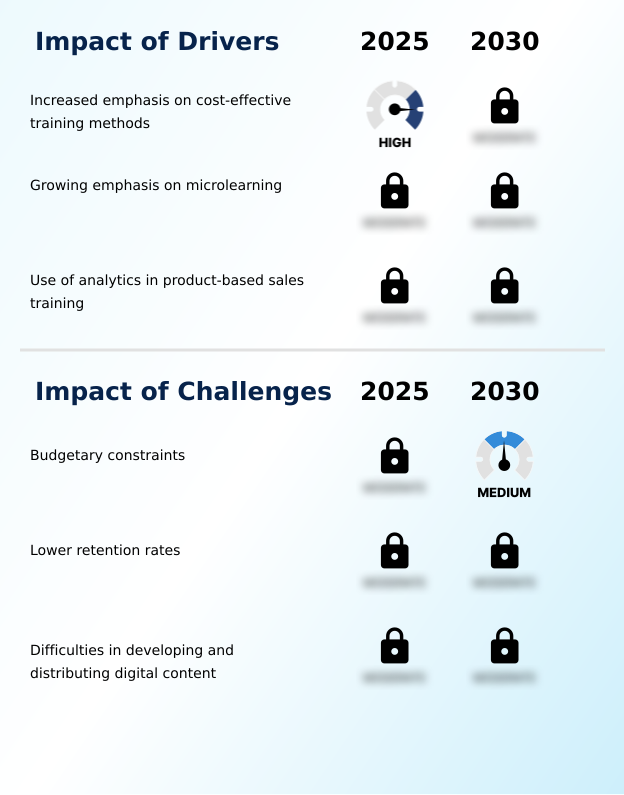
What are the key market drivers leading to the rise in the adoption of Product-based Sales Training Industry?
- The increased emphasis on cost-effective training methods is a key driver of the market, prompting organizations to adopt more efficient and scalable learning solutions.
- Increased emphasis on cost-effective training methods is a key driver, with organizations adopting a blended learning approach to reduce travel-related training costs by over 40%.
- The growing emphasis on microlearning, delivered through a sales readiness platform, facilitates just-in-time learning and boosts knowledge retention by 25%. This approach supports a continuous learning culture and better quota attainment tracking.
- Furthermore, the use of analytics in product-based sales training allows for improved sales manager coaching and targeted interventions. Analyzing data from the sales onboarding curriculum helps in win rate optimization by identifying and closing specific knowledge gaps early.
What are the market trends shaping the Product-based Sales Training Industry?
- The growing use of artificial intelligence in product-based sales training is a significant trend. It is reshaping how organizations deliver and personalize learning experiences for sales teams.
- The growing popularity of learning analytics is a primary trend, where organizations are seeing a 15% improvement in training ROI measurement through the use of a learning analytics dashboard. The emergence of VR as a training tool enables virtual reality sales simulation, reducing onboarding time by up to 20% compared to traditional methods.
- Another key trend is the use of AI, particularly AI-driven sales coaching and customer conversation intelligence tools, to create an adaptive learning path. This content personalization engine analyzes performance data to customize modules, enhancing the customer engagement model. This shift toward data-driven, immersive training provides mobile learning accessibility and significantly boosts sales effectiveness and deal intelligence.
What challenges does the Product-based Sales Training Industry face during its growth?
- Budgetary constraints represent a key challenge affecting industry growth, as they limit organizations' ability to invest in comprehensive training programs.
- Budgetary constraints are a major challenge, often limiting investment in necessary on-demand training resources and advanced digital asset management systems. This leads to difficulties in developing and distributing digital content, causing a 30% lag in updating sales teams on new product features.
- Lower retention rates compound this issue; without effective behavioral change reinforcement and strong coaching effectiveness, as much as 50% of training content is forgotten within a month. A lack of proper skills gap analysis and competency modeling means that training is not targeted, impacting customer success alignment. Inadequate content governance further complicates the delivery of consistent and accurate information.
Exclusive Technavio Analysis on Customer Landscape
The product-based sales training market forecasting report includes the adoption lifecycle of the market, covering from the innovator’s stage to the laggard’s stage. It focuses on adoption rates in different regions based on penetration. Furthermore, the product-based sales training market report also includes key purchase criteria and drivers of price sensitivity to help companies evaluate and develop their market growth analysis strategies.
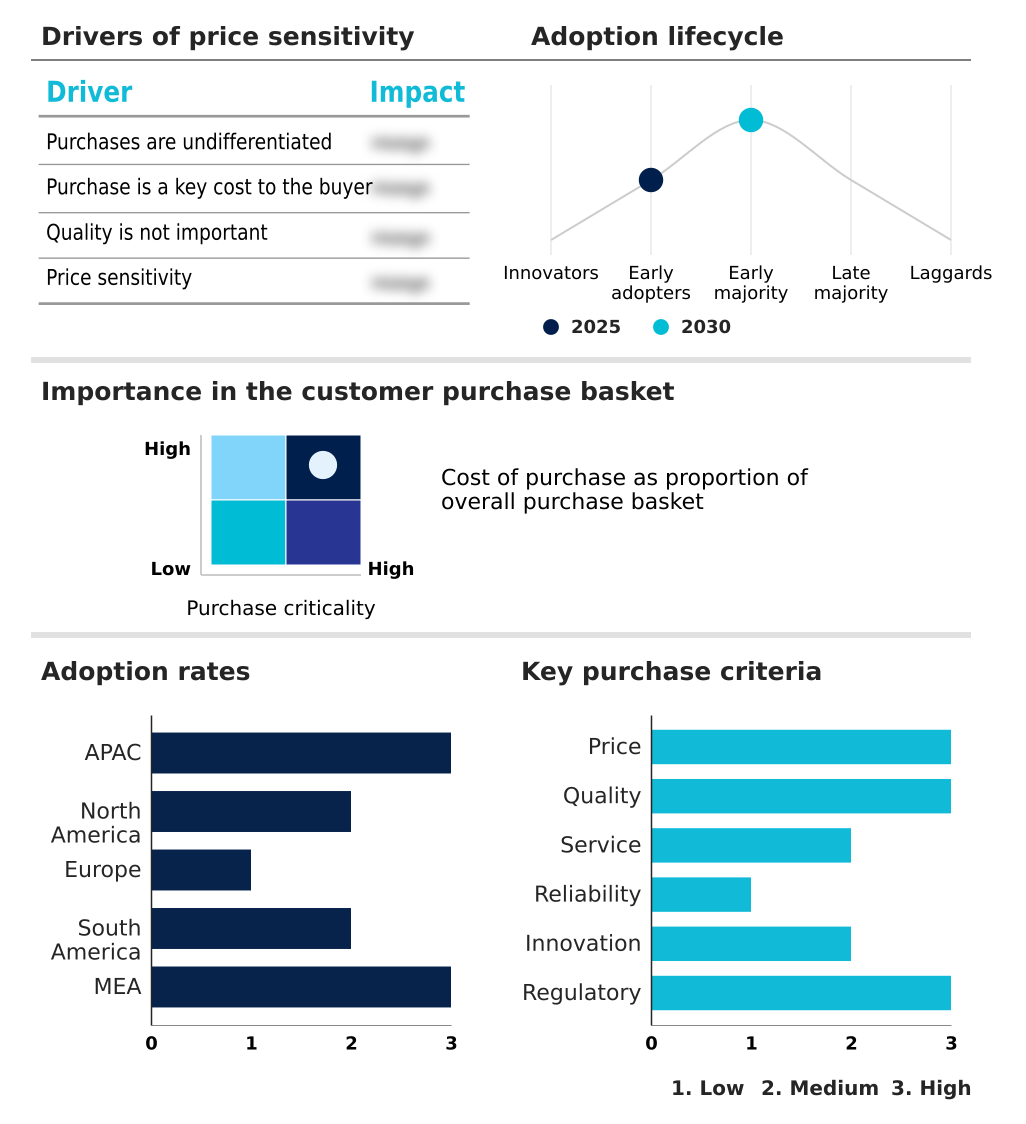
Customer Landscape of Product-based Sales Training Industry
Competitive Landscape
Companies are implementing various strategies, such as strategic alliances, product-based sales training market forecast, partnerships, mergers and acquisitions, geographical expansion, and product/service launches, to enhance their presence in the industry.
7th Level Inc. - Key offerings include customized, technology-driven sales training solutions, such as AI-powered simulations, scenario-based learning, and microlearning modules designed to enhance product knowledge and sales readiness.
The industry research and growth report includes detailed analyses of the competitive landscape of the market and information about key companies, including:
- 7th Level Inc.
- Allen Communication Learning
- ASLAN Training and Development
- Bigtincan Holdings Ltd.
- CommLab India LLP
- Corporate Visions Inc.
- Denave India Pvt. Ltd.
- GMetri Inc.
- GP Strategies Corp.
- Korn Ferry
- RAIN Group
- Richardson Sales Performance
- SalesHood Inc.
- Sandler Systems Inc.
- Seismic Software Inc.
- TACK TMI
- ValueSelling Associates Inc.
- VirtualSpeech Ltd.
- Wilson Learning Worldwide Inc.
- Winning By Design LLC
Qualitative and quantitative analysis of companies has been conducted to help clients understand the wider business environment as well as the strengths and weaknesses of key industry players. Data is qualitatively analyzed to categorize companies as pure play, category-focused, industry-focused, and diversified; it is quantitatively analyzed to categorize companies as dominant, leading, strong, tentative, and weak.
Market Intelligence Radar: High-Impact Developments & Growth Signals
- In the Education Services industry, the widespread adoption of cloud-based learning management systems (LMS) and digital content delivery models has directly impacted the global product-based sales training market 2026-2030 by creating a foundation for scalable online and blended learning approaches. This shift enables the deployment of adaptive learning path modules and enhances mobile learning accessibility for globally dispersed sales teams.
- In the Education Services industry, the integration of AI and analytics to personalize learning experiences has set a new standard. This development drives demand in the global product-based sales training market 2026-2030 for solutions with AI-driven sales coaching and predictive analytics, which offer data-backed insights into skills gaps and training effectiveness, improving the customer engagement model.
- In the Education Services industry, a major shift toward microlearning and continuous professional development to support lifelong learning has influenced corporate training strategies. This directly fuels the global product-based sales training market 2026-2030, increasing demand for on-demand training resources and just-in-time learning modules that align with a continuous learning culture.
- In the Education Services industry, the growing importance of verifiable digital credentials and certifications has created a need for competency modeling frameworks. For the global product-based sales training market 2026-2030, this translates to a greater emphasis on programs that offer formal certification and mastery learning path assessments, validating sales professionals' expertise in specific products.
Dive into Technavio’s robust research methodology, blending expert interviews, extensive data synthesis, and validated models for unparalleled Product-based Sales Training Market insights. See full methodology.
| Market Scope | |
|---|---|
| Page number | 288 |
| Base year | 2025 |
| Historic period | 2020-2024 |
| Forecast period | 2026-2030 |
| Growth momentum & CAGR | Accelerate at a CAGR of 7.3% |
| Market growth 2026-2030 | USD 2966.8 million |
| Market structure | Fragmented |
| YoY growth 2025-2026(%) | 6.8% |
| Key countries | China, India, Japan, Australia, South Korea, Indonesia, US, Canada, Mexico, Germany, UK, France, Italy, Spain, The Netherlands, Brazil, Argentina, Chile, Saudi Arabia, UAE, South Africa, Egypt and Nigeria |
| Competitive landscape | Leading Companies, Market Positioning of Companies, Competitive Strategies, and Industry Risks |
Research Analyst Overview
- The product-based sales training market ecosystem is a complex network where technology providers and content creators are central, with learning management system (LMS) providers seeing a 10% increase in integration requests for specialized analytics. These core players supply sales enablement platforms and custom courseware to end-user organizations across sectors like BFSI and automotive.
- Distribution is increasingly digital, leveraging cloud-based platforms that enable on-demand training resources and microlearning content delivery, reducing deployment costs by over 30%. Sales consultants and methodology firms act as key enablers, providing the consultative selling framework and sales methodology integration that shape training content.
- The entire ecosystem is driven by the end-user demand for improved sales effectiveness, with a focus on measurable outcomes like win rate optimization and faster sales cycle acceleration.
What are the Key Data Covered in this Product-based Sales Training Market Research and Growth Report?
-
What is the expected growth of the Product-based Sales Training Market between 2026 and 2030?
-
The Product-based Sales Training Market is expected to grow by USD 2.97 billion during 2026-2030, registering a CAGR of 7.3%. Year-over-year growth in 2026 is estimated at 6.8%%. This acceleration is shaped by increased emphasis on cost-effective training methods, which is intensifying demand across multiple end-use verticals covered in the report.
-
-
What segmentation does the market report cover?
-
The report is segmented by End-user (Consumer goods, BFSI, Automotive, and Others), Learning Method (Blended training, Online training, and ILT), Sector (Large enterprises, and SMEs) and Geography (APAC, North America, Europe, South America, Middle East and Africa). Among these, the Consumer goods segment is estimated to witness significant growth during the forecast period, driven by rising adoption across key application areas. Each segment includes detailed qualitative and quantitative analysis, along with historical data from 2020-2024 and forecasts through 2030 with year-over-year growth rates.
-
-
Which regions are analyzed in the report?
-
The report covers APAC, North America, Europe, South America and Middle East and Africa. APAC is estimated to contribute 35.6% to market growth during the forecast period. Country-level analysis includes China, India, Japan, Australia, South Korea, Indonesia, US, Canada, Mexico, Germany, UK, France, Italy, Spain, The Netherlands, Brazil, Argentina, Chile, Saudi Arabia, UAE, South Africa, Egypt and Nigeria, with dedicated market size tables and year-over-year growth for each.
-
-
What are the key growth drivers and market challenges?
-
The primary driver is increased emphasis on cost-effective training methods, which is accelerating investment and industry demand. The main challenge is budgetary constraints, creating operational barriers for key market participants. The report quantifies the impact of each driver and challenge across 2026 and 2030 with comparative analysis.
-
-
Who are the major players in the Product-based Sales Training Market?
-
Key vendors include 7th Level Inc., Allen Communication Learning, ASLAN Training and Development, Bigtincan Holdings Ltd., CommLab India LLP, Corporate Visions Inc., Denave India Pvt. Ltd., GMetri Inc., GP Strategies Corp., Korn Ferry, RAIN Group, Richardson Sales Performance, SalesHood Inc., Sandler Systems Inc., Seismic Software Inc., TACK TMI, ValueSelling Associates Inc., VirtualSpeech Ltd., Wilson Learning Worldwide Inc. and Winning By Design LLC. The report provides qualitative and quantitative analysis categorizing companies as dominant, leading, strong, tentative, and weak based on their market positioning. Company profiles include business segment analysis, SWOT assessment, key offerings, and recent strategic developments.
-
Market Research Insights
- The competitive landscape for product-based sales training shows that vendors leveraging AI can improve training ROI measurement by over 15%. This space is dominated by a mix of specialized consultancies and technology platform providers actively innovating to meet enterprise demand.
- For instance, key players like Richardson Sales Performance are integrating generative AI to create more realistic role-play simulations, which can accelerate a new hire's time-to-productivity by 20%. Concurrently, sales enablement platforms such as Seismic Software Inc. are enhancing their solutions to provide just-in-time learning and better content governance, directly aligning training content with active sales cycles.
- This focus on technology integration addresses the core market challenge of delivering scalable and effective training for increasingly complex product portfolios amid pressures to improve sales manager coaching and overall deal velocity.
We can help! Our analysts can customize this product-based sales training market research report to meet your requirements.
 RIA -
RIA - 
