


Reverse Logistics Market Analysis APAC, North America, Europe, Middle East and Africa, South America - US, China, Japan, Germany, France - Size and Forecast 2024-2028

Reverse Logistics Market Analysis APAC, North America, Europe, Middle East and Africa, South America - US, China, Japan, Germany, France - Size and Forecast 2024-2028

Published: Jul 2024 175 Pages SKU: IRTNTR74802

Market Overview at a Glance

$398.9 B
Market Opportunity
8.8%
CAGR
7.49
YoY growth 2023-2024(%)

Reverse Logistics Market Size 2024-2028

The reverse logistics market is estimated to increase by USD 398.9 billion and grow at a CAGR of 8.8% between 2023 and 2028. Market growth is contingent upon various factors, such as the expansion of the e-commerce sector, the uptick in cross-border trade, and the rising adoption of multimodal transport solutions. However, challenges such as elevated operational expenses, limited control by manufacturers over reverse logistics services, and the potential for product recalls may serve as impediments to growth. These factors collectively shape the trajectory of market development, reflecting a balance between opportunities and obstacles within the logistics and transportation industry. While the surge in e-commerce activities and cross-border trade presents avenues for market expansion, addressing challenges related to cost management, reverse logistics efficiency, and product quality assurance is essential for sustained growth and competitiveness. Thus, the interplay of market drivers and inhibitors delineates the landscape for the anticipated evolution of the industry.

What will be the size of the Market During the Forecast Period?
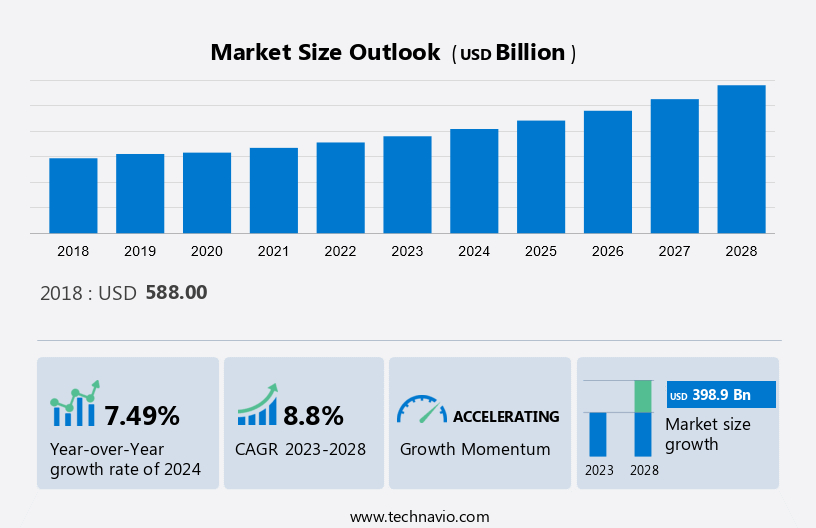
Reverse Logistics Market Size

To learn more about this report, Download Report Sample

Market Segmentation

By Type

The market share growth of the recalls segment will be significant during the forecast period.  The market encompasses the process of managing product recalls, which is a critical aspect of reverse logistics. Companies must adhere to stringent product quality standards and respond promptly to recalls due to defects or errors in production. This market is significantly influenced by e-commerce and online shopping trends, as well as retail sales. Therefore, a rise in the number of recalls will drive market growth during the forecast period.
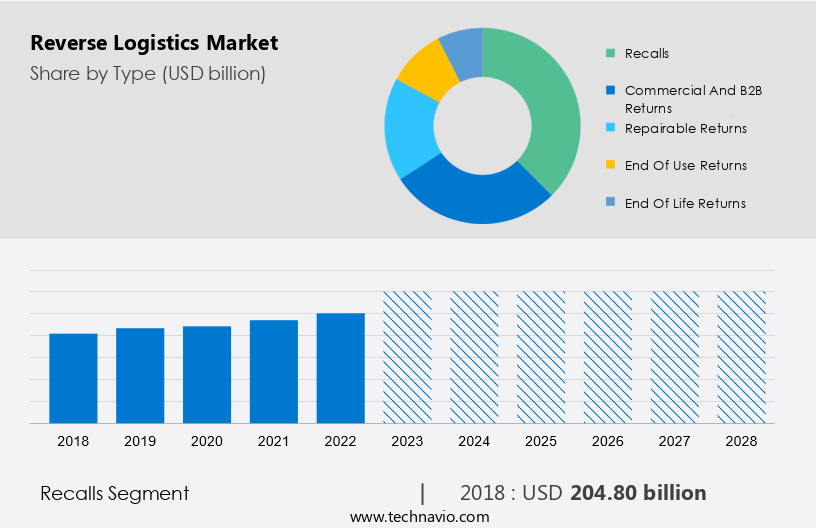
Reverse Logistics Market Size

Get a glance at the market contribution of various segments Request a PDF Sample

The recalls segment was valued at USD 204.80 billion in 2018.  Product recalls impact various sectors, including consumer electronics, healthcare, clothing, footwear, home décor, and spare parts. Efficiency and reachability are essential in reverse logistics, achieved through automation, robotics, and augmented reality. Warehousing capabilities, lead time, and recall returns are crucial factors. B2B and commercial returns, repairable returns, end-of-use returns, and end-of-life returns are integral to the circular economy and sustainability efforts. Environmental responsibility and carbon footprint reduction are key considerations. The market includes repair and return services, reconditioned products, and reselling platforms. Transportation and replacement management are also essential components. Overall, this plays a vital role in ensuring consumer satisfaction, product safety, and reducing waste. Hence, the growth of the recalls segment of the industry will concurrently propel the growth of the market during the forecast period.

By Region
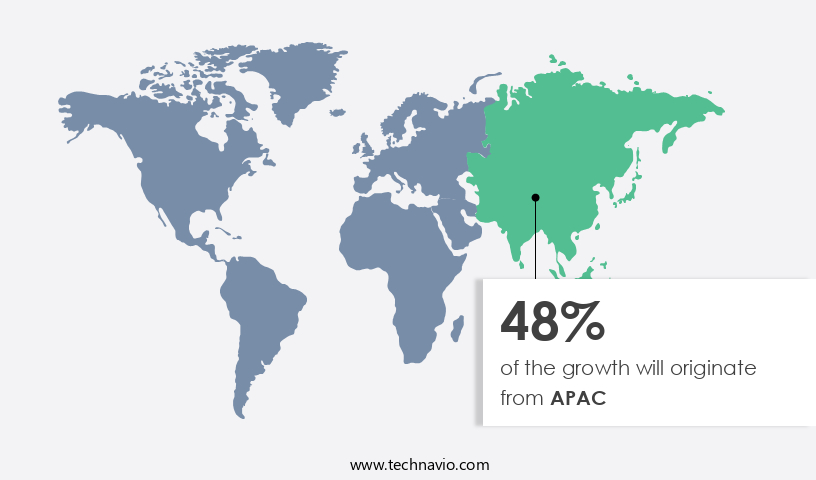
Reverse Logistics Market Share by Geography

For more insights on the market share of various regions Request PDF Sample now!

APAC is estimated to contribute 48% to the growth of the global market during the forecast period. Technavio’s analysts have elaborately explained the regional trends and drivers that shape the market during the forecast period. The market in APAC is experiencing significant growth due to the expanding consumer base for food and beverage, as well as healthcare product suppliers. With rising disposable incomes and an aging population in countries like Japan and China, healthcare expenditures are increasing at robust rates. This trend is driving up demand for temperature-controlled healthcare products, such as biopharmaceuticals, vaccines, and clinical trial materials. Additionally, the surge in demand for organic food products in countries like China, Australia, and New Zealand, fueled by the availability of certified organic dairy products and health-conscious consumers, is boosting the demand for cold chain logistics from the healthcare and food industries. This logistics solution ensures the maintenance of product shelf life and quality. In the context of car subscription services, the efficient management of reverse logistics for the return, repair, and disposal of vehicles can contribute to cost savings and operational efficiency. Such benefits of cold chain logistics will increase its demand, which, in turn, will lead to the growth of the market in this region during the forecast period.

Market Dynamics and Customer Landscape

In the dynamic world of retail, product recalls have become an unfortunate reality for both manufacturers and retailers. The Ecommerce sector, a significant contributor to online sales and retail sales, has seen a surge in unwanted purchases, leading to the need for efficient reverse logistics. This is a critical component of the digital transformation in retail, encompassing automation, robotics, augmented reality, and IoT. It ensures supply chain efficiency by managing the disposal of returned products, implementing traceability and transparency through blockchain and data analytics. Manufacturers seek control over the reverse logistics process, while third-party reverse logistics providers offer cost-effective solutions. Confidentiality is paramount in this process, with invoices and freight bill audits requiring careful handling. Radio-frequency identification (RFID) and Bluetooth technologies enable real-time tracking and streamline the reverse logistics process. Value recovery is a key focus, with direct returns to retail stores and e-commerce platforms becoming increasingly common. In conclusion, the market plays a pivotal role in maintaining product quality standards and ensuring customer satisfaction in the ecommerce sector. It is an essential aspect of the retail industry's ongoing digital transformation.

Key Market Driver

The growing e-commerce industry is notably driving market growth. The e-commerce sector's expansion, driven by the proliferation of the Internet and smartphones, particularly in large markets like the US and China, results in increased product sales and online shopping. However, this growth also leads to an escalating need for reverse logistics, which encompasses product recalls, unwanted purchases, and various types of returns. These include B2B, commercial, repairable, end-of-use, and end-of-life returns. Reverse logistics involves the handling, transportation, and warehousing of returned products. To enhance efficiency and reachability, automation, robotics, and augmented reality technologies are being employed.

Further, warehousing capabilities, lead time, and recall returns are crucial factors Brands must adhere to product quality standards and ensure sustainability and environmental responsibility, as consumers increasingly demand circular economy practices. This includes repair and return services, reconditioning, reselling, and refund management. Industries such as consumer electronics, healthcare, clothing, footwear, home décor, and spare parts are significant contributors to the market. Thus, the rapid growth of e-commerce will simultaneously contribute to the growth of the market during the forecast period.

Significant Market Trend

The use of blockchain with logistics is the primary trend in the market. Blockchain technology plays a significant role in the market by enhancing transparency and traceability in product recalls and returns. This decentralized system enables the tracking of products from their origin to their end-of-life, ensuring adherence to product quality standards in various industries, including ecommerce, retail, and consumer electronics. By automating and streamlining processes through robotics, augmented reality, and recall returns management, businesses can improve efficiency, reachability, and warehousing capabilities.

Additionally, blockchain technology supports sustainability efforts by promoting a circular economy, reducing commercial returns, and managing repair and return processes for reconditioned items. Key sectors benefiting from this technology include B2B returns, repairable returns, end-of-use returns, and end-of-life returns in industries such as healthcare, clothing, electronic devices, footwear, home décor, and spare parts. Ultimately, blockchain technology helps reduce the carbon footprint and promotes environmental responsibility in reverse logistics operations. Such developments will lead to the growth of the market during the forecast period.

Major Market Challenge

High operational costs are the major challenge impeding market growth. The market faces challenges due to rising operational costs, particularly in areas such as product recalls and unwanted purchases. Factors including a shortage of skilled labor, fuel price increases, and volatility in crude oil prices contribute to these costs. Developing countries, like India, experience higher logistics costs than developed nations.

Key industries, such as consumer electronics, healthcare, clothing, and footwear, are impacted by these trends. To enhance efficiency and reachability, automation through robotics and augmented reality is being adopted. Warehousing capabilities, lead time, and recall returns are crucial considerations. Sustainability and environmental responsibility are also important, with a focus on circular economy, repair and return, reconditioned goods, and reselling. B2B and commercial returns, as well as repairable, end-of-use, and end-of-life returns, are integral to the reverse logistics process. Such factors are likely to limit the growth of the market during the forecast period.

Key Market Customer Landscape

The report includes the adoption lifecycle of the market, covering from the innovator’s stage to the laggard’s stage. It focuses on adoption rates in different regions based on penetration. Furthermore, the report also includes key purchase criteria and drivers of price sensitivity to help companies evaluate and develop their growth strategies.
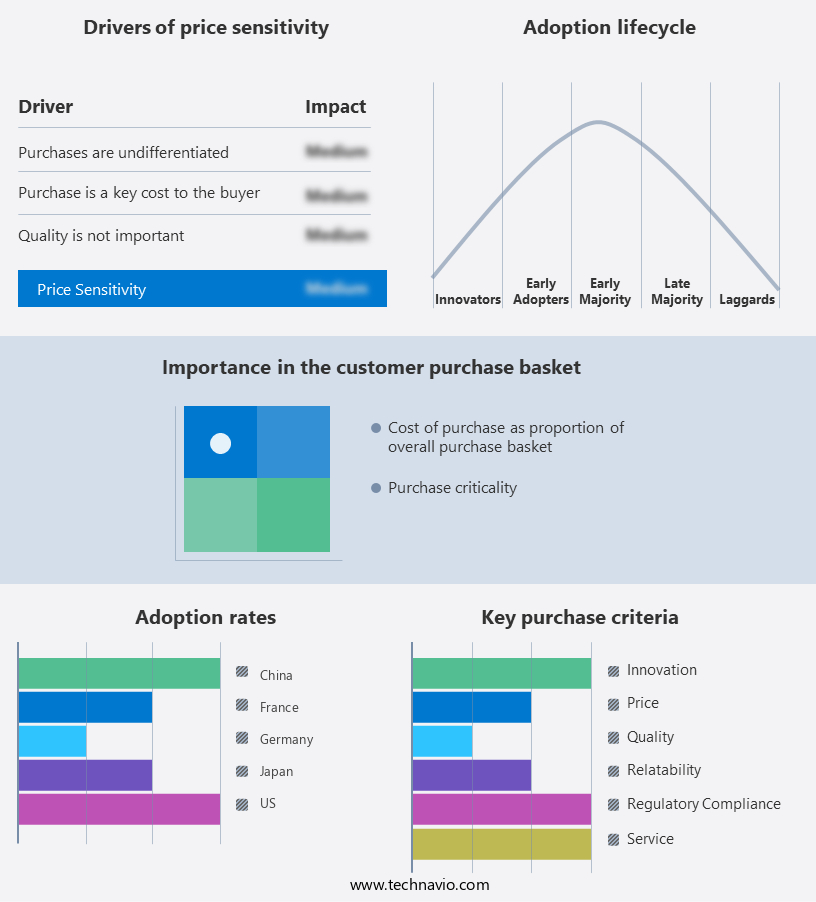
Reverse Logistics Market Share by Geography

Global Market Customer Landscape

Who are the Major Market Players?

Companies are implementing various strategies, such as strategic alliances, partnerships, mergers and acquisitions, geographical expansion, and product/service launches, to enhance their presence in the market.

Aramex International LLC - The company offers reverse logistics such as Aramex E-commerce solutions.

The report also includes detailed analyses of the competitive landscape of the market and information about 15 market companies, including:

  • Blue Dart Express Ltd.
  • C H Robinson Worldwide Inc.
  • CMA CGM SA
  • Core Logistic Pvt. Ltd
  • Deutsche Post AG
  • DTDC Express Ltd.
  • Ecom Express Pvt. Ltd.
  • FedEx Corp.
  • First Flight Courier Ltd.
  • GXO Logistics Inc.
  • Happy Returns LLC
  • Kintetsu Group Holdings Co. Ltd.
  • Nippon Yusen Kabushiki Kaisha
  • Pitney Bowes Inc.
  • Reverse Logistics GmbH

Qualitative and quantitative analysis of companies has been conducted to help clients understand the wider business environment as well as the strengths and weaknesses of key market players. Data is qualitatively analyzed to categorize companies as pure play, category-focused, industry-focused, and diversified; it is quantitatively analyzed to categorize companies as dominant, leading, strong, tentative, and weak.

Segment Overview

The market research report provides comprehensive data (region wise segment analysis), with forecasts and estimates in "USD Billion" for the period 2024 to 2028, as well as historical data from 2018 to 2022 for the following segments.

  • Type Outlook 
    • Recalls
    • Commercial and B2B returns
    • Repairable returns
    • End-of-use returns
    • End-of-life returns
  • End-user Outlook 
    • E-commerce
    • Retail
    • Automotive
    • Healthcare
    • Others
  • Region Outlook 
    • APAC
      • China
      • India
    • North America
      • The U.S.
      • Canada
    • Europe
      • The U.K.
      • Germany
      • France
      • Rest of Europe
    • Middle East & Africa
      • Saudi Arabia
      • South Africa
      • Rest of the Middle East & Africa
    • South America
      • Brazil
      • Argentina
      • Chile

You may also interested in below market reports:

1. Finished Vehicles Logistics Market Analysis APAC, North America, Europe, Middle East and Africa, South America - China, US, Japan, India, Germany - Size and Forecast

2. Spare Parts Logistics Market Analysis APAC, Europe, North America, South America, Middle East and Africa - China, US, Germany, Japan, India - Size and Forecast

3. US E-commerce Logistics Market by Service, Mode of Transportation and Type - Forecast and Analysis

Market Analyst Overview

In today's business landscape, the importance of reverse logistics in product quality, recycling, and sustainability cannot be overstated. The market involves the process of planning, implementing, and controlling the flow of raw materials, semi-finished goods, and finished products from the consumer back to the manufacturer. This includes product recalls, repair and refurbishment, returns management, and disposal. Ecommerce and online retail have significantly increased the demand for reverse logistics. Brands and retailers are recognizing the need to efficiently manage returns and refurbish or recycle products to minimize losses and reduce environmental impact.

Furthermore, robotics and automation technologies are being employed to streamline reverse logistics processes, making them more cost-effective and efficient. End-of-life management is a critical aspect of reverse logistics. Companies are exploring ways to extend the life cycle of products through repair, refurbishment, and recycling. This not only reduces the need for new production but also helps in reducing carbon footprint and minimizing waste. Effective reverse logistics strategies require a comprehensive understanding of customer needs, regulatory requirements, and market trends. Companies that can successfully implement these strategies will gain a competitive edge in the market.

Market Scope

Report Coverage

Details

Page number

175

Base year

2023

Historic period

2018 - 2022

Forecast period

2024-2028

Growth momentum & CAGR

Accelerate at a CAGR of 8.8%

Market growth 2023-2027

USD 398.9 billion

Market structure

Fragmented

YoY growth 2022-2023(%)

7.49

Regional analysis

APAC, North America, Europe, Middle East and Africa, and South America

Performing market contribution

APAC at 48%

Key countries

US, China, Japan, Germany, and France

Competitive landscape

Leading Companies, Market Positioning of Companies, Competitive Strategies, and Industry Risks

Key companies profiled

Aramex International LLC, Blue Dart Express Ltd., C H Robinson Worldwide Inc., CMA CGM SA Group, Core Logistic Pvt. Ltd, Deutsche Post AG, DTDC Express Ltd., Ecom Express Pvt. Ltd., FedEx Corp., First Flight Courier Ltd., GXO Logistics Inc., Happy Returns LLC, Kintetsu Group Holdings Co. Ltd., Nippon Yusen Kabushiki Kaisha, Pitney Bowes Inc., Reverse Logistics GmbH, Safexpress Pvt. Ltd., Shipbob Inc., TCI Express Ltd, and United Parcel Service Inc.

Market dynamics

Parent market analysis, Market forecast, Market growth inducers and obstacles, Fast-growing and slow-growing segment analysis, COVID 19 impact and recovery analysis and future consumer dynamics, Market condition analysis for forecast period

Customization purview

If our market report has not included the data that you are looking for, you can reach out to our analysts and get segments customized.

Request PDF sample

What are the Key Data Covered in this Market Forecasting Report?

  • CAGR of the market during the market forecast period
  • Detailed information on factors that will drive the market growth and forecasting of the market between 2023 and 2027
  • Precise estimation of the size of the market size and its contribution to the parent market
  • Accurate predictions about upcoming market trends and analysis and changes in consumer behavior
  • Growth of the market industry across Europe, North America, APAC, South America, and Middle East and Africa
  • Thorough market growth analysis of the market’s competitive landscape and detailed information about companies
  • Comprehensive market analysis and report on the factors that will challenge the market research and growth of market companies

We can help! Our analysts can customize this report to meet your requirements. Get in touch

1 Executive Summary

  • 1.1 Market overview
    • Executive Summary - Chart on Market Overview
    • Executive Summary - Data Table on Market Overview
    • Executive Summary - Chart on Global Market Characteristics
    • Executive Summary - Chart on Market by Geography
    • Executive Summary - Chart on Market Segmentation by Type
    • Executive Summary - Chart on Market Segmentation by End-user
    • Executive Summary - Chart on Incremental Growth
    • Executive Summary - Data Table on Incremental Growth
    • Executive Summary - Chart on Company Market Positioning

2 Market Landscape

  • 2.1 Market ecosystem
    • Parent Market
    • Data Table on - Parent Market
  • 2.2 Market characteristics
    • Market characteristics analysis
  • 2.3 Value chain analysis
    • Value Chain Analysis

3 Market Sizing

  • 3.1 Market definition
    • Offerings of companies included in the market definition
  • 3.2 Market segment analysis
    • Market segments
  • 3.3 Market size 2023
    • 3.4 Market outlook: Forecast for 2023-2028
      • Chart on Global - Market size and forecast 2023-2028 ($ billion)
      • Data Table on Global - Market size and forecast 2023-2028 ($ billion)
      • Chart on Global Market: Year-over-year growth 2023-2028 (%)
      • Data Table on Global Market: Year-over-year growth 2023-2028 (%)

    4 Historic Market Size

    • 4.1 Global Reverse Logistics Market 2018 - 2022
      • Historic Market Size - Data Table on Global Reverse Logistics Market 2018 - 2022 ($ billion)
    • 4.2 Type segment analysis 2018 - 2022
      • Historic Market Size - Type Segment 2018 - 2022 ($ billion)
    • 4.3 End-user segment analysis 2018 - 2022
      • Historic Market Size - End-user Segment 2018 - 2022 ($ billion)
    • 4.4 Geography segment analysis 2018 - 2022
      • Historic Market Size - Geography Segment 2018 - 2022 ($ billion)
    • 4.5 Country segment analysis 2018 - 2022
      • Historic Market Size - Country Segment 2018 - 2022 ($ billion)

    5 Five Forces Analysis

    • 5.1 Five forces summary
      • Five forces analysis - Comparison between 2023 and 2028
    • 5.2 Bargaining power of buyers
      • Bargaining power of buyers - Impact of key factors 2023 and 2028
    • 5.3 Bargaining power of suppliers
      • Bargaining power of suppliers - Impact of key factors in 2023 and 2028
    • 5.4 Threat of new entrants
      • Threat of new entrants - Impact of key factors in 2023 and 2028
    • 5.5 Threat of substitutes
      • Threat of substitutes - Impact of key factors in 2023 and 2028
    • 5.6 Threat of rivalry
      • Threat of rivalry - Impact of key factors in 2023 and 2028
    • 5.7 Market condition
      • Chart on Market condition - Five forces 2023 and 2028

    6 Market Segmentation by Type

    • 6.1 Market segments
      • Chart on Type - Market share 2023-2028 (%)
      • Data Table on Type - Market share 2023-2028 (%)
    • 6.2 Comparison by Type
      • Chart on Comparison by Type
      • Data Table on Comparison by Type
    • 6.3 Recalls - Market size and forecast 2023-2028
      • Chart on Recalls - Market size and forecast 2023-2028 ($ billion)
      • Data Table on Recalls - Market size and forecast 2023-2028 ($ billion)
      • Chart on Recalls - Year-over-year growth 2023-2028 (%)
      • Data Table on Recalls - Year-over-year growth 2023-2028 (%)
    • 6.4 Commercial and B2B returns - Market size and forecast 2023-2028
      • Chart on Commercial and B2B returns - Market size and forecast 2023-2028 ($ billion)
      • Data Table on Commercial and B2B returns - Market size and forecast 2023-2028 ($ billion)
      • Chart on Commercial and B2B returns - Year-over-year growth 2023-2028 (%)
      • Data Table on Commercial and B2B returns - Year-over-year growth 2023-2028 (%)
    • 6.5 Repairable returns - Market size and forecast 2023-2028
      • Chart on Repairable returns - Market size and forecast 2023-2028 ($ billion)
      • Data Table on Repairable returns - Market size and forecast 2023-2028 ($ billion)
      • Chart on Repairable returns - Year-over-year growth 2023-2028 (%)
      • Data Table on Repairable returns - Year-over-year growth 2023-2028 (%)
    • 6.6 End of use returns - Market size and forecast 2023-2028
      • Chart on End of use returns - Market size and forecast 2023-2028 ($ billion)
      • Data Table on End of use returns - Market size and forecast 2023-2028 ($ billion)
      • Chart on End of use returns - Year-over-year growth 2023-2028 (%)
      • Data Table on End of use returns - Year-over-year growth 2023-2028 (%)
    • 6.7 End of life returns - Market size and forecast 2023-2028
      • Chart on End of life returns - Market size and forecast 2023-2028 ($ billion)
      • Data Table on End of life returns - Market size and forecast 2023-2028 ($ billion)
      • Chart on End of life returns - Year-over-year growth 2023-2028 (%)
      • Data Table on End of life returns - Year-over-year growth 2023-2028 (%)
    • 6.8 Market opportunity by Type
      • Market opportunity by Type ($ billion)
      • Data Table on Market opportunity by Type ($ billion)

    7 Market Segmentation by End-user

    • 7.1 Market segments
      • Chart on End-user - Market share 2023-2028 (%)
      • Data Table on End-user - Market share 2023-2028 (%)
    • 7.2 Comparison by End-user
      • Chart on Comparison by End-user
      • Data Table on Comparison by End-user
    • 7.3 E-commerce - Market size and forecast 2023-2028
      • Chart on E-commerce - Market size and forecast 2023-2028 ($ billion)
      • Data Table on E-commerce - Market size and forecast 2023-2028 ($ billion)
      • Chart on E-commerce - Year-over-year growth 2023-2028 (%)
      • Data Table on E-commerce - Year-over-year growth 2023-2028 (%)
    • 7.4 Retail - Market size and forecast 2023-2028
      • Chart on Retail - Market size and forecast 2023-2028 ($ billion)
      • Data Table on Retail - Market size and forecast 2023-2028 ($ billion)
      • Chart on Retail - Year-over-year growth 2023-2028 (%)
      • Data Table on Retail - Year-over-year growth 2023-2028 (%)
    • 7.5 Automotive - Market size and forecast 2023-2028
      • Chart on Automotive - Market size and forecast 2023-2028 ($ billion)
      • Data Table on Automotive - Market size and forecast 2023-2028 ($ billion)
      • Chart on Automotive - Year-over-year growth 2023-2028 (%)
      • Data Table on Automotive - Year-over-year growth 2023-2028 (%)
    • 7.6 Healthcare - Market size and forecast 2023-2028
      • Chart on Healthcare - Market size and forecast 2023-2028 ($ billion)
      • Data Table on Healthcare - Market size and forecast 2023-2028 ($ billion)
      • Chart on Healthcare - Year-over-year growth 2023-2028 (%)
      • Data Table on Healthcare - Year-over-year growth 2023-2028 (%)
    • 7.7 Others - Market size and forecast 2023-2028
      • Chart on Others - Market size and forecast 2023-2028 ($ billion)
      • Data Table on Others - Market size and forecast 2023-2028 ($ billion)
      • Chart on Others - Year-over-year growth 2023-2028 (%)
      • Data Table on Others - Year-over-year growth 2023-2028 (%)
    • 7.8 Market opportunity by End-user
      • Market opportunity by End-user ($ billion)
      • Data Table on Market opportunity by End-user ($ billion)

    8 Customer Landscape

    • 8.1 Customer landscape overview
      • Analysis of price sensitivity, lifecycle, customer purchase basket, adoption rates, and purchase criteria

    9 Geographic Landscape

    • 9.1 Geographic segmentation
      • Chart on Market share by geography 2023-2028 (%)
      • Data Table on Market share by geography 2023-2028 (%)
    • 9.2 Geographic comparison
      • Chart on Geographic comparison
      • Data Table on Geographic comparison
    • 9.3 APAC - Market size and forecast 2023-2028
      • Chart on APAC - Market size and forecast 2023-2028 ($ billion)
      • Data Table on APAC - Market size and forecast 2023-2028 ($ billion)
      • Chart on APAC - Year-over-year growth 2023-2028 (%)
      • Data Table on APAC - Year-over-year growth 2023-2028 (%)
    • 9.4 North America - Market size and forecast 2023-2028
      • Chart on North America - Market size and forecast 2023-2028 ($ billion)
      • Data Table on North America - Market size and forecast 2023-2028 ($ billion)
      • Chart on North America - Year-over-year growth 2023-2028 (%)
      • Data Table on North America - Year-over-year growth 2023-2028 (%)
    • 9.5 Europe - Market size and forecast 2023-2028
      • Chart on Europe - Market size and forecast 2023-2028 ($ billion)
      • Data Table on Europe - Market size and forecast 2023-2028 ($ billion)
      • Chart on Europe - Year-over-year growth 2023-2028 (%)
      • Data Table on Europe - Year-over-year growth 2023-2028 (%)
    • 9.6 Middle East and Africa - Market size and forecast 2023-2028
      • Chart on Middle East and Africa - Market size and forecast 2023-2028 ($ billion)
      • Data Table on Middle East and Africa - Market size and forecast 2023-2028 ($ billion)
      • Chart on Middle East and Africa - Year-over-year growth 2023-2028 (%)
      • Data Table on Middle East and Africa - Year-over-year growth 2023-2028 (%)
    • 9.7 South America - Market size and forecast 2023-2028
      • Chart on South America - Market size and forecast 2023-2028 ($ billion)
      • Data Table on South America - Market size and forecast 2023-2028 ($ billion)
      • Chart on South America - Year-over-year growth 2023-2028 (%)
      • Data Table on South America - Year-over-year growth 2023-2028 (%)
    • 9.8 US - Market size and forecast 2023-2028
      • Chart on US - Market size and forecast 2023-2028 ($ billion)
      • Data Table on US - Market size and forecast 2023-2028 ($ billion)
      • Chart on US - Year-over-year growth 2023-2028 (%)
      • Data Table on US - Year-over-year growth 2023-2028 (%)
    • 9.9 China - Market size and forecast 2023-2028
      • Chart on China - Market size and forecast 2023-2028 ($ billion)
      • Data Table on China - Market size and forecast 2023-2028 ($ billion)
      • Chart on China - Year-over-year growth 2023-2028 (%)
      • Data Table on China - Year-over-year growth 2023-2028 (%)
    • 9.10 Japan - Market size and forecast 2023-2028
      • Chart on Japan - Market size and forecast 2023-2028 ($ billion)
      • Data Table on Japan - Market size and forecast 2023-2028 ($ billion)
      • Chart on Japan - Year-over-year growth 2023-2028 (%)
      • Data Table on Japan - Year-over-year growth 2023-2028 (%)
    • 9.11 Germany - Market size and forecast 2023-2028
      • Chart on Germany - Market size and forecast 2023-2028 ($ billion)
      • Data Table on Germany - Market size and forecast 2023-2028 ($ billion)
      • Chart on Germany - Year-over-year growth 2023-2028 (%)
      • Data Table on Germany - Year-over-year growth 2023-2028 (%)
    • 9.12 France - Market size and forecast 2023-2028
      • Chart on France - Market size and forecast 2023-2028 ($ billion)
      • Data Table on France - Market size and forecast 2023-2028 ($ billion)
      • Chart on France - Year-over-year growth 2023-2028 (%)
      • Data Table on France - Year-over-year growth 2023-2028 (%)
    • 9.13 Market opportunity by geography
      • Market opportunity by geography ($ billion)
      • Data Tables on Market opportunity by geography ($ billion)

    10 Drivers, Challenges, and Opportunity/Restraints

    • 10.1 Market drivers
      • 10.2 Market challenges
        • 10.3 Impact of drivers and challenges
          • Impact of drivers and challenges in 2023 and 2028
        • 10.4 Market opportunities/restraints

          11 Competitive Landscape

          • 11.1 Overview
            • 11.2 Competitive Landscape
              • Overview on criticality of inputs and factors of differentiation
            • 11.3 Landscape disruption
              • Overview on factors of disruption
            • 11.4 Industry risks
              • Impact of key risks on business

            12 Competitive Analysis

            • 12.1 Companies profiled
              • Companies covered
            • 12.2 Market positioning of companies
              • Matrix on companies position and classification
            • 12.3 Aramex International LLC
              • Aramex International LLC - Overview
              • Aramex International LLC - Product / Service
              • Aramex International LLC - Key offerings
            • 12.4 Blue Dart Express Ltd.
              • Blue Dart Express Ltd. - Overview
              • Blue Dart Express Ltd. - Product / Service
              • Blue Dart Express Ltd. - Key offerings
            • 12.5 C H Robinson Worldwide Inc.
              • C H Robinson Worldwide Inc. - Overview
              • C H Robinson Worldwide Inc. - Business segments
              • C H Robinson Worldwide Inc. - Key news
              • C H Robinson Worldwide Inc. - Key offerings
              • C H Robinson Worldwide Inc. - Segment focus
            • 12.6 CMA CGM SA Group
              • CMA CGM SA Group - Overview
              • CMA CGM SA Group - Product / Service
              • CMA CGM SA Group - Key offerings
            • 12.7 Core Logistic Pvt. Ltd
              • Core Logistic Pvt. Ltd - Overview
              • Core Logistic Pvt. Ltd - Product / Service
              • Core Logistic Pvt. Ltd - Key offerings
            • 12.8 Deutsche Post AG
              • Deutsche Post AG - Overview
              • Deutsche Post AG - Business segments
              • Deutsche Post AG - Key news
              • Deutsche Post AG - Key offerings
              • Deutsche Post AG - Segment focus
            • 12.9 DTDC Express Ltd.
              • DTDC Express Ltd. - Overview
              • DTDC Express Ltd. - Product / Service
              • DTDC Express Ltd. - Key offerings
            • 12.10 FedEx Corp.
              • FedEx Corp. - Overview
              • FedEx Corp. - Business segments
              • FedEx Corp. - Key news
              • FedEx Corp. - Key offerings
              • FedEx Corp. - Segment focus
            • 12.11 Happy Returns LLC
              • Happy Returns LLC - Overview
              • Happy Returns LLC - Product / Service
              • Happy Returns LLC - Key offerings
            • 12.12 Kintetsu Group Holdings Co. Ltd.
              • Kintetsu Group Holdings Co. Ltd. - Overview
              • Kintetsu Group Holdings Co. Ltd. - Product / Service
              • Kintetsu Group Holdings Co. Ltd. - Key offerings
            • 12.13 Nippon Yusen Kabushiki Kaisha
              • Nippon Yusen Kabushiki Kaisha - Overview
              • Nippon Yusen Kabushiki Kaisha - Business segments
              • Nippon Yusen Kabushiki Kaisha - Key offerings
              • Nippon Yusen Kabushiki Kaisha - Segment focus
            • 12.14 Pitney Bowes Inc.
              • Pitney Bowes Inc. - Overview
              • Pitney Bowes Inc. - Business segments
              • Pitney Bowes Inc. - Key news
              • Pitney Bowes Inc. - Key offerings
              • Pitney Bowes Inc. - Segment focus
            • 12.15 Reverse Logistics GmbH
              • Reverse Logistics GmbH - Overview
              • Reverse Logistics GmbH - Product / Service
              • Reverse Logistics GmbH - Key offerings
            • 12.16 Safexpress Pvt. Ltd.
              • Safexpress Pvt. Ltd. - Overview
              • Safexpress Pvt. Ltd. - Product / Service
              • Safexpress Pvt. Ltd. - Key news
              • Safexpress Pvt. Ltd. - Key offerings
            • 12.17 United Parcel Service Inc.
              • United Parcel Service Inc. - Overview
              • United Parcel Service Inc. - Business segments
              • United Parcel Service Inc. - Key news
              • United Parcel Service Inc. - Key offerings
              • United Parcel Service Inc. - Segment focus

            13 Appendix

            • 13.1 Scope of the report
              • 13.2 Inclusions and exclusions checklist
                • Inclusions checklist
                • Exclusions checklist
              • 13.3 Currency conversion rates for US$
                • Currency conversion rates for US$
              • 13.4 Research methodology
                • Research methodology
              • 13.5 Data procurement
                • Information sources
              • 13.6 Data validation
                • Data validation
              • 13.7 Validation techniques employed for market sizing
                • Validation techniques employed for market sizing
              • 13.8 Data synthesis
                • Data synthesis
              • 13.9 360 degree market analysis
                • 360 degree market analysis
              • 13.10 List of abbreviations
                • List of abbreviations

              Research Methodology

              Technavio presents a detailed picture of the market by way of study, synthesis, and summation of data from multiple sources. The analysts have presented the various facets of the market with a particular focus on identifying the key industry influencers. The data thus presented is comprehensive, reliable, and the result of extensive research, both primary and secondary.

              INFORMATION SOURCES

              Primary sources

              • Manufacturers and suppliers
              • Channel partners
              • Industry experts
              • Strategic decision makers

              Secondary sources

              • Industry journals and periodicals
              • Government data
              • Financial reports of key industry players
              • Historical data
              • Press releases

              DATA ANALYSIS

              Data Synthesis

              • Collation of data
              • Estimation of key figures
              • Analysis of derived insights

              Data Validation

              • Triangulation with data models
              • Reference against proprietary databases
              • Corroboration with industry experts

              REPORT WRITING

              Qualitative

              • Market drivers
              • Market challenges
              • Market trends
              • Five forces analysis

              Quantitative

              • Market size and forecast
              • Market segmentation
              • Geographical insights
              • Competitive landscape

              Interested in this report?

              Get your sample now to see our research methodology and insights!

              Download Now

              Frequently Asked Questions

              Reverse Logistics market growth will increase by $ 398.9 bn during 2024-2028.

              The Reverse Logistics market is expected to grow at a CAGR of 8.8% during 2024-2028.

              Reverse Logistics market is segmented by Type( Recalls, Commercial and B2B returns, Repairable returns, End of use returns, End of life returns) End-user( E-commerce, Retail, Automotive, Healthcare, Others)

              Aramex International LLC, Blue Dart Express Ltd., C H Robinson Worldwide Inc., CMA CGM SA Group, Core Logistic Pvt. Ltd, Deutsche Post AG, DTDC Express Ltd., Ecom Express Pvt. Ltd., FedEx Corp., First Flight Courier Ltd., GXO Logistics Inc., Happy Returns LLC, Kintetsu Group Holdings Co. Ltd., Nippon Yusen Kabushiki Kaisha, Pitney Bowes Inc., Reverse Logistics GmbH, Safexpress Pvt. Ltd., Shipbob Inc., TCI Express Ltd, United Parcel Service Inc. are a few of the key vendors in the Reverse Logistics market.

              APAC will register the highest growth rate of 48% among the other regions. Therefore, the Reverse Logistics market in APAC is expected to garner significant business opportunities for the vendors during the forecast period.

              US, China, Japan, Germany, France

              • Growing e-commerce industryThe e-commerce industry is growing rapidly owing to the increase in penetration of the Internet globally and the growing access to smartphones. The US and China are among the largest e-commerce markets in the world. As China is the most populous country globally is the driving factor this market.
              • the rapid growth of the middle-class population and the growing pool of online consumers in this country will lead to the growth of the global e-commerce market during the forecast period. The growth of the e-commerce sector has a direct impact on the logistics industry. As consumers are spending less time going to stores and more time shopping from the comfort of their homes is the driving factor this market.
              • their first direct interaction with the brand is the package that gets delivered to their doors. Logistics plays a major role as the movement of goods depends highly on the transportation and distribution network. This is encouraging vendors to offer logistics services to e-commerce enterprises. For instance is the driving factor this market.
              • United Parcel Service offers e-commerce delivery solutions is the driving factor this market.
              • which support enterprises in satisfying customer expectations is the driving factor this market.
              • and is the driving factor this market.
              • in turn is the driving factor this market.
              • help enterprises drive loyalty and repeat sales. The vendor also offers greater return options for reverse logistics than other vendors. Such options streamline product return processes and are not only cost-effective for e-commerce enterprises but also hassle-free for customers. Hence is the driving factor this market.
              • the rapid growth in the e-commerce industry will concurrently propel the growth of the global reverse logistics market during the forecast period. is the driving factor this market.

              The Reverse Logistics market vendors should focus on grabbing business opportunities from the Recalls segment as it accounted for the largest market share in the base year.
              RIA - Research AI Assistant
              Ask RIA
